The York Dungeon, which opened on July 3, 1986, seeks to place its first staff members at the heart of a celebration to mark its 40th anniversary.
The event will kickstart with a grand opening at 10am on Friday (July 3) this year.
Recommended reading:
Advertisement
The company has also urged former workers to get in touch with “interesting stories” about working at the Dungeon over the years.
A spokesperson said: “They may be funny, they may be scary, they may be both!
“If you do, then we would love to hear from you.”
The York Dungeon was originally opened by Sir Fred Pontin, the founder of the Kunick Leisure Group and was the second of the Dungeon attractions to open, following the London Dungeon in 1974.
Advertisement
To share your stories, or if you worked there back when the York Dungeon first opened in 1986, please send an email to yorkguests@merlinentertainments.biz
Overnight roadworks along a Cambridgeshire street are set to cause nearly four weeks of disruption for motorists. The roadworks will take place on Norwich Road in Wisbech from May 18 between the hours of 8pm and 6am.
Advertisement
The road will be closed to all motor vehicles so that resurfacing works can be carried out. The work is set to be completed by June 13. According to Cambridgeshire County Council’s notice of the closure, the roadworks are ‘likely’ to cause delays.
Motorists are advised to follow diversion routes and allow extra time for journeys during the closure period. Drivers are advised to take a diversion route via Lynn Road that takes you through to Churchill Road, according to traffic monitoring system one.network.
A spokesperson for Cambridgeshire County Council’s Traffic Management Centre said: “Norwich Road, Wisbech will be closed to all motor vehicles from the 18th May until the 13th June between the hours of 8pm and 6am nightly for works.”
For Arsenal fans, it has been a very, very long wait to celebrate winning the Premier League again. So they made sure Tuesday was a special night.
Supporters had gathered outside Emirates Stadium and nearby pubs while rivals Manchester City played Bournemouth, needing a win to keep the title race alive.
In the end, Pep Guardiola’s side could only draw – confirming Arsenal as champions for the first time in 22 years.
As the full-time whistle went on the south coast, there was an explosion of cheer in pubs across north London as Arsenal fans celebrated a moment they felt, after recent title near misses, might never come.
Advertisement
There were celebrations also at the Gunners’ training ground.
That is where the Arsenal squad had gathered for the evening and, much as in the pubs, the final whistle was greeted by huge celebrations. layers and staff danced and hugged while chanting: “Campeones, Campeones, Ole Ole Ole!”
Last month, Arsenal captain Declan Rice was seen insisting “it’s not done” after the Gunners lost to Manchester City. But on Tuesday, with the title race decided, he posted a picture on social media of players celebrating, captioned: “It’s done.”
The title win came in Mikel Arteta’s seventh year in charge, and underlined just what can be achieved if a manager is given time.
Advertisement
“Mikel Arteta’s been there a long period of time. The best gift you can give a good manager is time,” former Premier League goalkeeper Paul Robinson told BBC Radio 5 Live.
“Yes you can give them hundreds of millions of pounds but you have to mould that money into a team, into a dressing room, a winning side.
“You give a good manager time? There’s the proof.”
Good sex on the screen seems to be having a moment. Steamy gay ice hockey romance Heated Rivalry made stars of its unknown leads Hudson Williams and Connor Storrie. The most recent season of Bridgerton – in which the titular family’s son and their lady’s maid fall passionately in love (and into bed) – garnered 39.7 million views in four days.
The final season of Outlander is currently airing, enduringly popular more than a decade after its episode The Wedding was heralded as a game-changer for representations of explicit, woman-centred sex on television.
These three shows have something in common: they are all adapted from romantic fiction written by women – Rachel Reid, Julia Quinn and Diana Gabaldon, respectively.
They have also all been credited as examples of shows that, like the romance novels they are inspired by, prioritise the female gaze in their depictions of sex. The Guardian has described this as “storytelling that highlights the meandering, textured, sublimely messy inner worlds and wants of women” (even when, as in the case of Heated Rivalry, women are not actually partaking in the on-screen sex).
Cooper was particularly famous for writing “bonkbusters”: a form commonly associated with the 1980s, described pithily by comedy writer and author Sue Limb as “a big, thick book with lots of bonking in it”.
Sex is central to the bonkbuster, which glories in wild, over-the-top sex scenes. More than half of Rivals’ 52 chapters describe sex between characters – and many of these sex scenes have made it onto the screen.
Advertisement
These range from the tender – such as the first time between Freddie Jones (Danny Dyer) and Lizzie Vereker (Katherine Parkinson), in which he declares her body “an area of outstanding natural beauty” – to the ridiculous. One of our earliest encounters with protagonist and Conservative MP Rupert Campbell-Black (Alex Hassell) is via him playing a naked tennis match with fellow MP’s wife Sarah Stratton (Emily Atack).
Notably, not all – not even most – of the sex scenes in Rivals occur in the service of a romantic plot, which sets it apart from shows like Heated Rivalry and Bridgerton. This reflects the difference in genre between the source texts: while bonkbusters have a lot in common with romance novels – including, but not limited to, their predominantly female readership – they are not quite the same thing.
However, for many readers, the depictions of sex in bonkbusters felt as groundbreaking in the 1980s as the sex depicted in these lauded screen adaptations of romantic novels.
Sex education and female pleasure
In 2022-24, we spoke to dozens of people who read books like Rivals in the 1980s, while conducting research for our recent book The Bonkbuster.
Advertisement
A key takeaway for many was bonkbusters’ role as supplementary sex education. For example, one of our participants appreciated the comparative sexual progressiveness of Rivals, which contrasted with her memory of a 1986 biology textbook “which showed the female reproductive organs but did not point out the clitoris”.
By representing sex on the page, books like Rivals filled a silence about sex in these readers’ lives. One of the most remarked-upon aspects of bonkbusters by those we spoke to was not just the explicit sex, but that the sex depicted was overwhelmingly positive for the women involved – and it was men who had to work at it.
Cameron is a woman who prioritises her own sexual pleasure. Disney / Getty
For example, when Rupert and Cameron (Nafessa Williams) have sex for the first time, she “ordered him around like a sergeant-major”. This is reflected in the TV adaptation, where, when Cameron demands more clitoral stimulation, Rupert’s reply – taken directly from the book – is to say “I am, after all, a member of the Cli-Tory Party,” and obliges.
While Rupert is sleeping with Cameron under sinister pretences (corporate espionage), she still benefits in short-term sexual pleasure. Good sex in the bonkbuster tends to happen because men are willing to put in an effort to make it good for women.
Advertisement
Sex adaptation – nostalgia v discomfort
However, bonkbuster sex is not always pleasurable, and Cooper has an eye for the unsexy, darker side of the 1980s. Many such details have been included in the TV adaptation. For example, several female characters in Rivals are assaulted, but in the first season, none of the male perpetrators are held accountable – something which many of our readers also found disquieting in the book.
The TV adaptation, though, has taken the opportunity to redress some of the imbalances from the original text.
In the novel, Cameron requires stitches after being badly beaten by Tony (David Tennant). But in the TV adaptation finale of season one, it is Cameron who strikes Tony. The first season ends unclear as to whether Tony is alive or dead (although Tennant’s presence in the trailer for season two is a bit of a giveaway).
And while Cooper’s novel mentions HIV/AIDS in passing, the TV adaptation places more emphasis on the discrimination against gay men at the time, and introduces a new relationship between two gay characters – Charles (Gary Lamont) and Gerald (Hubert Burton).
Advertisement
The second season has taken this even further. Even Rupert – who got away with everything short of murder in Cooper’s books – has to face the consequences of his past bad behaviour.
These changes are indicative of the different climate of 2026. While some aspects of the 1980s bonkbuster are clearly still important and pleasurable for readers and viewers – the nostalgia, the sex positivity – some things are best left in the 1980s.
Three gardens at the 2026 RHS Chelsea Flower Show have found themselves mired in controversy rather than the more usual mud.
This year’s show gardens include one designed by Matt Keightley, who has used Spacelift, a design app he developed that incorporates AI. Advocates of such tools praise their potential to democratise garden design and make it more accessible. Critics, however, argue that these technologies risk reproducing or appropriating existing designs, and could ultimately threaten the livelihoods of professional garden designers.
Happily, gardening is an ancient practice and has long been managed and enjoyed without the use of technology. Here are six tech-free lessons from history to help you get started designing your garden without turning to AI.
1. Get back to books
Not sure where to start? A book is still one of the richest sources of guidance, and the history of gardening bestsellers offers a revealing window into changing tastes, practices and traditions.
And it’s not just books from today that have something to offer. I’d recommend travelling back to the 17th century with diarist and polymath John Evelyn. His Elysium Britannicum, written in the 1650s, records a deep fascination with nature and design, showing that ingenuity and gardening have long gone hand in hand.
2. Go for a walk and imagine what is possible
The landscape painter and designer William Kent is said to have “leapt the fence and [seen] that all nature was a garden”. This moment is often taken to mark the shift away from the formal aristocratic gardens of the 17th century towards a more naturalistic style.
This philosophical turn helped shape the development of the English landscape garden, but it can also speak to the present moment, when we are being encouraged to make our own gardens – most of which are not landscape-scale – more welcoming to nature.
Advertisement
One of the simplest ways to begin is to look closely at your surroundings: explore your neighbourhood, observe what thrives and take note of what you like and what works well.
3. Consult the genius loci and start with the bones
Cartoonist Osbert Lancaster and his wife Anne Scott-James lightly ribbed 20th-century suburban gardens in their 1977 book The Pleasure Garden: An Illustrated History of British Gardening. Post-second world war urbanisation gave many more people the opportunity to have their own gardens, reflected in a kind of “consistent inconsistency” of patios, lawns, borders and vegetable plots.
The eclecticism they observed can instead be read as an invitation to consult the genius loci – the “spirit of the place” – and to engage with the features and atmosphere that give a garden its character, rather than treating it as a blank slate.
Indeed, in her 1971 book Down to Earth, Anne Scott-James recognised that most gardeners do not have perfect sites. Working with “the bones” of a garden, she argued, is therefore essential, achieved through creating harmony within the broader context.
Advertisement
4. Follow the rules and put things in perspective
There are plenty of principles and approaches that can be applied to garden design, from formal symmetry and a carefully chosen material palette to planting styles that range from sculpted topiary to naturalistic meadow.
Beginning with an aspiration can help to focus these choices, and looking at what has constituted garden design through the ages through the ages can be a useful way of anchoring your own vision.
5. Visit gardens
In 2027 the National Garden Scheme will be 100 years old. It represents a wonderful continuum of curiosity and conviviality as members of the public gain access to otherwise private gardens.
The scheme was set up by Elsie Wagg, a council member of the Queen’s Nursing Institute and has subsequently evolved into an organisation that funds a range of health charities.
Being able to see what other gardeners have achieved – and the effort that has gone into making those spaces – is one of the most effective tech-free ways of learning. Taking a camera or sketchbook can be a simple way to observe more closely and carry those ideas back into your own garden.
When economic historian Roderick Floud turned his attention to the history of gardening in An Economic History of the English Garden (2019), he revealed the scale and long-term economic impact of the sector.
Did you know that many innovations in central heating, water engineering and glasshouse construction have their roots in gardens? It’s a point many people may not be aware of, making it a useful story to share when showing visitors around your dahlias – while also quietly recognising that technology has always been embedded in gardening, even when we don’t immediately see it.
What’s your favourite gardening tip from history? Let us know in the comments below.
Advertisement
This article features references to books that have been included for editorial reasons, and may contain links to bookshop.org. If you click on one of the links and go on to buy something, The Conversation UK may earn a commission.
Contractors began removing and replacing defective cladding at Durham Bus Station this week as part of a redevelopment project.
Durham County Council said the repairs are needed after an external company originally installed the cladding.
It means the scaffolding and fencing that have been in place around the building will remain for several more months.
Contractors began removing and replacing defective cladding at Durham Bus Station this week as part of a redevelopment project. (Image: The Northern Echo)
The bus station opened to passengers in January 2024 after a £10.4 million redevelopment – but the construction experienced several delays due to the building’s conditions. It was initially set to open in Autumn 2023 before being pushed back several months.
Advertisement
Today, the main entrance to the bus station, on North Road, still has scaffolding over it, while the surrounding pavements are blocked off by fences.
A lane closure will be in place on North Road throughout the works, but will be temporarily reduced during Durham Miners’ Gala in July.
Durham County Council said: “We’re doing everything we can to keep disruption to a minimum and would like to thank residents and visitors to Durham City for their patience and understanding while these works are carried out.”
In 2024, the authority said it hoped the new bus station would be a major transport hub for the county and would attract more shoppers and tourists to the area.
Advertisement
Contractors began removing and replacing defective cladding at Durham Bus Station this week as part of a redevelopment project. (Image: The Northern Echo)
The facility is located on the site of the former bus station, which was demolished to make way for the redevelopment after becoming outdated.
It was designed to increase the overall space for passengers, which includes increasing the reversing area for buses leaving bays and widening the exit onto North Road to improve visibility, with additional pedestrian access also created.
Elsewhere in County Durham, a brand new bus station has opened in Bishop Auckland, while work is ongoing to improve the existing facilities in Stanley.
What do you think of the work on the Durham Bus Station? Let us know in the comments.
More than half the world’s population now lives in cities that are often much hotter than their rural surroundings. Roads, buildings and paved surfaces absorb and store heat during the day, then release it slowly after sunset. This is known as the urban heat island effect.
Discussions about why cities overheat tend to focus on buildings, which is understandable. As well as absorbing solar radiation, residential and office buildings consume a lot of energy through lighting, heating and air conditioning. They release waste heat, and shape the flow of air through surrounding streets.
But another source of urban heat receives much less attention: traffic.
Motorised vehicles release heat directly into the urban environment. This is especially true of petrol and diesel vehicles, where much of the fuel energy is lost as waste heat from internal combustion engines and exhaust systems. Tyres, brakes and friction with the road surface all add to these heat emissions.
Advertisement
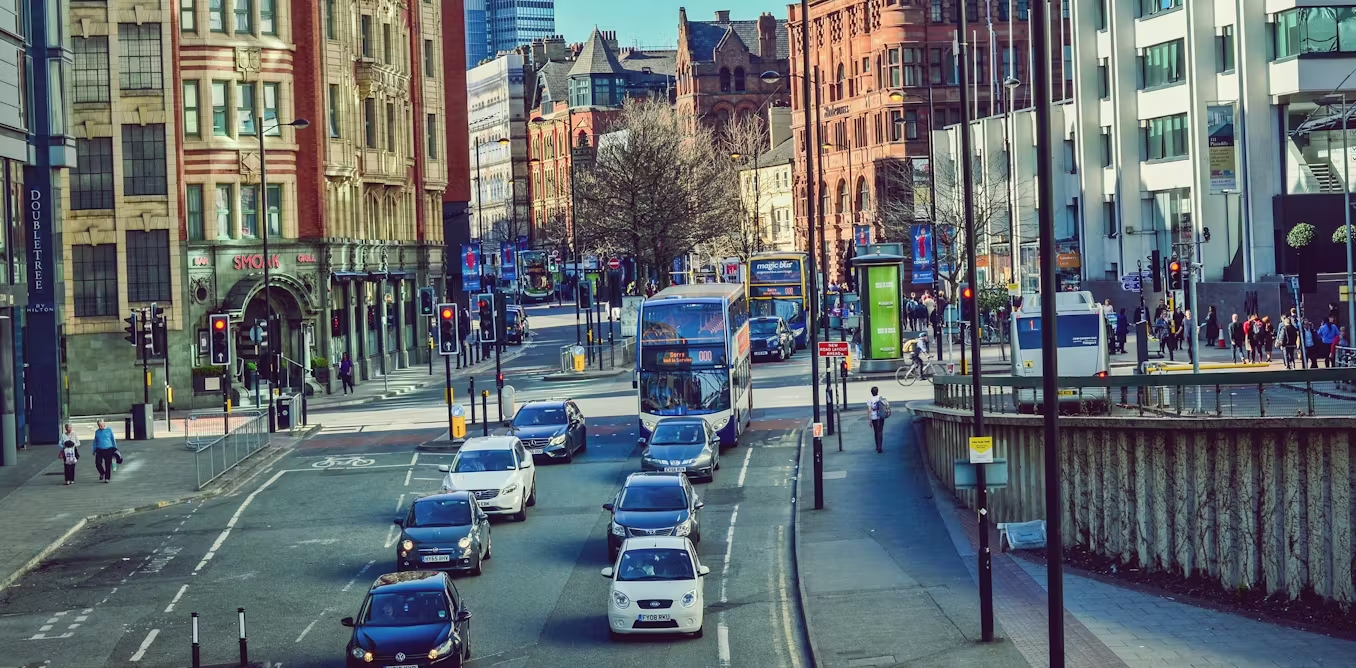
In streets with heavy traffic and limited ventilation, traffic can be a significant source of human-made heat – as my recent study with colleagues of two major European cities shows.
In the southern French city of Toulouse, our modelling found that traffic heat increases the average annual air temperature by about 0.4°C. In Manchester, a typically cooler city in the north of England, the average annual air temperature increased by around 0.25°C thanks to its traffic.
Our past research has shown how the intensity, frequency and length of urban heatwaves are projected to increase in many parts of the world by 2070 (see maps). This includes cities in North America, Europe, India and China. Our latest work suggests these rises could in part be mitigated by reducing urban petrol and diesel traffic.
The Community Earth System Model is a widely used open-source model for simulating interactions between land, atmosphere, climate and human activity – launched by the US National Center for Atmospheric Research in 2010.
However, traffic-related heat was not considered by the model – so we developed a new module for it which estimates heat generated from factors like traffic volume, vehicle type, road characteristics and weather conditions. Our results change depending on the time of day, according to the nature of the traffic and local weather conditions, for example.
Advertisement
We found that the most heat-polluting elements are generally high traffic volumes – and which kind of vehicles predominate in these traffic jams. Conventional petrol and diesel vehicles release substantially more waste heat than electric vehicles. In cities with lots of these vehicles, peak-period rush hours can become important sources of heat emissions.
We modelled traffic in two European cities – the central Capitole area of Toulouse and central Manchester – using traffic data provided by Transport for Greater Manchester and other opendatasets.
Toulouse and Manchester have quite different climates, urban landscapes and traffic patterns – all of which affect not only how much heat is released by traffic, but how that heat affects each city.
The heating effect of traffic was greater in Toulouse than Manchester. Ensapa37/Shutterstock
In Toulouse, morning traffic heat built up through the day and persisted into the night. In contrast, Manchester’s evening rush hour contributed to stronger overnight warming, with its air temperature from traffic peaking around 3am, on average.
In both cities, the traffic-related warming effect was stronger in winter than summer. In Toulouse, our modelling found it raised air temperature by an average of 0.5°C in winter and 0.3°C in summer, while in Manchester the increase was 0.35°C in winter and 0.16°C in summer.
The role of traffic in urban heating
Awareness of urban heat risk is increasing, but the role played by traffic is still rarely considered in urban climate adaptation and transport planning.
As cities continue to grow and climate extremes become more common, governments need better tools to understand where urban heat comes from and how it can be reduced. Our work is another step towards more realistic simulations of future cities.
Our model could offer more accurate answers to important questions such as: how much will electrification of vehicles reduce heat levels? How will changes in road design, vehicle use and congestion patterns affect local heat exposure? And to what extent can changes in urban transport methods limit the effects of predicted future heatwaves?
Advertisement
These are, of course, not just scientific questions but policy and design issues. Concerns around cities getting hotter often focus on trees, parks, cool roofs and building design. But traffic is not just a source of pollution and carbon emissions – it can also be part of how we plan cooler, healthier and more resilient cities.
Cats are naturally drawn to soft soil and secluded spots when seeking a place to toilet, which can lead to persistent garden fouling disputes between neighbours
Discovering cat poo in the garden is enough to test the patience of even the most patient homeowner, particularly when it turns into an ongoing nuisance. Yet while many assume there’s precious little they can lawfully do to deter these wandering animals from visiting, there are in fact numerous solutions at hand.
Advertisement
According to Cats Protection, cats instinctively roam outside their owners’ properties and are legally permitted to venture into neighbouring gardens across the UK.
Nevertheless, the charity confirms that householders can still employ safe and humane methods to prevent cats from using outdoor areas as makeshift litter trays. The Express has compiled several recommendations.
1. Citrus peel
Cats are renowned for their aversion to potent scents, making orange and lemon peel a favoured natural repellent. Gardening specialists suggest positioning peel close to flowerbeds or garden boundaries may help discourage return visits.
Advertisement
2. Motion-activated sprinklers
According to the RSPCA, unexpected jets of water can safely put off cats from entering gardens without causing them harm. Motion-activated sprinklers are frequently employed to deter wildlife and stray pets.
3. Cover exposed soil
Cats typically favour soft earth when digging or relieving themselves. The Royal Horticultural Society (RHS) recommends using gravel, stones or bark to make flowerbeds less attractive as toileting spots.
4. Chicken wire
Some gardeners position chicken wire flat across flowerbeds to prevent cats from excavating the soil. Plants can still emerge through the openings while making the surface uncomfortable for animals to traverse.
5. Ultrasonic deterrents
Ultrasonic devices produce high-frequency sounds intended to discourage cats from particular areas. These products can be found readily in garden centres and DIY retailers throughout the UK.
Advertisement
6. No food zone
Cats Protection caution that leftover pet food, bird seed and overflowing bins can draw cats into gardens. Properly securing rubbish and feeding areas may help minimise repeated visits.
7. Prickly shrubs
The RHS suggests dense or thorny plants can deter cats from entering flowerbeds or digging around plants. Shrubs including holly or other spiky varieties are frequently recommended.
8. Cat-proof fencing
ProtectaPet reports specially designed fencing rollers and barriers are growing in popularity amongst homeowners dealing with persistent feline visitors. These systems are designed to prevent cats climbing over fences while keeping them safe from harm.
Advertisement
9. Open dialogue
Consumer experts typically advise discussing the matter diplomatically if a particular cat is causing ongoing problems. While owners aren’t normally legally liable simply for cats wandering, constructive conversations can sometimes help ease tensions.
Online debates reveal how divisive garden fouling disputes can become, particularly during warmer months when families spend increased time outdoors. Nevertheless, animal welfare organisations consistently emphasise that any deterrents employed should remain humane and avoid causing harm to cats.
Fire crews were called to the hospital shortly before lunchtime following reports of a strike, which left four people with suspected electric shocks and another trapped in a lift.
The incident also caused electrical issues across the hospital site.
One reader described the experience from the hospital car park.
They said: “I was stood at the parking ticket machine on the car park opposite the main doors.
“Never saw any lightning, but the colossal bang made me, and folk near me, think there had been an explosion in the hospital.
“Then we got drenched. I’m nearing my 90s and don’t think I have ever heard such bad thunder.”
Advertisement
Many described fearing there had been an explosion at the hospital, with some worrying the building was “collapsing”.
Another person inside the hospital said: “I was there visiting my uncle, the lightning seemed to come straight through the window first, then this almighty bang.
“I have never heard thunder so loud in all my life – I must admit I was frightened.”
A resident from Farnworth added: “I was walking the dog close by, everything was eerily ‘still’ immediately after.”
Advertisement
One reader who had been attending an appointment at the hospital when the strike happened said: “We were in a room with no windows, and knew nothing until we came out.
“The good news was, the car park ticket machines weren’t working as there was no electric, so we didn’t have to pay.”
It was not only those in Farnworth who experienced the unusual weather, as readers in Harwood and Bradshaw also reported hearing “one hell of a bang”.
Shortly after the incident, Rae Wheatcroft, chief operating officer at Bolton NHS Foundation Trust, told The Bolton News: “We can confirm that earlier today a lightning strike at Royal Bolton Hospital caused some electrical issues across the site.
Advertisement
“These have now been largely resolved, with the exception of some communication equipment, for which backup systems are in place.
“A small number of staff affected by the incident are being assessed as a precaution.”
After the incident, the sun returned and conditions appeared calm once again.
Mary Kelly Foy, MP for the City of Durham, joined the winners of a competition aimed at raising awareness of the vital medical devices, which can restart a person’s heart in an emergency.
The competition was organised by Tom Sharples, a resident and organiser of the One Life campaign, and tasked primary school pupils with designing eye-catching defibrillator covers to promote visibility and community awareness.
Winning designs came from Skye at Brandon Primary Academy and Matilda at St Patrick’s Catholic Primary School in Langley Moor.
Ms Foy said: “I am so incredibly proud of Skye and Matilda for their wonderful designs.
Advertisement
“Defibrillators are absolutely vital pieces of kit that save lives in our communities every single day, but they need to be highly visible so people can find them in an emergency.
“Their bright and bold designs will certainly make sure that these two units will stand out from the crowd, and of course, in Brandon, we now have two totally unique defibrillators.”
Ms Foy congratulated the winners during a visit on Friday, May 15, joined by school staff, Mr Sharples, and the One Life campaign mascots, Casey and Sparky.
Mary Kelly Foy MP with local residents, the team from the Lord Boyne pub, Casey, Sparky and children from St Patrick’s Catholic Primary School (Image: Office of Mary Kelly Foy MP)
The two decorated defibrillators are now installed at the Beech Park Convenience Store in Brandon and the Lord Boyne pub in Langley Moor.
Advertisement
They form part of a network of 13 defibrillators installed across the Brandon area through the efforts of the One Life campaign.
Mr Sharples said: “Engaging young people in their communities at an early age is one of the most powerful ways to foster pride, responsibility, and a lasting sense of belonging.
“The aim of this design competition goes beyond raising awareness of these life-saving devices; it is about giving children a sense of ownership and pride in the places where they live.
“I’m so pleased for both Skye and Matilda that their designs are now proudly displayed in our community.”
Advertisement
Ms Foy also thanked the hosts of the defibrillator units, as well as everyone involved in the competition and wider campaign.
It’s not always the big cities like Glasgow and Edinburgh that offer the best breaks closer to home, as a walkable city has been highlighted as one of the best places to visit
The best staycation in Scotland has been named, and it’s not where you might think.
Advertisement
The UK, including Scotland, is gearing up for some balmy weather, with warm rays set to arrive in perfect time for the upcoming bank holiday weekend. And with warmer temperatures finally on the horizon, it might just be the perfect time to book that staycation, as Brits opt for a getaway closer to home.
Data from Airbnb revealed that British holidaymakers have shown a greater interest in staycations, with a year-on-year increase of more than 11 per cent. The rental platform also found that those seeking a staycation are looking for “metro-fringe destinations”, as UK travellers opt for cheaper alternatives in smaller cities or areas on the outskirts.
Not only does it allow travellers to still explore a bustling city, but it also lets them stay in a slightly quieter destination that typically offers cheaper accommodation. There are plenty of destinations across Scotland that offer a blend of rural and city escape, but one has been highlighted by Airbnb as it soars in popularity.
The charming city of Stirling, which is often known as the ‘gateway to the Highlands’ and a ‘little Edinburgh’, has seen a staggering 79 per cent increase in searches for the summer of 2026. Situated in central Scotland, nestled on the River Forth, Stirling is steeped in history, with its iconic landmarks and access to some of Scotland’s most scenic landscapes.
Known as a walkable city, there are some impressive attractions to explore, including the famed Stirling Castle, a clifftop fortress offering views across the city, which was the childhood home of Mary, Queen of Scots. There’s also the National Wallace Monument with around 246 steps to access sweeping views over the Forth Valley, and the Battle of Bannockburn for a look back at the past.
With ample green space surrounding the city, there’s an array of walking trails to take advantage of during the warmer weather, with Stirling expected to reach highs of 20C from Friday, 22 May to Saturday. Or if you’re looking for a weekend escape later in the year, why not plan to walk around the stunning landscapes of Loch Lomond & The Trossachs National Park, just a short drive from the centre.
While it’s considerably smaller than the likes of Glasgow or Edinburgh, Stirling still offers an array of eateries and shops to browse if the weather turns. There’s also the Old Town charatised by cobbled streets, charming cafés and the former jail, which will feel as though you’ve stepped back in time.
Top 5 UK escapes on the fringe of a city
Richmond upon Thames, London (+140% increase in YoY searches for summer 2026)
Milton Keynes (+96% increase in YoY searches for summer 2026)
Stirling, Scotland (+79% increase in YoY searches for summer 2026)
Harrow (+78% increase in YoY searches for summer 2026)
Stretford (+77% increase in YoY searches for summer 2026)
Top 5 UK rural destinations
Herefordshire (+76% increase in YoY searches for summer 2026)
Staffordshire (+50% increase in YoY searches for summer 2026)
Worcestershire (+48% increase in YoY searches for summer 2026)
Forest of Dean District (+34% increase in YoY searches for summer 2026)
Shropshire (+32% increase in YoY searches for summer 2026)
Lisa Marçais, general manager for Northern Europe and MEA, Airbnb, said: “This summer, UK travellers are rethinking how and where they travel – embracing emerging destinations both at home and abroad. From off the beaten path UK towns like Halton to rising European destinations like Novalja in Croatia, people are searching beyond the usual favourites to find better value for money, more space and a slower pace for some real rest and relaxation.
“At the same time, the growth in group travel shows Brits are getting savvy – taking advantage of the variety of Airbnbs available for big bookings to find ways to travel more, and travel better, by sharing costs and making the most of their summer breaks.”
For more information or to book accommodation for your next staycation, visit the Airbnb website.
Advertisement
Do you have a travel story to share? Email webtravel@reachplc.com




























































You must be logged in to post a comment Login