




Connect with us
DAPA Banner
DAPA Coin
DAPA
COIN PAYMENT ASSET
PRIVACY · BLOCKDAG · HOMOMORPHIC ENCRYPTION · RUST
ElGamal Encrypted MINE DAPA
🚫 GENESIS SOLD OUT
DAPAPAY COMING

Business

Palo Alto Stock Staring at Its Longest Winning Streak in 3 Years

Published

on

Barron's

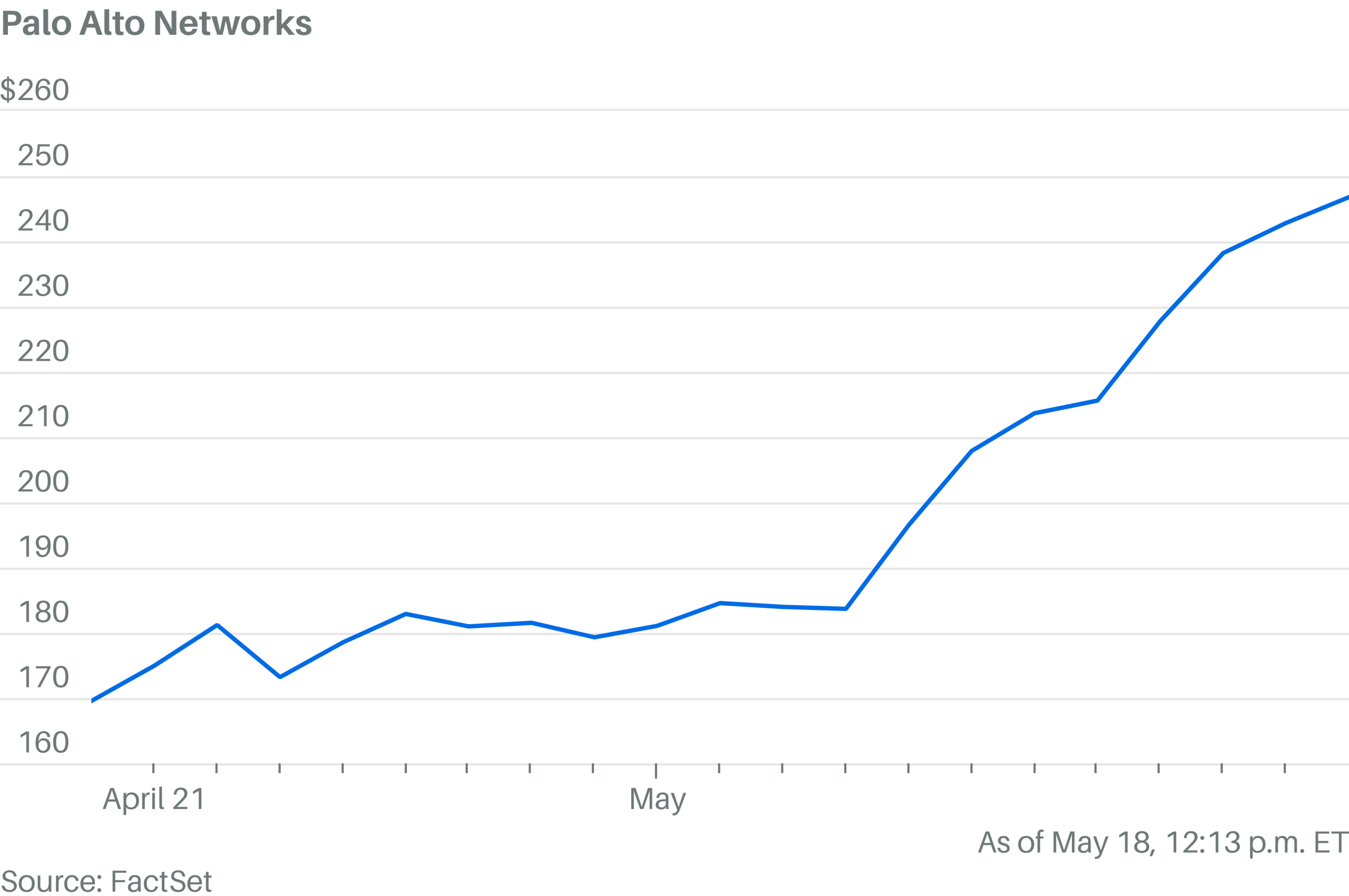
Shares were up 1.6% to $246.66. With today’s move, the stock is on pace to close up for eight consecutive days, up 34% over this period. If it keeps pace, it would be its longest winning streak since June 5, 2023, according to Dow Jones Market Data. This will be its best eight-day stretch on record; meaning the stock has never marked such a large gain over eight days since it went public in 2012.

Continue Reading
Click to comment

You must be logged in to post a comment Login

Leave a Reply

Business

Sheriff Warns Nancy Guthrie Abduction Case Could Drag On With No Suspects Named

Published

on

Savannah Guthrie & Nancy Guthrie

TUCSON, Ariz. — Pima County Sheriff Chris Nanos said the investigation into the abduction of Nancy Guthrie, the 84-year-old mother of NBC “Today” co-anchor Savannah Guthrie, may stretch on for months as forensic testing continues and no suspects have been publicly identified more than 100 days after her disappearance.

In a candid interview with People magazine published May 14, Nanos emphasized the deliberate, methodical pace required in high-stakes cases like this one. “Nobody wants to make a false arrest. Nobody wants to falsely accuse somebody,” he stated, underscoring the sheriff’s office commitment to building a case that can withstand courtroom scrutiny rather than rushing to judgment.

Nancy Guthrie vanished on February 1 after a family dinner in the upscale Catalina Foothills neighborhood north of Tucson. She was reportedly dropped off at her home by her daughter Annie Guthrie and son-in-law Tommaso Cioni. The next morning, family members reported her missing. Investigators discovered blood spatter on the front porch and along the walkway, signs of forced entry, and a tampered doorbell camera showing a masked individual.

The case has captivated national attention due to Savannah Guthrie’s prominent role on morning television. The family has offered a $1 million reward for information leading to Nancy’s safe return, and Savannah has made occasional emotional appeals while largely stepping back from daily broadcasts to focus on her family.

Sheriff Nanos revealed that multiple laboratories, including the FBI’s advanced forensic facility in Quantico, Virginia, are analyzing DNA evidence recovered from the blood at the scene. Officials are working to determine whether the genetic material belongs to Nancy Guthrie, a potential perpetrator, or both. The process is painstaking and time-consuming, especially when samples are small, degraded, or mixed.

Advertisement

“I know we have DNA that is unknown — who the contributor or depositor is — but I think they’re getting closer to finding out who that was,” Nanos told People. He rejected any notion that the case has gone cold, stressing that active forensic work continues. “When the labs tell us, ‘Hey, there’s nothing else we can do,’ well, then maybe we’ve got a problem… we’ve got a cold case. But right now, the labs aren’t telling us that.”

The prolonged timeline reflects standard procedure in complex abduction cases where physical evidence is limited and no immediate witnesses have come forward. Extensive searches of desert areas surrounding Tucson have yielded no confirmed proof of life. Cryptocurrency ransom demands surfaced early in the investigation but led nowhere.

No suspects have been publicly named. While family members, including Annie Guthrie and Tommaso Cioni, cooperated with early searches of their properties, authorities have repeatedly stated there is no public evidence linking them to any wrongdoing. Online speculation and amateur sleuth theories have proliferated on platforms like Reddit and X, prompting officials to urge the public to avoid spreading unverified claims that could hinder the probe.

Nanos acknowledged the emotional toll on the Guthrie family and the broader community. “There’s frustration because people want to know,” he said. Yet he defended the cautious approach, noting that protecting constitutional rights and ensuring a fair process must take precedence. “At some point in time, someday we may have somebody in a courtroom that deserves his or her right to have a fair and impartial trial. The way you get that is through a fair and impartial investigation.”

Advertisement

The Catalina Foothills neighborhood, known for its affluent homes and scenic views, remains on edge. Increased patrols and community vigils reflect ongoing concern. Neighbors have described Nancy as active and independent, making her sudden disappearance especially unsettling.

For Savannah Guthrie, the ordeal has been deeply personal. The Emmy-winning journalist has balanced professional duties with private grief, occasionally sharing memories of her mother on social media. The family has cooperated fully with investigators while requesting privacy as the case unfolds.

Forensic experts say DNA analysis from blood spatter can be particularly challenging. Advanced techniques, including genetic genealogy, are reportedly being used, which can take weeks or months to produce usable profiles for comparison against national databases. The extended timeline, while frustrating, is necessary to ensure any evidence is admissible in court.

The investigation involves multiple agencies, including the FBI, which has assisted with forensic resources and behavioral analysis. Door-to-door inquiries, extensive video review from nearby properties, and tip evaluation continue as part of the active probe.

Advertisement

As the case surpasses the 100-day mark, it joins other long-term missing persons investigations that test law enforcement resources and family resilience. Nancy Guthrie left behind medication and personal items, raising immediate red flags that this was not a voluntary disappearance.

Community support has been strong, with local organizations offering assistance to the family and volunteers participating in searches. However, officials continue to warn against interference from amateur investigators, noting that trespassing and spreading misinformation can complicate official efforts.

The sheriff’s office has activated its emergency operations protocols and continues treating the matter as a high-priority abduction case. Anyone with information is urged to contact the Pima County Sheriff’s Department or the FBI tip line. Anonymous reporting options remain available.

Nancy Guthrie’s disappearance has highlighted vulnerabilities in even affluent, seemingly safe neighborhoods. The tampered doorbell camera and blood evidence suggest a deliberate act, yet the lack of clear motive or immediate witnesses continues to puzzle investigators.

Advertisement

As forensic results are awaited, the Guthrie family and the Tucson community hold onto hope for answers. Sheriff Nanos’ latest comments reflect both realism about the challenges ahead and determination to pursue every lead until resolution is reached.

For Savannah Guthrie and her loved ones, each passing day without news brings renewed heartache. Yet the sheriff’s assurance that laboratories are making progress offers a thread of hope in what has become one of Arizona’s most widely followed missing persons cases in recent memory.

The coming weeks could prove pivotal as DNA analysis and other evidence are finalized. Until then, the investigation continues quietly but steadily, with officials reminding the public that even small details could help bring Nancy Guthrie home.

Advertisement
Continue Reading

Business

Sensex drops 600 points, Nifty below 23,450. 6 key factors behind today’s D-St rout

Published

on

Sensex drops 600 points, Nifty below 23,450. 6 key factors behind today's D-St rout
Indian stock markets opened deep in the red on Wednesday, with the Sensex and Nifty falling around 0.8% each as the rupee’s sharp decline and other macro concerns dampened investor sentiment.

The Sensex declined more than 600 points to slip below the 74,600 mark, while the Nifty 50 fell over 190 points to trade below 23,450. This came as India VIX, which measures market volatility, rose more than 1% to hover near 18.93 in morning trade.

Shares of Tata Steel, Zomato-parent Eternal, Bharat Electronics (BEL), Bajaj Finance, M&M, Maruti Suzuki, Power Grid, Hindustan Unilever, UltraTech Cement, SBI, Bajaj Finserv, and Tech Mahindra declined up to 2%, emerging as the top losers on the Sensex. Bucking the trend, TCS and Infosys traded with marginal gains. The bearish sentiment was broad-based, with the Nifty Midcap 100 and Nifty Smallcap 100 indices dropping around 1% each.

All sectoral indices traded in the red, with the Nifty FMCG, Nifty Auto, Nifty Realty, and Nifty Metal indices falling more than 1% each. Around 1,879 stocks declined on the NSE, while 598 advanced and 83 remained unchanged.

Advertisement

“While fourth-quarter earnings continue to underscore the resilience of domestic economic momentum, market focus is increasingly pivoting toward mounting inflationary pressures. Concerns over potential earnings downgrades for Q1FY27 are gaining traction, driven by higher-than-anticipated WPI readings, the gradual pass-through of elevated fuel prices, and persistently firm bond yields,” said Vinod Nair, Head of Research at Geojit Investments.

Key factors dampening the sentiment on Dalal Street today:

1) Rupee weakens to a fresh low, inches closer to 97

Rupee continued its free fall against the US dollar, hitting a fresh lifetime low of 96.8650 on Wednesday and eclipsing its previous all-time low of 96.6150, which it had hit yesterday. The currency is down 6% since the Iran war ⁠began in late February.
Rupee’s weakness comes as elevated crude oil prices and continued pressure on capital flows kept the currency under stress, said Jateen Trivedi, VP Research Analyst of Commodity and Currency at LKP Securities. “Sustained higher crude prices are increasing concerns over India’s import bill and widening trade deficit, which is keeping sentiment weak for the rupee,” he said.“Market participants continue to prefer dollar buying and rupee selling as a hedge against ongoing volatility and external sector pressure. The broader trend remains weak, with the rupee expected to trade in a range of 96.25–97.00 in the near term,” according to the analyst.

2) Bond yields remain high

The 30-year US Treasury yields rose to 5.20% late on Tuesday, their highest level since 2007. Yields on the benchmark 10-year bonds, which have an impact on the mortgage rates, meanwhile, surged to their highest level in over a year to about 4.67%. While the bond yields have slightly cooled down on Wednesday morning, the yields remain elevated.

High bond yields typically make bonds attractive to investors, which in turn can lead to some downturn in equity markets.

Advertisement

3) Iran-US conflict

US President Donald Trump told lawmakers at the White House that the country will “end the war very quickly” with Iran. “There’s so much oil out there, they’re going to come plummeting down..We’re going to end that war very quickly. They want to make a deal so badly…You are going to see oil prices plummet. They’re going to come down. There’s so much oil out there, they’re going to come plummeting down,” he said at a press conference. This came after he threatened Iran, saying the US may launch new attacks if Tehran fails to agree to some of the terms of the peace deal.

Meanwhile, US Vice President JD Vance said that the Iran conflict will not become a “forever war”. “We’re going to take care of business and ⁠come home,” he said during a White House briefing.

Iran, however, scaled up its threats. “With lessons learned and knowledge we gained, return to war will feature many more surprises,” Iran’s Foreign Minister Seyed Abbas Araghchi said in a post on X.

4) Oil prices hold above $110/barrel

Brent crude declined marginally but remained above $110 per barrel. WTI Crude, meanwhile, hovered above $104 per barrel. Oil prices continued to remain elevated above $100 per barrel level amid the prolonged blockade over the Strait of Hormuz, a narrow 33-kilometre waterway connecting the Persian Gulf with the Gulf of Oman that handles over 20% of the world’s daily oil and gas shipments.

Advertisement

5) FII selling resumes

Foreign investors remained net sellers of Indian equities on Tuesday, selling shares worth Rs 2,457 crore on Dalal Street. This comes after a three-session buying streak during which FII bought Indian shares worth Rs 5,240 crore.

However, foreign investors have mostly remained bearish on Indian markets this month so far, remaining net sellers of Indian equities in eight out of 12 sessions so far in May.

6) Global market crash

Dalal Street accompanied its global peers, which only declined sharply. In Asia, South Korea’s Kospi crashed more than 2% while Japan’s Nikkei fell around 1.5%. Hong Kong’s Hang Seng and China’s Shanghai Composite dropped around 0.5% each.

Wall Street closed in the deep red yesterday, with tech-heavy Nasdaq declining 0.9% and S&P 500 falling 0.7%. European markets, however, closed mixed on Tuesday, with the UK’s FTSE and Germany’s DAX closing in the green with marginal gains.

Advertisement

What lies ahead?

Technically, the 23,400–23,300 zone remains a crucial support band for the bulls, and a decisive breach could drag Nifty toward 23,100–23,000, said Rajesh Palviya, Head of Research at Axis Direct. “On the upside, unless Nifty reclaims 23,750 decisively, momentum is likely to remain capped, while only a sustained move above 23,900–24,000 would meaningfully improve the near-term outlook,” he said.

Going ahead, Nifty’s failure to move above the recent breakdown area of 23,800 – 23,900 will keep the bias corrective, and the index will consolidate with downward bias in the range of 23,200 – 23,900, said Bajaj Broking. It added that the benchmark index needs to start forming higher highs and higher lows on a sustained basis in the daily chart and a move above the breakdown area of 23,800 – 23,900 to signal a pause in the recent downtrend.

(With inputs from agencies)
(Disclaimer: Recommendations, suggestions, views, and opinions given by experts are their own. These do not represent the views of The Economic Times)

Advertisement
Continue Reading

Business

Spurs’ Game 1 Domination Over Thunder Should Worry Lakers and Luka

Published

on

Earvin "Magic" Johnson reacts after being introduced as part of the NBA 75th Anniversary Team during the 2022 NBA All-Star Game at Rocket Mortgage Fieldhouse on February 20, 2022 in Cleveland, Ohio.

OKLAHOMA CITY — Magic Johnson didn’t hold back after watching Victor Wembanyama dismantle the Oklahoma City Thunder in Game 1 of the Western Conference finals, delivering a pointed message that should send chills through the Los Angeles Lakers organization and reigning MVP Luka Doncic.

The Lakers legend, speaking on his popular “Earned” podcast shortly after the Spurs’ 122-115 double-overtime victory on Monday night, described Wembanyama’s historic 41-point, 24-rebound performance as a “changing of the guard” that exposed just how far behind Los Angeles is in the current Western Conference hierarchy.

“This is what the future looks like,” Johnson said. “Wemby is doing things we’ve never seen before. The Lakers have to look at this and realize they are not close right now. Not to San Antonio. Not to Oklahoma City. They have serious work to do if they want to compete for titles again.”

Johnson’s comments come at a critical time for the Lakers, who missed the playoffs for the second straight season and now face major questions about LeBron James’ future and the direction of the franchise. With James turning 42 in December and the team lacking young star power, the emergence of Wembanyama and a reloaded Spurs squad creates a stark contrast in timelines.

Advertisement

Wembanyama’s Game 1 masterpiece — the youngest 40-point, 20-rebound playoff performance in NBA history — left the Thunder, the league’s top seed, reeling. The 22-year-old phenom added elite defense, clutch shooting and leadership that silenced a raucous Paycom Center crowd. Rookie Dylan Harper chipped in with 24 points and seven steals, signaling that San Antonio’s youth movement is arriving faster than expected.

For the Lakers, the implications are sobering. While Los Angeles has relied heavily on James and Anthony Davis, the Spurs are building a sustainable contender around elite young talent with championship upside. Johnson, a five-time champion and Lakers icon, didn’t sugarcoat the gap.

“You watch Wemby dominate like that and you realize the West is getting deeper and younger,” he added. “Luka is incredible, but even he’s going to have his hands full if this is the new standard. The Lakers can’t just patch things together anymore. They need a real plan.”

Doncic, who led the Mavericks to the 2025 Western Conference finals before falling short, has been the subject of his own trade rumors this offseason. Johnson’s comments indirectly spotlight the pressure on Dallas to surround their superstar with better support or risk falling further behind rising powers like San Antonio.

Advertisement

The Spurs’ victory improved their season series record against Oklahoma City to 5-1 and marked the fifth time in NBA history a team has won five of its first six games against the league’s best regular-season record holder. All four previous teams advanced past that opponent in the playoffs, adding historical weight to Monday’s result.

Johnson, who has been vocal about the Lakers’ need for bold moves, used the game as a teaching moment. He praised Wembanyama’s two-way dominance and compared the Spurs’ development under coach Mitch Johnson to the Showtime Lakers teams he once led. “They play the right way. They share the ball. They defend. That’s championship basketball,” he said.

The Lakers’ current roster construction has drawn increasing criticism. Despite adding pieces around James and Davis, the team has lacked the athleticism, depth and shooting required to compete with elite Western Conference teams. Recent draft misses and limited cap flexibility have left the franchise in a difficult position as it tries to balance competing now with building for the future.

Magic’s message carries extra weight because of his close relationship with Lakers leadership and his history of candid analysis. He has repeatedly urged the organization to pursue star talent aggressively rather than incremental improvements. Monday’s game, and Wembanyama’s performance in particular, reinforced that point dramatically.

Advertisement

For Doncic, the warning is clear. At 27, the Slovenian superstar remains one of the league’s most gifted offensive players, but his Mavericks have struggled to advance deep into the playoffs consistently. A Spurs team led by Wembanyama could become a long-term divisional rival that challenges Dallas for supremacy in Texas and the West.

League executives believe the Western Conference is entering a new era defined by young superstars like Wembanyama, Shai Gilgeous-Alexander and potentially expanded roles for players like Harper and Stephon Castle. This shift puts additional pressure on veteran-led teams like the Lakers to adapt quickly or risk falling into mediocrity.

Johnson ended his commentary with a direct challenge to the Lakers. “LeBron is still LeBron, but he can’t do it alone forever. They need to build something sustainable around him and AD. Otherwise, teams like these Spurs are going to pass them by.”

As the Western Conference finals continue, all eyes will be on whether Oklahoma City can adjust to Wembanyama’s dominance or if San Antonio’s youth movement is ready to crash the NBA Finals. For the Lakers, Magic Johnson’s words serve as both warning and motivation heading into what could be a pivotal offseason.

Advertisement

The basketball world is watching to see how Los Angeles responds. With Wembanyama announcing himself on the biggest stage, the margin for error is shrinking. The Lakers, once the gold standard of NBA franchises, must now confront a new reality where the future is arriving faster than many expected — and it wears a Spurs uniform.

Whether James stays or departs, and how aggressively the front office pursues star talent, will define the next era. Magic Johnson made it clear Monday night: standing still is no longer an option.

Continue Reading

Business

Our ambition is for Wales to become one of the easiest places in the UK to start, grow and invest in a business

Published

on

Business Live

Minister for Enterprise, Connectivity and Energy, Adam Price, says his message to business and to the country is direct: Wales means business. Not as a slogan. As an instruction.

Adam Price.(Image: Senedd Cymru)

A country can possess many of the ingredients of prosperity and still fail to turn them into prosperity itself. Wales knows that lesson too well.

Welsh productivity sits just above four-fifths of the UK average. We have a deep-water port at Milford Haven, an Airbus wing plant at Broughton, a compound semiconductor cluster in south-east Wales, a steel transition under way at Port Talbot, and a floating offshore wind opportunity in the Celtic Sea that few coastlines anywhere can match. We have universities good enough to anchor industries we have not yet built. The materials of an advanced economy are here. The efficient arrangement of them is not.

That is the gap we have inherited.

Prosperity is not a stockpile. It is circuitry: knowledge moving between firms, sites made ready for investment, power and planning and skills arriving in the right order. Where the wiring is poor, possibility stays trapped as potential.

Advertisement

As the new Cabinet Minister for Enterprise, Connectivity and Energy in the first Plaid Cymru-led government, my message to business and to the country is direct: Wales means business. Not as a slogan. As an instruction.

Government does not create prosperity alone. Firms invest, workers raise their game, researchers generate knowledge, unions defend fair growth, communities give enterprise its roots. But government decides the speed at which all this is allowed to happen. It can make a site investable or strand it. It can treat energy, transport, planning, procurement and finance as separate files, or as parts of one system. Wales now needs the latter.

READ MORE: Defence firm moving to Wales with plans to create 250 jobsREAD MORE: Iconic jean maker Hiut Demin Co looking to expand

The results of fragmentation are familiar to anyone who runs a Welsh business. An established engineering firm I met recently – profitable, with orders waiting – was told the grid cannot connect its expansion. Such answers used to be rare. They are now ordinary. Promising projects stall on land, grid, planning, transport or finance, sometimes on all five at once. Companies get passed between programmes when what they need is a route through.

Advertisement

None of this is uniquely Welsh. Modern economies are full of such coordination problems. The difference between places that advance and places that drift is not that the former have no problems. It is that they have built institutions capable of seeing the whole chessboard.

Our ambition is for Wales to become one of the easiest places in the United Kingdom to start, grow and invest in a business. That does not mean a bonfire of standards. Deregulation is not development. What we mean is more demanding: a state that is faster, clearer, more commercially literate and more serious about delivery.

The test is simple. If a firm wants to grow, does it know where to go? If a strategic site is blocked by power, transport or planning, who owns the next decision? These are not ideological questions. They are the practical grammar of economic development.

Over the coming weeks I will meet business organisations, employers, investors, founders and unions across Wales. I will ask for big ideas and for small ones – the low-cost and no-cost changes that would make Wales easier to operate in. Which forms have outlived their purpose? Which approvals add delay without protecting anything? A confident government should be humble enough to ask, and disciplined enough to act on the answers.

Advertisement

The larger choices remain. Inward investment matters, but not as a numbers game. The right question is not whether activity lands in Wales, but whether it deepens and broadens what Wales can do. A factory that assembles components made elsewhere is worth something. A factory – or head office – whose presence pulls suppliers, designers and engineers into the country is worth a great deal more.

Economies grow by accumulating know-how. Some of it sits in individuals. Most of it sits between them – in firms, networks, suppliers, institutions and places. A country becomes richer when it can do more complex things, and when it can move from what it already knows how to do into adjacent activities that stretch its capability.

The wing at Broughton was not built from nothing. It grew from decades of aerospace know-how that successive generations chose to keep. The compound semiconductor cluster in south-east Wales is a younger example of the same dynamic – a globally significant capability built deliberately through firms, a catapult centre and university research that have learned to work together. Our task is to make such accumulation routine rather than accidental, and to repeat it.

Energy will carry much of this weight. Clean, reliable, affordable power is no longer simply a climate matter; it is industrial infrastructure. In the economy now arriving, firms will ask not only where land is available but where electricity is, predictable and increasingly clean. The Celtic Sea could remake the economic geography of west Wales – provided that ports, grid, supply chain and skills are ready in time. They are currently not. Aligning them is the difference between hosting an industry and merely hosting its energy on the way somewhere else.

Advertisement

Connectivity matters in the same way. It is not only about roads, railways, buses or broadband, important as each is. It is about the economic cost of distance and delay: whether the valleys or rural communities are joined to opportunity, whether Wales is as well-connected to itself as to its neighbours, whether we operate as a coherent national economy rather than a string of thin local ones.

This is why enterprise, connectivity and energy belong in one ministerial brief. A growing firm needs premises, power, workers, finance and routes to market. None of those things arrive in step unless someone makes them.

The new government will not solve every problem in its first weeks; no honest minister should pretend otherwise. Some barriers are expensive. Some require legislation. Some depend on the UK Government. But the most valuable changes are often changes of grip and attitude: quicker answers, clearer ownership, earlier attention to power and infrastructure, a front door that businesses can find, and a willingness to stop doing things that do not work.

The relationship between government and business should be candid. We will not always agree. Government answers to workers, communities, future generations and the natural world as well as to firms. But a mature economy does not seat business and government on opposite sides of the room. It asks them to be serious together.

Advertisement

Productivity can sound bloodless. Stand in a Valleys high street where every other unit is shuttered, and the abstraction sharpens. A productivity gap, in the end, is a young person at Cardiff Central with a one-way ticket. Closing it is the difference between a country children leave to succeed and one they stay in to build.

Wales’s economic story will not be rewritten by one announcement, one programme or one minister. It will be rewritten by a different discipline: fewer excuses, clearer priorities, and a government that treats the time of Welsh business as if it matters.

Wales means business. Now we must prove it.

  • Adam Price is Cabinet Minister for Enterprise, Connectivity and Energy in the new Plaid Cymru Welsh Government.

Continue Reading

Business

Agilysys Stock Surges 29% to $90.85 on Record Q4 Earnings and Strong Guidance

Published

on

Xperia 1 VIII

NEW YORK — Agilysys Inc. shares skyrocketed more than 29% to $90.85 in morning trading Wednesday after the hospitality technology provider delivered better-than-expected fourth-quarter results, announced record full-year revenue and issued upbeat fiscal 2027 guidance that exceeded Wall Street forecasts.

The dramatic move marked one of the largest single-day percentage gains for the company in recent years and pushed its market capitalization above $2.5 billion. Volume was exceptionally heavy as investors rushed to capitalize on the strong report and renewed optimism around the company’s growth trajectory in the hospitality software sector.

Agilysys reported fiscal fourth-quarter revenue of $82.9 million, representing its 17th consecutive record revenue quarter. The company posted adjusted earnings per share of $0.63, significantly beating analyst expectations of $0.50. For the full fiscal year 2026, Agilysys achieved record revenue of $319.3 million, showcasing consistent execution amid a recovering hospitality industry.

“We are extremely pleased with our performance this year,” said Agilysys President and CEO Ramesh Srinivasan. “Our focus on delivering AI-powered solutions tailored to the hospitality industry is resonating strongly with customers, driving both new bookings and expansion within existing accounts.”

Advertisement

The company raised its fiscal 2027 revenue guidance to a range of $365 million to $370 million, above consensus estimates. Management highlighted strong momentum in its SaaS subscription business, successful deployment of new AI features unveiled at the recent INSPIRE 2026 conference, and continued traction with major clients including properties in diverse hospitality segments.

Analysts responded quickly to the results. Oppenheimer raised its price target on Agilysys to $100 from $90 while maintaining an Outperform rating. Needham and other firms also reaffirmed Buy ratings, citing accelerating growth, margin expansion and the company’s strong positioning in the hospitality technology market.

Agilysys specializes in property management systems, point-of-sale solutions and guest experience platforms for hotels, resorts, casinos and other hospitality venues. The company has benefited from the post-pandemic recovery in travel and tourism, with increased demand for modern, cloud-based systems that improve operational efficiency and guest satisfaction.

Recent product innovations, including over 30 new AI-powered features and software modules, have been well received. Properties deploying Agilysys technology have reported measurable gains in revenue per available room, reduced labor costs and improved guest review scores.

Advertisement

The stock’s surge reflects renewed investor confidence after a period of volatility. Agilysys shares had pulled back from earlier highs earlier in 2026 amid broader market rotation out of small-cap technology names. Wednesday’s move erased much of that decline and highlighted the company’s fundamental strength.

Wall Street’s consensus price target now sits well above current levels, with several analysts projecting upside of 20-30% or more. The company’s transition to a higher-margin, recurring-revenue SaaS model has been a key driver of the positive re-rating.

For long-term investors, Agilysys offers exposure to the growing hospitality technology sector. As hotels and resorts continue modernizing their operations with cloud solutions, AI analytics and integrated guest management platforms, Agilysys is well-positioned to capture market share from legacy systems.

The company’s balance sheet remains solid, supporting continued investment in research and development as well as strategic acquisitions. Management has expressed confidence in sustaining double-digit revenue growth while expanding operating margins in the coming years.

Advertisement

Competition in the hospitality software space includes larger players and specialized vendors, but Agilysys has carved out a strong niche with its industry-specific solutions and high customer retention rates. Recent partnership extensions, such as with FreedomPay for integrated payment solutions, further strengthen its ecosystem.

Retail investors have taken notice of the momentum. Agilysys has a dedicated following among growth-oriented traders who appreciate its consistent revenue beats and clear path toward higher profitability. Message boards and social media platforms lit up Wednesday with bullish commentary following the earnings release.

Looking ahead, the company will host its earnings conference call later today to provide additional color on growth drivers, customer wins and the rollout of new AI capabilities. Investors will listen closely for updates on the Marriott PMS rollout and other major enterprise deals.

While the stock’s rapid rise invites some profit-taking, analysts generally believe the fundamentals support further upside. Agilysys continues to trade at a reasonable valuation relative to its growth rate, particularly compared to broader software peers.

Advertisement

The hospitality industry’s ongoing digital transformation provides a favorable backdrop. Hotels worldwide are investing in technology to enhance guest experiences, streamline operations and improve revenue management. Agilysys’ focus on this vertical positions it to benefit from these long-term trends.

As the trading day continues, attention will shift to whether the momentum can be sustained or if early sellers will cap the gains. For now, Agilysys has delivered a strong message to the market: its strategy is working, and the best may be yet to come.

The company’s ability to consistently deliver record quarters while investing in innovation has earned it a growing reputation as a standout performer in the hospitality technology space. Wednesday’s surge serves as validation of that progress and sets a positive tone heading into fiscal 2027.

Investors and industry watchers will continue monitoring Agilysys closely as it executes on its ambitious growth plans in a dynamic market environment.
Advertisement
Continue Reading

Business

The Chip Stock Rally Has Stalled. Nvidia Will Prove It Still Has Room to Run.

Published

on

The Chip Stock Rally Has Stalled. Nvidia Will Prove It Still Has Room to Run.

The Chip Stock Rally Has Stalled. Nvidia Will Prove It Still Has Room to Run.

Continue Reading

Business

Southeast Asia Loses $13 Billion to Illicit Tobacco Trade as Shadow Market Surges

Published

on

Southeast Asia Loses $13 Billion to Illicit Tobacco Trade as Shadow Market Surges

A landmark study by the EU ASEAN Business Council and Euromonitor International warns that illegal cigarettes and e-vapes now threaten government revenues, public health, and regional investment across six major economies.

Key takeaways

  • Southeast Asia’s ASEAN-6 economies lost a combined $13.07 billion in tax revenue over two years to illicit tobacco trade, with the Philippines alone forfeiting $2.46 billion as illicit cigarettes hit 25.3% of the market and illegal e-vapes captured a staggering 85.6% share.
  • The crisis is driven by an “affordability trap”,  annual excise tax hikes (5% in the Philippines) widen the price gap between legal and illegal products, pushing price-sensitive consumers toward smugglers who operate tax-free and can easily undercut legitimate sellers.
  • Neither taxation nor outright bans alone will solve the problem; the report calls for a multi-pronged regional strategy combining smarter excise design, ASEAN-wide customs coordination, digital track-and-trace systems, and stronger enforcement by agencies like the Bureau of Internal Revenue and Bureau of Customs.

Governments across Southeast Asia forfeited a combined $13.07 billion in tax revenues over the past two years as the illicit tobacco trade continued its relentless expansion through the region, according to a major new study released Monday by the EU ASEAN Business Council (EU ABC) and Euromonitor International.

The 43-page report, covering the Philippines, Indonesia, Malaysia, Singapore, Thailand, and Vietnam, collectively known as the ASEAN 6, paints a stark picture of a shadow market growing faster than governments can contain it. Illegal cigarettes, counterfeit products, contraband, so-called “illicit whites,” and unregulated e-vapor devices are displacing legitimate sales, eroding fiscal bases, and fuelling criminal networks across one of the world’s most economically dynamic regions.

“The continued rise in illicit tobacco trade in ASEAN and the broader Asia Pacific region signals displacement of the legitimate market, while amplifying challenges for regulation, enforcement, and diminishing fiscal contribution,” the EU ABC said in the report.

A Region Under Strain

The scale of the problem differs sharply across the bloc, but no country in the study is spared. Indonesia and Malaysia top the list of national revenue losses, with the Philippines ranking third, having shed an estimated $2.46 billion in potential tax receipts between 2024 and 2025. Of that, roughly $2.06 billion was attributable to illicit cigarettes and $400 million to illegal e-vapor products.

The Philippines presents perhaps the most acute case study in the report. Illicit cigarettes accounted for 25.3% of total cigarette sales in the country in 2025, up from 23.8% in 2024, significantly above the ASEAN 6 average of 16.1%. The report projects that figure could climb further to 28.9% by 2028 if current trends continue.

Advertisement

Even more alarming is the situation in the e-vape sector. An estimated 85.6% of e-vapor products sold in the Philippines last year were illicit, the highest incidence among ASEAN markets where e-vapes are legal. Illegal operators across the country are estimated to have reaped approximately $2.21 billion in revenues from this trade during the two year period.

The Philippines, Thailand, and Vietnam have been designated “elevated risk” markets by Euromonitor’s analysts, who cited a convergence of price-sensitive consumers, entrenched regional smuggling routes, and persistent enforcement challenges as key factors.

“The archipelagic composition of the Philippines is expected to render border enforcement challenging in the market, making it particularly susceptible to the inflow of illicit cigarettes,” the report noted.

The Affordability Trap

Researchers point to a structural paradox at the heart of the crisis: tax policy designed to discourage smoking is simultaneously making illicit products more commercially attractive.

Firdaus Muhamad, Euromonitor’s head of consulting for the Asia Pacific region, identified what he termed the “affordability trap” as the dominant driver of illicit market growth.

Advertisement

“The common trap in this story that we’re telling is affordability pressures,” he told reporters at a briefing tied to the report’s release. “Annual tax increases and the legal illicit price gap create room for some illicit products to compete.”

In the Philippines, cigarette excise taxes are mandated to increase by 5% annually under existing law. Muhamad noted that illicit operators, freed from tax obligations, can absorb price increases while still undercutting legal alternatives, preserving or even expanding their profit margins over time.

This dynamic, the study suggests, is not unique to the Philippines. Across the ASEAN 6, the widening gap between the cost of legal and illegal tobacco products is steadily shifting price-sensitive consumers toward the shadow market.

The Wider Economic Damage

EU ABC Executive Director Chris Humphrey argued that the consequences extend far beyond lost excise revenue.

“Here in the Philippines, the National Calamity Fund could easily be funded if we could stop the illicit trade in tobacco and collect the proper taxes from it,” he said.

Humphrey stressed that widespread illicit trade also distorts competitive dynamics and deters broader foreign investment. “It diminishes the region’s attractiveness for investments not just in tobacco, but in other sectors as well,” he said.

The report estimates that the ASEAN 6 illicit tobacco market will continue to expand, with the regional illicit trade incidence projected to rise from 23.6% in 2025 to 27.8% by 2028. Researchers warn that the consequences span multiple dimensions: weakening public finances, undermining legitimate businesses, stimulating criminal activity, and exposing consumers to unregulated products with unknown health profiles.

Advertisement

A Call for Regional Action

To arrest the trend, Humphrey called for strengthened cooperation among ASEAN member states, particularly those sharing porous land borders, and for accelerated investment in digital track and trace systems capable of monitoring tobacco flows across borders.

Analysts and civil society observers echoed the call for coordinated enforcement. Filomeno Sta. Ana III, coordinator of the advocacy group Action for Economic Reforms, pointed to execution as the decisive variable.

“The key measure is good enforcement,” he said, noting that the Bureau of Internal Revenue, the Bureau of Customs, and local governments must intensify anti-smuggling operations to make a meaningful dent in illicit supply chains.

The report also addressed the debate over outright bans on e-cigarettes and vapor products, concluding that prohibition alone has not eliminated illicit trade in jurisdictions where such restrictions are in force. Humphrey warned that banning vapes without robust enforcement would likely drive consumers underground rather than eliminating demand.

Advertisement

Outlook

The EU ABC Euromonitor study arrives at a critical juncture for regional policymakers. ASEAN governments face the dual challenge of maintaining tobacco taxation as a public health tool while preventing the tax structure from inadvertently subsidising a criminal shadow economy.

The report’s findings suggest that neither taxation nor enforcement alone will be sufficient. Researchers point toward a multi-pronged strategy, combining smarter excise design, regional customs coordination, stronger digital monitoring infrastructure, and sustained political will, as the most credible path to reclaiming lost ground.

Without such action, the study warns, the illicit tobacco market in Southeast Asia is set to grow deeper, more organised and more costly, both for governments counting on excise revenues, and for the communities that depend on the public services those revenues are meant to fund.

Advertisement
Continue Reading

Business

PlayStation Plus to raise monthly subscription fee

Published

on

PlayStation Plus to raise monthly subscription by £1 in UK

A basic monthly subscription to the gaming service will rise by £1, $1 (75p), and €1 (87p) to £7.99, $10.99, and €9.99 respectively. Meanwhile, a basic three-month subscription will go up by £3, $3, and €3 to £21.99, $27.99, and €27.99 respectively.

Continue Reading

Business

Dollar at six-week high on rate-hike bets, Iran war uncertainty

Published

on

Dollar at six-week high on rate-hike bets, Iran war uncertainty
The U.S. dollar was steady near a six-week high on Wednesday as investors come to terms with the possible need for higher interest rates to tackle inflation due to the Iran war, pushing the Japanese yen back into the intervention zone.

The uncertainty over when the Middle East war may end has weighed on sentiment, fanned inflation fears and triggered a global bond selloff, with the yield on the U.S. 30-year Treasury bond hitting its highest level since 2007. [US/]

President Donald Trump said the ‌United States may ⁠need to ⁠strike Iran again but suggested Iran wants a deal to end the war that has roiled markets and sent energy prices soaring.

The euro last bought $1.1608, having touched its lowest level since April 8 in the previous session. The British pound was at $1.3398, not far from a six-week low it touched earlier this week.

Advertisement

The Australian dollar, often seen as a barometer for risk sentiment, was 0.14% lower at $0.7097, while the New Zealand dollar fell 0.24% at $0.5822.


Against a basket of currencies, the dollar was steady at 99.306. The index is up more than 1% in May due to ⁠safe-haven demand ‌and markets pricing in chances of the Federal Reserve hiking interest rates by the end of the year.
Traders are now pricing in an over 50% chance of a hike in December, CME FedWatch ⁠showed, in a sharp reversal from two rate cuts expected before the war. Investor focus will be on the minutes of the Fed’s last meeting due later in the day. Carol Kong, currency strategist at Commonwealth Bank of Australia, expects the minutes to be hawkish, pushing the dollar up further, noting that more Fed policymakers have warned about high U.S. inflation since the last Fed meeting in April.

“We continue to expect the FOMC to start a tightening cycle in December,” Kong said.

The fragile ceasefire agreed in April has mostly held, although markets remain worried as the Strait of Hormuz – a key route for global ‌supplies of oil and other commodities – is still effectively closed.

Brent crude futures were at $110.8 per barrel in early trading, well above the levels before the war started at the end of February.

Advertisement

The dollar’s rise has pushed the yen back near ⁠the 160-per-dollar level that led to Japanese officials last month launching their first currency market intervention in nearly two years.

Tokyo had stepped in to stem the yen’s slide in several bouts of intervention at the end of April and early May, sources told Reuters, but the yen’s strength did not last long. It was last at 159.03 per U.S. dollar, its weakest level since April 30.

“Near term, excessive volatility is key while 160/161 remains the line to watch,” said Christopher Wong, currency strategist at OCBC.

“Intervention risk should make markets more cautious about chasing dollar/yen higher, but unless U.S. Treasury yields and the broad USD soften, official action may only temporarily slow the move rather than reverse it,” he said.

Advertisement
Continue Reading

Business

Sawai Group Holdings Co., Ltd. 2026 Q4 – Results – Earnings Call Presentation (OTCMKTS:SWGHF) 2026-05-19

Published

on

OneWater Marine Inc. (ONEW) Q1 2026 Earnings Call Transcript

This article was written by

Seeking Alpha’s transcripts team is responsible for the development of all of our transcript-related projects. We currently publish thousands of quarterly earnings calls per quarter on our site and are continuing to grow and expand our coverage. The purpose of this profile is to allow us to share with our readers new transcript-related developments. Thanks, SA Transcripts Team

Continue Reading

Trending

Copyright © 2025