After a fairly chalky opening weekend in which seven of eight home teams won their Game 1s, the 2026 NBA playoffs are starting to get more competitive. On Monday, both the Atlanta Hawks and Minnesota Timberwolves scored road upsets over the New York Knicks and Denver Nuggets, respectively, to tie their first-round series at a game apiece.
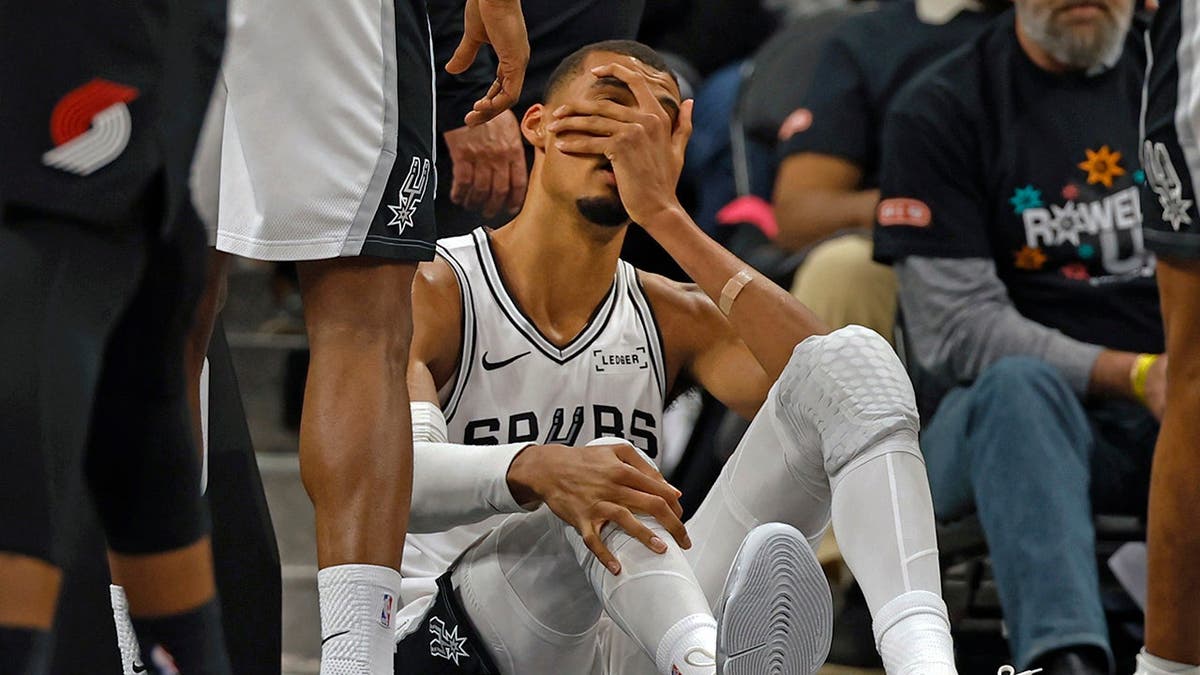
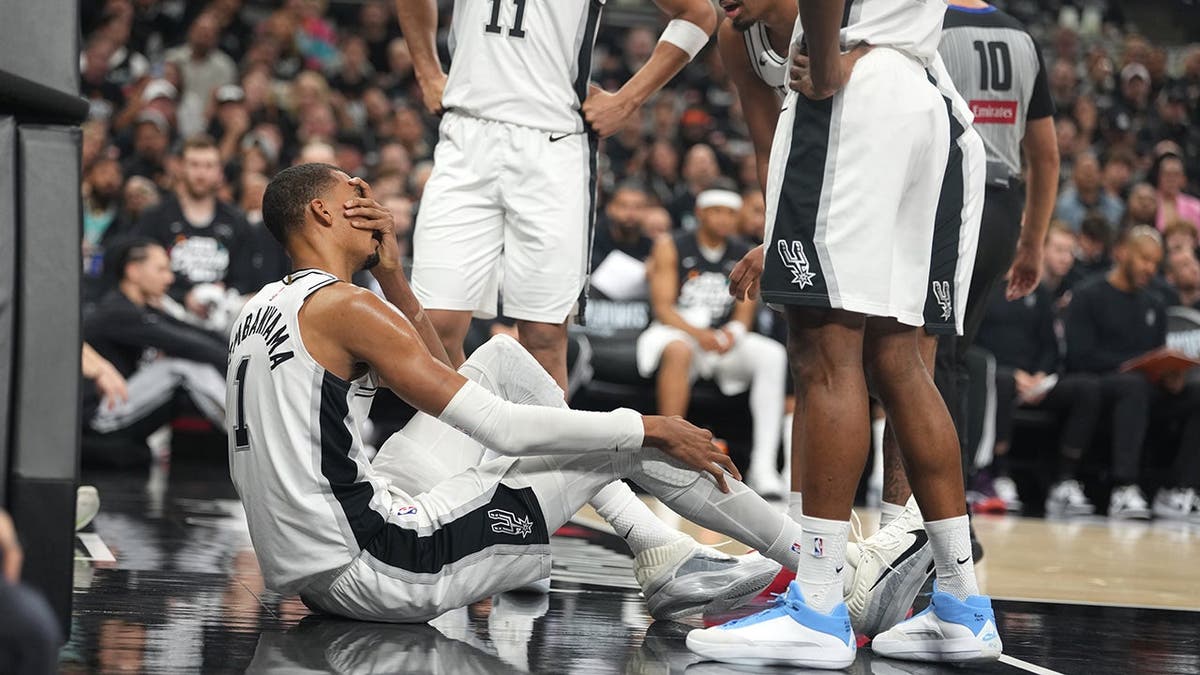
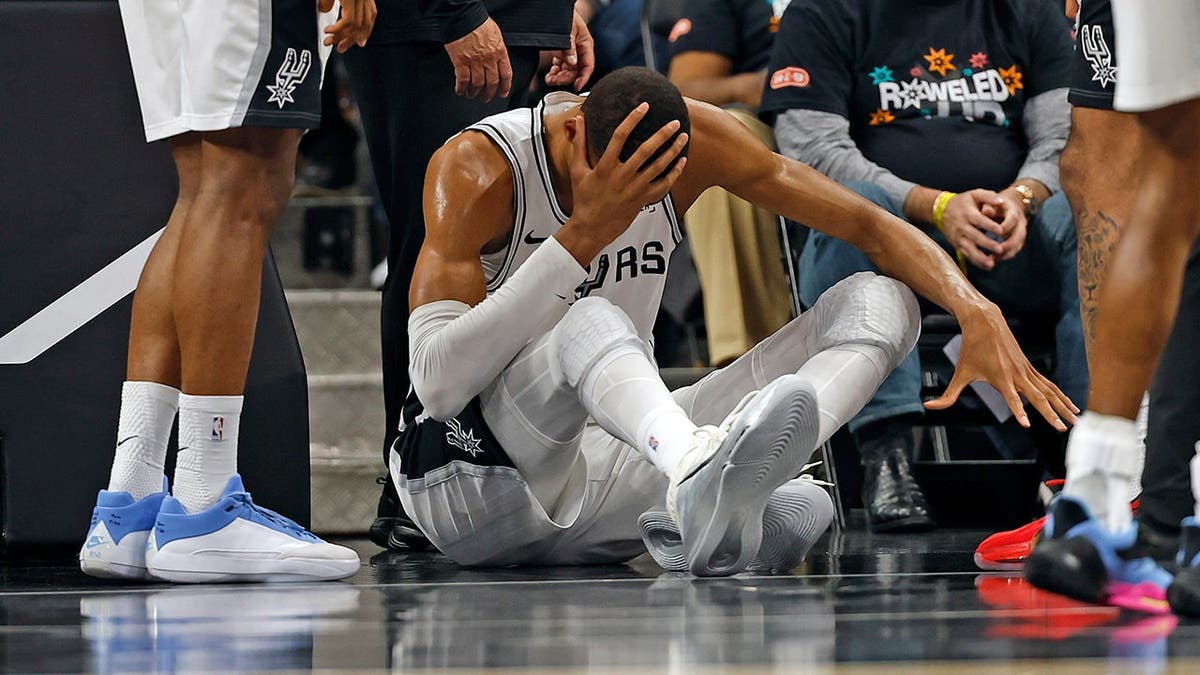
On Tuesday, the Philadelphia 76ers joined in the fun, tying their series with the Boston Celtics and making it slightly more plausible, if still quite unlikely, that Joel Embiid makes it back before the end of the first round. Meanwhile, the first-round series between the Portland Trail Blazers and San Antonio Spurs took a major turn when Victor Wembanyama left Game 2 with a concussion following a hard second-quarter fall. The night concluded with the shorthanded Los Angeles Lakers, still missing Luka Dončić and Austin Reaves, taking a stunning 2-0 lead over the Houston Rockets.
The makes five upsets across six games in the last two days. With all three of Tuesday’s games in the books, here are Tuesday’s winners and losers.
Winner: The entire Lakers organization
JJ Redick said it himself the week before the playoffs: “I’m sure everybody wants to play us.” He was right. Teams aren’t supposed to put up a fight when two of their three best players are sidelined. There are many reasons the Lakers have been able to do so, some of which are beyond their control. They’ve benefitted from tremendous shooting variance. They’re playing a Rockets team that’s melting down before their eyes. But on talent alone, they should be preparing to get swept. That they aren’t speaks to a sort of organizational fortitude that the Lakers have built over the course of the season.
It starts with Redick. This was an absolute masterclass from the second-year Lakers coach defensively. It seemed as though the Lakers knew Houston’s offensive playbook better than the Rockets did, consistently shooting into gaps and mixing up coverages to befuddle a more talented opponent. Kevin Durant‘s nine turnovers were no accident. The Lakers won a March regular-season game with very similar tactics, ultimately forcing seven turnovers in that one through an unpredictable variety of double-teams that Durant was ill-equipped to handle.
General manager Rob Pelinka has drawn quite a bit of criticism for his asset management over the years. Well, he got Marcus Smart for roughly $5 million last offseason and Deandre Ayton for around $8 million. Both have been high-level starters in this series. Ayton’s post defense stymied Alperen Sengun all night. Smart’s 23 points and seven assists were one of the few reliable sources of offense for the purple and gold. One of the others? Luke Kennard, who was acquired for a second-round pick at the deadline. It stands in stark contrast to a Houston team absolutely loaded with assets at this year’s deadline deciding to stand pat and then refusing to trust a recent No. 3 overall pick (Reed Sheppard) in games like this one. The Rockets have every infrastructural advantage and haven’t capitalized.
And then there’s LeBron James. A few months ago, it seemed as if this season was a lock to be his last in Los Angeles. He bought in over the course of the second half of the season, found a supporting role he could thrive in, and then, when Dončić and Reaves went down, eagerly reclaimed his mantle as the team’s centerpiece. He’s 41 years old and just won a playoff game with 28 points, eight rebounds and seven assists playing primarily with castoffs.
Everyone here deserves credit for what’s happening. Everyone is punching above their weight class. That only happens when every element of a team, from the front office to the coaching staff, down to the players, is working in lock step. The Lakers believe they can win this series. They have an underappreciated group of players eager to prove their worth by buying completely into whatever schemes their mad scientist of a coach can concoct. We don’t know when or if Dončić and Reaves will be able to return this postseason, but even if they can’t, and even if the Lakers can’t close the door, they have to leave this series feeling good about what has transpired here thus far. This is a level of organizational connectivity and cohesion that has felt absent for so much of the James era in Los Angeles.
Loser: Rockets coach Ime Udoka
Through two games, it’s still unclear what Houston is trying to accomplish offensively. These Sengun isolations and post-ups aren’t working on Ayton. Durant created plenty of his own offense in the first half but none in the second. There are only three genuinely positive offensive players on this roster, and one of them, Sheppard, played 11 minutes in a game in which the Rockets scored 94 points. What kind of shots do the Rockets want? What are the mismatches they’re trying to exploit? These doubles on Durant are not new. What’s the adjustment to combat them?
Redick’s coaching will receive justified plaudits, but his dissection of Houston’s offense comes with the caveat that Houston is barely even running one. It is giving the ball to its two best players and asking them to generate advantages with no space. There’s not nearly enough ball or player movement to help spark those advantages, and one of the few players on the roster who might help address that, the No. 3 overall pick in last year’s draft, is seemingly plastered to the bench because his coach doesn’t trust his defense.
Just as these two games are a celebration of everything going right in Los Angeles, they’ve been a thorough condemnation of the team the Rockets are trying to build. You’re not going to garner much sympathy for the absence of Fred VanVleet and Steven Adams when the other team is missing Luka Dončić and Austin Reaves. The Rockets have had all year to figure out a VanVleet-less offense and most of it to adjust to life without Adams. If the plan after all of that time is still as simple as “keep getting offensive rebounds until something goes in,” well, then it’s probably time to re-evaluate the plan, and maybe even the person conceiving it.
Winner: The Tyrese Maxey-VJ Edgecombe duo
Embiid’s injury history hangs over every good thing that happens to this 76ers franchise. At times, they seem almost cursed. Appendicitis? Really? To the same guy who scored 50 points in a playoff game with Bell’s Palsy? It felt in that moment as though a once-promising season once again went down the drain for unavoidable medical reasons.
The 76ers still have a long way to go, of course, but they tied this series on the backs of their two new franchise players. Tyrese Maxey and VJ Edgecombe combined for 59 points, 14 rebounds and 11 assists in their Game 2 111-97 upset win in Boston. Edgecombe made all sorts of history in his playoff coming-out party, most notably passing Magic Johnson as the youngest player ever to score 30 points and pull in 10 rebounds in the postseason.
Edgecombe’s 16-point second quarter helped Philadelphia regain control after the Celtics nearly ran away with it early, but the fourth quarter belonged to Maxey. The Celtics briefly pulled the score within two, but two pull-up Maxey 3s gave Philadelphia a cushion it would never surrender.
The win itself is, of course, meaningful. Philadelphia stole home-court advantage and tied the series. It bought Embiid a few extra days to potentially return. But in the bigger picture, it’s a reminder that Embiid’s horrid luck doesn’t need to doom this franchise completely. The 76ers have one of the brightest rookie stars in the NBA, and Maxey is going to make an All-NBA Team. The two of them together are enough of a foundation to compete with even seasoned champions like the Celtics. They’ll need help and health to hit their ceiling, of course, but the 76ers are in a deceptively promising position for a team seemingly afflicted with some sort of divine jinx.
Loser: Celtics coach Joe Mazzulla
If Joe Mazzulla has a weakness as a coach, it’s how slowly he makes adjustments during games. Boston playoff losses often feel similar. A lot of dribbling. A lot of good 3s that didn’t go in. A single, iffy strategic decision that an opponent picks persistently until suddenly a winnable game slips through Boston’s fingers. That’s largely how Game 2 played out. If Boston had shot as it normally does, the Celtics probably would have won. If Philadelphia shoots as it normally does, Boston probably wins too.
The former is just variance. The latter? Well, Boston didn’t help matters with its vanilla defensive scheme. The Celtics spent most of the game dropping their big men, Neemias Queta and Nikola Vučević, into the paint in pick-and-roll. That left Boston’s perimeter defenders helpless to contest Philadelphia’s pull-up 3s. That commitment to locking off the paint was technically successful. The 76ers scored just 32 paint points in Game 2, down from 45 in Game 1 and Philadelphia’s season-long average of 50.2, but the exchanges were some of the easiest shots Philadelphia saw all season, especially for Edgecombe. Philadelphia’s two star guards combined to shoot 11-of-22 from deep, and the 76ers as a team nailed 49% of their triples.
It’s an interesting dilemma for Mazzulla, given the roster he’s working with. Having Al Horford at center in previous years gave the Celtics the versatility to play almost any pick-and-roll defense. When Boston finally tinkered with more aggressive coverages late in the game, Maxey had little trouble attacking it. Vučević’s defense has been an issue in the postseason for basically his entire career. Couple that with the absence of Jrue Holiday on the perimeter this season and the Celtics just aren’t as versatile defensively as they used to be.
Mazzulla still has plenty to work with, but he’ll have to mix things up a bit as the playoffs progress.
Winner: Scoot Henderson
The word “bust” hadn’t quite attached itself to Scoot Henderson‘s name after his first two NBA seasons, but it was certainly circling the former No. 3 overall pick. Portland’s additions of Jrue Holiday and Damian Lillard had a chance to be enormously beneficial for Henderson in the locker room, but adding two potential Hall of Famers at your position doesn’t exactly scream confidence from your organization. Shaedon Sharpe got a big contract extension last offseason. Deni Avdija grew into an All-Star this year while Henderson was injured. A few months ago, it just wasn’t quite clear what his long-term place in Portland would be.
Well, we’re starting to get an answer. In two strong playoff performances against the Spurs, he’s staking his claim as a foundational player in Portland. In Tuesday’s 106-103 win, Henderson led all scorers with 31 points on 11 of 17 shooting and 5 of 9 from deep.
What’s most notable here is the shooting. His long-term upside was always tied to his ability to pair his elite athleticism with a consistent jumper. That’s finally starting to happen. The five 3-pointers he drilled in Game 2 tied a season high. He hit over 40% of his triples in his last 20 regular-season games. If he can keep shooting like this, it’s going to make it that much harder to keep him away from the basket, and his steadily improving craft as a finisher is making him far more dangerous when he gets there.
This is the version of Henderson we waited three years to see. He’s met the moment with absolute fearlessness, and whether it leads to a series upset or not, it bodes very well for both his future and Portland’s.
Loser: San Antonio Spurs
The Spurs made waves for their fiesta-themed uniforms and fan t-shirts in Game 1, but the whole night played out like a party. Victor Wembanyama’s 35-point playoff debut almost superseded the game itself. It felt like a moment in NBA history. The future face of the league was ready to officially start his ascent to the mountaintop. Portland played San Antonio competitively, but victory was never really in doubt. We allowed our minds to drift to what we assumed was coming next.
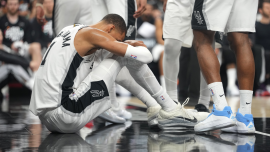
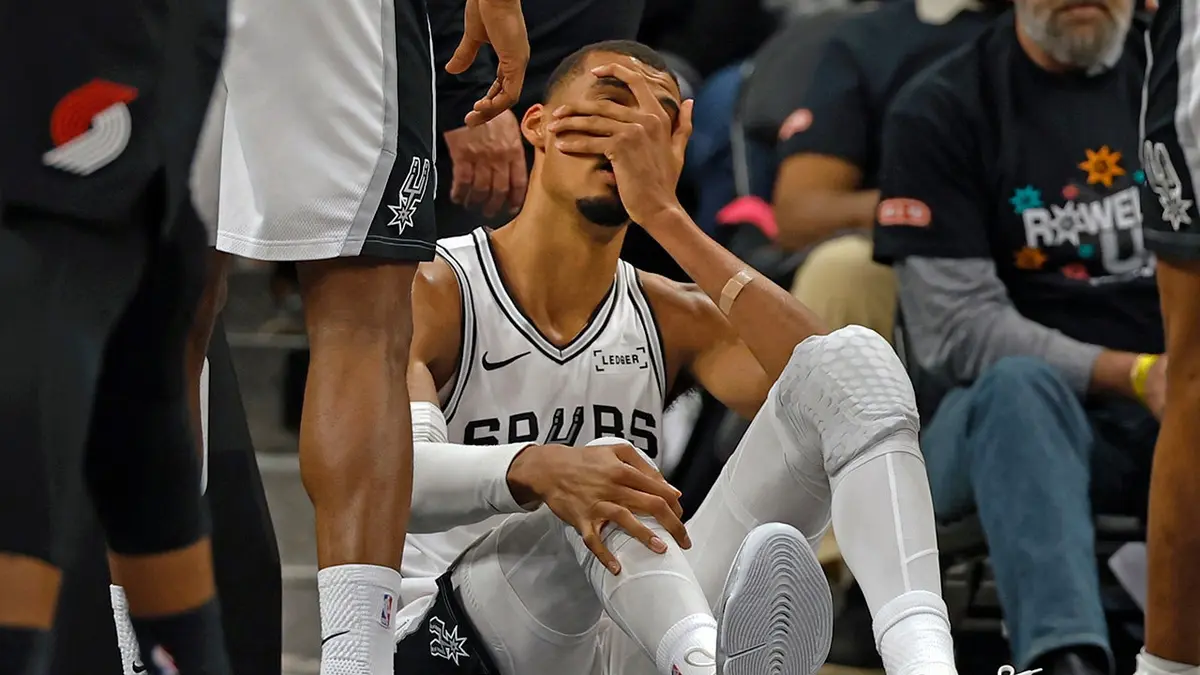
Well, you know what they say about assuming. A second-quarter concussion for Victor Wembanyama changed everything. The series is now tied at one game apiece, and Wembanyama will have to go through the concussion protocol before he can return to the floor. That likely means missing time, and the next two games in this series will be in Portland. The Spurs have won plenty without Wembanyama this season. They went 12-6 without him in the regular season, including much of their surprising run through the NBA Cup.
Spurs star Victor Wembanyama exits Game 2 vs. Blazers, diagnosed with concussion after hard fall to floor
James Herbert
But a head injury isn’t a simple bruise or sprain. It’s a serious, non-basketball medical concern that the Spurs will treat with an abundance of caution. There’s no telling how it might linger, and even if San Antonio makes it through Portland, Denver is likely looming in the next round as a far more difficult opponent. Throw in whatever happened to Harrison Barnes‘ hand in the fourth quarter and the Spurs suddenly have several medical concerns to contend with in a suddenly precarious first-round matchup.









































You must be logged in to post a comment Login