

The only good data center is a canceled data center.
Tech
How a new data center could impact your town’s electric bills and environment


Or so a growing number of Americans seem to feel.
Throughout the United States, citizens are mobilizing against the construction of new data centers in general — and the massive, “hyperscale” ones that fuel artificial intelligence, in particular.
- Data centers can increase local air pollution, though their emissions vary widely between different contexts. Their impact on local water supplies, meanwhile, has been greatly exaggerated.
- Data centers often drive up an area’s electricity bills.
- But hyperscale campuses can deliver major economic benefits to their host communities, including job growth and tax revenue.
- In some cases, the benefits of data center development almost certainly outweigh the costs.
The past four years have witnessed an unprecedented boom in the construction of such facilities, driven by AI firms’ insatiable thirst for computing power. Between 2022 and 2025, annual spending on the creation of data centers in the United States jumped from $15 billion to over $35 billion, in constant dollars.
And many Americans have had enough.
At the local level, municipalities are nixing data center projects at a historic clip. Over the first three months of this year, plans for at least 20 such facilities have been shelved amid public backlash, according to an analysis by Heatmap Pro. Together, those canceled projects represent $41.7 billion in forgone investment.
In statehouses and Congress, meanwhile, lawmakers are pushing to freeze data center construction outright. Last month, Maine’s state legislature passed a moratorium on new data centers in the state. Gov. Janet Mills ultimately vetoed that legislation, but insisted that she too supported freezing all data center construction in Maine, except for a single, long-planned project in the economically challenged town of Jay.
At least 12 other states are entertaining data center moratoria, while four municipalities have imposed permanent bans. In the Senate, Bernie Sanders has introduced a bill that would pause the construction of AI supercomputing campuses nationwide, until a long list of regulations and social programs are enacted.
This rebellion against data centers is partly motivated by concerns about artificial intelligence. Some progressives, right-wing populists, and tech-wary centrists believe that unfettered AI development poses intolerably high risks — to workers’ economic security, the Earth’s climate, and/or humanity’s survival. From this perspective, the point of blocking new data centers is primarily to throw sand into the gears of AI progress. And if artificial intelligence really is on the cusp of wrecking civilization, then trying to choke off Big Tech’s access to computing power makes some sense.
That said, much of the resistance to data centers is rooted in anxieties about the buildings themselves.
Many Americans have come to think that these industrial complexes offer little to their host communities beyond economic burdens and ecological devastation. Judging by activist rhetoric and viral media accounts, data centers invariably slurp up localities’ water, pollute their air, despoil their landscapes, and poison their residents with “infrasounds” — all while driving up municipalities’ electricity bills and sponging off their tax dollars.
But the truth is more complicated.
If a large data center comes to your town, it could make the local environment slightly worse — and your electric bill somewhat higher. But it could also raise your municipality’s wages, while reducing its property tax rates.
The scale of these costs and benefits vary widely from place to place. Yet in areas with sound environmental regulations, relatively clean and robust electric grids, and progressive tax codes, data centers tend to be a “win-win” for both residents and large tech companies (assuming the latter don’t get the former killed in a robot apocalypse, anyway).
So, how do you decide whether your community should welcome hundreds of acres of computing hardware? Let’s examine the (real and imagined) environmental harms and material upsides point by point — and how the balance between them shifts with local conditions.
Data centers can be dirty
Data centers do come with some environmental costs. But the scale and uniformity of their local impacts are often exaggerated.
The most serious of these harms is air pollution.
A hyperscale campus can require as much electricity annually as a midsize American city, as such complexes must power tens of thousands of continuously running processors — and then dissipate the consequent heat with industrial-scale cooling systems.
In some places, data centers meet these gargantuan energy demands by spitting a ton of particulates into the sky. For example, xAI’s Colossus campus in Memphis is partly powered by 35 on-site natural gas turbines. All that combustion appears to have dramatically increased the concentration of nitrogen dioxide in nearby air, with peak levels jumping 79 percent since the facility opened in 2024, according to researchers at the University of Tennessee, Knoxville.
Elon Musk’s Tennessee operation is exceptionally dirty. But more typical data centers also tend to increase regional air pollution, at least marginally, by boosting the utilization of an area’s natural gas or coal plants and running backup diesel generators when their energy needs temporarily exceed the grid’s supply.
Nevertheless, in all these cases, the problem arises from the type of energy that a data center uses, not from some inextricable feature of all server farms.
Data centers sited in regions with abundant non-carbon energy sources produce relatively little air pollution, at least by the standards of industrial enterprises. According to Google’s official data, its Oregon cloud computing operations run exclusively on non-carbon energy sources about 87 percent of the time.
Water is less of a problem
On most other fronts, data centers’ environmental costs tend to be overstated.
Server farms do need substantial amounts of water. But this is true of almost all forms of industrial production. And modern data centers are not exceptionally water-intensive operations, in part because they typically use closed-loop cooling systems that recirculate the same pool of H2O repeatedly.
According to the calculations of AI researcher Andy Masley, as of 2023, 0.04 percent of America’s fresh water was being consumed inside data centers. For comparison, the nation’s golf courses churned through 33 times as much H2O that year.
To be sure, data centers don’t need to consume a significant share of the national water supply to burden especially arid regions. Fortunately, parched localities tend to already constrain the amount of local water available for industrial purposes.
Consider Box Elder County, Utah. There, investors are seeking to build a massive hyperscale campus over sagebrush in the state’s hinterlands. This has prompted furious pushback from local residents, driven partly by fears that the facility would deplete the rapidly declining Great Salt Lake. If that body of water continues losing volume, it will release plumes of toxic dust over Utah’s urban core.
In this context, it’s understandable that residents would fear a vast data center soaking up their region’s scarce reserves. And yet, to secure its H2O, the Box Elder project needed to purchase water rights from an existing agricultural user. This transaction did not increase the total amount of industrial water consumption in Utah, but merely transferred a small portion of a fixed pool from one business to another.
Critically, as City Journal’s Shawn Regan notes, that exchange is plausibly net-positive for the Great Salt Lake: When farmers use water to irrigate a field, much of it gets lost to evapotranspiration and never returns back to its source. By contrast, when water courses through a closed-loop data center, it retains far more of its volume, and then gets periodically flushed back into the local watershed. Therefore, shifting water rights from a farm to a data center conceivably reduces long-term depletion.
Finally, when sited too close to residential areas, some data centers generate noise pollution that meaningfully degrades their neighbors’ quality of life. But server farms located in far-flung, industrial zones do not have this problem. And contrary to some viral videos, there is no reason to think that data centers emit subaudible “infrasounds” that damage the health of those in their vicinity.
Data centers create more jobs than you might think
So, data centers come with some real environmental costs, which can be profound in certain circumstances.
It does not follow, however, that server farms are always bad for the localities that host them. An industrial enterprise can benefit a community, even if it imposes some ecological burdens. Or so most people — including most prominent data center skeptics — seem to believe.
After all, when a town loses a car plant or steel mill to offshoring, progressives and right-wing populists don’t typically cheer that municipality’s good fortune — even though such manufacturing facilities can be far worse for local air quality than a data center.
The key question, then, is how a given data center’s ecological harms stack up against its economic benefits. And the latter, like the former, vary widely from one situation to another.
Hyperscale campuses can enrich communities in two primary ways: by generating jobs and tax revenue.
Data center opponents often belittle their benefits to employment. And not without reason. Once built, a server farm is among the least labor-intensive industrial facilities one can find.
Nonetheless, data center projects can meaningfully benefit a region’s workers in both the short run (by creating a large number of temporary construction jobs) and in the longer term (by fostering a favorable ecosystem for tech sector development).
A recent study from the Brookings Institution spotlights the latter point. To gauge data centers’ impacts on employment, researchers examined labor market trends in 93 counties that welcomed their first data center between 2008 and 2024 — and 3,000 counties that never received one. After controlling for a variety of variables, the authors estimate that the arrival of a large data center raised private employment in the former counties by 4 to 5 percent over a five- or six-year period. Meanwhile, the data centers also appeared to lift wages for both existing workers and new hires by about 3 to 4 percent.
These gains are driven partly by temporary spikes in construction employment. But hyperscale data centers — the kind that powers AI — also yielded more durable jobs in the information sector. As the authors note, vast cloud computing campuses generate demand for local fiber installers, IT contractors, managed service providers, and other types of tech firms. And these businesses generally open near such campuses, so as to regularly service them.
This dynamic is most visible in counties that host data center clusters: When places welcomed at least four new data centers in the studied time period, their employment soared by 23 percent. By contrast, counties with a single, non-hyperscale data center saw boosts to construction employment, but little durable growth in IT jobs.
Servers will sometimes pay your taxes
But the biggest local benefit of data centers is typically fiscal.
Hyperscale campuses generate a lot of tax revenue without consuming much in the way of public services. In many jurisdictions, a data center doesn’t just need to pay taxes on its land or buildings, but also on its exceedingly valuable equipment — servers, networking gear, generators, etc. For this reason, such facilities can yield far more revenue per acre than a housing complex or office park.
What’s more, unlike the residents of a new subdivision, servers in a hyperscale facility do not send any children to a municipality’s public schools, drive around on its roads, crowd its parks, or use public transit.
For these reasons, data centers can sometimes deliver immense fiscal value. In Loudoun County, Virginia, they now provide nearly half of the county’s tax revenue — enough to cover all of its government’s functions beyond the school system. In other words, Loudoun County residents effectively get their local police departments, courts, parks, infrastructure maintenance, and many other social services provided free of charge — a fact that has allowed the county to slash its property tax rate by about 30 percent over a decade.
To be sure, northern Virginia’s experience is somewhat exceptional; Loudoun has been a major IT infrastructure hub for decades, and hosts 200 data facilities. Nevertheless, other jurisdictions enjoy similar fiscal benefits at a smaller scale.
Indeed, data center development can be especially valuable for economically declining rural towns. Such municipalities often struggle to attract highly profitable, labor-intensive industries, since they lack large numbers of knowledge workers. But a single data center’s direct labor needs are fairly light, even as its commercial value is high. They can therefore provide rural localities with a modicum of economic development and revenue, when few other enterprises will.
For precisely this reason, however, localities sometimes get caught in a race to the bottom to attract data center investment, showering exorbitantly wealthy tech companies in tax incentives, a phenomenon that has further embittered much of the public against hyperscale projects.
Fortunately, there’s reason to think that most communities could be driving a harder bargain, without chasing away investment. As Brookings notes, many of these tax breaks appear to be subsidizing projects that would happen even in their absence. When making siting decisions, hyperscalers tend to care more about the availability of power, land, and fiber infrastructure than fiscal favors.
When a data center comes to your town, it will probably — though not definitely — push up your electric bill
Of course, data centers also come with one infamous economic downside: Their gargantuan energy demands can push up nearby residents’ electricity bills.
The mechanism here is straightforward: If you abruptly add the equivalent of a midsize city to a region’s electric grid, power demand will probably rise faster than utilities can expand production. In the short term, this may force them to purchase more expensive electricity from wholesale markets. In the longer run, it can require them to finance new power plants and transmission infrastructure. In either case, ratepayers are liable to foot some of the bill.
Market analysts and economists have produced evidence that this is already happening in some markets.
Even on this front, however, context matters. Rising electricity demand does not automatically translate into higher prices. And data center development does not unfailingly correlate with electricity inflation.
Virginia is, again, a case in point. The Old Dominion saw a 14 percent increase in electricity demand between 2019 and 2024, due in part to data centers’ energy consumption, according to a study from the Lawrence Berkeley National Laboratory. And yet, over that same period, electricity rates in the state actually fell by 1 cent per kilowatt hour, in inflation-adjusted terms.
Trends in North Dakota were even more paradoxical. That state saw electricity demand skyrocket by almost 40 percent, amid a data center building boom. Nevertheless, its inflation-adjusted electricity prices fell by 3 cents per kilowatt hour.
These results are counterintuitive. But they are consistent with the (often odd) economics of power markets. Electric grids aren’t built to provide the exact amount of power a region requires. Rather, they generally maintain excess generation and transmission capacity.
For this reason, in systems with a lot of spare capacity, moderate increases in demand can lead to fuller utilization of existing resources, rather than major new capital expenses. In such circumstances, adding a data center to the grid may spread its fixed costs across a larger volume of electricity sales, lowering the amount that each individual household must contribute to sustain the system.
To be clear, more often than not, adding a bunch of hyperscale data centers to a region’s grid is likely to push up its electricity prices. But that result is not automatic. And governments can limit ratepayers’ burdens by forcing hyperscalers to meet the full costs of satisfying their power demands.
New data centers may end the world; but first, they’ll probably lower someone’s property taxes
Although this catalog of data centers’ effects may seem complicated, the upshot is simple: data center projects are neither intrinsically good nor bad for localities. Each offers a distinct mix of costs and benefits, depending on factors including how its operations are fueled, regulated, and taxed.
Put differently, policymakers have the power to make data center development pay off for more communities — by, among other things, decarbonizing electric grids, enforcing noise limits, and paring back tax breaks for Big Tech firms. Regardless, even under today’s flawed policy frameworks, ordinary people often benefit when a data center comes to town.
Hyperscalers might eventually trigger a robot apocalypse. But in the meantime, they’ll almost certainly make some municipalities a bit better off.

Continue Reading


Meta is working on a tool to ID images and video created with its new image generation model, Muse Image. The company showed off a preview of the web-based tool that can check for the invisible watermarks used by the new model.
This watermarking system, called Content Seal, remains in place “even when cropped, compressed, resized, or screenshotted,” Meta explains in a blog post. “We’re previewing a detection tool that lets you check whether an image carries a Content Seal watermark, providing an initial way to help you better understand if an image was made with Meta AI.”
Content Seal seems to be a somewhat new approach for Meta. The version that’s part of Muse Image is proprietary, though the company has previously released open-source versions of the tech, Meta told Engadget. Meta’s new models don’t include any visible watermarks, like some previous versions of Meta AI that added a small logo to the bottom right corner.
For now, Meta AI’s detection abilities are limited to images that are created or edited with Muse Image, though the company said it plans to expand Content Seal watermarks to AI-generated and edited videos as well. Meta is also working on a separate video generation model called Muse Video that will be “coming soon.”
I tried out the new detection feature on images I created today with Meta AI and the web-based tool was able to detect a watermark for edited images and entirely AI-made creations (like the one pictured above). It also found the watermark in screenshots of my images. “A positive result means that the image was generated or edited using the Meta AI app or meta.ai,” the company explains in an FAQ. “A negative result means it is unlikely that the image was processed using Meta AI app or meta.ai.”
Interestingly, Meta AI’s new detection abilities don’t seem to be part of the Meta AI app yet. When I asked Meta’s app-based assistant about an image the web tool had identified as AI-made, it replied that it did not have the ability to check. “I can’t tell you definitively if this specific image was made with Meta Al just by looking at it,” it said. “Meta Al doesn’t automatically watermark images, and I don’t have a tool that can detect which Al model made an existing image.”
Meta has previously faced some criticism for how it labels and identifies AI-generated material in its apps. The Oversight Board told the company earlier this year that it was “concerned” that Meta was “inconsistently implementing” digital watermarks on AI content created by its own tools.
The new feature does still seem to have some other limitations, though. Content Seal is not compatible with SynthID or C2PA Content Credentials, two established watermarking methods used by other companies. The web-based feature was unable to identify images created or edited with earlier versions of Meta’s AI models in my testing. When I added images created in older chats with Meta AI, it was unable to tell me if the image was made with its AI. The feature also appears, for some reason, to be subject to Meta’s rate limits. After uploading a handful of examples, I was alerted that I had reached my “daily limit on identification checks.”

TikTok has become one of the most famous social networking apps in the world, where users can enjoy short clips and share their own. To make the platform more accessible, the company also offers TikTok Lite, a smaller and lighter version of the app. It has been created with the needs of users who use older mobile phones or have low internet connectivity in mind. Despite the two apps offering a similar experience, there are differences in terms of performance, storage space, features, and safety options. In this guide, we’ll compare TikTok and TikTok Lite to help you understand which version is right for you.
TikTok vs. TikTok Lite: Key Differences
Although both applications offer a similar experience, there are quite a few differences between TikTok and TikTok Lite. TikTok Lite is considerably smaller than the former. It requires less space and fewer resources, which makes it run easily on older smartphones and devices with limited storage. The app also features a data-saving mode that helps reduce mobile data usage. It performs better on slower internet connections as well.
Both apps provide video-watching capabilities, enable uploading and downloading of videos, and allow editing, liking, commenting on, sharing posts, and sending direct messages. TikTok Lite has limited functionality compared to TikTok, lacking advanced browsing features and content management tools. The lite version has fewer safety features compared to the full version of the TikTok application. The standard version includes AI-generated content, misleading information, and harmful content, as well as enhanced comment filters and content controls. As TikTok Lite lacks many of these security tools, the complete version is superior from a safety perspective and for efficient use of the app.
Which One Should You Choose?

The TikTok Lite app would be perfect for people using older Android phones with low storage space and slower internet connections. Also, the TikTok Lite app is suited for people who do not want to use much mobile data but still want to use TikTok’s services. However, the regular TikTok app will be suitable for people using new phones, providing all features alongside increased security options.
In conclusion, your choice depends solely on the nature of your device and what you need. If you are looking for something that uses less storage space, draws less power from your battery, and uses less mobile data, then TikTok Lite is the best option.


A hidden authentication backdoor has been found in multiple Tenda router firmware versions, potentially allowing an attacker to gain administrative access to the device’s web management panel.
According to a security bulletin from the CERT Coordination Center, the issue remains unfixed because the Chinese maker of the networking equipment couldn’t be reached.
CERT/CC says the issue, tracked as CVE-2026-11405, is caused by an undocumented authentication mechanism in the ‘login()’ function of the ‘/bin/httpd’ web server binary.

If a user attempts to log in, the router firmware will perform standard MD5-based authentication. If that fails, it will retrieve an alternate password from the ‘sys.rzadmin.password’ configuration value and compare it directly to the plaintext password supplied by the remote user.
If the passwords match, the device grants administrator (role=2) access and creates a valid session, regardless of the username entered.
So any username will be accepted by the mechanism as long as the backdoor password is supplied.
CERT/CC says this mechanism isn’t documented anywhere, or mentioned on the administrative interface, leaving users unaware of the risk.
“Successful exploitation grants full administrative access to the device’s web interface, regardless of the configured administrator account credentials,” describes CERT/CC.
“With administrative control, an attacker can reconfigure the device, alter network settings, and disable security features, enabling broader compromise of the local network.”
CVE-2026-11405 impacts the following Tenda firmware versions and devices:
- US_FH1201V1.0BR_V1.2.0.14(408)_EN_TD – Tenda FH1201 (WiFi router)
- US_W15EV1.0br_V15.11.0.5(1068_1567_841)_EN_TDE – Tenda W15E (WiFi router)
- US_AC10V1.0re_V15.03.06.46_multi_TDE01 – Tenda AC10 (WiFi router)
- US_AC5V1.0RTL_V15.03.06.48_multi_TDE01 – Tenda AC5 (WiFi router)
- US_AC6V2.0RTL_V15.03.06.51_multi_T – Tenda AC6 V2 (WiFi router)
CERT/CC reports that no patch is currently available, and Tenda users are advised to disable the remote web management panel to prevent internet access to the vulnerable interface.
Additionally, it is recommended to restrict local network exposure by changing the default LAN IP address to reduce opportunistic discovery by automated scanners.
CVE-2026-11405 was discovered and reported to CERT/CC by an anonymous researcher.
While no mention of active exploitation exists, the issue is very likely to be targeted by botnets focusing on router flaws in the coming period.
BleepingComputer has contacted Tenda for comment, and we will add their response if we receive one.

Security teams log 54% of successful attacks and alert on just 14%. The rest move through your environment unseen.
The Picus whitepaper shows how breach and attack simulation tests your SIEM and EDR rules so threats stop slipping by detection.
Dynaudio is pulling out of North America.
In a tersely worded statement from Skanderborg, Denmark, the Danish loudspeaker manufacturer announced that it will refocus its future market development efforts on Europe and Asia. As part of that shift, Dynaudio says it will “cease operations of its commercial activities in North America and permanently shut down its U.S. subsidiary in the fall of 2026.”
That is not a small distributor adjustment. That is not a quiet change in rep coverage. That is Dynaudio exiting the North American market as a direct commercial operation.
The statement acknowledges that Dynaudio has achieved sales growth in North America in recent years, which makes the decision even more notable. The company points instead to ongoing economic challenges and market uncertainty as the reason for prioritizing markets it believes offer stronger strategic opportunities.
In other words, North America may not have been a disaster. It may simply have become too expensive, too unpredictable, or too low-priority to justify the investment required to keep a full U.S. subsidiary operating.
For a brand with Dynaudio’s history, dealer footprint, studio credibility, and recent product momentum, that is a significant industry development.
Dynaudio’s Statement
Dynaudio has not yet provided the detailed transition plan that dealers, customers, and service partners will want to see. The company says continuity of product support and customer service will be addressed and communicated shortly.
That will be the critical part of this story.
Owners of Dynaudio loudspeakers, custom installation products, automotive systems, and professional monitors will want to know whether warranty support, parts availability, repairs, and dealer service will continue in the U.S. and Canada after the subsidiary closes.
Dynaudio also currently lists North American service contacts for Dynaudio Pro, including Dynaudio North America in Illinois and additional service partners in the U.S. and Canada. That may provide a temporary support bridge, but it does not answer the bigger question: what happens after fall 2026?
The Timing Is Strange
The timing is hard to ignore.
Dynaudio did not look like a brand retreating from the U.S. market in 2026. Quite the opposite.
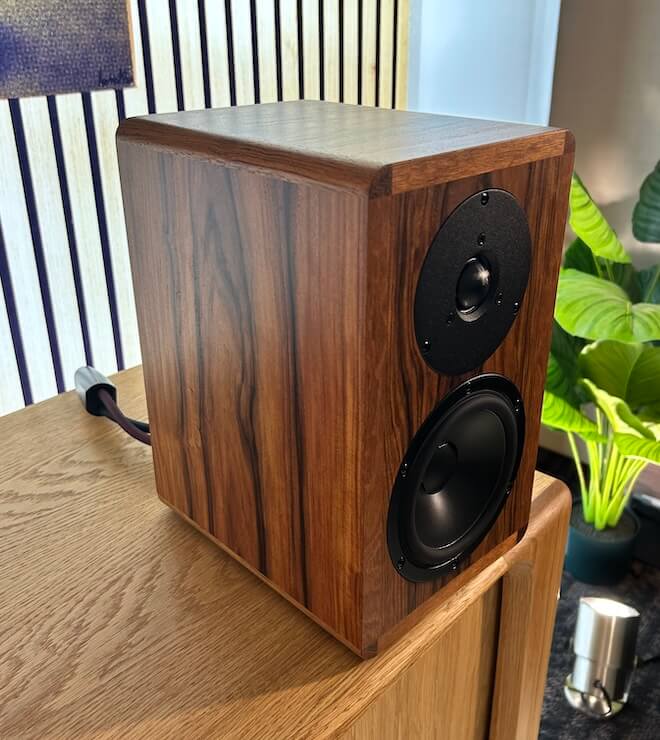
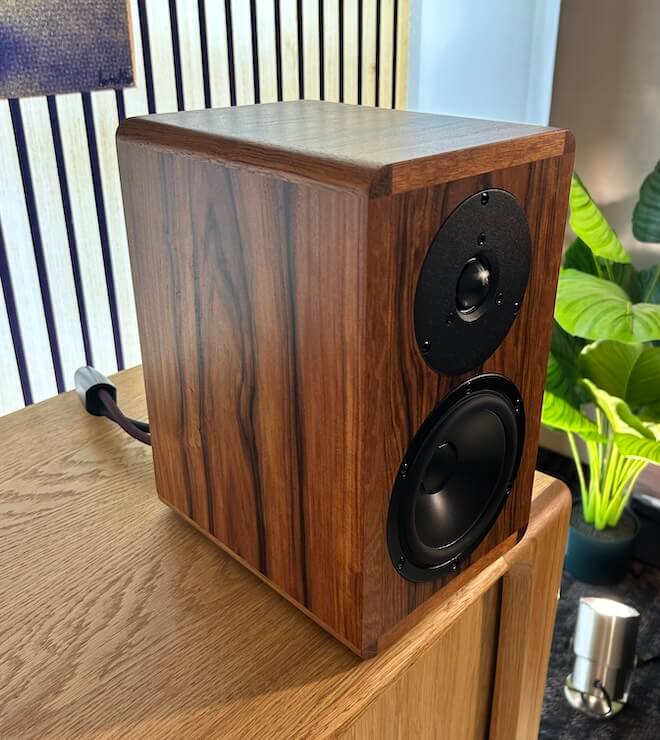
At AXPONA 2026, Dynaudio had one of its most visible recent North American showings, highlighted by the Dynaudio Legend, a luxury passive bookshelf loudspeaker that made its public debut in Chicago. The Legend was positioned by Dynaudio as a handcrafted, premium bookshelf speaker using matched natural rosewood veneer panels, Brazilian cherry corner pieces, and Danish assembly at Dynaudio headquarters.
The room created real interest because Legend felt like a reminder of what Dynaudio does best: elegant Danish industrial design, serious driver engineering, and loudspeakers that don’t need to look like they were designed by a committee of enraged refrigerator manufacturers.
eCoustics had two Dynaudio reviews planned this year, including an anticipated review of the Legend. That review has now been delayed, and in light of today’s announcement, the delay takes on a very different meaning.

Dynaudio also had a major presence at HIGH END Vienna 2026. The company’s Symphony Opus One immersive audio system was at the center of its demonstrations in Vienna before its June launch in Copenhagen. Dynaudio’s forthcoming Confidence i series was also previewed for High End Vienna, showing that the company was still pushing hard into the upper end of the market.
That is why this announcement lands with a thud. Dynaudio was not invisible. It was not quiet. It was not showing signs of creative exhaustion.
It was showing up.
From North American Expansion to Exit
The reversal becomes even sharper when you look back at Dynaudio’s North American investment.
In 2019, Dynaudio opened a 25,000-square-foot North American headquarters and Experience Center in Northbrook, Illinois. The facility was designed for product demonstrations, dealer and sales rep training, and warehousing to support regional demand.
That was a serious commitment.
Seven years later, Dynaudio is preparing to shut that U.S. subsidiary down.
The company has not said whether a third-party distributor will take over North American sales. It has not said whether existing dealers will continue to receive product. It has not said whether Canada will be handled differently from the United States. It has not said whether Dynaudio Pro, Custom Install, Home Audio, and Automotive are all affected equally.
Until Dynaudio clarifies those points, the safest reading is that Dynaudio is ending its own commercial operation in North America, while promising some form of future support continuity.
That distinction matters.
Dynaudio products may not vanish from every shelf overnight. Existing dealer inventory may remain in the market. A future distribution arrangement is possible. But none of that has been confirmed.
Tariffs, Greenland, and the Danger of Easy Explanations
It is tempting to speculate.
The current U.S. trade environment has created real pressure for European manufacturers, and the U.S. and European Union trade framework has involved a 15% tariff structure on many EU exports. That kind of cost pressure matters when you are shipping large, heavy, premium loudspeakers into a dealer-driven market.
There is also the bizarre timing of President Donald Trump’s renewed comments that Greenland should be controlled by the United States rather than Denmark, a position that has strained relations between Washington and Copenhagen.
But there is no evidence at this stage that Greenland, tariffs, or any single political issue caused Dynaudio’s decision.
The more practical explanation is probably less theatrical and more painful: North America is expensive. Warehousing is expensive. Dealer support is expensive. Shipping is expensive. Product demos are expensive. Customer support is expensive. And in a market where high-end loudspeaker sales can be slow, seasonal, and dealer-dependent, even growth may not be enough if the margin math no longer works.
Not every retreat is a collapse. Sometimes it is a spreadsheet with a knife.

The Bottom Line
Dynaudio’s decision to exit North America is one of the more surprising hi-fi industry developments of 2026.
This is a company with a deep loudspeaker legacy, strong engineering credibility, a meaningful presence in home audio and professional audio, and recent show momentum at both AXPONA and High End Vienna. The brand was visible. The products were interesting. The Legend looked like a serious statement piece. Opus One suggested a more ambitious design-led future.
And yet Dynaudio has decided that its future market development efforts belong elsewhere.
GoerTek’s 2014 acquisition gave Dynaudio access to Chinese engineering, electronics, and wireless expertise, and Dynaudio’s 2016 management update referenced GoerTek-linked Asia-Pacific experience at the executive level. That does not mean China is “the reason,” but Europe and Asia as priority markets are consistent with Dynaudio’s ownership and long-term product direction.
That does not mean the brand is finished in North America forever. It does mean that the current structure is finished.
For customers, the immediate concern is support. For dealers, it is inventory, warranty coverage, and continuity. For the industry, it is another reminder that the North American hi-fi market may look attractive from the outside, but it is increasingly difficult to serve profitably from the inside.
Danish loudspeakers are not the problem.
The business of selling them here might be.
For more information: dynaudio.com
Related Reading:

I know a frozen-treat machine isn’t the most obvious thing to buy in the middle of winter, but Amazon‘s Prime Day sale has dropped both the Ninja Creami Deluxe and Ninja Slushi to all-time low prices.
That makes these two deals a lot more tempting than they have any right to be in July, especially if you want to get ahead before summer or you just like ice cream, frozen drinks and weekend entertaining year-round.
The Slushi is the one I can speak to personally. I bought mine on June 3 last year for AU$424.15, which was the lowest price I’d seen at the time, and I’ve since made hundreds of frozen drinks with it across summer and winter.
The Creami Deluxe is the one I’d consider first if you’re more interested in ice cream than drinks. With the Deluxe version now at an all-time low, splurging feels a lot easier to justify, and I’m tempted to grab one myself.
All the deals below are Exclusive Prime prices, so if you don’t have a membership already, sign up now and get a 30-day free trial that you can cancel at any time.
Ninja products tend to attract a lot of attention, and the Slushi is one of the few that I think mostly deserves it. While you might assume one of the best blenders could do a similar job, it really can’t.
A blender crushes ice into a drink, which usually waters it down. The Slushi chills and churns the liquid itself, so the texture is much closer to a proper frozen drink.
The useful bit is Ninja’s RapidChill technology, which keeps the liquid moving while it freezes. Chilling your drink first can speed things up, but I usually find the Slushi is ready in under 30 minutes, and then it will keep it icy for as long as you need.
That’s important at parties, because people can keep coming back for refills without the mix turning into a block of ice or melting into a watery mess.

The main caveat is that the drinks need sugar to freeze properly. The machine will alert you if the sugar level is too low, so completely sugar-free drinks are not really the point here.
You also need to be careful with alcohol, because too much will stop the mixture from freezing. In practice, I’ve found it works best when you treat recipes as a starting point and adjust them after a batch or two.
Frozen cocktails are the obvious use, but spiced winter drinks that would normally be served hot are surprisingly fun as slushies, too.
At this all-time low Prime Day price, it’s much easier to recommend, and it gives you plenty of time to master a few recipes before the weather warms up again.
More Amazon Prime Day deals in Australia
More Prime Day Ninja deals

In the early 1990s, Don’t Copy That Floppy was an anti-piracy campaign that attempted to connect with computer-savvy youth through the power of hip-hop. While somewhat difficult to imagine given our current draconian Digital Rights Management (DRM) hellscape, warning kids about the potential legal ramifications of duplicating floppy disks containing copyrighted software was seen as necessary since at the time there was usually nothing preventing users from simply copying the contents of one disk to another.
Unfortunately 30+ years down the road, we’re now finding that somebody really should have been backing up some of those disks. Which is why the University of Cambridge of launched the Future Nostalgia project and produced Copy That Floppy! — a phenomenal guide on preserving the contents of floppy disks while we still can.

There’s no telling how much data could potentially be lost to time because its stuck on such an antiquated and fragile storage media, and the situation only gets worse with the passage of time. The problem isn’t just that modern computers don’t have floppy drives. The disks themselves degrade with age, a process which is accelerated if they aren’t stored properly.
As such, Copy That Floppy! only briefly touches on the most ideal situation — that is, buying a USB floppy drive and making copies of the bog standard 3.5 inch disks you might come across. It then moves right on into more advanced topics, such as interfacing with less common drive types, how to safely clean floppies, and the use of advanced tools such as Greaseweazle to analyze captured disk images.
We’ve seen demonstrations of some of these techniques before, and a few years back Adafruit got interested in floppy preservation with modern hardware. But in-depth guides like these that pull all that information together into one place are valuable resources.

An anonymous reader quotes a report from Wired: Meta launched its inaugural AI image model from the Meta Superintelligence Labs on Tuesday, its effort to compete with the likes of OpenAI’s GPT Images 2.0 and Google’s Nano Banana 2 in the AI image generation race. The new model, called Muse Image, rolled out with deep integrations woven into the Instagram app. As part of this update, public Instagram profiles are now automatically opted into being fodder for generative AI remixes. All someone has to do is tag your account’s profile in a prompt — if it’s public — and they can use Meta AI to generate an image using your likeness.
Meta positions this feature as a cheeky way to personalize generations with images of real people. “Whether you want to design a custom event invitation, mock up a collaborative creative concept, or generate a personalized graphic, tagging a username lets Meta AI use public photos to build a visual that’s ready to post,” reads one of Meta’s announcement blogs about the new AI tool. […] Instagram’s help center site includes more details about how this feature will impact users, saying that “people may be able to create content with your Instagram content using AI features at Meta” if you leave your account public and on the default settings. (A previously archived version of this page from 2025 does not include similar, AI-focused language.) Instagram users who want to stop others from using their public posts for AI images (without switching your account to private) must manually disable the options under the app’s “Sharing and reuse” settings. However, turning off the setting only blocks future AI generations; any AI images already created from their content will remain.
Meta also says users will not be notified when others create AI-generated content using their posts.


Chinese hackers tracked as ‘UAT-7810’ are actively evolving their malware to expand their Operational Relay Box (ORB) network by compromising internet-facing networking devices, primarily unpatched Ruckus routers.
According to Cisco Talos researchers, the ORB network serves as a secure relay infrastructure for other China-aligned advanced persistent threats (APTs), including UAT-5918.
This type of infrastructure, which was previously documented by Google Mandiant, allows threat actors to proxy their network traffic through regional devices, making it appear to originate from legitimate local infrastructure to evade detection and complicate attribution.
The Talos analysts have identified new malware in the campaign, including LONGLEASH, a new version of the previously documented SHORTLEASH backdoor, DOGLEASH, a Linux backdoor, JARLEASH, an administrative tool, and LEASHTEST, a testing utility.
The researchers report that UAT-7810 primarily exploits known (n-day) vulnerabilities to gain initial access, including CVE-2020-22653, CVE-2020-22658, and CVE-2023-25717 in Ruckus routers, as well as CVE-2025-2492 in ASUS AiCloud routers.
LONGLEASH malware
The newly discovered LONGLEASH malware is an upgraded version of SHORTLEASH, first documented by SecurityScorecard in 2025, that significantly expands its capabilities.
The malware builds on the previous version, which supported command-and-control (C2) communications, web server hosting, network tunnel management, and operation as both a C2 server and client.
In addition to those, Talos researchers have now also observed the following capabilities:
- Reverse shell
- HTTP, DNS, SOCKS, TCP, ICMP, and UDP proxying with traffic redirection
- SMTP client/server functionality
- TLS and PKI support
- Self-removal for when tampering or other suspicious activity is detected
- Ability to act as an intermediate C2 server, forwarding commands and data between infected nodes
DOGLEASH, JARLEASH, and LEASHTEST
Apart from LONGLEASH, the researchers have also discovered DOGLEASH, a lightweight Linux backdoor deployed via web shell scripts.
Upon launch, it opens a listening TCP port and authenticates incoming requests using a hardcoded password, supporting shell command execution, file access and modification, OS information retrieval, and arbitrary code execution directly in the host’s memory.
JARLEASH is a Java-based administrative tool that provides web-based file management and includes FTP, SFTP, and Netcat server functionality.
Finally, the threat actors have developed LEASHTEST, which can be used to verify whether an MIPS IoT device can perform functions related to malware operations, likely to help refine LONGLEASH’s MIPS support.
Cisco Talos concludes that UAT-7810 continues to expand its ORB infrastructure, actively replacing or extending SHORTLEASH with the more capable LONGLEASH while broadening its toolkit with new malware.
A complete list of the indicators of compromise (IoCs) linked to UAT-7810 activity and the latest toolset is available at the bottom of Cisco Talos’ report.
Security teams log 54% of successful attacks and alert on just 14%. The rest move through your environment unseen.
The Picus whitepaper shows how breach and attack simulation tests your SIEM and EDR rules so threats stop slipping by detection.


Despite earning a 90% “very positive” rating on Steam, Paddle Paddle Paddle (PPP) has been hit with an unusually high 21% refund rate. Mateo says his game has collected more than 55,000 refunds, and he’s now pointing to Valve’s famously lenient refund policy as the culprit. It doesn’t help that…
Read Entire Article
Source link

When it comes to home cleaning, you can never be too prepared as there’s no telling what spills and stains you might have to deal with. A tipped-over glass of wine or a forkful of pasta that’s hit the floor is more of an inevitability, no matter how careful you are, but if you don’t have any gadgets to hand that can help you clean it all up, it can take ages to sort with a manual touch. This is why you need one of the best steam cleaners to hand.
Although the best hard floor cleaners are the perfect solution for everyday messes, steam cleaners provide a more heavy-duty approach when it comes to sanitising the mess in question. For instance, cleaning up a bit of mud left by your shoes after a long hike is an easy enough task for a hard floor cleaner, but something left behind by a pet or a child (if you catch our drift) is where steam cleaners come into effect.
As you may have guessed from their name already, steam cleaners operate by boiling water to produce a mess-targeting vapour which can then be concentrated to remove whatever it is that’s found its way to your floor. These appliances can work wonders, but because they are a more heavy-duty solution, they work best with sealed floors such as varnished wood or concrete. Anything less may be warped by a steam cleaner over time.
There’s a good variety of steam cleaners available, each with different power settings and accessories designed to target certain messes. It can all be a bit overwhelming if you’re approaching the market for the first time, but this is where the hard work of our expert testers comes in, as they’ve done the hard work for you to find out which of the bunch are actually worth buying.
All of the options selected for this list have performed brilliantly in our testing process, and we’ve made sure to keep a few budget-friendly options in the mix too for anyone who doesn’t want to spend too much money. Keep on reading to see which picks we currently recommend, and if you need other cleaning solutions for your home then we’ve got you covered with the best vacuum cleaners and the best carpet cleaners.
Best Steam Cleaner at a glance
SQUIRREL_ANCHOR_LIST
We test all steam cleaners in the same way. Each model is tested on hard floors, letting us see how well they clean tough everyday stains. We take before and after photos of cleaning to show the power on offer, and test how well cleaners get into the edges of the room. For cleaners with detail attachments, such as squeegees and wire brushes, we test how well they clean tough stains including tiles and grouting, burnt-on stains on oven shelves and limescale-encrusted shower screens. We report on how easy each cleaner was to use and how far it could clean on a tank of water.
Powerful and fast cleaning
Steam blast loosens tough stains
Simple controls
Doesn’t stand up on its own
For floors only
If you’re looking for a steam floor mop to quickly clean up hard floors, the Shark Klik n’ Flip S6003UK Steam Mop could well be the model for you. This well-priced steam mop is focused on floor cleaning, shipping with a double-sided mopping pad that clips to the bottom of the mop. It’s a huge mop, making short work of floors, as you can clean large areas with a single swipe based on our tests.
Cleverly, the Klik n’ Flip head can flip over partway through a clean, giving you the clean side of the pad to keep cleaning with, without introducing a lengthy changeover. This is a feature we found super handy, that let us clean larger areas without having to stop and start.
Cleaning performance was excellent, with the Shark Klik n’ Flip S6003UK Steam Mop tidying up mud on our tiled floor with ease, and picking up everyday kitchen stains: the steam blast function is particularly useful for cleaning up tougher stains, and we found that this helped remove dried-on pet food without having to get down on our needs.
Thanks to the design of the cloth, we found that we could push the S6003UK right into the edges of our room, giving us edge-to-edge cleaning. We needed to get down on our knees and manually clean areas far less with this model than rivals. Easy to use, easy to move and brilliantly priced, the Shark Klik n’ Flip S6003UK Steam Mop is the best steam mop that we have ever tested. If you’ve got lots of hard floors, this is a great model to buy.
Hugely versatile
Powerful floor cleaning
Makes short work of most jobs around the house
Have to hold trigger down
If you’re looking for a versatile steam cleaner that can be used across floors, windows and even to tackle bathroom tiles, the Vax Steam Fresh Total Home steam cleaner is a fantastic choice.
With two tanks on-board, the Vax Steam Fresh Total uses a combination of steam and detergent when in its upright mopping mode, with the latter adding a scent boost into cleaning.
Just note that when the device is in handheld mode, you can only use steam to clean. Vax includes a huge array of additional tools which can be used in both handheld mode or via the hose. These tools include a detail nozzle for pushing steam into hard-to-reach areas, a squeegee, and grout, scrubbing and even deep scrubbing brushes too.
In upright mopping mode, you can either use a tough HD steam cleaning pad or a softer steam pad depending on how dirty your floor is. Both options attach via velcro, so it’s easy to swap them mid-clean.
There’s also a built-in scrubbing brush to help agitate any tough and dried in stains too.
Want to refresh a carpet or a rug? Attach the included carpet glider which helps the Vax Steam Fresh Total Home to slide on carpet without causing any damage. Using the steam mop is impressively easy, thanks to its power button and intuitive switch that allows you to control the amount of steam that’s produced. A potential issue with using the mop is the fact you need to manually hold the trigger in order to start producing steam.
Although we appreciate the fact we can control the amount of steam, some may find this tiring and difficult to use after a while.
There’s unfortunately no option to collect solids, which you can find on the more expensive Dyson WashG1, however if you need fast and efficient cleaning around the house then the Vax Steam Fresh Total Home steam cleaner remains a seriously great choice.
Large water tank
Easy to fill
Heats up quickly
Powerful steaming
Versatile
Unclear steam dial
Bulky for small jobs
Noisy
If there’s one problem with cylinder steam cleaners, it’s that you have to wait for most of them to cool down before you refill and continue cleaning. Not so with the Polti Vaporetto Smart 100_B, which has a removable water tank, so you can fill it as many times as you need to complete your cleaning job, all without any cool-down time. We found this makes this cylinder steam cleaner a great choice for large and difficult jobs, but its bulk means that it’s not an ideal tool if you only want to tackle smaller jobs or just mop floors.
Although the controls are a little confusing on this model (the steam dial goes from min to max, but it’s not clear where about you are in the range), performance is mostly excellent. The Polti Vaporetto Smart 100_B coped well with our tough floor challenge, brought grout back to life and easily managed to clean up a hard floor.
There are tools to tackle most jobs, but only one mop pad in the box is a little disappointing, as this gets dirty quickly. That said, for the price, this is an excellent choice and the continuous cleaning makes it brilliant for large jobs, particularly those outside of hard floors.
Vac cleans in front of steam mop
Fast heat-up time
Good run-time per tank
Decent-length cable (7.5m)
Limited suction power
Average steam power
No pivot on head
The Bissell Vac & Steam 1977E is a fantastic time-saver, vacuuming and cleaning at the same time. We loved the original, and now the 1977E model has had a small update and now comes in a fetching blue colour. As a standalone steam cleaner or a standalone vacuum cleaner, this model won’t win awards; yet, the combination of the two features produces some powerful cleaning results. With a 400W bagless vacuum cleaner and 1100W steam heater, we found that small particles were sucked up before the microfibre pad steams the floor and picks up stains. For well-trodden areas in your home with hard floors, the Bissell Vac & Steam 1977E effectively halved our cleaning time. Bissell recommends three passes for a dirty area and that worked well for us, picking up dust and removing stains well.
The downside of the system is that it’s not very flexible, and it’s neither a good vacuum nor a flexible and powerful steam cleaner. Still, it’s the combination of parts that is important, and the Bissell Vac & Steam 1977E delivers on hard floor cleaning. We recommend this model for homes that need regular cleaning; our tester has dogs, so needs to clean daily, where the Bissell Vac&Steam 1977E came in handy. For deeper floor cleaning, the Shark S6003UK is a better choice.
Stands up on its own
Heats up quickly
Uses water efficiently
Seam volume not adjustable
Only one microfibre pad
Residue from messier stains
The Beldray Detergent Steam Cleaner is our top pick for the best budget steam mop that can also use detergent.
It’s sturdy and a mop we found to be easy to work with, given how lightweight it is. We also think the Beldray cleaner looks the part with its turquoise and white colour scheme, too, and is able to be conveniently disassembled with the handle can be removed with a literal touch of a button. The fact there’s a 5-metre cable here also enables this cleaner to go rather far round your house, and also helps its manoeuvrability. For its steaming powers, this Beldray mop comes with a 330ml water tank. That may sound small, but thanks to the fact it uses its water rather sparingly, you can actually go rather far before that tanks needs refilling. To go with the 330ml of water, this cleaner also has a 200ml detergent tank to help freshen up floors and offer a little more oomph for cleaning.
Beldray says water will heat up in 25 seconds, making this a relatively prompt mop to heat water up with. There isn’t much in the way of controls, apart from an onboard power switch, which is a handy addition considering other cleaners require you to physically turn it off from the wall. This appliance also comes with a Velcro-attached microfibre pad for the mop head, and a carpet glider to help it to move smoothly across carpeted surfaces.
In our testing, we found the Beldray Detergent Steam Cleaner to do a pretty good job of removing most of the mess we’d left down in tiles in one fell swoop. In addition, it saturated the colours of our rug when steaming a patch for 30 seconds, although didn’t quite get rid of a small stain that was left. It arguably did a better job of dealing with laminate flooring, as our dried muddy footprints were fully gone within 20 seconds without any marks or residue. Our toughtest test involving a combo of coffee and tomato paste stains dried into a patch of tiles arguably pushed this cleaner to its limits, with it taking around two and a half minutes for the stain to be fully removed.
A steam mop is designed specifically for hard floors, with a microfibre cloth used to pick up dirt and steam pushed through the cloth to clean and remove dirty. A steam cleaner is different, as it has different attachments for different jobs: nozzles and brushes for detail cleaning, window cleaning accessories and more.
The latter is better for tackling jobs around the house, but a steam mop is more convenient for everyday use. If you want a balance, you can get models that convert from a mop to a handheld unit for occasional detail jobs. Steam cleaners don’t have to use detergent, and use clean water and steam alone to remove stains. This makes them more gently cleaners in some regards, as you don’t have to use harsh chemicals to remove stubborn stains. That’s not to say that you shouldn’t use chemicals in the normal way.
For example, for cleaning floors and surfaces, using traditional detergent and disinfectant makes sense, although you can then use a steam cleaner afterwards for dealing with some stains. Likewise, you should still clean with cleaning products for the deepest clean, letting the steam cleaner handle deeper jobs. The larger the tank of water you have, the longer the steam cleaner can keep cleaning. This is more important on some models than others. Many models have a refillable water tank that you can remove and top up when you like. These ones heat water when its pumped from a tank, effectively giving you continuous cleaning. For these models, the size of the tank isn’t so important, as you can get water when you need it.
If you have a cleaner with a built-in tank where all of the water is heated at the same time, you have to have a cool-down time (up to 20 minutes or so) before you can refill and use them again. For these models, it’s important to have a running time that will last for the length of job you have, so that you don’t have to pause in the middle of cleaning. Steam cleaners, bar standalone steam mops, will come with a variety of attachments for different jobs. Largely, these are there to make specific tasks easier. Each accessory works by changing how steam is directed, such as a thin nozzle to help push steam towards tile grouting, or by providing a tool to help clean, such as a wire brush for cleaning an oven. Tools can do both, such as an upholstery brush that directs steam over a wider area and gives you a brush to agitate the upholstery and loosen dirt. When you buy a steam cleaner you should think about the jobs you want to do and make sure that your chosen model has the right accessories.
Steam is generally safe to use on most surfaces but there are some exceptions to this. As you’re using water, using a steam cleaner on an unsealed surface isn’t recommended. And, surfaces that may react badly to a lot of water, such as solid wood flooring, may not be suitable, as you could get swelling.
The situation is worse if you apply steam directly to the surface but also applies with steam mops. Although mop heads will absorb most of the heat of the steam, they can still get very wet, which is no good for many surfaces. For dealing with hard floors, we recommend that you buy one of our best hard floor cleaners, instead.
Steam is an effective way to kill bed bugs and their eggs, thanks to the high temperatures proving lethal. If you’re worried about an infestation, then steam cleaning soft furnishings can help. Make sure that you use the upholstery attachment and/or mattress accessory to clean. You should move slowly over the area, taking at least 30 seconds before moving the steam head in order to deliver a killing dose of steam. Make sure that you cover all areas, and press the steam head into crevices and around the bed; for mattresses, cover the sides and underneath, too.
Karcher commissioned research that showed that enveloped viruses, such as SARS-CoV-2, can be killed by high temperatures. Spot cleaning for 30 seconds at maximum steam level was enough to kill the virus. This shows that cleaning close-up is required to be effective, so cleaning with a burst of steam can be a good secondary way of disinfecting surfaces, although cleaning with detergent should always be done. Steam can be good on surfaces that are otherwise hard to clean, such as curtains and upholstery.
Using a steam mop is slightly different, as the microfibre cloth absorbs some heat. Steam mops will remove dirt, bacteria and viruses, but the pad should be cleaned at a high temperature in a washing machine to disinfect it after use. In short, then, a steam cleaner can help disinfect surfaces but should be used as an additional tool after traditional cleaning.
Learn more about how we test steam cleaners
FAQs
Do you need a steam mop or a steam cleaner?
Should you use detergent with a steam cleaner?
What size water tank do I need?
What accessories do I need?
Can you use a steam cleaner on all surfaces?
Can a steam cleaner kill bed bugs?
Can a steam cleaner kill coronavirus?
Test Data
Karcher SC5 easyFix Premium Steam Cleaner
Shark Klik n’ Flip Automatic Steam Mop S6003UK
Vax Steam Fresh Total Home Steam Cleaner
Polti Vaporetto Smart 100_B
Bissell Vac & Steam 1977E
Beldray Detergent Steam Cleaner
Full Specs
Karcher SC5 easyFix Premium Steam Cleaner Review
Shark Klik n’ Flip Automatic Steam Mop S6003UK Review
Vax Steam Fresh Total Home Steam Cleaner Review
Polti Vaporetto Smart 100_B Review
Bissell Vac & Steam 1977E Review
Beldray Detergent Steam Cleaner Review
UK RRP
£499
£149.99
£159.99
£165
£148.99
£39.99
Manufacturer
Karcher
Tokit
Vax
Polti
Bissell
–
Size (Dimensions)
301 x 439 x 305 MM
100 x 110 x 1180 MM
x x INCHES
270 x 400 x 290 INCHES
280 x 229 x 1181 MM
1170 x 222 x 350 MM
Weight
9 KG
2.3 KG
4.63 KG
5 KG
4.81 KG
2.07 KG
ASIN
B077CBLBT3
B01N3930UF
–
B079TNF6QL
B01MYDV5WI
B08HDJK24W
Release Date
2018
2020
2024
2021
2018
2021
First Reviewed Date
23/07/2018
17/11/2020
10/10/2024
22/02/2021
02/08/2018
–
Model Number
–
–
Vax Steam Fresh Total Home Steam Cleaner
–
–
BEL01097
Accessories
Floor cleaning kit, EasyFix + extension tube (2 × 0.5 m), hand nozzle, detail nozzle, round brush (small), microfibre cover for manual nozzle
Floor head
2x water filters, 250ml bottle of detergent
Mop head with microfibre pad and carpet glider, squeegee tool with microfibre cover, two small round brushes, curved nozzle, scraper tool and two extension tubes
Floor head (carpet and hard floors)
–
Provided heads
–
–
Carpet glider, floor head (3x mopping pads), 4x cleaning pads, scrubbing brush, deep scrubbing brush, window tool, detail nozzle, grout brush,
–
–
–
Bin capacity
–
–
litres
–
–
–
Modes
–
–
Variable steam
–
–
–
Stated Power
–
–
1400 W
–
–
–
Run time
–
–
hrs min
–
–
–
Water tank size
1.5
0.33
0.26
2
0.38
0.35
Floor cleaner type
–
–
Steam cleaner
–
–
–
Detergent capacity
–
–
0.13 litres
–
–
–
Steam cleaner type
Cylinder
Mop
2-in-1
–
2-in-1
Mop
Cleaning solution tank
–
–
Yes
–
–
Yes
Steam pressure
4.2 bar
–
–
4 bar
–
–

Business58 seconds ago
How to Solve Puzzle Number 1123 Fast

Crypto World59 seconds ago
Strike Bitcoin loans remove margin calls

Entertainment3 minutes ago
The Best Star Trek Showrunner Reveals The Episode He Hated The Most


-

 Fashion4 days ago
Weekend Open Thread: High Hopes
-
 NewsBeat3 days ago
Taylor Swift and Travis Kelce wedding staffer hilariously struggles to keep her cool while checking in megastars
-

 Fashion2 days ago
Open Thread: What Great Books Have You Read Recently?
-
 Crypto World7 days ago
Airdrop Registration Becomes Key Focus For Remittix As RTX Launch Updates Approach
-

 Politics5 days ago
The House | “Reframing the debate from a binary discussion of winners and losers”: Yuan Yang reviews ‘We Are Not Machines’
-

 Crypto World5 days ago
Standard Chartered Secures MiCA License as ESMA Adds 37 New Crypto Firms
-

 Business1 day ago
AXT Shares Jump Nearly 14% as Semiconductor Materials Maker Rebounds on AI-Linked Indium Phosphide Demand
-

 Sports7 days ago
Broncos roster: OL Ben Powers (No. 74) entering final year of contract
-

 Crypto World6 days ago
Binance stock trading tops $1B in first month after launch
-
Crypto World1 day ago
SK hynix (000660.KS) Stock Dips as $28B Nasdaq ADR Offering Drives AI Memory Expansion
-

 Crypto World6 days ago
Alibaba-affiliate Ant Group enters the humanoid robot market with 12 deals
-

 Crypto World3 days ago
South Africa proposes crypto tax guidance under existing rules
-

 News Videos2 days ago
Best Time to Enter Small Caps Right Now? Another Bull Run? | Financially Free
-

 News Videos1 day ago
Whats Hidden Inside This Cash Register? #treasure #reselling #money
-

 Tech3 days ago
Lenovo laptops are now shipping with YMTC SSDs, a sign of Chinese NAND entering the mainstream
-

 Business6 days ago
Meta Platforms Stock Jumps 7% Today as Bloomberg Reports Company Plans to Enter the Cloud Business
-
 NewsBeat6 days ago
New exhibition reflects five decades of movement between island of Ireland and GB
-

 Business5 days ago
What a 10 Percent Drop Means for Buyers, Sellers and Renters
-

 Crypto World5 days ago
Binance Re-Enters Philippines As EU MiCA Rules Restrict Access
-

 News Videos2 days ago
Avoid entering in FOMO #bitcoin #cryptocurrency #trading #scalping
You must be logged in to post a comment Login