There are defamation lawsuits designed to win, and then there are defamation lawsuits designed to generate headlines for your fans on social media, punish journalists, and maybe — if you’re lucky — force a settlement or intimidate future reporting. FBI Director Kash Patel’s brand new defamation lawsuit against The Atlantic is very obviously the second kind.
On Friday, The Atlantic published a truly devastating profile of Patel, reporting that “more than two dozen” current and former officials described a director who shows up to Ned’s in DC and the Poodle Room in Las Vegas to drink until he is visibly drunk, and who has been difficult to wake on occasions when his security detail needed him. There’s also this fun anecdote in the opening, talking about a time, earlier this month, when Patel had trouble logging into his computer:
He quickly became convinced that he had been locked out, and he panicked, frantically calling aides and allies to announce that he had been fired by the White House, according to nine people familiar with his outreach. Two of these people described his behavior as a “freak-out.”
That’s just kinda amusing, but there are a lot more serious concerns, such as the fact that the nation’s top cop is (according to the article): “often away or unreachable, delaying time-sensitive decisions needed to advance investigations.”
The article included a response from Patel, attributed to him by the FBI: “Print it, all false, I’ll see you in court — bring your checkbook.”
Advertisement
On Monday, represented by MAGA-world’s go-to lawyer Jesse Binnall, Patel did exactly that, filing a 19-page complaint in federal court in DC seeking $250 million in damages.
The complaint is, to put it charitably, not great. To put it less charitably, it reads like a press release with a case caption stapled to the top.
Let’s start with the central legal problem, because it’s kinda fatal. Patel is indisputably a public official — he runs the FBI — which means under New York Times v. Sullivan, he has to plead and eventually prove that The Atlantic published with “actual malice,” meaning with knowledge that the statements were false, or with reckless disregard for their truth or falsity — a legal term of art that requires showing the publisher actually suspected the statements were false and deliberately avoided finding out, not merely that they moved quickly or relied on anonymous sources. This is a very high bar. It’s been a high bar since 1964. Every lawyer who files a defamation case for a public figure is supposed to know that this is the hill they have to climb.
Here is how the complaint attempts to plead actual malice:
Advertisement
Defendants’ conscious decision to ignore the detailed, specific, and substantive refutations in the Pre-Publication Letter, and their refusal to give a reasonable amount of time for the FBI and Director Patel to respond, is among the strongest possible evidence of actual malice.
In other words: Patel denied it, The Atlantic published anyway, therefore actual malice. There is no real attempt to plead actual malice beyond that.
That’s not actual malice. That’s just how journalism works. Every news story that anyone has ever complained about in history has been published after the subject denied it. If “the subject denied it and you published anyway” were sufficient to establish actual malice, the First Amendment would be a dead letter and every investigative story ever written would generate a winning lawsuit.
Yes, those filing SLAPP lawsuits often claim that their subjects’ denials constitute actual malice — but that’s not how it works in court, and it never has been.
And we know this argument doesn’t work because we just watched a judge throw out Donald Trump’s $10 billion defamation suit against the Wall Street Journal for making essentially this exact argument. That was all of a week ago. A public figure’s denial, followed by publication, is not actual malice. A court said that a week ago. This is well-known, settled law. Binnall surely knows this. Patel’s filing this suit anyway.
Advertisement
The complaint does gesture weakly at some other theories — that the anonymous sources were “partisans with axes to grind,” that The Atlantic imposed a two-hour comment deadline, that there was “editorial animus” evidenced by prior Atlantic coverage. But even stacked together, these don’t get you to actual malice. Relying on anonymous sources isn’t reckless disregard—it’s how journalism works. Short deadlines for comment aren’t evidence of malice either; they’re standard operating procedure for breaking news. Prior negative coverage doesn’t even come close to the legal standard, since public figures doing controversial things tend to get criticized.
There’s also the fact that the complaint tries to twist statements by anonymous sources which the Atlantic reported on as The Atlantic’s own speech. Almost every one of the 19 allegedly defamatory statements enumerated in paragraph 18 is, on the face of the article, attributed to anonymous sources. For example, count 18(e) claims that a request for ‘breaching equipment’ — “normally used by SWAT and hostage-rescue teams to quickly gain entry into buildings” — was made because Patel was unreachable. The complaint states:
Fitzpatrick knows that her anonymous sources, unwilling to go on the record, are partisans with axes to grind and are not in a position to know the facts.
Almost all of the claims are like this. “According to multiple people familiar with the request.” “According to information supplied to Justice Department and White House officials.” “According to the more than two dozen people I interviewed.”
Advertisement
The Atlantic’s defense (if it even gets that far) is therefore not going to need to be “we can prove Kash Patel was drunk at Ned’s.” It’s going to be “multiple credible sources told us this, we reported what they said along with corroborating evidence, and we have our notes, emails, and recordings to prove that’s what they told us.” That’s a fundamentally different — and far easier — thing to defend. Publishers aren’t required to prove the absolute truth of everything their sources say. They’re required to not publish with reckless disregard for the truth, which requires evidence about what the publisher knew or suspected, not what turned out to be the ultimate truth of the matter.
The Atlantic had multiple sources for each of its claims. It has corroborating evidence to support the claims. That is not a situation that says actual malice. It’s a situation that says “we did careful reporting.”
The complaint doesn’t grapple with this distinction at all. It just keeps repeating that the FBI told The Atlantic the claims were false before publication, as if that’s the end of the story. It isn’t. Subjects of investigative reporting deny things all the time. Publishers weigh denials against their sources and decide whether to publish based on all of the evidence they’ve collected. The First Amendment protects that decision-making process precisely so that powerful officials can’t just deny critical stories into non-existence.
In theory, there’s also the issue of discovery. Whenever cases like this get filed, people on social media say things like “can’t wait for discovery.” But cases like this rarely even get to the discovery stage. The Atlantic will almost certainly file for a motion to dismiss, which almost always happens pre-discovery, and a failure to competently plead actual malice is a good reason for the case to be tossed at that stage, without any discovery.
Advertisement
But also, given that Patel was famously seen on video chugging a beer at the Olympics in the Men’s Hockey locker room, it seems like Patel himself might not be all that interested in discovery either.
Of course, the goal was never to win. The goal was to file. And, sure some people will point to Trump’s settlements with news orgs, but those were to the president himself, and quite clearly designed to curry favor. As powerful as the FBI director is, it’s doubtful that the Atlantic is looking to curry favor with the FBI director via a settlement.
And that brings us to the other tell: the Streisand Effect. The complaint itself complains how much attention the article — again talking about how various officials in the FBI were concerned about situations where the FBI director appeared to be blackout drunk — got some attention on the internet.
The Article was widely disseminated on the internet, through AMG’s magazine and associated platforms, and was foreseeably republished, summarized, and discussed throughout national and international media.
Ya think?
Patel’s response to this alleged injury was to file a $250 million lawsuit — an action guaranteed to drive far more traffic to the very article he says is destroying his reputation. Every news outlet that covers the lawsuit links to or summarizes the original piece. Every social media post about the suit reintroduces the allegations to people who had never seen them. If your complaint is that too many people read the story, filing a splashy nine-figure lawsuit is a strange way to handle it.
Advertisement
None of this is an accident or a rookie mistake. This is how Binnall — and his predecessor in this particular niche, Steven Biss — have always done it.
Long-time Techdirt readers may recall that we first covered Kash Patel filing a SLAPP suit all the way back in 2019, when he was a White House staffer and former Devin Nunes aide. He used Steven Biss — Nunes’s own go-to lawyer for suing critics, satirical Twitter cows, and journalists — to sue Politico over accurate reporting about Fiona Hill’s congressional testimony. That complaint, like this one, read more like a press release than a pleading, opening with a tirade about “weaponized media” and “partisan hacks and character assassins who work to advance the interests and agendas of dark money.”
Biss specialized in filing SLAPP suits for MAGA figures. Most of them lost. He filed so many of them that when he had a stroke in 2023, his law license was eventually suspended on impairment grounds, and a bunch of his cases had to be handed off to someone else. That someone else was mostly Jesse Binnall, who promptly continued the losing streak. The Flynn family’s SLAPP suit against CNN? Tossed. Patel’s own 2024 threat letter to MSNBC commentator Olivia Troye? Answered with a Monty Python reference.
Filing is the point. Winning is beside it. These suits generate favorable headlines in friendly media, signal aggression to critics, raise the cost of covering the subject, and — if everything goes perfectly — get a defendant to settle just to make the expense go away. Whether they actually prevail on the merits is beside the point for the filer. Binnall has built a practice around this model. Patel has used that practice repeatedly across multiple roles over the last few years.
Advertisement
This is a textbook SLAPP, and it’s a good reminder of why we need anti-SLAPP laws to begin with.
Which brings us to a frustrating final wrinkle: the case was filed in federal court in DC, and while DC has an anti-SLAPP statute, the DC Circuit ruled a decade ago that it doesn’t apply in federal court. On top of that, the DC Court of Appeals more recently invalidated part of the law’s fee-shifting provisions. So even though DC ostensibly has protections against exactly this kind of lawsuit, The Atlantic basically can’t use them here. This is a pattern repeated across the country — patchwork state laws, some strong, some weak, many with large loopholes, and many federal circuits have barred their use in federal courts.
This is why we need a federal anti-SLAPP law, and why we need strong anti-SLAPP laws in every state and territory. The people who file these lawsuits know exactly which jurisdictions lack them, and they file accordingly. The asymmetry — where the cost of filing a meritless suit is minimal for the plaintiff, while the cost of defending it is substantial for the defendant — is exactly what makes the SLAPP tactic work. Anti-SLAPP laws with robust fee-shifting flip that equation, making bad-faith plaintiffs think twice.
Absent that, we’re left with the situation we have now: the head of the nation’s federal law enforcement agency uses a $250 million defamation suit as a political messaging tool, filed by a lawyer whose track record of losing these cases is long and detailed. The Atlantic will likely win on a motion to dismiss. Patel will get his headlines. And a lot more people will have read about Kash Patel’s alleged drinking habits than ever would have otherwise.
Advertisement
For the supposed “free speech party,” filing vexatious SLAPP suits against investigative reporters has become a rite of passage — a way of making clear there’s a price for making the people in power look bad.
Summary: Mozilla released Firefox 150 with fixes for 271 security vulnerabilities identified by Anthropic’s Claude Mythos Preview, an unreleased frontier AI model distributed under the restricted Project Glasswing programme. The collaboration began with Claude Opus 4.6 finding 22 bugs in Firefox 148 earlier this year; Mythos produced more than twelve times as many. Firefox CTO Bobby Holley said the defects are “finite” and that defenders can “finally find them all,” while the UK AI Security Institute confirmed Mythos can also execute autonomous multi-stage network attacks, making the dual-use tension the central policy question.
Mozilla released Firefox 150 on Monday with fixes for 271 security vulnerabilities identified by Anthropic’s Claude Mythos Preview, an unreleased frontier AI model restricted to a handful of organisations under Project Glasswing. The number is striking not because the bugs were exotic but because they were not. “We haven’t seen any bugs that couldn’t have been found by an elite human researcher,” Mozilla said in a blog post titled “The zero-days are numbered.” The point is that no human team could have found 271 of them this fast.
The collaboration between Mozilla and Anthropic began earlier this year with a more modest effort. Starting in February, Firefox’s security team used Claude Opus 4.6 to scan nearly 6,000 C++ files across the browser’s codebase. That pass produced 112 unique reports, of which 22 were confirmed as security-sensitive bugs and shipped as fixes in Firefox 148. Fourteen were classified as high severity, representing almost a fifth of all high-severity Firefox vulnerabilities remediated in 2025. The Mythos evaluation, which followed as part of the continued partnership, produced more than twelve times as many confirmed vulnerabilities. Bobby Holley, Firefox’s chief technology officer, described the experience as giving the team “vertigo.”
What Mythos is, and who gets to use it
Claude Mythos Preview is the model at the centre ofAnthropic’s restricted Mythos modelprogramme, Project Glasswing, announced on 7 April. It is a general-purpose frontier model, not a security-specific tool, but its coding capabilities have crossed a threshold that Anthropic considers significant enough to warrant controlled distribution. The UK’s AI Security Institute evaluated the model and found it capable of executing multi-stage network attacks autonomously, completing a 32-step corporate network attack simulation called “The Last Ones” in three out of ten attempts. It can chain multiple small vulnerabilities into a single devastating attack, reconstruct source code from deployed software to find exploitable weaknesses, and build custom tools for lateral movement and data extraction once inside a network.
Access is restricted to 12 named launch partners, including Amazon Web Services, Apple, Broadcom, Cisco, CrowdStrike, Google, JPMorganChase, the Linux Foundation, Microsoft, Nvidia, and Palo Alto Networks, with roughly 40 additional organisations granted access for defensive security work. Anthropic committed up to $100 million in usage credits and $4 million in direct donations to open-source security organisations, including $2.5 million to Alpha-Omega and OpenSSF through the Linux Foundation and $1.5 million to the Apache Software Foundation. The model is available to Glasswing participants at $25 per million input tokens and $125 per million output tokens through the Claude API, Amazon Bedrock, Google Cloud’s Vertex AI, and Microsoft Foundry.
Advertisement
The restricted rollout has already been tested. On the same day Anthropic announced Glasswing, a group ofunauthorised users gained accessto Mythos Preview by guessing the model’s URL through a third-party vendor environment, an incident Anthropic said it is investigating.
The defender’s argument
Holley framed the 271 vulnerabilities not as an indictment of Firefox’s code quality but as evidence that the security landscape is shifting in favour of defenders for the first time. “A gap between machine-discoverable and human-discoverable bugs favors the attacker, who can concentrate many months of costly human effort to find a single bug,” he wrote. “Closing this gap erodes the attacker’s long-term advantage by making all discoveries cheap.”
The logic is straightforward. A zero-day vulnerability is valuable to an attacker precisely because it is unknown. If a defender can find and patch the same bug before an attacker discovers it, the bug has no offensive value. The cost asymmetry has historically favoured attackers: a browser like Firefox has millions of lines of code, and a single undiscovered flaw in any of them is enough for exploitation. An elite human security researcher might spend weeks or months finding one such flaw. A model like Mythos can scan the entire codebase in a fraction of that time. Mozilla’s thesis is that this changes the economics permanently. “Software like Firefox is designed in a modular way for humans to be able to reason about its correctness,” the blog post stated. “It is complex, but not arbitrarily complex. The defects are finite, and we are entering a world where we can finally find them all.”
The claim is bold and deliberately so. Mozilla is arguing that the age of zero-day vulnerabilities in well-structured software has an expiration date, not because attackers will stop looking, but because defenders will get there first.
Advertisement
The numbers in context
The 271 figure requires some unpacking. Mozilla’s official security advisory for Firefox 150, MFSA 2026-30, lists 41 CVE entries, three of which are standard memory-safety roll-ups that aggregate multiple individual bugs under a single identifier. The 271 number represents the total count of discrete code defects identified by Mythos during its evaluation, many of which were grouped into those CVE bundles. The distinction matters because the headline number and the formal advisory number measure different things: one measures what the AI found, the other measureshow much AI-generated code actually shipsthrough the industry’s standard vulnerability disclosure process.
The most dangerous flaws include use-after-free vulnerabilities in the DOM and WebRTC components, the kinds of memory safety bugs that have been the bread and butter of browser exploitation for two decades. These are not novel attack surfaces. They are the same categories of bugs that Google’s Project Zero has been finding across browsers since 2014. Google’s own AI vulnerability research programme, Big Sleep, a collaboration between Project Zero and DeepMind, found a zero-day in SQLite in October 2024 and has since expanded to discover multiple flaws in widely used software. The difference with Mozilla’s effort is scale: 271 bugs in a single evaluation pass, patched before release, across a codebase that has accumulated technical debt over more than two decades.
The dual-use problem
The UK AI Security Institute’s evaluation of Mythos Preview confirmed what the Mozilla results imply from the other direction: the same capabilities that make the model effective at finding vulnerabilities make it effective at exploiting them. The model became the first AI to complete “The Last Ones,” a benchmark designed to simulate a full corporate network compromise. It succeeded in three out of ten attempts, averaging 22 of 32 steps across all runs. Independent testing confirmed that Mythos cannot reliably execute autonomous attacks against organisations with well-hardened defences, but the trajectory is clear. Each generation of frontier model has performed better on offensive security benchmarks than the last.
This is the tension that Project Glasswing is designed to manage. By restricting Mythos to vetted organisations with defensive mandates, Anthropic is attempting to give defenders a structural head start, a window in which the good actors can scan and patch before the capabilities proliferate. The strategy depends on the restriction holding. The vendor breach on launch day suggests that containment is harder than access control. Anthropic has also identified thousands of zero-day vulnerabilities across every major operating system and every major web browser using Mythos, findings it is disclosing to the affected vendors through Glasswing.
Advertisement
Anthropic’s expanding enterprise footprint, from legal contract review in Microsoft Word to cybersecurity through Glasswing, reflects a company that is monetising Claude across every professional vertical where accuracy matters. The Mozilla partnership is the most dramatic demonstration yet, not because the model did something no human could do, but because it did what only a handful of humans can do, and did it 271 times in a single pass.
Holley’s conclusion captures both the promise and the vertigo: “Our work isn’t finished, but we’ve turned the corner and can glimpse a future much better than just keeping up. Defenders finally have a chance to win, decisively.” Whether that future arrives depends on whether the models that find the bugs remain in the hands of the people who fix them, or whether the capabilities leak faster than the patches ship. For now, Firefox 150 has 271 fewer ways to be broken. That is not a small thing. The question is how long that advantage lasts when the tool that found them iscommanding extraordinary valuationsprecisely because of what it can do.
Longtime Slashdot reader mmarlett writes: The Atlantic has a long article on the story of missing scientists recently featured here on Slashdot. In short, it is an incoherent conspiracy theory that spreads wide and far, not paying any attention to boundaries of time, space, or area of expertise. “Which is all to say that another piece of flagrant nonsense has ascended to the highest levels of U.S. politics and media,” writes the Atlantic’s Daniel Engber. “To call it a conspiracy theory would be far too kind, because no comprehensive theory has been floated to explain the pattern of events. But then, even the phrase pattern of events is imprecise, because there is no pattern here at all. Given all the people who could have been roped into this narrative but weren’t, any hope of finding meaning falls away. Barring any dramatic new disclosures, the mystery of the missing scientists has the dubious honor of being a sham in every way at once.”
Disclaimer: This post talks about Bluesky and an offering from Bluesky and I am on the Bluesky board. Take everything I say with whatever size grains of salt you feel is appropriate.
I’ve written a few times now about how I think that AI tools, used carefully and thoughtfully, represent our best chance at taking back control over the open web. I know this is not a popular opinion with many Techdirt readers, but I’m hoping some of you will read through this to try to understand and engage with the points I’m making here. I truly do believe that if used well and appropriately, these tools can serve to put power back into the hands of users, rather than giant centralized companies who are more interested in exploiting your attention.
Over the last few weeks I’ve been playing around with an AI-powered tool that Bluesky has released (much to the chagrin of many users) to a relatively small group of early beta testers. I think the negative reaction to the product announcement is understandable, given the general distrust of all AI tools, but it’s really worth examining what this tool is and what it can enable, including really empowering people to take back control over their own social experience. It literally gives you a path to routing around Bluesky’s own design features if you don’t like them.
Yes, a lot of AI is overhyped garbage being shoved at people who don’t want it — but that doesn’t mean the underlying tools can’t be useful when applied carefully by those who choose to use the tools appropriately.
Advertisement
It means not outsourcing your brain to the tool, but rather using it the way any skilled person automates some aspect of work that they do. I’ve sanded and restained the floors of my house, and while I could have done the whole thing by hand with a stack of sandpaper, it was helpful to rent a floor sander from a local hardware store, learn how to use it properly, and then use it so that I could finish the job in a day rather than weeks. I view AI tools the same way. If you learn how to use them properly, as an assistive tool rather than a replacement for your brain, they can help you accomplish useful things.
Let me give an example: a couple of weeks ago, law professor Blake Reid wrote a short thread on Bluesky about how he needed to take a break from social media, because he worried that it was eating up too much of his time and he was better off just stopping cold turkey, to avoid getting sucked into unproductive discussions that push him to (as he put it) “get over my skis” in engaging in conversations where he’s tempted to weigh in despite not having much expertise (a common thing on social media). It’s a worthwhile thread.
But in that thread he mentioned that he was hopeful that maybe some day technology itself could help him use social media in a healthier way, to dial back how much time he spent on it, and get him focused on the more productive and useful discussions (which he admits also happen regularly on Bluesky).
What was amusing to me was that the only reason I saw that post by Reid was because I’ve been beta testing a new tool that… kinda does that. When he wrote that thread, I was actually on vacation, hiking in the National Parks in Utah, and mostly offline. But in the evenings, I would check in, and rather than sorting through everything I missed on social media that day, I had a tool just show me things that I would find useful that I might have missed.
Advertisement
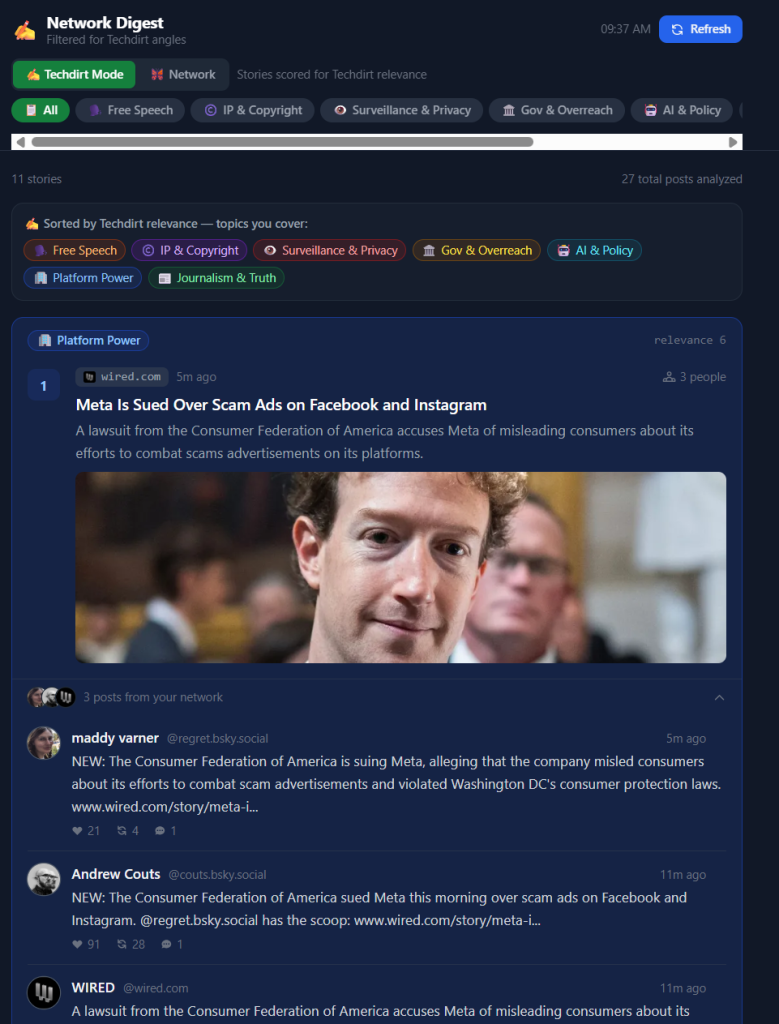
But using an AI tool, I had built an entirely personalized news aggregator, which had access to my Bluesky account, Techdirt’s RSS feed, and the knowledge that I had been out all day and wanted not just a summary of what news might be interesting to me as the editor of Techdirt, but also what people on Bluesky were saying about it. Here’s a screenshot of what my first attempt at this looks like:
The tool that let me do this is an advanced version of Attie, which I also recognize is extremely controversial among users on Bluesky, many of whom vocally have expressed their hatred of the very idea of it when it was announced last month. But, my main interest is in figuring out to empower users who want to take control over their own social experience, and this seems like a clear example of that. I’ll note that this version of Attie has not yet rolled out to most of the beta testers (I believe some have access to it — but this is one small benefit of being on the board).
Honestly, I think the way Bluesky announced Attie may have done it an injustice, positioning it as a kind of AI-powered feed generator. There are multiple other feed generator tools for Bluesky out there, many of which are really fantastic. For a while now I’ve used both Graze.social and Surf.social to make AI-powered feeds (which never seemed to generate much controversy).
But generating feeds alone isn’t all that interesting. With the more advanced version of Attie, I can take much more control over my entire social experience. The fact that with a single prompt I could build that personalized aggregator (based not just on my own feed, but Techdirt’s RSS) is something more powerful, including the fact that the tool knows to summarize a whole days’ worth of posts, because I’m trying to see in a glance if there’s anything relevant for Techdirt and I’d been offline the entire day.
Rather than just letting a single company (in this case Bluesky) define my entire experience for me, I can vibe-code my social experience. I can tell it not just the types of content I want to see, but how I want to see it. And for what reason. And how much (or how little) content to show me. And with what context around it. It’s all based on what I expressly want. Not what any company thinks I want.
Advertisement
And I keep experimenting with other versions of this as well. In one test, I had it also try to summarize stories and tell me why it thought I’d find them useful for Techdirt:
In this case it not only found a story that is interesting to me, but it suggested multiple sources for me to read about it, even noting (for example) that Professor Eric Goldman’s blog post is “the definitive blog post” for my coverage (it’s not wrong).
I go back to the piece I wrote a little while back about the kind of learned helplessness of social media users. We’ve had two decades of billionaires deciding exactly how they wanted to intermediate your social experience. How your feed looks. What kind of algorithm you’ll see. What sorts of content will be put in your feed. They got to focus on engagement maxxing. You just had to deal with it.
In such a world, the only thing users felt they could do in response was to yell. They could yell at the CEOs of these platforms. Or at the government, telling them to yell at the CEOs of these platforms.
But with an AI tool that explores an open social ecosystem, you don’t need to yell at a CEO or a regulator. You can just tell the tool what you want, what you don’t want, how you want (or don’t want) to see it, and what context would be useful. It puts you in control.
Advertisement
And yes, sometimes it makes mistakes. It can recommend a story I’m not interested in. But, then I can just tell it that such and such story isn’t useful and why… and it will update the system for me.
Once again, I understand that some people hate any and all uses of AI. And I’m not suggesting you have to run out and use the tools yourself. You do you. But showing concrete use cases where these tools actually deliver more user agency — more control over your online environment, rather than deferring to the whims of any particular company — matters.
The larger point here isn’t really about Attie specifically (indeed, anyone could build their own version of this thanks to open protocols). It’s that for two decades, users have been trained to believe their only options are to accept whatever a platform gives them, or yell loudly enough that someone powerful might change it. That’s the learned helplessness I wrote about earlier, and it’s corrosive.
Tools like this — built on open protocols, not locked inside a corporate walled garden — represent a different path. One where you don’t petition a billionaire for a better feed algorithm. You don’t petition the government to try to put time limits on social media. You just build the experience you want. You tell it to make you a better interface that matches what you want. You tell it you don’t want to spend that much time. That’s what “protocols, not platforms” actually looks like in practice, helped along by agentic tools, and it’s why I think this matters well beyond whether any particular AI tool is good or not.
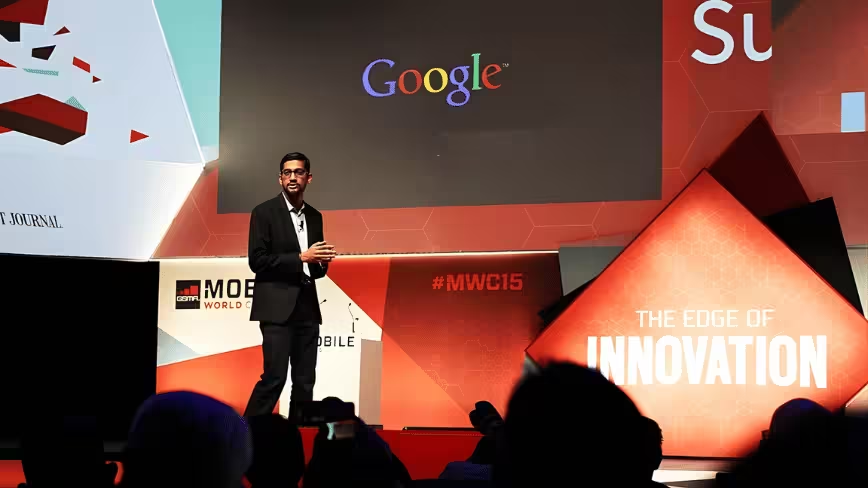
Summary: Sundar Pichai opened Cloud Next 2026 with Google Cloud at $70 billion in annual revenue, 48% growth, a $240 billion backlog that doubled in a year, and $175-185 billion in planned capital expenditure. The Gemini app has 750 million monthly users, AI Overviews reach two billion, and the Gemini API processed 85 billion requests in January alone. Pichai framed the conference around Search evolving from a retrieval engine into an “agent manager” and announced the Universal Commerce Protocol with Shopify, Target, and Walmart, while positioning Google’s full-stack integration from custom silicon to consumer distribution as the advantage competitors cannot replicate.
Sundar Pichai opened Google Cloud Next 2026 on Tuesday with a set of numbers that reframe the competitive dynamics of enterprise AI. Google Cloud is now generating more than $70 billion in annual revenue, growing at 48% year on year, with a backlog of $240 billion, up 55% and more than double the roughly $155 billion of a year ago. The number of billion-dollar deals Google Cloud signed in 2025 exceeded the combined total of the three previous years. Existing customers are outpacing their own commitments by 30%, spending faster than they contracted. Google has committed $175 billion to $185 billion in capital expenditure for 2026, nearly doubling the $91.4 billion it spent last year. Pichai described the moment as “a fundamental rewiring of technology and an accelerant of human ingenuity.” The money suggests he may not be exaggerating.
The keynote, titled “The Agentic Cloud,” was less a product launch than a thesis statement. Google is positioning itself not as a cloud provider that offers AI but as the operating system for what it calls the agentic enterprise: a model in which AI agents handle routine business operations autonomously, communicate with each other across platforms, and interact with the physical world through commerce, search, and real-time data. The pitch is that Google is the only company that controls every layer of that stack, from the custom silicon that runs inference, to the frontier models that power reasoning, to the cloud platform that hosts the agents, to the productivity suite and search engine through which three billion users interact with them.
The scale of the machine
The Gemini app has reached 750 million monthly active users as of the fourth quarter of 2025, up 100 million from the previous quarter. AI Overviews, Google’s AI-generated search summaries, reach two billion monthly users across more than 200 countries and drive 10% more search queries globally. AI Overviews now trigger on approximately 48% of all tracked queries, up from 31% in February 2025, a 58% increase in a year. The Gemini API processed 85 billion requests in January 2026, a 142% increase from 35 billion in March 2025. Eight million paid Gemini Enterprise seats are deployed across 2,800 companies. Thirteen million developers are building with Google’s generative models. Gemini 3 Pro has had, in Pichai’s words, “the fastest adoption of any model in our history.”
Advertisement
These are not cloud metrics. They are platform metrics. Google is arguing that its advantage over AWS, Azure, OpenAI, and Anthropic lies not in any single product but in the fact that it reaches more users, processes more queries, and touches more surfaces than any competitor. Search alone handles more than a billion shopping interactions per day. Workspace has more than three billion users. Android runs on billions of devices. The thesis is that when AI agents become the primary interface for work and commerce, the company with the largest existing surface area wins, because the agents need somewhere to run, something to connect to, and someone to serve.
Pichai’s most consequential framing may have come in a podcast appearance earlier this month: “A lot of what are just information-seeking queries will be agentic in Search. You’ll be completing tasks. You’ll have many threads running.” He described Search evolving from a retrieval engine into an “agent manager,” an orchestration layer that dispatches AI agents to complete tasks on a user’s behalf rather than returning a list of links.
The infrastructure for this is already being built. Google announced the Universal Commerce Protocol at NRF in January, an open-source standard foragentic commerceco-developed with Shopify, Etsy, Wayfair, Target, and Walmart. More than 20 partners have endorsed it, including Adyen, American Express, Best Buy, Flipkart, Macy’s, Mastercard, Stripe, The Home Depot, Visa, and Zalando. UCP is built on REST and JSON-RPC transports with the Agent2Agent protocol, Model Context Protocol, and a new Agent Payments Protocol built in. It lets AI agents treat any participating store as a programmable service, with the merchant remaining the merchant of record. Pichai, who described himself as “an indecisive shopper,” said he is “looking forward to the day when agents can help me get from discovery to purchase.”
The implications for the advertising industry are significant. If Search shifts from showing links that users click to dispatching agents that complete purchases, the entire cost-per-click model that funds Google’s advertising business, and by extension the businesses of every company that advertises on Google, changes.Retailers are already deploying AI-powered shoppingthrough Gemini, ChatGPT, and Copilot. The question is whether agentic commerce cannibalises Google’s own advertising revenue or whether Google can capture a larger share of the transaction itself. UCP suggests Google is betting on the latter.
The full-stack argument
The competitive positioning at Cloud Next was unusually direct. Thomas Kurian said competitors are “handing you the pieces, not the platform,” leaving enterprise teams to integrate components themselves. The claim rests on Google’s vertical integration: Ironwood TPUs and the forthcoming eighth-generation split into Broadcom-designed training chips and MediaTek-designed inference chips provide the silicon. Gemini 3 Pro, 3 Flash, and 3.1 Pro provide the models. The Gemini Enterprise Agent Platform, formerly Vertex AI, provides the developer tools and runtime. Workspace Studio provides the no-code agent builder. Search and Android provide the consumer distribution. No other company assembles all of these under one roof.
Advertisement
The argument has a specific target:Microsoft Copilot, which despite being embedded in virtually every Fortune 500 company has struggled with adoption. Only 3.3% of Microsoft 365 users with Copilot access actually pay for it, and its accuracy net promoter score deteriorated to negative 24.1 by September 2025. Google’s eight million paid Gemini Enterprise seats in roughly four months represents a faster trajectory, though from a much smaller base.GitHub has frozen new Copilot sign-upsbecause agentic coding sessions consume more compute than users pay for, illustrating why owning the silicon layer, as Google does, is not just a technical advantage but an economic one.
The capital question
The $175 billion to $185 billion in planned capital expenditure is the number that makes the rest of the strategy credible or alarming, depending on how the next two years unfold. Roughly 60% goes to servers and 40% to data centres and networking equipment. Combined with Microsoft, Meta, and Amazon, total big tech AI infrastructure spending isapproaching $700 billion this year, a figure large enough to reshape energy markets and strain power grids. Pichai acknowledged on the fourth-quarter earnings call that the “top question is definitely around compute capacity and all the constraints, be it power, land, supply chain,” and expects Google to remain supply-constrained through 2026.
The backlog provides the justification. At $240 billion, it represents more than three years of current revenue contracted but not yet delivered. Thirteen product lines each generate more than $1 billion in annual revenue. The ServiceNow deal alone was worth $1.2 billion over five years. If the demand is real, and the backlog suggests it is, then the capital expenditure is not a gamble but an obligation: the cost of building the infrastructure to fulfil commitments already made.
Google Cloud holds roughly 11% of the cloud infrastructure market, behind AWS at 31% and Azure at 25%. The gap has narrowed: Google grew at 48% in the fourth quarter of 2025, the fastest of the three, and achieved sustained profitability for the first time. But the gap remains. What Pichai presented at Cloud Next is not a plan to close that gap through incremental cloud sales. It is a plan to redefine what the cloud is, from a place where companies store data and run workloads to a platform where AI agents perform work, make decisions, complete purchases, and coordinate with each other across organisational boundaries. If that transition happens, the company that built the agents, the models, the chips, the protocols, and the distribution channels stands to capture a share of the value that the current market share numbers do not reflect. That is the bet. Cloud Next 2026 is the moment Google made it explicit.
For decades, playing a video game was like following someone’s elaborate script. Every character and branching path was meticulously created by a developer. While impressive, these environments were ultimately finite and predictable. They had boundaries, not just on the map, but in their very code. Modern reality has changed it. Artificial intelligence is transforming the virtual world from static landscapes to dynamic systems with no pre-written steps. The gaming environment is becoming smart, and the players enjoy total immersion and engagement in the process.
Beyond the script: creating characters that think
The most noticeable impact of AI falls on the inhabitants of these virtual worlds, Non-Player Characters (NPCs). We’ve all seen a classic city guard who repeats the same line of dialogue endlessly or an enemy running along a predictable path. Modern AI leaves these simplistic automatons behind.
Instead of a rigid script, today’s NPCs perceive and react to the world around them. They utilize complex algorithms to navigate difficult environments, find cover, or coordinate group attacks. More impressively, they learn from player behavior. Imagine an enemy that notices you always use stealth and begins setting traps. This creates a much more engaging experience, the world feels less like programmed challenges and more like intelligent agents with their own goals.
Dynamic pathfinding: Characters don’t follow predefined routes. They can analyze the environment in real time and figure out the best way to the destination point. Remarkably, they cope with that even if the terrain changes suddenly.
Behavioral trees: Developers apply complex decision-making models. This allows NPCs to choose from a wide range of actions based on current situations, making them highly unpredictable.
Machine learning: Some advanced systems train NPCs by having them observe human players. This allows them to adopt effective strategies that a developer might never have programmed manually.
Worlds without end: the magic of procedural generation
Creating a whole world where gamers will learn to survive takes much time and effort. Building every tree or mountain manually is a rigorous task. AI-driven Procedural Content Generation (PCG) turns out to be a solution here. Designers, technical artists, and engineers use the PCG as a toolset of helpful components. The framework creates game content automatically and generates believable environments.
AI technologies allow designers to avoid manually scattering random trees if they need to depict a credible forest landscape. Instead, the AI algorithm learns the rules of a forest ecosystem. The combination of realistic views and the engineer’s initial intent in the setting captures players and makes them enjoy the game. For example, No Man’s Sky used PCG to create a virtual galaxy with billions of planets. Planets have their unique flora and fauna. Players can fight with alien species or trade with them to get necessary resources or equipment. The game fosters a sense of exploration and impresses with its scale. The future of AI in GameDev lies in this ability to create believable worlds.
Advertisement
A game that knows you: the personalized experience
It is interesting to play a game as long as it is unpredictable. AI allows for tailoring playing experiences to individuals. This is possible due to the AI analyzing the skill levels, performance, and preferences of players. The game adapts to your style of playing and makes subtle adjustments to the game in real time. This is far more than just a simple “easy, normal, hard” difficulty setting.
Dynamic difficulty adjustment: The system detects your performance and adjusts the game levels accordingly. For example, it might slightly reduce enemy numbers or provide more resources. Vice versa, if you’re doing well, the algorithm keeps the challenge.
Personalized content: It’s great to know your decisions impact the storyline of the game. AI might notice you prefer a certain weapon type and start dropping more powerful versions of it. In narrative games, it can alter future plot points based on the choices and emotional reactions it observes from the player. Besides, the system might adapt in-game rewards to players’ preferences. For example, you can receive new gear, abilities, or characters.
Social customization: AI may suggest players with the same skill levels to keep the competitive environment. At the same time, it may also offer personalized NPCs, which adds to the general immersive experience.
Conclusion
To summarize what was mentioned before, AI allows for never having the same gaming experience twice. This makes gameplay exciting for gamers, yet the development process becomes challenging and demands high competence from the specialists. Therefore, game studios partner with a specialized AI development company in the United States to create unforgettable playing grounds. And the amazing news is that it is only the beginning. AI continues to develop and inspire improvements in all the spheres where it is applied.
Whether you are in the cyber field or not, skills in security have a range of benefits that can empower virtually every career.
The cybersecurity space is endlessly evolving as new technologies, protocols and systems demand heightened security measures. Unfortunately, malicious people can circumvent cybersecurity tech almost as quickly as it is invented, so it takes time and commitment to stay on top of skills in this space.
Upskilling in cybersecurity shouldn’t cost an arm and a leg, nor should it be inconvenient to your day-to-day life. With that in mind, SiliconRepublic.com has created a list of some of the most interesting cybersecurity courses designed to suit almost every lifestyle and budget, whether you are a novice, a student or a veteran professional.
Cisco Networking Academy
Cisco Networking Academy is running an Introduction to Cybersecurity course. The free, six-hour, self-paced course covers the basics and aims to give students and professionals the skills needed to protect their personal digital life and gain insights into the biggest security challenges facing companies, governments and educational institutions. There is also a paid option that is instructor-led and may be better suited to a student or professional looking for additional structure.
Advertisement
There is also a three-hour Cybersecurity Landscape course that will give learners a greater understanding of cybersecurity core concepts, risk management and what it takes to develop a career as a SOC analyst. The academy noted that this is the first course in its Cybersecurity Defense Analyst Career path.
Coursera
Education platform Coursera has dozens of free, inexpensive and slightly more pricey courses open to professionals and students looking to advance their cybersecurity knowledge. For example, there is a CompTIA Security course for people at an intermediate level. At 10 hours a week, the flexible course roughly takes two weeks to complete, enrollment is free and areas covered include cyberthreat intelligence, incident response, risk management, governance and cryptography, among others.
There is also a Certified Cloud Security Professional course. Similarly it is for people at an intermediate level, can be undertaken in 10 weeks and is free to take part in. Skills gained from the various modules include, IT security architecture, cloud technologies, cybersecurity, computer science and encryption.
There are also a range of options that, if you are unsure about what you are looking for, offer free trials. Consider courses such as Introduction to Cybersecurity Essentials, Google Cybersecurity, IBM Cybersecurity Analyst and Cybersecurity for Everyone.
Advertisement
EdX
Learning resource EdX has plenty of courses for cybersecurity students to avail of, including an IBM Beginners Guide to Cybersecurity course, Cybersecurity Basics: Tools and Cyberattacks course and the Launch your Cybersecurity Career course.
Advanced professionals have options such as Cybersecurity Fundamentals and Cybersecurity Risk Management. Both courses take eight weeks on average to complete, with a commitment of roughly 10 to 12 hours per week and come with a certificate to show you are now qualified, provided you pass the course.
TryHackMe
TryHackMe is a gamified, hands-on cybersecurity training platform designed for people of all skill levels. The browser-based resource offers users guides, challenges and learning content for complete beginners as well as seasoned hackers.
Students and professionals can enroll in programmes such as Cyber Security 101, Pre Security, Jr Penetration Tester, Soc Level 1, Web Fundamentals and AI Security among others. Many of the initial courses are free and for more advanced options there are monthly payment options. Users can also benefit from a wide community of peers with a common interest and take part in group challenges to advance skills and knowledge.
Advertisement
Udemy
Educational platform Udemy has a plethora of learning opportunities. The Stay Secure: Modern Information Security Awareness course can help users learn cybersecurity skills to prevent cyberthreats, avoid phishing scams, strengthen passwords and stay safe online. The course is for beginners, is free and consists of 15 lectures.
There is also an SOC Analyst Essentials: Introduction to Cybersecurity programme, where learners explore SOC basics, cybersecurity tools, threat detection, malware analysis and core skills for aspiring SOC analysts. There are 20 lectures and will take, on average, an hour and a half to complete.
Additional courses include Cybersecurity Defence Fundamentals Encryption and OS Security, Cybersecurity Fundamentals: Don’t get Hacked, and Cybersecurity at Work: Stay Safe Online For Employees.
Don’t miss out on the knowledge you need to succeed. Sign up for the Daily Brief, Silicon Republic’s digest of need-to-know sci-tech news.
The Samsung Galaxy A57 5G nails the basics with a slim, premium-feeling design, a bright 6.7-inch AMOLED display and dependable all-round performance for everyday use. Its weak points are easier to forgive at this price, but middling cameras, average battery life and a steep jump for extra storage stop it from being a true standout.
Lightweight and thin design for a phone of its size
Brilliant, big display that’s great for media
IP68 water and dust resistance
Fingerprint sensor is slow and unreliable
Battery life not as strong as expected
Not the smoothest, fastest performance around
A bump in storage costs a fortune
Key Features
Advertisement
Review Price:
£529
Slim, lightweight build
Advertisement
The Galaxy A57 measures in at 6.9mm thick and just 179g, an impressive combination considering its large screen.
Premium-looking screen
Advertisement
The 6.7-inch AMOLED screen looks more premium than ever, with slimmed down, (nearly) symmetrical bezels.
Full dust and water resistance
Advertisement
The Galaxy A57 is the first in Samsung’s A-series to offer full IP68 dust and water resistance.
Introduction
For the right person, a mid-range phone can be the perfect balance of features and cost. It’s a delicate balance, because you’ll inevitably lose out on something when you compare it to more expensive phones.
Samsung walks that tightrope every year, focusing on a couple of key parts of the experience while compromising on a few others to bring the price down to a more palatable level.
Advertisement
The Samsung Galaxy A57 is the latest in a long line of mid-market phones, and while not perfect, it hits the mark in a few areas. Let’s get into it.
Advertisement
Design
Premium metal and glass build stands out
Lightweight design
A bit of a fingerprint magnet
There are both good and bad elements in the design department, but for the most part, the A57 does a really good job of disguising the fact that it’s not one of the more expensive phones. There’s no plastic to be found anywhere, with both front and back adorned with Gorilla Glass Victus+.
Image Credit (Trusted Reviews)
I really like how Samsung’s played with glass finishes to add some visual contrast. The dark, glossy back plays off nicely with the slightly opaque, frosted finish on the camera island, making it look better than the more expensive Galaxy S series in some ways.
Image Credit (Trusted Reviews)
Advertisement
At least, it is until you actually pick it up and use it, because that glossy, dark finish on the back is a proper fingerprint magnet. One touch, and smears will appear. It’s the reason so many more expensive phones now use a frosted, matte glass finish. This tends to hide fingerprints much better. Perhaps then, a case of giving with one hand and taking away with the other.
Image Credit (Trusted Reviews)
It’s a similar thought when looking at the aluminium frame and the front of the phone. Because I do really like that raised area on the right edge where the volume and side buttons live. It makes that aluminium edge less boring somehow, but then, there’s a bit of a chin in the bezel, where Samsung hasn’t quite managed to give us a uniform bezel on all four sides and corners around the display.
Still, it comes across as a well-thought-through and purposeful design. The thing I noticed first when I unboxed it was how thin and lightweight it seemed. For a phone with such a large display, it has a nimbleness that belies the numbers on a spec sheet. Still, it’s slightly thinner and lighter than the Galaxy S26 Plus, and considerably more so than the Galaxy S26 Ultra.
Advertisement
Image Credit (Trusted Reviews)
It’s obviously still a way off being as skinny as the S25 Edge, but at the same time, when you realise it’s packed in a battery that’s the same capacity as the larger and heavier S26 Ultra, it’s impossible not to be impressed.
Advertisement
It shares the same water and dust resistance rating as its more expensive cousins too. So if you happen to like walks in the rain, it should cope just fine.
Display
6.7-inch 120Hz AMOLED display
A fantastic panel for the price
Optical fingerprint sensor is hit-and-miss
Just like its design and build, the display is a highlight on the A57. Using it to watch movies or game on, I was never left with a sense that I was using an inferior display, even though technically I was.
Image Credit (Trusted Reviews)
It doesn’t quite reach the same brightness levels of the S26 series, but it’s still very bright, vivid and colour-rich, making it a joy to stream videos and get hooked into social media feeds on. The fact that it’s 6.7 inches diagonally helps too. It’s an expansive canvas with few noticeable weaknesses.
Any weaknesses it does have only show in other areas. As an example, it can hit 120Hz refresh rates, meaning it can ramp up to be super smooth and sharp, even with quick animations. However, because it’s not an LTPO panel, it can’t adapt those refresh rates at small 1Hz increments like the top-tier phones.
Advertisement
Advertisement
Image Credit (Trusted Reviews)
You might not notice it at all while watching video or even gaming, but you might notice it when moving quickly from a static page to a moving one. Like when you swipe quickly to go to the Home Screen from a browser page. Going from not moving, to moving, the display often leads to the odd frame drop and stuttering animation. It’s not horrendous, and maybe not even noticeable if you’re not used to the most premium devices on the market.
This lack of ultra-adaptive refresh rate also affects the battery life. But I’ll get more into that later on. The short version of that takeaway is that the less efficient display means that if you use your phone a lot, you’ll drain the battery faster than you would with a more expensive Galaxy S-series phone.
Image Credit (Trusted Reviews)
One other weakness in the display has nothing to do with the display itself, but rather with the fingerprint sensor built into it. Unlike the more premium models, it doesn’t have an ultrasonic sensor, but uses an optical one. And it’s not a great optical sensor, in my experience. It takes a comparatively long time to set up, and you have to hold your finger on it for a second or two before it registers. Plus, in my experience, the first attempt fails fairly frequently.
There’s a possibility I’ve just become too accustomed to the high-end ultrasonic scanners on more premium devices, but I’ve also used mid-range devices with optical scanners that aren’t as slow and finicky as this one.
Advertisement
Image Credit (Trusted Reviews)
Despite the minor compromises, however, I will say this: if your time is spent mostly on social media, YouTube and video watching or casual games, I think you’ll struggle to find a better display than the A57’s for that. It’s a really wonderful canvas for just about everything.
Software
OneUI 8.5 based on Android 16
Smattering of AI features, but not full Galaxy AI support
Six years of OS upgrades
There’s not a huge amount to cover on the software side that hasn’t already been addressed in our other recent Samsung reviews. The One UI 8.5 version of Samsung’s Android skin is largely the same as what you’ll find on the Galaxy S26 series.
Image Credit (Trusted Reviews)
That includes a smattering of AI features built into apps like the Gallery app for editing photos using voice dictation, or getting Bixby (Samsung’s oft-neglected built-in assistant) to change your phone settings for you.
Advertisement
Advertisement
It does lack some of the features that require more power, though. You’re not going to get DeX, Samsung’s desktop-like interface for external monitors, as an example. The more proactive and pervasive system-wide AI features are also missing. Elements like ‘Now Nudge’ can remind you of upcoming appointments, but they lack the agentic feel of the built-in AI tools.
Image Credit (Trusted Reviews)
Cameras
Three cameras, but includes a junk macro lens
Solid performance, but can struggle with HDR processing
No telephoto lens for zoom, but digital zoom is solid
It’s in the camera department that you start to see the obvious signs that we’re dealing with a mid-range phone. There are three cameras, as is fairly typical, but one of those is a low-resolution macro camera, which effectively acts as a backup lens for close-up photography. You do get an ultrawide lens as well as the main camera, alongside that macro camera.
Image Credit (Trusted Reviews)
How well this camera serves you will likely depend on when you usually take photos, and in what conditions. Outside in bright daylight, it does a pretty good job of delivering sharp, bright and vibrant photographs.
Advertisement
There’s a little over-sharpening and contrast boosting in the processing that makes images ‘pop’ on screen. Being critical, it can often appear overexposed, particularly in the brighter parts of the image, but that’s being quite nitpicky.
It struggles at times with scenes where there’s bright backlighting and HDR needs to kick in, often leaving the shadowed foreground object a little too dark. On that note, there are times when shadowed areas in not-so-well-lit indoor scenes, or even grey clouds in the skies, can be a little grainy and noisy.
Advertisement
One of the plus points is that the main sensor is large enough and pixel dense enough that you can punch in to 2x zoom and still get a pretty decent image that doesn’t obviously lack in sharpness.
It makes up for the lack of a dedicated zoom camera slightly, but putting it side-by-side with the Galaxy S26, with its 3x zoom camera, the A57 does struggle with anything beyond 2x zoom. Image quality falls away quite rapidly once you go above that 2x mark and, in my testing, really not worth going anywhere beyond 5x zoom.
Advertisement
Indoors, away from super bright light sources, it does a decent job of capturing colour and detail. You will probably start seeing that aforementioned noise and grain in darker parts of the image, and see the camera struggle a bit with focusing, especially moving objects like Richard Parker – my pet cat.
Advertisement
At night time, launching into the dedicated night mode can result in some bright, in-focus images. The primary camera is definitely stronger than the ultrawide, which can sometimes struggle to contain details in brighter parts of the image. But it’s hard to be too critical. The important thing to note is that regardless of the conditions, it’s possible to get a good enough image that you’d be happy to share on social media.
Of course, it’s not as strong or versatile as phones that cost twice as much, but as I suspect anyone buying this will be happy enough with the results.
As a video maker, the lack of 4K recording at 60fps was a tad disappointing. Shooting 4K at 30fps is okay, but I often found the footage a little grainy, lacking in sharpness and smoothness. Particularly when panning across a scene, there was some stuttering and a rolling shutter-like effect. Having to jump down to 1080p to get 60fps means you effectively have the choice between sharp footage or smooth footage; you can’t have both. So I’d say it’s definitely not the phone for wannabe content creators.
Performance
Mid-range Exynos 1680 power
Can handle most daily tasks just fine
Not quite powerful enough for high-res gaming
Advertisement
Performance, like cameras, is another area where you’ll see a difference between these mid-range phones and the top-tier models. But, just like the camera department, whether or not it’s got enough juice depends very much on what you do.
Advertisement
For the most part, the experience of using the A57 is fluid and smooth. As mentioned when I was talking about the display, there’s a little bit of stutter and frame-dropping in the user interface when going between static and moving content on screen, but once it’s going, it’s responsive and quick.
Image Credit (Trusted Reviews)
Inside, the phone has the Exynos 1680, which is a very middle-of-the-road type of processor. That said, it’s got enough grunt that it’ll handle most of your casual tasks easily enough.
Casual games aren’t a struggle at all, but I did notice it would often drop the resolution in some games to keep gameplay smooth. Mario Kart Tour, which has long been my go-to game on mobile, didn’t look as sharp as it does on more powerful phones. But, crucially, the gameplay isn’t hampered by frame-dropping at all, and so it feels pretty smooth.
It’s a powerful enough chipset that it can also handle quite a lot of the AI-based tasks on the phone. Using Bixby to call up settings options wasn’t as snappy and instant as the S26, but it wasn’t too much of a hindrance either.
Advertisement
Advertisement
Image Credit (Trusted Reviews)
As is always the case, tempering expectations is advised with performance. You’re not going to be able to play the highest fidelity games in their highest settings. If you did, you’d soon find the phone chugging to a halt. But if your game time mostly involves games like Block Blast, Mario Kart or something more casual, the A57 has more than enough grunt for those.
Battery Life
Same 5000mAh battery as S26 Ultra
One day for most users, but can squeeze more out
Full charge in 75 minutes
Tempering expectations is also advised with the battery. Samsung advertises this phone as having a two-day battery, and whether or not that’s achievable very much depends on your screen time and the type of phone user you are. But, for busy power users, I think you’ll get one full day, not two.
Image Credit (Trusted Reviews)
When the screen’s on, even playing the casual games I mentioned before, the battery seems to drain a little quicker than the more powerful S26 models, even the smallest one, which has a smaller battery. My suspicion is that because it can’t drop as low as 1Hz on static pages, and is at a minimum of 60Hz all the time, it uses a lot more energy to power that display. Especially considering how bright it is.
Advertisement
On my lighter days (I’m a pretty light user already) I could make it last two days. But that’s true of most phones these days. It’s very conservative with battery use in standby mode with the always-on display disabled, so if your screen use is 2-3 hours a day and mostly low-intensity tasks, I think two days might just be possible.
Image Credit (Trusted Reviews)
Charging speeds when empty are fast enough to be convenient, but not market-leading. A full charge takes about 75 minutes, but you can get 50% topped up in 25 minutes in those times when you’ve run empty and you’re in a rush to get out again. You just need to make sure you have a compatible 45W charger to get those speeds.
Should you buy it?
You want a premium-feeling mid-ranger
Advertisement
With its combination of aluminium frame and glass rear, the A57 5G doesn’t feel as cheap as most mid-range phones.
Advertisement
You want great performance
The Exynos chipset inside the A57 is fine for day-to-day tasks, but it can’t compete with the most powerful mid-rangers around.
Advertisement
Final Thoughts
On the whole, Samsung’s Galaxy A57 shares many of the same strengths as previous models. It’s a capable phone with a brilliant display built into a big phone that’s remarkably lightweight and thin-feeling.
Any compromises, like imperfect cameras, performance and battery life, are largely expected at this price point. Costing just over £/$500 for the base model is about on par with what you’d expect for this phone from Samsung.
What’s a little harder to accept is that if you want more storage than the 256GB base model, you’re going to need nearly £/$200 more to get it. And at that price, you can get a much better phone from just about anyone.
Advertisement
Advertisement
How We Test
We test every mobile phone we review thoroughly. We use industry-standard tests to compare features properly and we use the phone as our main device over the review period. We’ll always tell you what we find and we never, ever, accept money to review a product.
Used as a main phone for over a week
Thorough camera testing in a variety of conditions
Tested and benchmarked using respected industry tests and real-world data
FAQs
How many OS upgrades will the Galaxy A57 get?
Samsung has committed to six years of OS upgrades and security patches.
Does the Samsung Galaxy A57 come with a charger?
Advertisement
No, despite offering 45W fast charge support, you won’t get a charging brick in the box in most regions.
Engineers took the existing flagship and completely overhauled it to create the 2027 BMW i7, which uses the brains and brawn from BMW’s most recent electric vehicles. This resulted in two all-wheel drive versions that will roll into showrooms late next year, with production kicking off this July at the German factory in Dingolfing.
Designers gave the front end a nip and tuck, as the kidney grille is now thinner and illuminated with beautiful clean LED strips, while the headlights now form a single neat band across the front; the actual beams are now tucked away lower in the bumper to keep things appearing minimalist. You can still get the sleek crystal lenses if you want to add some sparkle when the lights come on. Meanwhile, at the back, the taillights are zipped in tighter towards the middle and have a smoked finish to sharpen the overall look, and just for fun, there’s a new light bar that projects animated patterns onto the ground beside the doors when you’re getting in or out, using a tidy 200K pixels and available in three moods.
BMW MODEL CAR KIT – Racing enthusiasts can fuel their imaginations with the LEGO Technic BMW M4 GT3 EVO Race Car (42226) building set for boys and…
AUTHENTIC DETAILS – This race car playset features iconic BMW detailing and is equipped with a working steering function, a detailed 6-cylinder…
BUILD, PLAY & DISPLAY – Kids can enjoy assembling their model car and racing it down an imaginary track, then display it on a shelf or table to…
All models now have dual motors, with the base i7 50 xDrive producing 449 horsepower and accelerating from 0 to 60 in 5.3 seconds while reaching 130 mph. If you want a little more power, the i7 60 xDrive is the way to go, with 536 horsepower under the hood and a 0-60 time of 4.6 seconds; it is also electronically limited to 149 mph. Both versions employ cutting-edge motor technology that eliminates the need for rare earth magnets and is combined with silicon-carbide inverters to provide the smoothest, quietest ride imaginable.
The battery size is approximately 113 kilowatt-hours, thanks to the new sixth-generation cylindrical cells, which pack 20% more energy into the same space as previously. The top model can now travel over 350 miles on a full charge, which is a significant improvement over the previous model. To make things even better, the engineers reduced the wiring weight by 30% and shortened the harness by 2,000 feet using the new zonal electrical setup, which feeds a central computer with twenty times the processing power. That extra brain aids with over-the-air upgrades and smarter route planning, which automatically includes charging stops and heats the battery in advance.
Advertisement
Charging can get you to 80% in 28 minutes if you plug into a compatible station, and every car has a North American Charging Standard (NACS) port built right in, so you don’t need a special adapter for that. The regenerative braking system is quite sophisticated, as it determines how much energy to take back in based on what you’re doing, traffic lights, and traffic circumstances, resulting in that pleasant one-pedal feel when you want to slow down.
Step inside, and all of the information you need appears instantaneously on the long glass strip of screen that runs pillar to pillar at the base of the windshield. Speed, range, and navigation are right in front of you, in your natural sight line, while the media and AI’s avatar hang out above the new 17.9-inch touchscreen in the center. The front passenger has access to a 14.6-inch screen for personal enjoyment while driving. And in the back, those who want to go all out may purchase an optional 31.3-inch movie screen that descends down from the roof with 8K quality, as well as a built-in camera for video conversations, streaming, and games to play while parked. Music enthusiasts can select an audio system with up to thirty-six speakers that are fully calibrated for the immersive Dolby Atmos experience.
The seats are still extremely luxurious, and for those seeking even greater comfort, there are executive lounge chairs and footrests that can even slide out of the seat in front. Materials such as leather, wood, crystal, and metal combine to create a warm and inviting atmosphere. Four-zone climate control and a panoramic glass roof are standard features, and adaptive air suspension with electronic dampers ensures a smooth ride regardless of the road conditions. Furthermore, twenty-two inch wheels are available as an option, a fresh new dimension not before provided on this model.
Prices begin at roughly $106,200 for the i7 50 xDrive and $124,700 for the i7 60 xDrive before destination fees, and you know what? That’s not a bad deal, especially given the additional technology and range. With these changes, the already fantastic luxury electric vehicle just became even better, as you can now travel even longer on a single charge, charge up much faster when you need to stop, and with all of the screens and sound, every mile seems like a great treat.
Apple has released updates for iOS 26.4.2 and iPadOS 26.4.2, as well as version 18.7.8 for older devices, providing bug fixes and security updates to all users.
Apple’s new update can be applied to all current-gen iPhones.
Incremental updates for Apple’s operating systems provide some much-needed bug fixes, security updates, and performance improvements between major updates. On Wednesday, Apple issued the second incremental update of version 26.4, bringing iOS and iPadOS up to 26.4.2. The previous incremental update, for iOS 26.4.1 and iPadOS 16.4.2, landed on April 8. Continue Reading on AppleInsider | Discuss on our Forums
Google announced two new tensor processing units (TPUs) for the “agentic era,” with separate processors dedicated to training and inference. “With the rise of AI agents, we determined the community would benefit from chips individually specialized to the needs of training and serving,” Amin Vahdat, a Google senior vice president and chief technologist for AI and infrastructure, said in a blog post. Both chips will become available later this year. CNBC reports: After years of producing chips that can both train artificial intelligence models and handle inference work, Google is separating those tasks into distinct processors, its latest effort to take on Nvidia in AI hardware. […] None of the tech giants are displacing Nvidia, and Google isn’t even comparing the performance of its new chips with those from the AI chip leader. Google did say the training chip enables 2.8 times the performance of the seventh-generation Ironwood TPU, announced in November, for the same price, while performance is 80% better for the inference processor.
Nvidia said its upcoming Groq 3 LPU hardware will draw on large quantities of static random-access memory, or SRAM, which is used by Cerebras, an AI chipmaker that filed to go public earlier this month. Google’s new inference chip, dubbed TPU 8i, also relies on SRAM. Each chip contains 384 megabytes of SRAM, triple the amount in Ironwood. The architecture is designed “to deliver the massive throughput and low latency needed to concurrently run millions of agents cost-effectively,” Sundar Pichai, CEO of Google parent Alphabet, wrote in a blog post.


































































You must be logged in to post a comment Login