Connect with us
DAPA Banner

Tech

Nvidia launches enterprise AI agent platform with Adobe, Salesforce, SAP among 17 adopters at GTC 2026

Published

on

Jensen Huang walked onto the GTC stage Monday wearing his trademark leather jacket and carrying, as it turned out, the blueprints for a new kind of monopoly.

The Nvidia CEO unveiled the Agent Toolkit, an open-source platform for building autonomous AI agents, and then rattled off the names of the companies that will use it: Adobe, Salesforce, SAP, ServiceNow, Siemens, CrowdStrike, Atlassian, Cadence, Synopsys, IQVIA, Palantir, Box, Cohesity, Dassault Systèmes, Red Hat, Cisco and Amdocs. Seventeen enterprise software companies, touching virtually every industry and every Fortune 500 corporation, all agreeing to build their next generation of AI products on a shared foundation that Nvidia designed, Nvidia optimizes and Nvidia maintains.

The toolkit provides the models, the runtime, the security framework and the optimization libraries that AI agents need to operate autonomously inside organizations — resolving customer service tickets, designing semiconductors, managing clinical trials, orchestrating marketing campaigns. Each component is open source. Each is optimized for Nvidia hardware. The combination means that as AI agents proliferate across the corporate world, they will generate demand for Nvidia GPUs not because companies choose to buy them but because the software they depend on was engineered to require them.

“The enterprise software industry will evolve into specialized agentic platforms,” Huang told the crowd, “and the IT industry is on the brink of its next great expansion.” What he left unsaid is that Nvidia has just positioned itself as the tollbooth at the entrance to that expansion — open to all, owned by one.

Advertisement

Inside Nvidia’s Agent Toolkit: the software stack designed to power every corporate AI worker

To grasp the significance of Monday’s announcements, it helps to understand the problem Nvidia is solving.

Building an enterprise AI agent today is an exercise in frustration. A company that wants to deploy an autonomous system — one that can, say, monitor a telecommunications network and proactively resolve customer issues before anyone calls to complain — must assemble a language model, a retrieval system, a security layer, an orchestration framework and a runtime environment, typically from different vendors whose products were never designed to work together.

Nvidia’s Agent Toolkit collapses that complexity into a unified platform. It includes Nemotron, a family of open models optimized for agentic reasoning; AI-Q, an open blueprint that lets agents perceive, reason and act on enterprise knowledge; OpenShell, an open-source runtime enforcing policy-based security, network and privacy guardrails; and cuOpt, an optimization skill library. Developers can use the toolkit to create specialized AI agents that act autonomously while using and building other software to complete tasks.

The AI-Q component addresses a pain point that has dogged enterprise AI adoption: cost. Its hybrid architecture routes complex orchestration tasks to frontier models while delegating research tasks to Nemotron’s open models, which Nvidia says can cut query costs by more than 50 percent while maintaining top-tier accuracy. Nvidia used the AI-Q Blueprint to build what it claims is the top-ranking AI agent on both the DeepResearch Bench and DeepResearch Bench II leaderboards — benchmarks that, if they hold under independent validation, position the toolkit as not merely convenient but competitively necessary.

Advertisement

OpenShell tackles what has been the single biggest obstacle in every boardroom conversation about letting AI agents loose inside corporate systems: trust. The runtime creates isolated sandboxes that enforce strict policies around data access, network reach and privacy boundaries. Nvidia is collaborating with Cisco, CrowdStrike, Google, Microsoft Security and TrendAI to integrate OpenShell with their existing security tools — a calculated move that enlists the cybersecurity industry as a validation layer for Nvidia’s approach rather than a competing one.

The partner list that reads like the Fortune 500: who signed on and what they’re building

The breadth of Monday’s enterprise adoption announcements reveals Nvidia’s ambitions more clearly than any specification sheet could.

Adobe, in a simultaneously announced strategic partnership, will adopt Agent Toolkit software as the foundation for running hybrid, long-running creativity, productivity and marketing agents. Shantanu Narayen, Adobe’s chair and CEO, said the companies will bring together “our Firefly models, CUDA libraries into our applications, 3D digital twins for marketing, and Agent Toolkit and Nemotron to our agentic frameworks to deliver high-quality, controllable and enterprise-grade AI workflows of the future.” The partnership extends deep: Adobe will explore OpenShell and Nemotron as foundations for personalized, secure agentic loops, and will evaluate the toolkit for large-scale workflows powered by Adobe Experience Platform. Nvidia will provide engineering expertise, early access to software and targeted go-to-market support.

Salesforce’s integration may be the one enterprise IT leaders parse most carefully. The company is working with Nvidia Agent Toolkit software including Nemotron models, enabling customers to build, customize and deploy AI agents using Agentforce for service, sales and marketing. The collaboration introduces a reference architecture where employees can use Slack as the primary conversational interface and orchestration layer for Agentforce agents — powered by Nvidia infrastructure — that participate directly in business workflows and pull from data stores in both on-premises and cloud environments. For the millions of knowledge workers who already conduct their professional lives inside Slack, this turns a messaging app into the command center for corporate AI.

Advertisement

SAP, whose software underpins the financial and operational plumbing of most Global 2000 companies, is using open Agent Toolkit software including NeMo for enabling AI agents through Joule Studio on SAP Business Technology Platform, enabling customers and partners to design agents tailored to their own business needs. ServiceNow’s Autonomous Workforce of AI Specialists leverage Agent Toolkit software, the AI-Q Blueprint and a combination of closed and open models, including Nemotron and ServiceNow’s own Apriel models — a hybrid approach that suggests the toolkit is designed not to replace existing AI investments but to become the connective tissue between them.

From chip design to clinical trials: how agentic AI is reshaping specialized industries

The partner list extends well beyond horizontal software platforms into deeply specialized verticals where autonomous agents could compress timelines measured in years.

In semiconductor design — where a single advanced chip can cost billions of dollars and take half a decade to develop — three of the four major electronic design automation companies are building agents on Nvidia’s stack. Cadence will leverage Agent Toolkit and Nemotron with its ChipStack AI SuperAgent for semiconductor design and verification. Siemens is launching its Fuse EDA AI Agent, which uses Nemotron to autonomously orchestrate workflows across its entire electronic design automation portfolio, from design conception through manufacturing sign-off. Synopsys is building a multi-agent framework powered by its AgentEngineer technology using Nemotron and Nemo Agent Toolkit.

Healthcare and life sciences present perhaps the most consequential use case. IQVIA is integrating Nemotron and other Agent Toolkit software with IQVIA.ai, a unified agentic AI platform designed to help life sciences organizations work more efficiently across clinical, commercial and real-world operations. The scale is already significant: IQVIA has deployed more than 150 agents across internal teams and client environments, including 19 of the top 20 pharmaceutical companies.

Advertisement

The security sector is embedding itself into the architecture from the ground floor. CrowdStrike unveiled a Secure-by-Design AI Blueprint that embeds its Falcon platform protection directly into Nvidia AI agent architectures — including agents built on AI-Q and OpenShell — and is advancing agentic managed detection and response using Nemotron reasoning models. Cisco AI Defense will provide AI security protection for OpenShell, adding controls and guardrails to govern agent actions. These are not aftermarket bolt-ons; they are foundational integrations that signal the security industry views Nvidia’s agent platform as the substrate it needs to protect.

Dassault Systèmes is exploring Agent Toolkit software and Nemotron for its role-based AI agents, called Virtual Companions, on its 3DEXPERIENCE agentic platform. Atlassian is working with the toolkit as it evolves its Rovo AI agentic strategy for Jira and Confluence. Box is using it to enable enterprise agents to securely execute long-running business processes. Palantir is developing AI agents on Nemotron that run on its sovereign AI Operating System Reference Architecture.

The open-source gambit: why giving software away is Nvidia’s most aggressive business move

There is something almost paradoxical about a company with a multi-trillion-dollar market capitalization giving away its most strategically important software. But Nvidia’s open-source approach to Agent Toolkit is less an act of generosity than a carefully constructed competitive moat.

OpenShell is open source. Nemotron models are open. AI-Q blueprints are publicly available. LangChain, the agent engineering company whose open-source frameworks have been downloaded over 1 billion times, is working with Nvidia to integrate Agent Toolkit components into the LangChain deep agent library for developing advanced, accurate enterprise AI agents at scale. When the most popular independent framework for building AI agents absorbs your toolkit, you have transcended the category of vendor and entered the category of infrastructure.

Advertisement

But openness in AI has a way of being strategically selective. The models are open, but they are optimized for Nvidia’s CUDA libraries — the proprietary software layer that has locked developers into Nvidia GPUs for two decades. The runtime is open, but it integrates most deeply with Nvidia’s security partners. The blueprints are open, but they perform best on Nvidia hardware. Developers can explore Agent Toolkit and OpenShell on build.nvidia.com today, running on inference providers and Nvidia Cloud Partners including Baseten, CoreWeave, DeepInfra, DigitalOcean and others — all of which run Nvidia GPUs.

The strategy has a historical analog in Google’s approach to Android: give away the operating system to ensure that the entire mobile ecosystem generates demand for your core services. Nvidia is giving away the agent operating system to ensure that the entire enterprise AI ecosystem generates demand for its core product — the GPU. Every Salesforce agent running Nemotron, every SAP workflow orchestrated through OpenShell, every Adobe creative pipeline accelerated by CUDA creates another strand of dependency on Nvidia silicon.

This also explains the Nemotron Coalition announced Monday — a global collaboration of model builders including Mistral AI, Cursor, LangChain, Perplexity, Reflection AI, Sarvam and Thinking Machines Lab, all working to advance open frontier models. The coalition’s first project will be a base model codeveloped by Mistral AI and Nvidia, trained on Nvidia DGX Cloud, that will underpin the upcoming Nemotron 4 family. By seeding the open model ecosystem with Nvidia-optimized foundations, the company ensures that even models it does not build will run best on its hardware.

What could go wrong: the risks enterprise buyers should weigh before going all-in

For all the ambition on display Monday, several realities temper the narrative.

Advertisement

Adoption announcements are not deployment announcements. Many of the partner disclosures use carefully hedged language — “exploring,” “evaluating,” “working with” — that is standard in embargoed press releases but should not be confused with production systems serving millions of users. Adobe’s own forward-looking statements note that “due to the non-binding nature of the agreement, there are no assurances that Adobe will successfully negotiate and execute definitive documentation with Nvidia on favorable terms or at all.” The gap between a GTC keynote demonstration and an enterprise-grade rollout remains substantial.

Nvidia is not the only company chasing this market. Microsoft, with its Copilot ecosystem and Azure AI infrastructure, pursues a parallel strategy with the advantage of owning the operating systems and productivity software that most enterprises already use. Google, through Gemini and its cloud platform, has its own agent vision. Amazon, via Bedrock and AWS, is building comparable primitives. The question is not whether enterprise AI agents will be built on some platform but whether the market will consolidate around one stack or fragment across several.

The security claims, while architecturally sound, remain unproven at scale. OpenShell’s policy-based guardrails are a promising design pattern, but autonomous agents operating in complex enterprise environments will inevitably encounter edge cases that no policy framework has anticipated. CrowdStrike’s Secure-by-Design AI Blueprint and Cisco AI Defense’s OpenShell integration are exactly the kind of layered defense enterprise buyers will demand — but both are newly unveiled, not battle-hardened through years of adversarial testing. Deploying agents that can autonomously access data, execute code and interact with production systems introduces a threat surface that the industry has barely begun to map.

And there is the question of whether enterprises are ready for agents at all. The technology may be available, but organizational readiness — the governance structures, the change management, the regulatory frameworks, the human trust — often lags years behind what the platforms can deliver.

Advertisement

Beyond agents: the full scope of what Nvidia announced at GTC 2026

Monday’s Agent Toolkit announcement did not arrive in isolation. It landed amid an avalanche of product launches that, taken together, describe a company remaking itself at every layer of the computing stack.

Nvidia unveiled the Vera Rubin platform — seven new chips in full production, including the Vera CPU purpose-built for agentic AI, the Rubin GPU, and the newly integrated Groq 3 LPU inference accelerator — designed to power every phase of AI from pretraining to real-time agentic inference. The Vera Rubin NVL72 rack integrates 72 Rubin GPUs and 36 Vera CPUs, delivering what Nvidia claims is up to 10x higher inference throughput per watt at one-tenth the cost per token compared with the Blackwell platform. Dynamo 1.0, an open-source inference operating system that Nvidia describes as the “operating system for AI factories,” entered production with adoption from AWS, Microsoft Azure, Google Cloud and Oracle Cloud Infrastructure alongside companies like Cursor, Perplexity, PayPal and Pinterest.

The BlueField-4 STX storage architecture promises up to 5x token throughput for the long-context reasoning that agents demand, with early adopters including CoreWeave, Crusoe, Lambda, Mistral AI and Nebius. BYD, Geely, Isuzu and Nissan announced Level 4 autonomous vehicle programs on Nvidia’s DRIVE Hyperion platform, and Uber disclosed plans to launch Nvidia-powered robotaxis across 28 cities and four continents by 2028, beginning with Los Angeles and San Francisco in the first half of 2027.

Roche, the pharmaceutical giant, announced it is deploying more than 3,500 Nvidia Blackwell GPUs across hybrid cloud and on-premises environments in the U.S. and Europe — what it calls the largest announced GPU footprint available to a pharmaceutical company. Nvidia also launched physical AI tools for healthcare robotics, with CMR Surgical, Johnson & Johnson MedTech and others adopting the platform, and released Open-H, the world’s largest healthcare robotics dataset with over 700 hours of surgical video. And Nvidia even announced a Space Module based on the Vera Rubin architecture, promising to bring data-center-class AI to orbital environments.

Advertisement

The real meaning of GTC 2026: Nvidia is no longer selling picks and shovels

Strip away the product specifications and benchmark claims and what emerges from GTC 2026 is a single, clarifying thesis: Nvidia believes the era of AI agents will be larger than the era of AI models, and it intends to own the platform layer of that transition the way it already owns the hardware layer of the current one.

The 17 enterprise software companies that signed on Monday are making a bet of their own. They are wagering that building on Nvidia’s agent infrastructure will let them move faster than building alone — and that the benefits of a shared platform outweigh the risks of shared dependency. For Salesforce, it means Agentforce agents that can draw from both cloud and on-premises data through a single Slack interface. For Adobe, it means creative AI pipelines that span image, video, 3D and document intelligence. For SAP, it means agents woven into the transactional fabric of global commerce. Each partnership is rational on its own terms. Together, they form something larger: an industry-wide endorsement of Nvidia as the default substrate for enterprise intelligence.

Huang, who opened his career designing graphics chips for video games, closed his keynote by gesturing toward a future in which AI agents do not just assist human workers but operate as autonomous colleagues — reasoning through problems, building their own tools, learning from their mistakes. He compared the moment to the birth of the personal computer, the dawn of the internet, the rise of mobile computing.

Technology executives have a professional obligation to describe every product cycle as a revolution. But here is what made Monday different: this time, 17 of the world’s most important software companies showed up to agree with him. Whether they did so out of conviction or out of a calculated fear of being left behind may be the most important question in enterprise technology — and it is one that only the next few years can answer.

Advertisement

Source link

Continue Reading
Click to comment

You must be logged in to post a comment Login

Leave a Reply

Tech

Samsung 2026 Q-Series Soundbars: Wireless Dolby Atmos, Q-Symphony and SpaceFit for TV and Movies

Published

on

Samsung isn’t chasing the soundbar market; it has effectively been running it for 12 straight years alongside two decades of dominance in global TV sales. The company’s 2026 Q-Series soundbars, the HW-Q990H, HW-Q900H, HW-Q800H, and HW-QS90H, build on that position, with the flagship Q990H and QS90H first previewed at CES 2026 and now joined by the full lineup. Following its latest OLED, Neo QLED, MiniLED, and Frame TV announcements, Samsung is tightening its grip on the TV and home audio ecosystem in one move.

Our Editor at Large Chris Boylan got to spend some quality time with the QS90H and Q990H at Samsung’s US headquarters last month and was impressed by what he saw (and heard).

Samsung Q-Series Soundbars

Samsung HW-Q800H Soundbar Lifestyle

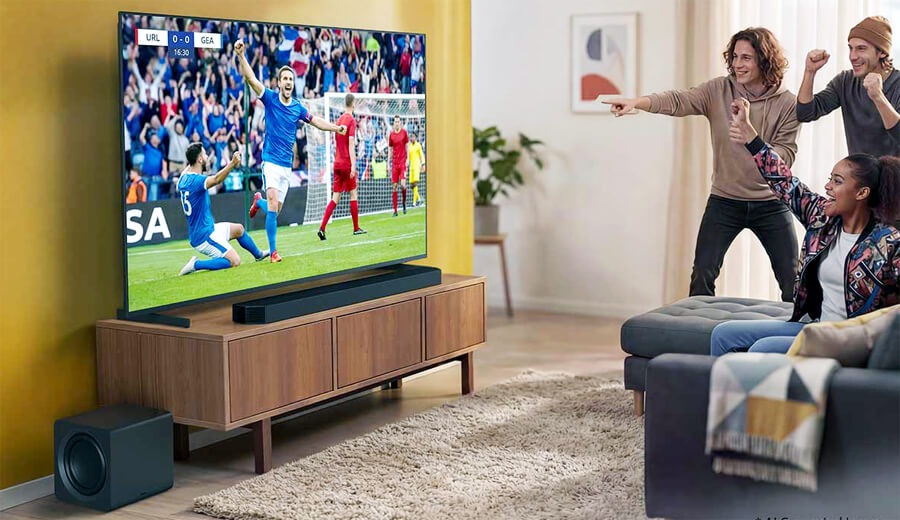
Samsung’s 2026 Q Series soundbars are aimed at anyone who wants a cinematic experience without dealing with an AVR or a room full of wired speakers. The focus here is scale and flexibility, delivering immersive sound that adapts to different room sizes and listening habits without requiring a dedicated home theater setup.

Q Series Soundbar Features 

Here are some key features shared across Samsung’s 2026 Q Series soundbars:

AI Dynamic Bass Control: Designed to deliver deeper, more controlled low frequencies with reduced distortion, while supporting high resolution audio up to 24-bit/96kHz.

Advertisement

Active Voice Amplifier Pro: This feature analyzes background noise in real time and adjusts dialogue levels accordingly, helping voices cut through without constantly reaching for the remote.

Wireless Dolby Atmos: Although Q-Series soundbars provide a Dolby Atmos-compatible HDMI-eARC connection, there is a wireless connection option. The soundbars are compatible with Dolby Atmos delivered over Wi-Fi from select streaming sources.

Pro Tip: Samsung’s Wireless Dolby Atmos is not the same as Dolby Atmos Flex Connect

Eclipsa Audio: Samsung’s Q-Series SoundBars incorporate Eclipsa Audio, an open immersive surround sound format developed by Samsung in partnership with Google and other companies. Similar to Dolby Atmos, Eclipsa Audio expands on traditional surround sound with the addition of height information. With Eclipsa Audio-encoded content, sound can come from all around and above the listener. This enables a more enveloping and immersive listening experience with sound emanating from all three dimensions, just like in real life. Eclipsa Audio is currently the only immersive surround sound format supported on YouTube.

Advertisement

Sound Elevation: Designed to align audio with what you’re seeing on screen, this feature directs sound upward so dialogue appears to come from the characters, not the soundbar sitting below the TV.

Auto Volume: Helps keep levels consistent across channels, apps, and sources, reducing those sudden jumps that usually send you scrambling for the remote. 

Advertisement. Scroll to continue reading.

Q-Symphony: This feature allows Q Series soundbars to work with compatible Samsung TVs and Wi Fi speakers as a single, integrated system. It can pair with up to five Samsung audio devices, creating a more flexible home theater setup while adjusting performance based on speaker placement in the room.

Advertisement

SpaceFit Sound Pro: Samsung’s built-in room calibration system uses the soundbar’s onboard microphones to analyze your space and adjust playback accordingly. It can update settings automatically over time, or recalibrate when the soundbar is moved, helping maintain consistent performance without manual tweaking.

Voice Assistants and Control: Q Series soundbars support voice control via Alexa, Google Assistant, and Bixby. For those who prefer buttons, onboard controls and the upcoming Samsung Sound app handle the basics, and there’s even a dedicated Spotify Connect button. Notably, a traditional remote is not included.

HW-Q990H

Samsung HW-Q990H Soundbar Angle View

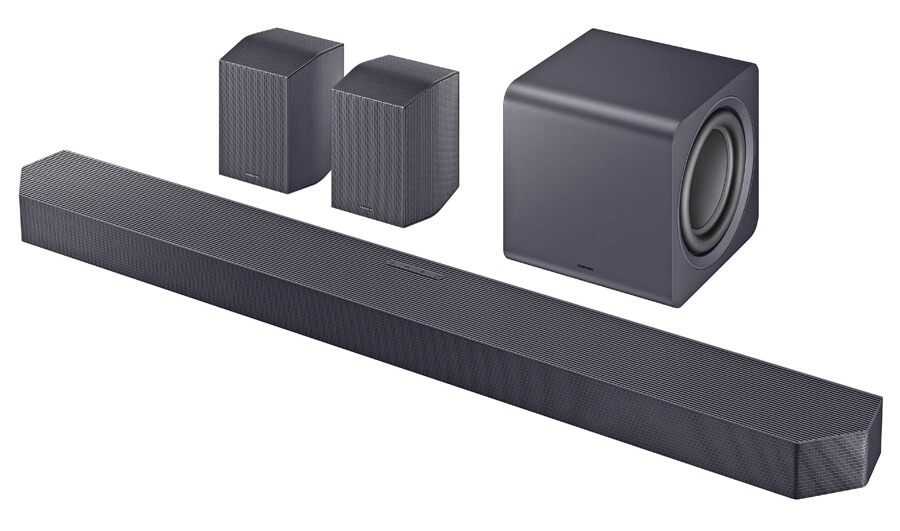
The HW-Q990H is Samsung’s Q Series flagship and its most ambitious soundbar to date. It uses an 11.1.4 channel layout with three front channels, two side firing, two wide firing, and four rear channels, along with four upfiring channels split between the front and rear. The included compact subwoofer features a dual 8-inch driver design aimed at delivering serious low end without overwhelming the room.

Height effects are handled by the upfiring channels in both the bar itself and the included rear speakers, while next generation AI tuning adjusts output in real time based on both the room and the content. The goal is to deliver a level of immersion that approaches a full home theater system, without the rack of gear or the wiring that usually comes with it. Just as important, Samsung is focusing on features that address everyday soundbar frustrations rather than piling on gimmicks.

The Q990H supports Dolby Atmos and DTS-X as well as Eclipsa Audio immersive surround sound.

Advertisement

The main soundbar measures 48.5 inches wide, 2.8 inches high, and 5.5 inches deep, making it a solid match for 50-inch and larger TVs. It can be placed on a shelf or wall mounted.

Per editor at Large, Chris Boylan, the HW-Q990H offered a cinematic sound on DTS-X and Dolby Atmos soundtracks like “Blade Runner” and “F1” with nice immersion and surprisingly solid bass reproduction, considering the compact size of the included subwoofer.

HW-Q900H

Samsung HW-Q900H Soundbar Front View

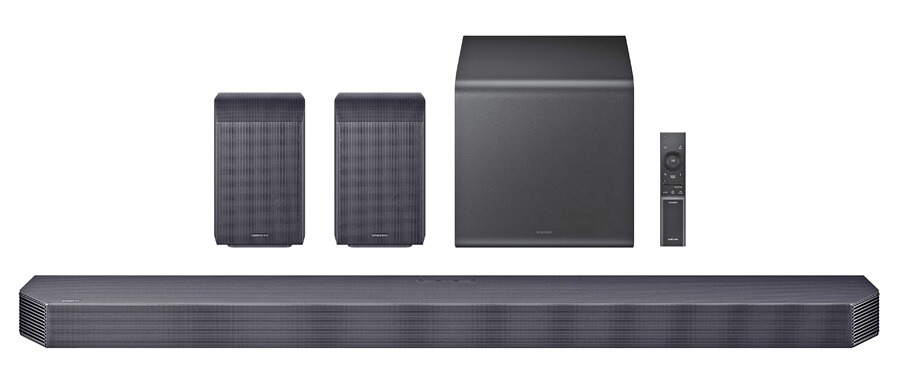
The HW-Q900H is a step down from the Q990H but still brings a substantial feature set. It uses a 9.1.4 channel layout with three front channels, two side firing, two wide firing, and two rear channels, along with four upfiring height channels split between the front and rear. The system also includes a compact active subwoofer with a dual 8 inch driver design intended to deliver strong low end without overwhelming the room.

Unlike the flagship, the Q900H supports Dolby and Eclipsa Audio formats but does not include DTS compatibility.

The main soundbar measures 43.71 inches wide, 2.8 inches high, and 4.73 inches deep, making it a good fit for a wide range of TVs. It can be placed on a shelf or wall mounted.

Advertisement

HW-Q800H

Samsung HW-Q800H Soundbar Front View

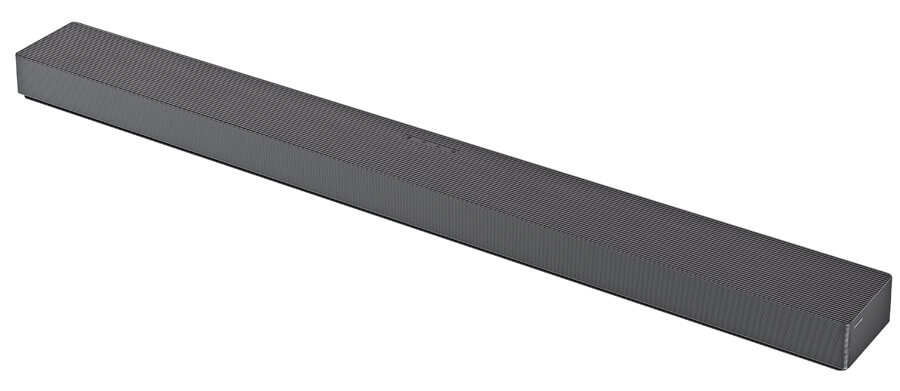
The HW-Q800H is a more streamlined option in the lineup, built around a 5.1.2 channel configuration with three front channels, two side firing, and two upfiring height channels, paired with a wireless subwoofer.

Advertisement. Scroll to continue reading.

Like the Q900H, it supports Dolby and Eclipsa Audio formats but does not include DTS compatibility.

The soundbar measures 43.71 inches wide, 2.8 inches high, and 4.72 inches deep, making it an easy fit for most TV setups. It can be placed on a shelf or wall mounted.

HW-QS90H

Samsung HW-QS90H Soundbar Angle View

The Samsung HW-QS90H takes a different approach, trading modular expansion for simplicity. It features a self contained 7.1.2 channel design with 13 drivers, including nine wide range speakers, eliminating the need for separate surrounds or a dedicated subwoofer.

The unit features a “Convertible Fit” design which uses an internal gyroscope to detect whether it is installed horizontally (like on a credenza) or vertically (like mounted on a wall) and automatically adjusts its driver array to accommodate these different placements. The result is a soundbar that adapts to the room rather than forcing the room to adapt to it, which makes a lot more sense as living spaces get tighter.

Advertisement

The QS90H uses a built-in Quad Bass Woofer system, designed to deliver meaningful low frequency impact from a single enclosure, keeping floor space clear and setup straightforward.

The QS90H supports both Dolby and DTS formats as well as Eclipsa Audio.

It measures 49.02 inches wide, 2.71 inches high, and 4.92 inches deep, and can be placed on a shelf or wall mounted.

Our Editor at Large Chris Boylan tested the QS90H with several 4K Blu-rays and clips from a Kaleidescape Strato E 4K media player including “Blade Runner, “Baby Driver,” “F1” and “Spider-Man: Into the Spiderverse.” He found that the bar did a convincing job drawing the viewer into the action, when mounted on a wall below the company’s S90H OLED TV. Surround sound virtualization was effective at giving the illusion of sound coming from behind the viewing position and bass was solid for a one-piece unit though he did miss the bass extension you get with a separate dedicated subwoofer. Boylan confirmed that the bar could decode both Dolby Atmos and Eclipsa Audio (DTS-X is also supported).

Advertisement

Comparison

Samsung Model HW-Q990H HW-Q900H HW-Q800H HW-QS90H
Product Type Soundbar System Soundbar System Soundbar System Soundbar 
Price $1,999.99 $1,499.99 (Coming Soon)  $1,099.99 $999.99 (Coming Soon)
Number of Channels 11.1.4 9.1.4 5.1.2 7.1.2
Primary Channels 3  Front (Left, center, right)

2 Side-Firing

2 Wide-Firing
 
4 Rear Channels

3 Front (Left, center, right)
·
2 Side-Firing
Advertisement

2 Wide-Firing
 
2 Rear Channels

3 Front (Left, center, right)

2 Side-Firing

3 Front (Left, center, right) ·
Advertisement

2 Side-Firing
·
2 Wide-Firing

Subwoofer Channel 1 1 1 N/A
Up- firing Channels 2 Front
2 Rear
2 Front
2 Rear
2 Up- firing 2 Up- firing
HDMI ARC Yes (eARC) Yes (eARC) Yes (eARC) Yes (eARC)
Dolby Atmos™ Yes Yes Yes Yes
DTS:X Yes No No Yes
Remote Controller Yes Yes Yes Yes
Q-Symphony compatible Yes Yes Yes Yes
Surround Sound Expansion Yes Yes Yes Yes
Game Mode Pro Yes Yes Yes Yes
AVA Pro Yes Yes Yes Yes
Connecitivity Wi-Fi

Bluetooth Version: 5.3

Voice Assistants 
Built-in: Alexa, Bixby 

Advertisement

Works with: Google cast, Airplay 

HDMI IN: 2 

HDMI OUT: 1
 
HDMI CEC 

Optical In: 1 

Advertisement

USB: N/A 

Spotify
Connect

Roon Ready

Wi-Fi
Advertisement

Bluetooth Version: 5.3

Voice Assistants 
Built-in: Alexa, Bixby 

Works with: Google cast, Airplay 

HDMI IN: 1 

Advertisement

HDMI OUT: 1 

HDMI CEC

Optical In: 1 

USB: N/A 

Advertisement

Spotify Connect

Roon Ready

Wi-Fi

Bluetooth
Version: 5.3

Advertisement

 Voice Assistants 
Built-in: Alexa, Bixby 

Works with: Google cast, Airplay 

HDMI IN: 1
 
HDMI OUT: 1

HDMI CEC 

Advertisement

Optical In: 1 

USB: N/A 

Spotify Connect

Roon Ready

Advertisement
Wi-Fi

Bluetooth Version: 5.3

Voice Assistants 
Built-in: Alexa, Bixby 

Works with: Google cast, Airplay 

Advertisement

HDMI IN: 1 

HDMI OUT: 1 

HDMI CEC 

Optical In: 1 

Advertisement

USB: N/A 

Spotify Connect

Roon Ready

Audio Formats/AV Decoding Dolby Atmos™
 
Dolby TrueHD
 
Dolby Digital Plus
Advertisement

Dolby 5.1ch

DTS:X

DTS 5.1ch

DTS-HD HRA
 
DTS-HD MA
 
DTS Express
 
MP3

Advertisement

AAC

OGG

FLAC

WAV

Advertisement

ALAC

 AIFF

Dolby Atmos™
 
Dolby TrueHD
 
Dolby Digital Plus

Dolby 5.1ch
 
DTS:X: No

Advertisement

DTS 5.1ch: No

DTS-HD HRA: No

DTS-HD MA: No

DTS Express: No 

Advertisement

MP3

AAC

OGG

FLAC

Advertisement

WAV

ALAC

AIFF

Dolby Atmos™
 
Dolby TrueHD
 
Dolby Digital Plus
Advertisement

Dolby 5.1ch 

DTS:X: No

DTS 5.1ch: No

DTS-HD HRA: No

Advertisement

DTS-HD MA: No

DTS Express: No 

MP3
 
AAC

OGG

Advertisement

FLAC

WAV

ALAC

 AIFF

Advertisement
Dolby Atmos™ 

Dolby TrueHD

Dolby Digital Plus 

Dolby 5.1ch 

Advertisement

DTS:X

DTS 5.1ch

DTS-HD HRA

DTS-HD MA

Advertisement

DTS Express

MP3

AAC

OGG

Advertisement

FLAC

WAV

ALAC: Yes

AIFF: Yes

Advertisement
Sound Modes Surround Sound Expansion

Game Mode Pro

Adaptive Sound

DTS:X

Advertisement

Bass Boost: No 

Night Mode

Voice-enhance mode

Surround Sound Expansion
 
Game Mode Pro
Advertisement

Adaptive Sound

DTS:X: No

Bass Boost: No
 
Night Mode

Voice-enhance mode

Advertisement
Game Mode Pro

Adaptive Sound: Yes
 
DTS:X: No

Bass Boost: No 

Night Mode

Advertisement

Voice-enhance mode

Game Mode Pro

Adaptive Sound: Yes 

DTS:X

Advertisement

Bass Boost: No 

Night Mode

Voice-enhance mode

Video Compatibilty 4K Video Pass: 120Hz 
Advertisement

HDR: HDR 10+

4K Video Pass: 120Hz 

HDR: HDR 10+

4K Video Pass: 60Hz
 
HDR: HDR 10+
4K Video Pass: 60Hz 
Advertisement

HDR: HDR 10+

Dimensions (WHD) Soundbar 48.50 x 2.8 x 5.43 

Subwoofer: 9.80 x 9.91 x 9.80 

Rear Speaker: 5.10 x 7.93 x 5.53

Advertisement
Soundbar 43.71 x 2.38 x 4.72
 
Subwoofer: 9.80 x 9.91 x 9.80 

Rear Speaker: 5.10 x 7.93 x 5.53

Soundbar43.71 x 2.38 x 4.72
 
Subwoofer: 9.80 x 9.91 x 9.80 

Rear Speaker: N/A

Advertisement
Soundbar: 49.02 x 2.71 x 4.92
Weight  (lbs) Soundbar: 16.08 

Subwoofer: 18.28 

Rear Speaker: 7.49

Soundbar: 11.68 
Advertisement

Subwoofer: 15.87 

Rear Speaker: 6.83

Soundbar: 11.24 

Subwoofer: 15.87 

Advertisement

Rear Speaker: N/A

Soundbar: 14.75
Package Contents Soundbar
 
Subwoofer

Rear Speaker Kit 

HDMI Cable (HDMI 2.1)

Advertisement

Wall Mount Kit

Rubber Foot

Remote Controller 

Battery for Remote Controller

Advertisement
Soundbar 

Subwoofer

Rear Speaker Kit

HDMI Cable (HDMI 2.1)

Advertisement

Wall Mount Kit

Rubber Foot

Remote Controller
 
Battery for Remote Controller

Soundbar
Advertisement

Subwoofer

Rear Speaker Kit: No

HDMI Cable(HDMI 2.1)

Wall Mount Kit

Advertisement

Ruber Foot

Remote Controller 

Battery for Remote Controller

Soundbar
Advertisement

Subwoofer: No

Rear Speaker Kit: No

HDMI Cabl (HDMI 2.1)

Wall Mount Kit

Advertisement

Rubber Foot

Remote Controller
 
Battery for Remote Controller

The Bottom Line 

Samsung didn’t reinvent the soundbar in 2026, but it didn’t need to. What it’s doing here is doubling down on the formula that put it on top in the first place: tight integration with its TVs, flexible system scaling, and fewer wires without completely sacrificing immersion.

What’s new or at least more refined is the range itself. You now have a clearer ladder from the full surround Q990H, to the more compact Q900H and Q800H, all the way down to the one-piece QS90H, which ditches the usual box of extras and goes all in on a single enclosure. The QS90H in particular stands out because it tries to solve the biggest real world problem: people want better sound, but they don’t want more stuff in the room.

Advertisement

What still makes Samsung unique is ecosystem control. Q-Symphony, SpaceFit, and Wireless Dolby Atmos aren’t just features, they are leverage. Pair these with a recent Samsung TV and you get the full experience. Use another brand and you leave performance and functionality on the table. That’s not a bug, it’s the strategy.

What’s missing is just as important. DTS support is inconsistent across the lineup, which is hard to ignore for anyone with a physical media library. But they do offer Eclipsa Audio decoding, which may matter in time as more content creators create immersive audio content in that format on YouTube. There’s also still a reliance on Samsung’s ecosystem to unlock everything, which won’t sit well with buyers who mix and match brands.

Advertisement. Scroll to continue reading.

So who is this for? Anyone building a TV-first home theater who wants strong, immersive sound without the complexity of separates. If you already own a Samsung TV, the case is easy. If you don’t, these are still competitive soundbars, but the real value only shows up when you stay inside the walled garden.

Advertisement

Pricing & Availability

HW-Q990H – $1,999.99 at Samsung

HW-Q900H – $1,499.99 (Coming Soon) 

HW-Q800H – $1,099.99 at Samsung

HW-QS90H – $999.99 (Coming Soon)

Advertisement

Source link

Continue Reading

Tech

Samsung Music Studio 7 and 5 Wireless Speakers Debut With Erwan Bouroullec “Dot” Design and High Performance Audio

Published

on

Samsung has spent the better part of the last decade dominating the TV market and building a soundbar empire, but dedicated two-channel speakers and a whole home music ecosystem have never really been part of the conversation, until now. With the $499 Music Studio 7 (LS70H) and $299 Music Studio 5 (LS50H), Samsung is making a direct move into wireless whole home audio for 2026, and it’s not doing it quietly.

Following its latest OLED, Neo QLED, MiniLED, and Frame TV launches, these new Wi-Fi speakers, first previewed at CES 2026 and now fully detailed—pair a more refined, room-friendly sound with a distinctive “dot” design from Erwan Bouroullec that actually gives them an identity in a sea of forgettable boxes. Samsung isn’t chasing louder or flashier. It’s aiming for flexible multi-room and true two-channel performance wrapped in something people might actually want to look at for more than five minutes.

What sets Samsung’s Music Studio speakers apart from most competitors is that they can be used both for whole home audio (up to 10 speakers in the home) and also used as part of a multi-speaker home theater audio system (up to 5 speakers).

Music Studio 7 and 5 Shared Features

Here are some key features that the Music Studio 7 and 5 have in common:

Advertisement

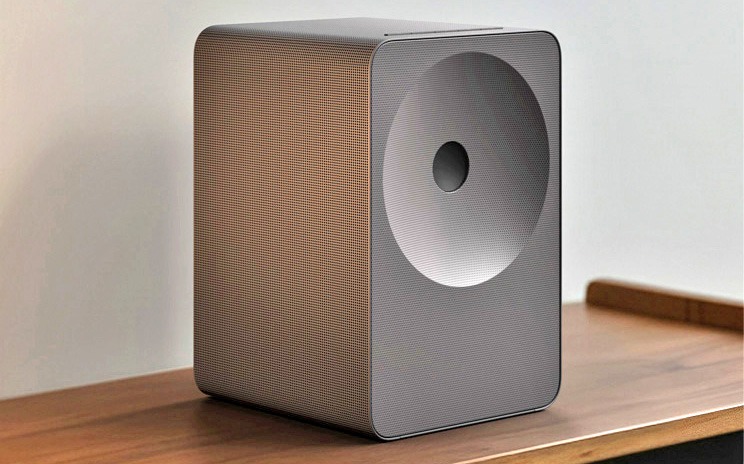
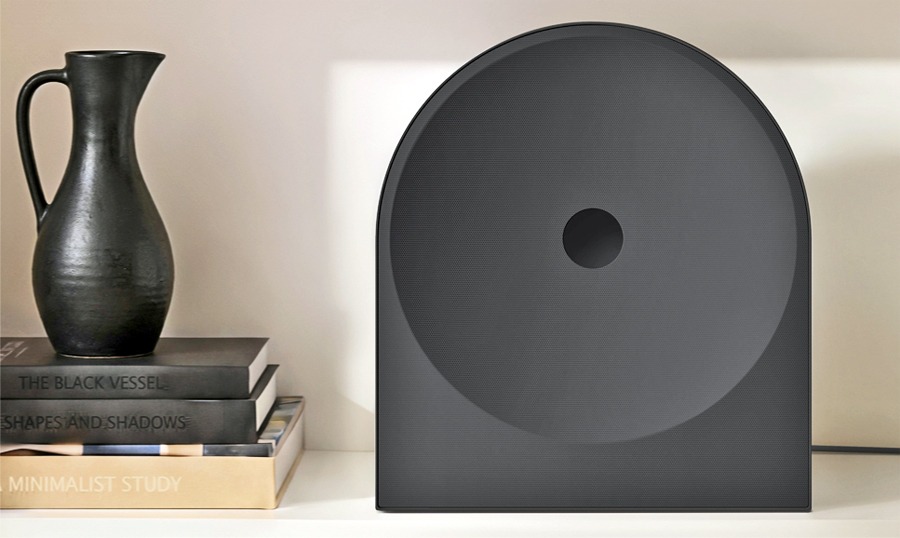
Style: The Music Studio 7 and 5 feature a distinctive “dot” design concept created by renowned designer Erwan Bouroullec. The idea draws from a universal symbol found throughout music and visual art, while remaining rooted in Samsung’s current industrial design language. The result is a speaker that blends into a room naturally—doing its job without screaming for attention, which is how most people actually want their speakers to behave.

Wireless Streaming: Music Studio speakers support both Bluetooth and Wi-Fi streaming, with compatibility for Google Cast, AirPlay, and Roon Ready systems. That gives users real flexibility across platforms without being locked into a single ecosystem.

Voice Assistants and Control: Users can control the Music Studio 7 and 5 via voice commands using Alexa, Google Assistant, and Bixby. Non-voice control is available through onboard controls and the Samsung Sound App (coming soon). There is also a dedicated Spotify Connect button for direct playback. A traditional remote control is not included.

Audio Lab Pattern Control: This technology manages how sound is distributed across channels, reducing overlap and congestion so effects, music, and dialogue remain clearly defined.

Advertisement

AI Dynamic Bass Control: Designed to deliver deeper, more controlled low frequencies with minimal distortion, this system dynamically adjusts bass output in real time while supporting high-resolution audio up to 24-bit/96kHz.

Active Voice Amplifier Pro: Samsung’s AVA analyzes ambient noise in real time so voice audio remains clear and intelligible. Enabling this feature boosts dialogue from the Music Studio 7 and 5, making it easier to hear over background noise without cranking the overall volume. This is particularly handy for listening to podcasts, audiobooks, weather and news reports in a busy home.

Wireless Dolby Atmos: The Music Studio 7 includes a Dolby Atmos-compatible HDMI eARC connection with up-firing driver for height effects, while the Music Studio 5 offers neither of these things. Both speakers can reproduce Dolby Atmos music over a wireless connection from compatible streaming services, however, the Music Studio 5 virtualizes the height effects while the Music Studio 7 offers a discrete up-firing driver for the height channel. Both speakers can be a part of a Wireless Dolby Atmos system over Wi-Fi when used with compatible Samsung TVs and select streaming sources.

Advertisement. Scroll to continue reading.
Advertisement

Pro Tip: Samsung’s Wireless Dolby Atmos implementation is not the same thing as Dolby Atmos FlexConnect. Although the two systems share some features and functionality, they are entirely different implementations.

Eclipsa Audio: Samsung’s Music Studio wireless speakers incorporate Eclipsa Audio, an open immersive surround sound format developed by Samsung in partnership with Google and other companies. Similar to Dolby Atmos, Eclipsa Audio expands on traditional surround sound with the addition of height information. With Eclipsa Audio-encoded content, sound can come from all around and above the listener. This enables a more enveloping and immersive listening experience with sound emanating from all three dimensions, just like in real life. Eclipsa Audio is currently the only immersive surround sound format supported on YouTube.

Q-Symphony: This feature allows the Music Studio speakers to work in tandem with compatible Samsung TVs, soundbars, and Wi-Fi speakers to create a more immersive home theater system. Q-Symphony supports pairing up to five Samsung audio devices and can automatically optimize sound based on speaker placement within the room.

SpaceFit Sound Pro: Samsung’s room calibration technology is built into both Music Studio models via onboard microphones. SpaceFit analyzes your listening environment and adjusts output accordingly. It can recalibrate automatically on a daily basis or whenever the speaker is moved.

Advertisement

Waveguide: This design technology helps direct and disperse sound more evenly throughout the room, improving coverage so audio remains consistent regardless of where you’re sitting.

Music Studio 7 (LS70H)

Samsung Music Studio 7 (LS70H) Wireless Speaker Closeup

The Music Studio 7 (LS70H) is the flagship of Samsung’s 2026 Wi-Fi speaker lineup, designed to deliver a more immersive listening experience from a single enclosure.

On the outside, it features a curved rectangular form that aligns with the series’ distinctive design language. Inside, Samsung has implemented a 3.1.1 channel configuration, including a built in subwoofer, with left, center, right, and top firing drivers working together to create a convincing sense of height and spatial depth without the need for a full surround system.

The LS70H measures 7.28 x 10.59 x 7.50 inches and weighs 12.35 pounds.

Music Studio 5 (LS50H)

Samsung Music Studio 5 (LS50H) Wireless Speaker Close-up

The Music Studio 5 (LS50H) sits below the Music Studio 7 in Samsung’s 2026 Wi Fi speaker lineup and takes a different design approach, with a rounded top half and rectangular base that feels more decor friendly than most wireless speakers. It can reproduce stereo sound on its own or be paired with a second unit for a wider more enveloping soundstage. Though it has no built-in height speaker, it can reproduce virtualized Dolby Atmos immersive sound.

While it looks different from the Music Studio 7, the LS50H is still engineered to deliver controlled bass with minimal distortion and supports modern connectivity options, including Wi Fi casting, streaming services, voice control, and Bluetooth for seamless everyday use.

Advertisement

Inside, the Music Studio 5 uses a 2-channel configuration with a 4-inch woofer and dual tweeters, balancing clarity, low end presence, and a form factor that fits more easily into real living spaces.

The LS50H measures 9.88 x 11.18 x 5.39 inches and weighs 5.29 pounds.

Advertisement. Scroll to continue reading.

Comparison

Samsung Model  Music Studio 7 (LS70H) Music Studio 5 (LS50H)
Product Type Wi-Fi Speaker Wi-Fi Speaker
Price $499.99 $299.99
Number of Channels 3.1.1 2
Speaker Configuration 3 main channels (Left, center/front, right)
· 
1 Built-in Woofer ·
Advertisement

1 Up-firing 

2 Tweeters
· 
1 Built-in Woofer
HDMI ARC Yes (eARC) No
Dolby Atmos Yes Yes (virtualized)
Remote Controller No No
Q-Symphony compatible Yes Yes
SpaceFit Sound Pro Yes Yes
Built-in Mic Yes Yes
Group Play Yes Yes
Active Voice Amplifier (AVA) Pro Yes Yes
Connectivity Wi-Fi: Yes 

Bluetooth: Yes
 
Bluetooth Version: 6

Voice Assistants Built-in: Alexa, Bixby 

Advertisement

Works with: Google cast, Airplay

HDMI IN: No 

HDMI OUT: 1
 
HDMI CEC: Yes

Optical In: 1
 
USB: No

Advertisement

USB Music playback: No
 
Samsung Sound App: Yes
 
Spotify Connect: Yes 

Roon Ready: Yes

Wi-Fi: Yes
 
Bluetooth: Yes 

Bluetooth Version: 6

Advertisement

Voice Assistants Built-in: Alexa, Bixby 

Works with: Google cast, Airplay

HDMI IN: No 

HDMI OUT: No 

Advertisement

HDMI CEC: No

Optical In: 1
 
USB: No

USB Music playback: No 

Samsung Sound App: Yes
 
Spotify Connect: Yes 

Advertisement

Roon Ready: Yes

Audio Format/AV Decoding Dolby Atmos: Yes 

Dolby TrueHD: Yes 

Dolby Digital Plus: Yes
 
Dolby 5.1ch: Yes 

Advertisement

DTS:X: No 

DTS 5.1ch: No
 
DTS-HD HRA: No 

DTS-HD MA: No 

DTS Express: No 

Advertisement

MP3: Yes
 
AAC: Yes 

OGG: Yes 

FLAC: Yes 

WAV: Yes 

Advertisement

ALAC: Yes

AIFF: Yes

Dolby Atmos: Yes 

Dolby TrueHD: Yes 

Advertisement

Dolby 5.1ch: Yes 

DTS:X: No 

DTS 5.1ch: No
 
DTS-HD HRA: No 

DTS-HD MA: No 

Advertisement

DTS Express: No 

MP3: Yes 

AAC: Yes 

OGG: Yes 

Advertisement

FLAC: Yes
 
WAV: Yes 

ALAC: Yes

AIFF: Yes

Sound Modes Adaptive Sound: Yes
 
Night Mode: Yes
Advertisement

Voice enhance mode: Yes
 
Stereo: Yes

Adaptive Sound: Yes 

Night Mode: Yes

Voice enhance mode: Yes 

Advertisement

Stereo: Yes

Dimensions (inches WHD) 7.28 x 10.59 x 7.50 9.88 x 11.18 x 5.39
Weight (lbs) 12.35 5.29
Package Contents Speaker: Yes 

Power Cord: Yes

Speaker: Yes 
Advertisement

Power Cord: Yes

The Bottom Line 

The Music Studio 7 and Music Studio 5 mark Samsung’s most credible push yet into wireless whole home audio and two-channel audio. What makes them stand out isn’t just the feature list, it’s the combination of design, flexibility, and ecosystem integration. The Bouroullec “dot” design gives them a visual identity most wireless speakers lack, while support for Wi-Fi streaming, Roon, AirPlay, Google Cast, and Q Symphony makes them far more adaptable than the average plug and play box.

Samsung appears to be intentionally blurring categories here. The Music Studio speakers aren’t just lifestyle speakers. They can run in stereo mode, pair with each other for wider stereo separation, handle Dolby Atmos music, slot into a multi room system, or integrate into a home theater setup with Samsung TVs. That kind of versatility is where Samsung is clearly aiming to separate itself.

But there are tradeoffs. No analog input, no USB playback, and no phono stage means traditional sources are completely off the table without workarounds. If your system still revolves around physical media or external components, these aren’t built for you.

Advertisement

Competition is stiff. Sonos, Bluesound, Denon HEOS, Apple HomePod, and even higher end lifestyle brands like Naim all play in this space, and many offer deeper ecosystems or better support for wired sources. Samsung is betting that its design, TV integration, and Harman backed tuning will be enough to pull people in.

Who are these for? Not the purist with racks of gear and a Thorens spinning in the corner. These are for people building a modern system around streaming, multi room audio, and a Samsung TV who want something that looks good, sounds better than a soundbar on its own, and doesn’t require a weekend to set up.

Samsung isn’t just filling a gap here. It’s trying to create a new lane between soundbars and traditional stereo. Whether that lane gets crowded depends on how good they actually sound – and our initial listening sessions have us optimistic – but for the first time, it feels like Samsung is at least asking the right questions.

Pricing and Availability

Samsung Music Studio 7 (LS70H): $499.99 or less from Amazon  (available in Black)

Advertisement

Samsung Music Studio 5 (LS50H): $299.99 or less from Amazon (available in Black or White)

Source link

Advertisement
Continue Reading

Tech

AI agents that automatically prevent, detect and fix software issues are here as NeuBird AI launches Falcon, FalconClaw

Published

on

The mantra of the modern tech industry was arguably coined by Facebook (before it became Meta): “move fast and break things.”

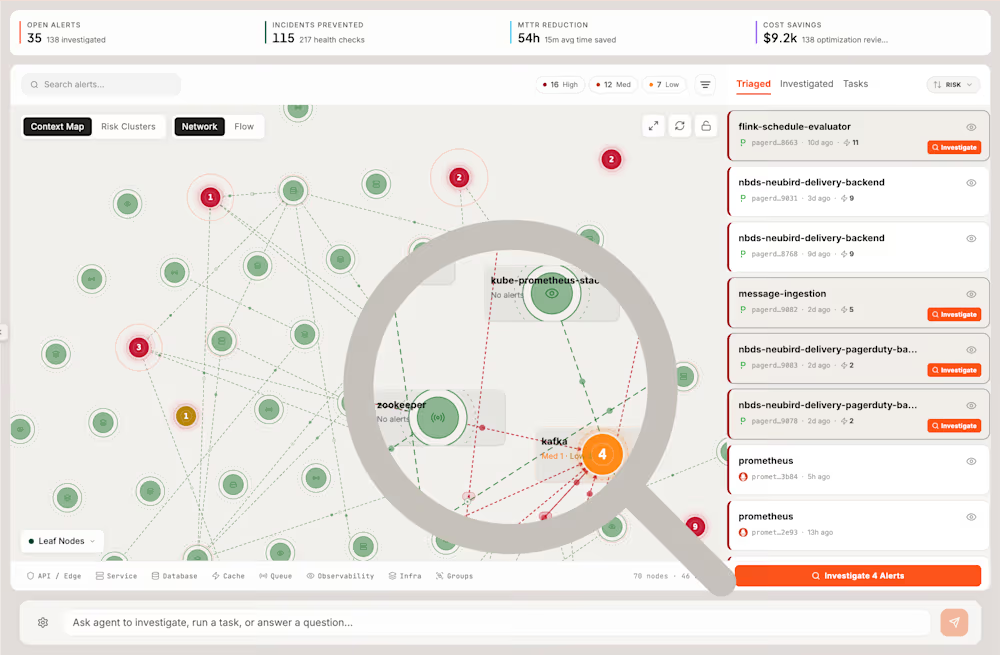
But as enterprise infrastructure has shifted into a dizzying maze of hybrid clouds, microservices, and ephemeral compute clusters, the “breaking” part has become a structural tax that many organizations can no longer afford to pay. Today, two-year-old startup NeuBird AI is launching a full-scale offensive against this “chaos tax,” announcing a $19.3 million funding round alongside the release of its Falcon autonomous production operations agent.

The launch isn’t just a product update; it is a philosophical pivot. For years, the industry has focused on “Incident Response”—making the fire trucks faster and the hoses bigger. NeuBird AI is arguing that the only sustainable path forward is “Incident Avoidance”.

As Venkat Ramakrishnan, President and COO of NeuBird AI, put it in a recent interview: “Incident management is so old school. Incident resolution is so old school. Incident avoidance is what is going to be enabled by AI”.

Advertisement

By grounding AI in real-time enterprise context rather than just large language model reasoning, the company aims to move site reliability engineering and devops teams from a reactive posture to a predictive one.

The AI divide: a reality check on automation

Accompanying the launch is NeuBird AI’s 2026 State of Production Reliability and AI Adoption Report, a survey of over 1,000 professionals that reveals a massive disconnect between the boardroom and the server room.