









Connect with us
DAPA Banner

Business

Oakmark International Equity Market Q1 2026 Commentary

Published

on

Touchstone International Value Fund Q4 2025 Commentary

investor reviewing stock reports and financial dashboards on hybrid tablet-laptop with AI digital finance workflow with business charts and online investment platforms

primeimages/E+ via Getty Images

Beware of noise, hurry and crowds

In his book Celebration of Discipline, American theologian Richard Foster warned that noise, hurry and crowds were the most significant obstacles to a vibrant spiritual life. The same could be said of successful value investing. When it comes to investing, ignoring the noise, exhibiting patience and being indifferent to the prevailing sentiment of the crowds sounds like the right thing to do. Most people would not argue with these principles, yet behavior suggests otherwise.

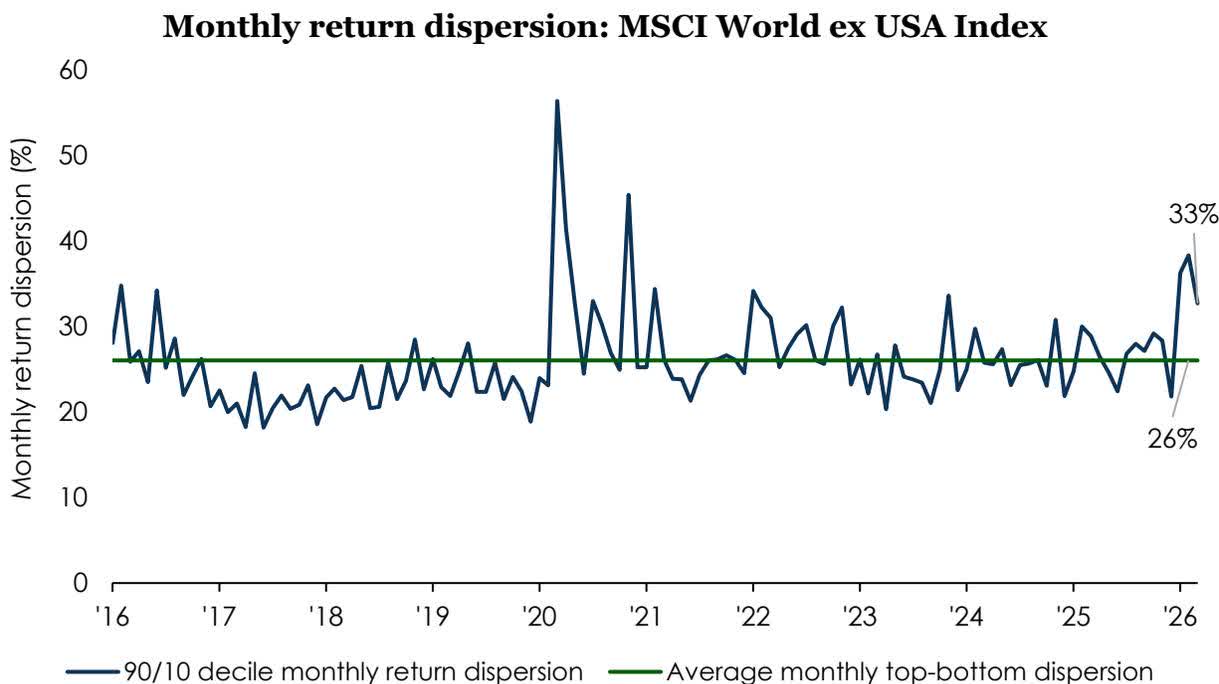
If there ever were a quarter of noise, this may have been it. The first 90 days of 2026 experienced near-record stock dispersion—that is, an unusually wide spread between the best- and worst-performing stocks—based on whatever company or industry the market happened to view that day as an AI winner or loser. For instance, the difference between the highest- and lowest-return stocks in the MSCI World ex-USA Index has been well above average, with a gap in performance of over 80 percentage points in the quarter, as investors debated the impact of AI. Then, in the last month of the quarter, bombs started falling in Iran and oil ran up well past $100 per barrel. As I write today, trying to make a deadline for publication with something timely and relevant, the White House announced progress toward a de-escalation. Noise galore.

Line chart showing monthly return dispersion for the MSCI World ex USA Index from 2016 to 2026. The y-axis represents 'Monthly return dispersion (%)' from 0 to 60. The x-axis shows years from '16 to '26. A blue line represents the '90/10 decile monthly return dispersion', which is highly volatile, peaking at approximately 58% in early 2020 and ending at 33% in early 2026. A horizontal green line represents the 'Average monthly top-bottom dispersion' at approximately 26%.

Source: FactSet. Monthly data from 12/31/2015 through 3/31/2026. Returns represent the average performance of top and bottom decile stocks within the MSCI World ex USA Index; spreads are calculated as top decile minus bottom decile. Charts are for informational purposes only and do not depict the performance of any Harris | Oakmark strategy or product.

Advertisement

We aren’t technology neophytes; we believe AI is for real and is changing the way many of us work, and there will be winners and losers. However, we do believe the market has been too eager to declare victory and defeat. Where there is a real threat of change, we lower our estimate of value by reflecting a higher risk of disruption. In the case of large, deeply embedded enterprise software companies such as SAP, we think the market has skewed too negative on the risks introduced by AI, when in fact, there is a real possibility that AI is additive. We do not pretend to know how the Iran conflict is going to end, but there have been scores of these conflicts over my nearly 27 years at Harris | Oakmark and the world keeps turning. Remember, WTI (West Texas Intermediate) oil futures have both been in the triple digits and negative over the past six years. Meanwhile, population and incomes grow and the global economic pie along with them. We see the same bewildering headlines you do, but remain focused on the clarity of business values, which are far more stable than daily headlines.

The only way to really hurry your way to success in the equity markets is to have insight into the next tick and the ability to act before it moves. This requires an advantage in physics, not insight. At Harris | Oakmark, we estimate the intrinsic value of a business. There is an identifiable reason (or reasons) why the market price and our estimate differ. Often it boils down to our time horizon being longer than the marginal market participant. It takes time for value to be realized. Fixed income investors seem to understand this better than equity investors. In the bond world, one typically starts the conversation with duration—in other words, the desired time horizon for the securities you are looking to own. Equities are perpetual in duration, which means their theoretical time horizon is longer than that of even the longest bonds. Yet much of the market coverage focuses on one-minute charts, and the financial press seems to like or dislike a company based on how well it performed over the last quarter relative to broader expectations, with almost no airtime given to the long-term outlook for the business. Today, an estimated 60% of index options tied to the S&P 500 have same-day expirations and there are even new 5- and 10-minute option contracts being marketed for indices and cryptocurrencies. This short-termism reflects investors losing touch with the actual duration of the assets they own. Just because you can trade a stock one minute at a time (or less) doesn’t mean you should. At Harris | Oakmark, we think of equities as proportionate interests in real businesses that have real value based on the total future cash flows of the business. We have more insight into what the business ought to look like over time than where the stock will go over the next day, quarter or year. Don’t get me wrong, we would love the value gap to close the second we buy a stock, but unfortunately that is not how markets function.

Following the crowd is the easier—but more dangerous—path. I’m sure I’m not the only one who pleaded with my parents that, “everyone else was doing it” to which they replied, “if everyone else jumped off a cliff would you?” In markets, it is generally cause for concern when everyone seems to believe the same thing. Market participants make markets and markets price assets. Crowding occurs when there is more than typical agreement between market participants. That “agreement” gets priced into the asset such that there is little room for different outcomes without the stock getting pummeled. Beyond that, crowding introduces endogenous (or self-inflicted) risks that go beyond fundamentals, such as distorting liquidity dynamics on a security such that the distribution of future price outcomes skews negatively. By nature, as value investors we seek mispriced stocks—specifically, stocks selling well below their intrinsic value. Often this means going against the “crowd”. In our view, if everyone seems to believe something, you should assume a good portion of that belief is priced into the security. Meaning, if you and the crowds are right, there is little to no excess return and if wrong, painfully below average returns are likely. When a stock is undervalued, investors can afford to be wrong given the stock is unlikely priced to perfection. This is the essence of the “margin of safety” concept and the reason we require a significant discount before investing in any company.

We cannot promise much as regulated investment advisors but know that we are truly committed to a disciplined process that ignores the noise, exhibits patience, and is indifferent to the crowd.

Advertisement

Thank you for your partnership with us in our international equity portfolios.

We are eager to hear from you, so please do not be shy.

Tony Coniaris, CFA, Portfolio Manager

Advertisement

Important Disclosure

The securities mentioned above comprise the following percentages of the Oakmark International Fund’s total net assets as of 03/31/2026: SAP 2.0%. Portfolio holdings are subject to change without notice and are not intended as recommendations of individual stocks.

This material is not intended to be a recommendation or investment advice, does not constitute a solicitation to buy, sell or hold a security or an investment strategy, and is not provided in a fiduciary capacity. The information provided does not take into account the specific objectives or circumstances of any particular investor, or suggest any specific course of action. Investment decisions should be made based on an investor’s objectives and circumstances and in consultation with his or her financial professionals.

The information, data, analyses, and opinions presented herein (including current investment themes, the portfolio managers’ research and investment process, and portfolio characteristics) are for informational purposes only and represent the investments and views of the portfolio managers and Harris Associates L.P. as of the date written and are subject to change and may change based on market and other conditions and without notice. This content is not a recommendation of or an offer to buy or sell a security and is not warranted to be correct, complete or accurate.

Advertisement

Certain comments herein are based on current expectations and are considered “forward-looking statements.” These forward-looking statements reflect assumptions and analyses made by the portfolio managers and Harris Associates L.P. based on their experience and perception of historical trends, current conditions, expected future developments, and other factors they believe are relevant. Actual future results are subject to a number of investment and other risks and may prove to be different from expectations. Readers are cautioned not to place undue reliance on the forward-looking statements.

Investing involves risk; principal loss is possible. There is no guarantee the Fund’s investment objective will be achieved. Value stocks may fall out of favor with investors and underperform growth stocks during given periods. Foreign securities presents risks that in some ways may be greater than investments in U.S. investments. Those risks include: currency fluctuation; different regulation, accounting standards, trading practices and levels of available information; generally higher transaction costs; and political risks. The Fund’s portfolio tends to be invested in a relatively small number of stocks. As a result, the appreciation or depreciation of any one security held by the Fund will have a greater impact on the Fund’s net asset value than it would if the Fund invested in a larger number of securities. Although that strategy has the potential to generate attractive returns over time, it also increases the Fund’s volatility. These and other risk considerations are described in detail in the Fund’s prospectus.

Before investing in any Oakmark Fund, you should carefully consider the Fund’s investment objectives, risks, management fees and other expenses. This and other important information is contained in a Fund’s prospectus and summary prospectus. Please read the prospectus and summary prospectus carefully before investing. For more information, please visit Oakmark.com or call 1-800-OAKMARK (1-800-625-6275).

Harris Associates Securities L.P., Distributor, Member FINRA.

Advertisement

QCM-5140INT-07/26

Original Post

Editor’s Note: The summary bullets for this article were chosen by Seeking Alpha editors.

Advertisement
Continue Reading
Click to comment

You must be logged in to post a comment Login

Leave a Reply

Business

What a United-American merger would mean, from antitrust hurdles to airfare

Published

on

What a United-American merger would mean, from antitrust hurdles to airfare

American Airlines and United Airlines airplanes at the Terminal A at Newark Liberty International Airport (EWR) in Newark, New Jersey, US, on Thursday, Jan. 12, 2023.

Aristide Economopoulos | Bloomberg | Getty Images

United Airlines CEO Scott Kirby reportedly floated the idea of a potential tie-up with rival American Airlines to the Trump administration earlier this year, a suggestion that if acted upon, would create the world’s largest airline.

Advertisement

While the Trump administration has appeared more open to mega deals than its predecessors, such a merger would face heavy regulatory scrutiny with the top four airlines (those two carriers, plus Delta Air Lines and Southwest Airlines) already dominating about 80% of domestic capacity. If they combined, American and United would have a roughly 40% domestic share, according to airline-data firm OAG.

“This would be the biggest of all time. I can’t even see the slightest chance that a court would allow it,” said George Hay, a law professor at Cornell University.

Department of Transportation has no comment on possible United, American Airlines deal

American and United declined to comment on the discussion of a merger, which was reported Monday by Bloomberg. The White House didn’t immediately comment on the reported discussion.

American shares were up 9% on Tuesday morning. Seaport Research Partners airline analyst Daniel McKenzie said he attributed the move “to short covering rather than the market assigning legitimacy to the merger idea.” 

He added that the deal would be “be dead on arrival, though politely reviewed until the public backlash became too deafening.”

Advertisement

If the Justice Department “doesn’t object to that, then what would they object to? It is very hard to imagine a deal of that magnitude and concentration going through,” said Samuel Engel, senior vice president at consulting firm ICF.

He said consolidation allows carriers to better control capacity, which in turn can drive up fares, a key consideration generally with antitrust investigations

An American-United merger would likely require significant divestitures on routes where the two carriers’ combining would mean only one or two airlines are serving that route, said TD Cowen airline analyst Tom Fitzgerald, who said 289 routes fit that criteria now.

The Trump administration has shown a warmth toward mergers in the industry, however.

Advertisement

“Is there room for some mergers in the aviation industry? Yeah, I think there is,” Transportation Secretary Sean Duffy told CNBC’s Phil LeBeau last week, regarding industry consolidation. Duffy said President Donald Trump “loves to see big deals happen, adding that he would “have to review” a tie-up.

Transportation Sec. Duffy: There's room for airline mergers in the U.S.

Delta and United already account for most of the U.S. industry’s profit.

American had fallen behind both airlines as it struggled to capitalize on higher-spending customers that are driving major airlines’ revenue in recent years. Kirby, whom American fired in 2016, has gone head-to-head with his former employer, including in key markets like Chicago.

The Biden administration challenged two major airline tie-ups, and won. A federal judge knocked down American’s partnership with JetBlue Airways in the Northeast in 2023 and in early 2024, a court ruled against JetBlue’s planned acquisition of Spirit Airlines, which is now in its second bankruptcy.

JetBlue and United formed a partnership that allows customers to book on each other’s airlines but falls short of the schedule coordination under that failed American deal. Kirby has expressed hesitation about taking that deal further.

Advertisement

“I like the partnership with JetBlue,” Kirby said in Boston last month. “I think highly of their team. They’ve got the right DNA and culture, but … we’re doing a great job growing. I feel really good about our standalone.

“Mergers are big and hard and complicated,” he added.

Read more CNBC airline news

Choose CNBC as your preferred source on Google and never miss a moment from the most trusted name in business news.
Continue Reading

Business

McKee launches Little Debbie soft baked cookies

Published

on

McKee launches Little Debbie soft baked cookies

The soft, chewy cookies come in two flavors.

Continue Reading

Business

Form 13F ARVEST INVESTMENTS For: 14 April

Published

on


Form 13F ARVEST INVESTMENTS For: 14 April

Continue Reading

Business

Morrisons Cuts 200 Head Office Jobs in AI and Automation Push

Published

on

Morrisons

Morrisons has placed up to 200 head office jobs at risk as Britain’s fifth-largest supermarket leans harder on artificial intelligence and automation to rein in costs and shore up a balance sheet still groaning under private equity debt.

The Bradford-based grocer confirmed to staff on Monday that a fresh round of restructuring would hit roughly 8 per cent of the workforce at its Hilmore House headquarters, with the cuts spread across every department. It is the latest and arguably most pointed intervention yet in a wider efficiency drive that has been running since last year.

A company spokesman said the proposals were part of a longer-term plan to streamline processes, automate manual tasks and “capitalise on the potential of data and artificial intelligence to improve performance”. In plain English, fewer humans in head office, more algorithms doing the heavy lifting.

The news, first reported by trade title Better Retailing, lands less than a month after Morrisons confirmed it would make its entire convenience buying and operations teams redundant and relocate its general merchandise staff to a new office more than an hour’s drive away, a move that affected around 100 employees.

For Morrisons, an SME-built business that grew out of a Bradford market stall to become a national multiple of roughly 500 supermarkets and a clutch of convenience stores, the squeeze is familiar territory. The chain has struggled since Clayton Dubilier & Rice, the American private equity group, took it private in 2021 in a transaction that piled £6.6 billion of debt onto its balance sheet.

Advertisement

The numbers remain sobering. Morrisons posted a statutory pre-tax loss of £381 million in its latest financial year, a modest improvement on the £414 million loss the previous year. Net debt has been cut by 46 per cent to £3.17 billion since 2022, largely through redundancies and the disposal of selected stores and petrol forecourts.

The cost-cutting programme is also delivering measurable results. The group said last month that it had shaved a further £49 million from its cost base in the most recent quarter, taking total savings since the programme began to £894 million. Trading, too, has ticked up, with like-for-like sales in the three months to the end of January rising 2.8 per cent.

Yet the board is under no illusion about the road ahead. The company warned that the trading environment remained “highly competitive, with grocery market growth lagging previous expectations”, and that the conditions seen in the first quarter had persisted into the second.

Chief executive Rami Baitiéh said he was closely watching the impact of the war in Iran on consumer confidence, and has repeatedly flagged the drag from the autumn 2024 Budget and wider government legislation, which he argues have created “significant cost headwinds” for operators across the sector.

Advertisement

In a statement issued on Tuesday, a Morrisons spokesman said the “multi-year programme will ensure our central functions are better placed to serve our stores and strengthen our ability to deliver for customers in the current very challenging market conditions”. He added: “As we evolve and adapt, we are proposing to make some changes to a number of areas within our central structure. This will involve making some tough but necessary decisions, which will impact on colleagues in our head office, where we are proposing to place a number of roles at risk of redundancy.”

The grocer said it would do what it could to redeploy affected staff, helping them “find alternative roles elsewhere in the business wherever we can”.

For the wider SME supplier base that depends on Morrisons’ buying desks, the restructuring raises a more awkward question: as AI takes the strain inside Hilmore House, how long before the same logic is applied to the conversations small suppliers have traditionally had with a human buyer on the other end of the line?


Jamie Young

Jamie Young

Jamie is Senior Reporter at Business Matters, bringing over a decade of experience in UK SME business reporting.
Jamie holds a degree in Business Administration and regularly participates in industry conferences and workshops.

When not reporting on the latest business developments, Jamie is passionate about mentoring up-and-coming journalists and entrepreneurs to inspire the next generation of business leaders.

Advertisement

Continue Reading

Business

Lucid names auto industry outsider as CEO, expands Uber deal

Published

on

Lucid names auto industry outsider as CEO, expands Uber deal

Lucid electric vehicles are seen at the New York International Auto Show on April 2, 2026.

Danielle DeVries | CNBC

Lucid Group has named the former chairman and CEO of Schindler Group, an industrial manufacturer of escalators and elevators, as its new chief executive.

Advertisement

Silvio Napoli, who spent nearly 31 years at Schindler, is set to become the all-electric vehicle maker’s second CEO following the abrupt departure of Lucid founder Peter Rawlinson in February 2025.

Interim CEO Marc Winterhoff will remain with the company as its chief operating officer once Napoli takes the reins, according to Lucid. A company spokesman said Napoli is expected to begin as CEO in the coming weeks, pending completion of his relocation from Switzerland and U.S. visa process.

Shares of Lucid fell roughly 5% in midday trading, as the company also announced expanded investments Tuesday of $750 million from an affiliate of Saudi Arabia’s Public Investment Fund — its largest shareholder — and Uber Technologies.

Inside Lucid’s high-stakes turnaround plan

The latter is an expansion of a previously announced tie-up with Uber that includes the ride-hailing company investing another $200 million in Lucid. Uber has also agreed to purchase at least 35,000 Lucid vehicles designed exclusively for use as part of Uber’s future global robotaxi service. That’s up from $300 million and 20,00 vehicles announced in July.

The PIF-backed investment is $550 million, according to Lucid.

Advertisement

The selection of Napoli, who also serves on the board of American-Irish multinational power management company Eaton Corp., marks a stark change in direction for Lucid from automotive veterans Rawlinson and Winterhoff.

The company said Napoli’s “deep operational expertise, financial discipline, and track record of leadership in innovation” would position Lucid for its future growth plans, including upcoming midsize EVs and new autonomy initiatives.

“His expertise in capital allocation, operational efficiency and translating advanced technology into consistent high-quality performance over time will be critical as Lucid continues to scale and execute its strategy,” Lucid Chairman Turqi Alnowaiser said in a statement.

Choose CNBC as your preferred source on Google and never miss a moment from the most trusted name in business news.
Advertisement
Continue Reading

Business

Cardiff-based 1st Choice Accident Repair Centre acquired in an MBO

Published

on

Business Live

The deal, which provides an exit for the Development Bank of Wales, has been part funded by UK Steel Enterprise

1st Choice Accident Repair Centre MBO deal, left to right. Mervyn Ham and Mike Summers, 1st Choice; Mark Halliday, Development Bank of Wales.

One of the UK’s largest motor vehicle repair businesses has been acquired in a management buyout.

The deal, for Cardiff-based 1st Choice Accident Repair Centre, the value of which has not been disclosed, has been part funded with an investment of £600,000 from UK Steel Enterprise.

The deal provides an equity exit for the Development Bank of Wales, which backed a previous MBO of the business in 2018. The development bank would not disclosed the return on its equity investment. 1st Choice has expanded significantly in recent years, including the opening of a 30,204 sq ft flagship facility in 2022 following a £975,000 Development Bank loan. The business now employs 37 people and has grown into a £5m operation.

READ MORE: Work under way on the UK’s first nuclear small modular reactors in North WalesREAD MORE: Plans still of track for Wales’ first dedicated museum of contemporary art

Advertisement

The newly completed MBO sees executive chairman Mervyn Ham – formerly non-executive chairman and principal advisor – lead a strengthened management structure. It also retains founding MBO lead Mike Summers, who brings over 45 years’ sector experience, who becomes a senior advisor to the board while retaining an equity stake.

Eight employees become shareholders. Joining Mr Ham and Mike Summers on the board are Calum Young, part of the original 2018 MBO team, along with Matthew Willecome, Joe Callaghan and Natalie Willecome.

Mr Ham said “1st Choice operates in a sector facing well‑documented pressures – rising repair costs, increasingly complex vehicle technology and the need for continuous investment in skills and performance standards. The business has consistently positioned itself at the forefront of these challenges through investment, strong governance and a commitment to high-quality repair excellence.

“Eight years on from the company’s first buy-out, today’s milestone signals continuity, confidence and a broader ownership model designed to support long-term resilience and growth.

Advertisement

“As a shared‑ownership model, this deal blends the engagement and loyalty often seen in employee‑owned firms with the discipline and performance focus commonly associated with private equity-led structures.

“The development Bank has been an excellent partner over the past eight years, providing equity, debt and property finance that has helped drive 1st Choice’s growth. This MBO represents the next chapter – an opportunity for the management team and our employee shareholders to build on strong foundations and take the business forward with real ambition. Most of the team started as apprentices, and we are now fully committed to supporting them as owners.”

Michelle Noble, area manager at UKSE, said: “We’re delighted to support the management buy‑out at 1st Choice Accident Repair Centre. The team has demonstrated strong leadership, a clear growth strategy and an unwavering commitment to high‑quality service. Their continued investment in people, technology and operational excellence has positioned the business as a leading repair centre in the region. This transaction represents exactly the type of ambition UKSE aims to back a skilled local team building a resilient, future‑focused business with long‑term potential. We’re proud to play a part in their next chapter and look forward to seeing the company continue to grow and contribute to the local economy.”

Mark Halliday of the Development Bank of Wales said: “Our relationship with 1st Choice spans eight years and reflects the full breadth of what the Development Bank can offer – from equity to debt and property finance. The team has grown the business into a market‑leading operation, and this transaction marks a strong and successful exit for us. We’re proud to have supported their journey and wish the new management team every success as they take the business forward.”

Advertisement
Continue Reading

Business

Morrisons plans to cut 200 jobs at head office

Published

on

Morrisons plans to cut 200 jobs at head office

The supermarket says the redundancies form part of a restructure at its Bradford headquarters.

Continue Reading

Business

Jersey families to get cash to help with back to school uniforms

Published

on

Jersey families to get cash to help with back to school uniforms

The Minister for Social Security, Deputy Lyndsay Feltham said: “I recognise the cost-of-living pressures many households are facing and it’s important that we help where we can to ease any financial stress on families by ensuring children across the Island have the essentials they need for the new school year.”

Continue Reading

Business

Customers failed over outages, water boss tells MPs

Published

on

Customers failed over outages, water boss tells MPs

Bosses at South East Water are grilled over failures that left thousands without water over winter.

Continue Reading

Business

Robinhood Stock Surges 10% as Q1 2026 Earnings Approach and Crypto Momentum Builds

Published

on

Robinhood logo is seen on a smartphone in front of a displayed same logo in this illustration taken, July 2, 2021.

NEW YORK — Shares of Robinhood Markets Inc. jumped more than 10% in early trading Tuesday as investors positioned for the company’s upcoming first-quarter 2026 earnings and bet on continued strength in cryptocurrency trading volumes and expanding product offerings.

Robinhood logo is seen on a smartphone in front of a displayed same logo in this illustration taken, July 2, 2021.
Robinhood Stock

Robinhood Markets (NASDAQ: HOOD) stock was trading at $78.90, up $7.23 or 10.09%, shortly after the market open on April 14, 2026. The sharp rally came on elevated volume, reflecting renewed enthusiasm for the retail brokerage platform amid recovering crypto markets and anticipation ahead of its April 28 earnings release.

The Menlo Park, California-based company, known for democratizing access to stocks, options and cryptocurrencies, has transformed from a commission-free trading app into a broader financial ecosystem. Its growth has been fueled by rising user engagement, premium Robinhood Gold subscriptions and strategic moves into crypto and prediction markets.

Robinhood is scheduled to report first-quarter 2026 results after the market close on April 28, with a video webcast featuring Chairman and CEO Vlad Tenev and CFO Shiv Verma set for 5 p.m. ET. Analysts expect the report to highlight sustained momentum in funded accounts, assets under custody and transaction-based revenues, particularly from crypto.

Recent monthly metrics have shown resilience. In March 2026, Robinhood reported strong trading volumes, with notional equity and options activity remaining elevated. Crypto trading has been a standout performer, with January 2026 volumes reaching $22.9 billion, up 8% sequentially and 12% year-over-year. The company’s acquisition of Bitstamp has expanded its international crypto footprint and added institutional capabilities.

Advertisement

Robinhood has also deepened ties to the crypto ecosystem. In early April 2026, the U.S. Treasury selected Robinhood alongside BNY Mellon to serve as brokerage and trustee for the Trump Accounts program, a government-backed initiative providing investment accounts for newborns. The designation underscores Robinhood’s growing role as infrastructure in the financial system and could open new avenues for user acquisition and long-term asset growth.

The company has expanded its prediction markets business through a joint venture with Susquehanna International Group. The venture, which closed its acquisition of MIAXdx in January 2026, plans to launch a derivatives exchange offering futures and event contracts in 2026. Customer demand for prediction markets has been robust, with hundreds of millions of event contract trades executed in recent months.

Robinhood Gold, the company’s premium subscription service, continues to drive recurring revenue. Gold subscribers grew significantly in 2025, and management has highlighted higher engagement among paid users who benefit from enhanced margin rates, interest on uninvested cash and advanced research tools.

Broader diversification efforts include retirement accounts, Robinhood Strategies for managed portfolios and international expansion. The company launched a public testnet for Robinhood Chain, its Ethereum Layer 2 blockchain built on Arbitrum, aimed at enabling faster and cheaper on-chain transactions for users.

Advertisement

Despite the positive momentum, Robinhood has faced periods of volatility in 2026. The stock experienced a pullback earlier in the year amid broader fintech sector rotation and concerns over trading volume normalization after the 2025 crypto surge. However, analysts remain largely bullish, with consensus price targets suggesting meaningful upside. Wall Street has cited Robinhood’s ability to monetize its large user base, expand into wealth management and capitalize on crypto cycles as key drivers.

First-quarter earnings expectations center on revenue growth in the mid-teens range, with contributions from transaction fees, net interest income and Gold subscriptions. Consensus estimates project earnings per share around $0.45 to $0.49. Investors will scrutinize guidance for the remainder of 2026, particularly any commentary on crypto market trends and expense discipline.

Robinhood ended 2025 with strong financials, reporting full-year revenue up more than 50% year-over-year and generating substantial free cash flow. The company has been active in share repurchases, buying back millions of shares in recent quarters as a signal of confidence in its undervaluation.

Operational highlights include continued account growth and rising assets under custody, which approached or exceeded $300 billion in recent periods. The platform’s user-friendly interface and social features have helped it maintain appeal among younger retail investors while attracting more sophisticated traders through tools like advanced charting and futures access.

Advertisement

Challenges persist. Regulatory scrutiny of payment for order flow, a core part of Robinhood’s revenue model, remains a long-term risk. Competition from traditional brokers and other fintech platforms has intensified, while crypto volatility can create lumpy quarterly results. The company has also navigated macroeconomic factors, including interest rate fluctuations that affect net interest margins.

CEO Vlad Tenev has emphasized Robinhood’s evolution into a comprehensive financial services provider. In recent interviews and earnings calls, he highlighted plans to deepen crypto integration, expand internationally and build infrastructure that serves both retail and institutional clients.

Tuesday’s trading surge placed HOOD among the top percentage gainers on the Nasdaq, underscoring its high-beta nature tied to equity and crypto market sentiment. The rally appeared driven by a combination of short covering, positive sector rotation and pre-earnings positioning rather than any single new announcement.

Analysts have noted Robinhood’s improving profitability and scale as reasons for optimism. Some forecasts project continued double-digit revenue growth in 2026, supported by favorable trading conditions and market share gains. However, others caution that elevated valuations leave limited room for error if trading volumes soften or regulatory hurdles arise.

Advertisement

Robinhood operates in a highly competitive landscape but benefits from a large and engaged user base. Features such as 24/7 trading for certain assets, fractional shares and educational resources have helped retain customers through market cycles.

As the April 28 earnings date approaches, focus will turn to specific metrics: funded account growth, average revenue per user, crypto notional volumes and any updates on the prediction markets exchange launch. Management may also provide color on banking initiatives and potential new product rollouts.

The stock’s performance in 2026 has been mixed following a strong 2025 run, but Tuesday’s double-digit gain signals fresh investor interest. With crypto markets showing signs of stabilization and new government-backed opportunities on the horizon, Robinhood appears well-positioned to capitalize on retail participation in financial markets.

Longer-term, the company’s success will depend on executing its diversification strategy while maintaining its core strength in accessible trading. If Robinhood can sustain user growth and convert more customers to paid tiers, it could deliver consistent earnings expansion.

Advertisement

For now, shareholders are celebrating the morning’s momentum as the brokerage prepares to showcase its progress in two weeks. The upcoming report could serve as a pivotal moment, either reinforcing the bull case or prompting renewed caution depending on the details.

Robinhood Markets continues to redefine retail investing, blending technology, community and expanding financial products. Its ability to navigate volatility while scaling operations will determine whether the current rally marks the start of sustained gains or another chapter in its high-volatility journey.

Continue Reading

Trending

Copyright © 2025