
Crypto World
Poland delays crypto law, triggering cross-border firm relocation


Poland stands as the last EU member state without a domestically enacted enabling act to implement the bloc’s Markets in Crypto-Assets (MiCA) framework, as the Sejm again failed to override a presidential veto on the Crypto-Asset Market Act. According to Cointelegraph, President Karol Nawrocki defended his veto by warning that the draft imposes excessive regulation that could burden small businesses. Critics say the absence of a clear framework exposes the market to fraud and creates a permissive space for illicit activity. The political path forward remains uncertain.
With the MiCA transitional period set to end on July 1, Poland’s lagging implementation stands in contrast to the rest of the bloc. Absent a solution, local firms risk losing a compliant path to operate within the European market, prompting some to relocate their operations abroad in search of a regulatory environment that aligns with MiCA’s standards or speedier licensing processes. The situation illustrates how national politics can influence the EU’s single market for crypto, potentially creating regulatory arbitrage opportunities for Polish firms and shifting competitive dynamics within the region.
Key takeaways
- Poland remains the sole EU member yet to enact MiCA-compliant regulation, with a July 1 transition deadline looming.
- The Crypto-Asset Market Act draft has drawn criticism for its length and scope, including measures perceived as beyond MiCA’s remit, such as restrictions on marketing and the potential for administrative website blocking.
- The Polish Financial Supervision Authority (KNF) would become the sole crypto regulator under the act, with powers to levy fines and maintain a blacklist of “unreliable” domains; licensing timelines under the KNF have been described as some of Europe’s slowest.
- Industry groups warn that the Polish approach risks restricting competitiveness and driving firms to relocate to MiCA-friendly jurisdictions like Latvia or the Czech Republic.
- The policy debate remains deeply fissured across political lines, with multiple vetoes, competing drafts, and public disputes shaping the trajectory of Poland’s crypto regime and its EU interoperability.
MiCA transition stalls amid veto cycles
In November 2025, the Sejm passed the Crypto-Asset Market Act, intended to bring Polish law into alignment with MiCA. However, according to Cointelegraph, the government and many industry observers criticized the measure for its breadth and complexity. The Warsaw Enterprise Institute—the business-focused think tank cited as a critic—argued that the Polish bill runs to several hundred articles, whereas other EU members published shorter, more streamlined regimes. The institute also flagged provisions such as a purported ban on certain crypto marketing activities and the possibility of blocking websites by administrative decision, without a court remedy. They contended that such tools would not be justified by MiCA and would disadvantage Polish firms relative to peers in other EU countries.
The proposed regime would vest the KNF with sweeping oversight of Poland’s entire crypto market, including enforcement actions and a formal blacklist of domains deemed unreliable. Critics warned this centralized authority could be slow to react and prone to overreach, especially given the KNF’s existing reputation for protracted regulatory processes. A 2023 European Banking Authority peer review described the KNF as the slowest regulator in Europe for authorizations, a concern echoed by industry observers. In the same period, the Warsaw-based think tank noted Nova data points: the KNF had issued two licenses for brokerages in the last decade and just one electronic money institution license, while Lithuania had registered well over 100 such licenses. These contrasts underscored fears that the Polish regime could place local actors at a competitive disadvantage within the European market. (Source: European Banking Authority peer review via Cointelegraph)
On December 1, 2025, Nawrocki vetoed the law again, arguing the measure’s regulatory footprint was bloated. The government did not override the veto and subsequently reintroduced the identical bill. Nawrocki vetoed again in February, and on April 17 the Sejm failed to override for a second time. The persistence of the veto cycle has kept Poland outside the MiCA-aligned regulatory framework as the July 1 transitional benchmark approaches, according to Cointelegraph’s reporting.
Regulatory architecture and market implications
If enacted, the Crypto-Asset Market Act would centralize oversight within the KNF, granting it licensing authority, enforcement powers, and the ability to maintain a blacklist of domains. That centralization, while aligned with concerns about consumer protection and market integrity, also raises questions about proportionality and due process, particularly given the envisaged administrative tools for domain blocking and potential penalties. The broader EU policy context—MiCA’s aim for a harmonized internal market—implies Poland would still need to reconcile any national features with cross-border supervisory expectations and potential responsibilities shared with EU bodies.
From a compliance and banking perspective, the timing and shape of Poland’s regulatory approach carry material implications. Banks and payment institutions evaluating crypto-related exposure often require clear, predictable licensing regimes and robust consumer protections. Prolonged regulatory uncertainty can complicate onboarding, risk assessment, and liquidity planning for licensed operators, while a slow or opaque domestic framework could push firms to establish or relocate operations in jurisdictions with clearer paths to EU-wide market access.
Political dynamics and cross-border implications
The policy debate in Poland has unfolded amid broader political tensions and contentious public discourse around crypto regulation. Some industry voices portrayed Nawrocki’s veto as a principled insistence on proportional regulation rather than an anti-crypto stance. However, political actors have reacted in various ways to the stalemate. Prime Minister Donald Tusk has accused a local exchange of illicit funding and ties to Russian criminal networks, allegations that feed into a narrative about the risks presented by crypto markets and the political sensitivity of crypto policy. Zonda Crypto, the Polish exchange formerly known as BitBay, has not responded to Cointelegraph’s requests for comment on these claims. The episode illustrates how regulatory design, political alignments, and public narrative can interact to shape the policy landscape and the attractiveness of Poland as a jurisdiction for crypto firms.
Beyond the vetoes, industry participants have sounded the alarm about a potential outflow of businesses. The Warsaw Chamber of Commerce for Blockchain and New Technologies notes that a substantial share of Polish crypto firms have already looked abroad since the regulatory discussion began. Some prominent operators—such as Kanga—have signaled a willingness to relocate to MiCA-friendly environments like Latvia, where faster procedures and relatively lower regulatory burdens are cited as advantages. The chamber’s president has asserted that Polish firms may lose critical scale without a domestic pathway, while regulators emphasize the need to preserve tax bases and domestic innovation. The government’s own messaging has highlighted the risk that overregulation could push companies to neighboring jurisdictions, including the Czech Republic, Lithuania, or Malta, thereby eroding Poland’s domestic crypto ecosystem.
The evolving dynamic suggests a broader policy question for Poland: should the country pursue a tightly regulated, MiCA-aligned regime with clear consumer protections and supervisory certainty, or accept a continued regulatory fragmentation that risks market fragmentation and capital flight? As July 1 nears, the decision will have immediate commercial implications for firms operating in Poland and longer-term strategic consequences for Poland’s role in Europe’s evolving crypto market.
The Polish president’s office and parliament are still weighing options, while industry participants monitor whether a revised legislative approach or an alternative regulatory package will emerge before the MiCA transition window closes. The path forward will help determine whether Poland remains a hub for crypto innovation or becomes increasingly peripheral to the EU’s integrated regulatory regime.
Closing perspective: As the MiCA deadline approaches, Poland faces a defining choice about regulatory design, implementation speed, and alignment with EU standards. The coming months will reveal whether a scaled, proportionate framework can be enacted to sustain domestic innovation, support compliant banking relationships, and preserve Poland’s standing as a crypto market within the European single market or whether regulatory fragmentation will continue to push firms toward neighboring jurisdictions.



The White House has discussed offering a financial lifeline to the United Arab Emirates as the U.S. war with Iran wreaks havoc on the Gulf state’s economy, a White House official told CNBC.
The UAE has not formally requested a currency swap line, and plans are not currently being drawn up, the official said, speaking on condition of anonymity to talk about nonpublic plans. Still, it is being discussed within the administration, the person said. Such a move would provide liquidity in dollars to the oil-rich UAE, but could be politically tenuous for the administration as U.S. consumers grapple with higher prices at home.
The UAE and other Persian Gulf nations have been hit hard by the U.S. war with Iran. Tehran has fired troves of missiles at the U.S.’ regional allies, damaging economic infrastructure. Iran’s closure of the Strait of Hormuz has also largely choked off oil exports that the UAE depends on for cash flow.
The UAE is a particularly close ally of the Trump administration, and has labored to extend overtures to Washington since Trump returned to the White House. The country committed to invest more than $1 trillion in the U.S. last year. The leaders of the Gulf nation are also reportedly intertwined with President Donald Trump‘s family business.
Trump, on CNBC’s “Squawk Box” Tuesday, appeared to say that he was willing to assist the UAE when asked directly about whether a currency swap was under consideration.
“If I could help them, I would,” the president said. “It’s been a good country. It’s been a good ally of ours.”
A potential currency swap line comes with political risk for Trump, however, as U.S. voters could view it as a bailout of a foreign country — and a wealthy one — while American consumers are swallowing higher prices.
The White House official said Trump sees the UAE as a major ally of the U.S. and is open to helping them, but cautioned that a swap is still “something we’re thinking about considering.”
Even if the administration is open to providing support, the ultimate decision on providing swap lines rests with the Federal Reserve.
Swap lines historically have been limited to major central banks and systemically important markets, so offering one to the UAE would represent an unusual broadening of scope.
The prospect of a swap line between the U.S. and the UAE first cropped up on the sidelines of last week’s World Bank and IMF meetings in Washington, when U.S. Treasury officials pulled some Gulf allies aside to ask what they might need to rebuild their economies after the Iran war concludes, the official said. The UAE later raised a potential currency swap, but did not make a formal request for one, The Wall Street Journal first reported.
The Journal also reported the UAE warned it may have to use the Chinese yuan for oil sales and other transactions if it runs short on dollars, a threat to the supremacy of the dollar on oil markets.
The UAE, in a statement from its embassy in the U.S. posted to X, refuted that it needs a bailout.
“Any suggestion that the UAE requires external financial backing misreads the facts,” the statement read. “The UAE and the United States will continue to prosper together for decades to come, not because one depends on the other for support, but because both benefit from one of the world’s most important economic partnerships.”
— CNBC’s Jeff Cox contributed to this report.
Crypto World
Prediction markets are the new secret weapon for Coinbase (COIN) and Robinhood (HOOD) growth


Prediction markets are gaining traction as a new growth area for Coinbase (COIN) and Robinhood (HOOD), as investors look beyond a weak first quarter for crypto trading and focus on future products, according to Cantor Fitzgerald analyst Ramsey El-Assal.
El-Assal said “investors are increasingly treating the quarterly print as backward-looking,” with attention shifting to “forward-looking demand trends and the product roadmap,” including newer offerings such as prediction markets.
Both companies are expected to report softer results for the first quarter of 2026 after a pullback in crypto prices and trading activity. Bitcoin and ether (ETH) fell about 23% and 29% in the quarter, weighing on volumes across exchanges. Trading activity also slowed as the quarter progressed, with Coinbase volumes declining from roughly $66 billion in January to $54 billion in March, based on third-party data.
Cantor estimates Coinbase’s consumer and institutional trading volumes at $35 billion and $167 billion, both below Wall Street expectations. The firm also projects exchange revenue below consensus. Still, El-Assal maintained an “overweight” rating on the stock and raised his price target to $250, citing improving sentiment and longer-term growth drivers.
Robinhood faces similar near-term pressure. The analyst expects a sequential decline in trading volumes due to softer market conditions, along with a hit to net interest revenue from lower rates. But the company’s business model offers some cushion. Higher volatility can lift trading margins, and Cantor expects stronger yields in equities and options to partly offset weaker activity.
At the same time, crypto revenue quality may come under pressure. El-Assal noted the platform’s “tiered pricing structure … earns lower yields on large active traders … and higher yields on marginal traders,” with the latter group pulling back during volatility.
Despite these headwinds, both stocks have rallied in recent weeks. Coinbase shares are up about 18% quarter-to-date, while Robinhood has climbed roughly 40% in April from late-March lows, helped by improving risk sentiment and easing geopolitical tensions.
The focus now is on what comes next. For Coinbase, investors are watching regulatory developments and new business lines. The company’s prediction markets offering, launched this year, “continues to attract meaningful interest,” El-Assal said.
Robinhood is also leaning into prediction markets alongside other initiatives such as tokenization and private market access. The analyst said these efforts, along with regulatory changes like updates to pattern day trading rules, could help drive future growth.
Cantor maintained an “overweight” rating on Robinhood and raised its price target to $110.
The broader view, according to El-Assal, is that while current trading trends remain tied to crypto price cycles, the next phase of growth will depend more on product expansion and new use cases.
Later on Tuesday, the New York Attorney General’s office filed a lawsuit against Coinbase and fellow crypto exchange Gemini over their prediction market offerings, alleging that the products were actually gambling products and therefore in violation of state regulations.
Whether prediction markets — specifically, sports-related prediction markets — are gambling products are not is currently a topic of debate in both state and federal courts. The Commodity Futures Trading Commission has argued that prediction markets are swaps, and therefore properly regulated by that agency at the federal level. States have argued that at least the sports-related contracts are not swaps, and should be licensed and overseen by state regulators. This question is likely to end up before the U.S. Supreme Court.


Wilson Fisk proposed diversifying his criminal empire into Bitcoin (BTC) during a flashback scene in Daredevil: Born Again, Season 2, Episode 5, marking one of the MCU’s most direct crypto references to date.
The moment aired on Disney+ on April 14 as part of “The Grand Design,” an episode built around Kingpin’s origin story.
Kingpin’s Bitcoin Pitch Got Overruled
The flashback takes place around 2014 to 2015, before the events of the original Netflix Daredevil series. Fisk, played by Vincent D’Onofrio, rides in a car with his right-hand man James Wesley, played by Toby Leonard Moore.
After discussing complications with an associate known as “The Lion,” Fisk floats the idea of Bitcoin as a way to modernize and diversify their money laundering operations.
Wesley pushes back, viewing crypto as too volatile. He steers Fisk toward the art world instead, mentioning a contact at the Scene Contempo Gallery.
Fisk initially dismisses art as pretentious but agrees to visit. That decision leads directly to his first encounter with Vanessa Marianna, setting up one of the MCU’s defining romances.
The timeline fits. BTC traded around $200 to $300 during that period, still far from mainstream recognition.
For a forward-thinking crime boss exploring discreet financial channels, the suggestion landed as both plausible and amusing.
Crypto Fans Reacted Quickly
The line went mildly viral on social media. A post on Reddit’s r/Bitcoin community titled “Daredevil: Born Again S2 E5” drew upvotes and comments ranging from “that’s wild” to debates over whether Fisk would have been an early whale.
No later episodes have followed up on the idea. The art pivot is what stuck for Kingpin’s empire.
The post Marvel Drops Bitcoin Mention in Daredevil Season 2 appeared first on BeInCrypto.
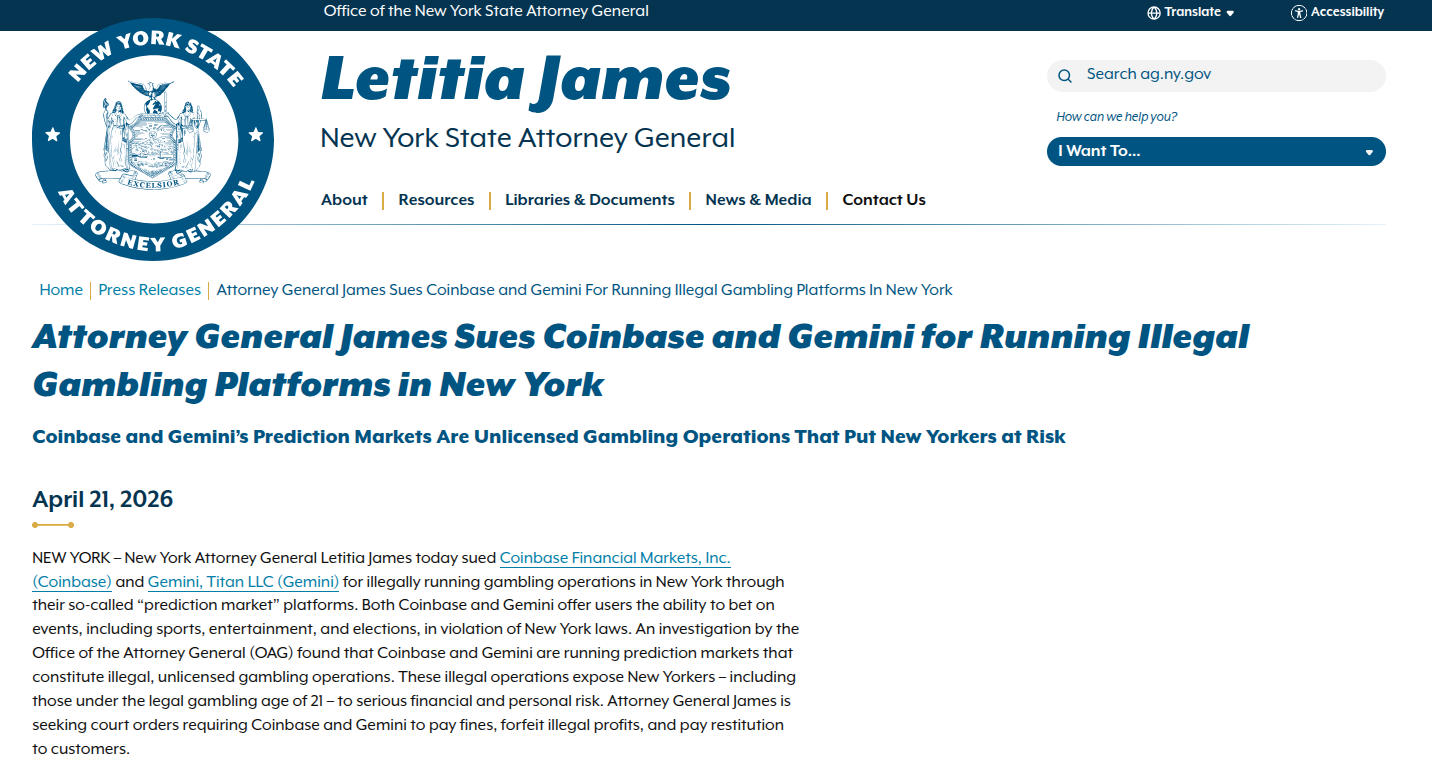
New York’s attorney general has filed lawsuits against crypto exchange operators Coinbase Financial Markets and Gemini Titan for allegedly violating state gambling laws, according to court records cited by Reuters.
Copies of the complaints show the state alleges both exchanges failed to obtain licenses from the New York State Gaming Commission to operate their markets, Reuters reported.
“Gambling by another name is still gambling, and it is not exempt from regulation under our state laws and Constitution,” Attorney General Letitia James said in a statement.
James said the lawsuit seeks to recover alleged illegal profits from operating prediction markets in the state, as well as restitution, and would bar Coinbase and Gemini from offering such products to individuals under 21 years of age.

Related: Polymarket in talks to raise $400M at a $15B valuation: Report
State regulators crack down on prediction markets
The move fits into a broader push by state regulators, including New York, to assert control over prediction markets, which occupy a fast-growing corner of crypto commerce that allows users to bet on real-world events.
Much of the recent scrutiny has centered on platforms like Polymarket and Kalshi, which have drawn questions over whether their products fall under financial regulation or gambling laws.
The tension has also reached the federal level. The Commodity Futures Trading Commission (CFTC) has taken legal action against several states attempting to regulate prediction markets, arguing it has sole authority over the sector.
New York’s lawsuit underscores a key risk for crypto companies. Even as the federal stance has softened, state-level enforcement remains active. By targeting prediction-style markets, regulators may be opening a new front — one that could force platforms to rethink how these products are offered in major jurisdictions.
Nevertheless, not every company is taking it lightly. As Cointelegraph reported, Polymarket has filed a lawsuit against Massachusetts, arguing the state lacks authority to regulate prediction markets approved by the CFTC.

Related: NYSE parent ICE completes new $600M investment in Polymarket


Optimism’s first privacy offering by core developer Sunnyside uses ZK and TEE hybrid technology to enable confidential computing for enterprises on the OP Stack.
Privacy Boost, a privacy offering built by Sunnyside—an Optimism core developer—launched on OP Mainnet on Tuesday, April 21. The product is a drop-in SDK enabling confidential computing for Sunnyside’s customers on any OP Stack chain. The hybrid architecture combines zero-knowledge proofs and trusted execution environments (TEE), with sub-500ms proof generation and compliance-compatible design.
Privacy Boost targets enterprise demand for onchain transaction privacy without exposing customer data. The protocol’s high-throughput design is expected to expand to additional blockchains beyond Optimism. The launch addresses institutional adoption barriers on Ethereum and Layer 2 networks where regulatory and operational requirements demand confidential data handling.
Sources: Optimism | Decrypt
This article was generated automatically by The Defiant’s AI news system from publicly available sources.

TLDR
- Nium has selected Coinbase to integrate USDC payments across its global network in more than 190 countries.
- The integration allows businesses to fund cross-border payouts in USDC and settle in stablecoins or local currencies.
- Coinbase provides custody, liquidity, and wallet infrastructure to support the new payment setup.
- Nium’s system enables just-in-time settlement, which removes the need for prefunded accounts in multiple jurisdictions.
- The company supports over 100 currencies, real-time payouts in more than 100 corridors, and holds over 40 regulatory licenses worldwide.
Singapore-based Nium has selected Coinbase to power USDC payments across its global network. The integration enables businesses to send, receive, and convert stablecoins across more than 190 countries. The rollout connects stablecoin liquidity with local fiat payouts through a single platform.
Coinbase powers USDC integration across Nium network
Nium will use Coinbase infrastructure for custody, liquidity, and wallet services across its payments network. The setup allows clients to fund cross-border payouts in USDC and settle in stablecoins or local currencies. As a result, businesses can avoid prefunding accounts in multiple jurisdictions and streamline capital use.
The integration supports just-in-time settlement, which deploys funds at payout instead of holding balances overseas. Nium also allows customers to link stablecoin balances to card programs for real-world spending. The company said the system connects settlement, compliance, and integration within one framework.
Nium stated that its network supports over 100 currencies and local collection in 40 markets. It also processes real-time payouts in more than 100 corridors worldwide. The company holds over 40 regulatory licenses across various jurisdictions.
The company recently launched a platform for stablecoin-funded cards on Visa and Mastercard networks. That platform converts balances to fiat at the point of sale. It also manages settlement and compliance through a unified system.
USDC expands global role in cross-border payments
USD Coin, known as USDC, launched in 2018 through Circle and Coinbase. The stablecoin maintains a 1:1 peg with the US dollar. It backs reserves with cash and short-term US Treasury holdings.
According to DefiLlama, USDC holds a market capitalization of about $78 billion. It ranks second among stablecoins by size. Tether’s USDT leads the market with roughly $188 billion in capitalization.
Circle has increased USDC adoption through partnerships focused on cross-border payments. In March, Circle partnered with Sasai Fintech to expand USDC corridors across Africa. The initiative targets remittances, business payments, and mobile wallet integrations.
In parts of Sub-Saharan Africa, remittance costs exceed 7%, according to industry data. The United Nations has set a 3% target for remittance fees. Circle said it aims to lower transfer costs through stablecoin settlement.
Earlier this month, Circle partnered with Thunes to extend USDC settlement across its payments network. Thunes operates in more than 140 countries worldwide. The integration enables near real-time transfers while reducing reliance on prefunded accounts.
Recent data shows rising USDC activity in the first quarter. A CEX.IO report found that USDC supply grew by about $2 billion during the period. In contrast, USDT supply declined by roughly $3 billion over the same timeframe.

Crypto World
USDT Now Live on Solana, Plasma, and Ethereum With 1:1 USD Onramps and Offramps: Privy and Ramp
Ramp expands stablecoin access by launching USDT across Solana, Plasma, and Ethereum with seamless 1:1 USD conversion for global money movement.
Ramp has launched USDT across Solana, Plasma, and Ethereum with integrated 1:1 USD onramps and offramps, according to an announcement from Privy on Tuesday, April 21, 2026. The expansion enables faster and cheaper cross-chain stablecoin access for thousands of businesses globally, with the infrastructure protected by Privy’s authentication and wallet solutions.
The deployment adds to Ramp’s growing multi-chain stablecoin infrastructure, positioning USDT across three major blockchain networks to reduce friction in fiat-to-crypto conversion flows. This move targets businesses seeking efficient global money movement rails without traditional banking intermediaries.
Sources: Privy (Official X Account)
This article was generated automatically by The Defiant’s AI news system from publicly available sources.


After attackers deposited rsETH from an exploited Kelp bridge and borrowed Wrapped ETH, Aave had frozen WETH across multiple markets.
Aave announced earlier today, April 21, that it has unfrozen wrapped ETH (WETH) reserves on its Ethereum Core V3 market, just over 24 hours after locking down WETH across multiple markets in response to the $290 million Kelp bridge exploit.
“WETH reserves on the Ethereum Core V3 market have been unfrozen and users can supply WETH to Ethereum Core V3 again,” Aave wrote on X this morning. WETH is a tokenized version of ETH compatible with decentralized finance smart contracts.
Late evening ET on April 19, Aave had frozen WETH reservers across its Core, Prime, Arbitrum, Base, Mantle, and Linea markets. “This action prevented new borrows against WETH collateral and contained the risk of stress spreading to other reserves, including stablecoins,” and April 20 incident report co-authored by Aae and LlamaRisk explained.
As The Defiant has reported, this year’s largest DeFi exploit so far happened on April 18, when a hacker exploited a vulnerability in liquid restaking protocol Kelp’s LayerZero bridge to forge a cross-chain message, releasing 116,500 KelpDAO Restaked ETH (rsETH), worth over $290 million, without any real tokens being sent.
The attacker deposited most of the rsETH as collateral on Aave and borrowed roughly $190 million in WETH across Ethereum and Arbitrum.
Aave’s risk team froze rsETH across all its markets within hours, then froze WETH itself on April 20 to stop the crisis from spreading further. Users had been unable to withdraw WETH or supply new deposits since.
As of April 21, WETH supply on Ethereum Core V3 is open again, though WETH’s loan-to-value ratio remains at zero, meaning it cannot be used as collateral for new borrowing. WETH on Ethereum Prime, Arbitrum, Base, Mantle, and Linea remains frozen, Aave noted on X.
The decision drew criticism from Spark’s head of strategy, who argued on X that the current interest rate configuration turns the unfreeze into a near-risk-free looping opportunity for holders of liquid staking and restaking tokens (LSTs and LRTs, which represent staked or restaked ETH positions) — keeping WETH locked up and making withdrawals even harder for ordinary depositors.
Depending on how Kelp ultimately allocates losses from the exploit, Aave faces between $124 million and $230 million in bad debt, per the protocol’s April 20 incident report. The Aave DAO holds $181 million in its treasury as of April 20, and says it has already received indicative commitments from ecosystem participants to help cover potential shortfalls.
Kelp is the second-largest liquid restaking protocol in DeFi per DefiLlama data, with $1.55 billion in total value locked across sixteen chains.
This article was written with the assistance of AI workflows. All our stories are curated, edited and fact-checked by a human.


Revolut has told investors it is targeting a valuation of $150 billion to $200 billion for a future initial public offering (IPO), the Financial Times reported on Tuesday.
The London-based fintech, which was valued at $75 billion in a secondary share sale last November, would not seek a stock market listing before 2028. No formal valuation target has been set, a source close to the company told the FT.
Revolut Eyes Up to $200 Billion Valuation in Future IPO
The company’s financial performance supports the ambition. Revolut’s pre-tax profit hit a record £1.7 billion ($2.3 billion) in 2025, a 57% increase from the prior year.
Revenue climbed 46% to £4.5 billion as its retail customer base grew 30% to 68.3 million.
Reports also indicate that Revolut is preparing for a secondary share sale in the second half of 2026. That transaction could value the company at around $100 billion, laying a stepping stone toward the IPO target.
Co-founder Nik Storonsky said in December that his personal stake would be worth roughly $80 billion if the company reached a $200 billion valuation.
Banking Licenses Fuel Global Expansion
Revolut received a full UK banking license from the Prudential Regulation Authority in March 2026, ending a years-long application process.
The license allows the crypto-friendly fintech to offer lending, savings, and credit products to UK customers.
The company also applied for a US banking license with the Office of the Comptroller of the Currency (OCC) in early March.
If approved, Revolut would operate more like a traditional bank in the world’s largest economy.
Can Revolut justify a $200 billion price tag? This may hinge on how quickly it converts new banking powers into lending revenue and grows its US footprint before any listing.
The post Revolut Builds $200 Billion IPO Case on Record Profits appeared first on BeInCrypto.


For all its talk of decentralized, autonomous, permissionless finance, the DeFi sector’s response to Saturday’s $290 million Kelp DAO hack tells a different story.
The firms involved are playing a messy, very human blame game over responsibility for the $14 billion fallout.
While the projects shirk responsibility, users have funds stuck in what had been considered the safe, reassuringly boring side of DeFi, and are potentially facing haircuts to cover bad debt.
Meanwhile, amid the uncertainty, the industry as a whole bleeds credibility.
Influential voices are urging the three key parties involved to get together and come up with a path forward. But, so far, it seems the firms are determined to play hardball.
LayerZero blames Kelp DAO’s choice of validator setup, while Kelp DAO says it followed LayerZero’s defaults. Aave stays out of it, hoping to get back to business as usual while avoiding its own role in driving rsETH’s deep integration.
Let’s take a look at the case against each of the projects involved.
Read more: Resolv hack shows DeFi learned nothing from last contagion
Kelp DAO
Kicking off with Kelp DAO, whose rsETH token was hacked on Saturday, there’s not an awful lot to go on.
The firm kept quiet for 48 hours after its initial acknowledgement of Saturday’s hack.
Users waiting to hear how losses might be distributed were finally presented with a brief statement that provided no new information.
It merely confirmed the mechanics of the exploit, congratulated, highlighted that Kelp DAO’s 1/1 DVN configuration is “the default for any new OFT deployment,” and congratulated itself on blocking a further $95 million hack attempt.
Read more: Hyperbridge exploited less than two weeks after April Fools’ day hack prank
It even came off as rather tame, given the potential attack of LayerZero which had been teased the previous day.
As for loss distribution, the firm says it’s “concurrently assessing the potential next steps.”
In praising Arbitrum’s decision to seize stolen ether (ETH), it didn’t give much more away, saying it’s “pursuing all available avenues to… mitigate the impact of the incident across the Defi ecosystem.”
We’ll keep waiting, then.
LayerZero
LayerZero has faced plenty of criticism, not just from Kelp DAO, that its architecture passes off the burden of security onto individual project teams, or ““empowers each application and asset issuer to define their own security posture,” as LayerZero puts it.
While the firm claims it recommends individual asset issuers to choose a secure setup, analysis from Dune suggests that almost half of over 2,500 OApp bridging contracts use a 1/1 DVN configuration.
One example, highlighted by blockchain security expert Taylor Monahan, explicitly states “use the LZ defaults” in its code comments.
Read more: Inside the $280M Drift hack: weeks of setup, minutes to drain
Indeed, in the wake of Saturday’s incident, many well-known crypto and DeFi projects paused bridging of their assets through LayerZero, including Ethena, EtherFi, WBTC, Tron and Curve.
Another point of contention is the lack of disclosure of the specific attack vector which granted access to its infrastructure leading to manipulation of the DVN, operated by Layer Zero itself.
Aave
Despite being furthest from the actual theft, DeFi’s former number-one protocol (now knocked off the top spot due to recent outflows) created the conditions for such widespread damage.
The use of rsETH as collateral in e-mode with targeted total value locked by allowing highly leveraged looping of ETH-correlated liquid (re)staking tokens, one of Aave’s key uses.
The risk assessments for these setups focused on “market and liquidity risk”, with bridging configurations deemed “a structural feature of composability rather than a scope question.”
Bridged rsETH had the same parameters as on mainnet, discounting any cross-chain risk entirely.
It appears likely that rsETH was specifically targeted for its deep liquidity, a feat achieved thanks to these decisions.
Aave appeared untouchable just a few months ago, but recent turmoil, hindsight on past hubris, and contributors lashing out at competitors, paints a different picture altogether.
Read more: Oracle error adds to turmoil at DeFi giant Aave
Arbitrum’s silver lining
Earlier today, Arbitrum’s security council pulled off a rescue of over 30,000 ETH ($71 million) of the hacker’s proceeds in the nick of time.
Shortly after, laundering of funds began on Ethereum. On-chain analysts confirmed DPRK involvement, spotting links to other TraderTraitor-related hacks, BTC Turk and ByBit.
While some of DeFi’s decentralization zealots may have an issue with the move, having the ability to seize illicit funds and not doing so would be the worst of both worlds, argued Curve Finance’s Michael Egorov.
Such a move is not without precedent, after all. In 2023, proceeds from the preceding year’s Wormhole hack were recovered with the help of Oasis, and in 2024, Blast seized $97 million from a rogue developer.
Yearn’s banteg also hopes that Arbitrum will have now scared off future attempts by Lazarus.
Important questions remain over the potential for similar actions in the future, centering on the need for a court order or a defined threshold above which to step in.
More pressingly, though, the question of how to redistribute the seized funds also remains to be answered.
Got a tip? Send us an email securely via Protos Leaks. For more informed news and investigations, follow us on X, Bluesky, and Google News, or subscribe to our YouTube channel.

POSCO Holdings Stock Jumps 8% on Low-Carbon Project Approval and Technical Breakout

Trump administration discussing currency swap line with UAE

Scarlett Johansson’s Mind-Bending Netflix Sci-Fi Is A Myth You’ll Wish Was True

Manchester United reach agreement with Casemiro over contract clause amid transfer speculation

Steven Gerrard disagrees with Gary Neville over ‘shock’ Chelsea and Arsenal claim | Football

US brings back mandatory military draft registration


-

 News Videos7 days ago
Secure crypto trading starts with an FIU-registered
-

 Fashion4 days ago
Weekend Open Thread: Theodora Dress
-

 Sports4 days ago
NWFL Suspends Two Players Over Post-Match Clash in Ado-Ekiti
-

 Politics4 days ago
Palestine barred from entering Canada for FIFA Congress
-
Entertainment2 days ago
NBA Analyst Charles Barkley Chimes in on Ice Spice McDonald’s Fiasco
-

 Business2 days ago
Powerball Result April 18, 2026: No Jackpot Winner in Powerball Draw: $75 Million Rolls Over
-

 Crypto World4 days ago
Russia Pushes Bill to Criminalize Unregistered Crypto Services
-

 Politics23 hours ago
Gary Stevenson delivers timely reminder to register to vote as deadline TODAY
-

 Tech3 days ago
Auto Enthusiast Scores Running Tesla Model 3 for Two Grand and Turns It Into Bare-Bones Go-Kart
-
 Business5 days ago
Creo Medical agree sale of its manufacturing operation
-

 Politics2 days ago
Zack Polanski demands ‘council homes not luxury flats for foreign investors’
-

 Tech6 days ago
‘Avatar: Aang, The Last Airbender’ Leaked Online. Some Fans Say Paramount Deserves the Fallout
-

 Crypto World4 days ago
Russia Introduces Bill To Criminalize Unregistered Crypto Services
-

 Tech7 days ago
Microsoft adds Windows protections for malicious Remote Desktop files
-
 Entertainment7 days ago
Dave Portnoy Slams Dianna Russini: ‘Makes Zero Sense’
-

 Crypto World7 days ago
X Launches New Cashtag Feature for Stocks and Crypto: X
-

 Entertainment7 days ago
Prince Carter Brings Fans Front Row and Backstage at Boys 4 Life Tour
-

 Sports6 days ago
British climbers complete new route in Swiss Alps
-
 Crypto World7 days ago
Paxos Labs Raises $12M to Launch Crypto Yield and Lending Platform
-

 Crypto World7 days ago
Bitcoin surpasses halfway mark in current halving cycle
You must be logged in to post a comment Login