The pre-pack sale of First-Rate Maintenance means it will continue trading under its own name
First-Rate Maintenance’s base in North Shields.(Image: Google Streetview)
A maintenance firm covering properties on Tyneside has been rescued out of administration.
First-Rate Maintenance, which began life in Newcastle in early 2020 before moving to North Shields three years later, has been sold via pre-pack administration to Scottish-based operator Dima Group. The move saves 28 jobs at the handyman services business which offers general maintenance, decorating, roofing, joinery, plumbing, landscaping, tiling and more.
Administrators from FRP Advisory said the Percy Park Rugby Club-based business had built a reputation for delivering services to housing associations, local authorities, landlords and national retailers. But last year the business began to experience cashflow pressures.
Joint administrators Steven Ross and Shaun Hudson said efforts had been made to stabilise the business but that the challenges faced meant directors had to call in professional insolvency advisors who arranged the sale.
Advertisement
First-Rate was originally launched with the support of its sister company and Newcastle student property specialist, Seekers – formerly known as Walton Robinson. The business touted itself as an expert in odd jobs and property maintenance across Tyneside and Newcastle, working with homeowners, landlords and managing agents on anything from minor repairs to full refurbishments.
Having been appointed earlier this month, the administrators completed a pre-pack sale to Dima Group FM, trading as First-Rate Maintenance Limited, an unconnected party. They said the deal allows First-Rate to continue trading under its current name and that it will keep existing contracts and services in place for clients.
Steven Ross, restructuring advisory partner at FRP and joint administrator of First-Rate Maintenance Limited, said: “This transaction delivers a positive outcome for all stakeholders. The sale preserves employment, maintains service continuity for customers and secures the future of a well‑regarded regional business, while achieving the best possible result for creditors.”
Andrew Gilmour of Dima Group added: “As the new operator, First-Rate Maintenance is committed to building on its established platform supporting its workforce, customers and partners as the business enters its next phase.”
Advertisement
Dunfermline-based Dima Group was launched in October 2018, originally as a security company, from a kitchen table with the aid of just a laptop and a phone. Two years later the firm opened its first office but then faced the Covid-19 pandemic within a matter of weeks.
The business has since relocated four times and now has a head offices on the city’s Enterprise Way, where it employs nearly 100 staff. It has since diversified into other services including provision of hospitality agency staff and chefs.
Dima works across Scotland and even provides services for every Dunfermline Athletic FC home game – including staff on the turnstiles, terraces, and hospitality areas that cater for fans.
India on Wednesday denied making any payments – either in cash or cryptocurrency – to Iran to secure safe passage for its vessels through the Strait of Hormuz amid heightened tensions in the region.
The clarification came after two Indian vessels had to turn back from the Strait of Hormuz after Iranian forces fired upon them as they attempted to cross the crucial waterway on April 18.
Before turning back, the captain of Indian tanker Sanmar Herald, in an audio recording that has surfaced, is heard pleading with Iranian forces to stop firing despite prior clearance to pass the Strait of Hormuz. “This is motor vessel, Sanmar Herald. You gave me clearance to go, my name is second on your list… You are firing now. Let me turn back.” While New Delhi has consistently rejected claims of any financial arrangements with Tehran for ship movement through the critical energy corridors, some reports linked the April 18 incident to a crypto scam.Reports suggest scammers are offering shipowners fake safe passage through the strait in exchange for crypto. At least one ship fell victim to the scam and was fired at while attempting to pass through the waterway, according to Marisk, a maritime risk services company.
Live Events
At a news briefing, Mukesh Mangal, Additional Secretary in the Ministry of Ports, Shipping and Waterways, termed as “fake news” the report of any payment being made for the safe passage of Sanmar Herald. “News is spreading about a reported payment by the captain of the vessel Sanmar Herald in US dollar to persons claiming to represent the Islamic Revolutionary Guard Corps (IRGC) Navy to grant passage, and fell victim to cyber criminals. We spoke with the owner of the vessel, and he confirmed that it is fake news and no such incident had happened,” he said.He said his ministry, in coordination with the Ministry of External Affairs, assesses the situation before asking Indian vessels, stranded in the Persian Gulf since the start of the Iran war, to cross the Strait of Hormuz.
“This unfortunate incident (of Iranian guards firing on Indian ships) happened on April 18. There was firing on two of our vessels, that’s why they had to go back,” he said. “As we have been telling in past also, we do not have any new data, any confirmation on any of our vessels has paid money to any of the authorities for this purpose.”
Advertisement
He termed as “fake news” reports suggesting that Sanmar Herald paid money to some cybercriminals, and that’s why it was fired upon.
“There is no relation (between the firing and the reports),” he said. “This is fake news.”
“It has come to our attention that there have been reports on social media about Sanmar Shipping’s very large crude carrier, Sanmar Herald, flying the Indian flag, falling prey to a cryptocurrency scam.
Advertisement
“We would like to clarify that these reports are completely false,” it said in a statement.
The shipping line said it is working in close coordination with the relevant agency of the Indian government to ensure the safe passage of Sanmar Herald.
According to shipping monitor TankerTrackers.com, two India-flagged ships, including a supertanker carrying Iraqi crude, were forced to turn back on April 18 after coming under fire.
The disruptions come as scores of commercial vessels and thousands of seafarers remain stranded in the Persian Gulf since the outbreak of the West Asia war on February 28, which has sharply curtailed movement through the Strait of Hormuz.
Advertisement
The Strait of Hormuz handles about a fifth of global oil and liquefied natural gas flows, making it one of the world’s most critical energy arteries. Iran’s ability to disrupt traffic through the narrow passage has emerged as a key lever in the conflict.
The halt in transit has driven up energy prices, triggered supply shortages in parts of the world and forced some countries to ration fuel, underscoring the global impact of the standoff.
Lululemon store sign on March 2,, 2026 in London, United Kingdom.
Peter Dazeley | Getty Images
Lululemon on Wednesday named Heidi O’Neill as the athleisure company’s new CEO, effective Sept. 8.
Advertisement
The news comes after the company has seen more than a year of disappointing performance and been embroiled in a dramatic proxy battle, with founder Chip Wilson criticizing the business.
Shares of the company sank more than 5% in extended trading.
O’Neill has held multiple roles at Nike, contributing to the sportswear behemoth’s growth. She also held positions at Levi Strauss, Hyatt Hotels and Spotify.
“Heidi is an inspiring leader and proven, consumer-driven brand strategist, with a rare ability to both imagine a new future for a brand and to create the structure and processes to deliver on that vision,” said Marti Morfitt, the company’s executive chair of the board of directors, in a statement. “We selected Heidi because of the breadth of her experience, her demonstrated success delivering breakthrough ideas and initiatives at scale, and her ability to be a knowledgeable change and growth agent.”
Advertisement
O’Neill said in a statement that she plans to focus on building off of the company’s core foundation and unlock growth in global markets. O’Neill will start with a base salary of $1.4 million, according to an 8-K filing.
“I am humbled by the opportunity and energized by what the team is already building,” she said in her statement. “I look forward to joining the company and helping to define and deliver the organization’s next chapter of success.”
Lululemon has been struggling with weak sales and increased competition, as well as mounting costs from tariffs. In its last earnings report, the retailer said it expects tariffs to cost the company $380 million this year.
Wilson, Lululemon’s largest shareholder, has also been placing increased public pressure on the company to make changes to its board of directors. He did not immediately respond to a request to comment on the appointment.
Advertisement
In a statement, GlobalData managing director Neil Saunders said O’Neill has “a very strong pedigree in the activewear and sporting space” and “has an intimate knowledge of how the industry works.”
“There will be some, mostly activist investors, who see O’Neill as something of a safe and traditional choice,” Saunders said. “This argument is partly valid as a lot of cultural change is needed at Lululemon in order to improve performance. However, in our view, O’Neill is her own person who will come with an agenda of change.”
While at Nike, O’Neill played a key role in the company’s doomed direct-to-consumer sales strategy, where the brand pivoted away from wholesale partners in favor of its own website and stores under former CEO John Donahoe. When current CEO Elliott Hill took over as Nike’s next chief executive, he made it a priority to walk back the direct selling plan.
Prior to leaving Nike, O’Neill also oversaw product and innovation at a time when the brand faced criticism for falling behind on new products and focusing too heavily on the same legacy lifestyle franchises, Dunks, Air Force Ones and Air Jordans. While the franchises briefly led to a surge in sales, fueling Nike’s growth to a $50 billion plus brand, they ultimately became ubiquitous in the market and viewed as uncool by some consumers.
Advertisement
Now, Hill is still working on unwinding that strategy and clearing inventory from those franchises from the marketplace, which has hit Nike’s margins and led to a decline in sales online.
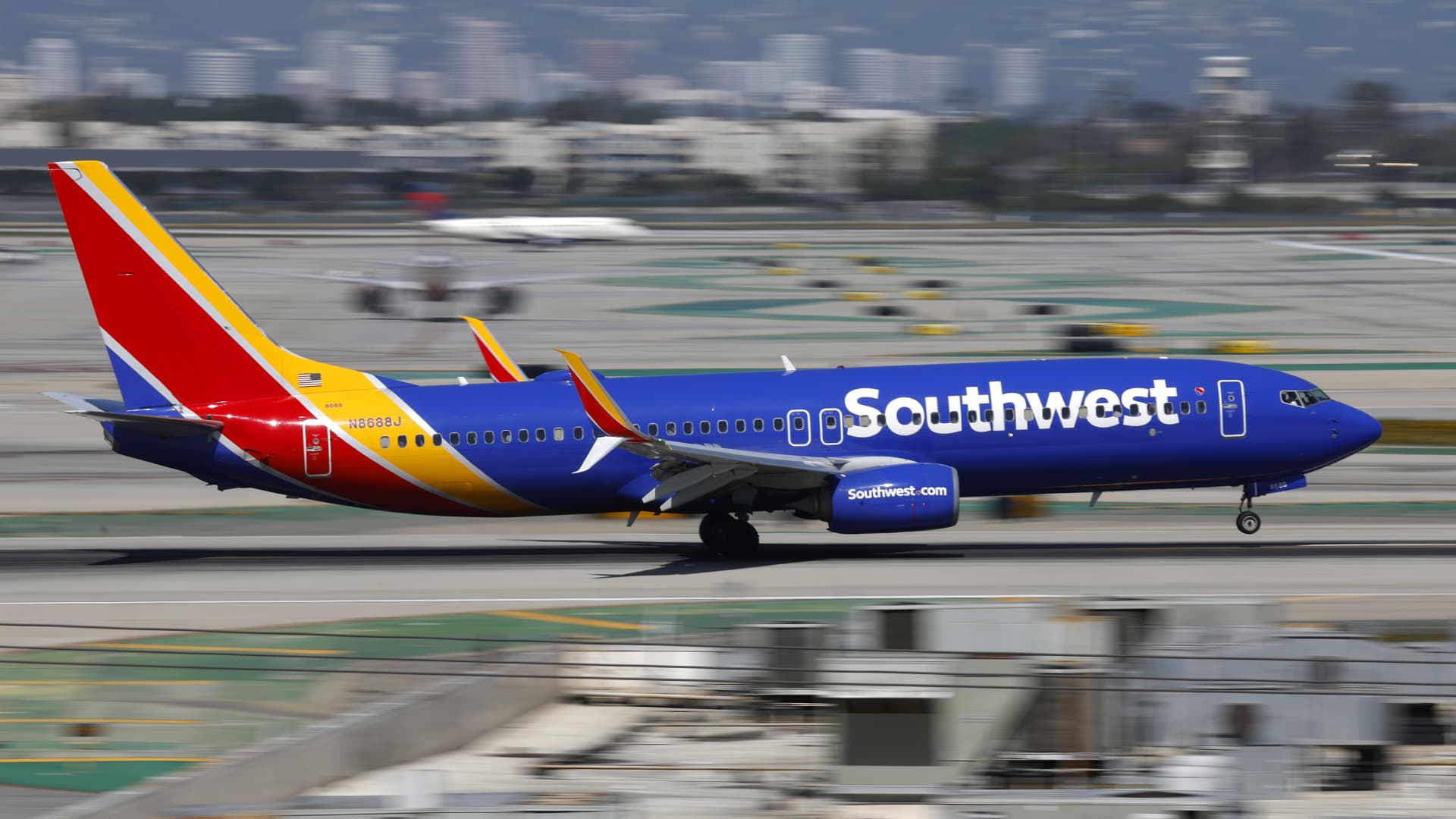
A Southwest Airlines Boeing 737 airplane lands at Los Angeles International Airport after arriving from Chicago on March 7, 2026 in Los Angeles, California.
Kevin Carter | Getty Images
Southwest Airlines forecast second-quarter earnings below analyst estimates, citing higher fuel prices, while holding off on updating its full-year 2026 forecast.
Advertisement
Southwest expects to earn between 35 cents and 65 cents a share in the current quarter, while analysts polled by LSEG expected 55 cents a share.
The airline in January forecast earnings per share of $4 this year, saying that it expected its new initiatives would pay off. Southwest has sought to increase revenue with checked bag fees and seat assignment fees.
“Achieving this outcome would require lower fuel prices and/or stronger revenue performance to offset higher fuel expense. The Company expects to provide updates to this guidance as appropriate,” Southwest said in an earnings release Wednesday.
Airlines have been either cutting their full-year forecasts or holding off on further forecasts because of volatile prices for jet fuel, generally their biggest expense after labor. They are also pulling back on their capacity growth plans to cut costs, which can drive up airfare when fewer seats are for sale.
Advertisement
Southwest said it expects its capacity to be flat to up no more than 1% in the second quarter, and unit revenues to rise by 16.5% to as much as 18.5% over last year.
“Demand continues to be strong, and we remain focused on controlling what we can control by managing costs, optimizing revenue initiatives, and directing capacity toward higher‑return opportunities,” CEO Bob Jordan said in the earnings release.
Here’s what the company reported for first quarter compared with Wall Street expectations, according to consensus estimates from LSEG:
Earnings per share: 45 cents vs. 47 cents cents expected
Revenue: $7.25 billion vs. $7.27 billion expected
Southwest swung to a profit of $227 million, or 45 cents a share in the first quarter, compared with a $149 million loss, or a loss of 26 cents per share, a year earlier.
Revenue rose nearly 13% to $7.25 billion compared with $6.43 billion in the year-earlier period.
A severe environmental and public health crisis is unfolding across Thailand, Laos, and Myanmar as widespread forest fires and agricultural burning create dangerous levels of air pollution. The recurring smog, exacerbated by the region’s dry season and persistent slash-and-burn farming practices, has led to a significant surge in respiratory illnesses and sparked urgent calls for structural legislative reform, as current government efforts remain hampered by weak enforcement and a lack of regional cooperation.
Key Points
The northern provinces of Thailand, including Chiang Mai and Chiang Rai, have been subjected to critical, long-term exposure to PM2.5 pollution, which has persisted for over two months.
Fires are driven by a combination of natural dry-season conditions and widespread agricultural practices, particularly slash-and-burn land clearing for crops and animal feedstock.
Cross-border pollution remains a major obstacle, as Thai officials struggle to mitigate smoke originating from Myanmar and Laos, where enforcement of burning bans is minimal.
Medical professionals report an alarming increase in severe respiratory issues and lung cancer cases among non-smokers, attributing these health trends directly to the poor air quality.
Volunteer firefighters in countries like Laos are currently tasked with managing large-scale blazes while relying on inadequate, basic equipment.
Lawmakers and health advocates are pushing for the enactment of a comprehensive Clean Air Act in Thailand, arguing that the crisis is a systemic issue that cannot be solved with short-term, superficial measures.
The Rising Impact of Seasonal Forest Fires Across Thailand and the Mekong Region
The Mekong region, encompassing Thailand and its neighboring nations, is currently grappling with a severe surge in forest fires. This seasonal phenomenon has escalated into a significant environmental and public health concern, drawing attention from meteorologists, government officials, and international environmental organizations. As the dry season persists, the proliferation of uncontrolled blazes continues to threaten biodiversity, regional air quality, and the stability of local economies.
Northern Thailand is currently facing a severe environmental crisis as persistent forest fires continue to blanket the region in hazardous levels of PM2.5 pollutants. With thousands of hotspots detected across conservation and national forest areas, residents are suffering from significant health complications, while government officials and emergency responders struggle to contain the blazes. Despite ongoing firefighting efforts and proposed infrastructure improvements, the situation remains dire, prompting urgent calls for stronger legislative action to address the recurring annual air quality disaster.
The primary drivers of these forest fires are a combination of extreme climatic conditions and traditional agricultural practices. The onset of the dry season often leads to parched vegetation, creating highly combustible landscapes. Simultaneously, the persistent reliance on slash-and-burn farming techniques to clear land for seasonal crops remains a major catalyst for ignition. While many of these fires originate as managed agricultural clearing, they frequently escape containment due to high winds and prolonged drought, rapidly evolving into widespread wildfires that transcend provincial and national borders.
The environmental consequences of these fires are profound. Beyond the immediate destruction of forest cover and wildlife habitats, the blazes release substantial amounts of carbon dioxide and particulate matter into the atmosphere. This has resulted in a critical decline in air quality across several provinces in Northern Thailand, Laos, and Myanmar. The presence of hazardous levels of PM2.5 pollutants poses a significant risk to public health, leading to increased respiratory illnesses and creating long-term challenges for healthcare infrastructure in the affected regions.
Advertisement
Regional authorities are increasingly aware of the transboundary nature of this crisis. Because smoke and pollutants do not respect national boundaries, isolated efforts by single governments often yield limited results. In response, there is a growing emphasis on regional cooperation within the ASEAN framework. Current strategies focus on strengthening satellite monitoring systems to identify fire hotspots in real-time, enforcing stricter regulations against unauthorized burning, and incentivizing farmers to adopt more sustainable agricultural methods that do not rely on fire.
Economic activity is also significantly impacted. The tourism sector, a cornerstone of the regional economy, faces disruptions as visibility drops and air quality concerns deter travelers. Furthermore, the agricultural sector faces long-term risks, as repeated burning can deplete soil nutrients and contribute to increased land degradation, ultimately undermining the productivity of the land.
Addressing this recurring crisis requires a multifaceted approach. While immediate emergency response teams remain essential for suppressing active fires, a sustainable long-term solution must address the root socio-economic causes. Transitioning toward modern, fire-free farming technologies and enhancing public education regarding the environmental impacts of burning are critical steps toward mitigation. As the Mekong region navigates the remainder of the current dry season, the focus remains on coordinating regional resources to minimize the damage and developing robust frameworks to prevent such extensive fire activity in future seasons.
While market regulator Securities and Exchange Board of India (Sebi) has been taking steps to curb speculative trading in the domestic futures & options (F&O) markets, Zerodha founder and CEO Nithin Kamath on Wednesday highlighted the highly skewed nature of India’s derivatives market, noting that despite widespread perception, the F&O segment remains relatively small.
Kamath said that in March, only about 30 lakh individuals traded F&O contracts, while across FY26, roughly 20 lakh traded exclusively in derivatives. Even after combining equity and F&O participants, the number rises to just around 64 lakh, a fraction of India’s nearly 13 crore investor base.
He pointed out that only 3.8 crore investors were active across segments, implying that just 30% of investors actually traded, underlining limited participation in the markets.
More importantly, Kamath emphasized that brokerage industry revenues are heavily dependent on a small set of active traders, with a disproportionate share of activity concentrated at the top. Around 60–70% of F&O volumes are generated by just 1–2% of traders, reflecting a sharply imbalanced market structure.
Advertisement
According to him, the data suggests that while retail participation has expanded, trading intensity—and consequently revenues—are driven by a very narrow base of investors.
Live Events
“Despite what people think about F&O trading in India and all its problems, it is still a very, very small market compared to almost anything else. In fact, in the month of March, only about 30 lakh people traded an F&O contract. Across FY26 as a whole, only about 20 lakh people traded only in F&O. If you combine people who traded in equities and F&O, that number goes up to roughly 64 lakh. So this is still a very small market. Altogether, out of nearly 13 crore unique investors, only around 3.8 crore investors were active across cash and F&O. That means only about 30% of investors traded anything at all,” Kamath tweeted. “And yet, the only reason broker revenues have held up is that a small number of people are trading more. Pretty much the entire revenue pool of the broking industry comes from this relatively small pool of traders. If you look at F&O turnover, around 60–70% of trading volumes come from a tiny set of investors, roughly just 1–2%. That is the lopsided structure of the Indian markets,” he added.
Despite what people think about F&O trading in India and all its problems, it is still a very, very small market compared to almost anything else. In fact, in the month of March, only about 30 lakh people traded an F&O contract. Across FY26 as a whole, only about 20 lakh people… https://t.co/aZbzItQb4P“>pic.twitter.com/aZbzItQb4P
The Port of Cebu is a major potential SAF export hub for ASEAN, fueled by strong underlying drivers in the Philippines.
The Port of Cebu has been recognized as a key hub for potential Sustainable Aviation Fuel (SAF) exports within ASEAN. This strategic positioning highlights the Philippines’ burgeoning role in the global shift towards greener aviation fuels. The identification of Cebu underscores its existing infrastructure and logistical advantages, making it an attractive gateway for the region’s SAF trade.
This recognition is bolstered by strong underlying drivers within the Philippines that support SAF development and export. These factors likely include a growing commitment to renewable energy, favorable government policies, and the potential for robust domestic production of feedstocks necessary for SAF creation. The nation is increasingly investing in technologies and partnerships to capitalize on these strengths.
By leveraging the Port of Cebu, the Philippines is poised to not only meet its own sustainability goals but also to become a significant supplier of SAF to other ASEAN nations. This initiative represents a forward-thinking approach to aviation, aiming to reduce carbon footprints and foster a more environmentally responsible air travel industry across Southeast Asia.
BMW wants to keep making sedans in spite of U.S. tariff pressures on German imports and the far higher sales of sport utility vehicles, said Sebastian Mackensen, the company’s North America chief.
Mackensen made the comments in an interview on Tuesday, a day before BMW unveiled an updated version of its full-size 7 Series sedan, which includes a slew of design and technology features BMW had originally developed for its electric vehicles.
The 7 Series vehicles will be the first without electric powertrains to come equipped with the new tech, which includes a panoramic heads-up display in the windshield and a voice assistant that uses artificial intelligence. Other upgrades include an enlarged drop-down screen that, along with a 36-speaker array, can essentially turn the rear seats into a small movie theater.
Called “neue klasse” — German for “new class” — BMW had intended its EVs to meld futuristic designs with a software-driven vehicle platform, following EV makers such as Tesla, Rivian, Lucid and Chinese brands.
Advertisement
“Already so many innovations have come to life that the company decided we need to bring those innovations into our entire lineup,” Mackensen said.
The 7 Series currently starts above $99,000 for the base model and runs up through a $168,000 starting price for the high-performance i7 M70 EV.
“I would say it is really on the top of our product portfolio,” Mackensen said. “It is the pinnacle of what we produce when it comes to luxury, but obviously always, always performance.”
However, since 2018, another full-size BMW, the X7, has rocketed past the 7 Series in the U.S. in terms of sales. In 2025 BMW sold nearly about twice as many full-size X7 SUVs as it did full-size sedans, if you combine sales of both the 7-Series with the similar, two-door, 8-Series.
Advertisement
This reflects an industry-wide trend, as SUV sales have overtaken sedans by a wide margin.
The X7, meanwhile, is made in Spartanburg, South Carolina, while the 7 Series, like all BMW sedans, is imported. Vehicles shipped to the U.S. from Germany carry a 15% tariff.
“This is definitely going to come into play,” said Robby DeGraff, manager of product and consumer insights at AutoPacific. “I can’t see BMW ever reallocating production of the 7 Series stateside, so the automaker is going to have to carefully keep tabs on demand and actual sales, to see how long it will be worth it to import the 7 Series.”
Though some of BMW’s closest rivals — such as Mercedes-Benz and Porsche — still have full-size sedans, several premium and luxury automakers have pulled theirs from the U.S. market in recent years.
Swedish maker Volvo stopped importing its S60 and S90 sedans in 2025. Lexus will discontinue the LS full-size sedan in the U.S. after the 2026 model year. German rival Audi said it will stop making the A8. It has been several years since American brand Lincoln made a sedan of any size.
Mackensen said that means the 7 Series sedan has a lot of potential.
“We obviously have a successful SUV lineup,” he said. “But we have always been a very successful sedan brand. We have a healthy share of sedans in our overall sales. And we like sedans. A lot of BMW customers like sedans, and we have no intention to stop offering sedans also in the future.”
Advertisement
By some metrics, sedans don’t have as strong a business case as SUVs do, said Stuart Pearson, head of automotive and mobility research at Oxcap Analytics.
“If you were being just purely economical about it and not thinking about image and brand, just saying, ‘Well, is this model worth the return?’ You might say no,” Pearson said.
Pearson added that BMW does sell many lower-priced sedans. The 7 Series shares underpinnings with some of them, such as the smaller 5 Series, so the cost of producing it is incremental, And, he added, the 7 Series is a technological flagship.
“I think they build these, these days, more to prove that they can than anything else,” said Sean Tucker, managing editor of Kelley Blue Book. “The fastest version of the 7 Series right now has a 0 to 60 time of 3.5 seconds. That is absurd for a car this large. The rear seats are as luxurious as the front seats. … This is everything BMW can build. It’s a showpiece.”
Advertisement
A substantial share of customers are still considering sedans overall. According to an AutoPacific survey of 18,000 Americans who plan to buy or lease a vehicle in the next three years, 45% of prospective BMW customers said they were most likely to get a four-door sedan. That percentage is very similar, if not identical, to that of Mercedes-Benz and Audi.
“I don’t think we’re going to see BMW pull the plug on its 7 Series soon, or Mercedes-Benz kill the S-Class anytime in the near future,” DeGraffsaid. “That, to me, would be a shocker. Those two brands really know their target audiences. Again, consumer choice is king in the luxury space.”
The U.S. alone accounts for about 30% of BMW’s profits, Pearson said, and that’s only grown as automakers have faced increasing pressure from Chinese automakers.
“The U.S. is a critical market to BMW,” Pearson said. “It’s always been one of its more profitable markets.”
Advertisement
The brand has set “ambitious” overall sales targets in the U.S. for 2026, Mackensen said — though he wouldn’t share specific numbers. In 2025, BMW was the top-selling luxury brand in the U.S., according to according to Kelley Blue Book.
“We are bullish on BMW performance in the United States,” he said.
NEW YORK — GameStop Corp. shares jumped more than 4.7% in midday trading Wednesday, climbing to $25.61 as renewed retail investor enthusiasm and speculation around CEO Ryan Cohen’s ambitious turnaround plans fueled the latest surge in the iconic meme stock.
GameStop Shares Surge 4.7% to $25.61 as Meme Stock Momentum Returns Amid Ryan Cohen Transformation Bets
The video game retailer’s stock rose $1.15, or 4.70%, from Tuesday’s close of $24.46, with volume exceeding 3.5 million shares by late morning on the New York Stock Exchange. The move extended recent gains, pushing the stock up roughly 21% year-to-date in 2026 despite ongoing challenges in its core brick-and-mortar business.
Analysts and traders pointed to a combination of factors driving the uptick, including persistent short interest, options activity and lingering optimism that Cohen could execute a “transformational” acquisition using the company’s substantial cash reserves, estimated near $9 billion. Cohen has repeatedly signaled interest in a major deal involving a larger consumer-facing company that could dramatically reshape GameStop beyond traditional gaming retail.
The rally comes weeks after GameStop reported stronger-than-expected fourth-quarter results in late March, posting adjusted earnings per share of 49 cents versus expectations of around 30 cents. While revenue continued to decline amid industry shifts toward digital downloads, the company demonstrated improved profitability and gross margins, largely driven by its growing collectibles segment.
Cohen, who took the helm as chairman and later CEO after his activist push in 2020-2021, has focused on cost-cutting, including store closures, while building a war chest through conservative cash management and earlier capital raises. His vision includes pivoting toward higher-margin areas such as trading cards, collectibles and potentially e-commerce expansions or outright acquisitions.
Advertisement
In January, GameStop’s board approved a massive long-term performance award for Cohen tied to ambitious targets: achieving a $100 billion market capitalization and significant EBITDA milestones. The package, valued potentially at $35 billion in stock options and fully at-risk, requires shareholder approval at a special meeting expected in the coming months. Cohen has put his own money behind the effort, purchasing substantial blocks of shares earlier in the year.
Market watchers noted heightened options activity in recent sessions, with call volumes outpacing puts and strikes around $25 attracting particular interest. Such patterns often signal speculative bets on further upside among retail traders who helped propel GME to extraordinary heights during the 2021 short squeeze.
Short interest remains a key narrative for GME enthusiasts, though exact current figures fluctuate. The stock’s history of rapid, volatility-driven moves has kept it on watch lists for both momentum traders and skeptics who question the sustainability of a business still heavily tied to declining physical game sales.
GameStop has not held traditional earnings conference calls under Cohen’s leadership, instead releasing results with minimal forward guidance. The approach has frustrated some Wall Street analysts, who maintain cautious ratings and lower price targets around $13 to $22, citing structural headwinds in the gaming sector and execution risks on any major acquisition.
Advertisement
Yet retail sentiment on platforms like Reddit’s r/Superstonk and r/GME continues to celebrate signs of strategic patience. Supporters highlight the company’s debt-free balance sheet, cash position and Cohen’s track record at other ventures, including his earlier success with Chewy.
Broader market context also played a role Wednesday. Technology and consumer discretionary stocks showed mixed performance, but meme names occasionally decoupled from fundamentals on social media buzz. GameStop’s 52-week range spans from about $19.93 to $35.81, illustrating the stock’s capacity for sharp swings even years after its headline-making 2021 peak above $400 pre-split.
Company officials have emphasized a long-term focus on value creation rather than short-term quarterly optics. Recent initiatives include expanded collectibles offerings, Power Packs for digital trading cards and promotional trade-in deals aimed at refreshing inventory and engaging customers.
Industry analysts remain divided on GameStop’s path forward. Some see potential in leveraging its brand and customer base for adjacent businesses, while others warn that physical retail faces existential threats as console makers and publishers push digital-first models. The rise of PC gaming and subscription services has further pressured traditional store-based revenue.
Advertisement
Cohen has described potential deals as “very, very, very big,” fueling speculation around targets such as eBay or other e-commerce platforms that could complement GameStop’s ecosystem. Any such move would likely deploy a meaningful portion of the cash hoard, raising questions about integration risks and shareholder dilution concerns.
As of midday Wednesday, GameStop’s market capitalization hovered near $11 billion. The stock’s price-to-earnings ratio stood elevated compared with traditional retailers, reflecting the premium investors place on its unique meme status and Cohen’s vision.
Trading in GME remained subject to heightened volatility, with circuit breakers possible during extreme moves. The company has faced past scrutiny over rapid price swings and the role of social media coordination, though regulatory attention has eased since the 2021 events.
For long-term holders, the narrative centers on whether Cohen can deliver on transformation goals before cash reserves erode or competitive pressures intensify. Recent insider buying by Cohen and earlier mentions of investor Michael Burry adding positions have provided bullish signals, even if temporary.
Advertisement
Critics argue the stock’s valuation already incorporates optimistic acquisition scenarios, leaving limited margin of safety if deals fail to materialize or underperform. Consensus forecasts for 2026 project a wide range of possible outcomes, from modest averages around $23 to highly bullish scenarios exceeding $80 in some technical models.
GameStop employs roughly 12,000 people across its global operations, though workforce reductions have accompanied store rationalization efforts. The company continues to operate hundreds of locations while testing new formats and online enhancements.
As trading progressed Wednesday, attention turned to whether the intraday gains could hold into the close or spark another wave of retail participation. Volume remained solid but below some of the heavier sessions seen earlier in April.
The latest move underscores GameStop’s enduring appeal as a high-beta play in an otherwise subdued market for certain consumer stocks. While fundamentals show a shrinking core business offset by cash and profitability improvements, the story remains dominated by bets on Cohen’s next strategic chapter.
Advertisement
Investors should approach GME with caution given its history of extreme volatility. Those monitoring the name will watch closely for any updates on the performance award vote, acquisition developments or the next quarterly filing.
With the stock trading well off its 2021 highs but showing resilience in 2026, GameStop continues to captivate a dedicated following even as the broader retail landscape evolves rapidly around it.


















 ETPrime Membership

























































You must be logged in to post a comment Login