

Crypto World
Hyperliquid price forms bearish double top, will it crash back to $35?

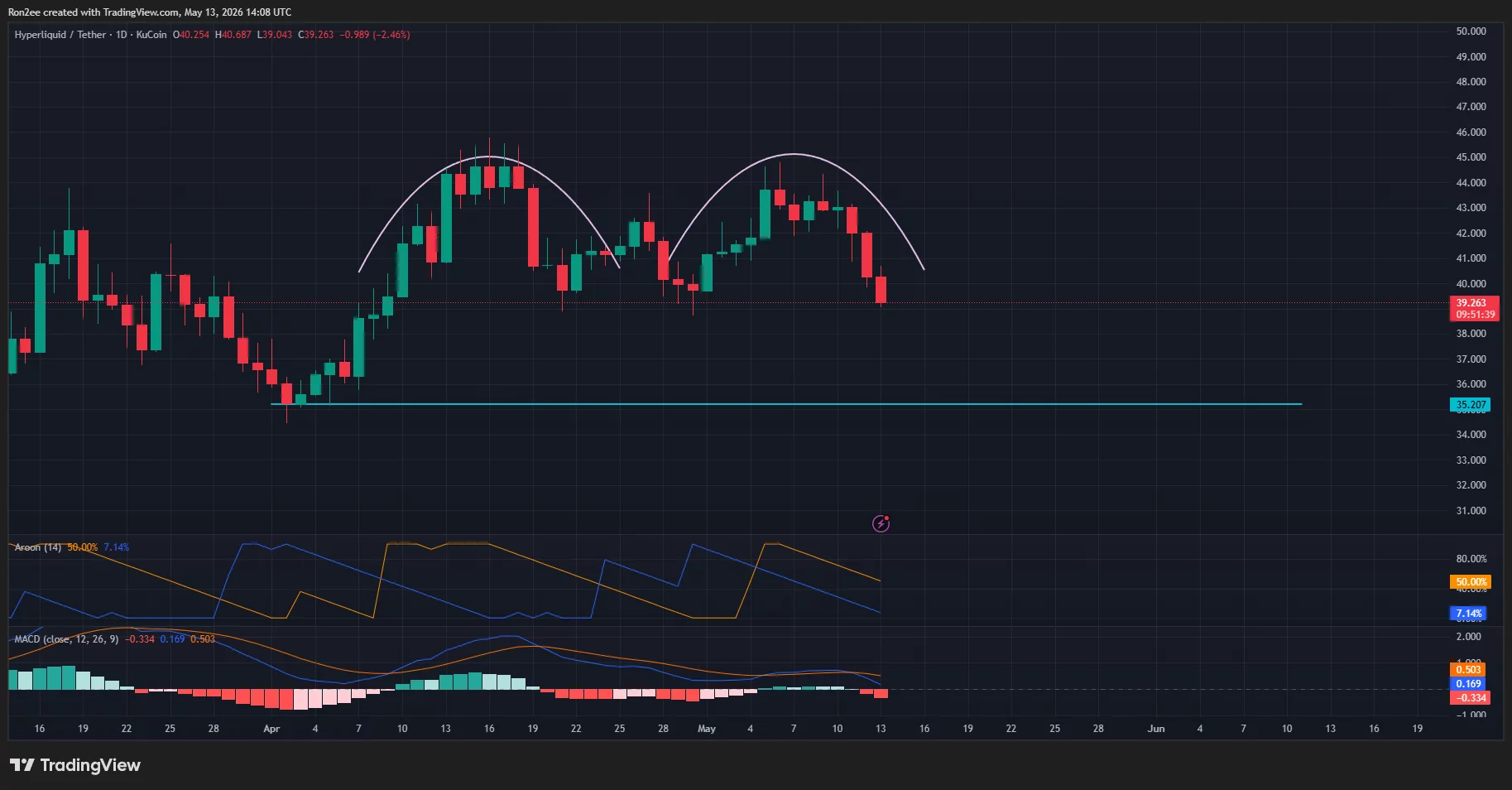
Hyperliquid price extended its decline on Tuesday after failing to hold above a key resistance zone, raising concerns that a bearish double top pattern may now be forming on the daily chart.
Summary
- Hyperliquid price fell toward $39 after forming a potential bearish double top pattern near the $44–$45 resistance zone.
- Whale positioning on Hyperliquid reached $4.236 billion, with long and short exposure remaining nearly balanced at a 0.98 ratio.
- A bearish MACD crossover and weakening momentum indicators raised the risk of a deeper correction toward the key $35 support level.
According to data from crypto.news, Hyperliquid (HYPE) price dropped to around $39.2 at press time on May 13 after briefly trading above $44 earlier this month. Despite the recent pullback, the token still remains significantly above its April lows near the $35 region.
The latest correction comes as whale positioning on Hyperliquid reached roughly $4.236 billion in total exposure, with large traders showing an unusually balanced stance between bullish and bearish bets. Long positions accounted for around $2.099 billion, while short positions stood slightly higher near $2.137 billion, producing a near-neutral long-short ratio of 0.98.
The positioning suggests that institutional and high-net-worth traders remain uncertain on the market’s near-term direction despite elevated volatility across digital assets.
At the same time, investor sentiment surrounding the Hyperliquid ecosystem has remained relatively strong following the launch of the first U.S.-listed exchange-traded funds tied to the HYPE token by 21Shares. The products include a spot ETF with staking exposure alongside a leveraged fund linked to the decentralized derivatives platform.
The ETF launch further strengthened Hyperliquid’s growing institutional profile as the protocol continues dominating decentralized perpetual futures trading. The platform currently controls a substantial share of decentralized perpetual open interest while processing billions of dollars in daily trading volume.
However, traders appear to have started locking in profits after HYPE repeatedly failed to break above the key $44–$45 resistance zone over the past several weeks.
Hyperliquid price analysis
On the daily chart, Hyperliquid price appears to have formed a bearish double top pattern with two major peaks established near the $44–$45 region. Typically, a double top pattern signals weakening bullish momentum and often precedes a deeper correction once the neckline support breaks.
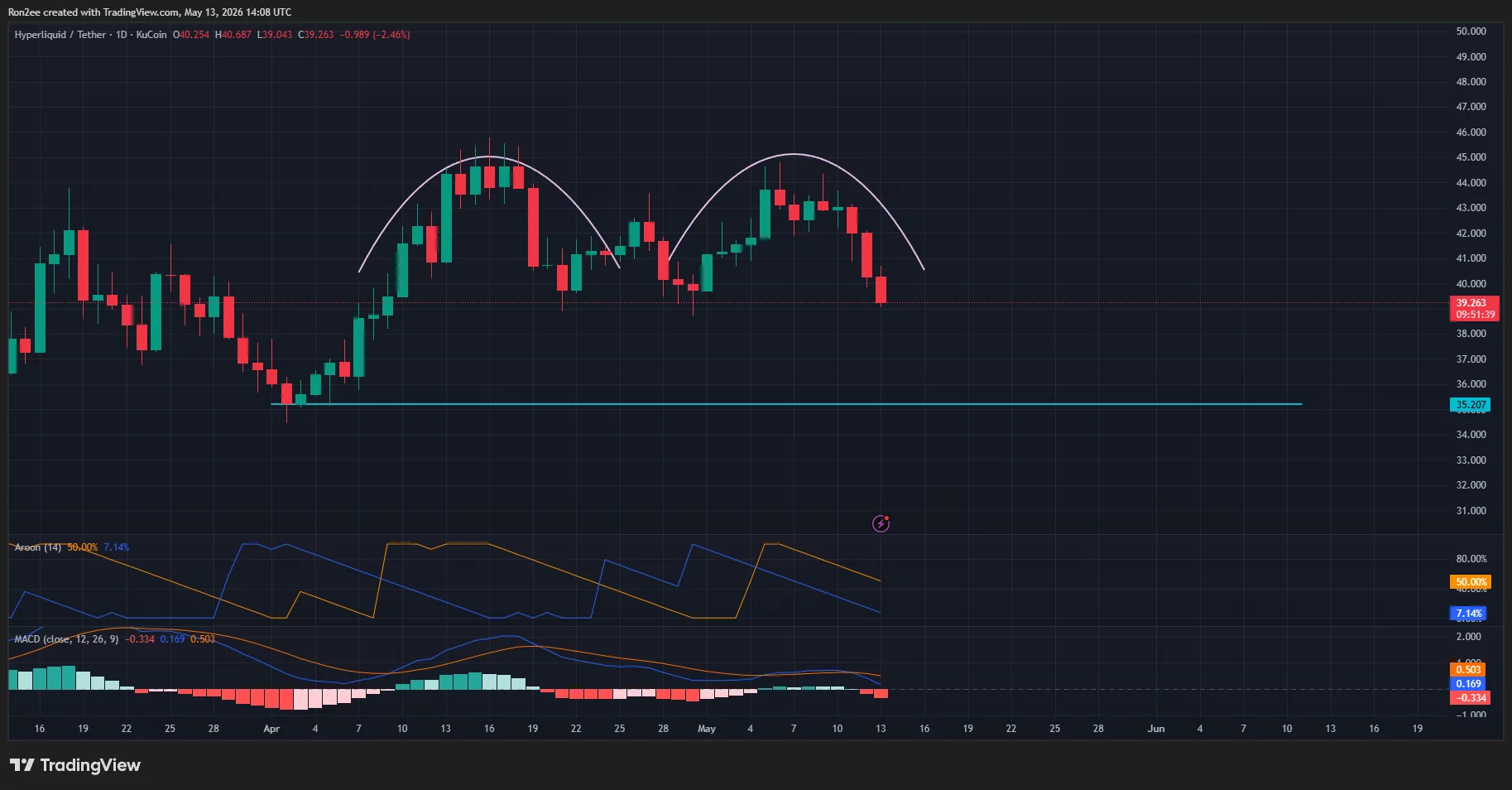
The neckline of the pattern currently sits near the $35.2 support zone, which also aligns with a major horizontal support area that buyers defended aggressively during the April consolidation phase.
A look at the MACD indicator reinforces the weakening momentum outlook. The MACD histogram has turned negative again, while the MACD line has crossed below the signal line, confirming a bearish crossover and suggesting that downside pressure may continue building in the short term.
Meanwhile, the Aroon indicator also points to fading bullish momentum. The Aroon Up indicator has declined toward the 50% level while the Aroon Down remains subdued near 7%, signaling that buyers are gradually losing control of the trend even though broader bearish dominance has not yet fully emerged.
If sellers manage to push HYPE below the neckline support near $35, the bearish double top setup could trigger a larger correction toward the $31–$32 region.
On the upside, bulls would likely need to reclaim the $44 resistance area to invalidate the bearish structure and restore momentum toward the psychological $50 level.
Disclosure: This article does not represent investment advice. The content and materials featured on this page are for educational purposes only.

The White House is reportedly weighing roughly 250 presidential pardons to mark America’s 250th birthday, the Wall Street Journal reports. Crypto’s most prominent legal cases are already running the numbers.
The plan remains preliminary. Yet it surfaces as Sam Bankman-Fried (SBF), Roger Ver, and other crypto defendants intensify their bids for clemency from Donald Trump.
A Pardon Pool Built for Symbolism
Trump has already issued more than 1,600 acts of clemency in his second term. That is several times more than the 250 he granted across his entire first term, and a meaningful share has flowed straight into the crypto industry.
In October 2025, the president pardoned Binance founder Changpeng Zhao after his guilty plea on anti-money laundering charges.
Earlier the same year, the BitMEX co-founders and Silk Road creator Ross Ulbricht received clemency of their own.
A symbolic batch of 250 pardons, packaged around Independence Day, would extend a pattern critics call transactional and supporters frame as a correction of past prosecutions.
“Ulbricht was sentenced to two life sentences, plus 40 years, a sentence worse than the worst drug sellers on the site,” wrote Collin Rugg.
Follow us on X to get the latest news as it happens
Who in Crypto Could Still Walk Free
Three names dominate the speculation. Sam Bankman-Fried, the convicted founder of FTX, has run a sustained public campaign for relief. Trump explicitly denied the request in January, but allies have not stopped lobbying.
While SBF’s pardon hopes have been dashed, Trump has signaled openness to clemency in other crypto-related cases. The President recently said he would “look at” the case of Samourai Wallet CEO Keonne Rodriguez.
Roger Ver, the early BTC backer widely called “Bitcoin Jesus,” has pushed harder than almost anyone. He hired political operative Roger Stone and recorded a direct video plea.
Elon Musk has reportedly explored backing his case as well, just like Ethereum co-founder Vitalik Buterin and other crypto leaders.
“Genuine good faith mistakes should be treated by giving the actor the opportunity to pay back taxes if needed with interest and penalties, not with prosecution,” Buterin proposed in reference to Roger Ver.
Joby Weeks, a miner who pleaded guilty to tax-related charges tied to a crypto scheme, is also seeking inclusion.
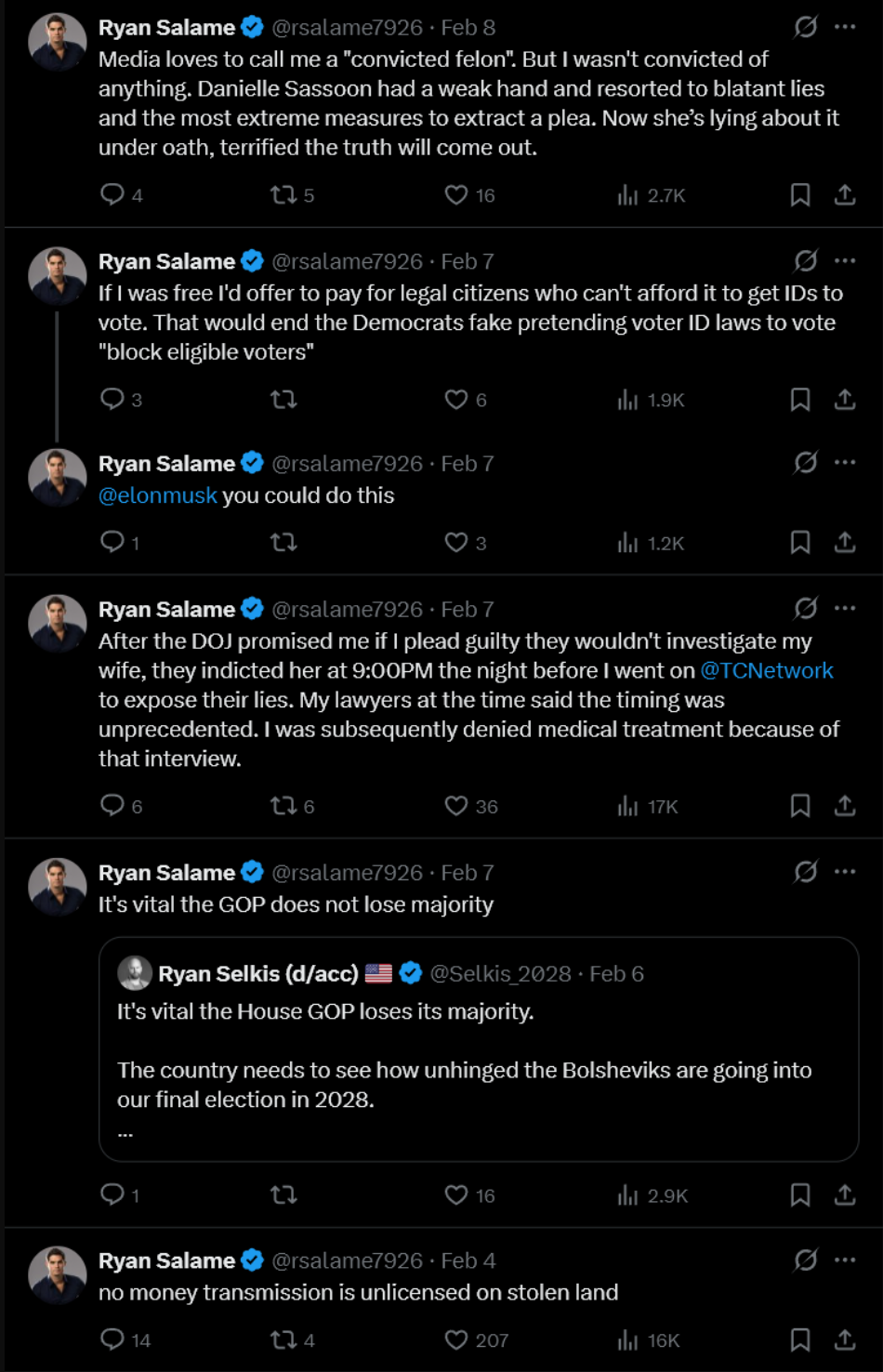
Former FTX executive Ryan Salame has openly aligned with MAGA messaging in his own quiet bid for relief.

Others have even called for extending clemency to Do Kwon, the embattled founder of the collapsed Terra/Luna ecosystem.
Meanwhile, Polymarket is already running a market for this development, with Ryan Salame (13%), SBF (11%), Do Kwon (9%) already in the list of prospects to be pardoned before 2027.

Why Summer 2026 Is the Window to Watch
The Senate is already investigating Trump’s crypto pardons. A bundled July 4 announcement would magnify scrutiny but also let the administration tuck clemency inside a celebratory national moment.
The stakes stretch beyond any single defendant, particularly for crypto. Each pardon resets how prosecutors and exchanges read the regulatory mood.
A symbolic 250 could send the loudest signal yet that the legal cost of running a crypto business has fundamentally shifted in the United States.
The final list, if it materializes, may surface in weeks rather than months. Which founder, hacker or trader earns a spot remains anybody’s guess.
The post Crypto Hopefuls Watch As Trump Weighs 250 Pardons for America’s 250th Birthday appeared first on BeInCrypto.
Key points:
- Bitcoin has reached a crucial support, as a break below the $79,000 level may deepen the pullback.
- Several major altcoins are facing selling pressure, indicating that the bears remain in the game.
Bitcoin (BTC) extended its pullback on Wednesday and slipped below the $80,000 level. However, analysts remain optimistic about BTC’s prospects in the near term.
Analyst CRG said in a post on X that BTC did not break above the Ichimoku cloud even once during the previous bear market, and when it did, a new bull market started. Interestingly, BTC has risen comfortably above the Ichimoku cloud, weakening the comparison with the previous bear market cycle.
Another bullish projection came from Maelstrom chief investment officer Arthur Hayes, who said in a Substack post that BTC “retaking the $126,000 is a foregone conclusion.” He expects BTC to pick up momentum after breaking above $90,000, where “many call over-writers will rush to cover as their strike gets taken out.”
Hayes expects the AI sector race with China and the ongoing war with Iran to result in money printing, benefitting the crypto ecosystem.
BTC’s bullish view is not shared by everyone. A BTC whale, known by the moniker ‘pension-usdt.eth,’ is short 1,000 BTC, worth roughly $81 million, with 3x leverage. The trade, which was opened when BTC was at $67,990, is down about $13 million, but the trader confirmed on X that he was still short as “the trade makes sense.”
Could BTC and the major altcoins rebound off their support levels? Let’s analyze the charts of the top-10 cryptocurrencies to find out.
Bitcoin price prediction
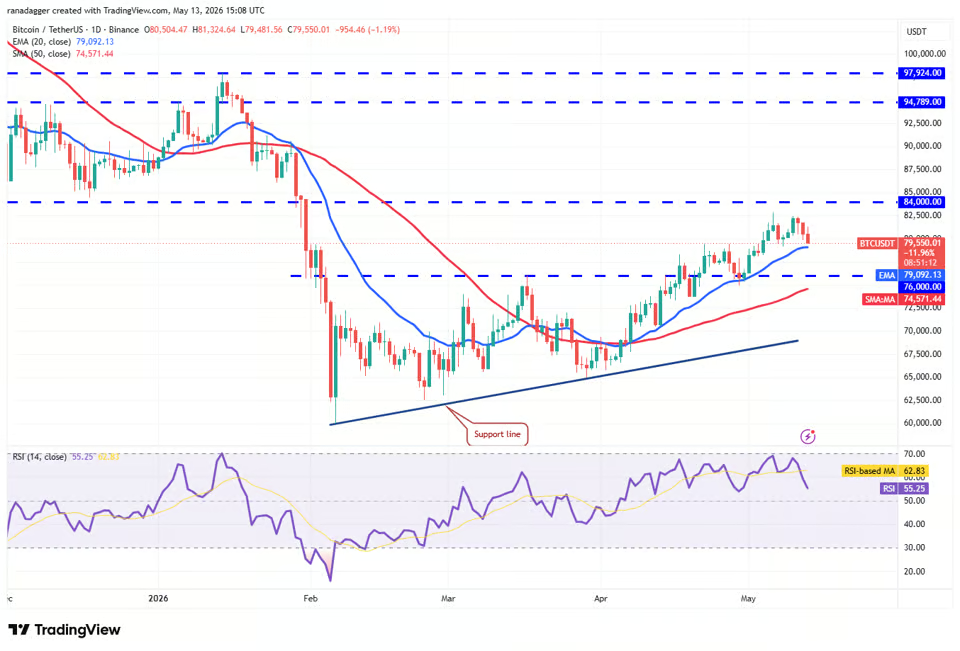
BTC has dipped to the 20-day exponential moving average ($79,092), which is a critical near-term support to watch.

BTC/USDT daily chart. Source: Cointelegraph/TradingView
If the price rebounds off the 20-day EMA with strength, the bulls will try to push the BTC/USDT pair above the $84,000 resistance. If they succeed, the BTC price is expected to pick up momentum and skyrocket toward $92,000 and subsequently to $97,924.
This bullish view will be invalidated in the near term if the price continues lower and breaks below the 20-day EMA. That suggests traders are booking profits. That may start a deeper pullback toward the 50-day simple moving average ($74,571) and later to the support line.
Ether price prediction
Ether (ETH) attempted to start a recovery from the 50-day SMA ($2,245), but the long wick on the candlestick shows selling at higher levels.

ETH/USDT daily chart. Source: Cointelegraph/TradingView
A break and close below the 50-day SMA opens the doors for a drop to the support line of the ascending channel pattern. Buyers are expected to fiercely defend the support line, as a close below it may sink the ETH/USDT pair to $1,916.
The first sign of strength will be a break and close above the $2,465 resistance. The ETH price may then ascend to the resistance line, which is a critical level to watch. A break above the resistance line may catapult the pair toward $3,050.
BNB price prediction
BNB (BNB) rebounded off the 20-day EMA ($643) on Tuesday and reached the $687 overhead resistance on Wednesday.

BNB/USDT daily chart. Source: Cointelegraph/TradingView
The upsloping 20-day EMA and the RSI near the overbought zone signal that the bulls have the upper hand. A close above the $687 level opens the doors for a rally to $730 and later to $790.
Sellers will have to tug the BNB price back below the 50-day SMA ($623) to weaken the bulls. If they manage to do that, the BNB/USDT pair may consolidate inside the $570 to $687 range for a while longer.
XRP price prediction
XRP (XRP) has been stuck between the downtrend line of the descending channel pattern and the moving averages for the past few days.

XRP/USDT daily chart. Source: Cointelegraph/TradingView
A tight consolidation below a crucial resistance suggests that the bulls are holding on to their positions as they anticipate an upside breakout. If the downtrend line is scaled, the XRP/USDT pair may surge to $1.61. Sellers are expected to defend the $1.61 level with all their might, as a close above it signals a potential trend change. The XRP price may then soar to $2.40.
Conversely, a close below the moving averages suggests that the bulls have given up. The pair may then descend to the $1.27 level, where the buyers are expected to step in.
Solana price prediction
Solana (SOL) turned down from the $98 resistance on Tuesday, indicating that the bears are active at higher levels.

SOL/USDT daily chart. Source: Cointelegraph/TradingView
The upsloping 20-day EMA ($89) and the RSI in the positive territory indicate an advantage to buyers. If the price rebounds off the 20-day EMA, the bulls will again attempt to pierce the $98 resistance. If they can pull it off, the SOL/USDT pair may climb to $106 and then to $117.
This positive view will be negated in the near term if the SOL price continues lower and breaks below the 20-day EMA. Such a move suggests that the pair may continue to oscillate between $76 and $98 for some more time.
Dogecoin price prediction
Dogecoin (DOGE) bounced off the 20-day EMA ($0.10) on Tuesday, indicating that the bulls are viewing the dips as a buying opportunity.

DOGE/USDT daily chart. Source: Cointelegraph/TradingView
The bulls tried to clear the $0.12 overhead hurdle but are facing significant resistance from the bears. However, if the bulls prevail, the DOGE/USDT pair may rally to $0.14 and subsequently to $0.16.
Sellers are likely to have other plans. They will attempt to defend the overhead resistance and pull the DOGE price back below the 20-day EMA. If they do that, the pair may extend its stay inside the $0.09 to $0.12 range for a few more days.
Hyperliquid price prediction
Hyperliquid (HYPE) continued lower and broke below the 50-day SMA ($40.55) on Tuesday, indicating profit-booking by short-term traders.

HYPE/USDT daily chart. Source: Cointelegraph/TradingView
If the price breaks below $38.70, it suggests that the HYPE/USDT pair may have topped out in the near term. The HYPE price may then tumble to $34.45.
Buyers have an uphill task ahead of them. Any recovery attempt is expected to face selling at the 20-day EMA ($41.56) and then in the $43.76 to $45.77 zone. The bulls will have to drive and sustain the price above the $45.77 level to signal the resumption of the up move. The pair may then surge to $50.
Related: Bitcoin to $100K in Q2? Strategy’s STRC unlocks potential to buy 3K BTC in two days
Cardano price prediction
Cardano’s (ADA) pullback is attempting to find support at the 20-day EMA ($0.26), but the bears continue to exert pressure.

ADA/USDT daily chart. Source: Cointelegraph/TradingView
If the price continues lower and breaks below the moving averages, it suggests that the ADA/USDT pair may remain inside the $0.22 to $0.31 range for a few more days.
Buyers will have to fiercely defend the moving averages and start a rebound off it to signal strength. The ADA price may then rise to $0.29 and later to $0.31. Sellers are expected to defend the $0.31 level, as a close above it indicates the start of a new up move. The pair may soar to $0.36 and eventually to the pattern target of $0.40.
Zcash price prediction
Zcash (ZEC) bounced off the $560 level on Tuesday, but the bulls could not sustain momentum on Wednesday.

ZEC/USDT daily chart. Source: Cointelegraph/TradingView
If the ZEC price closes below the breakout level of $560, it signals profit booking by short-term traders. The ZEC/USDT pair may then slump to the 20-day EMA ($481). A deeper correction to $400 may begin if the 20-day EMA cracks.
Contrarily, if the price bounces off the 20-day EMA with force, it suggests that the bulls remain in charge. Buyers will then make one more attempt to drive the price above the $643 level. If they succeed, the pair may surge to $750.
Bitcoin Cash price prediction
Bitcoin Cash (BCH) fell below the moving averages and the $443 support on Tuesday, indicating that the bears have an edge.

BCH/USDT daily chart. Source: Cointelegraph/TradingView
Sellers will attempt to pull the BCH price to the solid support at $419. Buyers are expected to aggressively defend the $419 level, as a close below it may resume the downtrend. The next stop on the downside may be $375.
Instead, if the price turns up sharply from $419 and breaks above the moving averages, it suggests that the BCH/USDT pair may remain range-bound for some more time. Buyers will be back in the driver’s seat on a close above $486.
Crypto World
UnitedHealth Group (UNH) Stock Surges to 52-Week Peak Following Impressive Q1 Performance

Key Takeaways
- UNH reached a 52-week peak of $404.14 mid-week, climbing approximately 30% in the last 30 days
- First quarter revenues totaled $111.7 billion, representing a 2% annual increase, while adjusted EPS exceeded forecasts at $7.23
- Operating margins at UnitedHealthcare expanded from 6.2% to 6.6% during the first quarter
- The company’s Medical Care Ratio declined to 83.9% in Q1, a significant improvement from the previous quarter’s 88.9%
- Strategic reduction of 1.3 million Medicare Advantage members in 2026 aims to preserve profitability
UnitedHealth Group (UNH) reached a 52-week peak of $404.14 during Wednesday’s trading session, concluding an impressive rally that pushed shares up approximately 30% during the previous month.
UnitedHealth Group Incorporated, UNH
For the current year, UNH has advanced roughly 21%. Looking at the trailing twelve-month period, the stock has delivered gains of about 29%.
This upward momentum represents a dramatic reversal from earlier weakness. Between January and late March, shares tumbled from $336 down to $259 — representing approximately a 23% decline.
The turnaround gained momentum following UnitedHealth’s first quarter earnings report in late April, which surpassed Wall Street estimates and included an upward revision to full-year guidance.
First quarter revenues reached $111.7 billion, marking a 2% year-over-year expansion. Adjusted earnings per share landed at $7.23, exceeding analyst projections. Reported EPS registered at $6.90.
UnitedHealthcare’s operating margins expanded from 6.2% to 6.6%, representing a modest yet significant enhancement for an organization navigating a transitional phase.
Medicare Advantage Continues to Present Challenges
Medicare Advantage has emerged as one of the more prominent headwinds for UNH. Federal reimbursement rates have failed to match the acceleration in program expenses, creating margin compression in recent years.
To address this dynamic, UnitedHealth strategically reduced its Medicare Advantage enrollment by 1.3 million participants for 2026. While challenging, leadership characterized this decision as essential for maintaining long-term financial health.
The financial results are reflecting this strategic shift. UnitedHealth’s Medical Care Ratio — representing the portion of premium revenue allocated to claims payments — dropped to 83.9% in Q1, compared to 88.9% in the fourth quarter of 2025.
This substantial quarter-over-quarter improvement indicates the enrollment reductions are already positively impacting the company’s cost profile.
Early 2025 Presented a Contrasting Scenario
The start of 2025 proved turbulent. UnitedHealth experienced significant selling pressure in early January following disappointing fourth quarter 2024 results and a Centers for Medicare & Medicaid Services proposal for Medicare Advantage rate adjustments that fell short of industry expectations.
The organization has additionally navigated executive transitions and an active antitrust review. While these concerns persist, market participants currently appear focused on operational performance rather than these ongoing issues.
At its current valuation near $400, UNH offers a dividend yield of approximately 2.3%, with a market capitalization hovering around $360 billion.
The stock’s 52-week trading range extends from $234.60 to $404.15 — with Wednesday’s high matching the upper boundary of that range.
Wednesday’s volume registered approximately 4.8 million shares, trailing the average daily volume of 8.5 million, indicating the advance occurred without exceptional trading activity.
UNH closed Wednesday’s session at $400.38 according to the most recent available pricing data.


Key Takeaways
- OpenAI CEO Sam Altman delivered approximately 4 hours of testimony in the federal lawsuit filed by Elon Musk in Oakland, California
- Altman maintained that Musk left OpenAI voluntarily, contradicting Musk’s allegations of a stolen charitable mission
- According to Altman, Musk demanded complete majority ownership of OpenAI, a proposal that left him “extremely uncomfortable”
- Defense attorneys questioned Altman’s credibility, referencing previous allegations of dishonesty from former colleagues
- The trial moves to closing statements on Thursday; the jury will provide an advisory verdict only
Sam Altman, CEO of OpenAI, appeared in federal court on Tuesday to defend against claims made by Elon Musk that he and fellow executives undermined OpenAI’s foundational nonprofit principles.
During his roughly four-hour testimony at the Oakland, California federal courthouse, Altman presented a clear counternarrative: rather than having his charitable endeavor taken from him, Musk chose to walk away from the project.
“We were kind of left for dead,” Altman stated during his testimony.
The legal proceedings originated from a 2024 complaint filed by Musk against OpenAI, Altman, and Greg Brockman, OpenAI’s president. Musk alleges that this trio diverted the organization from its initial nonprofit framework. Additionally, he contends that his approximately $38 million in contributions were redirected toward commercial ventures without his consent.
Altman denied making any commitments to Musk regarding maintaining OpenAI’s nonprofit status. He characterized their relationship as one marked by fundamental disagreements over strategic direction, ultimately leading to Musk’s complete loss of confidence in the organization.
To support his account, Altman referenced a December 2018 email from Musk stating: “My probability assessment of OpenAI being relevant to DeepMind/Google without a dramatic change in execution and resources is 0%. Not 1%.”
Altman emphasized these words were “burned into my memory.”
The Battle Over Ownership
A significant portion of Altman’s court appearance centered on Musk’s insistence on securing majority ownership of any for-profit iteration of OpenAI. According to Altman, Musk demanded controlling authority while making only vague references to potentially reducing his stake in the future.
Altman expressed skepticism about this happening. “My belief is he wanted to have long-term control,” he told the court.
He recounted what he characterized as a “hair-raising” exchange. When fellow co-founders questioned what would become of OpenAI should Musk pass away while maintaining control, Musk allegedly responded casually, suggesting his children could potentially inherit his stake.
Altman emphasized that OpenAI’s founding principle centered on preventing any individual from controlling artificial general intelligence. This made Musk’s ownership demands fundamentally incompatible with the organization’s values.
During negotiations, Musk floated the idea of combining OpenAI with Tesla. Altman declined, arguing that Tesla’s identity as an automotive manufacturer made it unsuitable for advancing OpenAI’s objectives.
Musk officially departed from OpenAI’s board in February 2018. Altman testified that staff reactions were mixed, with some experiencing a “morale boost,” while others feared Musk might pursue “vengeance.”
Defense Targets Altman’s Trustworthiness
Steven Molo, representing Musk, utilized cross-examination to cast doubt on Altman’s reliability. His questioning began bluntly: “Are you completely trustworthy?” Altman initially responded “I believe so,” before modifying his answer to an unqualified yes.
Molo highlighted previous accusations from former associates, including Dario Amodei, who founded Anthropic, and cited Monday’s testimony from Ilya Sutskever, OpenAI’s former chief scientist. Sutskever claimed to have documented what he characterized as recurring instances of dishonesty by Altman.
Altman also discussed his temporary 2023 ouster as CEO. He described the experience as an “incredible betrayal” and noted that board members offered minimal justification beyond claiming he hadn’t been forthcoming with them.
“I had poured the last years of my life into this,” Altman testified. “I was watching it about to be destroyed.”
OpenAI currently carries a valuation exceeding $850 billion according to private market investors. Musk’s lawsuit seeks the removal of both Altman and Brockman, along with redirecting over $130 billion to OpenAI’s nonprofit foundation. Final arguments are set for Thursday. The jury will deliver an advisory opinion, with final authority resting with Judge Yvonne Gonzalez Rogers.
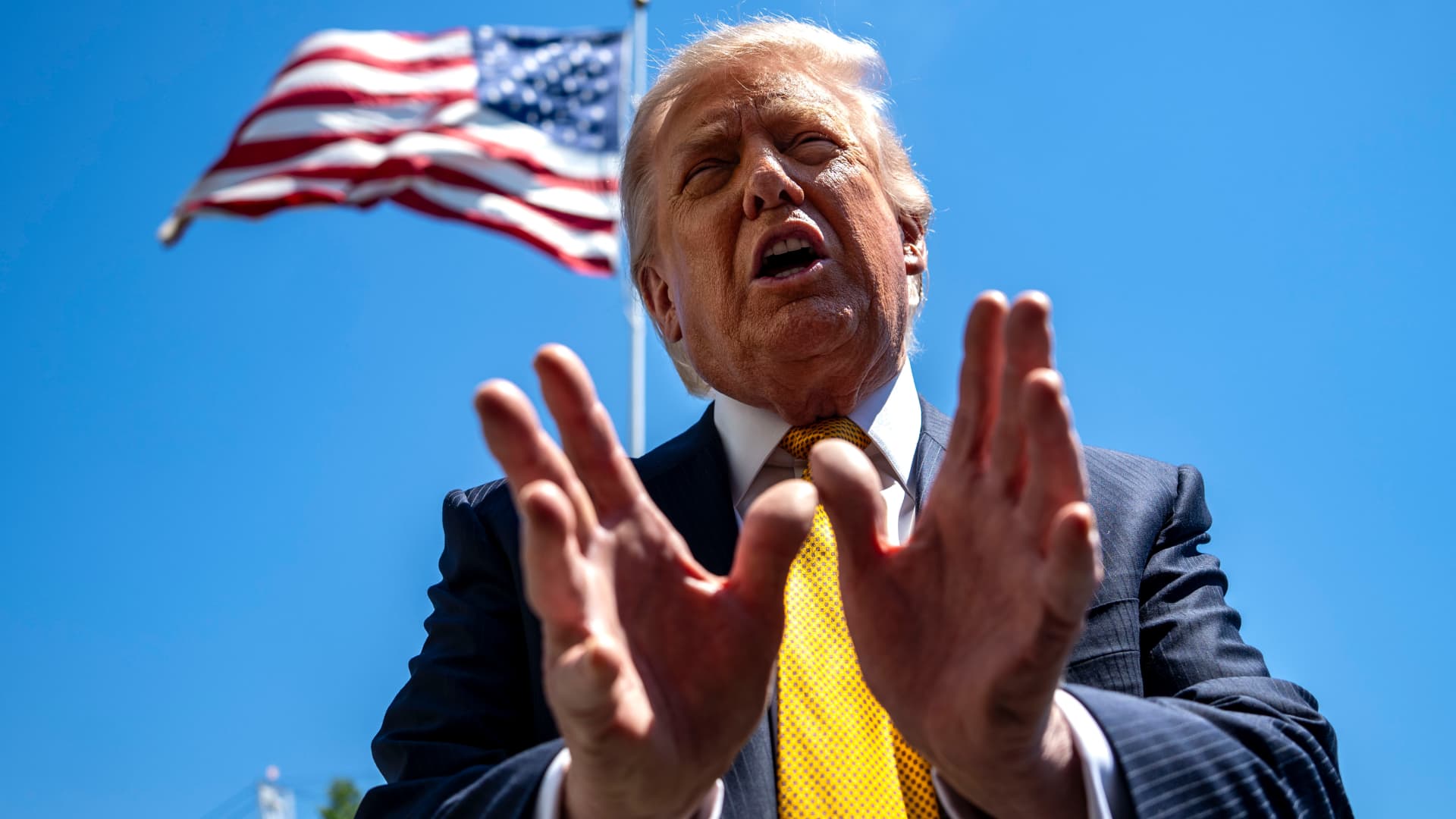
US President Donald Trump speaks to members of the media on the South Lawn of the White House before boarding Marine One in Washington, DC, US, on Tuesday, May 12, 2026.
Bonnie Cash | Bloomberg | Getty Images
Prediction market traders think President Donald Trump will make some major announcements in his trip to meet with Chinese President Xi Jinping in Beijing.
Traders on Kalshi give an 86% chance that he will announce China will buy aircraft from domestic manufacturer Boeing.
That belief is shared with Wall Street, as Boeing’s stock advanced nearly 2% on Wednesday ahead of the meeting.
“The speculation is that Trump wants this to be the largest order ever announced, which could mean a Boeing purchase commitment in the triple-digit billions,” wrote Tobin Marcus, head of U.S. politics and policy at Wolfe Research, in a note. “Investors will need to await clarification from the company about how ‘real’ those numbers are and what specific airframes are included.”
Traders are also placing more than 81% odds that Trump will announce an extension of the U.S.-China tariff truce. In their October deal, China agreed to pause export controls on rare earths while the U.S. cut tariffs on the country related to fentanyl to 10% from 20%.
Barclays predicted that tariff might move a few percentage points lower if China purchases aircraft, as well as American oil and soybeans. While Kalshi traders see a 79% chance a soybean purchase is announced, oil purchases have a much lower probability at just 24%.
Traders also think there’s a 69% chance a U.S.-China Board of Trade is announced. This is a key goal of U.S. Trade Representative Jamieson Greer, Wolfe’s Marcus noted. “We suspect that this will be done primarily through ongoing purchase commitments, with the Board of Trade eliciting a centralized answer from the CCP about what China will buy from the US to mitigate their bilateral trade surplus,” he wrote.
Trump told reporters on Tuesday as he departed for the trip that while he expected to chat about the Iran war with Xi, he also said, “I don’t think we need any help with Iran.” Despite that, traders see a likelihood of 61% that he talks about Tehran during the bilateral meeting. They also give a 59% chance he talks about oil or gasoline.
However, traders think there’s just a 54% chance he’ll talk about artificial intelligence. Jefferies analyst Edison Lee in a Tuesday note predicted the topic will likely be of great interest, considering the background of executives expected to join Trump on his trip.
“In addition to discussions on US AI chip/WFE [wafer-fabrication-equipment] export restrictions, the presence of Micron’s CEO and Meta’s president could offer scope for the issues of China’s ban on Micron’s products in key Chinese infra and restrictions against Facebook to be part of the discussions,” he wrote. “We also see these issues as part of the bargaining process in relation to US tech restrictions against China.”
And while China-U.S. tensions are high these days, traders don’t think that will stop a firm handshake. Traders think the most likely scenario is Trump and Xi will shake hands for about 8.5 seconds.
Disclosure: CNBC and Kalshi have a commercial relationship that includes customer acquisition and a minority investment.
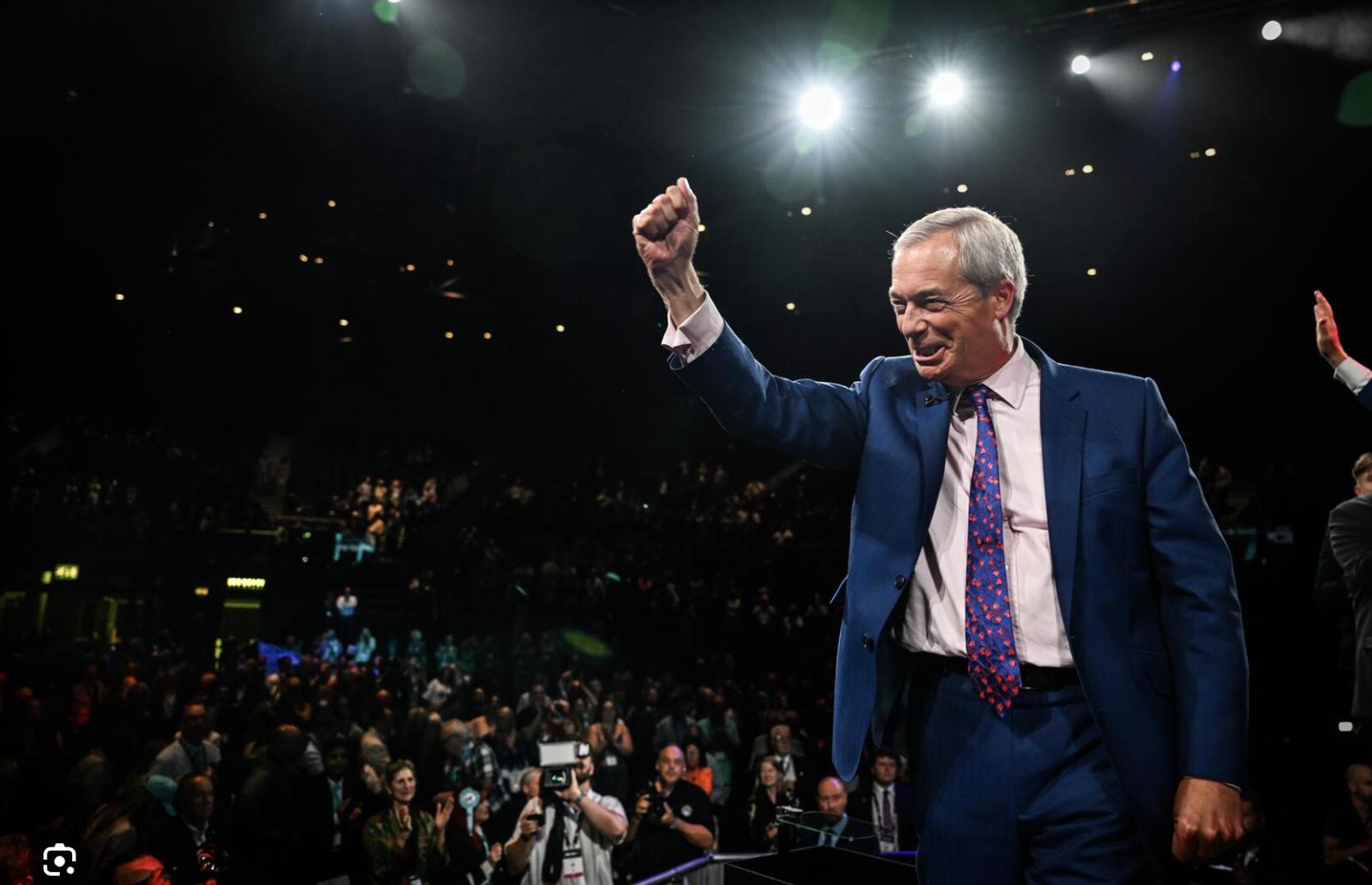
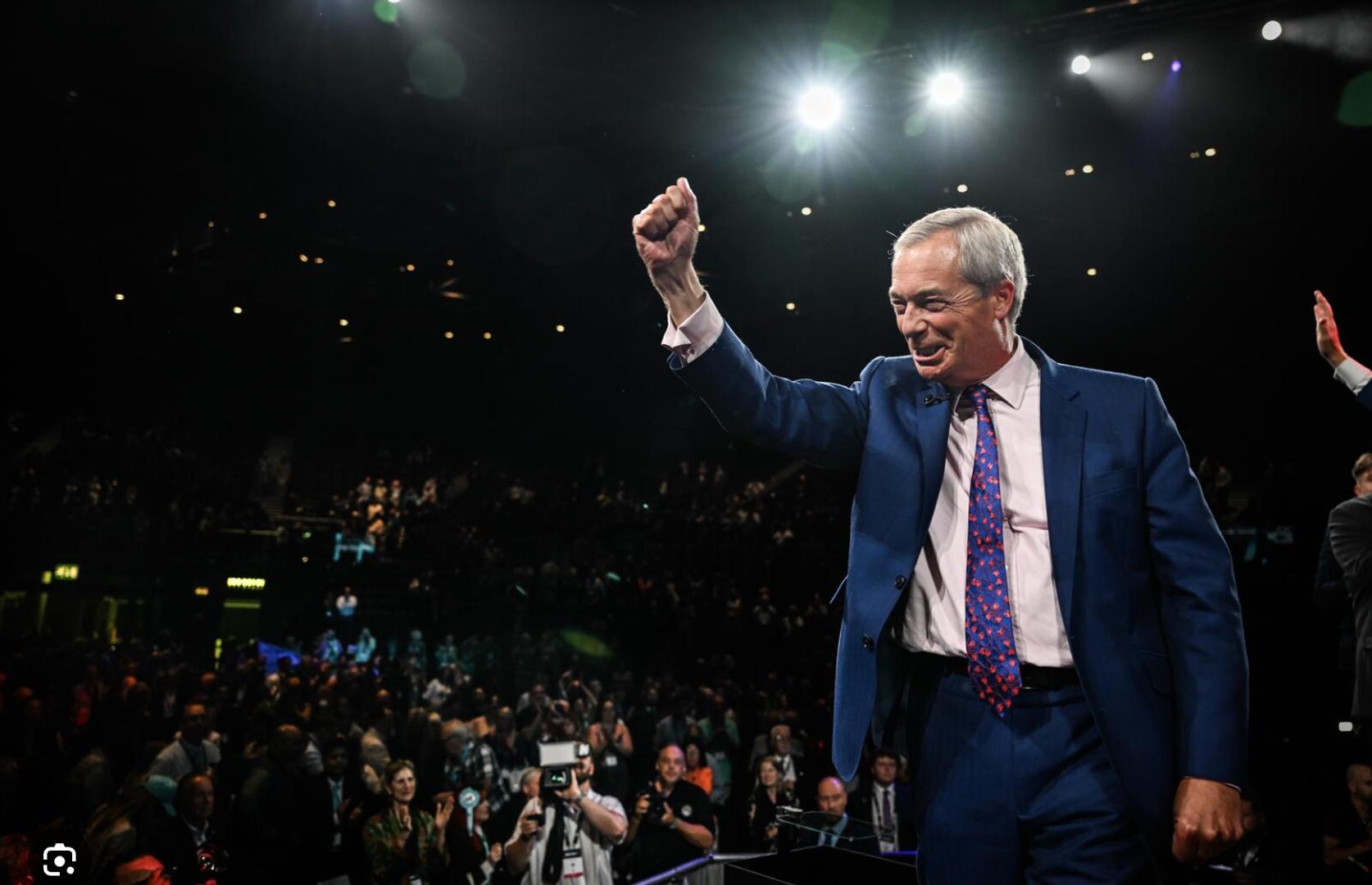
Nigel Farage, the leader of Reform UK and a member of Parliament, is facing a formal investigation by the parliamentary standards watchdog after failing to declare a 5 million-pound ($6.8 million) gift from crypto billionaire Christopher Harborne, news services including the Guardian reported Wednesday.
Farage received the donation from Harborne, a Thailand-based businessman with a 12% stake in stablecoin issuer Tether, weeks before announcing he would stand as a candidate in the 2024 general election, and did not declare it when elected as MP for Clapton. New MPs must register all financial interests received within the 12 months preceding their election.
A weekly YouGov poll of voting intentions has Reform UK gaining the largest share of votes, at 28%, putting Farage as the frontrunner to become the next prime minister. If the watchdog finds he breached the code of conduct, he could face suspension and potentially be forced to fight again for his parliamentary seat.
Farage, who is supportive of the crypto industry, has said that because Harborne’s donations were intended to cover his security expenses he was not compelled by law to declare them. Reform UK recently said the gift falls under the exemption for purely personal gifts. Labour and other parties argue that Harborne’s donations are subject to the rule, and the gift was referred to the parliamentary commissioner last month.
The parliamentary commissioner for standards, Daniel Greenberg, is set to investigate Farage under rule 5 of the code of conduct, which compels lawmakers to “fulfil conscientiously” requirements relating to their registration of interests, the Guardian said.
The Reform UK leader does not appear on the commission’s list of current investigations.
In April, BitMEX co-founder Ben Delo said in an op-ed for CoinDesk that he had given the party 4 million pounds since the start of the year.
The U.K. government imposed a moratorium on political crypto donations in March, citing a review warning that digital assets could be used to channel foreign money into U.K. politics. The ban covers donations of any size and will be written into the Representation of the People Bill, with criminal penalties for non-compliance.
Read more: Nigel Farage takes 6% stake in UK bitcoin treasury firm Stack BTC


Metaplanet (3350), Japan’s largest corporate bitcoin holder and the world’s third-largest bitcoin treasury company holding 40,177 BTC on its balance sheet, has confirmed a delay in its planned preferred share listing.
CEO Simon Gerovich discussed the complexity of navigating Japan’s underdeveloped preferred equity market as the primary reason for the hold-up.
The company’s planned instrument would be only the seventh listed preferred in Japan, Gerovich said, and, notably, the first-ever perpetual preferred share in the market.
Metaplanet announced back in November a two-tier listed preferred share class, Mars and Mercury. The move came after Strategy launched its own preferred shares, with Stretch (STRC) among the most popular.
Two key obstacles have stood in the way of Metaplanet’s listing of preferred shares.
First, Japanese exchange rules require preferred dividends to be backed by sustainable, recurring cash flows assessed across multiple market conditions. Metaplanet must demonstrate that its Bitcoin Income Generation Business can produce stable returns even in adverse bitcoin environments, and has just a six-quarter operating track record.
Second, the company’s ambition to pay monthly dividends is far more frequent than Japan’s typical once or twice-yearly cadence, which requires building entirely new dividend infrastructure around record dates.
Gerovich concluded that the company is committed to delivering preferred shares to the market and highlighted Japan’s status as one of the world’s most yield-starved major capital markets.
On the earnings, the company delivered net sales of $19.5 million (¥3.08 billion, up 251% year-on-year) and operating income of $14.4 million (¥2.27 billion, up 283%). Meanwhile, bitcoin yield came in at 2.8% quarter-to-date.
Metaplanet shares are down 25% year to date.


Binance founder Zhao Changpeng (CZ) said he prefers investing in the underlying infrastructure powering artificial intelligence rather than AI applications themselves, framing the current boom as an “infrastructure-first” investment cycle.
Summary
- Binance founder Zhao Changpeng says he favors investing in AI infrastructure such as data centers and energy systems over AI applications.
- He highlights NVIDIA’s dominance in AI chips but expects more customized compute solutions to emerge over time.
- His investment firm still allocates 70%–80% of capital to Web3, keeping crypto as the core focus.
Speaking during a Binance online livestream, CZ described his preferred strategy as focusing on the “shovels” of AI — including data centers, power supply systems and large-scale computing infrastructure required to support model training and inference workloads.
His comments reflect a growing investor narrative that the AI economy is not just about algorithms or software, but about energy, hardware and compute availability at industrial scale.
AI infrastructure becomes the dominant investment layer
CZ noted that while NVIDIA currently dominates the AI chip market, the long-term landscape may shift toward more specialized and customized compute solutions tailored to different AI workloads.
This view aligns with a broader industry trend in which hyperscale data centers, energy infrastructure and semiconductor supply chains are becoming the primary bottlenecks in AI expansion rather than software innovation itself.
He also said he is monitoring developments in robotics, suggesting that AI-driven physical automation may become a major adjacent investment theme alongside compute infrastructure.
The “shovels in a gold rush” analogy has become increasingly common across venture capital and macro investing circles, where capital allocators prioritize foundational layers that benefit from multiple waves of adoption rather than single-product AI companies.
Web3 remains core as CZ keeps crypto allocation dominant
Despite growing interest in AI-related infrastructure, CZ emphasized that his investment firm YZi Labs continues to focus primarily on the crypto and blockchain sector, which still represents roughly 70% to 80% of its portfolio.
He also suggested that AI’s broader economic impact will extend into biotechnology and robotics, but said the firm does not plan to aggressively expand into large-scale biotech exposure at this stage.
Instead, the strategy remains centered on digital asset infrastructure, decentralized networks and blockchain-based financial systems, even as capital increasingly flows into adjacent high-growth sectors like AI compute and automation.
This positioning reflects a broader convergence theme across technology investing, where AI, energy, semiconductors and blockchain infrastructure are increasingly viewed as interconnected parts of a single computational economy.
Infrastructure-driven narrative spans AI, crypto and global markets
CZ’s comments arrive at a time when global markets are increasingly rewarding infrastructure-heavy plays across multiple sectors — from semiconductor manufacturing and defense systems to energy grids and cloud computing.
In a similar macro pattern, investors have been rotating toward companies and assets that provide foundational capacity rather than end-user applications, especially as demand for compute-intensive technologies accelerates.
This infrastructure-first mindset also overlaps with broader macro uncertainty, where capital is increasingly concentrated in tangible capacity providers during periods of geopolitical fragmentation and supply chain stress.
Within this context, crypto infrastructure remains positioned alongside AI and data center expansion as part of a wider digital-physical convergence cycle, where compute, energy and financial networks are becoming tightly linked investment themes.
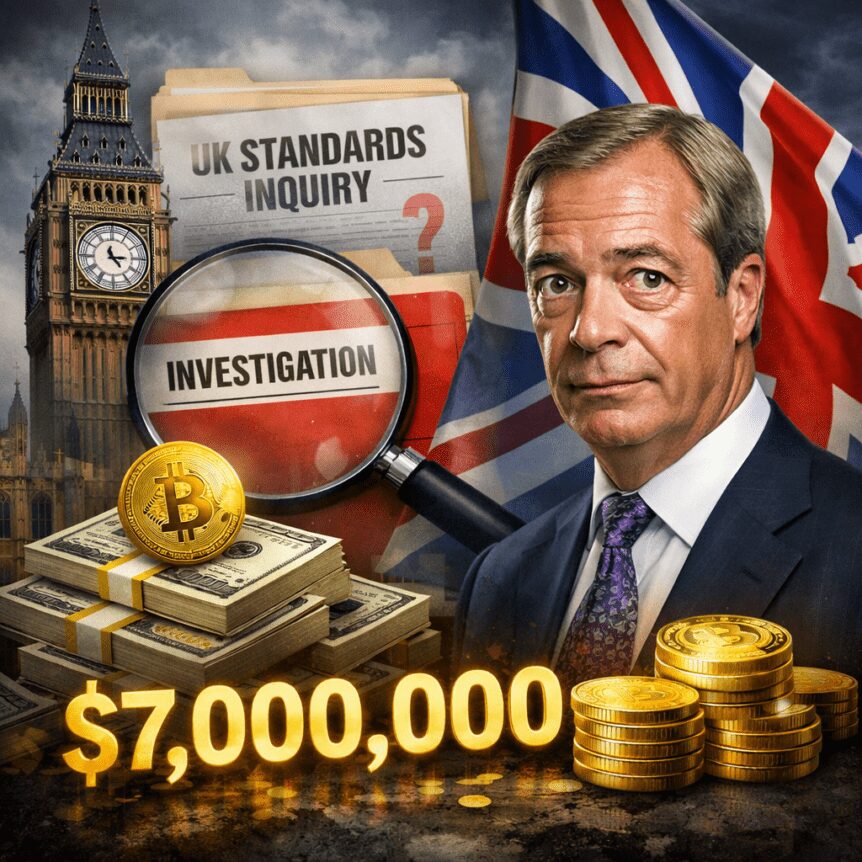
The UK Parliamentary Standards Commissioner has opened a formal inquiry into Nigel Farage, the Reform UK leader, over whether he breached House of Commons rules by failing to declare a £5 million gift from crypto-backed financier Christopher Harborne. The BBC reported the inquiry on Wednesday, underscoring a fresh wave of scrutiny surrounding political finance and crypto-linked contributions in the United Kingdom. Farage has argued there was no obligation to declare the payment, which he received before his election to Parliament in 2024. Critics contend that once he became a member of Parliament, registration obligations applied.
The Conservative Party has urged the parliamentary standards watchdog to investigate the matter, and the Electoral Commission is reportedly weighing whether to launch a formal probe into the donation. Together, these developments broaden the focus on how crypto-fueled funding intersects with political finance rules, amplifying regulatory attention on the sources and disclosure of money in UK politics.
The case sits within a broader regulatory backdrop as UK lawmakers and regulators deepen their examination of the role of digital-asset money in political life. The discourse has intensified in recent weeks after the UK Liberal Democrats urged the Financial Conduct Authority to investigate whether Farage breached market rules by featuring in a Stack BTC promotional video while holding a financial stake in the company. Farage had previously disclosed a $286,000 equity investment in Stack BTC after acquiring a 6.31% stake through his media vehicle Thorn In The Side in March.
Related: Liberal Democrats push FCA probe over Farage Stack BTC concerns
Key takeaways
- The Parliamentary Standards Commissioner has opened a probe into whether Farage breached House of Commons rules by not declaring a £5 million gift from Christopher Harborne, a crypto-linked financier, received before Farage’s 2024 election.
- The inquiry follows a Conservative push to initiate an official review and signals heightened regulatory interest in crypto-linked political financing and post-election disclosure obligations.
- The Electoral Commission is reportedly assessing whether to launch a formal investigation into the donation, adding a potential enforcement dimension to the case.
- UK political crypto donations are legal under current Electoral Commission guidance, but the issue has sparked calls for a moratorium and tighter governance, as lawmakers seek statutory guidance ahead of the next general election.
- The broader regulatory context includes scrutiny of Farage’s crypto exposure (including a disclosed Stack BTC investment) and ongoing debates over how crypto interests should be disclosed and regulated in political activities.
Regulatory proceedings and political-finance implications
According to BBC reporting, the Standards Commissioner’s inquiry centers on whether Farage failed to register a significant gift from a high-profile crypto backer. The rules governing registration are clear in principle, but the timing and filing requirements can become contested when gifts are received before a candidate attains parliamentary status or when individuals transition into public office. Critics say that post-election registerability should apply to large contributions or gifts connected to political activity, whereas proponents of Farage’s position argue there was no binding obligation to declare outside the usual framework.
In parallel, the Conservatives wrote to the parliamentary standards watchdog requesting a formal review, a move that aligns with broader questions about accountability and transparency in political financing. The Electoral Commission’s reported consideration of a formal investigation would add a separate layer of compliance scrutiny, potentially triggering procedural reviews of donor disclosure, donor verification, and the public reporting of electoral money. These developments arrive as UK authorities intensify oversight of how crypto wealth is used in political contexts, a trend that may shape future enforcement actions and guidance for political parties.
Crypto donations in UK politics: regulatory landscape and policy debates
Reform UK became notable for being the first major party to publicly accept cryptocurrency donations in 2025, reflecting a broader shift in fundraising practices among political movements. The party recently disclosed a £ million-level gift from Harborne in the fourth quarter of 2025, following a record donation in the prior quarter. While crypto donations are legal under current Electoral Commission guidance, the evolving nature of digital assets has driven calls from parliamentary committees for a temporary pause on crypto donations until the Commission issues statutory guidance ahead of the next general election, which is expected no later than 2029.
On March 18, the Joint Committee on the National Security Strategy urged the government to impose an immediate moratorium on crypto donations until formal guidance is in place. The committee also proposed structural reforms, including the creation of a Political Finance Enforcement Unit and a reduction of the declaration threshold for political donations—from approximately £12,000 (roughly $14,900) to around £500–£600 range—reflecting concern over foreign influence and the potential for strategic influence through digital assets. Earlier, Matt Western, the committee’s chair, urged a temporary ban on crypto donations to mitigate foreign interference risks and safeguard the integrity of political processes.
These policy discussions occur against a backdrop of ongoing regulatory exploration in the UK, including the use of digital assets within the financial system and the potential cross-border implications for governance and oversight. The evolving framework seeks to balance innovation and fundraising flexibility with robust disclosure, provenance, and anti-foreign interference safeguards, a tension that will shape the regulatory envelope for crypto-enabled political giving in years to come.
Farage, Stack BTC and compliance risk
Beyond the gift at the center of the standards inquiry, Farage’s crypto-related ties have drawn regulatory attention. Cointelegraph reported that the Liberal Democrats pressed the FCA to examine whether Farage violated market rules by appearing in a Stack BTC promotional video while holding a stake in the company. Separately, Farage disclosed a $286,000 equity position in Stack BTC after acquiring a 6.31% stake via Thorn In The Side in March, highlighting the potential for perceived conflicts of interest when political figures participate in or back crypto ventures. These disclosures intensify the compliance considerations for MPs engaging with crypto projects and the responsibilities associated with asset ownership, public representation, and disclosure obligations.
From a governance perspective, the juxtaposition of a high-profile political figure with crypto investments underscores the need for clear, enforceable rules around disclosure, voting conflicts, and political messaging tied to financial interests. For compliance professionals and institutional observers, the case highlights the importance of rigorous due diligence, transparent record-keeping, and consistent application of donor and asset disclosure requirements across party lines. It also illustrates the evolving nature of regulatory risk in an area where technology, finance, and politics intersect.
Related reporting has connected these debates to broader policy discussions about stablecoins and digital assets within the UK financial ecosystem, including indicators of how regulators might approach non-traditional fundraising tools in the future. For context, UK policymakers have already engaged with the topic through regulatory sandboxes and targeted inquiries into crypto-enabled finance, signaling a cautious but progressive stance toward normalization and oversight of crypto activities in public life.
Closing perspective
As parliamentary institutions sharpen their oversight of crypto-linked funding and asset ownership, the Farage inquiry illustrates the practical implications for compliance frameworks, donor governance, and political communication. The case could influence how political actors manage disclosures, how parties structure fundraising in digital assets, and how regulators align enforcement with evolving market practices. The next steps—whether the Electoral Commission formalizes an investigation, how the standards inquiry proceeds, and how policy proposals unfold—will shape the regulatory and political environment for crypto-related contributions in the UK.
Watch for further developments as committees, enforcing agencies, and political actors navigate the intersection of crypto money, disclosure rules, and public accountability.
Attribution: For broader context on related regulatory debates, Cointelegraph has reported on the Liberal Democrats’ push for FCA action and other UK crypto-political issues.
Crypto World
Fidelity International Debuts Digital Liquidity Fund With Blockchain Partners Sygnum and Chainlink
Key Highlights
- Fidelity International unveils FILQ, a blockchain-based liquidity fund developed alongside Sygnum and Chainlink
- The fund receives AAA-mf assessment from Moody’s, ensuring institutional-grade credit quality
- Chainlink infrastructure delivers real-time NAV data directly on blockchain networks
- Sygnum’s Desygnate platform enables regulated tokenization for Fidelity’s digital fund
- Major asset managers accelerate adoption of tokenized treasury products as market approaches $15 billion
Fidelity International has made its debut in the blockchain-based fund sector by unveiling a digital liquidity product created in collaboration with Sygnum Bank and Chainlink. This initiative represents a significant milestone in connecting conventional financial instruments with distributed ledger technology. The move demonstrates how established investment firms are increasingly exploring on-chain distribution channels for cash management solutions.
FILQ Digital Fund Goes Live Through Sygnum Partnership
The asset management firm introduced the Fidelity USD Digital Liquidity Fund—abbreviated as FILQ—via Sygnum Bank’s tokenization infrastructure. Moody’s Ratings awarded the fund its highest AAA-mf designation for money market instruments. This assessment reflects superior credit worthiness and robust liquidity characteristics for institutional cash products.
The offering creates a bridge between traditional regulatory frameworks and blockchain technology. It establishes the firm’s foothold in the rapidly growing tokenized investment vehicle sector. With approximately $1 trillion under management globally, Fidelity International brings substantial institutional credibility to digital asset markets.
Sygnum’s Desygnate technology handles the tokenization and issuance mechanics. This platform enables compliant investment vehicles to function within digital asset ecosystems. Consequently, the digital fund merges conventional fund governance with continuous blockchain settlement capabilities.
Real-Time Fund Metrics Powered by Chainlink Oracle Network
Chainlink’s decentralized oracle system will deliver on-chain net asset value calculations and distribution information for FILQ. This infrastructure allows investors to access current fund valuations and payout details with minimal delay. The arrangement enhances visibility for the digital fund while preserving its underlying regulatory framework.
JPMorgan serves as the authorized provider of daily NAV calculations for the product. Chainlink then transmits this verified data through blockchain channels. This configuration enables FILQ to share authenticated fund metrics within tokenized ecosystems.
The collaboration builds upon previous joint initiatives among the three organizations. During 2024, these partners explored on-chain NAV delivery mechanisms for digital securities. The current liquidity fund represents the evolution of that experimental work into a commercial application.
Blockchain-Based Money Market Products Experience Rapid Expansion
FIDILQ’s introduction coincides with tokenized government securities and money market vehicles nearing $15 billion in total value. Investment managers, trading platforms, stablecoin providers, and decentralized finance applications have collectively fueled this expansion. This environment provides favorable conditions for the new digital liquidity offering.
BlackRock and Franklin Templeton have previously introduced blockchain-based money market solutions. JPMorgan has submitted regulatory filings to establish a tokenized money market fund operating on Ethereum infrastructure. These developments indicate growing institutional appetite for yield-generating instruments on distributed networks.
Fidelity International’s entry through FILQ brings another prominent global institution into this space. The fund integrates Moody’s credit evaluation, Sygnum’s tokenization capabilities, Chainlink data distribution, and JPMorgan’s valuation services. This launch represents a meaningful advancement for regulated cash management products operating on blockchain technology.

PARKOUR VS MONEY HEIST 33!

Plans for ‘self-build’ plots rejected for being too far outside of village

Coinbase CEO Brian Armstrong calls Senate crypto bill a ‘true compromise’

Manchester United reach agreement with Casemiro over contract clause amid transfer speculation

US brings back mandatory military draft registration

Steven Gerrard disagrees with Gary Neville over ‘shock’ Chelsea and Arsenal claim | Football


-
 Crypto World5 days ago
HarrisX Poll Found 52% of Registered Voters Support the CLARITY Act
-

 Fashion5 days ago
Weekend Open Thread: Marianne Dress
-

 Crypto World6 days ago
Upbit adds B3 Korean won pair as Base token gains Korea access
-
 NewsBeat6 days ago
NCP car park operator enters administration putting 340 UK sites at risk of closure
-

 Fashion2 days ago
Coffee Break: Travel Steam Iron
-

 Fashion3 days ago
What to Know Before Buying a Curling Wand or Curling Iron
-

 Tech4 days ago
Auto Enthusiast Carves Functional Two-Stroke Engine from Solid Metal
-

 Politics2 days ago
What to expect when you’re expecting a budget
-
 Business4 days ago
Ignore market noise, India’s long-term story intact, say D-Street bulls Ramesh Damani and Sunil Singhania
-

 Politics4 days ago
Politics Home Article | Starmer Enters The Danger Zone
-

 Tech2 days ago
GM Agrees To Pay $12.75 Million To Settle California Lawsuit Over Misuse Of Customers’ Driving Data
-

 Politics6 days ago
Simon Cowell Says He Was ‘Horrible’ To Susan Boyle During BGT Audition
-

 Entertainment7 days ago
Sarah Paulson Called Out For Met Gala ‘Hypocrisy’
-

 Entertainment6 days ago
General Hospital: Ric & Ava Bombshell – Ric’s Massive Secret Exposed!
-

 Crypto World7 days ago
Robinhood says Wall Street is building onchain
-

 Entertainment7 days ago
Bold and Beautiful Early Spoilers May 11-15: Steffy Revolted & Liam Overjoyed!
-

 Sports6 days ago
UEFA Champions League final schedule, teams, venue, live time and streaming | Football News
-

 Entertainment6 days ago
Why David Letterman Called CBS ‘Lying Weasels’
-

 Fashion7 days ago
The Best Work Pants for Women in 2026
-
 Sports7 days ago
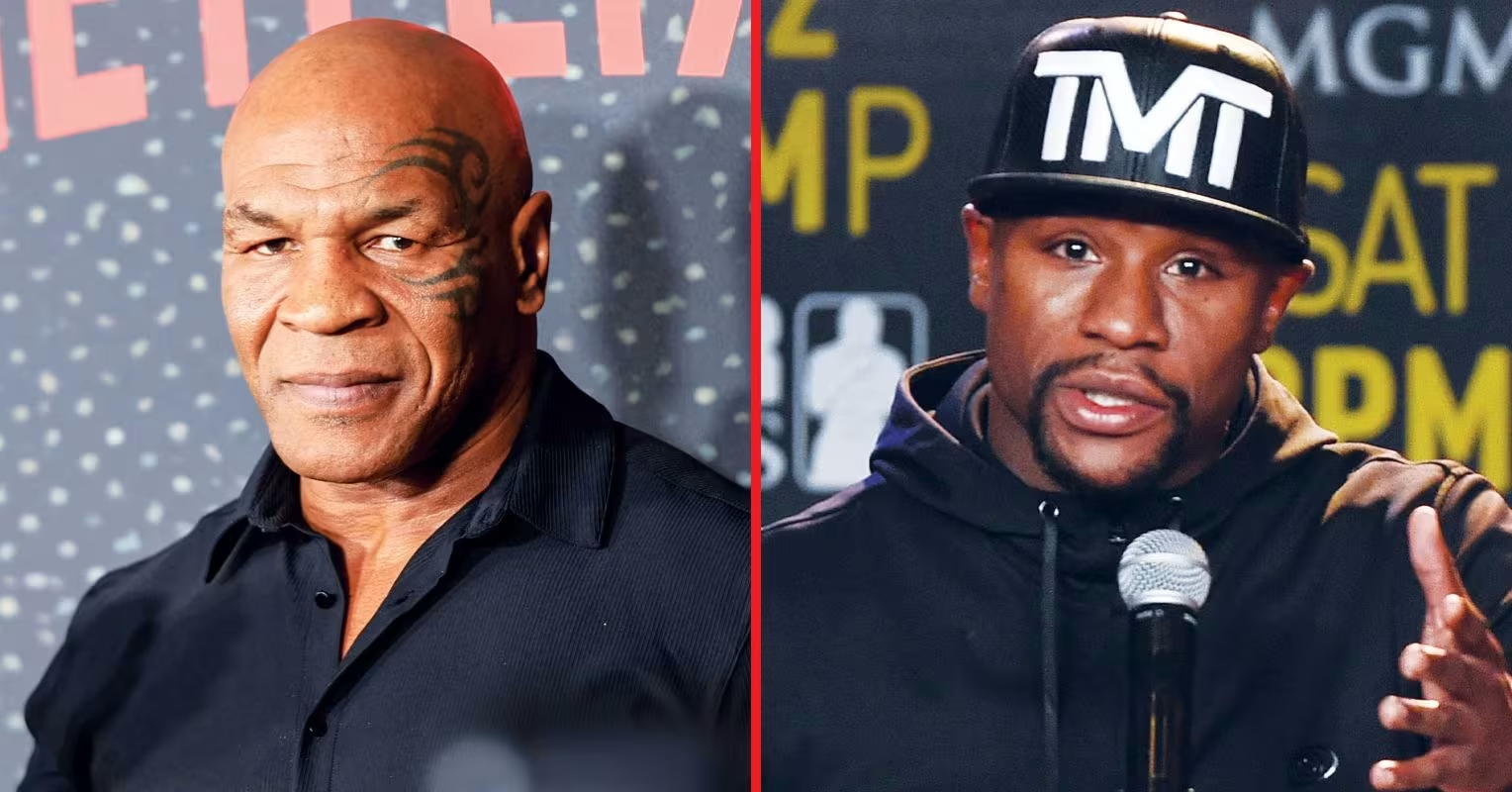
Mike Tyson speaks out on status of Floyd Mayweather fight
You must be logged in to post a comment Login