

Crypto World
Iran Reportedly Mulls Strait of Hormuz Toll Platform Paid in Bitcoin


Iran is reportedly considering a plan to exercise control over the Strait of Hormuz through an “insurance-based model,” with some speculating, based on an unverified website, that it could be paid in Bitcoin.
On Saturday, Fars News Agency, an Iranian news outlet closely affiliated with the Islamic Revolutionary Guard Corps, reported that the Iranian Ministry of Economic Affairs plans to manage the Strait of Hormuz through insurance, citing a state document it obtained.
However, other reports say Iran is looking to take payments for the “insurance” in Bitcoin through a website called “Hormuz Safe,” with a widely circulated screenshot of the purported site selling “Secure Digital Insurance for Maritime Cargo.”

Source: Dennis Porter
Control over the Strait of Hormuz has been the leading issue in the US-Iran war. The shipping lane handles about one-fifth of the global oil trade. Many ships have been prevented from transiting the strait after the US started launching airstrikes in Iran in late February.
Media reports state that Iran collected its first revenue from tolls imposed on ships transiting the Strait last month. Prior to the US-Iran war, no such measures were in place.
Fars News said the insurance platform seeks to distinguish between transit vessels from different countries.
“Under the Economy Ministry’s plan, managing the Strait through an insurance framework would enable the issuance of various marine insurance policies as well as certificates of financial responsibility,” Fars News said, adding it could generate over $10 billion in revenue for the country.
There is no guarantee that Iran will go ahead with the insurance proposal, and the website purporting to offer “Iranian Digital Insurance” could be fake. The website was down at the time of writing.
Scammers have previously defrauded shipping companies operating in the Strait of Hormuz by demanding payment in cryptocurrency for safe passage.
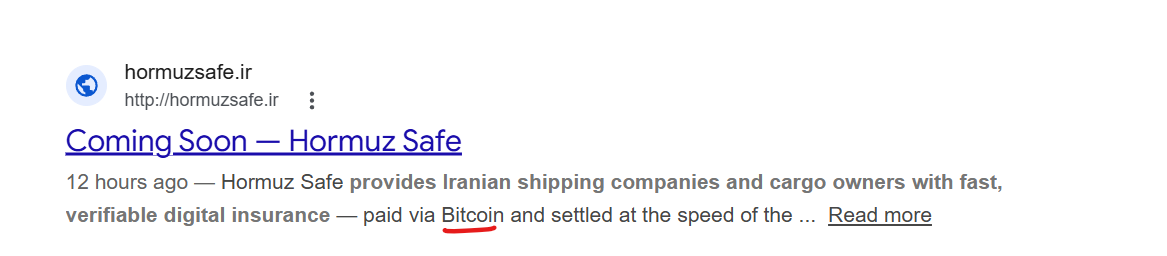
Description of Hormuz Safe seeking to accept shipper tolls in Bitcoin. Source: Google
US authorities recently seized Iranian USDT
Demanding insurance payments in Bitcoin could make sense, given that US authorities froze $344 million worth of USDT tied to Iran last month.
Earlier reports said Iran had been accepting oil tolls in US dollar-denominated stablecoins such as Tether USDt (USDT), as well as Bitcoin and fiat currencies such as the Chinese yuan, with USDT reportedly the preferred cryptocurrency.
Related: UAE investors buy AI dip, keep crypto exposure despite conflict
Industry leaders have touted Bitcoin as a more appropriate cryptocurrency for sanctioned countries because it is sufficiently decentralized and has no issuer capable of freezing funds.
In early April, a spokesperson for Iran’s Oil, Gas and Petrochemical Products Exporters’ Union said certain ships would be able to pass through the strait provided that they pay a tariff of $1 per barrel of oil in Bitcoin.
“Once the email arrives and Iran completes its assessment, vessels are given a few seconds to pay in Bitcoin, ensuring they can’t be traced or confiscated due to sanctions,” they said at the time.
Magazine: Adam Back says current demand is ‘almost’ enough to send Bitcoin to $1M



Your look at what’s coming in the week starting May 18.
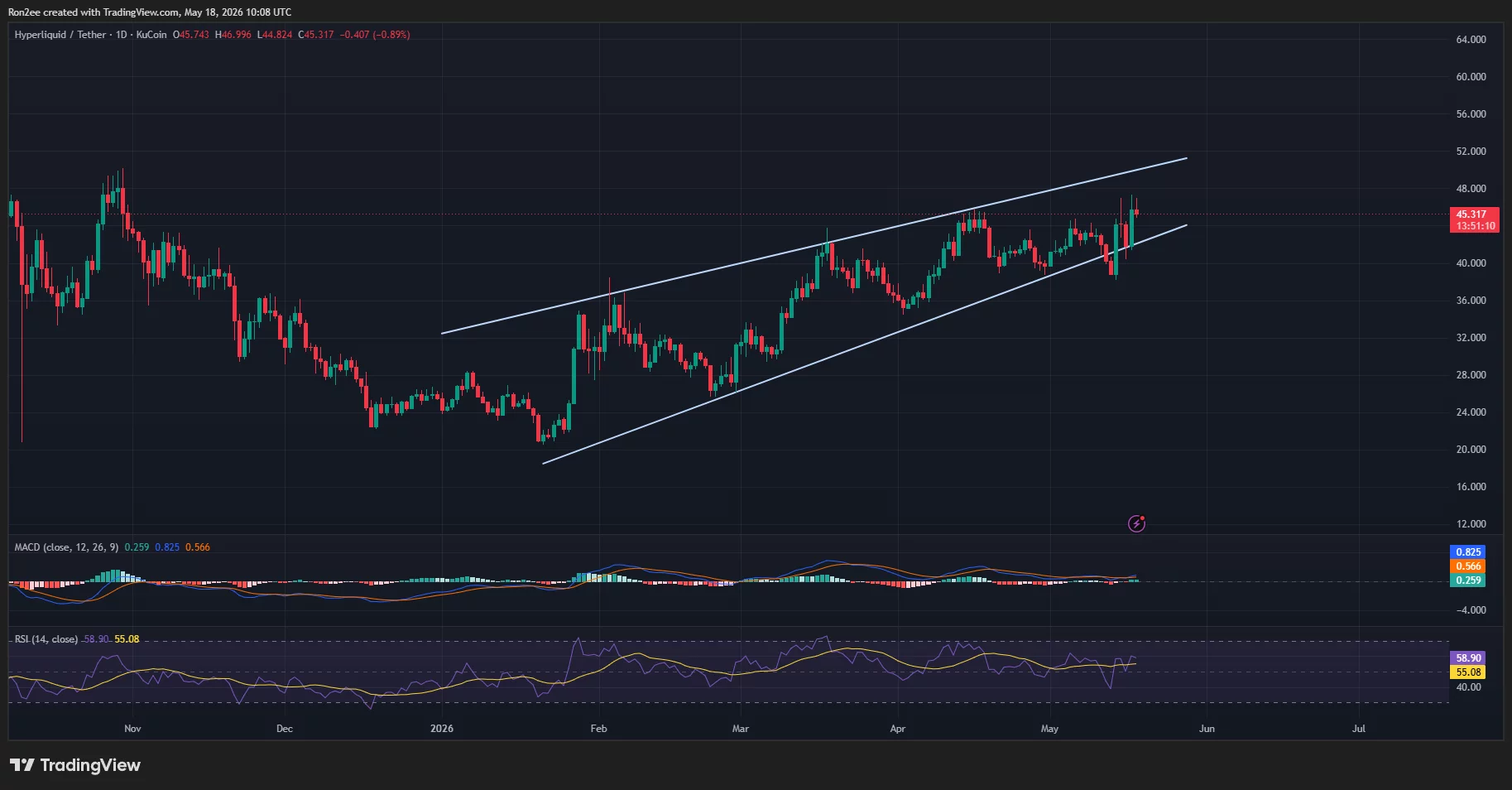
Hyperliquid price stabilized over the weekend after reclaiming a key bullish chart structure, while growing institutional adoption narratives continued supporting investor sentiment around the decentralized derivatives protocol.
Summary
- Hyperliquid price rebounded above $45 after reentering a bullish ascending wedge pattern following a recent pullback toward the $38 support zone.
- CME Group and ICE reportedly urged U.S. regulators to scrutinize Hyperliquid over potential manipulation and sanctions risks, contributing to recent volatility in HYPE price.
- Institutional interest in Hyperliquid continued rising as Bitwise and 21Shares expanded spot and leveraged HYPE ETF offerings in the U.S.
According to data from crypto.news, Hyperliquid (HYPE) price was trading around $45 at press time on May 18 after briefly rallying above the $46 level earlier in the session. The token has now recovered more than 100% from its January lows near $22 as demand surrounding decentralized perpetual trading infrastructure continued strengthening.
Despite the recent recovery, Hyperliquid faced heightened volatility over the past two weeks following reports that CME Group and Intercontinental Exchange urged U.S. regulators to scrutinize the protocol over potential market manipulation and sanctions compliance risks.
The concerns reportedly centered around the growing influence of decentralized offshore trading platforms within the perpetual futures market and whether existing compliance frameworks remain sufficient as trading volumes continue expanding rapidly.
The regulatory scrutiny narrative contributed to a sharp correction in Hyperliquid price earlier this month as some traders reduced exposure amid fears that increased oversight could temporarily weigh on sentiment surrounding decentralized derivatives platforms.
However, bulls have since regained control as institutional demand for Hyperliquid-linked investment products continued to accelerate.
One of the biggest catalysts supporting sentiment remains the recent launch of multiple Hyperliquid-related exchange-traded products in the United States.
Earlier this month, Bitwise launched its spot Hyperliquid ETF product, while 21Shares introduced both a spot-focused HYPE ETF and a leveraged 2x Long HYPE ETF. The launches reinforced expectations that institutional appetite for decentralized finance infrastructure continues expanding beyond Bitcoin and Ethereum.
Hyperliquid has also continued benefiting from broader ecosystem integration narratives involving Coinbase and Circle, particularly as institutional stablecoin infrastructure and trading connectivity tied to the protocol keep improving.
At the same time, derivatives activity surrounding Hyperliquid has remained elevated as traders continue positioning for a potential continuation of the broader uptrend.
Hyperliquid price analysis
On the daily chart, Hyperliquid price appears to have reentered a bullish ascending wedge pattern after successfully rebounding from the lower support trendline near the $38–$40 region.
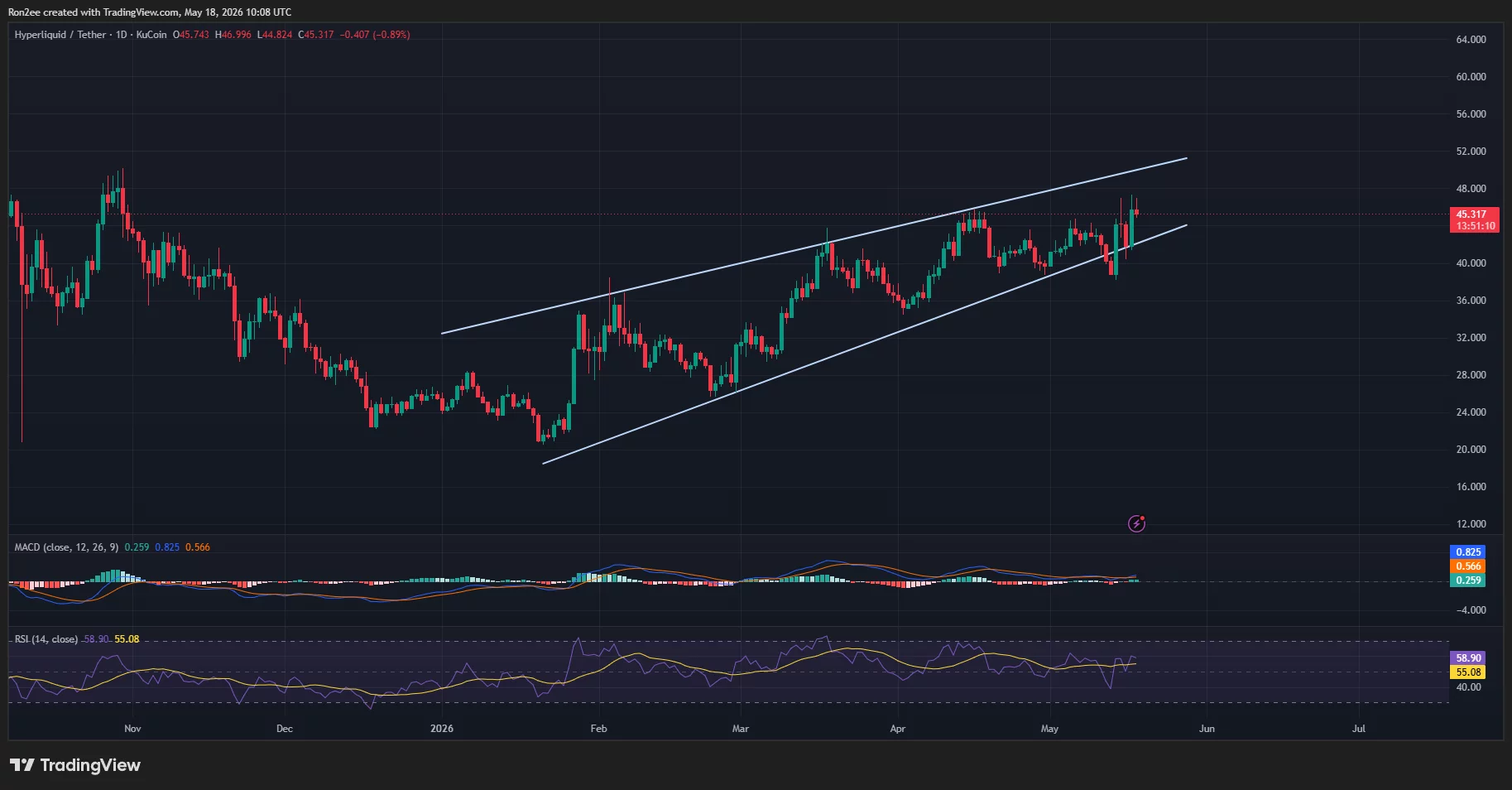
The recovery back toward the upper half of the structure suggests buyers continue defending the broader bullish trend despite recent regulatory-driven volatility.
Unlike the previously invalidated bearish double top structure near the $45–$46 resistance zone, the current setup increasingly resembles a bullish continuation pattern following Hyperliquid’s explosive rally earlier this year.
The MACD indicator has also started turning higher again after a brief cooldown phase, with the histogram gradually flipping back into positive territory. This often signals strengthening bullish momentum as buyers regain short-term control.
Meanwhile, the RSI currently remains near the 58 level, indicating momentum has improved without yet entering overbought territory. That leaves room for another potential leg higher if bullish momentum continues building.
As long as HYPE continues holding above the ascending wedge support near the $40 region, bulls may attempt another breakout above the key $46 resistance zone.
A successful breakout above that level could open the door for a rally toward the psychological $50 mark, with the upper wedge resistance near the $52 region acting as the next major upside target.
On the downside, failure to hold above the wedge support structure could weaken bullish momentum and potentially expose Hyperliquid to another correction toward the $38 support zone. A deeper breakdown below that level could invalidate the broader bullish continuation setup and shift momentum back in favor of sellers.
Disclosure: This article does not represent investment advice. The content and materials featured on this page are for educational purposes only.

Ethereum price is down, just barely holding $2,100, and a fresh protocol risk has just handed another bearish prediction. A cross-chain bridge exploit drained over $11 million just now, rattling sentiment at exactly the wrong moment.
— Coin Bureau (@coinbureau) May 18, 2026
 ALERT: VERUS-ETHEREUM BRIDGE HACKED FOR $11.4 MILLION
PeckShieldAlert says the Verus-Ethereum Bridge was drained for 103.6 $tBTC, 1,625 $ETH, and 147,000 $USDC.
The attacker has already swapped the stolen funds into 5,402 $ETH, now sitting in a single wallet.
The exploiter’s… pic.twitter.com/OEr6frBLkB
The Verus-Ethereum bridge was the target. An attacker extracted 103.6 tBTC, 1,625 ETH, and 147,000 USDC before swapping the haul into 5,402.4 ETH, worth just over $11 million. The exploit follows a brutal pattern: Kelp DAO lost $293 million in April via LayerZero’s cross-chain messaging system, and the Drift attack earlier this year added $270 million to the industry’s running tab.
All these bridge exploits consistently produce the largest individual losses in any given year. Oracle and protocol vulnerabilities remain a systemic threat, too.
Discover: The best pre-launch token sales
Ethereum Price Prediction: Reclaim $2,200 Before Bears Take Control
ETH is grinding through a bearish-to-neutral consolidation zone with limited near-term catalysts to reverse it. The current price is $2,110, with the RSI at 34, indicating weak overall momentum.
Key levels define the near-term range. Support sits just at $2,100; a close below that opens the door to further downside with few obvious technical floors. Resistance clusters at $2,200, then $2,250 if ETH manages a convincing breakout.

- Bull case: ETH holds $2,100, volume picks up, reclaims $2,250, with analysts projecting $2,425 in average.
- Base case: Sideways chop between $2,100 and $2,200 as the market digests the exploit and awaits ETF flow data.
- Bear case: A close below $2,100 on elevated volume invalidates the consolidation thesis entirely, with the next meaningful support significantly lower.
On-chain liquidity and DeFi market structure suggest the exploit adds friction to any recovery. Rotation out of smaller DeFi names is already visible. ETH needs a catalyst, not just a bounce.
Discover: The best crypto to diversify your portfolio with
LiquidChain Targets Early Mover Upside as Ethereum Tests Key Levels
ETH consolidating near six-week lows while cross-chain infrastructure keeps getting exploited raises an uncomfortable question for DeFi participants: what does a safer, unified liquidity architecture actually look like?
The current fragmentation of assets siloed across Bitcoin, Ethereum, and Solana is precisely what makes bridges high-value attack surfaces. To put it into perspective, the $293 million Kelp DAO loss was a LayerZero messaging failure, not a smart contract bug.
LiquidChain is a Layer 3 infrastructure project building what it calls the Cross-Chain Liquidity Layer, fusing BTC, ETH, and SOL liquidity into a single execution environment. The architecture centers on four components: a Unified Liquidity Layer, Single-Step Execution, Verifiable Settlement, and a Deploy-Once model that lets developers access all three ecosystems without redeploying across chains.
The presale token, $LIQUID, is currently priced at $0.0146, with $770K raised to date. The project is also currently giving a 1500% APY staking bonus only for early buyers.
Research LiquidChain and review the presale details here.
The post Ethereum Price Prediction: Verus DeFi Protocol Exploit Drains $11 Million appeared first on Cryptonews.
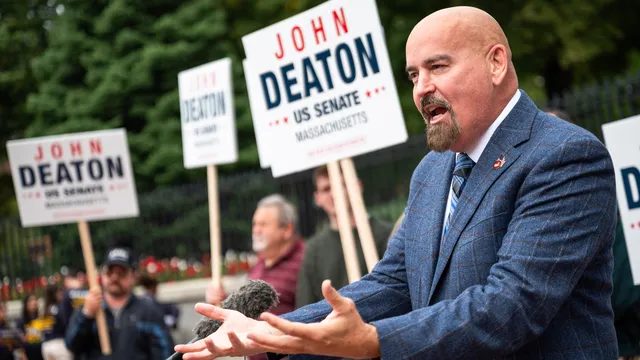
In the latest XRP News, Ripple Chief Technology Officer David Schwartz has made a personal financial contribution in XRP to John Deaton’s Senate campaign, publicly confirming his support for the pro-crypto lawyer who rose to national prominence defending XRP holders during the SEC v. Ripple lawsuit.
The donation positions Schwartz as one of the most senior crypto executives to directly back Deaton’s political bid using the very asset at the center of that regulatory fight.
Bullish signal for crypto-aligned political momentum. When a principal architect of the XRP Ledger puts his own tokens behind a Senate candidate, the symbolic weight compounds the financial one.
Discover: The best crypto to diversify your portfolio with
XRP News: Why a Personal XRP Donation Is Not the Same as a PAC Check, and Why That Distinction Matters
The mechanism here is worth understanding precisely. Schwartz’s contribution is a personal donation, not a disbursement from a corporate super PAC.
Those are not the same thing. Ripple, the company, has already pledged $25 million to the pro-crypto super PAC Fairshake, which operates independently of any candidate campaign and can raise and spend unlimited funds.
A personal contribution to a federal campaign is subject to FEC individual donor limits, must be reported by the campaign, and is valued in USD at the time of receipt, meaning the XRP is converted to a dollar figure on the books even if it arrives as a digital asset.
That compliance structure matters for what this move signals. Schwartz is not routing money through an intermediary.
He is attaching his name, his title, and his preferred asset directly to Deaton’s campaign in the public record. For the XRP community, which tracked every courtroom development in the SEC litigation, that personal identification carries a different register than a line item in a PAC disclosure.
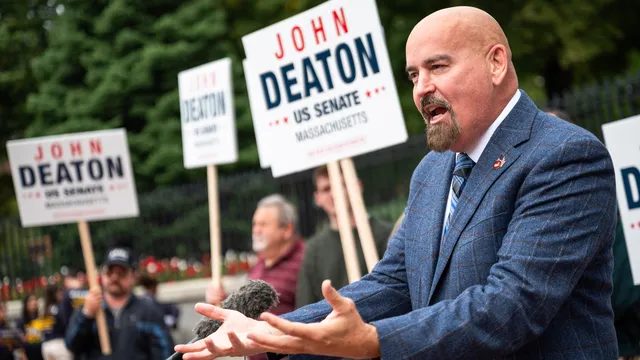
Deaton’s campaign has leaned into small-donor and community-driven optics, positioning him in contrast to industry-heavy PAC infrastructure.
Schwartz’s XRP donation threads both narratives: it is personal and community-adjacent, while also coming from a figure whose technical decisions shape a $30-billion-plus asset class. That combination is deliberately difficult to dismiss as either grassroots noise or pure corporate capture.
The political target is equally specific. Deaton is challenging Senator Elizabeth Warren in Massachusetts, one of Washington’s most vocal critics of the crypto industry and the architect of what supporters of the sector have labeled the “anti-crypto army” posture in the Senate.
JUST IN: — Watcher.Guru (@WatcherGuru) May 14, 2026
 Senator Elizabeth Warren says the crypto Clarity Act will "blow up the economy."
"It pushes more of the economy into crypto!" pic.twitter.com/4LbDiU2hUV
Warren’s regulatory pressure has been a direct backdrop to the broader legislative battles over digital asset frameworks now moving through Congress. A competitive Senate race in Massachusetts puts that pressure point on the electoral map.
Discover: The best pre-launch token sales
The post XRP News: Ripple CTO Backs John Deaton’s Senate Bid with XRP Donation appeared first on Cryptonews.

Key Takeaways
- Tesla implemented price increases of $500–$1,000 on select Model Y variants, pushing the Premium AWD configuration to approximately $50,000
- These adjustments arrive amid a 27% quarterly decline in U.S. electric vehicle sales, while Tesla’s automotive gross margins improved to 21% from 14% year-over-year
- The Model Y maintained its market leadership position with 78,591 units delivered in Q1, representing 36% of total U.S. electric vehicle sales
- TSLA shares currently trade at $422.24, with GuruFocus assessing the stock as 47.3% above its calculated fair value of $286.63
- Company insiders have liquidated approximately $32.2 million worth of shares during the preceding three-month period
On May 18, 2026, Tesla implemented subtle pricing adjustments across multiple Model Y configurations in the United States. The Premium All-Wheel Drive variant now carries a price tag near $50,000 — representing a $1,000 increase — while the Performance AWD edition saw a $500 uptick. Meanwhile, the base rear-wheel drive and all-wheel drive options remain anchored at approximately $40,000 and $42,000 respectively.
The Model 3 product range remains unaffected by these pricing modifications.
This marks the first time Tesla has adjusted Model Y pricing in the United States since 2024. The automaker declined to provide commentary when contacted regarding the rationale behind these increases.
The strategic timing appears somewhat paradoxical. During the first quarter, U.S. electric vehicle deliveries plummeted 27% compared to the corresponding period in the previous year. EVs currently constitute merely 5%–6% of total new vehicle transactions, declining from nearly 10% recorded in Q3 2025 — prior to the elimination of the $7,500 federal purchase incentive last September. Average electric vehicle transaction prices have subsequently decreased from approximately $58,000 to $55,000.
Despite this challenging environment, Tesla’s decision to elevate prices suggests either sustained demand for premium Model Y configurations — or a deliberate pivot toward margin optimization.
Profitability Metrics Show Improvement
Tesla’s automotive gross profit margin reached 21% during the first quarter, when regulatory credit revenue is excluded. This represents substantial expansion from the 14% recorded in Q1 2025, though it remains considerably below the 32% peak achieved in Q1 2022.
For the complete fiscal year, financial analysts project Tesla will deliver approximately 1.7 million electric vehicles worldwide — essentially flat compared to 2025 performance. The company’s delivery volume peaked at 1.8 million units in 2023.
The Model Y continues to dominate the U.S. electric vehicle segment by a substantial margin. Tesla delivered 78,591 units throughout Q1, marking a 23% year-over-year increase and commanding a 36% share of total domestic EV deliveries.
Strategic Pivot Underway at Tesla
Tesla recently halted production of both the Model S and Model X to repurpose its Fremont, California manufacturing facility for robotics production. The robo-taxi platform debuted in Austin, Texas during June and is currently undergoing geographic expansion.
Market analysts and the investment community have predominantly concentrated attention on this emerging business segment — rather than electric vehicle pricing strategies. Artificial intelligence-related initiatives have served as the primary catalyst for recent stock performance.
TSLA currently changes hands at $422.24. According to GuruFocus calculations using its proprietary GF Value methodology, fair value stands at $286.63 — suggesting the stock trades at a 47.3% premium. The price-to-earnings multiple registers at 387x, significantly elevated compared to its five-year median of 107x.
The composite GF Score registers at 82 out of 100. Growth characteristics earn a 9/10 rating while financial strength scores 8/10. The valuation component rates just 3/10.
Corporate insiders have divested approximately $32.2 million in TSLA equity over the trailing three-month window.
As of Friday’s market close, Tesla shares have declined 6% during the current calendar year while posting a 21% gain over the trailing twelve-month period.

Crypto World
Inside the Musk-OpenAI Legal Battle: Jury Weighs Nonprofit Promises and Billion-Dollar Claims

Key Takeaways
- In 2024, Elon Musk initiated legal action against Sam Altman and OpenAI, alleging betrayal of the organization’s original nonprofit mission.
- Jury deliberations commenced Monday to determine whether Altman and fellow OpenAI co-founders violated charitable trust obligations.
- During testimony, Musk claimed he was instrumental in establishing OpenAI and contributed approximately $38 million, significantly below his initial $1 billion commitment.
- Internal communications from 2017 reveal concerns among co-founders about whether Altman prioritized political aspirations over artificial intelligence advancement.
- Altman confirmed past consideration of a California gubernatorial bid and revealed Musk sought up to 90% ownership of OpenAI before his 2018 departure.
When Elon Musk and Sam Altman launched OpenAI in 2015, they envisioned a nonprofit organization that would challenge Google’s artificial intelligence supremacy. Fast forward ten years, and the former partners are locked in a contentious federal court battle in Oakland, California, disputing the very foundation of their original agreement.
The lawsuit, initiated by Musk in 2024, accuses Altman and co-founder Greg Brockman of abandoning the founding principles by steering OpenAI toward a profit-driven business model. Today, OpenAI commands a staggering valuation exceeding $850 billion. Meanwhile, Musk’s competing venture, xAI, completed a merger with SpaceX in February, achieving a combined valuation of $1.25 trillion.
After three weeks of witness testimony, closing arguments concluded last Thursday. Jurors began their deliberations this past Monday.
The Dissolution of a Partnership
Initially, the two entrepreneurs operated as unified collaborators. Early correspondence from 2015 shows Musk expressing enthusiasm about the founding team: “I’m super impressed with everyone so far. This is a great team.”
However, tensions emerged by 2017. Musk advocated for acquiring up to 90% equity stake in any potential commercial entity and proposed integrating OpenAI into Tesla. His co-founders unanimously declined both proposals.
Musk eventually resigned from OpenAI’s board in 2018 after contributing approximately $38 million — a fraction of his original $1 billion promise. His court testimony emphasized his role: “I came up with the idea, the name, recruited the key people, taught them everything I know, provided all the initial funding.”
Altman maintains that OpenAI never established binding agreements regarding its organizational structure and that Musk’s insistence on absolute authority caused the irreparable rift.
“Elon said he would only work on companies that he totally controlled,” Altman stated during his testimony.
Scrutiny Over Altman’s True Objectives
Trial proceedings revealed private emails from 2017 in which co-founders Ilya Sutskever and Greg Brockman challenged Altman’s intentions. Their message asked pointedly: “Is AGI truly your primary motivation? How does it connect to your political goals?”
Under cross-examination, Altman confirmed he had contemplated pursuing California’s governorship. Subsequently, he has engaged with more than 100 congressional representatives, and OpenAI currently collaborates with Democratic strategists as it prepares for a potential initial public offering.
Altman’s legal team argues that Musk’s litigation stems from “vengeance” and involves a claim for $150 billion in damages. Conversely, Musk’s attorneys characterize Altman’s preoccupation with maintaining his CEO position as a “fixation” potentially driven by political calculations.
Regarding trustworthiness, Musk’s attorney pressed Altman: “Do you always tell the truth?” Altman’s reply: “I believe I’m a truthful person…I am sure there is some time in my life when I have not.”
Implications and What Lies Ahead
Both SpaceX and OpenAI are advancing toward public market debuts. SpaceX may submit its IPO prospectus within days. The trial’s outcome could significantly impact OpenAI’s timeline and valuation.
UC Berkeley law professor Stavros Gadinis offered a sobering assessment: “After weeks of damaging testimony, the public is left choosing between two dueling billionaires, each convinced he is the rightful steward of transformative technology. The answer most people will reach is: neither.”
Jurors must now determine whether Altman and Brockman are liable for breaching charitable trust obligations and engaging in unjust enrichment.


Bitcoin fell below $77,000 on May 18 as selling pressure spread across the crypto market.
Summary
- Bitcoin’s drop below $77,000 came as ETF outflows and forced liquidations weakened short-term market sentiment.
- Fed minutes, jobs data and sentiment reports may shape rate expectations across markets this week.
- Nvidia’s May 20 earnings could guide AI stock demand and AI-linked crypto tokens this week.
crypto.news reported that U.S. spot Bitcoin ETFs recorded more than $1 billion in net outflows last week, while more than $661 million in crypto positions were liquidated within 24 hours.
The pullback erased part of Bitcoin’s CLARITY Act rally. Earlier reports said the bill cleared the Senate Banking Committee in a 15-9 vote and briefly pushed BTC above $82,000. That move faded as traders shifted back to macro risks, ETF exits and forced selling.
Fed minutes and jobs data enter focus
The U.S. calendar gives traders several events to watch from May 18 to May 22. Reports on pending home sales, weekly ADP employment changes, jobless claims, manufacturing activity and consumer sentiment are due through the week. The FOMC minutes are scheduled for Wednesday.
Markets will watch the Fed minutes for language on inflation and rate policy. crypto.news reported that recent PPI and CPI data raised concerns that the Federal Reserve may keep rates higher for longer. That setup can pressure Bitcoin and other risk assets when liquidity expectations fall.
Nvidia earnings test AI trade
Nvidia will report first-quarter fiscal 2027 results on May 20 at 2 p.m. PT, according to the company’s investor calendar. The release matters for crypto because AI-linked tokens often react when traders reprice demand for AI stocks and data-center growth.
Earlier market coverage showed why Nvidia matters to digital assets. crypto.news reported in February that strong Nvidia earnings helped lift Bitcoin and altcoins as investors moved back into risk assets. A strong report this week could support AI-related crypto names, while weak guidance may add more pressure.
Oil and Iran risks keep markets cautious
Oil prices remain another market driver. crypto.news reported that WTI crude futures climbed above $107 as stalled U.S.-Iran talks and Strait of Hormuz disruptions fed inflation concerns. Higher oil prices can keep rate-cut hopes under pressure and reduce demand for speculative assets.
The wider market also remains sensitive to political comments. President Donald Trump’s “clock is ticking” message to Iran helped push oil higher and added stress to crypto markets. Bitcoin’s next move may depend on whether macro data, Fed minutes and Nvidia earnings calm traders or extend the selloff.
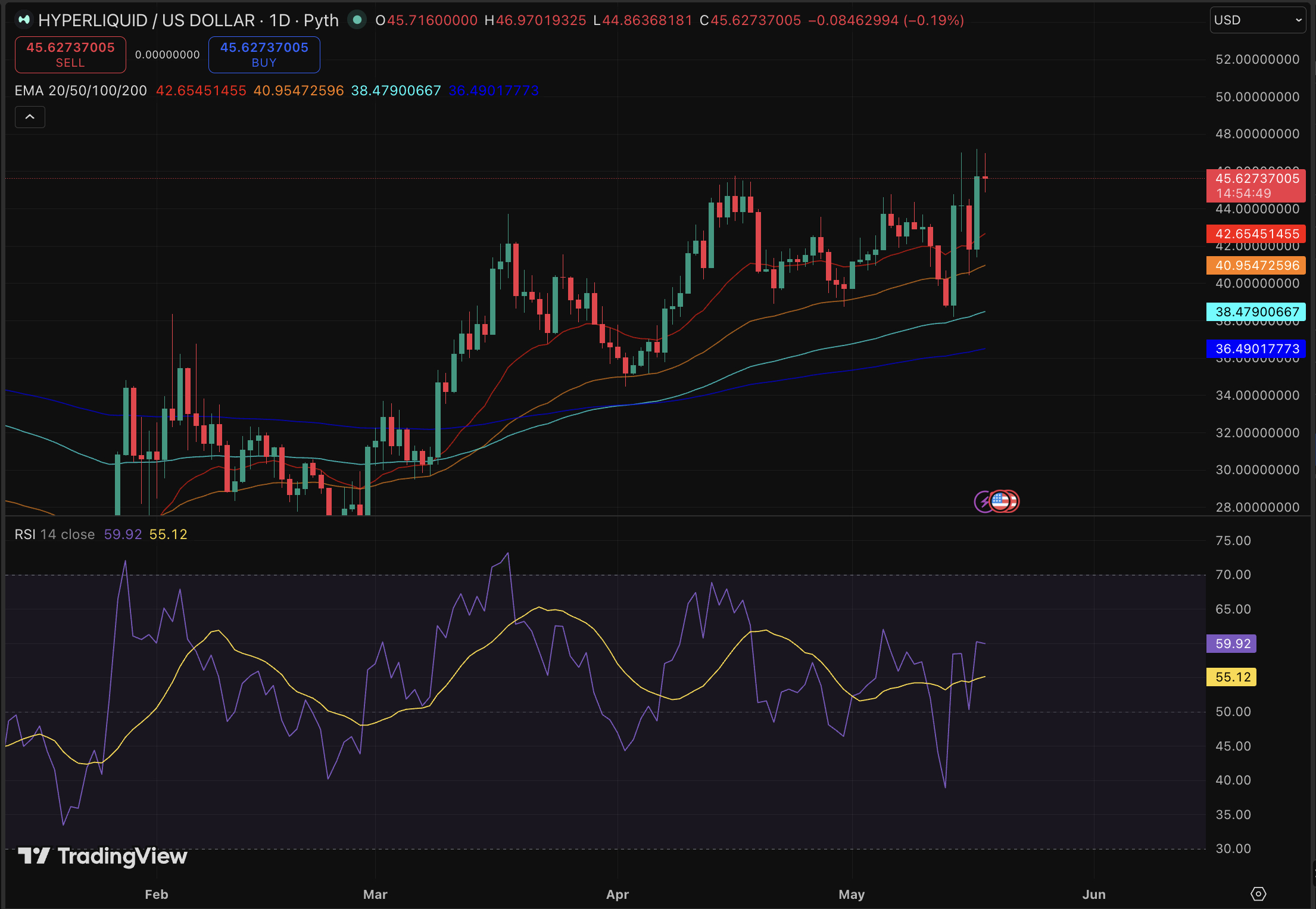
While Bitcoin, Ethereum, and XRP bleed support levels, one token is printing green. Hyperliquid’s HYPE is trading at above $45, posting more than 6% gain. Meanwhile, a full leverage meme presale, Maxi Doge, is approaching its $5 million raised milestone.
Coinbase’s listing roadmap announcement injected fresh optimism into HYPE’s, while speculation around HYPE-linked ETFs and ETPs, such as Bitwise, has amplified institutional attention. Hyperliquid also turned deflationary after last month’s burn of 43.4M HYPE valued at $1.96B.
For now, 100% of protocol fees are directed toward buybacks, generating an estimated net daily supply reduction of 16,484 tokens. Arthur Hayes publicly set a $150 HYPE target for August 2026, framing the thesis around real fee flows from on-chain perps dominance.
HYPE holds 44% perpetuals market share on-chain, which insulates it from the sentiment-driven volatility crushing majors.
Discover: The best crypto to diversify your portfolio with
$50 or Bull Fakeout?
HYPE is trading within a well-defined ascending parallel channel, having rebounded sharply from the lower support zone near $39 before reclaiming $45. The 24-hour range ran from $41 to $47, with more than $600M in volume confirming genuine participation.
Technically, the structure is constructive. EMA-20 sits at $42 and EMA-50 at $40, both below the current price, delivering a bullish EMA composite. RSI (14) reads a neutral 55, suggesting momentum without overextension at the indicator level. Price is, however, pressing above the upper Bollinger Band, a short-term overextension flag worth watching.
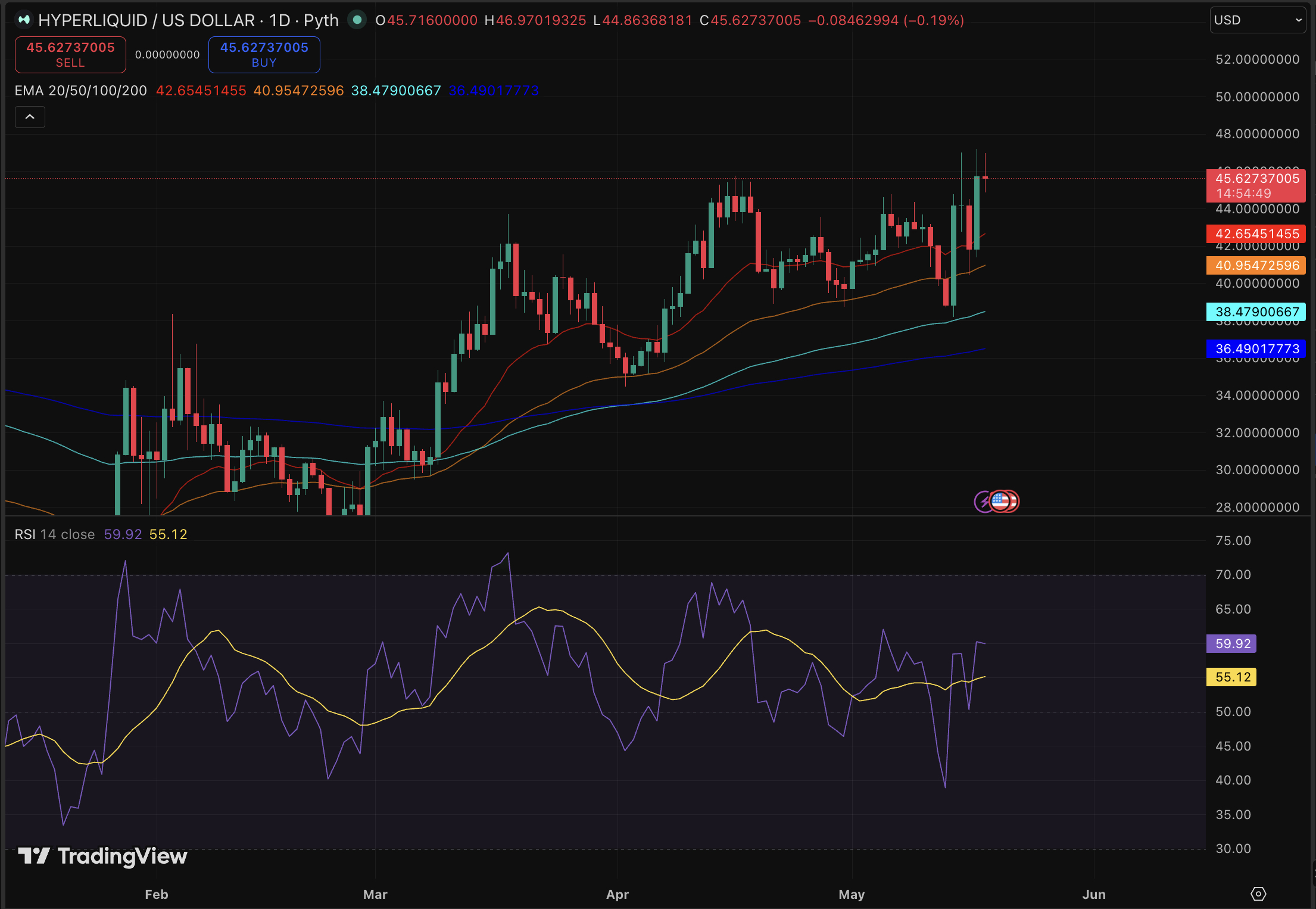
Key resistance sits at $47. A confirmed close above that level opens a path toward $50, with the all-time high of $60 representing roughly +27% upside from current levels.
Discover: The best pre-launch token sales
Maxi Doge Targets Early Mover Upside as Hyperliquid Tests Key Levels
HYPE’s 10% day is alpha, but at a $11B market cap, the upside math requires significant new capital to move the needle meaningfully. Early-stage opportunities carry different math entirely. That calculus is exactly where Maxi Doge ($MAXI) is positioning itself.
Maxi Doge is an ERC-20 meme token built around a 240-lb canine embodying a 1000x leverage trading culture. It embodies gym-bro humor that meets on-chain degeneracy, packaged with actual utility mechanics.
The presale has raised $4.7 million at a current price of $0.0002819. Staking is live with a dynamic APY. Features include holder-only trading competitions with leaderboard rewards, a Maxi Fund treasury for liquidity and partnerships, and meme-first marketing built to spread.
“Never skip leg-day, never skip a pump.”
The leverage-king identity isn’t arbitrary. It mirrors the exact trader psychology driving HYPE’s derivatives dominance, aggressive, competition-oriented, structurally designed around on-chain trading culture.
Research Maxi Doge before the next stage price adjustment.
The post Hyperliquid The Only Green Coin: Maxi Doge Follows With Full Leverage Trading appeared first on Cryptonews.
Bitcoin’s troubles only intensified as the legacy financial markets started to open during the night, with the asset dipping to a new multi-week low of under $77,000.
Most altcoins have followed suit with painful declines from ETH, DOGE, and especially BCH. On the contrary, HYPE and ZEC have defied the crash.
BTC Below $77K
The previous business week was significantly more bullish for the primary cryptocurrency. It began with some volatility on Sunday that included a dip below $80,400, but it quickly rebounded and gained $2,000 in minutes. Although it was stopped there at first, BTC returned to the $82,000 level on Tuesday, only to be halted once again.
This correction was more painful and pushed it south to under $79,000 on Wednesday. The bulls took the upper hand on Thursday after the CLARITY Act passed the US Senate Banking Committee, and bitcoin returned to $82,000. However, this turned out to be another fakeout, and the subsequent rejections have been quite brutal.
The asset fell to under $80,000 by Saturday and down to $78,000 on Sunday. After spending 24 hours fighting to stay above that support, it gave in on Monday morning after Trump’s latest threats against Iran. Bitcoin dropped to $76,500 for the first time in roughly three weeks, and currently stands below $77,000.
Its market capitalization is down to $1.540 trillion on CG, while its dominance over the alts remains above 58%.

HYPE Up, Most Down
Ethereum is close to breaking below $2,100 after another 3% drop on a daily scale. BNB is down to $640 after a 2% decline, while XRP is under $1.40 following a similar dip. DOGE has plunged by over 5% daily, while BCH has plummeted by more than 11% and now struggles at $365.
With most other alts in the red, there are two evident exceptions – HYPE and ZEC. The former has soared past $45, while the latter stands at around $530. Pi Network’s native token continues to dig new local lows, dumping below $0.15 earlier today.
The total crypto market cap has shed another $50 billion and is down to $2.630 trillion as of press time.

The post HYPE Defies Altcoin Crash as BTC Dips Below $77K: Market Watch appeared first on CryptoPotato.


AI agents are moving from advice into the transaction layer of banking, and Sygnum is the latest example. The bank ran live on-chain transactions through an AI agent while clients kept full custody.
The pilot uses the AI@Sygnum team’s in-house Model Context Protocol (MCP) server, powered by Anthropic’s Claude as the underlying AI model. Private keys never leave the client’s device.
Banks Race to Move AI Agents Beyond Advice
Institutions have spent months pushing AI agents from advisory tools toward live transaction execution. The trend now spans regulated banks and digital asset custodians.
Sygnum said it has become the first regulated Swiss bank to deploy an AI agent for live on-chain transactions. Clients submit a plain-language request, and the agent then plans each step, reviews the smart contracts, and flags risks before sending the transaction back for approval.
Every signature happens on the client’s own device through a self-custodial wallet, so private keys never leave their possession. Use cases include moving stablecoins, asset swaps, on-chain lending, token wrapping, and adding liquidity.
“Connecting AI agents to wallets is foundational to where finance is heading. The next decade will see agents transacting, settling and interacting with markets on behalf of clients,” Thomas Frei, Head of AI and Data Analytics and AI@Sygnum lead at Sygnum Bank, said.
Follow us on X to get the latest news as it happens
Sygnum is not alone. Anchorage Digital also introduced Agentic Banking in May, a platform for AI agents to move funds through regulated banking rails.
FIS and Anthropic have also partnered to bring agentic AI to banking, starting with the Financial Crimes AI Agent for anti-money-laundering work.
Subscribe to our YouTube channel to watch leaders and journalists provide expert insights
The post Banks Hand AI Agents the Wheel On-Chain, Sygnum Goes First appeared first on BeInCrypto.

Netflix’s M. Night Shyamalan Crime Thriller Surges on Streaming 2 Years Later

Can I cut my neighbour’s hedge if it grows into my garden? UK legal rights explained

HAL shares fall 10% in 3 days after Q4 results but Jefferies, Nuvama, other brokerages are raising target prices, here’s why

Manchester United reach agreement with Casemiro over contract clause amid transfer speculation

US brings back mandatory military draft registration

Steven Gerrard disagrees with Gary Neville over ‘shock’ Chelsea and Arsenal claim | Football


-

 Crypto World2 days ago
BloFin War of Whales 2026 Grand Prix opens registration for $5M trading championship
-

 Fashion3 days ago
Weekend Open Thread: Theory – Corporette.com
-

 Crypto World3 days ago
E-Estate Announces 1 Year Live: Washington DC Summit as Real Estate Tokenization Enters Its Next Phase
-

 Fashion7 days ago
Coffee Break: Travel Steam Iron
-

 Politics7 days ago
What to expect when you’re expecting a budget
-

 Tech3 days ago
Tech Moves: Microsoft AI leader jumps to OpenAI; former AI2 exec joins Meta; and more
-
Crypto World5 days ago
Bitcoin Suisse expands with Digital Asset License and Investment Business Act Registration Approval in Bermuda
-

 Tech6 days ago
GM agrees to $12.75M California settlement over sale of drivers’ data
-

 Politics5 days ago
Pakistan to enter Chinese capital market as war inflation bites
-

 Crypto World5 days ago
Bitcoin Suisse expands with Digital Asset License and Investment Business Act Registration Approval in Bermuda
-
 Crypto World4 days ago
Google’s Gemini AI Predicts Incredible Solana Price by the End of 2026
-

 Business3 days ago
H&R Real Estate Investment Trust (HR.UN:CA) Q1 2026 Earnings Call Transcript
-

 Tech2 days ago
Google reimburses Register sources who were victims of API fraud
-

 Sports2 days ago
Napoleonic enters 2026 Doomben 10,000 field via Abounding withdrawal
-

 Politics7 days ago
The geopolitics behind the UK’s South Atlantic hantavirus rescue mission
-

 Politics6 days ago
The Board of Deputies just smeared Polanski to suck up to Farage
-

 Fashion5 days ago
The Best-Kept Makeup Secret for a More Defined Face
-
 Entertainment4 days ago
Zara Larsson Has Blunt Response To Chris Brown Diss
-

 NewsBeat6 days ago
Comment on Keir Starmer surviving the day as Prime Minister like a turd that wont flush
-
 Tech5 days ago
Why AI is making typography a boardroom conversation
You must be logged in to post a comment Login