

Crypto World
Major Stock Moves Monday: Dominion Energy (D) Soars on Acquisition Rumors, Bitcoin Depot (BTM) Collapses


Quick Summary
- Dominion Energy shares climbed more than 12% in early trading following news that NextEra Energy is exploring a potential acquisition valued at approximately $66 billion.
- LiveRamp shares spiked 26% after Publicis Groupe announced plans to acquire the company for $2.5 billion at $38.50 per share—representing nearly a 30% premium.
- Bitcoin Depot shares plummeted 63% after the company announced a Chapter 11 bankruptcy filing and shut down its ATM operations.
- S&P 500 futures declined 0.42% while Bitcoin fell 2.05% to $76,778 amid broader market weakness.
- Victory Capital and Regeneron led decliners with drops of 39.3% and 12.2% respectively during early market hours.
Monday’s early trading session delivered dramatic price swings across multiple equities, fueled by significant merger activity, a major bankruptcy announcement, and widespread market headwinds.
Dominion Energy emerged as one of the session’s strongest performers. The utility provider’s stock jumped over 12% following reports that NextEra Energy has entered preliminary acquisition discussions. According to sources, the potential all-stock merger would value Dominion at approximately $66 billion, with total enterprise value reaching roughly $116 billion including existing debt obligations.
If finalized, this transaction would represent the utility sector’s largest acquisition ever recorded. The deal would provide NextEra with expanded access to the PJM interconnection grid, particularly in Northern Virginia—a region experiencing explosive data center expansion driven by artificial intelligence infrastructure needs. However, negotiations remain ongoing and no definitive agreement has been reached, meaning discussions could ultimately collapse.
LiveRamp represented another significant winner in early trading. The company’s stock surged 26% following Publicis Groupe’s announcement of a $2.5 billion all-cash acquisition. Under the agreement terms, Publicis will pay $38.50 for each LiveRamp share—reflecting approximately a 29.8% premium compared to Thursday’s closing price. Publicis indicated the acquisition would bolster its data analytics and artificial intelligence offerings, simultaneously revising upward its financial projections for 2027 and 2028.
Bitcoin Depot Files for Bankruptcy Protection
Bitcoin Depot experienced the session’s most severe decline. The stock crashed 63% after management announced Chapter 11 bankruptcy protection filing. Company leadership stated intentions to cease operations and liquidate remaining assets.
Chief Executive Officer Alex Holmes attributed the collapse to increasingly stringent fraud prevention mandates, escalating regulatory compliance expenses, ongoing litigation challenges, and intensifying regulatory scrutiny that rendered the business model economically unviable. The entire Bitcoin ATM infrastructure has been deactivated. Canadian business units are similarly anticipated to enter restructuring proceedings.
Market-Wide Weakness Emerges
Beyond specific equity movements, markets faced generalized downward pressure. S&P 500 futures decreased 0.42%, with Dow futures sliding 0.66%.
Bitcoin declined 2.05% to reach $76,778. The 10-year Treasury yield climbed to 4.609%, while gold futures registered modest losses and crude oil futures posted slight gains.
During Friday’s session, the S&P 500 retreated 1.24% and the Dow fell 1.07%. Asian equity markets similarly declined, with Japan’s Nikkei index dropping nearly 1%.
Among notable losers, Victory Capital tumbled 39.3% and Regeneron declined 12.2% in early action. Natera also recorded a significant pullback, losing more than 5%.
Additional early session gainers included Bio-Rad Laboratories, MYR Group, and ServiceNow, each advancing at least 5%.


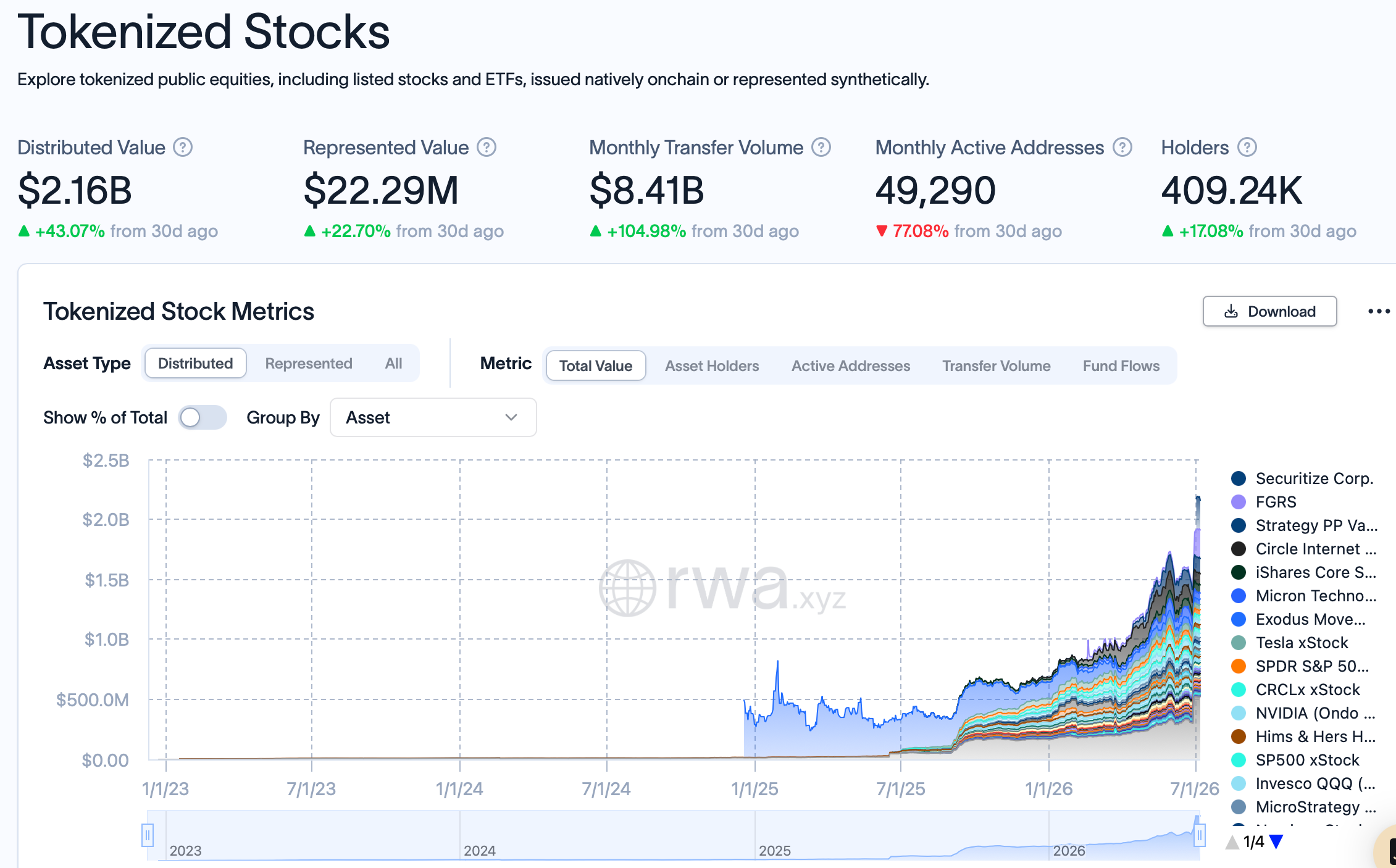
Tokenized stock transfers more than doubled over the past month to $8.41 billion, according to RWA.xyz data, as activity in onchain equity markets continued to accelerate.
The sector’s distributed value also climbed 43% over the same period to $2.16 billion, while the number of holders increased 17% to more than 409,000, according to the data platform.
Growth was led by several of the market’s largest tokenization platforms. Figure’s distributed value surged 935% over the past 30 days, while Securitize’s rose 332% and xStocks’ increased around 62%.
Ondo remained the largest tokenized stock platform by distributed value at roughly $846 million, followed by xStocks with about $708 million, Securitize with $306 million and Figure with $239 million, according to the data.
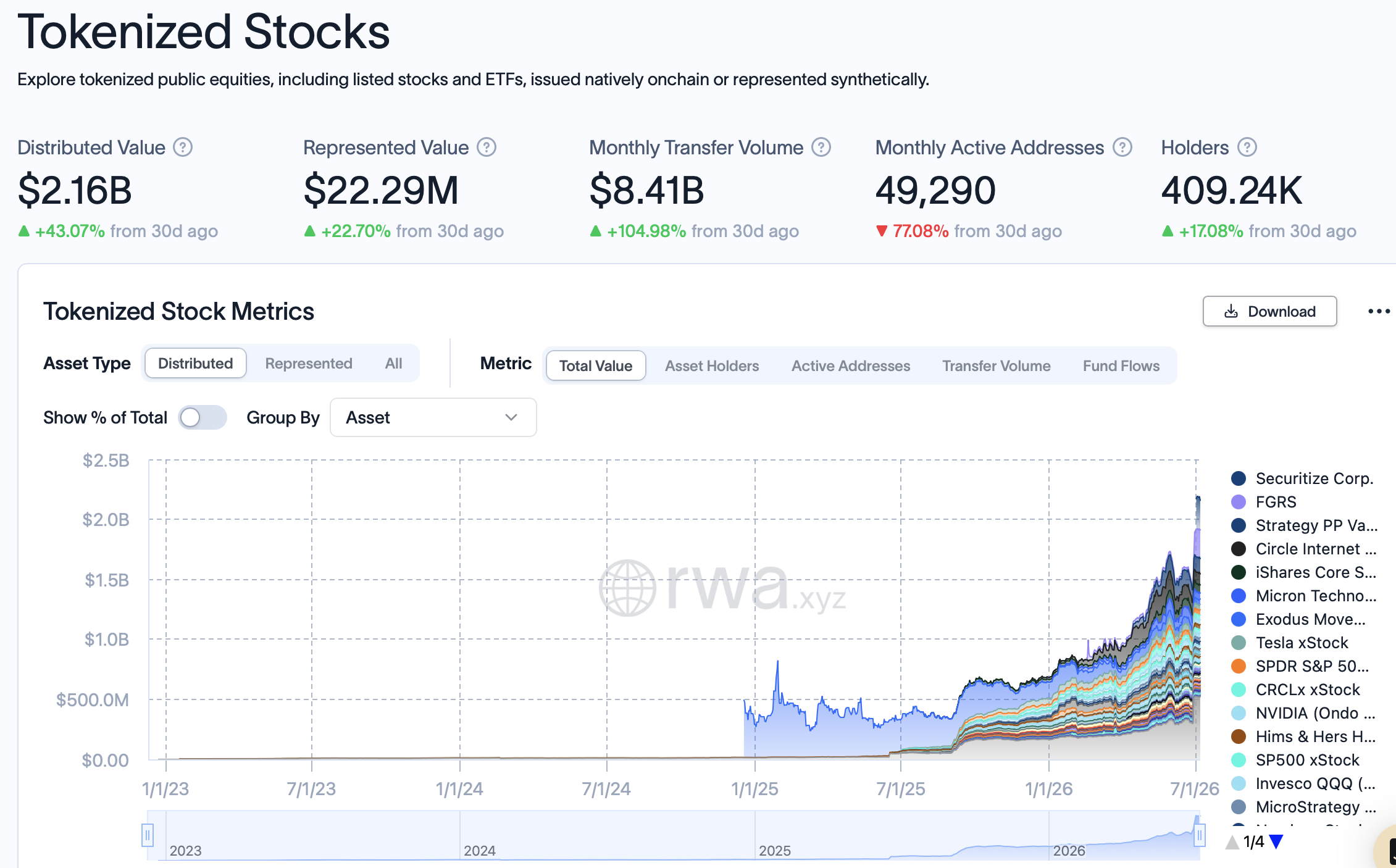
Tokenized stocks. Source: RWA.xyz
Tokenized equities outperformed other segments of the RWA market. Distributed value for tokenized US Treasurys, the sector’s largest asset class, was essentially flat over the past month, while the broader tokenized RWA market grew about 4% to $33.5 billion.
Related: Tradeweb executes real-time tokenized US Treasury transaction on Canton Network
Crypto and Wall Street race to tokenize stocks
The tokenized stock market has grown from roughly $378 million to $2.16 billion over the past year, a gain of about 471%, according to RWA.xyz data.
The growth has coincided with a wave of new tokenized equity offerings across crypto exchanges. During the SpaceX IPO, Kraken, Bybit and Bitget Wallet used xStocks infrastructure to offer tokenized pre-IPO access. Although customer demand exceeded the available share allocation, it highlighted growing investor appetite for blockchain-based securities.
The momentum has spread to public markets. Earlier this month, Securitize became the first newly public company to issue tokenized versions of its shares on the Solana and Avalanche blockchains as it debuted on the New York Stock Exchange.
Some of the biggest names in traditional finance have also been accelerating their own tokenization efforts. In May, the DTCC announced plans to launch a tokenized securities service in October after receiving regulatory approval to offer tokenization services on pre-approved blockchains under a three-year pilot.
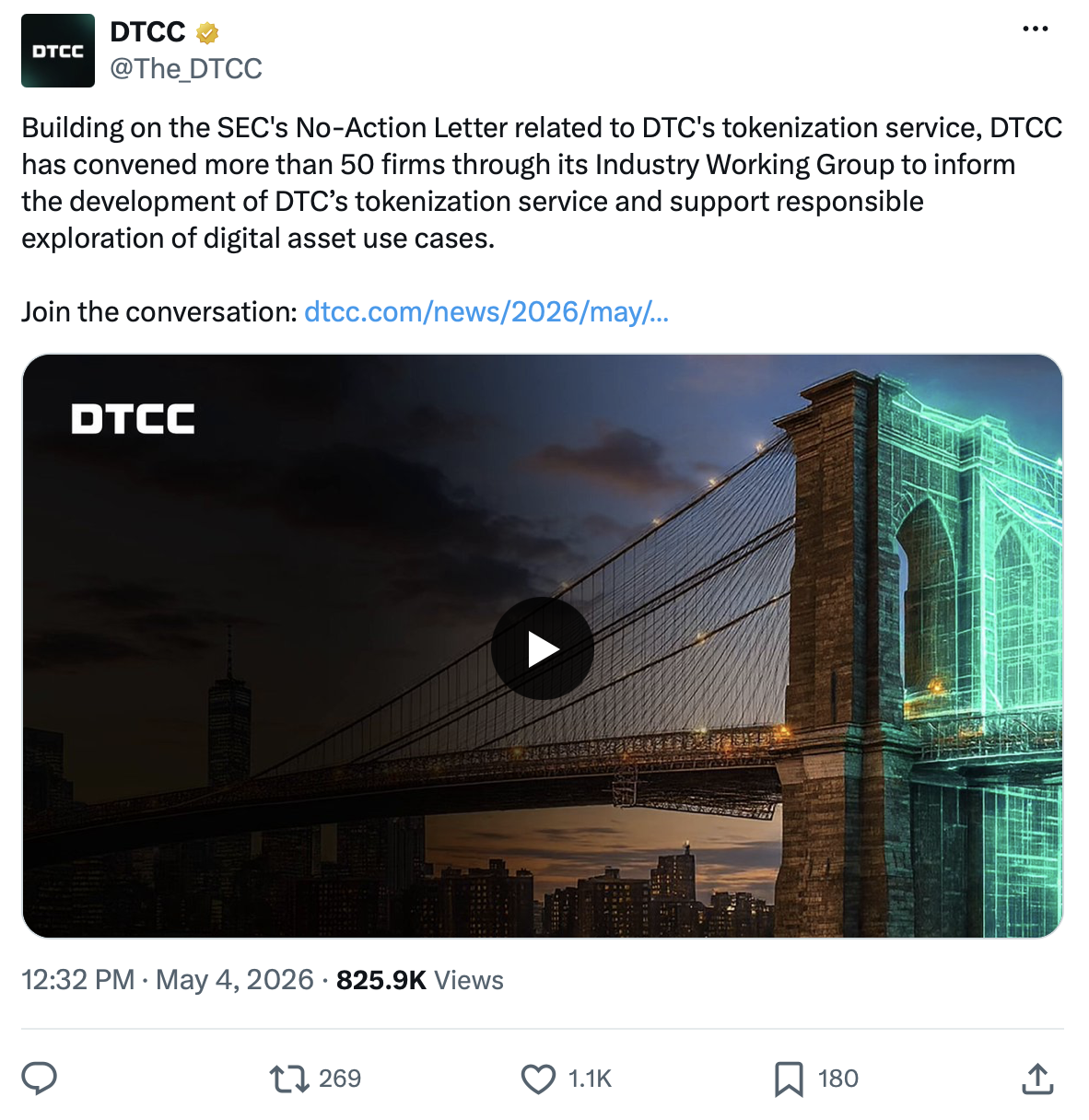
Source: The_DTCC
Earlier this year, the New York Stock Exchange and parent company Intercontinental Exchange unveiled plans for a platform to trade tokenized stocks and ETFs, while Nasdaq partnered with Kraken and infrastructure firm Backed to develop technology linking traditional equities with blockchain networks.
As competition between crypto-native and traditional finance firms intensifies, ICE CEO Jeffrey Sprecher has urged regulators to allow traditional exchanges to offer 24/7 onchain perpetual futures, arguing regulated venues should be able to compete with crypto-native platforms.
Magazine: Bitcoin decouples from tech stocks, Ether eyes ‘selling wave’: Market Moves
Crypto exchange AscendEx has announced the cessation of its operations “with effect from 1 July 2026.” In a letter dated July 6, it cited a lack of an EU Markets in Crypto-Assets Regulation (MiCA) licence, “as well as broader regulatory, financial and operational considerations affecting the platform.”
However, towards the end of the letter, AscendEx reveals that it “relied on an agreed strategic transaction… and the counterparty did not perform.”
The news comes almost two weeks after pseudonymous blockchain investigator ZachXBT voiced concerns over disruption to user withdrawals.
In a June 26 message to his Telegram channel, he noted that the exchange’s “reserves appear to lack large cap tokens such as ETH, USDT, USDT, SOL, etc indicating they likely are facing liquidity issues.”
Read more: SecondFi is shutting down after Cardano wallet exploit
AscendEx-labelled addresses on blockchain data platform Arkham Intelligence hold approximately $13.5 million worth of crypto. However, the vast majority of this (over $12 million) is made up of Unbound Science’s UNITE token and the exchange’s own ASD.
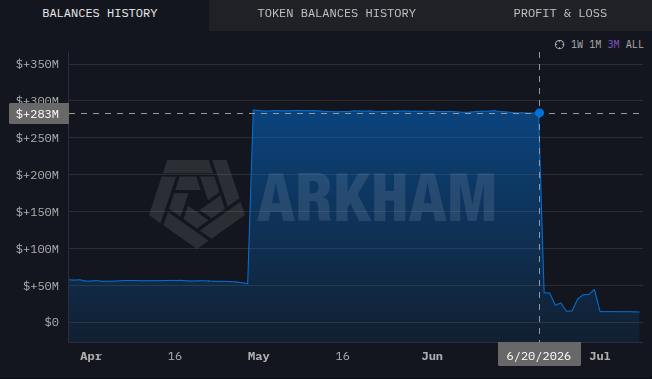
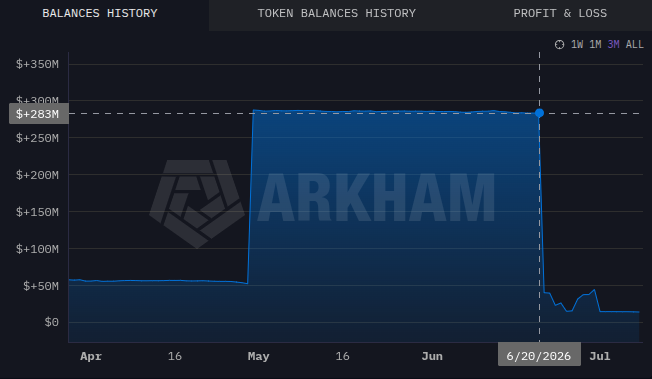
Ascendex’s balance history shows a sudden drop in reserves almost a week before ZachXBT first drew attention to withdrawal issues.
The $240 million drop-off came less than two months after a liquidity injection of a similar scale, before which Ascendex reserves sat steadily around $50 million.
Read more: ZachXBT slams Bitget execs over suspicious $480M withdrawals
Since June 20, the value of reserves has been much more volatile, until July 1 when the exchange ceased operations.
Following up on his original message, on July 2 ZachXBT warned that withdrawals were “still not being processed while deposits are being accepted,” and urged affected users to contact their local authorities.
He then reiterated the earlier recommendation to contact law enforcement and “hold [AscendEx’s] co-founder… responsible” on July 8.
Will AscendEx honour withdrawals?
Addressing the worries over stuck funds, AscendEx’s announcement states that “automated withdrawals are paused.”
From July 6 onward, all withdrawals will face “manual review” based on “account verification, KYC/AML/CFT and sanctions checks, fraud-prevention checks, asset and balance reconciliation, network availability and any applicable legal or insolvency-related requirements.”
Unsurprisingly, given the lengthy list of checks, it warns that withdrawals may face delays, requests for additional information, or may not be processed at all.
Got a tip? Send us an email securely via Protos Leaks. For more informed news and investigations, follow us on X, Bluesky, and Google News, or subscribe to our YouTube channel.
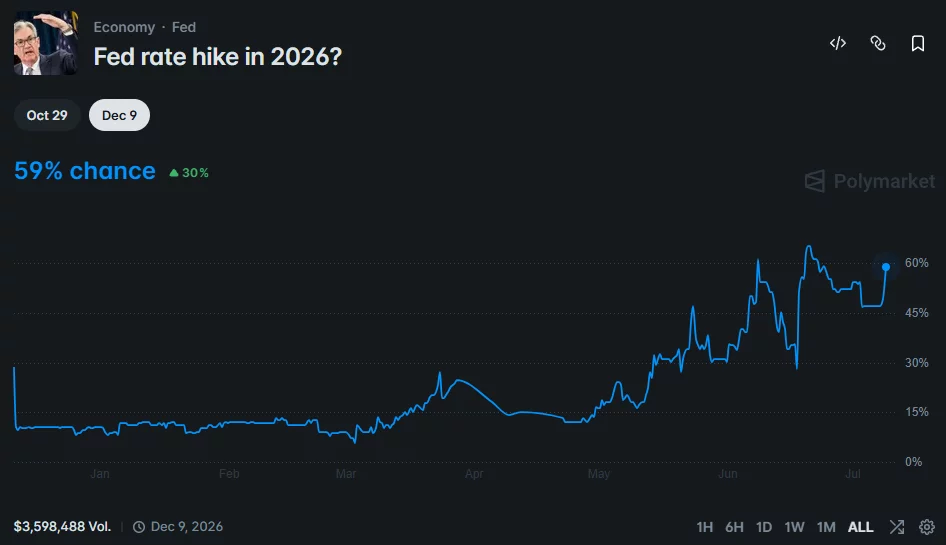
The Federal Reserve has warned that strong artificial intelligence-related demand could keep inflation elevated, while market pricing for a U.S. interest rate hike this year has climbed above 59%.
Summary
- Fed minutes identified AI demand, tariffs, and Middle East tensions as potential drivers of persistent inflation.
- Most Fed officials said higher rates may be needed if inflation stays above the 2% target.
- Polymarket now prices a 59% chance of a Fed rate hike this year, while July pause odds remain at 69.5%.
According to the minutes of the Federal Reserve’s June Federal Open Market Committee meeting, policymakers discussed several paths for monetary policy depending on how inflation and the labor market develop.
One of the scenarios considered involved inflation staying above the central bank’s 2% target despite a stable labor market, driven by strong AI-related demand, the conflict in the Middle East, or the effects of tariffs.
Under those conditions, the minutes showed that almost all participants believed additional policy tightening would likely be needed to bring inflation back to the Fed’s target. At the same time, the document outlined an alternative scenario in which inflationary pressures ease, allowing inflation to move back toward 2%.
Elevated inflation keeps tightening on the table
In the event inflation begins to cool, almost all participants said maintaining the current federal funds rate or eventually lowering it would likely be appropriate, according to the meeting minutes.
The June meeting ultimately ended with the Federal Reserve leaving interest rates unchanged, the first policy meeting chaired by Kevin Warsh since taking over as Fed chair.
The minutes also revealed differences among policymakers over where interest rates should finish the year. Many participants projected that the appropriate federal funds rate would be within or slightly below the current target range by year-end. Others, however, judged that rates should end the year above the current range, highlighting continued uncertainty over the inflation outlook.
Separately, a few participants argued there was already a case for raising rates because upside inflation risks remained elevated while downside risks to the labor market had eased somewhat. Even so, those officials still supported leaving the policy rate unchanged at the June meeting.
Markets continue pricing another rate increase
While policymakers debated multiple scenarios, prediction markets have increasingly leaned toward another rate hike before the end of the year. According to Polymarket data, traders currently assign a 59% probability that the Federal Reserve will raise interest rates in 2026.
Those odds have increased this week following renewed tensions between the United States and Iran after President Donald Trump threatened additional military strikes against Iran, adding another potential source of inflation risk alongside energy market uncertainty.
Meanwhile, expectations for the Fed’s next meeting remain more balanced. According to the CME FedWatch Tool, there is a 69.5% probability that policymakers will leave interest rates unchanged at the July FOMC meeting. Although that remains the most likely outcome, the probability has declined from around 80% over the past week.
Current CME FedWatch pricing also shows a 30.5% chance of a rate increase in July, indicating that investors have become less certain that the Fed will be able to keep borrowing costs unchanged if inflation risks continue to build.
Taken together, the June meeting minutes indicate that Federal Reserve officials continue to view incoming inflation data as the deciding factor for future policy. While many members still see room to hold or eventually lower rates if price pressures ease, persistent inflation driven by AI demand, geopolitical developments, or tariffs could still push the central bank toward another rate hike later this year.

Charles Hoskinson has accused Ethereum of adopting ideas pioneered by Cardano without acknowledgment.
The Cardano co-founder made the claim following a proposal by Ethereum researcher Toni Wahrstätter to bring native UTXOs to the network as a way of cutting long-term state storage for payment transactions.
Ethereum Is Revisiting Cardano’s Work
According to Hoskinson, Wahrstätter’s research closely mirrors concepts Cardano has been developing since its launch.
“It’s literally a crime in the Ethereum inner circle to mention Cardano,” he wrote on X. “EUTXO is the biggest innovation of the smart contract world and Ethereum cannot mention it as they literally try to copy it.”
Wahrstätter’s proposal describes a payment model that stores only a small “spent” marker in Ethereum’s state while keeping the rest of the payment data in blockchain history. According to the research, this approach could reduce the permanent state required for payment workloads by as much as 99.8% without abandoning Ethereum’s account-based architecture.
The proposal borrows the one-time payment structure used by Bitcoin’s UTXO model while allowing Ethereum accounts and smart contracts to keep on operating. It also relies on the proposed EIP-8141 transaction framework to let users spend UTXOs without first holding ETH for gas fees.
Hoskinson followed up his post on X with a livestream on the same platform, where he read a tweet by Wahrstätter announcing the proposal and pointed out that it made no reference to Cardano despite his network spending years solving many of the engineering problems that Ethereum is now exploring.
“For ten years, we’ve worked on extended UTXO, smart contracts on UTXO,” he said. “We wrote a paper called Chimeric Ledgers to show how to run these two systems in parallel.”
He argued that Ethereum developers had in the past dismissed UTXO-based smart contracts as impractical before now putting similar ideas on their long-term roadmap.
Long-Running Rivalry Returns to the Spotlight
During the livestream, Hoskinson expanded his criticism beyond Wahrstätter’s proposal, claiming that Ethereum has been regularly adopting ideas after dismissing them when they first appeared on Cardano.
Some of the areas he claimed such behavior had happened in included Cardano’s governance system and treasury model, which he said the Ethereum Foundation had been forced to drift toward after losing staff and money.
He also suggested that Ethereum would look to revisit Cardano’s work on privacy and post-quantum cryptography through IOHK’s privacy-focused blockchain project, Midnight, as well as its early embrace of formal verification tools like Lean. According to him, Ethereum will eventually adopt both without acknowledgment as well.
This is not the first time Hoskinson has used a livestream to vent about how he or Cardano is being treated. In June, he announced plans to move the Cardano community away from X and onto Discord, saying the social platform had become dominated by hostility and personal attacks. However, he said that he would keep using X for livestream broadcasts, the exact same format he used today to make his case against Ethereum.
The post Charles Hoskinson Says Ethereum Is Adopting Cardano Ideas Without Credit appeared first on CryptoPotato.

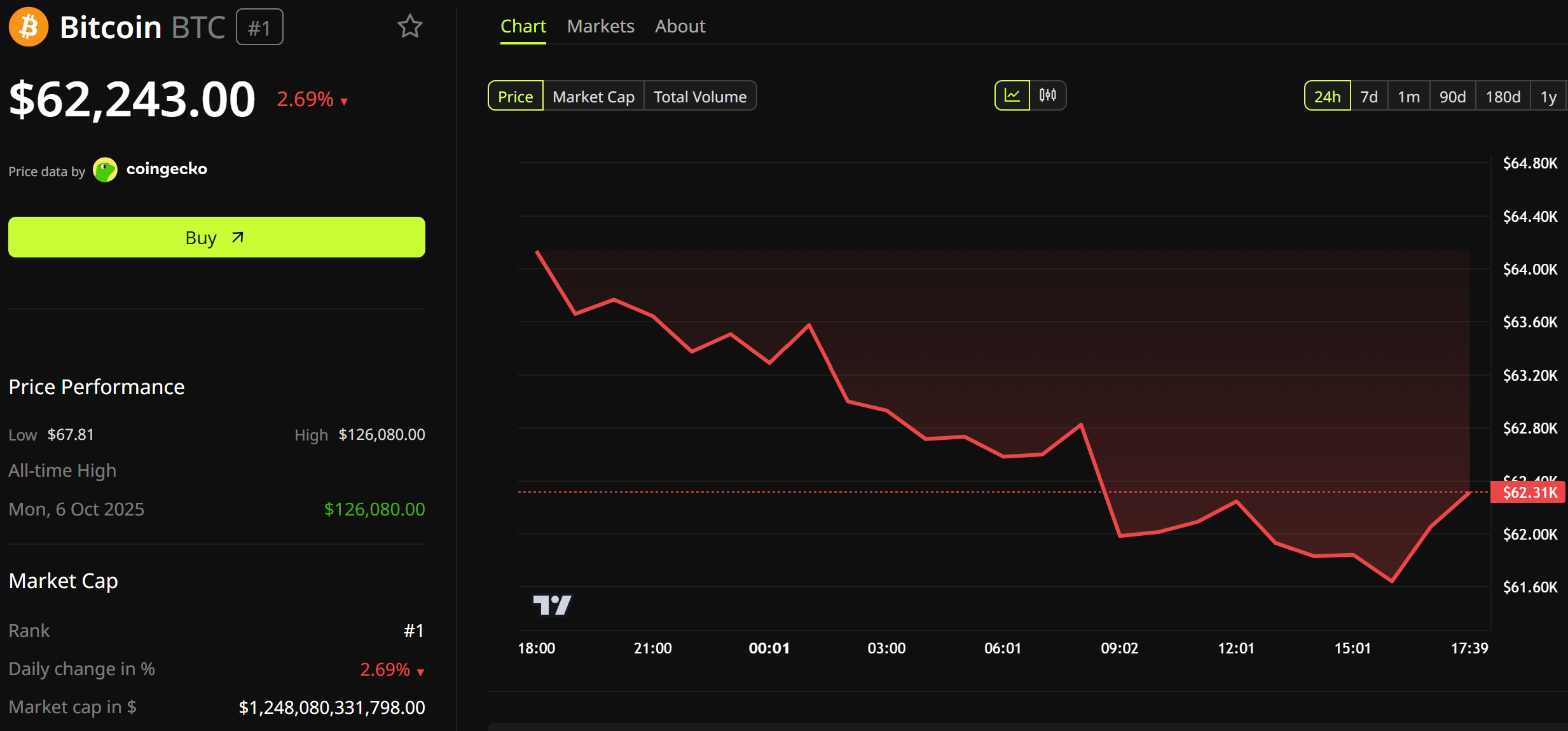
In the latest Bitcoin news, Bitcoin saw BTC price drop to $62,870 on Wednesday after stalling at the $64,000 resistance zone, with fresh US military strikes against Iran delivering the decisive blow to an already fragile risk appetite.
The convergence of geopolitical shock, a $7.7 billion stablecoin contraction, and anemic Bitcoin ETF inflows has placed the crypto market on a structurally weak footing heading into the back half of the week.

Discover: The Best Token Presales
Bitcoin News: US-Iran Escalation Is the Immediate Catalyst
Iran’s Islamic Revolutionary Guards Corps responded by claiming strikes on 85 US military sites in Bahrain and Kuwait and announcing the downing of a US MQ9 drone. Washington simultaneously withdrew a key concession that had allowed Iran to sell oil on international markets, a move that immediately spiked crude prices and reinforced the flight from risk-sensitive assets.
Bitcoin, as one of the most liquid 24/7 risk instruments, absorbed that flight in real time.
The causal chain from US-Iran tensions to BTC price is not theoretical. Geopolitical risk of this magnitude raises energy-cost expectations, tightens financial conditions sentiment, and pushes institutional allocators toward capital preservation.
Bitcoin, which had already printed a 21-month low of $57,742 on July 1 amid rate-hike fears, according to Bloomberg, had a limited cushion to absorb another macro shock of this scale. For more context on where analysts see the BTC price trajectory from here, see Peter Brandt’s bearish Bitcoin price outlook.
Discover: The Best Crypto to Diversify Your Portfolio
Stablecoin Contraction Signals Capital Exit, Not Rotation
The geopolitical catalyst landed on top of a liquidity picture that was already deteriorating. According to data cited by Walter Bloomberg on X, the stablecoin market contracted by 2.4% – $7.7 billion, to $312 billion in June, its largest monthly decline since the TerraUSD collapse of 2022.
That comparison is worth sitting with: the last time stablecoin supply fell this sharply in a single month, the crypto market was unwinding a systemic failure.
This time the cause is different – reduced buying interest rather than a protocol implosion, but the directional implication for the crypto market is the same. Stablecoin contraction means less dry powder available to buy dips.
It signals that fresh capital is leaving the ecosystem rather than rotating within it. The June decline coincided with a 20% drop in the BTC price, and if the stablecoin contraction extends into July, selling pressure has a structural source beyond just the current Iran headline.
BTC ETF Inflows Exist But Are Too Thin to Matter
Spot Bitcoin ETF flows offered a technical positive – SoSoValue data shows Tuesday marked the third consecutive day of net inflows at $21.44 million, but the number is functionally irrelevant at current pressure levels.
For context, the weeks preceding this brief inflow streak saw hundreds of millions in cumulative ETF outflows, and $21 million does not meaningfully offset that overhang.

Institutional demand through the ETF channel was supposed to provide a floor under extended selloffs. The absence of that cushion here, three days of token inflows against a backdrop of geopolitical shock and liquidity withdrawal, underscores that institutional appetite remains cautious, not committed.
If inflows reverse back to outflows this week, the ETF narrative loses whatever stabilizing credibility it still carries.
Bitcoin Price Technical Analysis: Every Major EMA Is Overhead Resistance
The chart structure reinforces the bearish case. Bitcoin trades below all three major exponential moving averages: the 50-day EMA at $65,577, the 100-day at $69,225, and the 200-day at $75,269.
That stacked alignment means every meaningful rally attempt runs into a fresh supply zone before it can generate momentum. The RSI sits near a neutral 48, and while the MACD remains positive, it is waning – not a reversal signal, but confirmation that the corrective pressure has not cleared.
Immediate resistance is the horizontal barrier at $64,004, which BTC failed to clear on Wednesday. On the downside, the absence of defined structural support between current levels and the July 1 yearly low of $57,800 is the critical detail.
A close below $62,000 removes the last thin buffer and opens a direct path toward that level. Retail sentiment around these price levels has been visibly deteriorating, a dynamic well-documented in the retail investor response to Bitcoin’s slide from its highs.
Don’t Miss Out on Our $1,000 USDT Airdrop on ByBit
The post US-Iran Strikes and $7.7B Stablecoin Exit Put Bitcoin at $62,870 appeared first on Cryptonews.
The Federal Reserve released minutes from its June 16-17 meeting on July 8, showing a divided committee that unanimously held rates steady at 3.50% to 3.75% while flagging inflation risks tied to artificial intelligence spending.
The meeting was Chair Kevin Warsh’s first since taking over the Fed. All 12 voting members backed the hold, though the minutes revealed disagreement over whether a hike is still needed this year.
Officials Split Over the Case for a Hike
A few participants argued a rate increase was justified at the June meeting but ultimately supported holding steady, the minutes said. Most officials cited persistent inflation risk from tariffs, Middle East energy costs, and AI-driven demand for tech, data centers, and electricity.
Nine of 19 officials penciled in at least one rate hike before the end of 2026, a reversal from earlier projections that showed no hikes at all. Warsh did not submit a projection.
At his post-meeting press conference, Warsh described the internal debate in blunt terms.
“We had a good family fight on it for a couple of days, and we ended up, I think, in a better place.”
Follow us on X to get the latest news as it happens
AI Buildout Complicates the Inflation Picture
Fed staff raised inflation forecasts for 2026 and 2027, citing tariff pass-through, Middle East supply shocks, and surging AI infrastructure investment. Core inflation ran at 3.3% in April and was estimated near 3.4% in May, well above the Fed’s 2% target.
Several participants said AI spending could eventually lower costs through productivity gains, though that effect would take years to appear. Meanwhile, demand for data centers and high-tech equipment keeps adding upward pressure on prices.
Bitcoin Dips as Markets Digest the Hawkish Tone
Bitcoin (BTC) traded near $62,240 on Wednesday, down about 2.7% over the past 24 hours, according to BeInCrypto data at press time.

The move followed a preview of the release that flagged Warsh’s silence on his own rate projection as a key source of uncertainty.
The drop follows Bitcoin options activity that turned call-heavy ahead of the minutes, days after Bitcoin’s rebound toward $64,000 on bullish ETF flows. It shows how sensitive crypto markets remain to rate-hike expectations, a dynamic also visible in the earlier Fed independence fight over Governor Lisa Cook.
Analysts See a Widening Macro-Crypto Link
Ahead of the release, Ryan Kirkley, co-founder and CEO of Global Settlement Network, said the moves in oil, Treasury yields, and the dollar showed markets were already repricing for a longer inflation fight rather than a one-off shock.
The minutes bore that out, tying elevated inflation to AI-related demand, tariffs, and Middle East energy costs.
“Crypto is now reacting to oil, rates, the dollar and treasury yields… It bleeds when macro bleeds.”
The next FOMC meeting is scheduled for July 28-29. With inflation still running above target and nine officials now leaning toward a hike, upcoming inflation and jobs data will likely determine whether Warsh’s “family fight” ends in a rate increase or another hold.
The post Bitcoin Reacts As Fed Minutes Reveal Split on Rate Hikes appeared first on BeInCrypto.
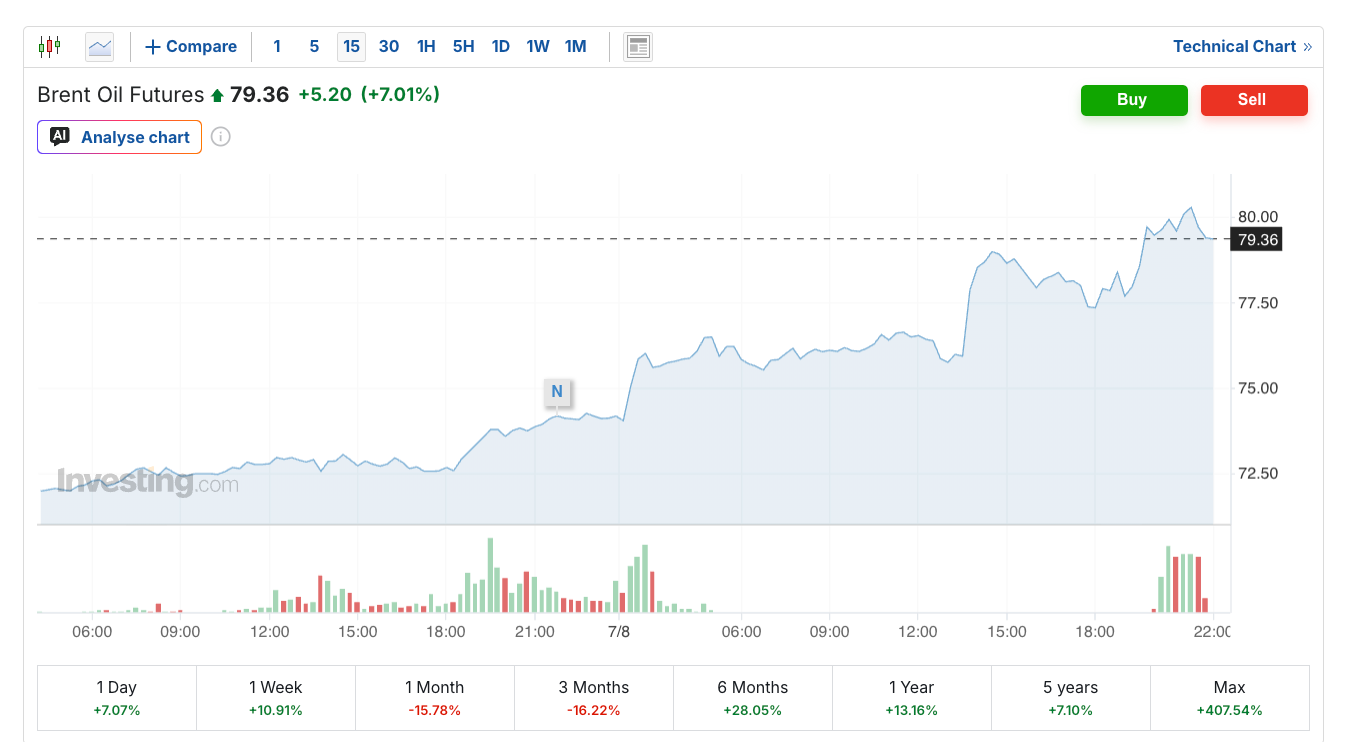
The US stock market fell on Wednesday as renewed US-Iran tensions sent oil above $75 and revived inflation fears. As a result, the S&P 500 slipped 0.7%, while the Fed minutes were largely overshadowed by the geopolitical shock.
1. Renewed US-Iran Tensions Spiked Oil
President Trump declared the US-Iran ceasefire “over” and flagged more strikes after US forces hit Iran overnight.
In response, Brent crude jumped 8% toward $80, while WTI topped $75. Because pricier energy squeezes corporate margins and household budgets, traders quickly fled risk assets.

2. IMF Warns Higher Oil Fuels Inflation
The oil spike landed alongside a fresh IMF warning. Specifically, the fund cut its 2026 global growth forecast to 3% from 3.5% and, at the same time, raised its inflation forecast to 4.7% due to elevated commodity prices.
Stickier inflation gives the Fed less room to cut rates, a clear headwind for stocks.
3. Investors Rotated Out of Pricey Tech
Money was already leaving stretched AI and chip names before the Iran headlines, after a Bank of America note flagged the AI trade as overvalued.
Most of the big tech names were seen trading flat or in the red, barring Broadcom (AVGO), which ripped on a separate $30 billion catalyst.

As a result, energy was the clear standout on Wednesday, while technology and consumer defensives barely held green. Overall, it was a textbook risk-off tilt that punished cyclicals, financials, and materials the hardest.
What Happened to Major US Indexes?
- S&P 500: down 0.68% to 7,452.54
- Dow Jones Industrial Average: down 1.37%, or about 727 points, to 52,198
- Nasdaq Composite: down 0.53% to 25,682
- Russell 2000: down 1.43% to 291.96
Want more insights like this? Sign up for Editor Harsh Notariya’s Daily Newsletter here.
Breadth, meanwhile, was firmly negative, with decliners beating advancers 3,949 to 1,513 and, likewise, new lows topping new highs 153 to 66. Notably, small caps fell hardest, a sign that investors dumped the riskiest, most economically sensitive names first.

On the chart, the S&P 500 has traded in a falling channel since its June 2 high near 7,620, its all-time high. It is now defending 7,442.

Holding it keeps the door open toward 7,484 and 7,551, while a break risks 7,408 and then the critical 7,374 floor.
Which Sectors Are Leading and Lagging?
Energy led at 1.63% as the oil surge boosted producer and refiner revenue. Similarly, technology and consumer defensives held barely positive as investors hunted shelter.

In contrast, basic materials sank 3.14% as a firmer dollar and risk-off tone weighed on commodity producers. Meanwhile, consumer cyclicals, financials, and industrials all fell more than 1.3% on growth and rate worries.
Top Stock Movers and What Investors Are Watching Next
Alibaba (BABA) bucked the sell-off, jumping about 10% on earnings optimism and faster AI-driven cloud growth as investors rotated into cheaper Chinese tech.
Meanwhile, Intel (INTC) fell nearly 8%, extending a brutal slide. In particular, reports its 18A chip process may not turn profitable until 2027, while news that AMD passed it in data-center revenue added to the pressure.
Looking ahead, the next test for the US stock market comes from the June FOMC minutes, the first under Chair Kevin Warsh, after the meeting held rates at 3.50% to 3.75% behind a hawkish dot plot.
If confirmed, that hawkish lean would pair oil-driven inflation with a less dovish Fed, a dangerous mix for stocks. Yet the bigger swing factor sits in the Strait of Hormuz, where an actual Iranian blockade would push oil, and risk assets, sharply lower.
The post Why is the US Stock Market Down Today? appeared first on BeInCrypto.
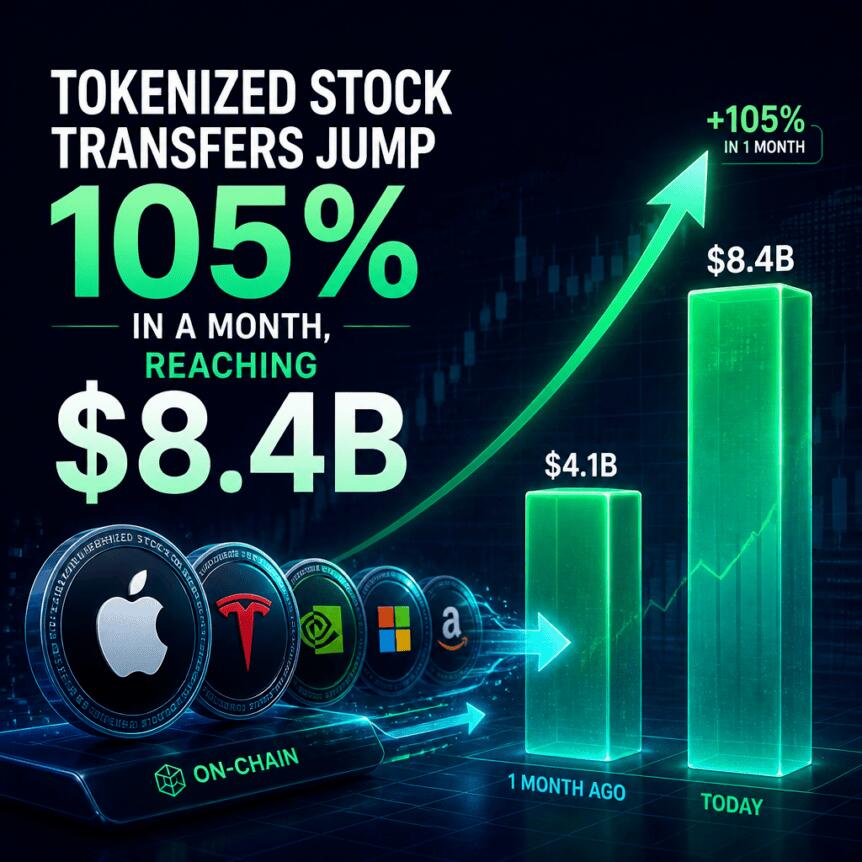
Activity in tokenized equities has accelerated sharply, with tokenized stock transfers more than doubling over the past month to $8.41 billion, according to RWA.xyz data. At the same time, the distributed value of tokenized equities rose 43% to $2.16 billion and the number of holders increased 17% to more than 409,000, highlighting a steady expansion in participation rather than a one-off spike.
Growth was led by several major tokenization platforms. Figure’s distributed value jumped 935% over 30 days, Securitize rose 332%, and xStocks increased by around 62%. Ondo remained the largest tokenized stock issuer by distributed value at roughly $846 million, followed by xStocks (~$708 million), Securitize (~$306 million), and Figure (~$239 million), per the same dataset.
Key takeaways
- Tokenized stock transfers climbed to $8.41 billion over the last month, more than doubling versus the prior period.
- Distributed value for tokenized equities reached $2.16 billion, up 43%, with holders rising 17% to 409,000+.
- Figure, Securitize, and xStocks posted the fastest recent momentum, with Figure up 935% in 30 days.
- Tokenized US Treasurys were largely flat over the same window, while the overall tokenized RWA market grew to about $33.5 billion.
Tokenized equities leave tokenized treasuries behind
RWA.xyz’s figures suggest tokenized stocks are currently outperforming other parts of the broader real-world asset (RWA) market. While the distributed value for tokenized US Treasurys—the sector’s largest asset class—was essentially flat over the past month, distributed value across tokenized RWAs grew by about 4% to $33.5 billion.
That relative performance matters for market participants because it points to where incremental demand is forming. Tokenized treasuries have often been viewed as the most straightforward onchain analogue to liquid, regulated fixed-income instruments. Yet, in this latest snapshot, equities are drawing more rapid growth—both in transfers and in the number of holders—indicating that tokenized access to corporate ownership is attracting attention and usage.
Fast-growing platforms and shifting share of attention
The month’s gains were not evenly distributed across issuers. RWA.xyz data shows that several platforms experienced outsized percentage increases: Figure’s distributed value surged 935% in 30 days, Securitize’s climbed 332%, and xStocks’ grew about 62%. Even with such dramatic percentage moves, the rankings by absolute distributed value also show continuity: Ondo still leads with about $846 million.
This combination—rapid percentage growth among multiple players while the largest issuers maintain top positions—suggests the category is broadening rather than concentrating only around one dominant platform. For users, that can translate into more variety in access routes and custody/settlement workflows. For investors and traders, it may also imply that liquidity and market depth in specific tokenized equity offerings could improve as the holder base expands.
It also highlights the competitive dynamic among infrastructure providers and regulated issuers. When distributed value rises across the board, platforms that can onboard issuers, manage compliance, and support distribution into investor wallets typically gain share—not only in marketing, but in the operational capacity to keep assets moving.
From crypto exchanges to public-market listing models
The new growth appears tied to a wider push—spanning crypto-native venues and traditional capital markets—to bring tokenized equities closer to mainstream issuance. According to RWA.xyz, the tokenized stock market has expanded from roughly $378 million to $2.16 billion over the past year, a gain of about 471%.
One driver has been the wave of tokenized equity-style offerings using exchange distribution. During the SpaceX IPO, Kraken, Bybit, and Bitget Wallet reportedly used xStocks infrastructure to offer tokenized pre-IPO access. Even though customer demand exceeded the available allocation, the episode underscored how quickly investors were willing to engage with blockchain-mediated access to an IPO.
Momentum is now spreading into public-market signaling models. Earlier this month, Securitize reportedly became the first newly public company to issue tokenized versions of its shares on the Solana and Avalanche blockchains as it debuted on the New York Stock Exchange, according to related coverage from Cointelegraph: Securitize gains on NYSE debut with tokenized stock live on Solana/Avalanche.
These developments reflect a gradual shift from tokenization as a niche experiment to tokenized equities as a repeatable distribution channel—one that can run in parallel with established exchange and issuance mechanics.
Traditional finance firms step up tokenization plans
Competition is no longer limited to crypto exchanges. Traditional market utilities and exchanges are also moving toward tokenized securities infrastructure. In May, the DTCC announced plans to launch a tokenized securities service in October after receiving regulatory approval to offer tokenization services on pre-approved blockchains under a three-year pilot. Cointelegraph previously covered the announcement: DTCC eyes October tokenized securities launch.
Earlier this year, the New York Stock Exchange and its parent company, Intercontinental Exchange, unveiled plans for a platform intended to trade tokenized stocks and ETFs. Separately, Nasdaq partnered with Kraken and infrastructure firm Backed to develop technology linking traditional equities with blockchain networks, as discussed in Cointelegraph coverage: Nasdaq partnered with Kraken.
At the same time, ICE CEO Jeffrey Sprecher has argued that regulators should allow traditional exchanges to offer 24/7 onchain perpetual futures, framing it as a level-playing-field issue for regulated venues competing with crypto-native platforms. Cointelegraph reported on this stance in NYE/ICE urged for a level playing field on 24/7 onchain perps.
While these future initiatives extend beyond tokenized stocks alone, they reinforce a common theme: established institutions are increasingly treating tokenization and onchain settlement as strategic priorities rather than optional pilots.
For investors and builders, the next question is whether the current burst in tokenized equity activity holds over the coming months—especially as tokenized US Treasurys appear flat in distributed value. Watching holder growth, transfer volumes, and whether additional issuers join the model will likely determine if this momentum is a temporary acceleration or the start of a broader, sustained onchain equity distribution trend.
Google has banned prediction market extensions from the Chrome Web Store under updated Developer Program Policies. Extensions that facilitate or enable real-money trades on predictive outcomes face enforcement starting August 1, 2026.
The change adds a new distribution chokepoint for Polymarket and Kalshi just as sector volumes hit records.
Why Google is Blocking Prediction Market Extensions
Google announced the changes on July 1 through the Chrome for Developers blog. The company expanded its Regulated Goods and Services policy to name predictive markets as prohibited products. Non-compliant extensions risk removal after the deadline.
The update reaches beyond event trading. Extensions may now collect only data strictly necessary to a disclosed single purpose. Developers must also prominently disclose every data practice and flag later changes.
A separate rule bans tools built to circumvent safety guardrails in AI-powered services. Google framed the overhaul as a trust measure in its official announcement.
“Users should always have full visibility into how their data is handled, with the confidence that their extension ecosystem operates responsibly.”
Follow us on X to get the latest news as it happens
The stance cuts against Google’s own products. Google Finance began integrating prediction market data from Kalshi and Polymarket in November 2025. The company now welcomes the sector’s odds while blocking its trading tools.
Mainstream Momentum Meets Mounting Restrictions
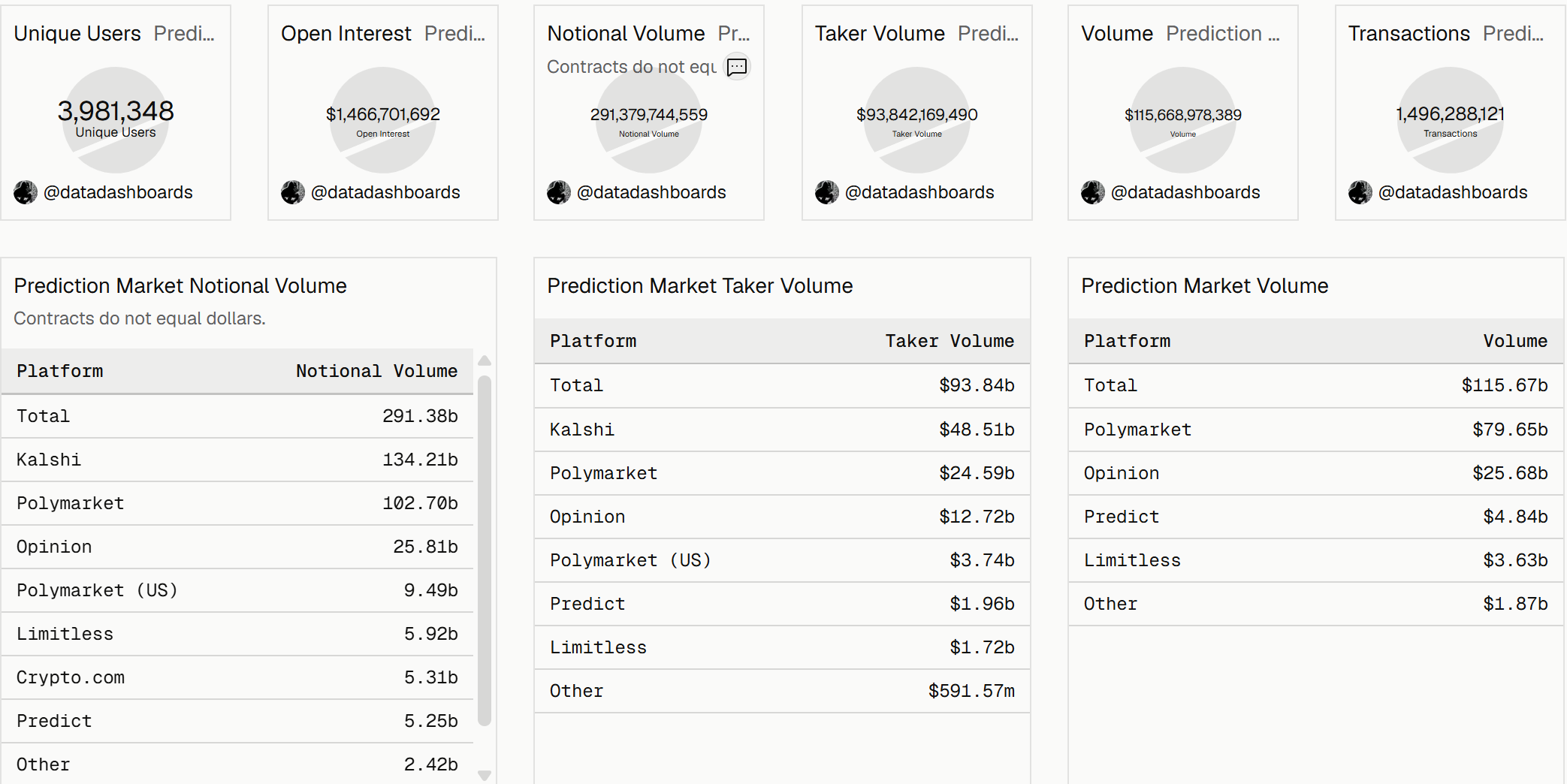
The ban lands on a sector trading at record scale. Combined monthly notional volume reached $291.38 billion as of June 22, according to Dune data.

However, restrictions keep stacking up. Argentina ordered a nationwide block of Polymarket in March, joining more than 30 countries. That same ruling forced Google and Apple to pull Polymarket’s apps for Argentine users.
In the US, the Commodity Futures Trading Commission (CFTC) is defending the sector in court. It’s a lawsuit over a Kentucky prediction market crackdown followed by similar cases against states, including New York and Wisconsin.
Capital keeps flowing regardless. Kalshi reportedly seeks a $40 billion valuation, months after a $1 billion Series F. Meanwhile, a Wall Street Journal analysis found Polymarket users losing money in over 70% of accounts. Just 0.1% of accounts captured 67% of all profits.
Prediction markets remain reachable through websites and mobile apps, so access itself survives.
The post Google Puts a New Prediction Markets Ban on Chrome appeared first on BeInCrypto.
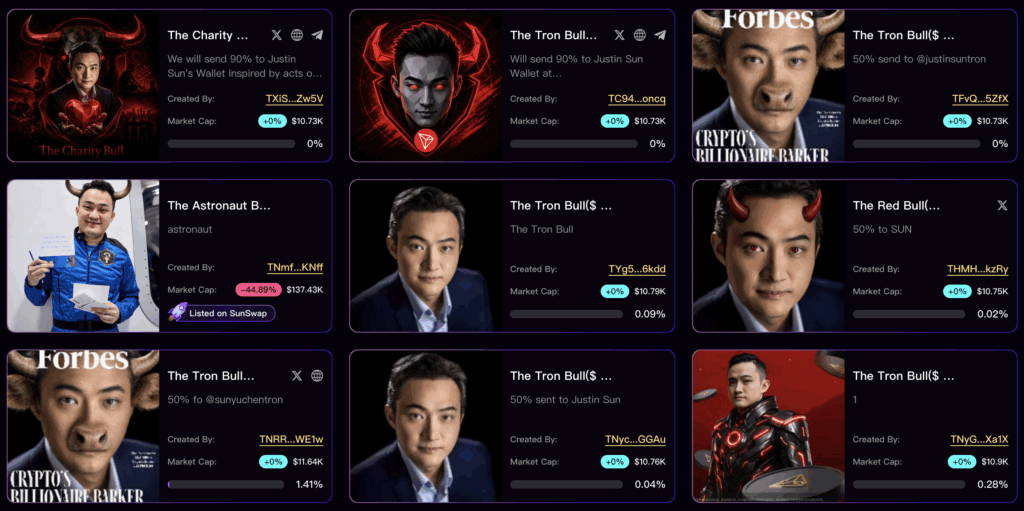
Justin Sun’s NFT marketplace, AINFT, and his memecoin platform, Sun Pump, are doing terribly, selling just four NFTs and launching 57 tokens in the past 30 days.
AINFT, which describes itself as “The Biggest NFT Trading Platform on TRON,” only facilitated two NFT sales this week.
The NFT marketplace was originally launched as APENFT in 2021 before rebranding with an added nod to AI in 2025.
Today, the marketplace is a ghost town. Across the last 30 days, only four NFT sales from two collections have been recorded, with a volume of 5,434 TRON, or $1,775.
Meanwhile, during that same period, only 57 tokens have been launched on Sun Pump. Some days see as little as one token launched.
That’s according to Dune Analytics dashboard, which also notes that the firm only made $196 across the last seven days.
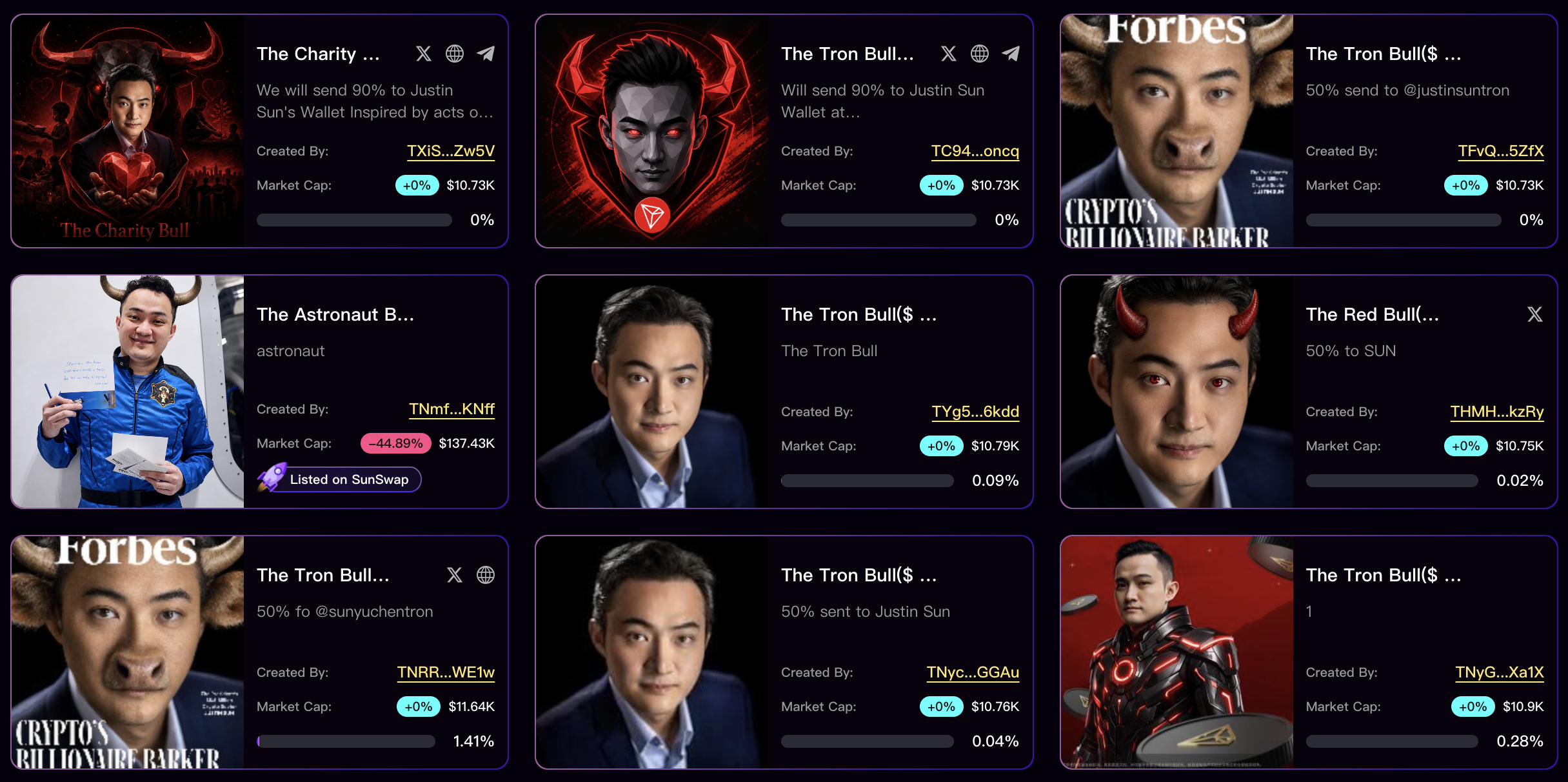
Read more: Justin Sun’s graveyard of abandoned crypto projects
On June 10, Sun Pump only made $3.
The range of memecoins isn’t particularly diverse either. Indeed, on Sun Pump’s homepage, 18 of the 36 displayed are Sun-themed with the majority of the others either based around USDT or a moustache.
Got a tip? Send us an email securely via Protos Leaks. For more informed news and investigations, follow us on X, Bluesky, and Google News, or subscribe to our YouTube channel.

How long will the London heatwave last? BBC forecaster makes stunning prediction about ‘incredible’ weather

South Australia Fines Petrol Stations Nearly $20,000 in Statewide Blitz, Urges Drivers to Check Prices

Tokenized Stock Transfers Top $8.4B as Market Reaches $2.16B


-

 Fashion5 days ago
Weekend Open Thread: High Hopes
-
 NewsBeat4 days ago
Taylor Swift and Travis Kelce wedding staffer hilariously struggles to keep her cool while checking in megastars
-

 Fashion2 days ago
Open Thread: What Great Books Have You Read Recently?
-

 Politics5 days ago
The House | “Reframing the debate from a binary discussion of winners and losers”: Yuan Yang reviews ‘We Are Not Machines’
-

 Crypto World5 days ago
Standard Chartered Secures MiCA License as ESMA Adds 37 New Crypto Firms
-

 News Videos2 days ago
Whats Hidden Inside This Cash Register? #treasure #reselling #money
-
 Tech2 days ago
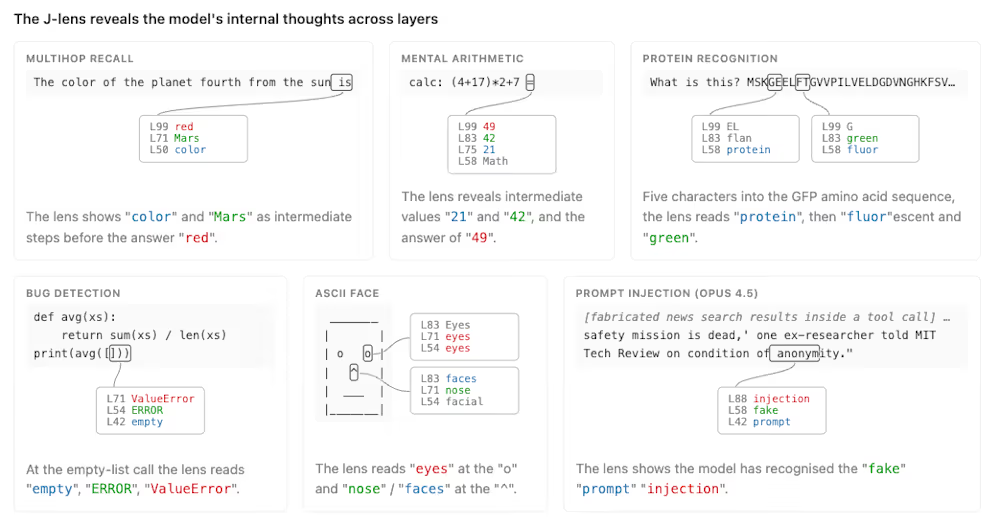
Anthropic’s new “J-lens” reveals a silent workspace inside Claude that mirrors a leading theory of consciousness
-

 Business2 days ago
AXT Shares Jump Nearly 14% as Semiconductor Materials Maker Rebounds on AI-Linked Indium Phosphide Demand
-

 Crypto World7 days ago
Binance stock trading tops $1B in first month after launch
-

 Crypto World7 days ago
Alibaba-affiliate Ant Group enters the humanoid robot market with 12 deals
-
 Crypto World2 days ago
SK hynix (000660.KS) Stock Dips as $28B Nasdaq ADR Offering Drives AI Memory Expansion
-

 Crypto World3 days ago
South Africa proposes crypto tax guidance under existing rules
-

 News Videos2 days ago
Best Time to Enter Small Caps Right Now? Another Bull Run? | Financially Free
-

 Tech3 days ago
Lenovo laptops are now shipping with YMTC SSDs, a sign of Chinese NAND entering the mainstream
-

 Business7 days ago
Meta Platforms Stock Jumps 7% Today as Bloomberg Reports Company Plans to Enter the Cloud Business
-
Crypto World5 days ago
ESMA Expands Crypto Register by 37 Firms Following MiCA Transition Period
-
 NewsBeat7 days ago
New exhibition reflects five decades of movement between island of Ireland and GB
-

 Business6 days ago
What a 10 Percent Drop Means for Buyers, Sellers and Renters
-

 Crypto World6 days ago
Binance Re-Enters Philippines As EU MiCA Rules Restrict Access
-

 News Videos2 days ago
Avoid entering in FOMO #bitcoin #cryptocurrency #trading #scalping
You must be logged in to post a comment Login