

The Trump administration announced last Friday that US visa holders who want a green card must first return to their home countries and apply from there, “except in extraordinary circumstances.”
Tech
Trump’s new green card rules: Why tech workers could be in trouble


On its face, this rule — which was officially promulgated in a memo from US Citizenship and Immigration Services (USCIS) — would upend America’s immigration system and the lives of hundreds of thousands of US residents.
- The Trump administration’s changes to the green card process could force hundreds of thousands of skilled immigrants to leave the country.
- This policy represents the triumph of MAGA nativists over the tech right, in the battle to define what an “America First” immigration policy looks like.
- Precisely how USCIS will implement the policy remains unclear.
For more than 50 years, through the “adjustment of status” process, visa holders in the United States have been able to remain in the country while applying for permanent residency. This was no small thing. For legal immigrants, the alternative to securing an adjustment of status is not taking a short sojourn abroad while Uncle Sam inspects their paperwork. Rather, due to various quirks of US immigration law, some immigrants must wait more than a decade for their green card applications to be approved.
President Donald Trump’s new rule therefore threatens to exile hundreds of thousands of legal immigrants — including physicians at understaffed rural hospitals, gifted technologists at Silicon Valley firms, the spouses of US citizens, and parents of American children.
Whether this will actually happen is unclear. Both the memo officially laying out the policy — and the administration’s messaging about it — contain ambiguities and apparent contradictions. For example, the administration has said that visa holders can only remain in the United States during the green card application process under “extraordinary circumstances” and that any visa holder who provides an “economic benefit” to America may still do so. Yet more or less all employed visa holders provide some economic benefit to the United States.
Regardless, the new memo represents a massive escalation in Trump’s crackdown on immigration. It also arguably marks the resolution of a years-long war for the soul of the MAGA movement.
Since Trump retook the presidency in 2024, his coalition’s hardline nativists and Silicon Valley patrons have been fighting over what an “America First” immigration policy actually entails.
America’s tech industry is heavily reliant on global talent. About one-fifth of our nation’s STEM workers in 2021 were foreign-born. For this reason among others, the tech right — a contingent of Silicon Valley luminaries who backed Trump in 2024 — advocate for a meritocratic brand of immigration restrictionism.
In their account, America needs to repel undocumented, low-skill migrants who threaten to burden its safety nets, warp its culture, and empower the Democratic Party. Yet the United States also needs to welcome highly talented, English-speaking, America-loving workers from around the globe in order to sustain its economic competitiveness and dynamism.
“I understand why we don’t want people to come to the US to be criminals, mooch on welfare…and otherwise undermine the country,” Blake Scholl, the Trump-friendly CEO of Boom Supersonic, posted on X after the latest immigration news. “But I don’t understand why we make it harder for motivated, ambitious, hardworking people to come to the land of opportunity.”
The nativist right isn’t so sure about that. In its view, whether immigrants engineer software in Silicon Valley — or deliver food in New York City — they are typically undermining native-born Americans’ interests, at least in their current numbers.
By deterring highly skilled, legal immigrants from seeking green cards, the Trump administration has made its allegiance to the second camp unambiguous.
While not entirely surprising, this development wasn’t always certain. Trump erected some obstacles to high-skill immigration during his first term. But these changes had been relatively modest. More critically, after a slew of tech titans lined up behind Trump’s candidacy in 2024, Trump signaled support for their immigration views.
During a June 2024 appearance on All-In, a podcast hosted by venture capitalists sympathetic to his campaign, Trump was asked whether he would “promise us you will give us more ability to import the best and brightest around the world to America”?
The candidate replied, “I do promise. But I happen to agree, otherwise I wouldn’t promise. … You graduate from a college, I think you should get automatically — as part of your diploma — a green card to be able to stay in this country and that includes junior colleges too.”
Months later, in the wake of Trump’s victory, his Silicon Valley supporters got into an online feud with hardline nativists over H-1B visas — which give temporary legal status to highly educated immigrant workers employed by American companies. After some MAGA influencers called for restricting such visas (and high-skill immigration more broadly), the tech right rallied to the program’s defense.
“The reason I’m in America along with so many critical people who built SpaceX, Tesla and hundreds of other companies that made America strong is because of H1B,” Elon Musk posted on X in December 2024. “I will go to war on this issue the likes of which you cannot possibly comprehend.”
Once again, Trump appeared to side with Silicon Valley, telling reporters that he supported the H-1B program, since “We need competent people, we need smart people coming into our country…we need a lot of people coming in.”
Why MAGA doesn’t want more “smart” immigrants
Of course, much of the MAGA movement disagreed.
Although the nativist right has tended to dedicate most of its energy to combating undocumented immigration, it has also sought to repel highly skilled legal immigrants in general — and those who work for tech companies in particular.
In fact, two of the original architects of Trump’s immigration vision — Steve Bannon and Stephen Miller — both long lamented the prevalence of foreign-born workers in Silicon Valley.
Notably, Trump himself did not share this view at the outset of his first presidential campaign. During a 2015 podcast appearance, Trump told Bannon that he worried about foreign-born Ivy League graduates being forced to return to their home countries instead of using their skills in the United States, since “we have to keep our talented people.”
Bannon replied, “When two-thirds or three-quarters of the CEOs in Silicon Valley are from South Asia or from Asia, I think…a country is more than an economy. We’re a civic society.”
Likewise, during his time working for then-Sen. Jeff Sessions, White House adviser Stephen Miller co-authored a “handbook” on immigration policy that decried “The Silicon Valley STEM Hoax” — namely, the idea that the United States needed to increase immigration in order to meet its demand for workers with tech skills. The document argued that increasing admissions of foreign-born STEM workers would “deny millions of Americans a shot at a good-paying middle-class job.”
From this perspective, highly skilled immigrants are scarcely more desirable than low-skill ones — and may even be less so. After all, few Americans are eager to perform seasonal agricultural labor. But many covet well-paid tech jobs. And if one believes that the supply of such positions is largely fixed, then every coding gig taken by an immigrant is one denied to a native-born American.
For many nativists, however, the problem with high-skill immigration isn’t purely economic. As Bannon’s comments suggest, the ethnic composition of Silicon Valley’s foreign-born labor-force is also a concern.
Following the Trump administration’s changes to green card policy last week, frank expressions of anti-Indian animus proliferated on right-wing social media. Previously, the far-right influencer — and periodic Trump confidante — Laura Loomer had suggested that “third-world invaders from India” threatened to overrun America, a country “built by white Europeans.”
Some Republican elected officials have played to such anti-Indian resentments. This week, US Rep. Greg Steube (R-Fla.) referenced Indian immigrants’ disproportionate share of H-1B visas while advocating for legislation that would end the program entirely.
Before last week, the second Trump administration had already been leaning toward the nativist right’s position on skilled immigration by, among other things, heavily constraining the issuance of new H-1B visas.
But Trump’s ostensible transformation of the green card application process constitutes a far more definitive — and consequential — rebuke of the tech right’s vision for immigration.
Indeed, the policy explicitly aims to chase most international students from the United States as soon as they graduate, the very scenario that Trump had spent years lamenting.
Further, unlike previous restrictions to H-1B visas, the green card memo seeks to reduce the number of foreign-born permanent residents in the United States, rather than merely the number of guest workers. Populists on the right and left have long argued that guest workers are uniquely exploitable — since they need to keep their jobs in order to remain in the country legally — and thus put downward pressure on labor standards in their industries. Yet immigrants applying for green cards are often seeking to escape that very form of dependence and secure the same bargaining power as US citizens.
What’s more, the new rules would hit Silicon Valley’s disproportionately Asian workforce particularly hard. America’s annual green card issuance is capped by country. For this reason, immigrants from highly populous nations with large educated workforces — such as India and China — must wait many years before their green card applications are approved. An Indian tech worker who applies for a green card tomorrow is likely to wait more than 12 years before actually securing permanent residency. Under traditional procedures, that worker could remain legally in the United States while awaiting approval. Under Trump’s new system, they would need to go into exile for a decade.
The full implications of Trump’s policy are uncertain. But the tech right’s defeat is unmistakable.
It remains unclear how USCIS agents will interpret their new marching orders. Although the administration’s memo suggests that adjustment of status should be offered only in extraordinary circumstances, it nonetheless gives USCIS officers discretion to provide such relief as they see fit. And the document also suggests that some categories of immigrants may be partial “exceptions” to the rule.
“We are hearing USCIS examiners are now asking questions like, ‘Why are you applying for adjustment? Why couldn’t you have left and applied abroad?’” Cyrus Mehta, an immigration attorney in New York City, told me. “Different local offices will likely take different positions on how to deal with it. Some will be business as usual. Others may be instructed to get tough.”
It’s possible then that the tech right could persuade the administration to interpret its own memo narrowly — or else, convince a court to strike the policy down.
In any case, the administration’s position is likely to deter many highly skilled visa holders from seeking permanent residency. And it will also provide talented young people abroad with another reason to seek admission to other wealthy countries, instead of the US.
If interpreted literally, meanwhile, the new rules would do far greater harm to the American tech sector than any of the Biden-era antitrust policies or AI regulations that purportedly “red-pilled” so many Silicon Valley billionaires.
In short, red America’s civil war over immigration policy is essentially over. The nativists won, the tech right lost; the latter’s best hope is merely to negotiate favorable terms of surrender.

Continue Reading

According to the companies, it would create the third-largest player in US TV.

The Fox Corporation announced it will be acquiring Roku, best known for its streaming device ecosystem. Subject to approval, Fox will pay about $22 billion for Roku, or $160 per share.
“This is a defining moment for Fox and a natural extension of the deliberate and focused strategy we have been executing for nearly a decade,” CEO and Executive Chair of Fox, Lachlan Murdoch, said in a statement. “Today, we take the next step: bringing together the most valuable live content portfolio in video consumption with the preeminent streaming platform through which America watches it. This combination will transform the scope of our company into high-growth verticals and yield a step change in our overall growth profile.”
The two companies claim that Roku will still operate as its own “partner-friendly platform.” The Roku Channel currently serves over 100 million households worldwide. Fox states that it will have a greater scale with Roku, reaching audiences for live content and streaming. It also gives Fox access to the “high growth” area of advertising and streaming subscriptions. On this note, the company points to the deal enhancing its “long-term growth profile” across streaming and TV.
Fox is paying with a combination of cash and some of its Class A common stock. Roku CEO and founder Anthony Wood said in the release.”I’m incredibly proud of what our team has built and the combination with Fox is an extraordinary opportunity to accelerate our vision, scale faster and innovate more aggressively for viewers, partners and advertisers.” The companies claim that combined, it would create the third-largest entity in US TV based on viewer share and yes, the deal is subject to regulatory approval.
Roku just updated its homescreen last month — the first time it’s done so in a decade. It brought features like increased personalization and a “top picks” section, but overall it doesn’t look hugely different.

Razorpay, the Bengaluru payments company, has filed draft papers for an initial public offering through India’s confidential route, according to people familiar with the matter. The filing moves one of the country’s larger fintech firms a step closer to the public markets, without yet putting its financials on public display.
The confidential mechanism, which Indian regulators have permitted in recent years, lets a company submit a draft red herring prospectus to the Securities and Exchange Board of India and the exchanges while keeping business, operational, and financial detail out of public view until later in the process. It buys time and discretion, which is why a string of well-known names have used it.
People familiar with the plans put the issue at between Rs 5,000 crore and Rs 6,000 crore, which at the upper end is roughly $700m, and suggest a listing could value the company at Rs 50,000 crore to Rs 60,000 crore.
Those figures come from sources rather than from Razorpay, and the company has not confirmed them. The size and terms can change before the offer is made public.

The 💜 of EU tech
The latest rumblings from the EU tech scene, a story from our wise ol’ founder Boris, and some questionable AI art. It’s free, every week, in your inbox. Sign up now!
Razorpay was founded in 2014 by Harshil Mathur and Shashank Kumar and built out from payment acceptance into banking, payouts, payroll, and lending. It was valued at $7.5bn in a December 2021 round, a mark set during the last cycle of large private fintech valuations.
The listing has a longer backstory in the company’s corporate structure. In 2025, Razorpay completed a reverse flip, shifting its parent’s domicile from the United States back to India, a move that carried an estimated $150m tax bill and is a near-prerequisite for an Indian listing. The confidential filing is the next item on that checklist.
Razorpay would join a run of Indian technology firms that relocated their domicile home before listing, a pattern driven by the depth of India’s retail investor market and by regulators’ preference for domestic incorporation.
The reverse flip is the costly part of that decision, since it crystallises a tax charge, but it is the price of access to the exchange on which these companies increasingly want to trade.
The 2021 valuation is the figure that hangs over the listing. At $7.5bn, it was set at the top of the last funding cycle, and the valuation reports now circulating, at the rupee equivalent of roughly $6–7bn at the upper end, would mark a more sober number than the private peak. That gap, between a late-cycle private mark and what public investors will pay, is the question many of this cohort of fintechs are testing as they come to market.
What comes next is procedural. Under the confidential route, a fuller prospectus and the financials it contains become public at a later stage, before the offer opens. Until then, the headline numbers remain attributed to people who know the plans rather than to the company.


‘Children will be given back their childhoods’, the UK government said in a statement.
The UK is the latest to ban social media for underage users, as countries across the world reassess Big Tech’s impact on children’s growth and safety.
“Children will be given back their childhoods…with less time for scrolling and more time for play”, the UK government said in a statement today (15 June).
The government is blanket banning under 16s from a number of large user-to-user platforms that enable social interaction and allow users to post in an algorithmic feed, such as Snapchat, TikTok, YouTube, Instagram, Facebook and X.
Livestreaming and “stranger communication” functionalities are also being banned, although, communication platforms such as WhatsApp and Signal narrowly avoided the government’s hand, despite safety issues associated with them.
“These restrictions – which together with the ban go further than any other country – will apply to a wider range of online services, including on gaming sites,” the government said.
The announcement follows a major public consultation in the country that received more than 100,000 responses submitted by parents, children and experts.
The data showed that 90pc of parents were in support of a social media ban for under-16s, and two-thirds of young people agree that under-16s should not be allowed to use at least some social media platforms.
The UK said that it is expanding on the same model for the ban as Australia, which became the first country to restrict social media for underage users last December.
Age-gating is an industry-wide challenge that often requires the use of AI or sensitive data collection by platforms or third-party services.
An Australian government-authorised report from last year found that age estimation technology also has a “margin of error” – meaning children could be wrongly estimated to be older than they are, while other issues such as VPN usage, joint family accounts or fake accounts also persist.
The UK’s media regulator Ofcom is expected to conduct new research on effective age assurances, review its enforcement capabilities and draft a clear enforcement strategy.
Restrictions will be in place by default for those under 16 and 17 to prevent a cliff-edge at 16, while the government said it will also look into possible overnight curfews and breaks in infinite scrolling for under-18-year-olds.
The government is also enforcing a minimum age of 18 for AI ‘romantic companions’ – chatbots designed to roleplay with users.
“This is a line in the sand. Tech giants had their chance and failed, but we’re stepping in to protect children, back parents and set a new normal for future generations,” said prime minister Keir Starmer, echoing comments made by French counterpart Emmanuel Macron, who told the media in January that “children’s brains are not for sale”.
Alongside the UK, France and Australia, countries such as Austria, Canada, Denmark, Germany, Spain and Greece have also made a similar move to restrict social media usage by children, which comes at a time when social media giants including Meta, Google and X face increasing regulatory scrutiny over child safety on their platforms.
Meanwhile, the EU, which also calls for a bloc-wide minimum age to access social media, video-sharing platforms and AI companions attempts to develop an app to enable anonymous age verification.
Don’t miss out on the knowledge you need to succeed. Sign up for the Daily Brief, Silicon Republic’s digest of need-to-know sci-tech news.
UK prime minister Keir Starmer holding a press conference on children’s online well-being. Image: Number 10 via Flickr (CC BY-NC-ND 4.0)

A new survey shows households with children under age 18 are experiencing economic strain, with parents suffering from depression, burnout, and hopelessness.
Capita launched the new national survey, Quarterly Insights from American Families, in partnership with YouGov. The survey will be conducted quarterly.
“This is the baseline,” said Elliot Haspel, a senior fellow with Capita. “We really want to be able to ask questions that serve as an early warning system for family well-being.”
Haspel said what stood out to him from the survey is “how much parents are facing precarity right now… I think that it tells us that families are really struggling and they really need support.”
The questions
YouGov, on behalf of Capita, surveyed 1,000 parents with children under age 18 between Feb. 2 and Feb. 16, 2026. North Carolina is one of four states that were oversampled in the survey, meaning the results are especially representative of those facing parents in our state.
The survey consists of 69 questions (available here) designed to track families across three dimensions: stability, predictability, and quality of life. Capita defines the question underlying each dimension:
- Stability: Can families meet basic needs without falling into crisis?
- Predictability: Can they plan their lives without constant disruption?
- Quality of life: Do they have the time, health, and connection to flourish, not just survive?
Haspel explained that this survey is meant to fill the gap between surveys such as RAPID, which focuses on parents and caregivers of young children, and surveys of all Americans more broadly.

Sign up for Early Bird, our newsletter on all things early childhood.
He said two-thirds of the survey questions will remain the same each time, and another third will shift based on Capita’s specific areas of interest at a given moment.
Haspel pointed out that for all Americans, life can be stressful, and parenting in particular will always come with its own stressors.
“The issue is, what are the artificial, unnecessary stressors that we put on families as a result of policy choices?” Haspel said.
The answers
One of the main findings from the survey revolves around the economic pressure that families are facing. As the Capita report puts it: “Multiple indicators point to significant and widespread financial stress.”
Here are some of those indicators:
- More than a third were worried at some point in the last year that food would run out before they had money to buy more — and almost as many actually had that happen.
- One in 5 reported skipping out on needed medical care due to costs in the last year, and 15% skipped filling a prescription for the same reason.
- In the last three months, 20% of households reported a member losing a job or having their hours cut.
- In the last month, 25% of respondents said they had a shift canceled, shortened, or extended with less than 24 hours’ notice. The same percentage were required to be “on call” — available without guaranteed hours — during that period.
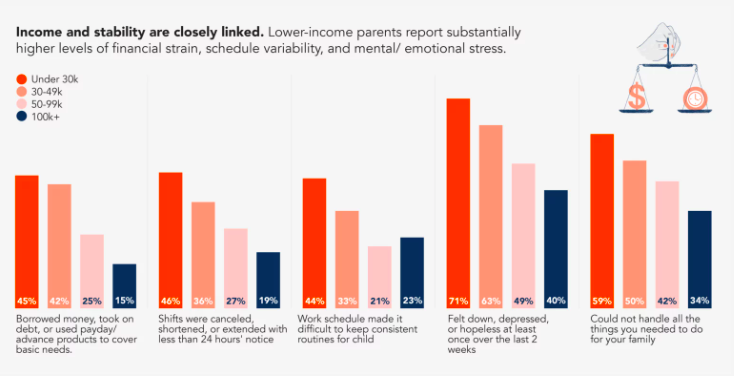
Financial stress can be a leading driver of “toxic stress.” This compounding, long-term stress can do permanent damage to the health of parents and the development of children — and can sometimes lead to Adverse Childhood Experiences (ACEs).
Evidence shows that safe, stable, and nurturing relationships with adults can protect children from the negative outcomes of ACEs and toxic stress. But the survey suggests most parents are struggling to maintain that kind of relationship with their children.
Two-thirds of respondents said that in the last month, stress made it hard to be as patient with their children as they wanted to be. And half of parents reported feeling down, depressed, or hopeless in the last two weeks.
There are several questions in the survey that pertain specifically to work and child care. Here are some related findings:
- More than 70% of respondents describe their job as family friendly.
- Almost two-thirds said family life is a top priority, and they want their job to fit around it.
- In the last year, 27% of respondents missed work or lost pay because of child care problems.
- One in 5 parents regularly supervise their children while working.
Despite the challenges presented by scheduling, about 70% of parents report being satisfied with their existing child care situation, whether they have children who are school age or below. And 81% said their communities are welcoming to families with minor children.
But 43% said their work schedules made it hard to keep consistent routines for their children, and that matters.
“That lack of control over one’s schedule contributes to lack of control over one’s life more broadly, and it can affect parenting relationships,” Haspel said.
As the Capita report explains:
Volatile schedules make it hard for people to be the kind of parents they want to be. They may have to forego baseball games or dance recitals they planned to attend, skip sitting down to dinner as a family, or miss tucking their kids into bed. Instability also has a significant impact on child development. Consistent routines are the foundation for children’s growth, learning, and feelings of security. Chronically disrupting those routines not only stresses parents but also interferes with their children’s long-term trajectory. Inconsistent or nonstandard parent work schedules are associated with cognitive delays and behavioral outcomes, especially if they begin during a child’s first year of life.
“Job quality or schedule quality is often thought of as labor policy, it’s not thought of as a family policy,” Haspel said. “If you care about having strong, healthy families, this is a contributing factor.”
The meaning
While this first set of survey results represent the baseline of what Capita plans to measure over time, there are still significant takeaways from this early warning system.
“A lot of what we’ve been hearing around the issues with affordability, the issues with being able to navigate all the extra challenges of parenting in 2020s America is showing up in family well-being,” Haspel said.
Here’s what Capita has to say about the initial survey results:
This first survey of Quarterly Insights paints a troubling picture of families feeling economic strain and suffering from depression, burnout, and hopelessness. These conditions reinforce one another, making it harder for parents to show up for their children, their partners, and themselves, maintain routines, and flourish. Ultimately, all of these factors make stability feel perpetually out of reach. While the heaviest burdens often land on those earning the least, working-class and middle-class families also feel the enormous weight of these compounding pressures.
The report goes on to point out that policies supporting the well-being of children and families are most likely to succeed if they address multiple aspects of family hardship and reach all families who are affected.
Editor’s note: This article was corrected to say that four states were oversampled in the Capita survey.

Thank goodness for Siri AI, because if the only updates with macOS Golden Gate were the other ones shown at WWDC, this would be the weakest release in history.
As it is, the new macOS Golden Gate is a significant and even dramatic update, but solely because of how useful Siri AI is. True, there is more to the update than Apple said, but all it mentioned was a Liquid Glass refinement, improved curves on windows, and a reworking of the sidebar.
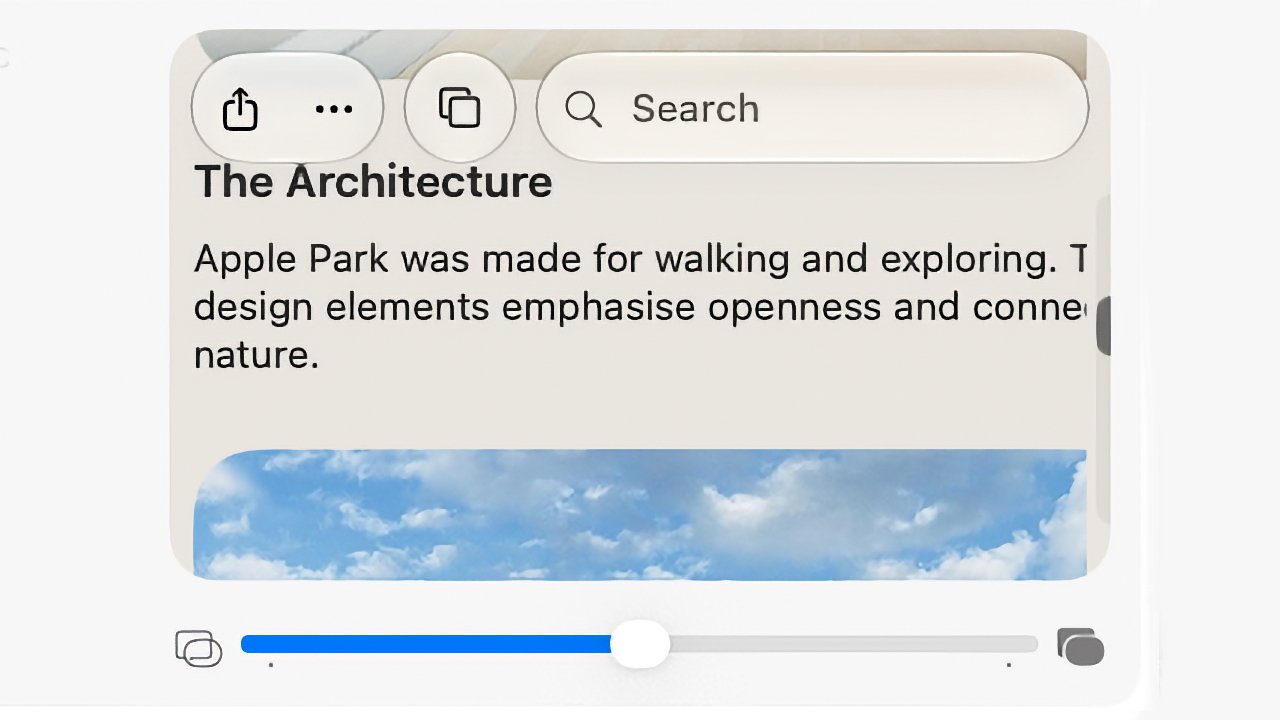
If that sounds like only an incredibly little difference from macOS Tahoe, it’s actually even smaller than you think. That Liquid Glass refinement is a slider to let users control how translucent it is, but it works across such a narrow range that it’s not worth bothering with.
So Siri AI is the star and even in its very first form, it is already so very close to excellent. Every year there comes a moment when the previous macOS seems amazingly old, and this time it’s when you first use Siri AI.

This slider in macOS System Settings controls Liquid Glass, but don’t expect to see much difference.
It’s the feature you immediately adopt and that when you turn to a Mac without it, you miss it. Siri AI truly is a dramatic improvement, although it is far from perfect.
macOS Golden Gate beta review — Siri AI wins
I did wonder whether it would be hard to use the new Siri AI because I’m so used to how it used to work. I’m used to asking one thing at a time, then muttering when Siri gets it wrong, and asking it again, then sarcastically saying thank you.
With the new Siri, though, the first thing I thought of was to ask about a concert I booked a year or more ago. I didn’t remember the date, and I could have searched my calendar, but I also wasn’t sure whether the tickets were being kept at the box office.
So I just asked Siri when I am seeing Dar Williams, and also where the tickets are. It pretty immediately showed me the date, the venue, and the email that had the tickets in.

It took Siri AI thirty seconds to check my calendar and find a specific email buried deep in my archive.
Just as I could have searched my calendar, of course, I could have searched my emails but I didn’t know if the tickets were there. Plus you know how long it takes to find anything in Mail, so having this close to instant result is a genuinely useful boon.
Similarly, as much as I like Apple Maps, I find it a bit irritating when I’m just looking up a place instead of trying to find a route. But then also when I want a route with multiple stops, it’s not as if it’s hard, but it’s now so much easier to ask Siri AI.
Consequently, I asked it for a route to a venue I have to speak at, arriving at a certain time on a specific day, and also including a stop at a colleague’s home to pick up various things for the event. It just did it.

I have a long drive ahead of me. But Siri AI made finding a multi-stop route very quick.
Or rather, it eventually just did it. No question, Siri AI is superb, but sometimes it has frozen on me, sometimes it has said it can’t do something. It has taken me three goes on occasion, but it has then worked.
macOS Golden Gate beta review — Siri AI failings
Part of the problem is that Siri AI is now in Spotlight. In most ways, that is superb. Instead of being off in some separate Talk to Siri feature, it’s now right there where you might spend much of your time anyway.
But as you type, Spotlight will go through figuring out whether you’re looking for a document, or an application. Sometimes it is poor at realizing that you want to ask Siri AI a question.
For some reason, though, there is a solution. Once you’ve typed your question, you can hold down the Command key and that tells Spotlight you want to Ask Siri.
I have not one thin clue how I stumbled across that, but I’m using it a lot now and it never fails. And I am also using Siri AI much more than I expected. If I want anything that is on my Mac, I’ll ask Siri AI and while this might just be that it’s a new toy, it really feels as if it’s already part of my workflow.
However, if I ask for something that requires what Apple calls “World Knowledge,” Siri AI stops being excellent. It becomes much more like any other AI, and sometimes it isn’t as good as them.
So for instance, when I start researching an article, I will now routinely do a search for every time I’ve written on AppleInsider about the same topic before. Google was never all that use for this, but Claude AI is excellent at surfacing them.
Siri AI is not. It doesn’t always find the articles I want, and sometimes it will find some but not include any links. I’ve seen this with all AI chatbots and am used to sighing and typing “prove it.”
But in the last such search I did with Siri AI, it did provide links but the first one I tried went to the wrong site. It was the right topic, but the article shown wasn’t on AppleInsider and wasn’t written by me.
That is typical of AI search results. Only, that same search did surface notes I’d made on the topic for a previous podcast recording. I’d entirely forgotten those, and Siri AI found them.
If something is on your Mac, iPhone, or iPad, then Siri AI is superb. If it’s on the web, it’s not always so hot.
macOS Golden Gate beta review — more Apple Intelligence
It used to be that there was a section in System Settings called “Siri and Apple Intelligence.” That has now changed to just Siri.
So it appears as if there is no longer a switch to turn off Apple Intelligence. It’s not clear yet whether turning off Siri will do that too.
It is clearer that Apple is trying to put some water between Siri and the rest of Apple Intelligence, because there are AI features that are separate. At present, you have to join a waitlist to get Siri AI, but even before you get the new Siri, there are many Apple Intelligence features in macOS Golden Gate.
For instance, if you open an image in the Photos app, choose Edit, and then click on Tools, you now get the options to reframe or extend the image that Apple demonstrated. With the right sort of image, extension is excellent.

The original photograph of me looking grumpy for no reason.
I took a close-up shot of myself against a wooden background, and in moments that background was far wider. Not only did it successfully duplicate the background, it also edited it. So seeing that there was light on one side of my face, it lit that edge of the frame as if there were a window just out of shot.
It also interpreted my stony face as being annoyed, so it gave me folded arms. That felt weird, but it didn’t look wrong.
Reframing of that same image worked, too, or at least mostly. It’s a more limited tool than it seemed in the WWDC keynote, but it did allow me to tilt my head and whole body back, as if I had taken a low-angle shot.

The same shot but with the background greatly extended. Sometimes when I try this, Photos also adds in folded arms.
If I shifted the frame to the left or right, it also worked. But along the way it briefly gave me an extended neck.
So it really does depend on your image, because you are as likely as not to get terrible distortion.
Still, I often create poster images for various projects and being able to extend the background will be a boon. It will mean I can have space to add a headline, for instance.

Photos can now turn the subject to the side, although apparently it can’t make me more cheeful.
That will be an occasional thing I do, it hasn’t so immediately become part of my daily workflow as Siri AI has. But then there is one other macOS feature that has definitely changed how I work, at least most of the time.
It’s the new natural language Shortcuts, the way that you can describe what you want and the Shortcuts app will create it for you. When it works, I cannot see any reason you’d make Shortcuts any other way.
If only it worked all the time.
macOS Golden Gate beta — Shortcuts are mixed
If you open the Shortcuts app on Mac, iPhone, or iPad now, you get a prominent New Shortcut button. Choose that and you are asked to describe what you want.
On the Mac, you practically have to dodge around that button to get anything done manually. It is that prominent and Apple is clearly pushing this verbal Shortcuts.

The prompt for you to describe a Shortcut you want is even more prominent the first time you open the app,
But then this is a change that will surely introduce more people to Shortcuts, and it’s only one extra step to go around it to manually writing them as before.
However, the results might also put newcomers off because Shortcuts now has that AI-style certainty of what it’s doing, even when it’s wrong. When it is right, though, it is very impressive.
On my iPhone, for instance, I asked for a Shortcut that would change my wallpaper at 6pm every weekday, and as well as doing that, it also set up the automation to run it.
Then on the Mac, I have long wanted a Shortcut that would do some work on my AppleInsider podcast notes. During the show, I’ll tap on my Stream Deck Pedal whenever there’s to be a new chapter, for instance, and I have that send the current time to a note.
But it’s the current running time in minutes, and I then edit in Final Cut Pro, whose time is in hours, minutes, and seconds. So I keep having to stop to think whether 119 minutes is really one hour 59 minutes, or whatever.
I’ve wanted that shortcut that would take 119 minutes and write it out as 01:59:00, and it has always defeated me. Not any more. I asked Shortcuts to do it, and it did.

Note the large icon to the rear where Shortcuts says what it has done, and then in the foreground, what it’s actually produced.
I then asked for various refinements to get the result copied to the clipboard, and it did that, too.
It is really very good, and so very easy that I initially thought there was no possibility that I would ever again want to write a Shortcut by hand. I was an immediate and total convert to the new way of doing them.
That didn’t last.
For years, I’ve also wanted a Shortcut that would switch Tab Groups in Safari and it’s always been impossible on the Mac. You can do it on iPhone and iPad, there is a Shortcuts action to do it, but it’s always fallen over with an “internal error” on the Mac.
So when Shortcuts next asked me what I wanted, I told it, and it did it. It stopped to ask me which Tab Group I wanted, then it presented me with the finished Shortcut including a full description of what it does.
It doesn’t work. It isn’t even close.
If you go into the Shortcut manually, you can see that instead of anything to do with Tab Groups, it’s trying to turn on Do Not Disturb. It doesn’t even reference the specific Tab Group it asked me about.
Incidentally, if you write a Shortcut manually and include the action to change Tab Groups, it still fails as it now has for years and years. There is progress of a sort, though, as in macOS Golden Gate, instead of an unspecific “internal error,” it says it cannot communicate with the app.
Which is a clue both to my problem and to where Apple is putting its attention. Because what’s probably happening is that behind all of this verbal and even manual Shortcut writing, the app is using AppleScript. This is the decades-old automation that can let you do just about anything on a Mac.
But AppleScript works by every app providing access to its features, specifically by providing what’s called a dictionary. You can open the Safari dictionary in Script Editor, and if you do, you’ll see that there’s nothing there to do with tab groups.
So it appears that Apple’s newest natural language Shortcuts tools fail because Apple’s oldest automation technology hasn’t been updated.
It would also appear that Shortcuts has that curse of AI, that inability to say it can’t do something. Except sometimes, it will say exactly that, such as when you try to use it to fix irritations with the Phone app.
macOS Golden Gate beta — Phone app
With macOS Tahoe, Apple brought the Phone app to the Mac and it seemed like it was going to be so useful. If someone calls, you would just answer it on the Mac as you work. If you need to call someone, you would just do it on the Mac without getting out your iPhone.
I had issues that my Mac Studio wasn’t displaying the phone call notification fast enough to stop people hanging up on me. But even if the on-screen notification had appeared at the same time as the ringing sound begins, the green answer button wouldn’t always react to a click.

Nobody can hear you when you use the Phone app on the Mac, unless you know to look under the Video menu to choose the same audio source you’ve already set everywhere else.
What I’d really like is a keystroke to answer a call, and then another keystroke to end it. There is no such keystroke, and while you can add your own to just about anything on the Mac, you can’t with the Phone app.
You also cannot write or describe a Shortcut that answers for you. If you could, you could attach that Shortcut to, say, a Stream Deck button, but you can’t.
And this is one case where the new Shortcuts says no. “I can’t create shortcuts for physical actions like answering a phone call,” it says.
So there is some error-trapping in the new Shortcuts, but it doesn’t know to say it can’t do other things, like the Safari tab groups.
But then maybe we shouldn’t expect the Phone app to be useful, because with macOS Tahoe, it seemed as if Apple abandoned it part way. By default, for example, no one could hear you when you used it to make or answer a call, which seems fundamental.
It turns out that regardless of any Sound settings you have, you have to expressly tell the Phone app to use a given microphone. And you tell it this via a menu called Video.
A phone app has a video menu. That hasn’t changed with macOS Golden Gate.
macOS Golden Gate beta — visual changes
Something that has changed with the new macOS is how the Mac looks. It’s so subtle with adjustments such as the Liquid Glass slider that it might as well not be there, but it is.
It’s not much more pronounced with app icons, but it does make a difference. App icons in the Dock do seem to pop, and it means that transparent ones are clearer, too.
There’s also how menus have shed their mass of icons. With macOS Tahoe, every menu item had its own icon and the result was a mess, but calmness has now been restored.
All of which is good and all of which is welcome, but overall this really would be an incredibly slight update if it weren’t for Siri AI.
Still, up to now, Siri has felt like it was really just for the iPhone and maybe also the iPad. With the Mac, because your hands are already on the keys, it seemed quicker to just type instead of interrupt your work to talk to Siri.
Now Siri somehow feels much more a part of the Mac, and that by itself means that macOS Golden Gate is a significant update.
macOS Golden Gate beta — Pros
- Siri AI for any information on your Mac is fantastic
- Natural language Shortcuts are usually brilliant
- Photos app improvements can be superb, depending on the image
- Minor visual updates are welcome
macOS Golden Gate beta — Cons
- Siri AI World Knowledge is poor
- Liquid Glass control is very limited
- Natural language Shortcuts is sometimes just wrong
- Years-old Shortcuts error remains
- Phone app still feels abandoned
macOS Golden Gate beta review rating: 4 out of 5
Tech
Fed up with constantly installing various updates for Windows 11? Microsoft is making monthly multiple reboots a thing of the past

- Microsoft is changing the way that Windows 11 updates are delivered
- The likes of .NET, driver or firmware updates will be bundled together with the monthly update
- This change is now in testing, alongside a lot of work to make Windows 11’s default apps better
Windows 11 is getting some more very useful changes, including an improved process for updates and a raft of tweaks for the default apps in the OS.
Microsoft has just released a new preview in the Experimental channel (build 26300.8687) which packs the changes for Windows Update (which were announced as incoming a while back in April).
Microsoft tells us: “We are rolling out a new unified update experience to reduce the number of reboots you see per month. We are starting by coordinating driver, .NET, and firmware updates to align with the monthly quality update, reducing the update experience to a single monthly restart.”
Latest Videos From

Elsewhere, Thurrott.com points out that Microsoft has a whole lot of work underway for the various core Windows 11 apps, and that the company is now documenting these changes under separate release notes for apps in its Learn portal.
Calculator is getting tweaked so it has readable text when using high contrast themes and more accurate square-root results (with rare errors fixed).
Windows 11’s Camera app now supports more video resolution options, and a full range of zoom levels (plus the zoom slider now works with more cameras, including the latest models). Microsoft has also ensured that the front-facing cameras on more devices are supported.
The Clock has the ability to run more countdowns (up to three simultaneously) and a new 15-minute snooze on alarms, among a whole load of minor changes.
Microsoft Paint now offers functionality to adjust how transparent the eraser is, and the AI image panel has been tidied up with a cleaner layout. The toolbar loads faster, too, and a bunch of stability tweaks have been applied, reducing the likelihood of crashes.
The Photos app also has some useful changes so it’ll now display very tiny images (such as pixel art) with an appropriate level of zoom so they look sharp rather than a blurry mess, as well as tweaks for the interface and again stability (resolving a crash that happened during text recognition).
With improvements to Media Player (custom captions, bug fixes and better overall reliability) and Sound Recorder, Microsoft is clearly busy with these default apps.
Analysis: a better way of working with updates

Bear in mind that all of these changes are in testing right now, but the various bits of tweaking and new features for Windows 11’s core apps shouldn’t take long to come through.
The move to consolidate the deployment of Windows 11’s updates will take longer, as it’s only in the Experimental channel (early testing) right now, and it’s just rolling out gradually there. However, it’s great to see this inbound, because it’s going to represent a major convenience for the average Windows 11 user.
Instead of having to bother with separate updates for firmware, or the .NET framework, or device drivers, Windows Update will bundle them all together with the monthly cumulative update that Microsoft releases. The upshot is that you’ll only have to reboot once to apply all those upgrades, and while installation will take longer, simplifying how updates work in this way is definitely worth the trade-off.
This is one of many improvements Microsoft has in the works for Windows 11 updates, and the key piece of functionality that’s already in the pipeline is the ability to delay a monthly update indefinitely. Update installation failures have long been a blemish on Microsoft’s reputation, too, and moves are afoot to cure these blues.

Follow TechRadar on Google News and add us as a preferred source to get our expert news, reviews, and opinion in your feeds.

The best laptops for all budgets
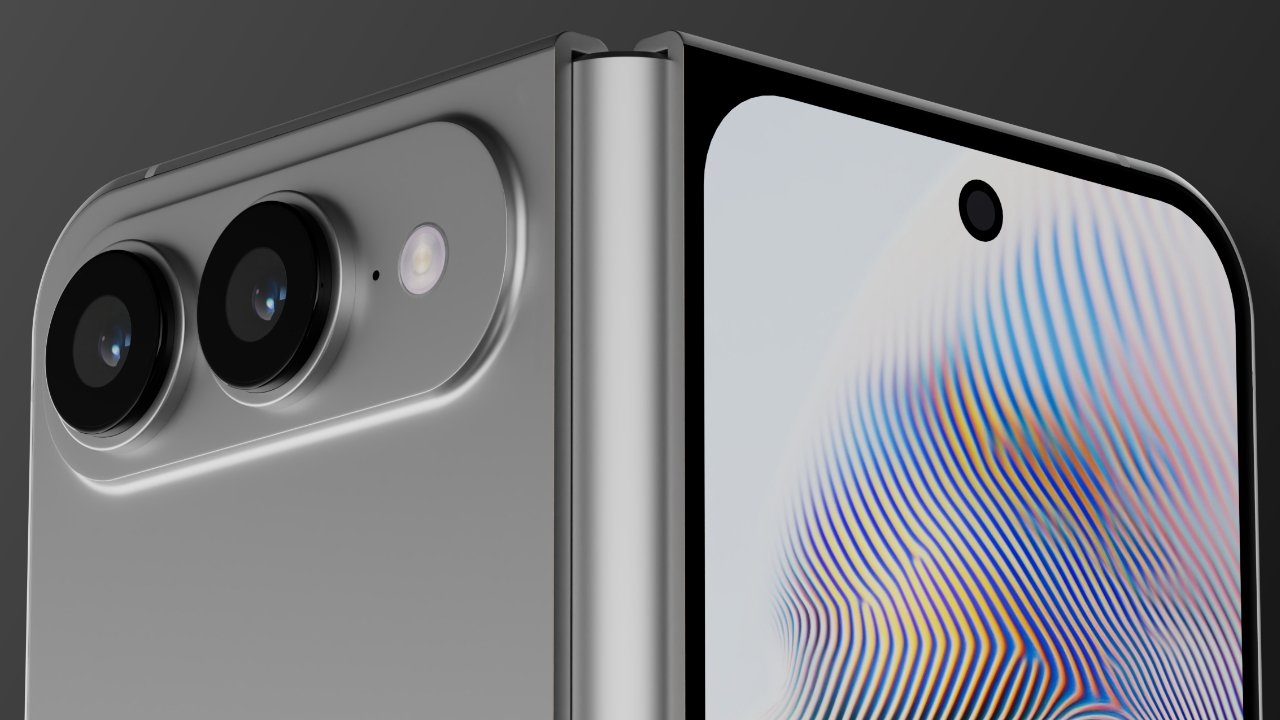
The iPhone Fold has been on and off for years, but now the supply chain is suggesting that Apple will announce it as expected in September 2026, yet not actually ship it for several months.
There are at last positive signs from Apple that it is preparing an iPhone Fold, but there have also been multiple reports that it is delayed. Now according to Economic Daily News, the CEO of Apple lens supplier Largan Precision has hinted at delays.
“Some new opportunities will be announced in the third quarter,” Enping Lin said at a shareholders’ meeting (in translation), “and some will be moved to the beginning of next year.”
By itself, that’s a slim comment to base speculation on, but Enping Lin also specifically referred to new devices. “The fourth quarter of this year will be busier than in previous years due to the scheduling of customers’ new machines,” he said.
Then there have been separate comments by Ruan Chaozong, general manager of Xinrixing, a firm now said to be making bearings for a folding iPhone. Ruan is reported to have said that Xinrixing is only waiting for Apple to decide on its shipping date.
It’s still all far from a concrete leak, but these two different firms are both alluding to some device being rescheduled. More, the fact that one is a manufacturer of bearings, and the other is known for iPhone lenses, makes it sound likely that the new device is from Apple.
Given that and the history of reported delays since the iPhone Fold is believed to have entered manufacturing testing, the rumors seem reasonable.
We’ve been here before so often
There do seem to have been more reports of a September 2026 launch for the iPhone Fold than for any previous year. Yet there have been such rumors every single year since at least 2019, when Samsung launched its first folding phone.
This time the volume of rumors is higher, but they also tend to be contradictory. A possible consensus seemed to be emerging in April 2026 when it was claimed that the iPhone Fold would take longer to ship than expected.
In that case, the rumor was that Apple would announce the iPhone Fold at its September 2026 event, but not ship until October. Even then, it might only ship in small quantities, which is what Apple did with the original AirPods.
Although around the same time as those reports, there were also ones that said no, production issues were delaying the iPhone Fold until 2027.
If it really is delayed until 2027, that might account for how there have been fewer believable leaks of components than might be expected.
Separately, Apple has already been reported to be planning at least one folding iPhone in 2027 and 2028. However, that’s expected to be a second-generation, bezel-free, and perhaps a flip model iPhone Fold.

Walking the floor at the world’s largest high end audio show, HIGH END, in Vienna last week, it was easy to get jaded. Hey, here’s a $120,000+ pair of speakers. Ooh, look: a $160,000 pair of speakers. OMG, what is this? a 3.6 Million dollar speaker system? Yep. And that one weighed almost three tons. Not exactly practical for most living spaces.
But walking into the secondary exhibition halls, connected to but separate from the main Austria Center Vienna (ACV) space, who do I see but SVS? Had they also crossed into the 6-figure system pricing territory? Nope. In fact, their highlighted product was the new 3000 Micro R|Evolution subwoofer which we previously saw in prototype form at CES 2026 and again in final form at AXPONA. It’s a compact powerhouse capable of reaching all the way down to 20 Hz, for the remarkably reasonable price of $999.

When I first entered their stereo listening room, I thought they were playing music through their Ultra Evolution Pinnacle floorstanding speakers. At $4,998/pair, they’re certainly not “cheap” but they look and sound like something that should have an extra 0 at the end of that price tag. Deep, extended bass, precise imaging, solid vocal presence – overall a supremely musical experience. But it turns out, they were actually playing music through their Ultra Evolution Bookshelf Speakers ($1,199/pair), supplemented with that 3000 Micro R|Evolution sub I mentioned earlier for a total speaker price of $2,198 including the subwoofer.
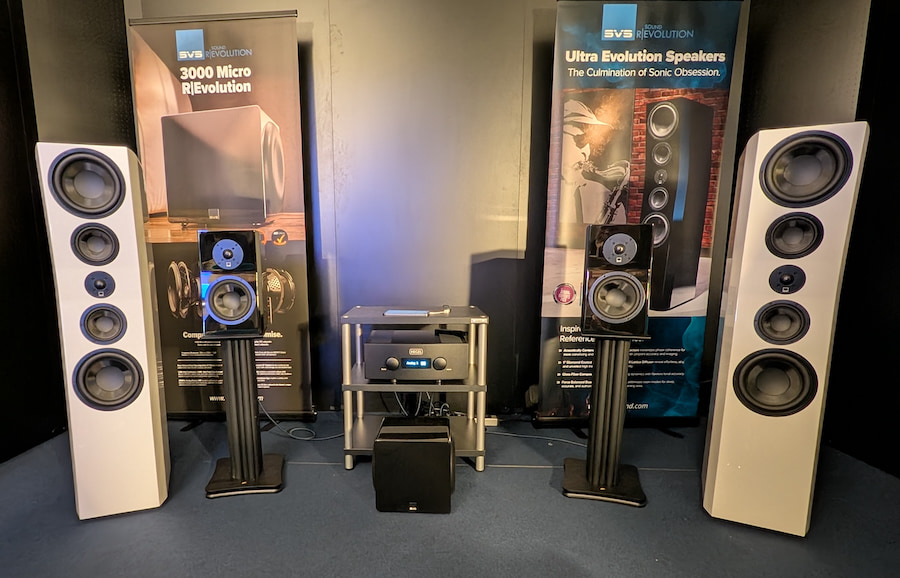
The blend between the bookshelf speakers and the sub was so seamless that I thought it must have been coming from the integrated towers which were located right next to the bookshelf speakers. And the soundstage was so wide as to be coming from well beyond both pairs of speakers. But I went up close to verify that we were actually hearing all this great sound from those two little guys and the compact sub in the middle. I’m not sure how many orders these folks got during and after the show. But I’m sure many European show attendees were as impressed as I was by what they heard.
SVS also had a small (5.2.2-channel) Dolby Atmos home theater system set up, featuring the company’s Ultra Evolution Titan towers, Ultra Evolution Center, a pair of Ultra Evolution Bookshelf speakers in the back, two Ultra Evolution Elevation speakers on the ceiling for height effects and two of the larger PB-3000 R|Evolution subwoofers, subs. SVS always manages to put on an impressive home theater demo, but this year things were improved by the ability to run the long-awaited Auto EQ room correction software on the two subwoofers. This helped them to dial in the bass response for the showroom, making it sound more like a professional movie theater with even bass response throughout the room (but without the sticky floors).

Also on display in the booth was the company’s upcoming R|Evolution Soundbar, which comes with one of the company’s powered subwoofers pre-paired for quick set-up. This sub is no joke – it features a 12-inch driver and 600 watts of amplification. SVS reps tell us the same can hit that magic 20 Hz low bass response, but we’re not sure how many dB down it will be at that frequency.
Since we first saw this bar at CES, they’ve added DTS:X decoding to the Dolby Atmos that we already saw and heard. The system will have optional rear speakers to those who want their sound a bit more immersive than what Dolby Atmos virtualization can do from a single bar. Pricing on that system has not yet been finalized but SVS says it should be around $1,500 for the soundbar+sub bundle and $1,800 for the bar+sub+rear speakers bundle. The soundbar is expected to being shipping toward the end of this year.
Check out SVS’s own live stream (previously recorded) where they give a quick booth tour from High End 2026.
The Bottom Line
Once again, SVS holds the line on pricing with one of the most impressive budget systems we heard at the HIGH END show. Those looking for an alternative to overpriced soundbar-based systems can put together a fine-sounding two channel or even 5.1.2-channel system featuring the Ultra Evolution Bookshelf and new 3000 Micro R|Evolution subwoofer with enough cash left over for a decent AV Receiver to power it all.
Price & Availability
Related Reading

The plane will soon be ready to fly over US communities.

NASA’s X-59 research plane took its first supersonic flight at the beginning of the month, and now it’s demonstrated that it can reach the speed and altitude conditions it’ll need to achieve for planned trips over US communities in the near future. The X-59 is designed to fly at supersonic speeds without producing a loud sonic boom; instead, it’ll make a “quiet sonic thump,” according to NASA. For now, though, it’s flying alongside another research craft that does produce a sonic boom, to obscure whatever noise it makes as it undergoes testing.
In a test flight on Friday, the X-59 flew Mach 1.4, or about 924 mph, and reached an altitude of 55,000 feet. For the previous flight, on June 5, it hit Mach 1.1.
The space agency says this latest test “was an even more critical step” than the one that preceded it, as it hit key targets that it’ll replicate during its Quesst mission. The Quesst mission, which is still months away, will see the X-59 fly over populated areas so NASA can get feedback from the public on what the sonic thump sounded like to listeners on the ground. Before that, though, the plane will go through an acoustic validation phase, in which the team will measure its supersonic acoustic signature to make sure it is indeed breaking the sound barrier without producing a traditional sonic boom.
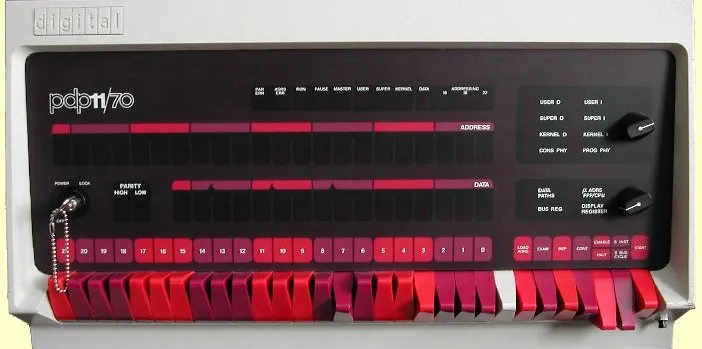
A year before the arrival of the brand-new 21st millennium, the Year 2000 Bug was predicted to grind modern society to a halt and ensure that at the dawn of the year 2001, there’d be nothing left but the smoldering wreck of once great societies. Thanks to the concerted efforts of countless engineers, software developers, and many others, we were left with mostly just silly glitches, with one of these surviving bugs apparently just discovered, as [Van Heusden] reported on an NTPd bug in BSD 2.11.
To be fair, it is a pretty obscure one, as the demonstration involves BSD 2.11 on a PDP-11/70 from 1975, so it’s probably not something that still sees much use outside retrocomputing enthusiast circles. In the blog post, the demonstration involves connecting a specific adapter by Traconex, capable of receiving WWV/WWVH time signals, and setting it up for use by the NTPd prior to running the ntpd -a any -d -d -d -d command.
This can create an ‘offset excessive’ error in the log, which, as the attached patch shows, is due to the use of explicit 20th-century numbering. Although not a bug that’ll really affect anyone, it shows that Y2K bugs didn’t just hide in two-digit year fields, but also lazy shortcuts and assumptions when handling years. This will be useful information while we try to avoid society melting down once more, as the Year 2038 problem is now pretty much right around the corner.

NewsBeat35 seconds ago
what the ‘peace deal’ really means

Business1 minute ago
Trump threatens 100% tariff on French wine over digital services tax

Crypto World3 minutes ago
Bitbank Warns of Account Suspensions Over Polymarket Use


-

 Business21 hours ago
No Jackpot Winner as $257 Million Prize Rolls Over to $269 Million Monday Draw
-

 Crypto World4 days ago
Oppenheimer backs SpaceX as $70 billion retail frenzy builds
-

 Crypto World4 days ago
Markets Rally as SpaceX IPO Looms Amid Iran Tensions and Inflation Surge
-

 Fashion3 days ago
Weekend Open Thread: Tuckernuck – Corporette.com
-

 Sports7 days ago
FIFA WC 2026 Group C: Morocco, Scotland challenge Brazil’s hunt for glory | FIFA World Cup 2022
-
 Crypto World13 hours ago
Zimbabwe Requires Crypto Businesses to Register Annually Under New FIU Regulations
-

 Entertainment6 days ago
The Ryan Gosling True Crime Thriller On Netflix That Gets Even Stranger, Stream It Now
-
 Sports6 days ago
Bangladesh beat Australia after 20 years in ODIs, register only their second win over six-time world champions | Cricket News
-

 Tech3 days ago
This Week In Security: Microsoft On Microsoft, Register Your Domains, Linux On ARM, And FreeBSD Joins The File Cache Club
-

 Tech2 days ago
NanoClaw integrates JFrog registries to secure AI agent downloads
-

 Crypto World2 days ago
Bitget enters Argentina’s regulated crypto market through PSAV registration
-

 Politics4 days ago
Politics Home | Healey Resignation Is “Colossal Failure Of Government”, Says Former Labour Defence Secretary
-

 Tech5 days ago
‘This is Seattle’s position on AI’: City Council votes unanimously to pause big new data centers
-
Tech4 days ago
Dutton Ranch star claims they ‘didn’t see any disruption’ on set following Chad Feehan’s exit from Yellowstone spinoff fueled by Taylor Sheridan clash rumors
-

 NewsBeat4 days ago
El Nino has formed in the Pacific and could set records, forecasters say
-
 Entertainment4 days ago
Donnie Wahlberg & More Heat Up Las Vegas at Circa’s Barry’s Downtown Prime
-

 Sports4 days ago
First Time Since 1971: Australia Register Historic Low In ODI Cricket
-
 Tech4 days ago
Opendoor Ends India Operations, Fueling a Bigger Conversation About AI and Outsourcing
-

 Politics4 days ago
Belfast burns, while Met chief points finger at Iran and Russia
-

 NewsBeat3 days ago
FBI searches office of Ohio voter registration group
You must be logged in to post a comment Login