

Business
Southeast Asia Eyes Eightfold CORSIA Carbon Credit Growth Amid Policy Gaps


CORSIA requires airlines to offset emissions growth via carbon credits. Southeast Asia could nearly triple its CEEU supply if governments authorize 54 pending projects across Vietnam, Thailand, and Myanmar. However, uneven Article 6 readiness and institutional capacity across ASEAN nations pose challenges to scaling high-quality carbon credit supply for CORSIA compliance.
Key Points
- CORSIA requires airlines to offset CO2 emissions above 85% of 2019 baseline by purchasing carbon credits (CEEUs); Asean supplies ~7% globally, mainly clean cookstoves in Cambodia and Laos, with potential to grow eightfold to 20.8 million units if governments authorize 54 pending projects across Vietnam, Thailand, and Myanmar.
- Boeing-backed report says Asean could strengthen CORSIA by expanding access to high-quality, lower-cost credits, easing rising compliance costs airlines face as credit prices tighten, while channeling climate finance regionally.
- Challenges remain: uneven Article 6 readiness and institutional capacity across Asean states, with governments cautious about overselling credits and jeopardizing their own NDC targets, limiting how quickly new supply can be authorized.
CORSIA’s Emissions Offsetting Mandate
CORSIA aims to keep international aviation’s net emissions flat by requiring airlines to offset any carbon dioxide growth above 85% of 2019 baseline levels. Airlines achieve this by purchasing and cancelling CORSIA-Eligible Emissions Units (CEEUs), each representing one tonne of CO2 reduced or removed elsewhere.
More than 130 countries participate, including seven Southeast Asian nations—Cambodia, Indonesia, Malaysia, the Philippines, Singapore, Thailand, and Vietnam. This creates mandatory demand for verified carbon credits, positioning the compliance market as a critical mechanism for balancing aviation’s growing environmental footprint against measurable climate action elsewhere.
Southeast Asia’s Emerging Supply Potential
Asean could become a major supplier of high-integrity carbon offsets, according to a report backed by Boeing, GenZero, and Abatable. The region already contributes roughly 7% of global CEEU supply, with 2.6 million credits issued from four clean cookstove projects in Cambodia and Laos.
This supply could grow nearly eightfold—to 20.8 million units—if governments swiftly issue Letters of Authorization (LoAs) for 54 additional qualifying projects, including 24 in Vietnam, 11 in Thailand, and 8 in Myanmar. Boeing’s Allison Melia emphasized that clear policy guidance and government-industry collaboration are essential to unlocking this potential, especially as tightening credit markets threaten to raise airlines’ compliance costs by billions of dollars in coming decades.
Institutional Gaps and Article 6 Readiness
Despite this opportunity, CORSIA implementation poses significant challenges for Asean governments. Environment ministries face the risk of “overselling” credits, potentially undermining their own Nationally Determined Contributions (NDCs) if too many units are authorized for export through corresponding adjustments under the Paris Agreement’s Article 6 framework.
Institutional readiness varies widely across the region. Singapore, Indonesia, Thailand, Vietnam, and Cambodia have adopted Article 6 frameworks, while Malaysia’s is still developing. Laos hosts CORSIA-eligible projects without a formal framework, and the Philippines and Singapore have completed a bilateral carbon deal absent a comprehensive rulebook. Brunei, Myanmar, and Timor-Leste remain in early stages, underscoring the need for stronger regional coordination and capacity-building to fully capitalize on CORSIA-driven demand.
Source : Asean poised for US$8.5bn windfall from UN-backed airline carbon scheme
Other People are Reading


China’s Chery takes over former Nissan car factory in South Africa

The changes come after representations from the Brokers’ Industry Standards Forum, which sought revisions to reflect current regulatory and market conditions. SEBI said the decision was taken to improve ease of doing business for brokers and ease of investing for clients.
Under the revised framework, for trades not covered under the margin trading facility, unpaid securities will be directly credited to the client’s demat account. After that, an auto-pledge will be created in favour of a separate account opened by the trading member, called the “client unpaid securities pledgee account,” or CUSPA. The pledge will carry the reason “unpaid” and will not need any specific instruction from the client.
The broker will also have to inform the client through email or SMS about the pending payment obligation and its right to sell the securities if the client does not pay. SEBI has asked trading members to frame a clear policy for handling such unpaid securities. This policy must explain the process, reasons, manner and timing for release or invocation of the pledge and liquidation of securities. The client must be given a maximum period of five trading days from the payout date to meet the payment obligation.
From WhatsApp chats to food orders: How Sebi cracked a Rs 144 crore stock manipulation scheme

Sebi has also clarified that while such unpaid securities pledged to the broker’s CUSPA may be considered for reporting client margin collection to the clearing corporation, the broker cannot give fresh exposure to the client on the basis of these securities. This means the securities may support margin reporting, but cannot be used to allow additional trading limits.
The circular also lays down how excess pledged securities should be released. Brokers must check the value of pledged securities daily against the client’s ledger balance, margin obligation or other factors that may be specified by exchanges. If the pledged value is higher than what is allowed, the broker must release the excess securities by the next trading day.
If the client does not pay within the prescribed period, the broker may invoke the pledge and sell the unpaid securities after giving reasonable notice. The sale will be done in the market using the client’s unique client code. Any surplus funds left after settling the client’s obligation must be credited to the client’s ledger.
A key investor protection measure is the auto-release provision. If the pledge is neither invoked nor released within five trading days after payout, depositories will automatically release the pledge at the end of the sixth trading day. The securities will then become free balance in the client’s demat account, without any encumbrance.
Sebi has also barred brokers from further pledging or transferring CUSPA-pledged securities to banks or non-bank lenders to raise funds. In exceptional cases, such as lower circuit stocks with only sellers, trading suspension, halt due to surveillance or other valid reasons recognised by market infrastructure institutions, brokers may seek an extension of the pledge by up to one additional calendar week.
Stock exchanges have been asked to issue operational guidelines within 30 days. Most amended provisions will take effect three months from the date of those guidelines, while provisions on extension of pledge in exceptional cases will come into force six months from the circular date.
(Disclaimer: Recommendations, suggestions, views and opinions given by the experts are their own. These do not represent the views of Economic Times)
Business
Nasdaq Drops 0.8% for Second Straight Session as AI Chip Stocks Suffer Worst Two-Day July Selloff in Months
NEW YORK — The Nasdaq Composite fell for a second consecutive session Thursday, declining 0.8% to close at 25,832.67 as semiconductor stocks endured their steepest two-day selloff since early June, even as the Dow Jones Industrial Average surged to a record high and Apple’s near-5% gain underscored just how sharply investor sentiment has divided between the technology sector’s winners and losers heading into the Independence Day holiday weekend.
The Philadelphia Stock Exchange Semiconductor Index fell as much as 6% Thursday, putting it on pace for a two-session decline of roughly 12%, the most since the early June rout that preceded the sector’s subsequent recovery. The VanEck Semiconductor ETF dropped 4.5%, led by a 13.6% decline in Teradyne and an 11.5% slide for KLA. Nvidia shares pulled back 1.4%, while Micron gave up 5.5%, extending a broader pullback from levels near all-time highs that the stock had been trading around just days earlier.
Semiconductor stocks are starting the third quarter with their worst two-day selloff in nearly a month, according to Bloomberg, with the Philadelphia index coming off its best quarter ever, an 88% advance in the second quarter. That context matters: when a sector has appreciated that much, that fast, even modest shifts in the underlying investment thesis can translate into significant price corrections as investors who bought at much lower levels begin locking in profits.
The catalyst for the two-day pullback is a combination of valuation concerns, profit-taking at historically elevated price levels and a genuine reassessment of how much more the artificial intelligence infrastructure spending narrative can drive semiconductor earnings per share higher from their already extraordinary recent levels. The Roundhill Memory ETF was pacing on Thursday to end the holiday-shortened week down nearly 15%. Micron was tracking to end the week down more than 12%, while Sandisk’s two-day decline totaled more than 20%.
Those declines arrived even as the companies’ underlying fundamentals have remained largely intact. No negative earnings pre-announcement from any major chip company has triggered the selling, and no concrete data point suggesting AI data center orders are slowing has surfaced during the week. What has shifted is investor psychology: after an 82% first-half gain across chip stocks broadly, the bar for continued appreciation has risen sharply, and multiple compression in richly valued growth names can be rapid when momentum turns.
Adding a new element to the AI investment debate, reports emerged Thursday that OpenAI had entered discussions about selling a 5% stake to the U.S. government, a development that circulated through technology desks during the session. The report, while not immediately negative on its face, added to a broader reconsideration of the AI trade’s near-term dynamics rather than its long-term direction.
Meta Platforms delivered another complication for the sector. Reports Wednesday that the social media giant would begin renting out its excess computing infrastructure, effectively entering the cloud business, initially boosted Meta’s shares by nearly 9%. But by Thursday, JPMorgan analyst Doug Anmuth had cautioned clients about the strategic implications, arguing the company’s AI capital should be focused elsewhere. “We’d much prefer that Meta develop core AI products, leverage them over its base of around 4 billion users, and require massive compute for its own inference rather than selling access to its infrastructure,” Anmuth wrote. Meta fell nearly 5% Thursday as investors processed that caution, reversing a portion of Wednesday’s cloud-announcement surge.
The striking divergence within Thursday’s session illustrated in concentrated form the rotation that has defined the market’s character since the third quarter began. While semiconductor names fell broadly, Apple’s 4.84% advance, driven by reports the company had instructed parts suppliers to prepare for 10 million foldable iPhones this fall, added enough Dow points to push the blue-chip average to an all-time closing record. McDonald’s, Walt Disney, Visa and Walmart also posted gains, reflecting the rotation into more defensive and consumer-facing names that has characterized the Dow’s outperformance during each of the chip sector’s recent down sessions.
“This is a rotation potentially out of a sector that’s been red hot for the last few months and into other areas, but I also do think that there’s a little bit of a revaluation of the AI trade in itself,” one analyst told CNBC, capturing the dual dynamic at play.
Netflix offered the most prominent exception to tech’s Thursday struggle, gaining 5% in afternoon trading for its best day since late February. The streaming company’s advance made it a notable outlier within the Nasdaq-100 as the broader index fell more than 2% at its worst intraday point, suggesting some investors are selectively rotating within the technology sector rather than leaving it entirely. Palantir Technologies also bucked the trend, adding 4% after D.A. Davidson analyst Gil Luria upgraded the stock to Buy from Neutral, citing competitive advantages in government AI software and what he described as an attractive valuation following the stock’s steep June decline.
The market’s response to the June jobs report, which showed 57,000 positions added against expectations of 115,000, provided the macro backdrop that helped cushion some of the chip sector’s losses by reducing near-term expectations of additional Federal Reserve rate increases. Treasury yields declined on the soft employment data, with the rate-sensitive dynamic benefiting defensive and dividend-paying sectors even as it did relatively little to arrest the momentum-driven selling in high-multiple semiconductor names.
With U.S. markets closed Friday for Independence Day, the pre-holiday close leaves investors with a bifurcated picture to consider over the long weekend: a Dow at all-time highs powered by traditional sector strength and Apple’s foldable iPhone narrative, alongside a Nasdaq that has now declined in each of the first two sessions of the third quarter as the great AI chip trade of 2026 encounters its most sustained period of investor doubt since the sector’s remarkable first-half run began earlier this year.

FOX Business correspondent Grady Trimble reports as Millions are traveling for America’s 250th birthday, setting record numbers despite increased airfare and gas prices on ‘Varney & Co.’
The federal government is urging state attorneys general to probe and prosecute any illegal activities contributing to high fuel costs for Americans.
“Although crude oil prices are now dropping rapidly, far too much of that price cut is being withheld from Americans when they pay for gasoline,” the letter, signed by Associated Attorney General Stanley Wodward, Jr. and Federal Trade Commission Chair Andrew Ferguson, claims.
The document includes a screenshot of a Truth Social post that President Donald Trump issued last week.
In that June 24 post, Trump asserted, “The big Oil Companies are not dropping their price at the pump commensurate with the sharply lower prices they are paying for Oil. Those prices are dropping like a rock! In other words, customers are being ‘gouged.’ I have instructed the DOJ to immediately start looking into this. Gasoline prices better start going down a lot faster than what I’m seeing!”
BESSENT WARNS GAS STATIONS ‘WE’RE WATCHING’ AS TRUMP DEMANDS IMMEDIATE PRICE CUTS
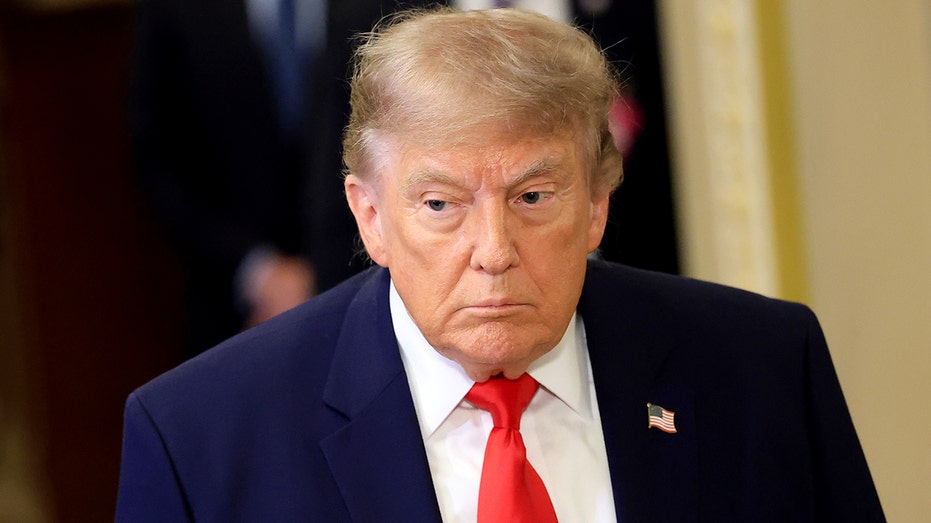
President Donald Trump speaks to the media as he arrives at the U.S. Capitol on June 24, 2026, in Washington, DC. (Anna Moneymaker/Getty Images / Getty Images)
The letter to the state attorneys general states, “As the Department of Justice (DOJ) answers the President’s call to action, both the DOJ and the Federal Trade Commission (FTC) are closely monitoring petroleum markets.”
“We urge state law enforcers to join us in investigating illegal practices. Recent volatility in crude oil prices does not suspend either the antitrust laws or state consumer protection laws, and it does not authorize companies to manipulate retail prices or collude with their competitors,” the letter declares.
“We also encourage State Attorneys General to use all tools available under your state laws to investigate and prosecute any misconduct causing unjustified price increases — particularly conduct that violates state antitrust and consumer protection statutes. Although the Division and the Commission do not enforce any laws aimed specifically at price gouging rather than anticompetitive conduct, many States have also enacted laws specifically targeting price gouging during periods of market disruption or emergency, and we urge those states to review whether enforcement is warranted under those laws,” the federal officials noted.
Gas prices spiked considerably after the U.S. launched the war effort against Iran earlier this year, but have been declining more recently.
TRUMP ALLEGES GAS PRICE GOUGING, CALLS FOR DOJ INVESTIGATION

A driver reaches for the pump at a gas station in Carolina Beach, N.C., on Wednesday, July, 1, 2026. (Allison Joyce/Bloomberg via Getty Images / Getty Images)
The AAA national average price for regular gas is $3.823 as of July 3, down from the month-ago average of $4.261.
“Gasoline Retailers must get their Prices down, IMMEDIATELY! They’re too high considering that Oil is now at $68 a Barrel, and heading south. The Retailers must quickly react to this statement, and do what they know is right — DROP YOUR PRICE FOR OUR GREAT AMERICAN PEOPLE! There will be no gauging, which is totally illegal. If Retailers don’t do this, big problems lie ahead!” he warned in part of a Monday Truth Social post.
In part of a post on Wednesday he declared, “Just as I promised, Oil Prices are plummeting FAST, and Gas Prices at the pump are dropping too, but not as fast as they should be.”
TRUMP DEMANDS GAS STATIONS LOWER PUMP PRICES IMMEDIATELY AND RENEWS PUSH FOR $2.50 GASOLINE
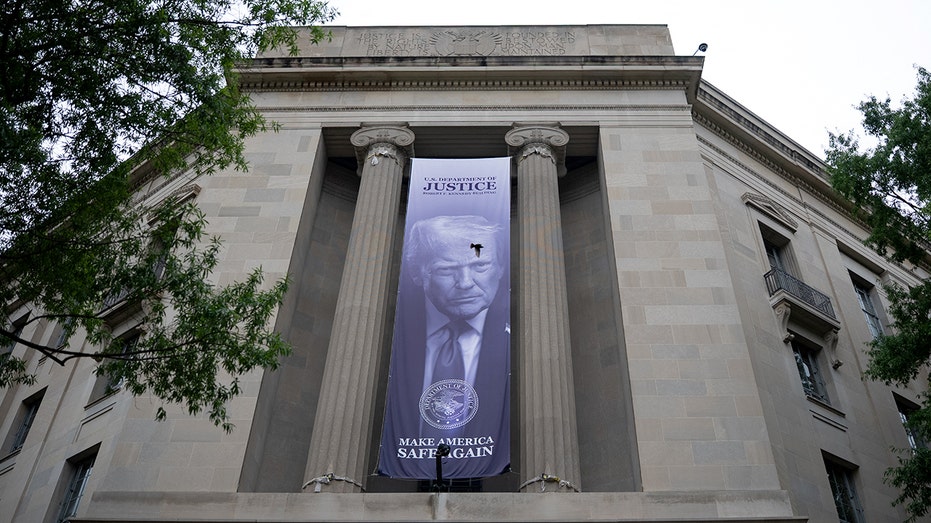
A banner featuring President Donald Trump hangs outside of the Department of Justice headquarters ahead of a press conference with Acting Attorney General Todd Blanche announcing annual healthcare fraud takedown results in Washington, D.C. on June 23 (Ken Cedeno / AFP via Getty Images / Getty Images)
GET FOX BUSINESS ON THE GO BY CLICKING HERE
“Affordable energy is essential to a thriving American economy. The Antitrust Division is committed to working alongside state law enforcement partners to provide resources and support to protect consumers from anticompetitive behavior that raises the price of gas,” Woodward said in a statement provided to Fox News Digital. “The Antitrust Division will use all available tools to ensure that companies are held accountable for unlawfully manipulating the market”

Services PMI and ISM non-manufacturing PMI among economic data due Monday
Business
Russell 2000 Slips Thursday After Its Best First Half Since 1991 as Chip Selloff Weighs on Small-Cap AI Names
NEW YORK — The Russell 2000 Index, which just completed the strongest first half of any year since 1991, closed Thursday with a modest decline of 0.55%, settling at 2,996.11 and finishing just below the psychologically significant 3,000-point level as the broad chip sector selloff that rattled the Nasdaq for a second consecutive session weighed on small-cap technology and semiconductor-adjacent names even as the Dow Jones Industrial Average hit a fresh all-time record.
The day’s pullback for small-cap stocks came on the final trading session before the Fourth of July holiday weekend, with U.S. markets closing Friday in observance of Independence Day. The small decline capped a week that itself followed one of the most remarkable six-month stretches for American small-cap equities in a generation.
The Russell 2000 gained 22% in the first half of 2026, its best performance since 1991 and well above the S&P 500’s 9.6% first-half advance. The rally also outpaced the Dow Jones Industrial Average’s 8.9% gain and the Nasdaq’s 12.8% climb, a reversal of the large-cap-heavy pattern that had defined much of the prior three years when megacap technology stocks captured nearly all of the headline performance.
“It’s both a valuation catch-up story and a fundamental story,” said Amy Zhang, portfolio manager at Alger. “The valuation gap was so wide that a truck can drive through it. At the same time, fundamentals are improving in small-caps and I think that’s why it’s causing the broadening trade.”
Consensus forecasts for Russell 2000 companies’ 2026 earnings growth have climbed to 38% from about 23% at the start of the year, according to LPL Financial, reflecting growing optimism that profit growth is broadening beyond the largest technology companies. Bottom-up analyst estimates suggest the Russell 2000 could deliver around 43% year-over-year earnings growth over the next 12 months, a figure that outpaces projections for the S&P 500 and has underpinned much of the institutional interest in the asset class through the first half of the year.
Semiconductor and semiconductor equipment companies were the biggest winners within the Russell 2000 during that period, underscoring how the artificial intelligence investment boom has rippled through the broader market well beyond the large-cap names that dominate most AI coverage. Chip-related companies accounted for 16 of the Russell 2000’s 50 best-performing stocks in the first half of the year, including Aehr Test Systems, Ichor Holdings and MaxLinear, which all rallied more than 400%. Rather than competing directly with industry leaders like Nvidia, many of these smaller companies have benefited from rising demand across the AI supply chain, supplying testing equipment, materials, components and specialized subsystems.
Those same names, however, have shared in this week’s semiconductor sector correction, which has wiped out meaningful short-term gains across the chip space broadly as investors who accumulated large positions during the sector’s extraordinary first-half run have taken profits ahead of the holiday. The VanEck Semiconductor ETF fell 4.5% Thursday alone, and the Philadelphia Semiconductor Index has posted its worst two-day decline since early June, with many of the smaller, more speculative names in the sector experiencing even steeper percentage drops than the large-cap bellwethers.
Small cap stocks are having a moment, according to Schwab’s market open report. The Russell 2000 gained 22% during the first half of the year, its best since 1991 and well above the S&P 500’s 9.6% gain. The index also topped the S&P 500 for two consecutive quarters, the first time that had happened since 2021, a milestone that has attracted fresh institutional attention to the small-cap universe and driven significant inflows into small-cap focused exchange-traded funds throughout the year.
Despite Tuesday’s chip-driven dip, broader small-cap market dynamics remain constructive for investors with a longer time horizon. The Russell 2000’s composition spans financials, industrials, healthcare, energy, biotech and technology, a diversification that gives the index exposure to domestic economic strength across multiple sectors simultaneously. Small-cap stocks generate roughly 70 to 80 percent of their revenue domestically, making the index particularly sensitive to U.S. economic conditions and comparatively insulated from global trade tensions that have periodically complicated the earnings outlooks of larger multinationals.
Bank of America analyst Jill Carey Hall said in a recent note that the bank still sees upside opportunities within small caps for less rate-sensitive stocks, especially because Russell 2000 performance has been concentrated this year and the broader universe has room to participate more fully in the rally.
The Federal Reserve interest rate outlook remains the most consequential variable for the small-cap outlook heading into the second half of 2026. Higher borrowing costs pose a particular challenge for smaller companies, which generally carry more floating-rate debt and face greater refinancing needs than large-cap peers. Bank of America has estimated that every additional 25 basis point rate hike would reduce Russell 2000 operating earnings by approximately 2%, a meaningful sensitivity given that the Fed’s next meeting is scheduled for July 28-29 and that some market participants had been pricing in the possibility of further tightening before this week’s soft employment report shifted that calculus.
“This should allow the Fed to take a patient approach to any shift in its policy over the next few months, seeing how the incoming economic data comes in rather than rushing to a decision to hike,” said Collin Martin, head of fixed income research and strategy at the Schwab Center for Financial Research.
The June nonfarm payrolls report, which showed just 57,000 jobs added against expectations of 115,000, has provided the most direct macro support for small-cap stocks this week by reducing near-term rate hike fears, even as the soft headline reading raised fresh questions about whether economic momentum is slowing more quickly than the consensus had anticipated.
For now, Thursday’s modest decline represents a pause in a larger story rather than a reversal, with the index barely off a recent all-time high reached on Wednesday of this week at 3,033.75 and well positioned, by most analysts’ assessments, to resume its outperformance once the semiconductor profit-taking cycle runs its course and attention shifts back to the improving earnings trajectory across the small-cap universe heading into the second half of 2026.

Union leaders are calling on employers to let staff work from home on Monday, after England’s World Cup last-16 tie against Mexico kicks off at 1am BST.
The Trades Union Congress (TUC) has appealed to businesses to show “common sense” and allow football fans to work flexibly following the match, whether by working from home, starting later or swapping shifts.
Paul Nowak, the TUC general secretary and a self-confessed England and Everton fan, admitted the scheduling was far from ideal for supporters. “That’s why we are appealing to employers to show some common sense and understanding by allowing their staff to work flexibly where possible,” he said.
The plea comes as separate research suggests more than half of bosses have no plans to make any special arrangements for the fixture. Just one in five employers intend to offer flexible working during the tournament, according to a poll of more than 1,100 managers by the Chartered Management Institute (CMI), a striking gap given the £3.8bn windfall the World Cup is expected to deliver for British business.
Petra Wilton of the CMI said: “We’re not saying every England win deserves a bank holiday, but if millions of people have stayed up until 3am supporting their team, asking employers to let them start a little later the next morning is simply common sense. We’re saying to employers across the country, ‘Let them start late.’”
Sir Keir Starmer has confirmed that British pubs can stay open through the night for the tie, which takes place at the Azteca Stadium in Mexico City. Should the match go to extra time, it could run as late as 4am.
The Chartered Institute of Personnel and Development (CIPD), which represents HR professionals, has encouraged employers to allow workers to take annual leave, swap shifts or make up time later in the week, echoing its broader guidance on handling major sporting events in the workplace.
“Employers are under no obligation to make special arrangements around World Cup matches; however, some may choose to offer flexibility where this works for the business and does not impact performance,” said David D’Souza of the CIPD.
For smaller firms, the calculation may be more nuanced. With research showing that rigid office mandates are already driving workers to seek more flexible roles elsewhere, a well-handled World Cup could prove a cheap win for morale and retention. Acas has urged employers to get their team line-up sorted before kick-off, advising that agreements covering time off, sickness absence and flexible hours are put in place ahead of matches rather than argued over the morning after.
Employment lawyers, meanwhile, have warned fans against pulling a sickie. Samir Moftah, head of employment law at Manak Solicitors, said: “Intentionally deceiving your employer about your health can constitute misconduct and, in certain situations, gross misconduct.” Employees found to have falsely claimed sickness absence could face disciplinary action, and dismissal in the most serious cases.
The debate over Monday morning extends beyond the workplace. After England’s last-32 victory over the Democratic Republic of the Congo, head coach Thomas Tuchel asked parents to let their children skip school to cheer the side on. Bridget Phillipson, the Education Secretary, responded that while the decision rested with parents, “children can be in school the next day.”
For SMEs weighing up how to respond, the tournament is as much an opportunity as a headache, and those thinking strategically about the World Cup event economy may find that a little flexibility on Monday pays dividends long after the final whistle.

Amy Ingham
Amy is a newly qualified journalist specialising in business journalism at Business Matters with responsibility for news content for what is now the UK’s largest print and online source of current business news.

The NHS is to offer rewards to people who walk for half an hour a day, in the first scheme of its kind to pay Britons back for getting active.
NHS England will launch its “marathon a month” challenge early next year, asking participants to walk for around 30 minutes daily. Those who manage it every day will cover roughly 26 miles over the month, the distance of a marathon, logging their progress online or via a phone or smartwatch.
Complete the challenge and rewards follow, potentially including incentives and discounts, although the organising team has yet to confirm precisely what is on offer. Vouchers are one option under consideration, and the presence on the team of Sir Keith Mills, the founder of Air Miles and Nectar, suggests the architecture of Britain’s best-known loyalty schemes will be brought to bear on the nation’s step count.
Crucially for taxpayers, the NHS will not be footing the bill for the rewards. NHS England is covering the initial set-up, but the wider plan is to draw in philanthropic backing from major corporates as the scheme rolls out, with public and private sector partners running the programme. GPs and other health staff will be encouraged to promote it to patients.
The scheme is being developed with Sir Brendan Foster, the Olympic medallist and founder of the Great North Run, who was asked by NHS England to build a campaign to get people walking as part of the government’s 10-year health plan for England.
“I’m known for running, but the ambition here is far simpler. We just want people to walk. Simple,” he says.
The aim is to sign up more than 100,000 people, with daily stats recorded digitally. If the target is hit, Sir Brendan says it would count as the biggest marathon in history. He is banking on “streak” culture, the habit-forming mechanic behind Snapchat and Duolingo, to keep participants going.
The under-25s Business Matters spoke to were broadly upbeat. One said the gamified challenge would push her to be more active, admitting that not wanting to break a streak is a powerful motivator for her and her friends. Another, who already clocks up roughly a marathon’s worth of walking each month, said he would happily take a free reward for something he is already doing.
The numbers behind the initiative are stark. Physical inactivity is associated with one in six deaths, according to official public health guidance, and a person is classified as inactive if they do less than 30 minutes of moderate-intensity activity per week. Sport England’s Active Lives survey showed that in the year to November 2025 nearly a quarter of adults, around 12 million people, fell into that category.
“If someone walks 30 minutes five times a week, they could gain up to four extra years of healthy life,” Sir Brendan says.
For employers, the scheme lands at a moment when workforce health has become a boardroom issue. Business groups have already backed the Keep Britain Working review amid mounting fiscal pressure from economic inactivity, and there has been a marked rise in UK employers using wellbeing strategies to lift engagement and cut absenteeism. A state-backed incentive scheme that nudges staff out of the door at lunchtime may prove a useful, and free, addition to the corporate wellbeing toolkit.
The potential savings for the health service are significant too, at a time when technology is already being deployed to claw back hundreds of millions in NHS costs.
Not everyone believes incentives alone will shift the dial. Sonia Pombo, head of research and impact at Action on Salt & Sugar, says: “Encouraging people to build regular movement into their daily lives can support better health, and making it simple, achievable and rewarding may help more people get started. But we cannot rely on individual behaviour change alone. If the government is serious about improving the nation’s health, particularly for children, it must pair initiatives like this with stronger prevention measures.”
Full details of the scheme, including how to sign up, will be released in the coming months.
Amy Ingham
Amy is a newly qualified journalist specialising in business journalism at Business Matters with responsibility for news content for what is now the UK’s largest print and online source of current business news.

Republic Services: It's A Garbage Company, Literally, And I Love It
Business
Dabur Q1 updates: Co expects double-digit revenue growth as rural demand stays ahead of urban

The company, in its quarterly update for the period ended June 30, 2026, said consumer sentiment remained resilient despite geopolitical concerns and hyperinflationary pressure in some of its key markets. Dabur said its business trajectory improved sequentially over the previous quarter, and it expects consumption in international markets to improve in the coming quarters as the Middle East situation eases.
In India, both rural and urban markets sustained their growth trend, with rural demand continuing to outpace urban. This is important for Dabur as a large part of its portfolio, including health, oral care, hair care and beverages, has strong rural and semi-urban reach.
The India FMCG business is expected to post near double-digit growth during the quarter. The home and personal care business is likely to grow at a near-teens level, led by strong demand for hair oils and shampoos. Dabur said hair oils and shampoos are expected to deliver high-teens growth, supported by perfumed and coconut hair oils.
Oral care is also expected to report near double-digit growth. Dabur said growth was broad-based across the segment, with the new herbal franchise and Meswak recording strong double-digit growth. Its flagship Red Toothpaste and Lal Dant Manjan brands also continued their upward trend.
Also Read: Vedanta Power Q1 update: Sales rise 38% on Meenakshi boost, Sakti shutdown weighs
The healthcare business is expected to show sequential improvement, with mid-single-digit growth. Key brands such as Hajmola, Pudin Hara, Dabur Honitus, Isabgol and the health juices range are expected to deliver robust double-digit growth. Dabur Glucose, which was affected in the early part of the quarter, recovered sequentially later.The food business continued to grow at a high double-digit pace. Badshah is expected to deliver high-teen growth, while the beverages portfolio recovered during the quarter. Dabur said Real Activ juices and coconut water recorded strong double-digit growth.
The company’s emerging channels, including e-commerce, quick commerce and modern trade, are expected to report strong double-digit growth. General trade also improved sequentially, with growth seen across urban and rural markets. Dabur said Project Saksham, its distribution and route-to-market optimisation initiative, is showing early positive signs.
The international business is expected to grow in the high teens in rupee terms, even with severe pressure in the Middle East. Egypt, Turkey, Bangladesh and the UK each recorded strong double-digit growth in rupee terms.
Dabur said elevated inflation during the quarter, especially in hair care, was managed through calibrated price hikes, helping maintain stable operating margins. Profit after tax is expected to grow at a double-digit level. The company said detailed financial results will be announced after board approval.
China’s Chery takes over former Nissan car factory in South Africa

ESMA Warns Prediction Market Event Contracts May Breach EU Retail Ban

Julie Chen Talks New Season Of ‘Big Brother’


-

 Tech6 days ago
Claude Code turned every engineer into three. Now companies need more product thinkers
-

 Crypto World4 days ago
Strategy authorizes up to $1.25B in Bitcoin sales under new capital plan
-

 Politics7 hours ago
The House | “Reframing the debate from a binary discussion of winners and losers”: Yuan Yang reviews ‘We Are Not Machines’
-

 News Videos5 days ago
MAJOR BITCOIN & MARKET UPDATE!!!! (MUST WATCH ASAP!!!)
-

 Tech4 days ago
Anonymous researcher drops 0-day ‘exploitarium’ repo
-

 Crypto World6 days ago
Coinbase, Circle Deepen Crypto Stock Losses Despite Resilient S&P 500
-

 Business4 days ago
Australia treasurer says alleged access of prime minister’s bank data ’incredibly concerning’
-

 Crypto World7 days ago
Kraken's xStocks Opens Bending Spoons IPO Registration to EEA Retail
-

 Sports7 days ago
FIH Pro League: India defeat Pakistan 7-1, register biggest win of campaign | Other Sports News
-

 Tech6 days ago
Bluekit phishing kit adopts browser-in-the-middle for login theft
-

 Tech6 days ago
Russian hackers now target Signal backup recovery keys
-
 Business4 days ago
The AI boom won’t burst all at once. It will pop in ‘rolling bubbles’: Macquarie
-

 Sports2 days ago
Broncos roster: OL Ben Powers (No. 74) entering final year of contract
-

 Tech6 days ago
Silicon Valley paid to kill AI regulation, now it wants the rules back
-

 NewsBeat3 days ago
Presenter Caroline Flack’s brother Paul Flack dies aged 55
-

 Crypto World2 days ago
Binance stock trading tops $1B in first month after launch
-
 Tech6 days ago
OpenAI mulls delaying IPO over valuation concerns
-
 NewsBeat1 day ago
New exhibition reflects five decades of movement between island of Ireland and GB
-

 Crypto World2 days ago
Alibaba-affiliate Ant Group enters the humanoid robot market with 12 deals
-

 News Videos3 days ago
How to Build INSANE Live Financial Dashboards With Claude
You must be logged in to post a comment Login