

Crypto World
Analyst Sees Pivotal Trend Test

Bitcoin (BTC) gave up the $80,000 level over the weekend and now faces a historically significant battle around $74,000-$75,000. This zone has repeatedly served as a critical support floor over the past two years, and analysts say the next test could be pivotal for the ongoing bear market.
Analyst Ardi notes that the $74,000-$75,000 region has anchored BTC’s price action in multiple phases. In 2024, the zone helped cap a seven-month consolidation, and in early 2025 it provided support before Bitcoin ascended to cycle highs near $126,000. As BTC approaches this crucial band after posting a 5.78% weekly correction to roughly $77,900, the weight of the zone is reinforced by several major price pivots formed there across different timeframes.
Key takeaways
- BTC is testing a long-standing support band around $74k-$75k after dipping below $80k, a level that has repeatedly defined price stability in recent years.
- Analysts see the next retest of this zone as potentially decisive for the current bear market, given its historical role as a support anchor across multiple cycles.
- The Bitcoin market-signal framework known as the bull-bear structure index has shifted back to bearish territory after BTC failed to sustain above $82k, signaling renewed selling pressure.
- On-chain activity highlights a shift of long-term holders’ coins to exchanges, with a rising share of older BTC moving on-chain and toward selling, amplifying near-term downside risk.
- If BTC can hold the $70k-$75k neighborhood, traders see potential for a relief rally toward the mid-to-high $80k range; a break below the zone could widen the downside toward $50k-$60k.
Critical price zone under scrutiny
As BTC approaches the $74,000-$75,000 corridor, market observers emphasize the zone’s weight as a potential fulcrum for the bear market. Ardi explains that this area has repeatedly functioned as a technical anchor, shaping strategic decisions for traders looking for the next directional impulse. The recurrence of pivotal pivots near this level across multiple timeframes adds to the sense that a robust defense here could extend the downtrend, while a durable hold might set the stage for a fresh leg higher once demand returns.
Bitcoin’s recent price action—trading around $77,900 after a weekly decline—puts the market in a position where a decisive hold in the $74k-$75k zone could calm near-term downside risks and pave the way for new momentum if buyers reemerge. The narrative hinges on whether buyers can sustain a floor in this band or if sellers gain the upper hand and drive BTC into deeper correction territory.
Bearish signals strengthen as price stalls above $82k
Market signals tracking BTC’s structural balance offer a sobering read. Bitcoin researcher Axel Adler Jr. notes that the Bitcoin bull-bear structure index turned bearish again after BTC failed to maintain a run above $82,000 earlier this month. The metric aggregates six indicators—spanning ETF demand proxies, trader activity, exchange flows, and short-term momentum—to gauge whether buyers or sellers currently control the market. A positive reading points to buyer dominance, while a negative one signals growing selling pressure.
The bullish tilt proved fleeting. The index turned positive for less than three trading days, around early May when BTC flirted with $82,000. By May 17, the reading had collapsed to -23.49, underscoring a swift reversal toward seller control. This shift aligns with a broader view that fading upside momentum could be accompanied by renewed selling pressure, particularly if price fails to sustain critical levels.
On-chain dynamics reinforce this sentiment. CryptoQuant data show more BTC flowing onto exchanges from investors who bought BTC six to twelve months ago, a cohort that typically sits on significant unrealized losses when prices retreat. The analysis notes the average cost basis among this cohort sits around $110,851, suggesting many holders are vulnerable to realizing losses as prices pull back.
Historically, this reflects investors locking in major losses and exiting the market, creating severe spot-market selling pressure.
Additionally, the share of older coins moving to exchanges spiked to about 10.54%, far above the usual sub-1% threshold. Easy On Chain highlighted this pattern as a potential sign that longer-held positions are being liquidated, adding to near-term selling pressure and challenging the odds of a rapid rebound until demand returns.
For context, recent coverage around Bitcoin’s price action has also looked at potential near-term traps and the broader supply/demand balance. A linked analysis from Cointelegraph discussed a bullish trap around the mid-$70k range, underscoring how fragile the market’s immediate upside can be when tested at key levels.
What happens next: scanning the two likely paths
Traders are watching the $70,000 level as a more decisive floor. Alex Wacy, another market observer cited in the coverage, framed the possible outcomes as a bifurcation: holding the $70k zone could underpin a return to the $85,000–$90,000 range, rekindling bullish expectations if demand reasserts itself. Conversely, losing the $70k area—and notably breaking below the $74k-$75k support band—could open a path toward deeper losses, potentially targeting the $50,000–$60,000 region if the selling pressure persists and momentum fails to recover.
These scenarios reflect a market navigating a delicate balance between macro uncertainty, fading upside momentum, and shifting on-chain behavior. If buyers manage to stablize above the pivotal zone, workflow from traders, funds, and miners could align toward a renewed attempt at higher highs, possibly drawing in fresh participation and forcing a reappraisal of risk in a market that has struggled to sustain meaningful rallies since mid-2024.
The broader context remains important. The interaction between price action, on-chain movements, and market sentiment indicators suggests a market that could see either a short-lived relief rally or a renewed leg lower depending on whether buyers respond decisively around the $74k-$75k zone. As always, traders will be parsing every retail and institutional signal, while analysts emphasize that a broad macro backdrop—ranging from central bank policies to global risk appetite—will continue to shape BTC’s trajectory.
Readers should monitor the next price action near the $74k-$75k support and the $82k threshold for momentum. The next few weeks could reveal whether the bear market finds a durable floor or slides further as longer-term holders reassess risk and exit positions into strength or weakness in the spot market. For ongoing analysis and updates, keep an eye on market commentary that connects price levels with on-chain signals and fund flows, as these elements collectively illuminate the risk-reward landscape for Bitcoin in the near term.
Related reading: BTC price ‘bull trap’ at $76.5K? Five things to know in Bitcoin this week

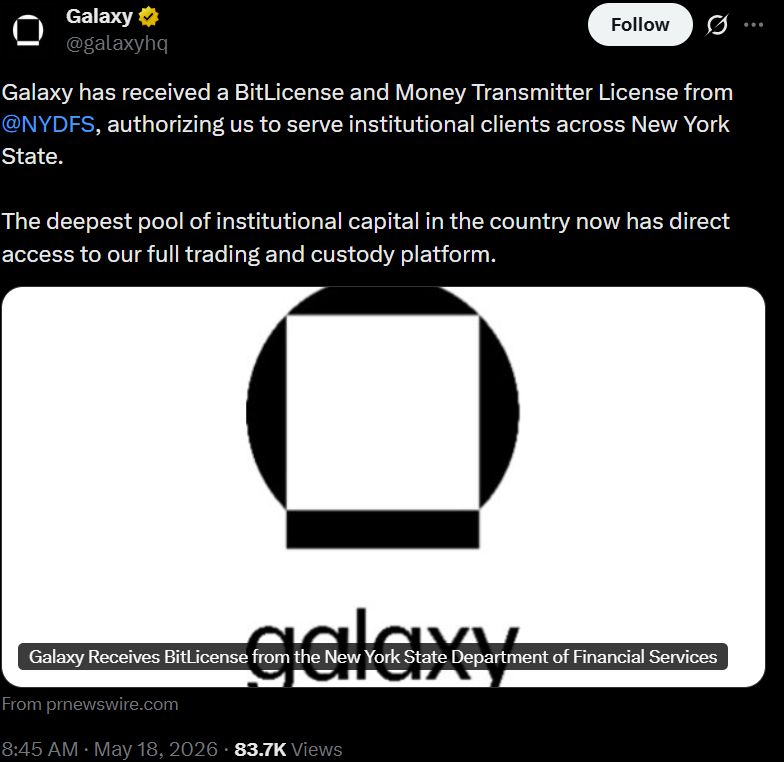
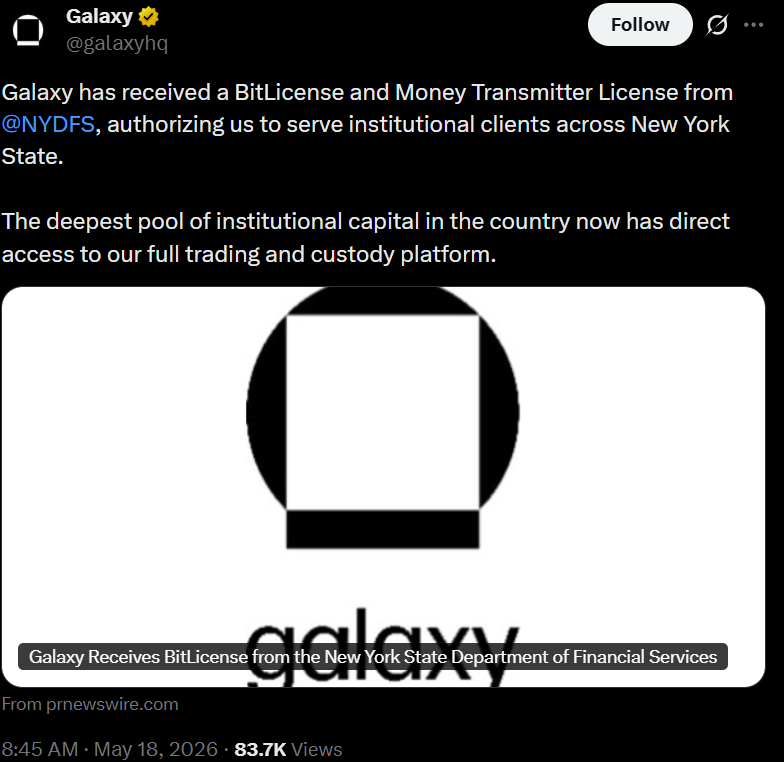
Galaxy Digital, a crypto-focused financial services company led by Mike Novogratz, has received a BitLicense and Money Transmission License from the New York State Department of Financial Services (NYDFS), allowing it to expand regulated digital asset services to institutional clients in the state.
The company said Monday that the approvals were granted to its subsidiary, GalaxyOne Prime NY, which provides trading and financing services to institutional investors.
The licenses extend Galaxy’s regulatory reach into New York, one of the most tightly regulated jurisdictions for cryptocurrency businesses in the United States.
In a statement, Novogratz said New York represents the “deepest pool of institutional capital in the country,” and that the approvals will help broaden institutional access to digital assets.
Introduced in 2015, New York’s BitLicense is widely considered one of the most difficult regulatory approvals for crypto companies to obtain because it requires extensive compliance controls related to anti-money laundering, cybersecurity, capital reserves and consumer protection.
Source: Galaxy
As Cointelegraph recently reported, Jack Mallers’ Strike was among the latest high-profile crypto companies to receive approval from the NYDFS, allowing the firm to offer Bitcoin services to residents and businesses in the state.
Related: Crypto funds see $1B in outflows as Iran tensions revive risk-off sentiment
Galaxy posts Q1 loss as data center business expands
The regulatory milestone comes as Galaxy continues to navigate a volatile digital asset market. The company last month reported a net loss of $216 million in the first quarter ended March 31, driven largely by lower digital asset prices, though the result was better than analyst expectations.
Gross revenue totaled $10.2 billion for the quarter, down from $12.9 billion in the same period a year earlier.
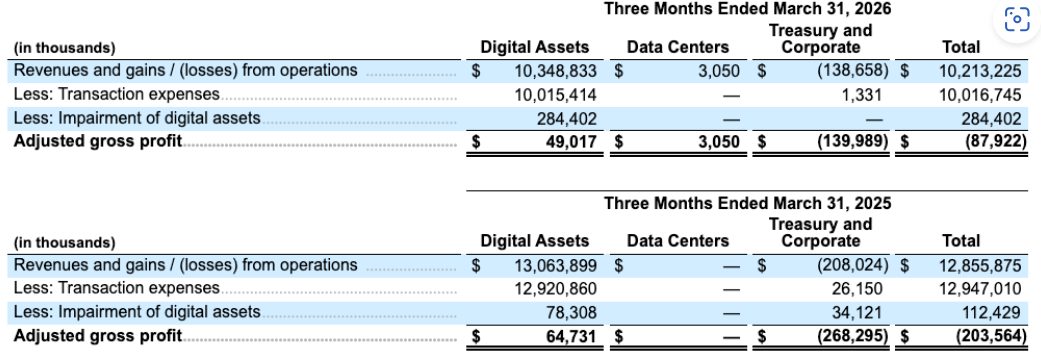
Galaxy’s Q1 2026 financial statement. Source: Galaxy
According to its Q1 earnings report, Galaxy expects growth to accelerate beginning in the current quarter as revenue from its data center business increases.
Like several other companies in the digital asset industry, Galaxy has expanded beyond cryptocurrency trading and investing into data center infrastructure. The company said future growth will be supported by its Helios Data Center campus in Texas and revenue tied to artificial intelligence and high-performance computing workloads.
Related: Galaxy, Sharplink plan $125M institutional DeFi yield fund backed by ETH treasury
Kevin Warsh is set to be sworn in as the next chair of the US Federal Reserve Board of Governors on Friday amid speculation about whether he’ll do what US President Donald Trump hopes he does: Lower interest rates once in office.
On Wednesday, the US Senate voted largely along party lines to confirm Warsh as the next Fed chair, succeeding Jerome Powell. While Trump nominated both Fed governors in different terms, the president repeatedly threatened to fire Powell in recent months, saying that the Fed chair “should be lowering interest rates.”
Source: Kalshi
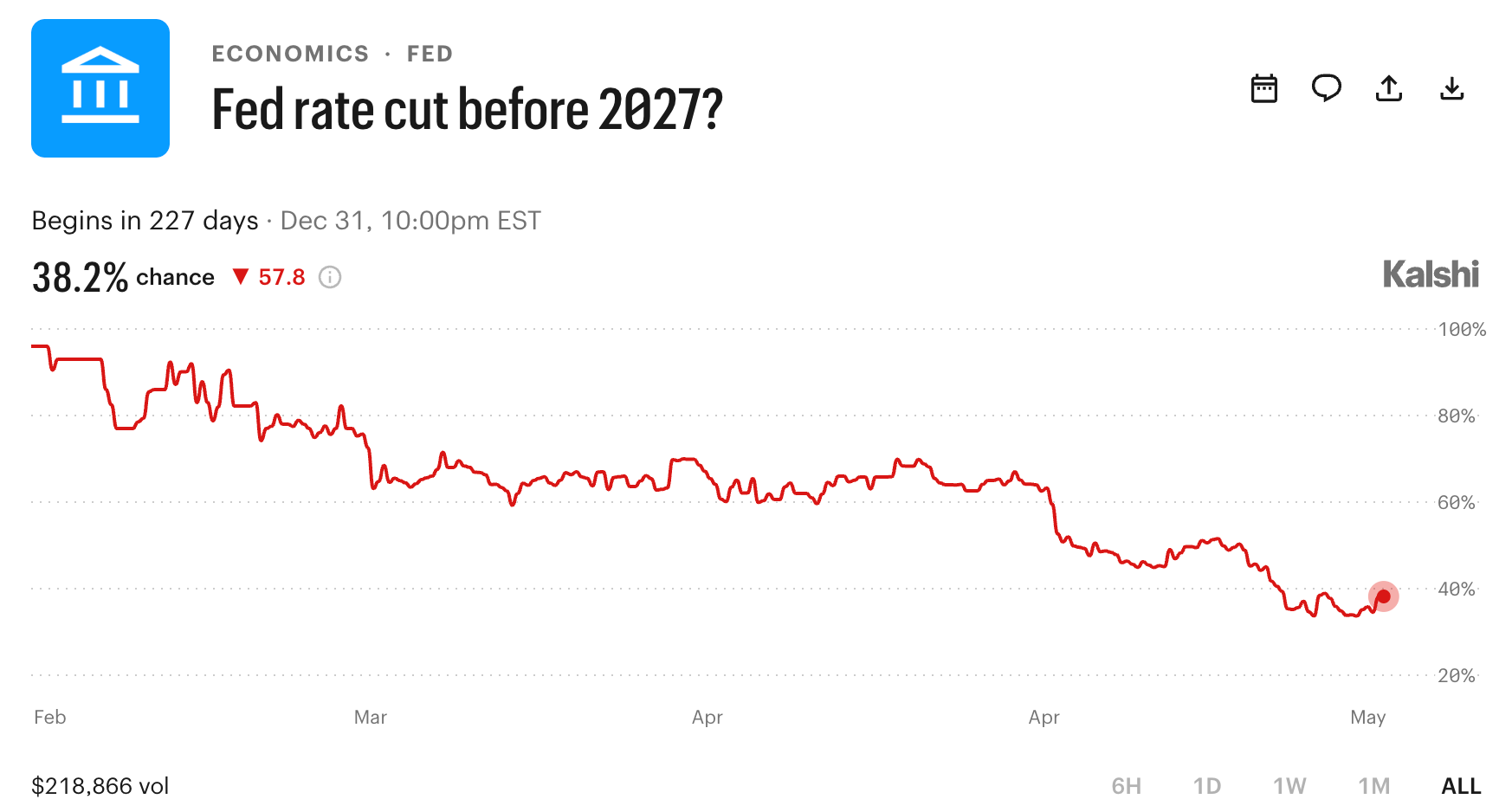
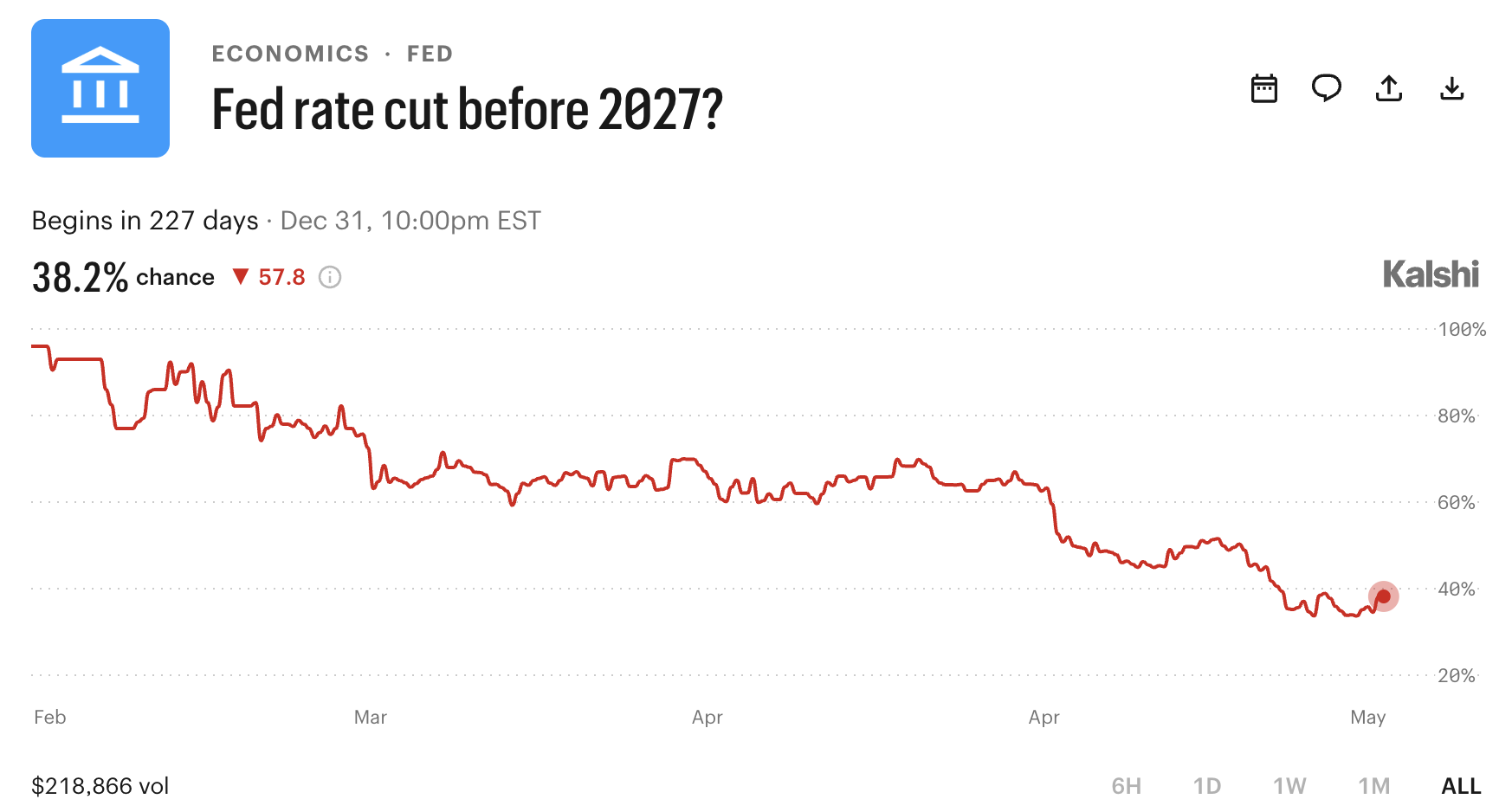
With Warsh expected to assume his role as Fed chair on Friday, prediction market platforms like Kalshi are offering users 38.2% chances on event contracts betting that the central bank will lower interest rates before 2027, dropping from 96% in February. In contrast, CME FedWatch shows a 98.8% probability that the Fed would not change its interest rates, currently at 3.50% to 3.75%, until the end of June, with a more than 94% chance of the same through July.
As Fed chair, Warsh will have significant influence in helping policy makers determine federal interest rates. With Powell, Trump repeatedly called for the Fed chair to cut rates on social media and said in April he would be disappointed if Warsh didn’t immediately move to do the same if confirmed. The next meeting of the Federal Open Market Committee, at which interest rates could be changed, is scheduled for June 16.
Related: Bitcoin, stocks risk ‘months’ of losses as Kevin Warsh Becomes Fed chair
At Warsh’s confirmation hearing in the Senate Banking Committee, Massachusetts Senator Elizabeth Warren said confirming him could result in the Fed “granting special accounts to [the Trump family’s] crypto company or bailouts to his friends on Wall Street if they get into trouble.” Warsh disclosed more than $100 million in assets ahead of the April hearing, including investments in AI and crypto companies.
US lawmakers awaiting CFTC nominations
With Warsh set to be sworn in on Friday, lawmakers are still looking to Trump to announce nominations for the US federal commodities regulator, the Commodity Futures Trading Commission (CFTC).
Since December, the CFTC has been led solely by Trump’s pick Michael Selig, who took over from acting chair Caroline Pham. The federal regulator has since taken a strong position on attempting to exclusively oversee prediction markets platforms like Kalshi and Polymarket amid US state authorities filing lawsuits against the companies over sports betting.
On Friday, the Republican and Democratic leaders of the House Committee on Agriculture called on Trump to “nominate a full panel” of CFTC commissioners, citing “urgent regulatory issues.” Specifically, the lawmakers voiced concerns about CFTC rulemaking if the Digital Asset Market Clarity Act (CLARITY), a bill to establish market structure for cryptocurrencies, became law.
Magazine: ETH stalls at $2.4K five times, SOL to rally to $120: Market Moves
Crypto World
Coinbase Lands Hyperliquid Stablecoin Role Eight Months After Governance Vote Picked Native Markets


Native Markets is selling its brand assets to Coinbase as USDC becomes the protocol’s canonical quote asset.


The Japanese bond market is facing strain not seen in decades. A renowned warns of a possible global domino effect that would impact yields, currencies and credit around the world.
In that scenario, XRP emerges as an unexpected tool to release trapped liquidity.
Why the Japanese Bond Crisis Worries the World?
The bond market is where governments and companies finance themselves by issuing debt. When yields rise, money becomes more expensive and financial stress increases across mortgages, credit and risk assets at a global level.
Japan is living a historic strain. The 30-year bond surpassed 4% for the first time since its creation in 1999, reaching levels close to 4.2% in May 2026. The 10-year bond hovers near highs not seen since the late 1990s.
Follow us on X to get the latest news as it happens
Analyst Catalina Castro raised the alarm about the situation in a post that sparked wide debate. According to her analysis, Japan, the main creditor of the United States, faces a panic scenario that could trigger massive sales of Treasury bonds.
The data backs part of her view. Japanese investors sold close to 29.6 billion dollars in US debt during the first quarter of 2026, the largest quarterly sale recorded since 2022.
The backdrop is the unwinding of the “yen carry trade.” For decades, Japan’s ultra-low rates allowed borrowing cheap yen to fund higher-yield assets. The Bank of Japan’s rate hikes are now dismantling that global flow.
“[…] Domino effect: Japan sells American bonds → American yields RISE further → mortgages rise → credit becomes more expensive → pressure on the ENTIRE American financial system. The stress on Japanese bonds BECOMES stress on American bonds. And we are already seeing it: the 30-year US Treasury bond reached 5% this week,” Castro explained on X (formerly Twitter).
How XRP Could Ease the Liquidity Strain?
The international financial system depends on nostro and vostro accounts. Banks keep prefunded funds in foreign currencies for cross-border operations, money that remains immobilized and does not circulate in the real economy.
It is estimated that between 27 and 37 trillion dollars remain parked in these accounts globally. When yields rise and money becomes more expensive, liquidity problems worsen significantly for the entire financial system.
This is where Ripple’s technology comes in. Its On-Demand Liquidity solution uses XRP as a bridge asset for real-time cross-border settlements. A bank converts local currency to XRP, transfers it and exchanges it to the destination currency in seconds.
This model eliminates the need for prefunded accounts and extensive intermediaries. According to Castro, it could release a significant portion of the trapped liquidity, redirecting it toward productive investment, loans or sovereign bond purchases.
“In theory, a bank sends its local currency, it’s converted to XRP/stablecoins/CBDCs in seconds, and then to the currency of the receiving bank. No intermediaries. No pre-funded accounts. That RELEASED liquidity can return to the productive system: to buy bonds, to lend, to invest. That’s the difference between a system that TRAPS liquidity and one that RELEASES it,” the analyst emphasized.
Ripple’s pilots show concrete results. They have demonstrated cost savings of between 40% and 70% and settlements in minutes, compared to the days required by traditional systems like SWIFT in international transfers.
Mass adoption, however, depends on pending factors. Regulatory clarity and institutional trust remain the main obstacles for this technology to scale within the traditional global financial system today.
What to Expect in the Coming Months?
The situation in Japan underlines the interconnected fragility of markets. It is not just an Asian problem, but a systemic risk that affects yields, currencies, credit and risk assets all over the world.
Investors are closely watching the next moves of the Bank of Japan. An escalation in Japanese yields or a greater repatriation of capital could intensify volatility in global markets during the coming months.
In parallel, the debate over modernizing financial infrastructures is gaining strength. Blockchain-based innovations like Ripple’s gain relevance as a path toward building a more resilient and efficient system.
Subscribe to our YouTube channel to watch leaders and journalists provide expert insights
The post Japanese Bond Crisis Triggers Global Alarm: Analyst Highlights XRP’s Key Role appeared first on BeInCrypto.

The crypto-focused financial services firm Galaxy Digital, led by Mike Novogratz, has secured both a BitLicense and a Money Transmitter License from the New York State Department of Financial Services (NYDFS) through its subsidiary GalaxyOne Prime NY. The licenses authorize Galaxy to expand regulated digital asset services for institutional clients within New York, marking a meaningful step in the company’s regulatory footprint in one of the most scrutinized crypto markets in the United States.
Galaxy said in a Monday release that approvals were granted to GalaxyOne Prime NY, which provides trading and financing services to institutional investors. Novogratz characterized New York as “the deepest pool of institutional capital in the country,” and said the approvals would broaden institutional access to digital assets. The BitLicense framework, introduced in 2015, is widely regarded as one of the most demanding regulatory regimes for crypto firms, requiring comprehensive controls across anti-money laundering, cybersecurity, capital reserves, and consumer protection.
As Cointelegraph recently reported, Strike’s NYDFS approval placed another high-profile crypto business within the state’s regulated framework, underscoring a growing emphasis on compliance and supervision in New York’s crypto ecosystem.
Key takeaways
- Galaxy Digital secures BitLicense and Money Transmitter License for GalaxyOne Prime NY, enabling regulated digital asset trading and financing services to institutional clients in New York.
- The licenses extend Galaxy’s regulatory footprint in a jurisdiction known for rigorous compliance standards, including AML/KYC, cybersecurity, capital reserves, and consumer protections.
- The development aligns with Galaxy’s broader diversification into data-center infrastructure, beyond traditional trading and investing activities.
- Galaxy reported a first-quarter net loss of $216 million with gross revenue of $10.2 billion, reflecting industry volatility, while signaling expected growth from its data-center business in the coming quarters.
- The NYDFS licensing pathway remains a critical gatekeeper for institutional participants and may influence how other crypto firms approach US market access and cross-border operations.
Regulatory milestone in a tightly regulated market
New York’s BitLicense is widely recognized as a stringent gateway to offering virtual currency services within the state. Beyond mere registration, firms must demonstrate robust compliance programs spanning anti-money laundering and cybersecurity, maintain appropriate capital reserves, and implement consumer-protection measures. The approval of GalaxyOne Prime NY signals not only a green light for Galaxy’s institutional clientele but also a benchmark for the level of oversight the firm will operate under in one of the most demanding regulatory environments in the United States.
The licensing decision reflects a broader pattern in which crypto firms seek to anchor operations in jurisdictions with clear, enforceable standards that can reassure institutions and counterparties. In New York, where financial services regulation is among the most developed in the crypto space, obtaining a BitLicense and related licenses is interpreted as a signal of legitimacy and operational readiness for high-volume, institution-grade activity.
Strategic expansion beyond trading and investing
Galaxy’s regulatory clearance comes amid a deliberate corporate strategy to broaden its asset and infrastructure footprint. In its Q1 earnings materials, Galaxy noted progress in expanding data-center capabilities as part of a planned growth axis alongside digital-asset trading and financing. The company points to its Helios Data Center campus in Texas as a key driver of future revenue, with revenue streams anticipated to be connected to artificial intelligence and high-performance computing workloads.
This shift mirrors a broader industry move where crypto firms are leveraging modern data-center capabilities to monetize energy- and compute-intensive workloads, including AI and HPC tasks, alongside traditional digital-asset activities. Galaxy has framed the data-center expansion as a means to sustain longer-term growth in a market characterized by cyclicality in asset prices and trading volumes. The company’s strategy aligns with expanding demand for regulated, institution-ready operational capabilities that can support both digital-asset markets and enterprise-grade compute workloads.
In a separate context, Galaxy has been involved in collaboration and product development that signals continued diversification beyond trading and custody. The company’s broader ecosystem includes institutional yield initiatives and DeFi-related offerings backed by crypto assets, demonstrating a deliberate attempt to diversify revenue streams and reduce reliance on price-driven trading performance.
Financial performance and forward-looking outlook
Galaxy’s first-quarter results highlighted the ongoing volatility in the digital-asset sector. The firm reported a net loss of $216 million for the quarter ended March 31, with gross revenue totaling $10.2 billion, down from $12.9 billion in the prior-year period. The quarterly results underscored the sensitivity of the business to crypto price cycles and market conditions, even as the firm pursued diversification into data-center infrastructure and related compute workloads.
Management indicated that growth momentum is expected to materialize as the data-center segment scales, with the Helios campus in Texas positioned to contribute meaningfully to revenue in the current and upcoming quarters. The company’s outlook suggests a bifurcated path: continued volatility in core crypto markets paired with the potential uplift from infrastructure-driven revenue streams, including AI- and HPC-related workloads. Investors and analysts will be watching how regulatory clarity and the broader policy environment influence Galaxy’s ability to monetize its data-center assets and any associated institutional offerings.
Notably, the regulatory environment in the United States remains a central factor for institutional players seeking to engage in regulated digital-asset activity. The NYDFS licensing pathway is often cited as a practical barrier to entry—one that can deter less prepared operators while signaling to counterparties that a firm has instituted robust compliance and governance frameworks. In this context, Galaxy’s approvals may facilitate more structured, compliant access for NY-based institutions seeking exposure to regulated digital-asset services, while potentially shaping competitive dynamics among large-cap players pursuing U.S. market access.
Beyond domestic licensing, observers note the broader regulatory discourse surrounding crypto assets in North America and Europe. While MiCA and other EU frameworks aim to standardize operations across member states, U.S. policy remains fragmented across federal and state levels. The industry’s emphasis on licensing, supervision, and consumer protections persists, with NYDFS serving as a prominent reference point for what constitutes enterprise-grade compliance in a regulated market environment.
According to Galaxy, the licensing milestone is a step toward deeper institutional participation in regulated digital assets, aligning with a broader industry push to ensure that market infrastructure keeps pace with demand from banks, asset managers, and other regulated entities seeking compliant exposure to crypto assets.
Closing perspective: the path ahead for Galaxy and its peers will hinge on the evolution of the regulatory regime, the pace of data-center-driven revenue growth, and the ability to maintain robust risk controls across trading, financing, and compute-intensive operations. As the market navigates ongoing cycles of volatility and policy developments, institutional-grade readiness and disciplined execution in both digital-asset and infrastructure lines will be decisive in determining long-term resilience and growth.


Shiba Inu saw billions of SHIB hit exchanges on May 18 as crypto market liquidations accelerated.
Summary
- Over 3 billion SHIB tokens were pushed onto exchanges on May 18, raising sell-side pressure as broader crypto market liquidations accelerated.
- CoinGlass data shows SHIB open interest at $61.2 million with $42,485 in futures positions liquidated in the 24-hour session ending May 18.
- SHIB was trading at $0.00000567 on May 18, down roughly 10% on the week and 54% over the past year.
On-chain exchange flow data tracked by CoinGlass shows SHIB open interest at $61.2 million on May 18, with $42,485 in futures positions liquidated in the 24-hour session. The inflow spike coincided with wider crypto market liquidations as leveraged long positions were unwound across multiple assets.
SHIB was trading at $0.00000567 at time of writing, down roughly 10% on the week. The token is 54% lower over the past 12 months and well below its all-time high of $0.00008616.
Exchange reserve data showed assets on Binance alone reaching 61.8 trillion tokens, a marked rise since March as profit-takers moved holdings onto platforms ahead of potential distribution.
Shiba Inu inflows signal rising sell pressure
Tokens moved onto exchanges are one step from the open market and available for immediate liquidation. The spike in SHIB inflows creates a mechanical increase in available sell-side supply, which typically suppresses price during periods of weak demand.
As crypto.news reported, institutional and whale-level SHIB transactions surged 111% earlier in 2026, indicating large holders are actively repositioning rather than holding passively.
Meme coins have faced persistent pressure throughout 2026. Bitcoin’s 22% decline in Q1 tightened conditions across speculative assets, with SHIB bearing the brunt alongside other high-beta tokens. The token’s 589 trillion circulating supply gives it limited leverage from burn activity, as individual whale distribution events can rapidly absorb months of supply reduction.
What SHIB needs to stabilise
Stabilisation requires demand to absorb incoming supply rather than sellers finding a thin order book. As crypto.news noted in its Shibarium upgrade analysis, on-chain adoption remains uneven and without acceleration in utility metrics, upside moves in SHIB continue to struggle.
A Fully Homomorphic Encryption upgrade planned for Q2 2026 through cryptography firm Zama could add a privacy dimension, but near-term price action depends on whether these exchange inflows reverse.
The broader context for meme coin behaviour in 2026 was covered by crypto.news in its analysis of how on-chain activity spikes often precede continued downside rather than reversals.


Aave has restored WETH loan-to-value ratios on Ethereum, Arbitrum, Base, Mantle, and Linea, re-enabling borrowing against the asset following a technical incident.
Crypto World
Digital Assets Security: BitGo Expert Outlines How Businesses Can Enter the Space Safely

TLDR:
- BitGo’s Deputy CISO says businesses must prioritize custody decisions before selecting any digital asset tools or wallets.
- Hot and cold wallet choices should align with a company’s liquidity needs and intended digital asset usage profiles.
- Governance frameworks covering people, process, and technology must be in place before any transactions begin.
- Business model alignment, not trend-chasing, should drive every company’s digital asset architecture and strategy decisions.
Digital assets security remains a top priority as businesses accelerate their move into the digital asset economy. BitGo Deputy CISO Manny Khan has outlined a structured approach for companies entering this space.
Writing in Forbes, Khan argues that businesses often get the process backwards. Most organizations start with tools rather than building the right foundation.
His framework centers on custody, governance, and architecture decisions tailored to each business model.
Custody and Wallet Architecture Must Come Before Anything Else
Custody is the first decision any business should make before entering the digital asset space. Khan stresses that organizations must honestly assess whether they are ready to hold digital assets internally.
Handing this responsibility to an IT team without proper preparation can lead to irreversible losses. History has shown that preventable mistakes in this area carry serious consequences.
For businesses handling meaningful value, partnering with a regulated, institutional-grade provider may be more appropriate. This does not mean all companies should follow the same path.
Each organization must weigh its internal maturity against external options realistically. Security and control are not mutually exclusive, but achieving both requires the right fiduciary relationships.
Wallet architecture decisions should also be driven by purpose, not convention. Hot wallets suit speed and operational availability, while cold wallets prioritize long-term asset protection.
Neither option is universally superior to the other. The right choice depends entirely on liquidity needs and intended usage.
Multi-sig and MPC technologies also carry real operational consequences. They affect accountability, transparency, and resilience across the organization.
Companies should categorize digital assets by usage and liquidity profiles. Forcing all use cases into one mold typically increases risk rather than reducing it.
Governance Frameworks and Business Model Alignment Drive Long-Term Success
Governance must be established before a company begins transacting in digital assets. Khan’s framework covers people, process, and technology, with disciplined vigilance at the center.
Teams need a clear understanding of the stakes involved at every level. Processes must define approvals, controls, and accountability from the start.
As Khan noted via BitGo’s official post: “Most businesses are approaching it backwards, starting with tools instead of building the right foundation first.” Digital asset readiness requires compliance, security, finance, and operational controls working together.
Treating it as a simple infrastructure project misses the real challenge entirely. Silos between departments create misalignment and increase exposure.
Business model alignment is equally critical when developing a digital asset strategy. A trading firm has different liquidity needs than a corporate treasury function.
A fintech business requires secure API integration, while a B2B2B provider may need shared-control models. Architecture decisions should always work backward from the customer profile and operating model.
Not every company requires the same level of urgency in adopting digital assets. Businesses operating locally or within narrow geographic footprints may not need immediate action.
However, cross-border activity and settlement friction are pushing global companies in this direction. Leaders must approach this space with clear eyes, sound controls, and architectures that fit their specific business.

Key takeaways:
- Aggressive Bitcoin buying by Strategy helped to offset the recent leveraged long liquidations.
- Rising bond yields and a heavy US government debt burden are driving investors toward scarce assets.
- A potential deal between the US and Iran could quickly restore traders’ risk appetite.
Bitcoin (BTC) faced a rejection following a failed attempt to break above $82,000 on Thursday. A subsequent retest of the $76,000 level on Monday triggered $400 million in liquidations for bullish Bitcoin positions over a four-day period. While traders’ confidence took a hit from the 7% price decline, the prospects for recovering the $80,000 mark remain valid.
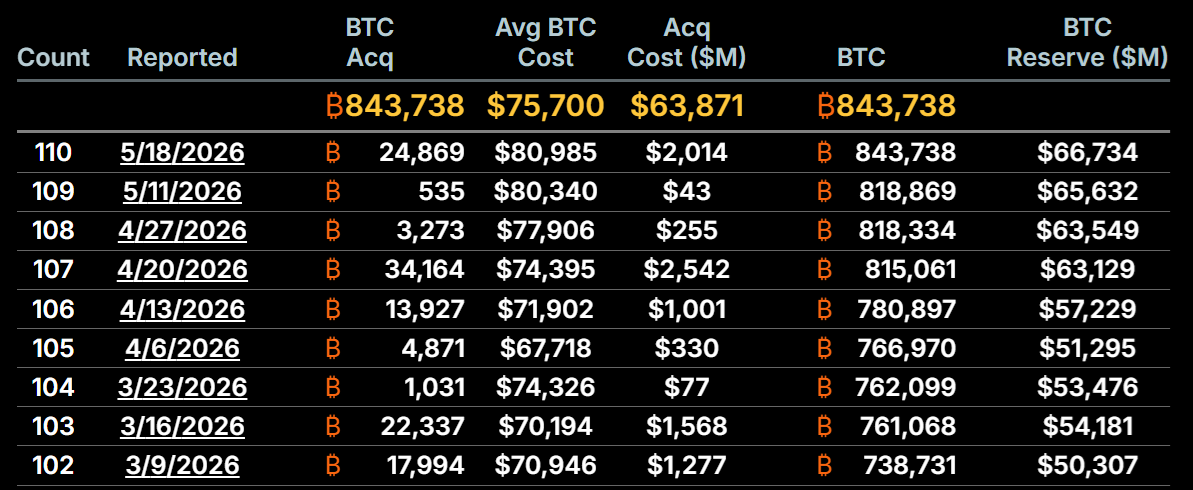
Bitcoin reserve accumulation by Strategy (MSTR US). Source: Strategy
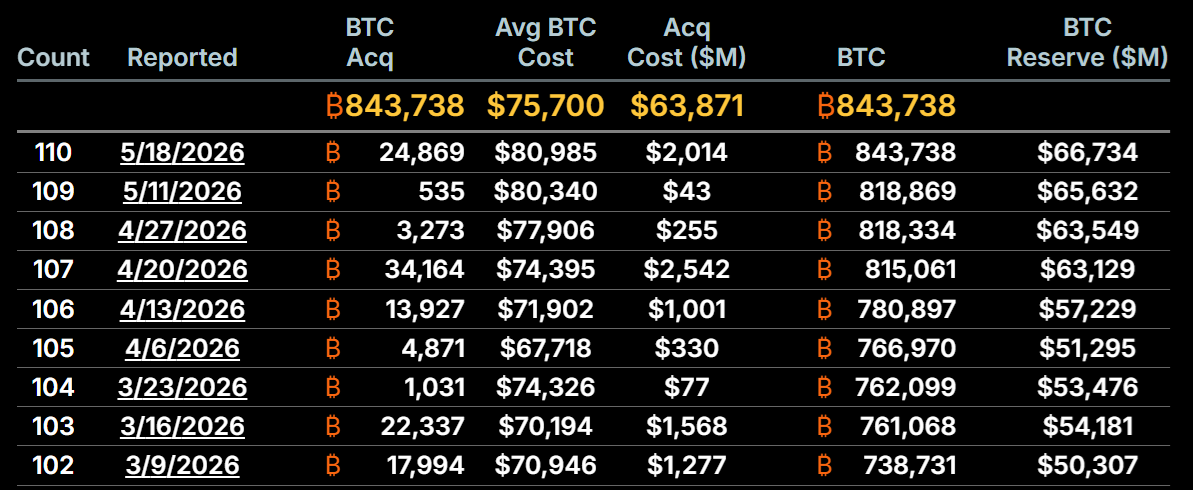
US-listed Strategy (MSTR US) completed the acquisition of $2 billion in BTC over the past week alone. Spearheaded by Michael Saylor, the company continues to surprise investors by finding innovative ways to reduce the cost of capital and raise cash through equity issuance, whether via MSTR common stock or STRC preferred equity.
More importantly, Strategy proved the company can also capitalize on a weaker market by repurchasing $1.5 billion of its debt due in 2029. Retiring some of its senior convertible notes reduces potential future dilution for current MSTR holders. This move clears the runway for new share issuance and additional Bitcoin purchases.
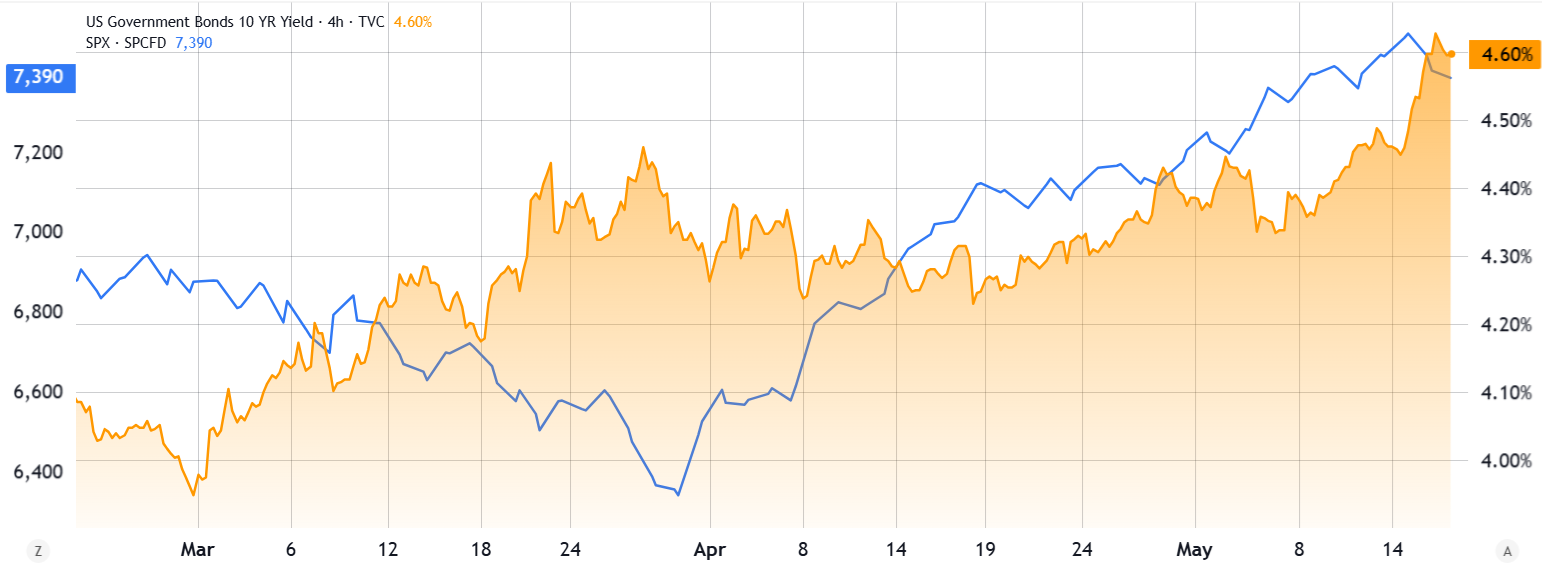
S&P 500 index (left) vs. US 10-year Treasury yield (right). Source: TradingView
From a macroeconomic perspective, the odds of a sustainable bullish momentum for Bitcoin improved as traders demanded higher returns to hold government bonds. Yields on the 10-year Treasury jumped to 4.60%, hitting their highest level in 16 months. Investors are gradually realizing the heavy burden on the US Treasury, especially with $2 trillion in long-term debt maturing in 2026.
US dollar weakness and a potential deal with Iran
The US Federal Reserve will likely need to continue accumulating bonds and Treasurys, a move that potentially weakens the US dollar. Typically, investors seek shelter in scarce assets when they lose confidence in the central bank’s ability to navigate a crisis without devaluing the currency. Even if gold acts as the primary beneficiary, the incentive to hold fixed-income assets drops significantly.
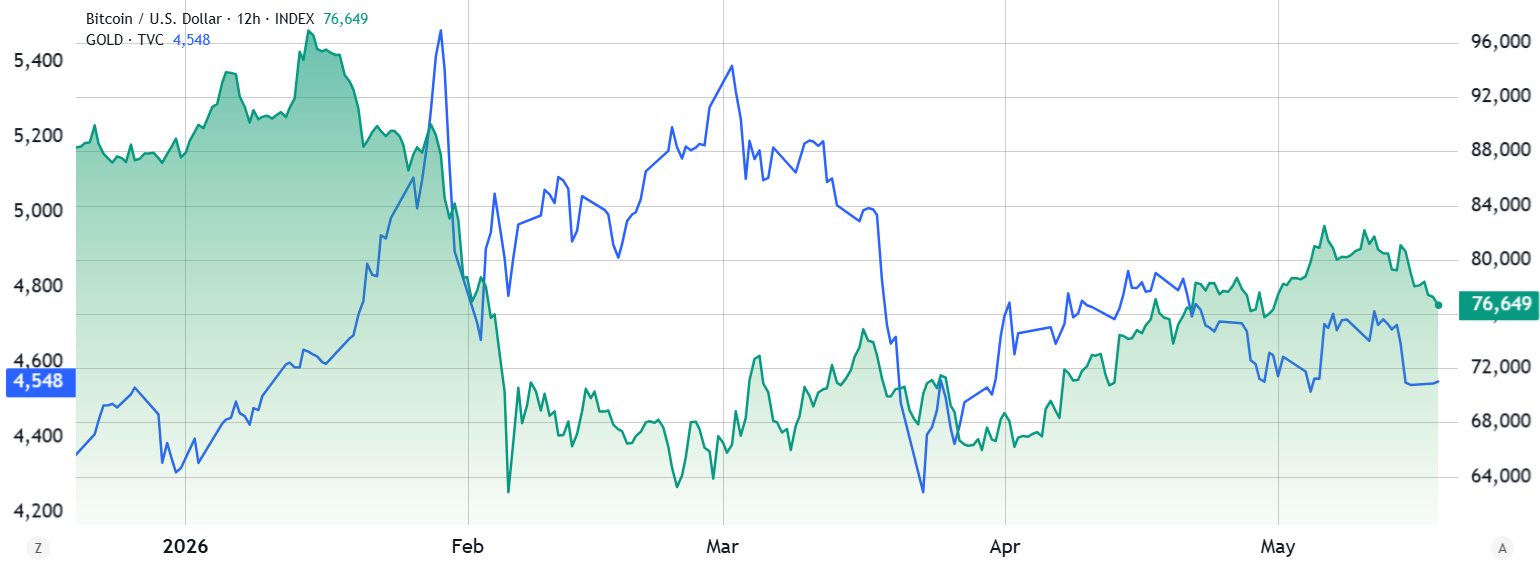
Gold/USD (left) vs. Bitcoin/USD (right). Source: TradingView
Gold prices surged in January after the US captured Venezuelan President Nicolas Maduro and President Trump’s global trade war escalated. However, gold retraced most of those gains over the next four months, while Bitcoin built strong bullish momentum, jumping to $76,500 from $65,000 in late February. These recent price moves hint at growing confidence in Bitcoin as a reliable hedge instrument.
Related: Analysts debate whether Bitcoin is in ‘sell in May’ bear market setup
Crude Brent oil prices jumped to $113 on Monday as negotiations to fully reopen the Strait of Hormuz backpedaled. Oil prices have surged more than 50% since the US and Israel attacked Iran in late February. President Trump’s administration also decided not to renew a waiver for Russian crude oil, further squeezing supply, according to Yahoo Finance.
A deal between the US and Iran, while not the baseline scenario, could trigger renewed risk appetite and catapult the Bitcoin price back above $80,000. Inflation has been pinned down by high energy prices, limiting the odds of expansionary monetary policies. Even so, the odds favor Bitcoin, as the US stock market is hovering near its all-time high while the cryptocurrency still sits 39% below its peak.
Crypto World
Hyperliquid's HYPE Token Rallies 7% as Trade.xyz Launches First Pre-IPO Perpetual Market for SpaceX


HYPE token gained 7% over 24 hours following the launch of a synthetic SpaceX pre-IPO perpetual contract on Hyperliquid, valuing the private aerospace company at $1.78 trillion.

Police to be given funding boost in crackdown and raids on ‘dodgy’ shops across region

Five dead, including two suspects, after shooting at San Diego mosque

Galaxy Wins New York BitLicense for Institutional Crypto Services

Manchester United reach agreement with Casemiro over contract clause amid transfer speculation

US brings back mandatory military draft registration

Steven Gerrard disagrees with Gary Neville over ‘shock’ Chelsea and Arsenal claim | Football

NO WAY! XRP, XLM AND HBAR ARE ABOUT TO BE ADOPTED! PAUL ATKINS JUST CONFIRMED IT!

India’s GDP Growth Under Every Prime Minister#wariko#financial development#finance

The Global Monetary Reset Is Here; EVERYTHING You Need To Know
-

 Crypto World3 days ago
BloFin War of Whales 2026 Grand Prix opens registration for $5M trading championship
-

 Fashion3 days ago
Weekend Open Thread: Theory – Corporette.com
-

 Crypto World3 days ago
E-Estate Announces 1 Year Live: Washington DC Summit as Real Estate Tokenization Enters Its Next Phase
-

 Tech4 days ago
Tech Moves: Microsoft AI leader jumps to OpenAI; former AI2 exec joins Meta; and more
-
Crypto World6 days ago
Bitcoin Suisse expands with Digital Asset License and Investment Business Act Registration Approval in Bermuda
-

 Politics6 days ago
Pakistan to enter Chinese capital market as war inflation bites
-

 Crypto World6 days ago
Bitcoin Suisse expands with Digital Asset License and Investment Business Act Registration Approval in Bermuda
-
 Crypto World4 days ago
Google’s Gemini AI Predicts Incredible Solana Price by the End of 2026
-

 Business3 days ago
H&R Real Estate Investment Trust (HR.UN:CA) Q1 2026 Earnings Call Transcript
-

 Tech3 days ago
Google reimburses Register sources who were victims of API fraud
-

 Sports3 days ago
Napoleonic enters 2026 Doomben 10,000 field via Abounding withdrawal
-

 NewsBeat6 days ago
Comment on Keir Starmer surviving the day as Prime Minister like a turd that wont flush
-

 Politics7 days ago
The Board of Deputies just smeared Polanski to suck up to Farage
-

 Fashion6 days ago
The Best-Kept Makeup Secret for a More Defined Face
-
 Entertainment4 days ago
Zara Larsson Has Blunt Response To Chris Brown Diss
-

 Politics6 days ago
The Trial of Majid Freeman, Verdict
-
 Tech6 days ago
Why AI is making typography a boardroom conversation
-

 Politics6 days ago
Palestine’s flag becoming a regular sight at European football stadiums
-

 Crypto World6 days ago
Senate Approves Kevin Warsh to Federal Reserve Board Seat
-
 Crypto World5 days ago
Two AI Tokens Lead May Rally, But Risks Are Rising
You must be logged in to post a comment Login