

Crypto World
BeInCrypto Institutional Research: 10 Chain Foundation Programs Driving Web3 Ecosystem Development



Best Web3 Ecosystem Development Program is a category within the BeInCrypto Institutional 100, an annual research-driven program recognising institutional digital asset excellence across 26 categories and six pillars.
This category sits under Pillar 6: Tokenization & Enterprise Blockchain. The 10 programs below are listed alphabetically by parent chain and are not ranked. A shortlist will be named in May 2026, with the winner announced at Proof of Talk in Paris on June 2–3, 2026.
Key Facts
- Long list: 10 named programs across grants, accelerators, hackathons, retroactive funding, gas rebates, incubators, AI-focused programs, and strategic ecosystem funds
- Initial pool: More than 25 chain-foundation programs screened; 10 advanced to the long list
- Order: Listed alphabetically by parent chain, not ranked
- Scoring: 30% quantitative data · 50% Expert Council · 20% disclosed company data
- Criteria assessed: Capital deployed, graduate impact, institutional focus, program quality, ecosystem growth, transparency
- Boundary scope: This category evaluates a specific named program, not the underlying chain or the chain’s wider ecosystem
| Program | Parent Chain | Program Scale & Structure | Representative Outcomes |
|---|---|---|---|
| Aptos $50M Markets and Machines Commitment | Aptos Run by Aptos Foundation and Aptos Labs |
Announced May 7, 2026 $50M+ strategic capital commitment across on-chain markets, protocol infrastructure, research, AI agents, and trading partners |
Decibel surpassed $1B cumulative volume after Feb 2026 mainnet launch Shelby supports AI-agent workloads through hot storage and licensed dataset exchange |
| Arbitrum Trailblazer AI Grant Program + Trailblazer 2.0 | Arbitrum Run by Arbitrum Foundation |
Trailblazer AI launched Nov 2024; Trailblazer 2.0 launched Jun 2025 $2M total budget across immediate grants and Vibekit-based agentic DeFi tooling |
Onboarded AI projects including Allora, ARC Agents, Eternal AI, Hyperbolic, Ora, and Eliza Vibekit launched with integrations for Pendle, GMX, Aave, and Camelot |
| Avalanche Retro9000 Retroactive Grants Program | Avalanche Run by Avalanche Foundation |
Launched Nov 2024 Up to $40M in retroactive grants plus $2M referral pool, with quarterly snapshots and C-Chain fee-based grant rounds |
Cohort 1 funded 19 grantees with more than $1M Cohort 2 funded 8 grantees; Cohort 3 funded 4 grantees, including infrastructure and app builders |
| Ethereum ESP New Grants Program | Ethereum Run by Ethereum Foundation Ecosystem Support Program |
Relaunched Nov 3, 2025 after redesign pause Dual-track Wishlist and RFP model focused on cryptography, privacy, application-layer development, security, and community growth |
ESP database includes 1,039 funded projects since 2024 2025 Academic Grants Round expanded to $2M, alongside Office Hours and new grant tooling teams |
| Hedera Crypto Economy Fund + Thrive 2025 Grants + Verifiable AI Tooling | Hedera Run by Hedera Foundation |
Crypto Economy Fund ongoing since 2022; Thrive 2025 grants launched in 2025 Multi-track structure across community innovation, enterprise grants, academic research, AI, tokenization, identity, and RWAs |
AI Studio and Verifiable Compute launched with EQTY Lab, NVIDIA Blackwell, Accenture Public Sector, and SCAN UK Hedera donated its codebase to Linux Foundation Decentralized Trust as Project Hiero |
| NEAR AI x HZN Incubation Program + NEAR AI Agent Fund | NEAR Run by NEAR Foundation and NEAR.AI |
Incubator launched May/Jun 2024 with follow-on phases through May 2025 $100K NEAR investment per team, up to $250K from Delphi Labs, $50K Aethir credits, and $20M AI Agent Fund |
Initial cohort funded Mizu, Pond, Nevermined, Hyperbolic, Ringfence, and Exabits Hyperbolic raised $7M seed; Mizu launched beta with 20K users in its first week |
| Polygon AggLayer Breakout Program | Polygon Run by Polygon Foundation and Polygon Labs |
Launched Apr 24, 2025 Structured incubator-to-graduation program for projects building around AggLayer, with 5–15% token airdrops to POL stakers |
Privado ID graduated after testing with HSBC and Deutsche Bank Miden raised $25M seed; Katana became an AggLayer CDK chain with VaultBridge |
| Solana Frontier Hackathon 2026 + Colosseum Accelerator Series | Solana Run by Solana Foundation and Colosseum |
Frontier ran Apr 6–May 11, 2026 Colosseum deploys more than $2.5M into select winners; up to 10 teams enter accelerator with $250K pre-seed funding |
Breakout Hackathon drew 10,000+ participants from 140+ countries and 1,412 final projects Colosseum alumni have raised more than $650M in venture capital |
| Starknet Propulsion v2 Program | Starknet Run by Starknet Foundation |
Original pilot launched May 2024; Propulsion v2 live Nov 27, 2025 Up to $1M per project in STRK, with gas-rebate funding tied to demonstrated user adoption |
Starknet user-centric projects grew from 72 to 193 between Nov 2023 and Nov 2024 Notable v2 participants include Ready, Focus Tree, AVNU, Endur, Ekubo, and Cartridge |
| Sui Foundation Ecosystem Development Program | Sui Run by Sui Foundation |
$50M new grants announced Feb 2026 Multi-track structure across RFP grants, flash RFPs, research awards, Hydropower accelerator, Sui Overflow, and DeFi ecosystem funding |
Sui Overflow 2025 drew 352 project submissions Monthly active developers reached 1,300 in Q1 2026, while Sui recorded $111B stablecoin volume in Jan 2026 |
About This List
The BeInCrypto Institutional 100 — Best Web3 Ecosystem Development Program (2026 Long List) identifies specific named programs run by chain foundations to grow Web3 ecosystems. These include strategic capital commitments, AI-focused grant programs, retroactive funding, RFP models, enterprise-backed foundation grants, incubators, hackathon-to-accelerator pipelines, gas-rebate mechanisms, and vertical-specific ecosystem funds.
The category evaluates the program itself. The underlying chain is evaluated separately under Category 6.2: Best Blockchain Infrastructure. Enterprise blockchain implementations built on these chains are evaluated under Category 6.1: Best Institutional Enterprise Blockchain Implementation. Pure-capital VC programs operated by venture firms are routed to fund-manager categories.
Methodology
This category is evaluated under Track B of the BeInCrypto Institutional 100 methodology: 30% quantitative metrics, 50% Expert Council scoring, and 20% disclosed company data.
Assessment spans six criteria: capital deployed through the program, portfolio impact of graduates, institutional focus, program quality and structure, ecosystem growth attributable to the program, and transparency.
The disclosed data weighting reflects the limited public visibility into foundation grant economics, including capital actually deployed versus committed, post-grant portfolio performance, and graduate retention.
Data was verified using foundation press releases, official program pages, on-chain ecosystem metrics, portfolio-company funding announcements, relevant regulator filings, audited ETF disclosures, Linux Foundation Decentralized Trust filings, and mainstream financial press.
The post BeInCrypto Institutional Research: 10 Chain Foundation Programs Driving Web3 Ecosystem Development appeared first on BeInCrypto.


Key Highlights
- Kraken is pursuing comprehensive banking authorization in Europe, with Lithuania identified as the target jurisdiction
- Success would make Kraken the sole cryptocurrency exchange holding a European banking license
- The strategy mirrors the approach taken by Revolut, which secured licensing from Lithuania’s banking regulator in 2018
- The exchange currently operates with MiCA credentials via Ireland and holds a MiFID license through Cyprus
- In early 2026, Kraken Financial achieved a milestone by becoming the first cryptocurrency company to connect with the Federal Reserve’s payment systems
Kraken, a leading global cryptocurrency exchange, is actively pursuing full banking authorization within Europe. According to sources with knowledge of the matter, the platform has set its sights on Lithuania as the preferred location for this regulatory milestone.
When approached for comment, Kraken representatives declined to provide details. The Bank of Lithuania confirmed that all licensing procedures for financial institutions remain confidential under current regulations.
Should the application succeed, Kraken would break new ground as the inaugural crypto exchange to secure comprehensive banking authorization in Europe. This designation would enable the platform to provide services including checking accounts, consumer credit products, and enhanced payment capabilities throughout the European Economic Area.
The regulatory strategy Kraken is pursuing follows an established precedent. Revolut, the digital banking platform, successfully obtained specialized banking credentials from Lithuanian regulators in 2018. That authorization enabled Revolut to broaden its financial service offerings across the EEA. Lithuania has also granted banking or specialized banking licenses to institutions such as Mano Bank, PayRay, and EMBank.
European Regulatory Framework Already Established
Kraken maintains MiCA authorization issued through Ireland’s Central Bank. Additionally, the exchange operates under a MiFID license granted by Cypriot authorities. These regulatory frameworks enable the platform to deliver compliant services to customers throughout the European Union.
MiCA regulations became enforceable EU-wide on July 1, 2026. Kraken has leveraged its existing authorizations to establish itself as a compliant operator for European customers under the updated regulatory environment.
Securing banking authorization would represent a significant advancement. It would enable Kraken to integrate cryptocurrency operations more seamlessly with conventional financial infrastructure, encompassing payment processing, asset custody, and institutional-grade services.
Constructing a Worldwide Regulatory Infrastructure
The European banking initiative represents one component of a broader licensing approach by Payward, Kraken’s corporate parent.
In March 2026, Kraken Financial achieved a significant first by obtaining access to the Federal Reserve’s fundamental payment systems. This development granted its US banking division direct connectivity to Fedwire for specific operational functions.
In May 2026, Payward obtained VARA authorization in the United Arab Emirates, incorporating another regulated jurisdiction into its operational framework.
Kraken co-CEO Arjun Sethi addressed attendees at Money 2020 Europe and detailed the company’s strategic vision. He indicated that the organization’s ten-year roadmap involves securing regulatory licenses across all major regions, either through acquisition of established entities or building operations from the ground up.
Kraken is additionally preparing for a public listing in the United States, creating additional incentive to establish a robust regulatory compliance record across key international markets.
The Lithuanian banking license, if obtained, would constitute one of the most significant achievements in this regulatory expansion. It would provide Kraken with direct access to traditional European banking infrastructure and position the exchange ahead of competitors regarding regulatory breadth.
Neither an application timeline nor anticipated approval date has been publicly disclosed.

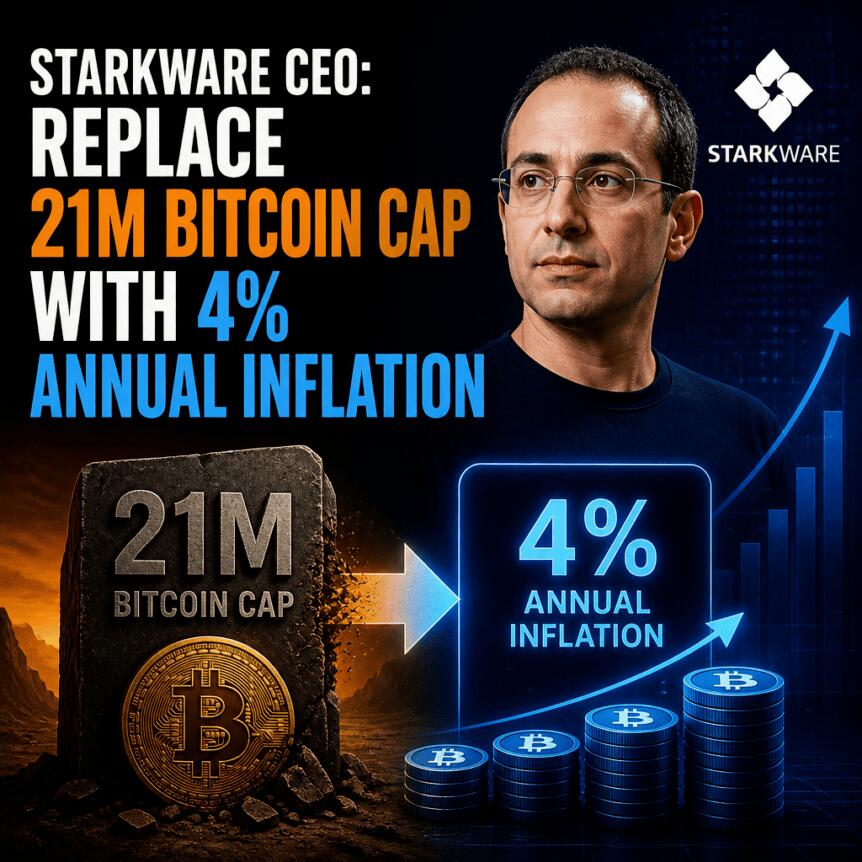
StarkWare CEO Eli Ben-Sasson has reignited a long-running Bitcoin debate by arguing that the network’s fixed 21 million coin cap “doesn’t make sense” and should be replaced with a steady 4% annual issuance model. His position challenges a foundational pillar of Bitcoin’s monetary narrative: that a hard supply limit protects the asset from monetary debasement and preserves purchasing power over time.
In a post on X Tuesday, Ben-Sasson said the cap becomes less meaningful as time passes because private keys are lost, eventually leaving holders unable to access their coins. He linked that concern to the idea that, as the timeline approaches infinity, the usable supply trends toward zero—an argument that directly contrasts with the traditional “digital gold” framing of Bitcoin’s capped issuance. Source: Eli Ben-Sasson on X
Key takeaways
- Ben-Sasson argues Bitcoin’s 21 million cap is undermined over long time horizons by lost private keys.
- He suggested replacing the fixed cap with an issuance rate of about 4% per year, while still maintaining a form of long-term scarcity.
- Ledger has previously estimated that millions of Bitcoin may already be permanently lost, feeding into the “lost keys” argument.
- Critics on X say Bitcoin’s divisibility and fixed supply mechanics still address “not enough to go around,” and that changing the cap would make Bitcoin more like other cryptocurrencies.
- A potential workaround discussed in the Zcash ecosystem—burning with periodic reissuance—highlights how miner economics could be addressed without removing a hard cap, but it would still require broad Bitcoin consensus.
Why Ben-Sasson thinks the cap will fail over time
Ben-Sasson’s core claim is not simply that Bitcoin supply will be inadequate, but that the economic effect of a cap is eroded if a growing share of coins become inaccessible. He pointed to the long-run reality that private keys can be lost, making coins effectively unrecoverable.
To anchor that idea in publicly available estimates, the proposal also echoes figures cited by Ledger. In November, Ledger estimated that up to 4 million Bitcoin have been burned or permanently lost. Ledger estimate (via Ledger Academy)
Ben-Sasson said he still supports a hard upper bound on supply. But rather than relying on a one-time fixed limit, he argued that a consistent 4% annual issuance rate better matches real-world population growth—an analogy meant to address whether Bitcoin’s supply schedule remains economically aligned as adoption expands.
Bitcoin maximalists push back: scarcity, divisibility, and “lost keys”
Ben-Sasson’s proposal met quick and pointed criticism from the Bitcoin community on X. One user challenged the premise that Bitcoin would run out “to go around,” citing Bitcoin’s divisibility into 2.1 quadrillion satoshis (the smallest base unit). Source: X user response
Ben-Sasson replied that satoshis are not a permanent solution if private keys continue to be lost. In his view, even though Bitcoin is divisible, the accessible balance still trends toward zero over time as keys go missing. Source: Ben-Sasson follow-up on X
Other opponents framed the debate around identity: lifting the fixed cap, they argued, would move Bitcoin toward the behavior of other cryptocurrencies that issue supply through inflation. Ben-Sasson countered that Bitcoin would retain scarcity as long as the inflation rate stayed fixed. Source: X user response
The clash reflects a deeper asymmetry in how people interpret Bitcoin’s supply mechanics. For many Bitcoiners, lost keys can be viewed as a feature rather than a flaw: if coins are permanently inaccessible, they effectively reduce circulating supply and reinforce supply-demand dynamics. A prominent example is Michael Saylor, who has said he plans to burn his Bitcoin private keys after his death as a “pro-rata contribution” to other holders—an act intended to make other coins scarcer by reducing the amount of reachable supply.
Looking for a middle path: Zcash’s approach to cap sustainability
As the debate intensified, Zcash founder Bryce “Zooko” Wilcox suggested Bitcoin developers look at a proposal being discussed in the Zcash ecosystem. Zcash also has a fixed supply cap set at 21 million ZEC, and Wilcox argued that Bitcoin could study how Zcash addresses miner incentives without removing its hard limit. Source: Zooko on X
The proposal Wilcox referenced is the “Network Sustainability Mechanism.” Its design aims to keep ZEC’s 21 million cap intact by allowing users to burn tokens, which are then reissued gradually as block rewards over a four-year period. The intent is to relieve pressure on miner incentives without changing the hard supply cap.
While the concept is attractive in theory—seeking to balance network security incentives with a capped supply—Bitcoin would face a different practical environment. Implementing a protocol-level mechanism would require agreement across Bitcoin’s decentralized ecosystem, including developers, miners, and node operators. That coordination challenge is a major reason Bitcoin’s core monetary rules have historically been difficult to change even when a proposal is technically feasible.
What this debate means for Bitcoin’s future trajectory
Ben-Sasson’s argument is likely to keep circulating precisely because it targets a common point of tension: the difference between theoretical supply and economically usable supply over very long time horizons. The discussion also highlights that “hard cap” supporters and critics may not be speaking about the same problem. One side focuses on monetary predictability and the protection against debasement; the other side emphasizes that lost keys reduce the practical share of supply and may eventually distort the cap’s economic assumptions.
For investors and builders, the more immediate takeaway may not be whether a cap change happens, but what kinds of proposals gain traction around the margins of Bitcoin’s monetary design. A cap-preserving mechanism inspired by other networks would still require broad consent, yet it signals a potential direction for future debate: adjusting incentives and usability while trying to preserve the properties Bitcoin is known for.
As this topic continues to trend, watch for whether any proposal gains concrete supporters beyond social commentary—especially ideas that address miner and security incentives without directly abandoning the cap narrative that underpins Bitcoin’s cultural and market identity.


Gemini has launched commission-free stock trading for customers across most U.S. states, adding thousands of exchange-listed securities to its app as it expands beyond cryptocurrency services.
Summary
- Gemini has launched commission free stock trading for eligible users across most U.S. states through its mobile app.
- The exchange has expanded beyond crypto by adding equities to its platform after recent moves into derivatives, prediction markets and AI powered services.
- Nasdaq will provide real time market data while Apex Clearing will execute, clear and safeguard customer stock trades.
According to Gemini’s announcement on Tuesday, eligible customers can now buy and sell thousands of U.S. exchange-listed stocks with 0% commissions directly through the Gemini app, although the service is not yet available in Alabama, Arkansas, Illinois, Massachusetts, Texas, Puerto Rico, Washington, D.C., or Guam.
As part of the rollout, Nasdaq has become the exchange’s official provider of real-time market data, while Apex Clearing Corporation will handle custody and trade clearing.
Gemini adds stocks to its growing financial platform
“We have over a decade of experience in building financial platforms. We started with crypto and are expanding to stocks so that customers can manage their entire financial lives right from the Gemini app,” Cameron Winklevoss, Gemini’s co-founder and president, said.
The launch extends Gemini’s strategy of building what it describes as an all-in-one financial platform. Before introducing stock trading, the company had already expanded into prediction markets, derivatives, artificial intelligence tools, staking, custody services and credit cards as it looked to reduce its reliance on spot crypto trading.
Recent regulatory approvals have also supported that expansion. Gemini secured a Commodity Futures Trading Commission license for its Olympus subsidiary to operate as a Derivatives Clearing Organization in April, adding to its existing Designated Contract Market license.
According to the company, those approvals strengthen its ability to support crypto spot markets, derivatives and prediction products under regulated infrastructure.
Gemini also said it has updated its Financial Industry Regulatory Authority broker-dealer registration to operate as an introducing broker. The updated registration allows the company to introduce customer orders in National Market System securities, while Apex executes, clears, and settles those trades.
“Crypto was just the beginning. Our goal is to bring many financial products, from crypto to equities to derivatives, under one regulated platform,” Tyler Winklevoss, Gemini’s co-founder and chief executive officer, said.
Zero-commission stock trading has already become common across the brokerage industry following the growth of firms such as Robinhood. Companies offering commission-free trading often generate revenue through other services, including payment for order flow, interest earned on customer cash balances, margin lending, premium subscriptions or data licensing, although Gemini has not disclosed how its stock trading business will be monetized.
Crypto exchanges continue adding traditional financial products
Gemini’s latest launch comes as several crypto platforms continue expanding into traditional financial markets. In June, Coinbase introduced an SEC-registered AI investment advisor, announced plans for stock options, expanded prediction markets, and outlined tokenized stock offerings backed one-for-one by underlying shares.
Outside the exchange sector, social media platform X has also been building financial services into its platform. In April, the social media company introduced smart cashtags for users in the United States and Canada, while its Canadian partnership with Wealthsimple enabled stock and cryptocurrency trading directly through the app as part of Elon Musk’s long-term “everything app” plans.
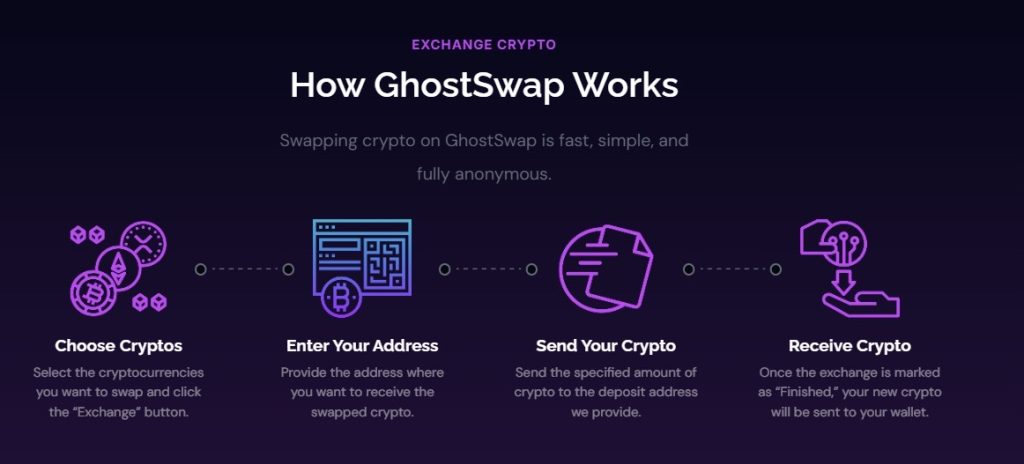
Hacks have always been part of crypto, but in 2026, it does look like we are noticing more and more of them, especially on custodial platforms. This year alone there has been hundreds of millions of dollars drained from exchanges, bridges, and protocols that hold user funds in centralized wallets.
As crypto news “scream” about the latest hacks, a quieter, more resilient model continues to operate without making the news: non-custodial swaps.
GhostSwap is a non-custodial crypto exchange where funds are never in a shared pool waiting to be drained. Instead, assets route directly from the user’s wallet to the destination address, which drastically reduces the attack surface compared to traditional custodial platforms.
Curious to understand what this actually means? Bear with us, please.
The 2026 Custodial Hack Wave
The numbers regarding crypto hacks this year are worrying, to say the least. In the first four months of 2026 alone, custodial platforms lost over $670 million to hacks and exploits. Here are some of the most biggest incidents:
KelpDAO suffered a $292 million loss on April 18, 2026, through an infrastructure attack via the LayerZero bridge. The custodial bridge/L2 platform proved vulnerable to a single point of failure in its cross-chain infrastructure.
Drift Protocol (which is basically a custodial perpetuals exchange on Solana) lost $285 million on April 1, 2026, through a combination of smart contract vulnerability and compromised admin keys. The attack exposed the risks of relying on centralized administrative controls.
Grinex, a custodial CEX operating in Kyrgyzstan with Russian links, had $13.7 million in USDT drained from 54 wallets on April 15, 2026. The attack showed that even smaller exchanges with less visibility are prime targets.
Step Finance lost $28.9 million between January and February 2026 through compromised executive email accounts and private keys. That breach is particularly interesting since it shows how even human factors (such as email access, or credential management) remain critical vulnerabilities.
Truebit Protocol suffered a $26.4 million exploit on January 9, 2026, through “zombie code” in its smart contracts; a reminder that legacy code can become a ticking time bomb.
ResolvLabs, a custodial stablecoin issuer, lost $25 million in March 2026 through an AWS KMS key management vulnerability. Even infrastructure giants like Amazon aren’t immune to configuration errors.
If a series of news about hundreds of millions in losses doesn’t make you think twice about keeping your assets on a custodial exchange, then honestly, what will?
This is where GhostSwap comes into play.
Why the Attack Surface Is Smaller with GhostSwap
GhostSwap’s non-custodial model doesn’t claim to be unhackable. To be completely honest, no system is in crypto. However, it drastically reduces the attack surface by eliminating several high-value targets that attackers typically go after.

In a custodial exchange, users deposit assets into exchange-controlled wallets. This creates large, tempting pools of customer funds. GhostSwap operates differently: funds move through the swap process and are delivered directly to the destination wallet rather than being stored as long-term customer balances.
No Accounts Means No Account Database to Breach
There’s no honey pot waiting to be drained.
Traditional exchanges maintain extensive databases of user accounts, login credentials, and often identity records. This creates multiple attack vectors: credential stuffing, password theft, and account takeovers.
GhostSwap’s no-account approach removes entire categories of risk. There is no user database to breach, no login system to compromise, and no credentials to steal.
Minimal Personal Data Reduces Exposure
Because GhostSwap doesn’t require routine account creation or standard KYC processes for most swaps, there is far less sensitive user information available to steal. The platform follows a data-minimization strategy, which collects only what’s necessary to complete a swap.
This means even if an attacker were to breach GhostSwap’s systems, there would be little valuable personal data to exfiltrate.
No Large Customer-Fund Pool to Drain
Perhaps the biggest and most significant difference is the absence of a centralized pool of customer assets. GhostSwap’s wallet-to-wallet swap model avoids maintaining a shared pool that could be drained in a single compromise.
When you compare this to custodial platforms, it’s pretty clear even to a newbie that a single successful attack can empty millions from a single wallet. GhostSwap’s model distributes risk across individual transactions, and eliminates the giant target.
The Refund-Address Safety Mechanism
A key operational safeguard in GhostSwap’s model is the refund address. During a swap, users provide both:
- A destination address where they want to receive the output asset
- A refund address where the original funds can be returned if the swap cannot be completed
This dual-address system provides a critical safety net. If a transaction encounters a problem (such as a routing issue, liquidity problem, or another failure condition) the refund address gives GhostSwap a predefined destination for returning funds when possible. This reduces the risk of assets becoming stranded during an incomplete swap and provides a clear recovery path.

It’s a simple but very effective mechanism. Rather than user funds remaining in limbo while support teams investigate, the refund address enables automated recovery. The asset has a defined path home.
GhostSwap Offers High-Standard Security
So, let’s conclude with this – Imagine waking up to check your portfolio, only to discover that the exchange where you kept your funds has been drained overnight. This happened to thousands of traders in 2026, so it’s not hypothetical.
When Drift Protocol lost $285 million on April 1, traders who had funds on the platform couldn’t access their assets for days. When KelpDAO lost $293 million just weeks later, many users watched their holdings vanish with no clear path to recovery.
Traders who use GhostSwap avoid this entire category of risk. Your funds move directly from your wallet to the swap route and land in your destination wallet; never held in a GhostSwap-controlled pool where they could be swept away in a single attack.
When you hear about the next custodial breach, and there will be a next one, you won’t have to panic about whether your funds were caught in the crossfire.
This peace of mind isn’t just theoretical anymore. In a year where over $670 million has been stolen from custodial platforms in the first four months alone, GhostSwap’s non-custodial model has proven its value by simply not appearing in the hack news.
Traders who value their assets and their sleep are increasingly turning to non-custodial swaps, not just for privacy, but for the security of knowing their funds are never held by the platform they’re trading on.
GhostSwap’s non-custodial model doesn’t eliminate all risk, but it does reduce the chance for the hack to happen. When there’s no honey pot, there’s less honey to steal.
The post Funds Never Held: GhostSwap’s Non-Custodial Model vs the 2026 Hack Wave appeared first on Cryptonews.


StarkWare CEO Eli Ben-Sasson has revived debate over Bitcoin’s fixed supply after suggesting annual issuance.
Summary
- Ben-Sasson argued lost private keys reduce usable Bitcoin supply, making fixed issuance worth reconsidering.
- Bitcoin supporters rejected the idea, saying the 21M cap remains central to BTC’s value.
- Zcash’s proposed burn-and-reissue model emerged as an alternative that keeps a fixed supply cap intact.
In a Tuesday post on X, Ben-Sasson said Bitcoin’s 21 million supply cap “doesn’t make sense” because users lose private keys over time. He argued that lost keys reduce the amount of usable Bitcoin and that, over a long enough period, more coins will become unreachable.
Ben-Sasson proposed replacing the fixed cap with a hard issuance rule of up to 4% per year. He said the figure roughly matches global population growth, while still keeping Bitcoin scarce under a known monetary rule.
Lost keys drive the argument
Bitcoin does not have a password reset system. When a holder loses a private key, the coins remain on-chain but cannot be spent. That is why lost Bitcoin can reduce the supply available to buyers and sellers.
Ledger estimated that 2.3 million to 3.7 million BTC are permanently lost, while some reports place the figure near 4 million BTC. Ben-Sasson used this trend to argue that a fixed cap could make Bitcoin less useful over very long periods.
His view runs against a core Bitcoin belief. Many Bitcoin supporters see lost coins as part of the asset’s scarcity, not a problem to fix. The old Bitcoin view is that lost coins act like a “donation” to other holders because the remaining supply becomes harder to buy.
Bitcoiners reject 4% inflation
The proposal drew fast pushback from Bitcoin users on X. Critics said Bitcoin’s 21 million limit is one of its main features and that changing it would make BTC look more like other crypto assets.
Some users also pointed to Bitcoin’s divisibility. Bitcoin can be split into 2.1 quadrillion satoshis, giving users small enough units for payments even if whole BTC becomes harder to access.
Ben-Sasson pushed back, saying those satoshis would also trend toward zero over time if private keys keep getting lost. He said Bitcoin could still remain scarce if the inflation rate stayed fixed and predictable.
The debate links back to comments from Strategy executive chairman Michael Saylor. Saylor spoke about burning Bitcoin private keys as a “pro rata contribution” to other holders, though the report said he did not directly promise to do so himself.
Zcash model enters the debate
Zcash founder Bryce “Zooko” Wilcox suggested another path. He pointed to Zcash’s proposed Network Sustainability Mechanism, which would let users burn ZEC and gradually reissue those coins as future rewards without raising the 21 million cap.
That model tries to help miner incentives while keeping the fixed supply rule. It differs from Ben-Sasson’s proposal because it does not create a higher lifetime limit.
Any change to Bitcoin’s cap would face a high bar. Developers can propose code changes, but node operators, miners, exchanges, wallets, and users would need broad agreement before the network accepts them.
As previously reported by crypto.news, StarkWare has already worked on ways to bring scaling tools to Bitcoin without forking Starknet or launching a new Bitcoin token. This new debate moves from scaling into monetary policy, where Bitcoin users have shown little interest in changing the current supply rule.

Secret Network, a privacy-focused layer-1 blockchain known for running encrypted smart contracts, has proposed relocating from its long-time Cosmos environment to Ethereum’s Arbitrum layer-2. The move, announced Tuesday by the project team, is framed as a response to what it calls increasing security and liquidity risks on the current stack—risks the team says have been intensified by rapid progress in AI-assisted code analysis.
The proposal is expected to require a governance vote. If approved, Secret Network plans a one-time snapshot of SCRT balances on Sept. 1 to enable the issuance of a new ERC-20 SCRT token contract on Arbitrum.
Key takeaways
- Secret Network says “old code” on Cosmos is becoming harder to keep safe, arguing AI is reducing the cost of finding and exploiting vulnerabilities.
- Arbitrum is positioned as the destination due to deeper liquidity and stronger developer and infrastructure support.
- A June bridge exploit that resulted in $4.7 million lost in bridged assets did not affect Secret’s native SCRT token, but the team cites it as evidence of growing cross-chain risk.
- Secret’s Cosmos TVL is reported at about $1.3 million, while Arbitrum’s total value secured is cited at $17.4 billion (L2Beat).
- SCRT holders reacted negatively to the announcement, with CoinGecko data showing a 24% drop over 24 hours to $0.041.
Why Secret Network wants out of Cosmos
In a forum post, the Secret team said the “environment has changed” since the project launched privacy-preserving smart contracts on Cosmos in 2020. The team’s central rationale is security: it argues that vulnerabilities in older, “stale” code are becoming easier and cheaper to analyze, and that AI tools lower the barrier for attackers.
“The security risk is the part we take most seriously,” the team wrote, adding that with AI, the cost of attacking outdated code is falling “across the board.”
The team tied this concern to recent incidents, pointing to an Axelar-Secret IBC bridge exploit that it says spotlighted the danger of aging or under-maintained code. According to the forum post, the release of increasingly capable AI models—such as Anthropic’s “Claude Mythos 5,” referenced in earlier reporting by Cointelegraph—raises the likelihood that attackers can more quickly discover weaknesses and turn edge cases into working exploits.
“Attacks that used to take deep manual effort are getting cheaper as models get better at reading contracts, tracing assumptions, and turning a forgotten edge case into a working exploit.”
Cross-chain stress: the $4.7M bridge incident and what it implies
Secret Network’s proposal follows a bridge exploit reported earlier this year. In June, an exploit involving Secret’s bridge resulted in the loss of $4.7 million in bridged assets, though the team said it did not impact the native SCRT token.
While the exploit did not directly compromise SCRT itself, the team’s broader message is that cross-chain plumbing—often built on components that may not receive rapid upgrades—can become an outsized risk as the threat landscape changes. The proposal effectively treats that bridge incident as part of a pattern: if the cost to find and exploit weaknesses continues to fall, the practical burden of keeping all components secure becomes harder over time.
Earlier coverage from Cointelegraph described the “infinite mint” bug behind the $4.7 million loss, emphasizing how bridge logic can be fragile when assumptions fail. Secret’s latest move suggests the project believes switching to a different execution and ecosystem environment could help reduce some of those risks.
Arbitrum as a liquidity and tooling upgrade
Beyond security, Secret also argued that Cosmos has weakened as a growth hub. In its Arbitrum pitch, the team described Arbitrum as offering “deep liquidity, tooling, wallet and exchange support, and thousands of builders composing with one another.” It also stated that “liquidity has thinned” on Cosmos while developers have “drifted to other ecosystems.”
The team warned that Cosmos tooling stability is “shakier than it used to be,” and said several projects that previously anchored the Cosmos ecosystem have migrated elsewhere.
In practical terms, this shift matters for Secret Network because privacy-focused applications often rely on consistent liquidity, reliable developer tooling, and accessible integrations. A thinner ecosystem can translate into weaker DeFi participation, fewer composability pathways, and more friction for users—especially when projects depend on bridging, exchanges, wallets, and dApp integrations to reach liquidity.
What the numbers say—and how the market reacted
Secret’s proposal arrives amid a wider migration trend from Cosmos to Ethereum-based execution environments. The forum post cited declining Cosmos DeFi depth alongside rising Ethereum layer-2 scale.
According to the figures referenced in the announcement, the total value locked across the Cosmos ecosystem is around $2 billion, down 88% from its peak during the 2021 bull market. By comparison, Arbitrum is cited as the leading layer-2 by total value secured at $17.4 billion, based on L2Beat data. DefiLlama figures also placed Secret’s Cosmos TVL at about $1.3 million.
Market reaction has been sharply negative for SCRT. CoinGecko data referenced in the update shows the token down roughly 24% over the past 24 hours to around $0.041, representing a drop of more than 99% from its 2021 peak.
The broader context is that Secret is not alone in leaving Cosmos. In February, NilChain—a privacy-focused chain built with the Cosmos SDK—announced its move to Ethereum. Sei Network completed a full transition away from Cosmos in June by closing its native Cosmos transaction layer and operating on Ethereum. Noble, a stablecoin blockchain, was also reported earlier as having announced its migration from Cosmos to Ethereum in January.
For observers, this matters because it suggests a structural reallocation of development effort and liquidity toward EVM and large layer-2 environments—even when projects originally benefited from Cosmos’s modular design.
How the migration would work if governance approves
Secret Network’s plan includes a governance step and a technical token migration path. The team said it will conduct a one-time snapshot of SCRT balances on Sept. 1. The snapshot will then be used to issue a new ERC-20 SCRT contract on Arbitrum.
This design choice is notable because it signals the project intends to maintain a continuity mechanism for existing holders rather than treating the transition as a completely separate token. Still, the details of the migration—such as timing relative to the governance vote, how bridging or redemption would be handled during the transition window, and how ecosystem integrations will migrate—remain contingent on the governance outcome.
With that in mind, the next items to watch are the governance vote itself and any follow-on proposals that spell out the operational timeline, liquidity migration plans, and security controls for the Arbitrum deployment. The team’s argument centers on AI-driven risk and aging code assumptions—readers will want to see how the new architecture and maintenance practices address those concerns in practice.


Australian crypto exchange Swyftx says it will be seeking opportunities in the crypto payments space after securing a license from Australia’s market regulator.
Swyftx said on Wednesday that it received its Australian Financial Services License (AFSL), joining the likes of Coinbase, BTC Markets and Crypto.com. The license allows it to offer derivative products, such as crypto options or futures, to retail customers, as well as non-cash payment facility authorization, setting up the fintech to offer payment services to business and retail clients. It does not hold an AFSL to offer spot crypto.
“Swyftx won’t be a pure crypto spot exchange in future,” Swyftx interim co-CEO Andrea Yuen told Cointelegraph. “In particular, we see a lot of opportunity in the payments space following local changes to credit card surcharging.”
From Oct. 1, Australian businesses will be banned from adding surcharges to Visa and Mastercard debit and credit card payments, which could prompt businesses to look for cheaper payment rails as they are set to absorb the cost. Swyftx is looking to pitch crypto and stablecoins as an alternative.
“Crypto payments and stablecoins offer an opportunity for merchants to reduce the transaction costs they might have to bear in future,” added Yuen.
Meanwhile, Swyftx said it is also looking to expand its presence overseas. The company serves clients in New Zealand and the US, and had previously eyed expanding to the UK, filing an application with the Financial Conduct Authority in March 2022.
“Looking ahead, we want to use a well-regulated Australian market as a base to expand our presence overseas,” said Yuen.
AFSL requirements take effect in 2027
Crypto companies with an AFSL need to meet the same compliance duties as other finance companies. Crypto exchanges previously only needed to have anti-money laundering and know-your-customer policies in place, but legislation passed in April requires most crypto firms to hold an AFSL from April 9, 2027.
“It’s an enormous responsibility to be a regulated financial service,” said Yuen.
Only a small number of crypto exchanges have so far obtained AFSLs, including Coinbase, BTC Markets, Crypto.com and KuCoin.
It comes as the Australian Securities and Investments Commission recently extended the grace period for crypto firms to apply for an AFSL to Sept. 30. ASIC said it has received around 30 license applications from crypto businesses since October last year.
Related: Australia’s crypto travel rule is coming into effect: Here’s what’s changing
Australian crypto ownership rises
A survey from Australian crypto exchange Independent Reserve suggested that 33% of Australians now own cryptocurrency, up from 31% in 2025.
“Younger Australians are confronting an economic reality where traditional wealth-building paths, particularly home ownership, feel increasingly out of reach,” Independent Reserve CEO Adrian Przelozny said.
“As a result, many are exploring alternative assets that have historically delivered stronger returns than traditional portfolios, and cryptocurrency has naturally become an option.”
Bitcoin remains the dominant digital asset, which was held by 71% of survey respondents.
Magazine: Has Bitcoin bottomed for this cycle? Analysts say ‘not yet’
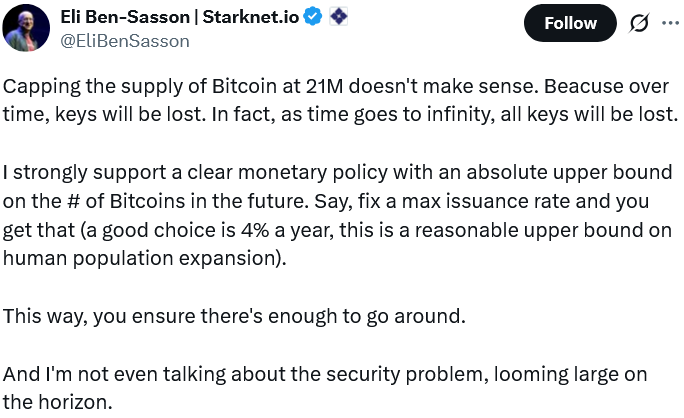
The debate over whether Bitcoin’s fixed supply cap should be lifted has resurfaced after StarkWare CEO Eli Ben-Sasson suggested Tuesday that it should replaced with a 4% annual issuance rate.
In a post to X on Tuesday, Ben-Sasson said the current 21 million cap “doesn’t make sense” because private keys are lost over time and “as time goes to infinity, all keys will be lost.”
Crypto wallet hardware provider Ledger estimated in November that up to 4 million Bitcoin had been burned or permanently lost. Ben-Sasson said he still supports a hard upper bound on Bitcoin’s supply, and that a 4% annual inflation rate roughly tracks the growth of the human population.
Bitcoin’s fixed cap has long been one of its core selling points, underpinning the “digital gold” narrative and drawing on Austrian economics, where a fixed money supply protects against monetary debasement and, in theory, preserves purchasing power over time. Many Bitcoiners have argued that changing the cap would undo the very thing that makes Bitcoin unique.
Source: Eli Ben-Sasson
Bitcoiners have also said the loss of private keys improves Bitcoin’s supply-demand dynamics because one can’t sell what one doesn’t have access to. One of the biggest advocates of this feature is Strategy executive chairman Michael Saylor, who plans to burn his Bitcoin private keys upon his death as a “pro-rata contribution” to other Bitcoin holders, making their coins scarcer in the process.
Bitcoiners bark at 4% Bitcoin inflation proposal
Ben-Sasson’s post was met with heavy criticism.
One X user argued that Bitcoin is divisible into 2.1 quadrillion base units, called satoshis, in an effort to counter Ben-Sasson’s claim that there won’t be enough Bitcoin “to go around.”
However, Ben-Sasson argued that those 2.1 quadrillion units would also trend toward zero over time because of lost keys.
Other opponents argued that lifting Bitcoin’s fixed cap would make it like other cryptocurrencies. However, Ben-Sasson said Bitcoin would retain its scarcity, provided that the inflation rate remained fixed.
Related: Has Bitcoin bottomed for this cycle? Analysts say ‘not yet’
The answer could be in Zcash’s proposed fix
The founder of Zcash, Bryce “Zooko” Wilcox, recommended that Bitcoin developers follow a proposal currently being considered in the Zcash ecosystem, since the privacy-focused network also relies on miners to secure the network and has a fixed supply cap of 21 million Zcash (ZEC).
The “Network Sustainability Mechanism” proposal seeks to keep ZEC’s fixed cap intact but lets users burn the token, which is gradually reissued as block rewards over a four-year period to ease pressure on miner incentives without lifting the hard limit.
However, Bitcoin developers, miners and node operators would need to reach consensus for such a change to occur, given the network’s decentralized governance model, which makes it challenging to implement protocol-level changes.
Features: Does ‘Paper Bitcoin’ mean there’s an unlimited supply of BTC?


Strike has launched a Bitcoin-backed loan product built to remove margin calls and price-based liquidations.
Summary
- Strike says its new Bitcoin-backed loans remove price liquidations while keeping payment duties in place.
- Borrowers avoid margin calls, but missed payments can still lead Strike to sell collateral.
- The product targets Bitcoin holders who need cash but do not want forced selling.
Jack Mallers, Strike’s founder and chief executive, said the new product protects borrowers from forced selling when Bitcoin falls. He described the offer as a “volatility-proof” loan that lets users borrow dollars while keeping their BTC posted as collateral.
The launch follows Strike’s first Bitcoin-backed loan product, which arrived in May 2025. As previously reported, Strike issued more than $10 million in BTC-backed loans within two days of that launch.
No margin calls, but not risk-free
The new product removes price-triggered actions tied to loan-to-value levels. Mallers said, “No margin calls. No price liquidations. No matter how far bitcoin falls, your bitcoin doesn’t move.”
That structure differs from many crypto lending products, where a sharp price drop can force borrowers to add collateral or face liquidation. Strike says borrowers can keep their collateral untouched if they make payments on time.
The protection has limits. If a borrower misses an interest or maturity payment, Strike gives a 10-day window to pay or contact the company. If the borrower does not respond or settle the overdue amount, Strike may sell part of the Bitcoin collateral.
Mallers also warned users about the difference between price risk and payment risk. “That’s why we call it ‘volatility-proof,’ not ‘liquidation-proof,’” he said.
Higher cost funds the protection
The new loan carries a higher cost than Strike’s standard Bitcoin-backed loans. The annual percentage rate can reach 14.2%, based on a 2.95 percentage-point premium above Strike’s standard loan range.
Strike’s standard loan product has charged rates between 7.75% and 11.25%, depending on terms and payment choice. The “volatility-proof” version also uses a shorter six-month term and a maximum initial loan-to-value ratio of 45%.
In simple terms, a borrower who posts $100,000 in Bitcoin can borrow up to $45,000. The lower borrowing limit and higher rate give Strike more room to manage the risk of sharp BTC price moves.
Mallers said the added cost supports hedging. “The secret sauce is that we’re taking the extra charge that we’re giving you guys and we’re putting it on extra hedges in the market to protect all of us,” he said.
Bitcoin lending market searches for trust
The launch comes while crypto lenders keep testing ways to make Bitcoin-backed credit easier to use. A Ledn research report found that 88% of surveyed crypto holders would consider a crypto-backed loan, while only 14% currently use one.
Ledn and Protocol Theory called that gap a trust problem, not only a demand problem. Market volatility, fear of liquidation, and low confidence in lenders have limited wider use.
Other firms also continue to build crypto-backed lending products. As crypto.news previously reported, Coinbase launched crypto-backed loans in the U.K. through Morpho on Base, allowing users to borrow up to $5 million in USDC against Bitcoin, Ethereum, and cbETH.
Strike’s new product tries to address one of the main fears in Bitcoin lending: forced selling during market crashes. It does not remove repayment risk. Borrowers still need to pay on time, and the higher rate makes the product costly for users who need longer-term credit.
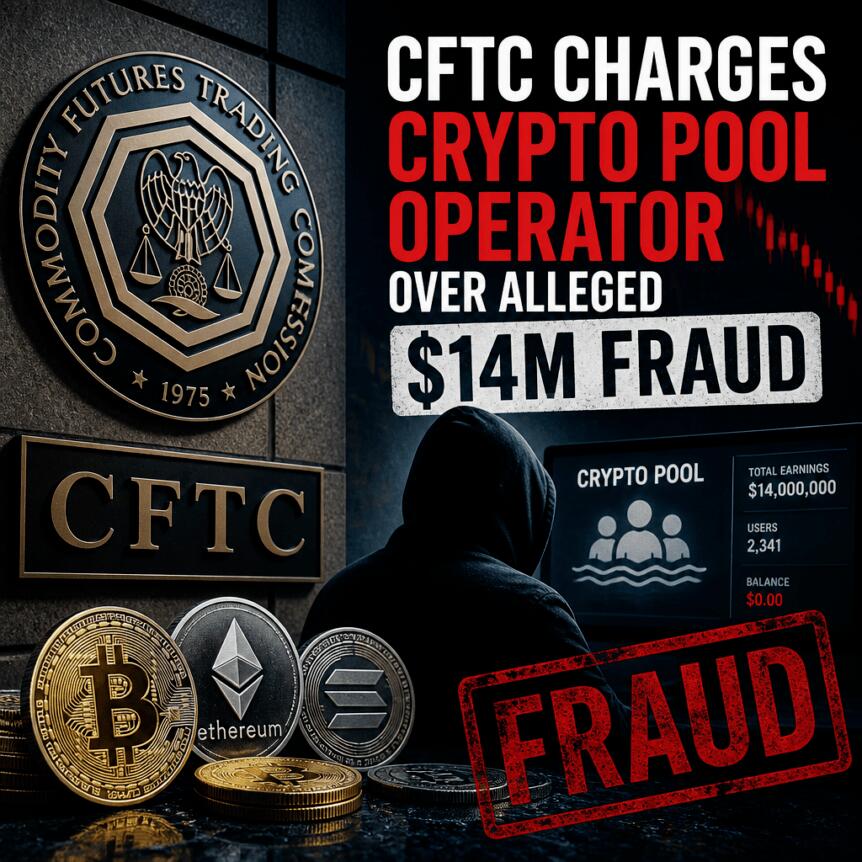
The U.S. Commodity Futures Trading Commission (CFTC) has filed a federal lawsuit against Trevor Vernon, a North Carolina man, and his company, Argent Capital Management, alleging they operated a crypto-involved commodity pool that defrauded investors of more than $14 million.
In its complaint filed Tuesday, the CFTC alleges Vernon solicited $14.8 million from at least 60 investors between March 2022 and February 2026 by presenting himself as a successful trader, while investors’ funds were allegedly used to generate “consistent and catastrophic losses.” The CFTC described the alleged misconduct as “akin to a Ponzi scheme,” and said it included trading in Bitcoin and Ether alongside equity index futures and related options.
Key takeaways
- The CFTC lawsuit alleges an investor-raising scheme tied to a commodity pool featuring both crypto and equity index derivatives.
- The agency claims investors were solicited with false performance messaging while losses were allegedly hidden, including through alleged misappropriation of funds.
- The complaint asserts Vernon violated federal commodities laws by failing to register the pool as required.
- The CFTC is seeking permanent restrictions on Vernon, along with potential disgorgement, penalties, and restitution.
A rare CFTC action in crypto underscores regulator focus
Crypto enforcement by the CFTC is comparatively infrequent, and the agency has faced ongoing scrutiny from some lawmakers about whether it has adequate resources to oversee a sector that has grown quickly and operates across multiple regulatory frameworks. This case stands out because it blends traditional commodities derivatives—such as equity index futures and options—together with cryptocurrency trading.
According to the CFTC’s lawsuit, the pool used a mix of instruments that the agency alleges were central to both returns claims and investor solicitation. The regulator’s emphasis on the commodity-pool structure is important: it signals that, where crypto is combined with derivatives and investor pooling, the CFTC may pursue conduct that fits within its commodities jurisdiction.
The allegations: hidden losses and misappropriated funds
Central to the CFTC’s claims is what it describes as Vernon’s pattern of misleading investors and obscuring the pool’s performance. The complaint alleges Vernon made false statements to both existing and prospective investors, including through quarterly account updates and monthly performance emails.
The CFTC alleges that trading across the pool—including crypto holdings such as Bitcoin and Ether, which the agency asserted were commodities—along with equity index futures and options resulted in losses exceeding $8.6 million. The regulator says Vernon did not disclose these losses to investors.
In addition, the CFTC claims Vernon misappropriated investor funds in a way it characterizes as similar to a Ponzi scheme—using money from investors, according to the agency, to pay earlier participants in order to conceal the underlying losses. The complaint states that at least $3 million was misappropriated for investor payments in that alleged manner.
The lawsuit also alleges personal misuse of funds: it claims Vernon misappropriated $136,000 for private air travel. The CFTC’s framing suggests it views the alleged conduct as not only misrepresentation but also improper diversion of pooled investor capital.
Registration failures and purported regulator misstatements
Beyond fraud-related allegations, the CFTC says Argent Capital Management failed to register with the agency as required under federal commodities law. Registration obligations are frequently a focal point in CFTC enforcement because they determine whether an operator is meeting baseline regulatory requirements for offering and running commodity-related investment products.
The complaint further alleges Vernon made false statements to the CFTC in January concerning issues the agency later raised in its lawsuit. The CFTC says Vernon’s conduct violated multiple legal requirements, not just investor communications and trading results.
Overall, the CFTC charged Vernon with seven counts relating to fraud, failure to register, and making false statements. Those counts reflect a broader enforcement approach that targets both how investors were recruited and how the pool was managed, including compliance steps that the regulator says were not followed.
What the CFTC is asking the court to do
In addition to seeking monetary remedies, the CFTC asked the court for injunctive relief aimed at preventing future misconduct. The regulator is requesting a permanent ban on Vernon from registration and trading, as well as disgorgement, penalties, and restitution.
These requests matter for investors and market participants because they signal the CFTC’s view that the alleged conduct warrants more than an order limited to the specific pool. A permanent prohibition and restitution-focused relief are typically designed to reduce the risk of repeat behavior and to address, to the extent possible, the financial harm described in the complaint.
More broadly, the case may also influence how firms and individuals structure “commodity pool” offerings that involve crypto trading or claim crypto-related performance. If the allegations reflect actual conduct proven in court, it would highlight how the CFTC may treat certain crypto activities as part of a broader commodities-and-derivatives framework—especially when an operator solicits outside capital and markets results while allegedly failing to disclose losses.
What to watch next
Readers should watch how the court responds to the CFTC’s requested remedies and whether the case proceeds on the specific theories of jurisdiction and alleged misappropriation outlined in the complaint. Until factual issues are resolved, the key uncertainty remains the extent to which Vernon and Argent Capital Management can rebut the CFTC’s claims regarding hidden losses, alleged investor misrepresentations, and compliance failures.

Why Coast FIRE Could Be Your Biggest Money Mistake

Telstra outage: Trains and emergency calls in Australia affected by telecoms outage
Kraken Pursues European Banking License in Lithuania


-

 Fashion5 days ago
Weekend Open Thread: High Hopes
-
 NewsBeat3 days ago
Taylor Swift and Travis Kelce wedding staffer hilariously struggles to keep her cool while checking in megastars
-

 Fashion2 days ago
Open Thread: What Great Books Have You Read Recently?
-
Crypto World7 days ago
Airdrop Registration Becomes Key Focus For Remittix As RTX Launch Updates Approach
-

 Politics5 days ago
The House | “Reframing the debate from a binary discussion of winners and losers”: Yuan Yang reviews ‘We Are Not Machines’
-

 Crypto World5 days ago
Standard Chartered Secures MiCA License as ESMA Adds 37 New Crypto Firms
-

 Sports7 days ago
Broncos roster: OL Ben Powers (No. 74) entering final year of contract
-

 Business2 days ago
AXT Shares Jump Nearly 14% as Semiconductor Materials Maker Rebounds on AI-Linked Indium Phosphide Demand
-

 Crypto World6 days ago
Binance stock trading tops $1B in first month after launch
-
Crypto World1 day ago
SK hynix (000660.KS) Stock Dips as $28B Nasdaq ADR Offering Drives AI Memory Expansion
-

 Crypto World6 days ago
Alibaba-affiliate Ant Group enters the humanoid robot market with 12 deals
-

 Crypto World3 days ago
South Africa proposes crypto tax guidance under existing rules
-

 News Videos2 days ago
Best Time to Enter Small Caps Right Now? Another Bull Run? | Financially Free
-

 News Videos1 day ago
Whats Hidden Inside This Cash Register? #treasure #reselling #money
-

 Tech3 days ago
Lenovo laptops are now shipping with YMTC SSDs, a sign of Chinese NAND entering the mainstream
-

 Business6 days ago
Meta Platforms Stock Jumps 7% Today as Bloomberg Reports Company Plans to Enter the Cloud Business
-
 NewsBeat6 days ago
New exhibition reflects five decades of movement between island of Ireland and GB
-

 Business5 days ago
What a 10 Percent Drop Means for Buyers, Sellers and Renters
-

 Crypto World5 days ago
Binance Re-Enters Philippines As EU MiCA Rules Restrict Access
-

 News Videos2 days ago
Avoid entering in FOMO #bitcoin #cryptocurrency #trading #scalping
You must be logged in to post a comment Login