
Crypto World
Bitcoin’s Bear Market May Be Over After a 20% Rally: But What Comes Next? (Analyst)


Bitcoin had a huge week, finally. The crypto asset jumped by 25% and neared $80,000 as the rally gathered serious momentum.
One analyst now believes that the bear market has ended and BTC has entered a “Soft Bull Market,” following its recent breakout above several important resistance levels.
Bears Get Squeezed
Doctor Profit identified $71,000 as extremely strong support and $78,500 as the next major resistance, while explaining that everything between those levels is “noise.” While the analyst is not ruling out a retest of the $71,000 region, he does not expect it to be necessary. According to his analysis, it is the lowest meaningful region Bitcoin could revisit before moving higher.
Meanwhile, a break above $78,500 could help the asset make a run toward approximately $82,000. He expects the “Soft Bull Market” to turn into a full bull market escalation once Bitcoin breaks $82,000 with strength. Doctor Profit also points to BTC’s reaction around $60,000 as evidence that significant capital is ready to enter when fear returns.
“Bulls showed that they are ready to deploy size when fear appears, while everyone waiting for $50K, $40K or some magical four-year-cycle bottom was left watching the market move without them. And personally, I doubt the market will now be generous enough to give the majority another clean opportunity below $71K.”
Addressing concerns about Bitcoin being in an overbought zone, Doctor Profit said the weekly and monthly RSI remain in neutral regions. While the analyst considers the daily RSI important for short-term movements, he does not see it as a major risk at the current price area. Much of the recent move came from shorts being forced to close rather than an overload of new leveraged longs or massive spot purchases, which means that “bears became buyers against their will.”
A similar pattern played out in 2023, when BTC climbed from around $16,000 to $25,000, gaining approximately 56%, before correcting roughly 22% toward $19,000. Fear and Greed then reached extreme fear levels, and many holders who had survived the bear market panic sold as they feared another major collapse.
Instead, Bitcoin quickly reversed and surged from approximately $19,000 to $30,000, a move of almost 60%. The comparison is less about repeating the exact price pattern and more about recurring psychology: fear, disbelief, short squeezes, corrections, panic, capitulation, and eventual expansion, Doctor Profit explained.
Powerful Weekly Reversal
For Ali Martinez, Bitcoin’s latest weekly surge could be an early sign of a new bull market. Back in 2019, the crypto gained almost 32% in one week, while in January 2023, BTC jumped 25% after the FTX collapse, despite deeply bearish sentiment.
Martinez is now seeing a similar setup. The move also came as many traders were expecting a market bottom in October based on the four-year-cycle theory.
The post Bitcoin’s Bear Market May Be Over After a 20% Rally: But What Comes Next? (Analyst) appeared first on CryptoPotato.



Disclosure: This article does not represent investment advice. The content and materials featured on this page are for educational purposes only.
Flowra has launched its Open Orderflow Auction for Solana, introducing an open block-building system that allows registered searchers to compete for transaction inclusion while giving validators greater control over blockspace and MEV revenue.
Summary
- Flowra’s Open Orderflow Auction lets registered searchers compete transparently for transaction inclusion on Solana blocks.
- Flowra’s single-validator test raised compute units per block by 20.6%, with comparable block fees higher.
- Programmable Block Policy lets validators set inclusion rules and support compliance screening without protocol changes.
Flowra has launched its Open Orderflow Auction for the Solana ecosystem, introducing a competitive block-building framework aimed at opening the network’s MEV market to broader participation.
The framework is designed to open block building to competitive bidding, improve price discovery in Solana’s MEV market, and help validators capture more revenue. Registered searchers can compete for transaction inclusion through a transparent auction instead of relying on closed orderflow channels. Flowra said the Open Orderflow Auction is now available to validators and searchers, while it continues onboarding institutional-grade validators ahead of a broader rollout.
Open Orderflow Auction targets Solana MEV competition
Flowra said the auction changes how transaction inclusion can be offered to searchers. Rather than routing orderflow through closed channels, registered participants can bid openly for access to blockspace. The company expects that model to create clearer competition around transaction inclusion and allow validators to receive more of the value generated by MEV.
Solana validators process transactions and participate in network consensus. Flowra’s framework focuses on that validator layer by introducing a new method for constructing blocks and allocating blockspace. The company says its aim is to improve transaction transparency, value distribution, and incentive alignment among validators, users, and builders.
Early validator testing shows higher block activity
Flowra reported early results from testing its setup on a single validator. According to the company, the Flowra-enabled validator increased compute units per block by 20.6%. The validator moved from 84% to 101% of the network average during the test. Flowra also reported higher block fees than comparable validator software.
The company said the same setup achieved 100% block production and 99.999% block engine uptime. Those figures come from Flowra’s early testing and relate to one validator. The company is using the results as it expands onboarding for its Open Orderflow Auction across institutional-grade validators in the Solana ecosystem.
Programmable block policy adds validator controls
Alongside the auction, Flowra introduced Programmable Block Policy. The feature allows validators to define transaction inclusion policies at the block-building layer. Flowra said this can give validators more operational flexibility, including the ability to address regulatory or institutional compliance requirements without changing the underlying Solana protocol.
Flowra recently announced a collaboration with compliance infrastructure provider Honeypot. The companies plan to bring sanctions and risk screening to the block-building layer. Flowra presented the policy system as a way for validators to control how blocks are constructed while retaining verifiability and auditability.
Flowra draws from Ethereum block-building model
Flowra said its architecture takes inspiration from the competitive block-building model that emerged on Ethereum. Ethereum.org describes proposer-builder separation as a structure in which block builders submit bids and validators can select the most profitable offer. Flowra believes Solana’s high-throughput, low-latency design can support a similar market-based approach.
“Solana’s performance has made it one of the industry’s leading blockchain networks, but its MEV market remains largely concentrated,” Flowra CEO Harry Hwang said. “By opening block building to transparent competition, we’re creating a more efficient market for blockspace while giving validators greater control over how their blocks are constructed with full verifiability and auditability.”
Flowra develops validator and order flow infrastructure for Solana. Its products include validator infrastructure, delegation programs, and MEV-related technologies. The company’s broader goal is to support a more open, efficient, and scalable foundation for blockchain networks while improving how value is distributed among network participants. The auction is available to validators and searchers participating across the Solana ecosystem as the network expands further.
Disclosure: This content is provided by a third party. Neither crypto.news nor the author of this article endorses any product mentioned on this page. Users should conduct their own research before taking any action related to the company.

The world’s largest corporate holder of bitcoin has extended its no-buy pause for yet another week. On the plus side, the company has refrained from selling again.
As announced by co-founder and former CEO Michael Saylor, Strategy has remained on the sidelines for another week in terms of BTC moves, but it continues to grow its USD reserve. This was done in a two-fold manner.
First, the firm increased its regular USD reserve to $5.1 billion, but it also established another – USD Cash – of $1.59 billion. Strategy also repurchased another $136 million worth of STRC, whose price continues to climb closer to the par level of $100.
Strategy increased USD Reserve to $5.10B, established additional USD Cash of $1.59B, and repurchased $136M of $STRC. As of 8/23/26: Strategy holds ~4% of Total BTC Supply and has ~0% Net Leverage. $MSTR https://t.co/WZ9GFtJBXh
— Michael Saylor (@saylor) August 24, 2026
The company announced its last sale on August 10, disposing of another 1,690 BTC. Since then, it has made no bitcoin moves.
Strategy’s latest announcement was the first since last week’s major surge in bitcoin prices, which drove the asset from under $65,000 to just over $78,000 as of press time.
Aside from the actual growth against fiat currencies, this big revival put the company’s massive position in profit for the first time in months. After all, Strategy’s average accumulation price is at around $75,400, and the firm spent approximately $63.3 billion to acquire it.
Given the current market conditions, that substantial fortune is worth over $65.6 billion. Recall that the company’s position had tanked to an unrealized loss of over $10 billion a few months ago.
The post Strategy Adds $1.9B to USD Reserve but Buys No Bitcoin as BTC Position Turns Green appeared first on CryptoPotato.


The company sold 18.26 million MSTR shares, increased its USD Reserve to $5.1 billion and repurchased another $136.4 million of STRC.
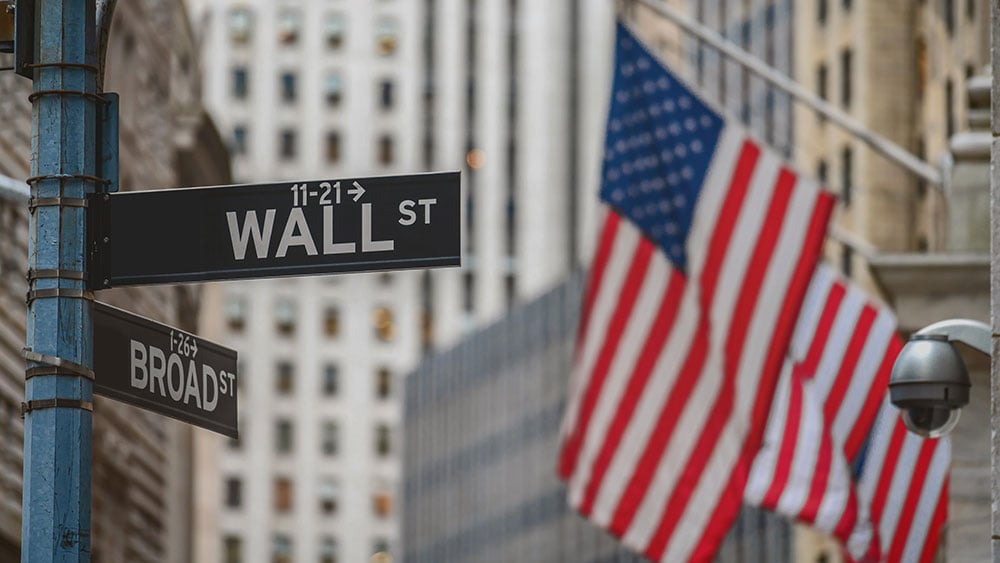
Futures for the Dow Jones Industrial Average and the other major stock indexes traded lower Monday as Wall Street braced for “the single greatest financial offensive ever” against Iran. Meanwhile, Alibaba (BABA) was an early loser on the stock market today. Ahead of Monday’s open, Dow futures dropped 0.1%, as S&P 500 futures lost 0.2%. Nasdaq-100 futures declined 0.5% in…
Copyright ©2026 Investor’s Business Daily, LLC. All rights reserved. 87990cbe856818d5eddac44c7b1cdeb8


A crypto trader claimed yesterday an update for the FOMO app caused $6 million in crypto losses.
In a social media post, they cited an example of someone allegedly losing 662 SOL, worth about $62,000, after opening the iOS app called FOMO.
FOMO co-founder Prashan Dharmasena rejected the claim, countering, “It’s crazy that people can just come on this app and blatantly lie,” adding that the account in question has no transaction signed by FOMO’s fee payer.
Sticking to his story, Dharmasena repeated his defense to at least two other accusers.
The source of the original accusation is Derivatives_Ape, an X account built around Solana trading commentary, but that account isn’t the alleged victim. Instead, the post claims a “friend” suffered the loss.
According to forensic researcher ZachXBT, Derivatives_Ape, is a co-founder of Zkasino who “stole $30 million of investor funds.”
Although ZachXBT named the account as Zkasino co-founder Elham Nourzai, the handle seemed to be controlled by another Zkasino co-founder, Ildar Elham.
Read more: ZKasino rug pull suspect arrested in United Arab Emirates
The transaction exists, but who caused it?
The transaction included in the original allegation is a real transaction.
Despite displaying as truncated text, the screenshot in the allegation is authentic from solscan.io, a legitimate block explorer for Solana’s blockchain. There is a transaction that moved 662 SOL out of the cited wallet 14 minutes before the allegation posted to social media.
However, Dharmasena contests whether any bug in the FOMO app caused that movement — and whether it was an unauthorized transfer.
FOMO itself closed a $17 million Series A led by Benchmark in September 2025. Chetan Puttagunta from Benchmark, a top VC firm, took a board seat.
The company also raised a $75 million Series B led by Index Ventures, valuing the company at $550 million, with another leading VC participating, Union Square Ventures.
Balaji Srinivasan and Solana co-founder Raj Gokal are investors.
Read more: Coldcard attack: 25 minutes, 500 wallets, $38M in BTC gone
FOMO app denies responsibility
Derivatives_Ape wrote that FOMO “must have accidentally added something malicious in its new code” and that a friend “could literally watch the funds moving on-chain, but on the FOMO app it still showed as if his balance was there.”
The same post pins total damage at $6 million so far, limited to iOS. No breakdown, victim list or methodology accompanies that estimate.
FOMO’s own security documentation states flatly, “FOMO cannot access, move, or freeze your funds.” That self-custodial design, if true, would make a server-side drain of funds difficult.
Dharmasena argues the wallet named in the complaint never signed a transaction through FOMO’s own fee payer, which although that would exonerate FOMO in his view, is also a bit narrower than saying the wallet never touched the FOMO app at all.
FOMO’s incentive to deny an exploit is obvious. An active drain would threaten a company that has raised roughly $94 million in disclosed funding.
Derivatives_Ape might also have an incentive problem. Dharmasena’s repeated “paid fud” framing alleges coordinated, financially motivated disinformation.
A third-party account came to FOMO’s defense, claiming, “There’s a few other users posting the same text, probably paid by competitors” and that the specific wallet named was “not created through @fomo” at all.
The FOMO iOS app, as of writing time, is still live in Apple’s App Store.
Got a tip? Send us an email securely via Protos Leaks. For more informed news and investigations, follow us on X, Bluesky, and Google News, or subscribe to our YouTube channel.
The London-based multinational bank with $850 billion in assets announced it will distribute Anchorpoint’s HKDAP to eligible clients and partners.
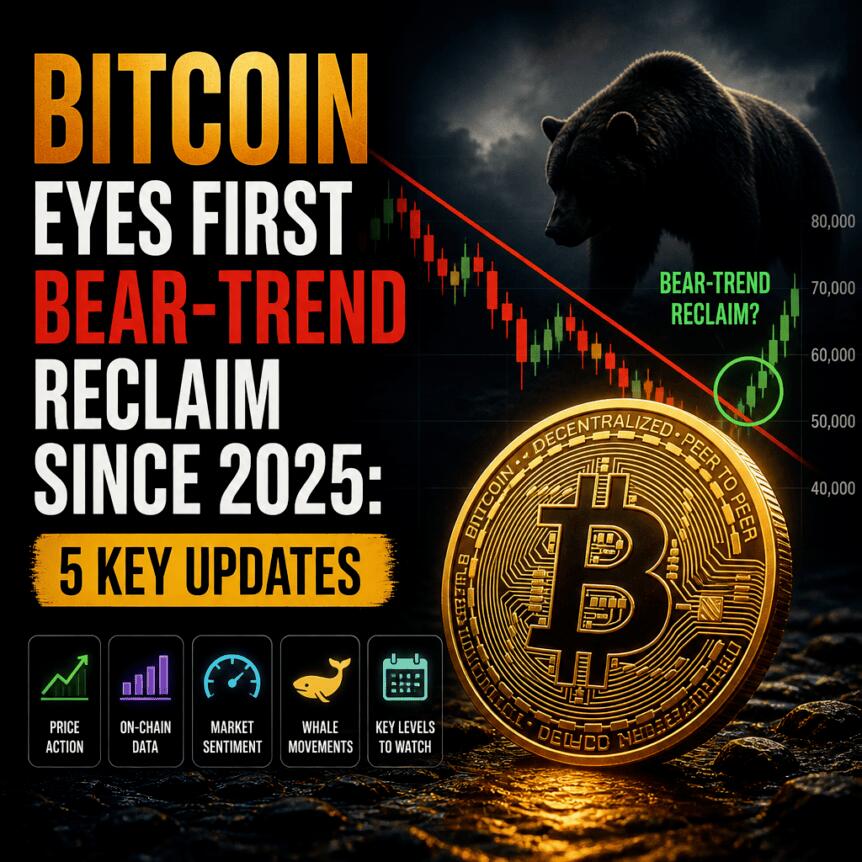
Bitcoin is entering the last week of August near its strongest levels since early May, as a bear-market recovery appears to be testing major technical levels and drawing fresh attention from both traders and ETF investors. After a rally that pushed the market to $79,550, BTC/USD finished the week around $77,727 on Bitstamp, according to TradingView data—an outcome traders are now watching for follow-through rather than a quick rebound.
The shift matters because it coincides with improving on-chain profitability by several wallet cohorts, a renewed return of capital to US spot Bitcoin exchange-traded products, and a busy US macro calendar that could influence risk appetite. Still, analysts caution that resistance overhead—especially around the $80,000 area—may determine whether this strength becomes a durable trend or another temporary relief move.
Key takeaways
- Bitcoin closed a weekly candle above its 50-week exponential moving average for the first time since early November 2025, reclaiming a long-watched bear-market level.
- On-chain data highlighted by CryptoQuant shows “new money” breaking into net profitability, but it also places a key breakeven region around $73,000.
- Spot Bitcoin ETF netflows totaled $1.9 billion over the prior week, the strongest weekly inflow since October 2025, per Farside Investors.
- Macro focus turns to the Fed’s Jackson Hole symposium and the release of US PCE inflation data ahead of Wednesday’s print.
Bitcoin reclaims the 50-week EMA—now comes the “hold” test
Last week’s move was notable not just for its size, but for what it reclaimed. BTC reached $79,550 during the rally, its highest level since early May. The week ended with BTC/USD at $77,727 on Bitstamp, which signaled a reclaim of the 50-week exponential moving average—currently near $77,752—based on TradingView charts.
This 50-week EMA has historically been treated as a pivotal line during bear markets, and the last time Bitcoin achieved a weekly close above it was in early November 2025. In earlier cycles, traders have noted that price often retests the 50-week EMA before the market either confirms a transition to a stronger regime or slips back into deeper declines.
That backdrop is why some analysts are framing last week’s breakout as conditional. Crypto trader and analyst Rekt Capital previously warned that the 50-week EMA alone was not the full challenge; he pointed to the broader $80,000 area as the next hurdle for bulls. In his ongoing X commentary, he argued that bear-market relief rallies in the past have tended to retrace sharply in the week following a strong breakout—making the coming sessions critical to whether the market can sustain the new highs.
Rekt Capital also shared charts suggesting the formation of “macro lower highs,” implying recent strength could still fit within a larger downtrend structure until Bitcoin convincingly changes that pattern.
Profitability shifts on-chain, but downside “margin” may be thin
Technical reclaim is one side of the story; on-chain profitability is the other. The rally improved conditions for multiple wallet cohorts. A key reference point highlighted by CoinGlass data is that August is shaping up as Bitcoin’s best performing month since 2017, with the asset up roughly 22% month-to-date as of the time of writing.
CryptoQuant’s analysis tied this rebound to changes in realized cost bases by age cohort. CryptoQuant pointed to the “aggregate cost basis” for short-term holders—defined as wallets holding UTXOs for less than 155 days—at about $68,700. On that basis, CryptoQuant estimated STHs are now net profitable by just over 11%.
The same read-through showed long-term holder profitability moving from near breakeven to about +18.5%, while “new money” profitability rose from approximately -1.4% to +12.7%. More importantly for risk assessment, CryptoQuant calculated that “new money” now has a breakeven level around $73,000—above both the STH and LTH cost bases.
That creates a narrower cushion. CryptoQuant said the “68K–73K region” is now the key area to watch: holding above it would suggest the profitability reset is becoming structurally more durable, while losing it could quickly push a meaningful portion of the recent buyer base back into loss territory.
For traders, the takeaway is practical: if the market’s technical strength is translating into sustained demand, the on-chain distribution should stabilize above the key breakeven band. If it doesn’t, the risk is that the next pullback becomes sharper because fewer holders are positioned to absorb selling without realizing losses.
Jackson Hole, PCE inflation, and Treasury market moves set the tone
Beyond charts and chain data, Bitcoin’s near-term direction is likely to remain sensitive to US policy signals. All eyes this week are on the Federal Reserve and chair Kevin Warsh as the annual Jackson Hole economic symposium gets underway. The event will feature central bankers from more than 70 countries and includes Warsh’s first keynote speech as Fed chair, alongside his first public appearance since the July Federal Open Market Committee press conference.
Markets have been weighing how Warsh approaches interest-rate guidance—particularly after data has supported some softening in the expected policy path. However, traders are also keeping one eye on inflation risk stemming from geopolitical drivers, including oil-price volatility tied to the US-Iran conflict.
CME Group’s FedWatch Tool shows 63.1% odds that rates remain at 3.50%–3.75% after the September FOMC meeting, reflecting broad expectations that the near-term path may not involve immediate tightening.
There’s also a more complex angle: Warsh’s role appears tied to Treasury market considerations as policymakers seek to reduce the Fed’s involvement in day-to-day market functioning. In recent remarks reported by CNBC, strategist Thierry Wizman warned that signaling a persistently “dovish” stance could complicate Treasury goals by pushing inflation expectations higher, potentially undermining stability in nominal long-term yields.
Alongside Jackson Hole, the macro schedule includes the release of the July Personal Consumption Expenditures (PCE) inflation index on Wednesday. The PCE is widely treated as the Fed’s preferred inflation gauge, and in June it showed a first month-on-month decline since 2020, adding weight to the focus on the new print. Consensus expectations for Wednesday’s report call for a 0.1% monthly increase, with the year-on-year rate cooling to 3.6% from 3.7% in June.
Importantly, investors are not entering this data week from a calm baseline. The previous week’s market narrative was shaped by a US Treasury decision to at least double the size of its debt buyback operations to $4 billion per operation. That move contributed to a short squeeze in crypto, with liquidations reported at $3.1 billion over two days as Bitcoin moved higher.
Some market commentary suggested the Treasury action may have echoed broader “yield curve control” expectations—an idea long discussed by crypto commentators in the context of liquidity regimes and the relationship between government financing costs and broader asset markets.
ETF flows rebound sharply — but investors are watching for follow-through
One of the clearest signals of renewed demand has come from US spot Bitcoin ETFs. According to Farside Investors data compiled via its BTC ETF tracker, the ETF cohort pulled in $1.9 billion over the prior five trading days—the strongest weekly total since October 2025, when Bitcoin reached its latest all-time highs around $126,200.
Activity was particularly strong during the week’s later sessions as BTC/USD extended gains beyond $70,000. BlackRock’s iShares Bitcoin Trust (IBIT) recorded net inflows of more than $500 million on Thursday, according to the report citing Bloomberg’s coverage.
OKX SG CEO Gracie Lin, speaking to Bloomberg, said the key pattern was that there were net inflows on every trading day the previous week, suggesting renewed investor interest. She also cautioned that after a strong rally, some profit-taking would not be surprising.
The contrast versus recent history is stark. Two months earlier, June saw highly unusual outflows, with more than $4.5 billion leaving spot Bitcoin ETFs—described as unprecedented in the coverage. By the end of last week, August inflows stood at $2.38 billion, a new year-to-date record.
For market participants, ETF flows are often used as a signal of whether “spot” demand is expanding or merely cycling with volatility. The immediate question now is whether this inflow momentum can persist as Bitcoin tests resistance and as macro catalysts (Jackson Hole and PCE data) land.
Looking ahead, the next few trading sessions should clarify whether Bitcoin’s weekly reclaim of the 50-week EMA translates into sustained demand: traders will likely weigh price acceptance above the $80,000 resistance zone, while on-chain investors should watch whether the $68,000–$73,000 breakeven band holds. With Jackson Hole and the July PCE report approaching, volatility risk may remain elevated, but the ETF flow trend could determine whether this strength is gaining real traction.


Gemini Space Station and Apex Fintech Solutions have signed a letter of intent that would make Gemini Titan the exclusive regulated venue for crypto prediction contracts distributed to brokerage customers through Apex’s futures commission merchant.
Summary
- Gemini and Apex have signed a letter of intent to distribute crypto prediction markets through Apex’s brokerage network.
- Gemini Titan would become the exclusive regulated venue for crypto event contracts offered through Apex’s FCM.
- Brokerages using the service would rely on Gemini for execution and clearing of crypto prediction contracts.
- The companies may also work together on sports, economic and financial event contracts on a non-exclusive basis.
Gemini and Apex said Monday that brokerages offering crypto event contracts through Apex’s Futures Commission Merchant, or FCM, would use Gemini for execution and clearing under the proposed arrangement, extending an existing relationship between the two financial companies into prediction markets.
The agreement remains subject to final terms, which the companies expect to work out over the coming weeks. Once completed, brokerage firms connected to Apex would be able to offer crypto event contracts without establishing a separate execution and clearing arrangement with Gemini Titan.
“Under the alliance, brokerages that offer crypto event contracts through Apex’s FCM will use Gemini for execution and clearing,” the companies said.
Other prediction-market categories could also become part of the relationship. Gemini and Apex said they may work together on contracts covering sports, economic events and financial markets, although those areas would be handled on a non-exclusive basis.
Gemini prediction markets would gain another distribution channel
The planned arrangement would give Gemini Titan access to brokerage customers using Apex infrastructure as the crypto exchange builds out a prediction-market business launched less than a year ago.
Gemini entered the regulated U.S. prediction-market sector after Titan received a Designated Contract Market license from the Commodity Futures Trading Commission in December 2025.
As crypto.news previously reported, Gemini Titan secured the CFTC authorization following a roughly five-year review, allowing the company to operate a federally regulated event-contract market in the United States.
Gemini began offering prediction markets shortly afterward, giving eligible customers access to contracts whose payouts depend on specified future outcomes.
Titan has since recorded more than 225 million event contracts traded, according to Gemini’s second-quarter 2026 earnings presentation. The company also reported more than 27,000 cumulative traders on the platform.
Prediction markets remain a relatively small revenue source for Gemini despite the increase in contract activity. Gemini reported about $500,000 in prediction-market revenue during the second quarter, compared with company-wide revenue of $45.5 million.
The business had already crossed 100 million contracts and 20,000 traders by the first quarter, when prediction-market revenue stood at roughly $400,000, according to an earlier company update.
Gemini’s founders Tyler and Cameron Winklevoss have identified prediction markets as one of the central parts of the company’s Gemini 2.0 strategy alongside artificial intelligence.
“Our thesis is that prediction markets will be as big or bigger than today’s capital markets,” the Winklevoss twins previously said. “Predictions will be the machine within our app to see the future. A truth machine.”
Gemini has also brought derivatives clearing in-house
Gemini added another regulatory component to its prediction-market infrastructure in April when its Olympus subsidiary received approval to operate as a Derivatives Clearing Organization.
The CFTC clearing approval gave Gemini Olympus authority to clear derivatives and provided the company with an affiliated clearing operation alongside Titan’s DCM license.
With Titan operating the regulated marketplace and Olympus providing clearing infrastructure, Gemini gained the ability to handle more of the derivatives trade lifecycle within its own group.
The April authorization covers infrastructure that can support futures, options, perpetual contracts and prediction markets. Gemini had already disclosed plans to study additional regulated crypto derivatives for U.S. customers after Titan obtained its DCM license.
Gemini said during its second-quarter update that its derivatives clearinghouse went live on Aug. 4, bringing settlement of prediction contracts under the company’s own infrastructure.
Such capabilities become relevant to the Apex agreement because the proposed arrangement specifically places both execution and clearing of crypto event contracts with Gemini.
Apex relationship already extends to U.S. stock trading
Gemini and Apex were already working together before Monday’s prediction-market agreement.
In July, Gemini introduced commission-free U.S. stock trading for eligible customers, with Apex Clearing Corporation providing custody and trade clearing for the service.
The stock trading rollout allowed Gemini customers to trade thousands of U.S.-listed equities while remaining within the company’s application.
Nasdaq provides real-time market data for the service, while Apex handles custody, execution-related infrastructure and clearing.
Gemini launched the product after updating its Financial Industry Regulatory Authority broker-dealer registration so that it could operate as an introducing broker. Customer orders could consequently be routed through the supporting brokerage infrastructure without Gemini taking on every part of the securities transaction itself.
The company has been adding products outside spot cryptocurrency trading as it develops a platform spanning crypto, equities, derivatives, credit cards, staking and prediction markets.
Prediction markets have also been combined with Gemini’s artificial-intelligence products. In May, the company introduced a Grok prediction feature that uses information including user positions, watchlists and previous prediction activity to personalize the contracts displayed to customers.
Gemini said the feature focuses on market discovery rather than allowing the AI system to execute trades automatically.
Prediction markets face competition and regulatory disputes
Gemini Titan operates in a sector where Kalshi and Polymarket account for substantially more trading activity, with the two platforms recording tens of billions of dollars in monthly volume.
Kalshi operates under a CFTC-regulated structure in the United States, while Polymarket has pursued its own route back into the U.S. market after previously restricting American customers.
Regulatory disputes have also developed over whether federally regulated event contracts can be subject to separate state gambling laws.
New York Attorney General Letitia James sued Gemini Titan and Coinbase Financial Markets in April, alleging that prediction contracts offered by the companies violated state gambling rules.
The state argued that certain event contracts amounted to gambling products offered without authorization from the New York State Gaming Commission. Gemini and other prediction-market operators have relied on their federal derivatives registrations in disputes over which regulators have authority over such products.
Similar legal fights have spread to other states. Wisconsin later sued Kalshi, Coinbase and Polymarket over prediction markets, with state regulators challenging the companies’ argument that federal commodities oversight takes precedence over state gambling laws.
Gemini’s federally regulated infrastructure has continued operating while those cases progress. Titan holds the company’s DCM authorization, while Olympus holds its DCO license for clearing derivatives.
The Apex agreement has not yet reached the definitive-contract stage. Gemini and Apex said they expect to finalize the remaining details of their proposed collaboration in the coming weeks.
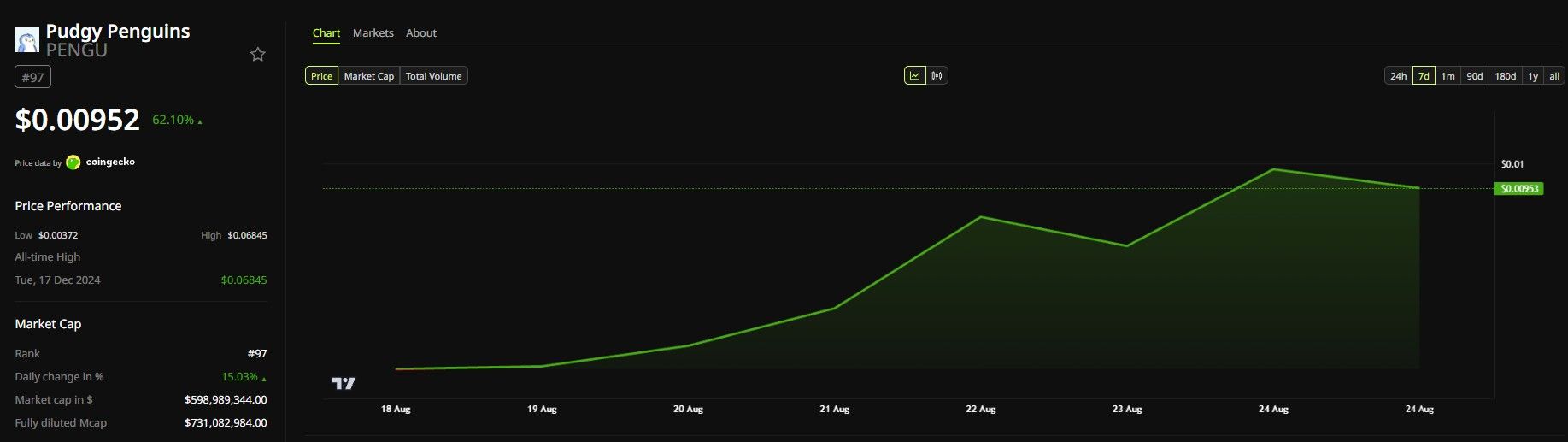
Pudgy Penguins token PENGU climbed 62.1% over the past week and now trades near $0.0095. Traders link a cryptic post from CEO Luca Netz to the company’s stated ambition of a public listing.
The token added roughly 15% in the last 24 hours alone. Meanwhile, its market value sits close to $598 million, ranking PENGU 97th across all cryptocurrencies.
What Is Driving the PENGU Token Rally
LBank, a centralized crypto exchange, opened a promotional campaign with Pudgy Penguins in August. The program combines trading competitions, giveaways, and yield products that lock user deposits for 30 days. Those locked products keep tokens away from exchange order books for a month at a time. Therefore, the campaign thins the supply available to sellers while it runs.
The brand keeps widening its offline footprint too. Plush toys and collectible figures now sell through Walmart and Target stores across North America. Netz pushed the Target rollout directly to his followers this weekend.
Retail distribution has become the core bull case here. In January, the project moved deeper into sports through its Manchester City NFT deal. That pivot matters more now, because the wider NFT market cap slide has hit blue-chip collections hard this year.
IPO Speculation Points Back to a 2027 Target
Netz posted four emojis: a pair of eyes, a penguin, and a building, followed by an arrow and the word soon.
Many traders read the building as a stock exchange. Netz attached no text to the post, however, and never tied it to a listing.
His timeline traces back to an interview published in August 2025. Netz said he would be disappointed in himself if the company failed to list within two years. That deadline falls in 2027, and he asked investors to hold him to it.
Revenue underpins his case. Pudgy Penguins guided toward roughly $50 million in annual sales at the time. Toys, not token activity, generated most of that figure.
That split also marks the harder part of the plan. Merchandise revenue flows to the company, while PENGU holders own a brand asset with no claim on it. A US listing would additionally demand audited accounts and a clean legal line between the equity and the token. Shareholders would capture the toy revenue, therefore, and the token would not automatically follow.

Momentum still looks fragile. The PENGU price trades far below its December 2024 record of $0.06845. The token has climbed off a February low near $0.0053, though, and it broke a long downtrend in April around $0.0083. Analysts flagged PENGU repeatedly among meme coins to watch through the spring.
The goal itself is therefore on the record, but the paperwork is not. No registration statement has surfaced, and the company has named neither a bank nor a venue. Traders are pricing a stated ambition, an exchange promotion, and retail momentum well ahead of any filing.
The post PENGU Jumps 62% in a Week on IPO Speculation and a Target Rollout appeared first on BeInCrypto.
Solana price held near $95 on Aug. 24 after gaining roughly 26% as regulatory optimism, record tokenized-asset value and active network governance votes supported the rally.
Summary
- Solana price gained about 26% after breaking above the former $78 resistance level.
- SOL faces daily resistance between $97.68 and $98.44 after briefly reaching $102.88.
- Validators are voting on proposals covering governance, inflation, and transaction fees.
- Liquidation liquidity is concentrated near $96.30, with another cluster around $93.
Solana price action today
According to data from crypto.news, Solana (SOL) price traded at $94.71 at press time on Aug. 24. The token had risen from around $75 before accelerating above $78 on Aug. 19.
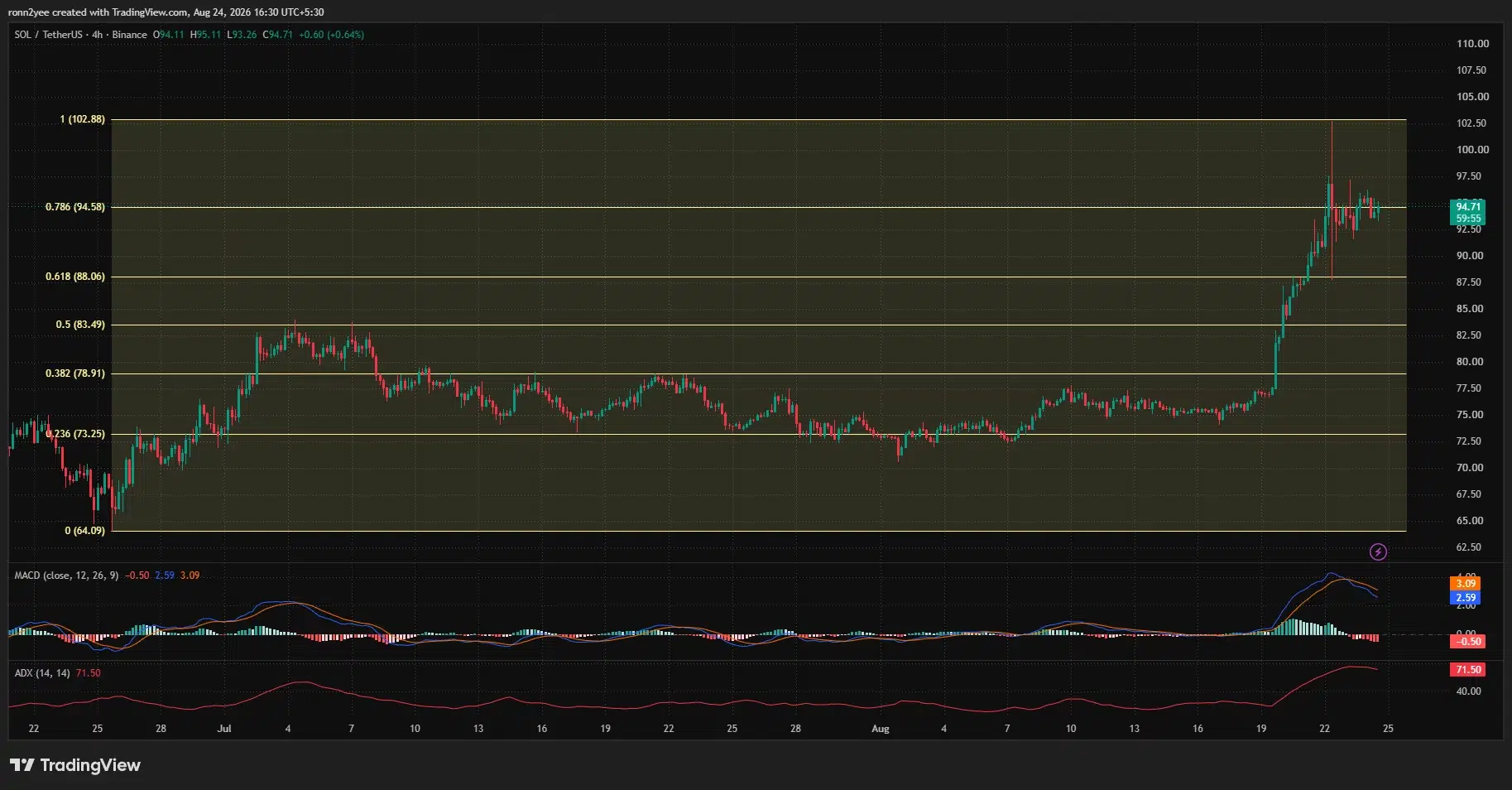
On the 4-hour chart, SOL extended the breakout through $83.49 and $88.06, corresponding to the 50% and 61.8% Fibonacci retracement levels measured from $64.09 to $102.88. The rally briefly carried the price above $100 before sellers forced it back toward $88.
Buyers subsequently defended the pullback and returned SOL to the $94.58 Fibonacci level. Price was consolidating slightly above that mark at the time of the chart capture, leaving the market near the upper end of its two-month range.
The daily chart shows SOL trading above its 20-, 50-, 100-, and 200-day moving averages. Those averages were positioned between $76.56 and $81.27, showing how far the price moved from its recent trend levels during the rally.
SOL’s advance also followed a wider crypto recovery. Bitcoin and crypto-linked U.S. stocks rose after the Treasury expanded its long-duration debt buybacks and President Donald Trump renewed his push for the CLARITY Act.
What is driving the SOL rally?
The rally coincided with the U.S. Securities and Exchange Commission’s Aug. 18 proposal for a new framework called Regulation Crypto Assets.
The SEC said the proposed rules would give crypto companies clearer routes to raise capital under federal securities laws. The framework would also establish conditions under which certain crypto-related investment contracts could move outside existing securities requirements.
The proposal does not amount to a Solana-specific ruling or automatically remove every regulatory risk facing SOL. However, its publication reduced some of the uncertainty surrounding how U.S. securities rules may apply to functional blockchain networks and token offerings. Public comments remain open through Oct. 20.
Solana also received a network-specific catalyst when voting opened on its first three formal governance proposals. According to crypto.news, voting will remain open through epoch 1023, expected to end on Aug. 27 at approximately 15:30 UTC.
SGP-0001 would introduce the Solana Constitution as a common governance framework. SGP-0002 would double the network’s annual disinflation rate from 15% to 30%, potentially removing about 18.9 million SOL from scheduled emissions over six years.
SGP-0003 proposes a new resource and inclusion fee structure. SolanaFloor estimated that the change could raise daily SOL burning from about 648 tokens to roughly 9,000, although the outcome depends on validator approval and subsequent network activity.
Solana’s tokenized real-world asset market provided another source of support. RWA.xyz data showed that the value of tokenized assets on the network crossed $4 billion for the first time, while the number of RWA holders reached approximately 348,489.
SOL resistance sits between $97.68 and $102.88
SOL must first close decisively above the daily resistance zone between $97.68 and $98.44 to extend its recovery. The price tested the area during the latest rally but failed to hold above it.
A confirmed breakout would bring $100 back into view, followed by the Aug. 22 wick at $102.88. Clearing that high would remove the most visible nearby supply zone on the provided charts.
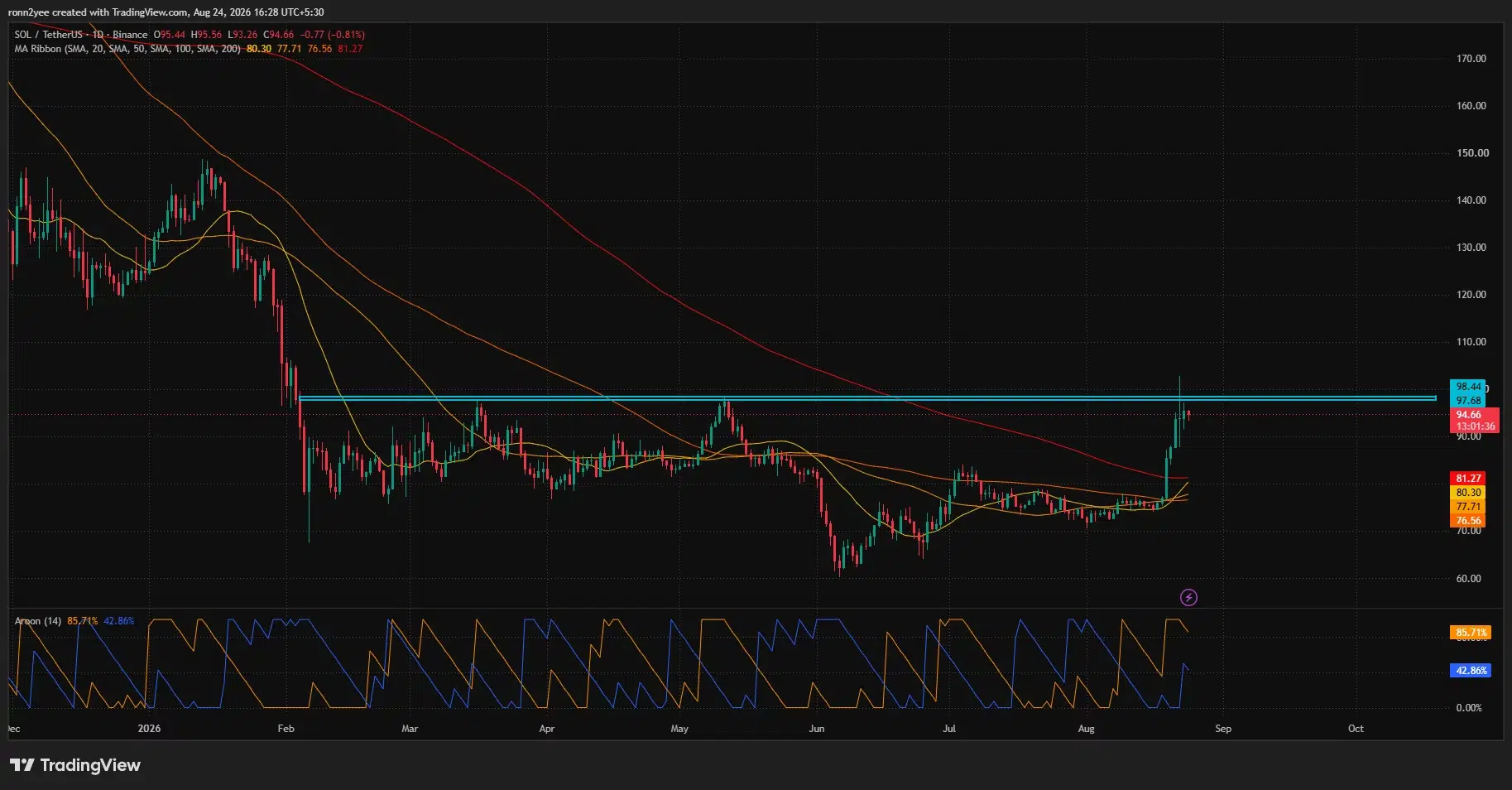
The Aroon indicator supports the broader bullish setup. Aroon Up stood at 85.71%, compared with Aroon Down at 42.86%, showing that a recent high carried more weight than the latest low.
Trend strength also remained elevated on the 4-hour chart, where the Average Directional Index registered 71.50. An ADX reading above 25 generally signals a strong trend, although the indicator measures strength rather than direction.
Short-term momentum has started to weaken. The 4-hour MACD line fell to 2.59, below its signal line at 3.09, while the histogram declined to minus 0.50. The bearish crossover suggests SOL may consolidate or retest support before attempting another breakout.
The first support sits near $94.58. A close below that level would expose the $92.50–$93.25 area, followed by $88.06. The deeper $83.49 level would become important if sellers reverse the breakout, while a move below $78.91 would materially weaken the current structure.
Liquidation map points to a battle near $96
CoinGlass’ 24-hour liquidation heatmap shows the largest nearby concentration of leveraged positions around $96.20–$96.40. Price often moves toward areas containing dense liquidation orders, but the map does not guarantee that SOL will reach or break the cluster.
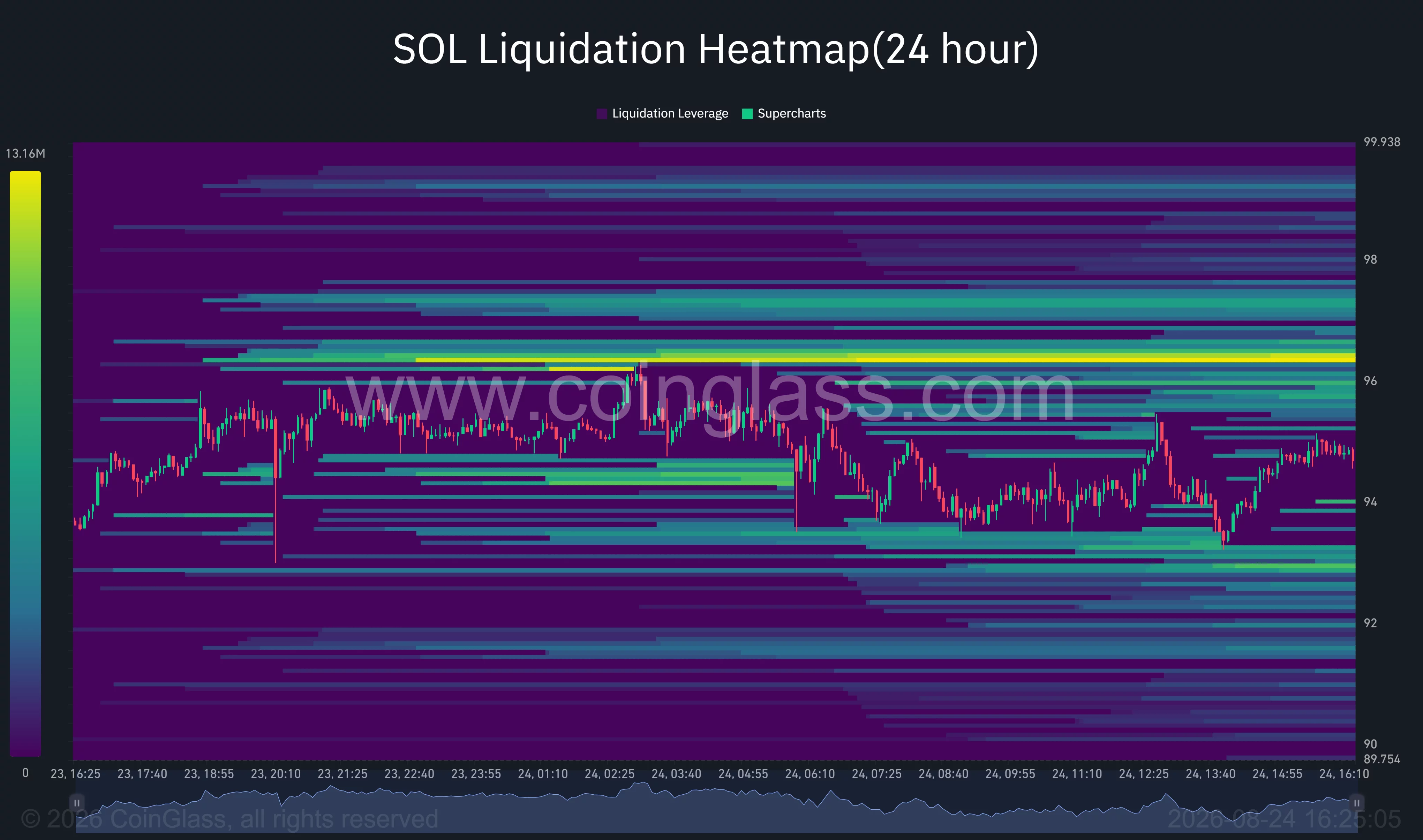
A move above $96 could force some short positions to close, potentially helping SOL retest the $97.68–$98.44 resistance zone. Further liquidity appears between approximately $97 and $99.50.
Below the market, liquidation concentrations are visible around $93 and from $91.50 to $92. A rejection below $94 could therefore produce a faster move toward those lower pools before spot buyers re-enter.
The chart does not support attributing the wider market’s reported multibillion-dollar liquidation total solely to SOL. Any such figure should be described as covering the broader crypto derivatives market unless CoinGlass provides an asset-specific total.
What analysts are watching next
Crypto analyst Haris identified the $98–$102 area as the main resistance zone after SOL’s latest rejection. The analyst said a break below $85 would weaken the setup, while the supplied daily chart places more immediate support at $88.06 and $83.49.
The governance vote may provide the next Solana-specific catalyst. Approval of SGP-0002 would reduce future token issuance faster, while SGP-0003 could increase the amount of SOL burned through network fees. Rejection would preserve the existing emission or fee structure.
For U.S. investors, the SEC proposal remains the larger policy event. The rules are still at the proposal stage and may change following public comments, meaning the recent rally reflects expectations rather than a completed regulatory change.
SOL’s ability to hold $94.58 while momentum resets will determine whether the move becomes a sustained breakout. A daily close above $98.44 would strengthen the bullish case toward $102.88, while a loss of $88.06 would raise the risk that the rally is unwinding.
Disclosure: This article does not represent investment advice. The content and materials featured on this page are for educational purposes only.

Liam Gallagher Denies Oasis Glastonbury 2027 Rumours

Faults expose larger cable issue

Flowra launches Open Orderflow Auction for Solana validators





-

 Fashion3 days ago
Weekend Open Thread: Madewell – Corporette.com
-

 Business6 days ago
SMA Solar Technology AG (SMTGY) Q2 2026 Earnings Call Transcript
-

 Crypto World2 days ago
anatomy of crypto’s biggest liquidation event since 2021
-

 Business2 days ago
Musk’s Tesla, SpaceX Confirm $16.8 Billion ‘Terafab’ Chip Plant as World’s Largest Building in Texas
-

 Tech6 days ago
Qwen3.8-27B runs frontier-class coding agents and reasoning locally, no cloud API required
-

 Crypto World7 days ago
OCC Greenlights Trump Family Crypto Firm for Trust Charter
-

 Politics2 days ago
6 months on, Irish renters crushed by effects of government housing bill
-
 NewsBeat2 days ago
The ‘Lucky Dip Gang’ causing carnage for clicks: After five thugs were killed speeding in the wrong direction on a motorway, GUY ADAMS investigates a sick new trend… and why police aren’t even allowed to pursue them
-

 Crypto World7 days ago
NAVI Prime launches institutional lending framework on Sui
-

 News Videos4 days ago
Don’t Leave Your Financial Future To Chance | August 19, 2026
-

 Tech5 days ago
GLM-5.3 hits the API at $1.4/$4.4 per million tokens
-
Tech6 days ago
5 Of The Most Reliable Car Brands To Consider If You’re Buying A Used SUV
-
 Crypto World7 days ago
Dow’s 3-Year Winning Run Isn’t a Crash Signal, Still 49% Odds of Double-Digit Gains
-

 Business6 days ago
Stock Market Today: Tech Futures Slide As Treasury Yields Jump; Nvidia, Micron, Sandisk Sell Off
-

 Tech6 days ago
Keychron K8 Ultra 8K review: a great value keyboard with comfort issues
-
 Tech7 days ago
Nvidia discloses $21B stake in SpaceX
-
Business6 days ago
Fabrinet (FN) Q4 2026 Earnings Call Transcript
-

 Business4 days ago
Five Below: Kids Discount Retailer Reaps Rich Rewards
-

 Business5 days ago
Marvell Shares Jump 7% as Google Chip Deal Confirms Custom AI Silicon Partnership, Analysts
-
 NewsBeat7 days ago
Trump explodes at CNN reporter after question about young blonde aide who wrote him besotted letters
You must be logged in to post a comment Login