

Crypto World
Coinbase Warns of Possible Weekend Disruptions: What You Need to Know

The leading US-based cryptocurrency exchange warned its users that they may experience certain disruptions this weekend.
The company has recently drawn significant attention after cutting staff and introducing a series of platform adjustments and other developments.
Attention This Saturday
Coinbase has scheduled a system upgrade for Saturday (May 23), which is estimated to last approximately half an hour. The team explained that during this time, trading will not be impacted, while order status updates across all markets may be delayed. The company promised to provide updates as the maintenance progresses.
These types of upgrades are fairly standard and typically not a cause for alarm. In October last year, for instance, Coinbase went temporarily offline due to a similar reason, and there were no reports of major complications.
Another disruption was witnessed earlier this month. Certain Coinbase users found themselves unable to complete transactions, while others experienced degraded service speeds due to an AWS overheating issue. The exchange swiftly diagnosed the problem and began working to “re-enable” trading across its markets.
Some users noted on social media that the outage happened shortly after Coinvase disclosed it was cutting its global workforce by 14%. CEO Brian Armstrong cited ongoing market volatility and the rapid pace of Artificial Intelligence (AI) as the main reasons for the decision.
Further Developments
Apart from the aforementioned news, Coinbase made the headlines after becoming the official treasury deployer of USDC under Hyperliquid’s Aligned Quote Asset (AQA) framework.
Under this role, the exchange will handle USDC liquidity directly for the protocol, helping strengthen its on-chain financial operations. The collaboration also positions Coinbase as a key contributor to the growing decentralized derivatives ecosystem.
For its part, Hyperliquid revealed that both Coinbase and Circle have agreed to stake HYPE tokens to support the activation of AQAv2 (the next upgrade to the Aligned Quote Asset (AQA) on the decentralized exchange).
Coinbase has also carried out some delisting efforts. Last week, it scrapped six non-USD trading pairs, including ICP/USDT and ICP/GBP. This was followed by a 10% price decline for Internet Computer to just under $3. The asset failed to rebound and extended its losses over the next few days, currently hovering near $2.50.
The post Coinbase Warns of Possible Weekend Disruptions: What You Need to Know appeared first on CryptoPotato.

The United States Senate has voted to advance a resolution that could force US President Donald Trump to seek congressional authorization to continue the country’s war with Iran.
The vote on a procedural war-powers measure on Tuesday passed by 50 to 47, with four Republicans also voting in favor, according to Reuters.
Policymakers have been arguing that Congress, not the president, should have the power to send troops to war, as spelled out in the US Constitution.
The US-Israeli war with Iran has been going on for almost three months, putting pressure on global economies because of surging fuel and energy prices after the closure of the Strait of Hormuz. The bill could force Trump to withdraw US troops from Iran unless he gains congressional approval.
However, the bill still faces major hurdles. It must pass the full Senate and Republican-led House of Representatives, and Trump could also veto it, which would then require a two-thirds vote in both the House and Senate to override it.
Pressure mounts on Trump over Iran war
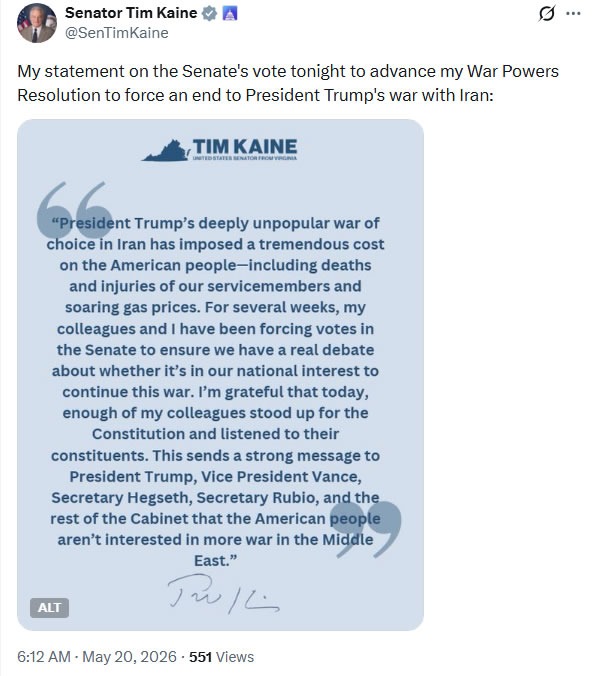
Democratic Senator and bill sponsor Tim Kaine of Virginia said on X that it had been 80 days since Trump launched his “illegal war” against Iran.
“Congress has the power to slam the brakes on this unwise conflict. Today should be the day when the Senate tells the President to stop his disastrous war.”
Republican Senator Bill Cassidy agreed, writing on X: “While I support the administration’s efforts to dismantle Iran’s nuclear program, the White House and Pentagon have left Congress in the dark on Operation Epic Fury.”
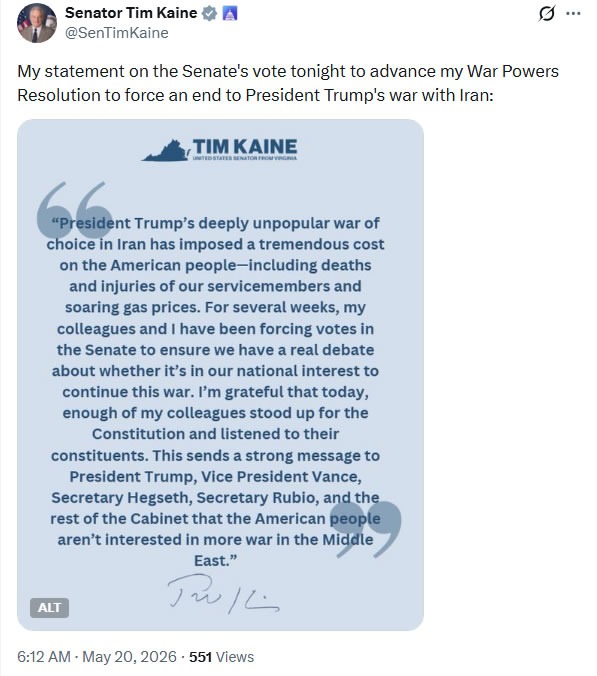
Statement from Senator Tim Kaine. Source: Tim Kaine
Potential impact on crypto markets
The ongoing conflict and macroeconomic headwinds, such as rising inflation, have hampered the crypto market’s recovery, with digital assets trading mostly sideways for almost four months.
Any potential end to the war with Iran could ignite a market rally if economies recover and confidence in higher-risk investments returns.
Related: Bitcoin lost its hold on $80K, but three events may send it back sooner than markets expect
HashKey Group senior researcher Tim Sun told Cointelegraph on Wednesday that this “directly indicates that Trump is facing mounting domestic political pressure regarding his continued use of military force.”
“This signal serves as a relatively mild positive catalyst for risk assets as a whole, rather than a decisive factor. The market’s current focus remains firmly on macroeconomic shifts.”
“If geopolitical conflicts ease and subsequently drive oil prices further down, it will lower the valuation risk across all risk assets and foster a positive turnaround in the crypto market,” he added.
Andri Fauzan Adziima, research lead at the Bitrue Research Institute, told Cointelegraph that the war powers resolution’s advance is “a strong bullish catalyst for crypto, likely sparking a sharp 6% to 10% Bitcoin relief rally in the coming days.”
“Past de-escalation headlines triggered instant 3% to 5% BTC spikes, and with Bitcoin holding $76K to $77K, this eases risk-off pressure, and boosts flows,” he added.
Markets had not reacted at the time of writing, with Bitcoin remaining flat at around $76,500 over the past 24 hours.
Magazine: Guide to the top and emerging global crypto hubs: Mid-2026
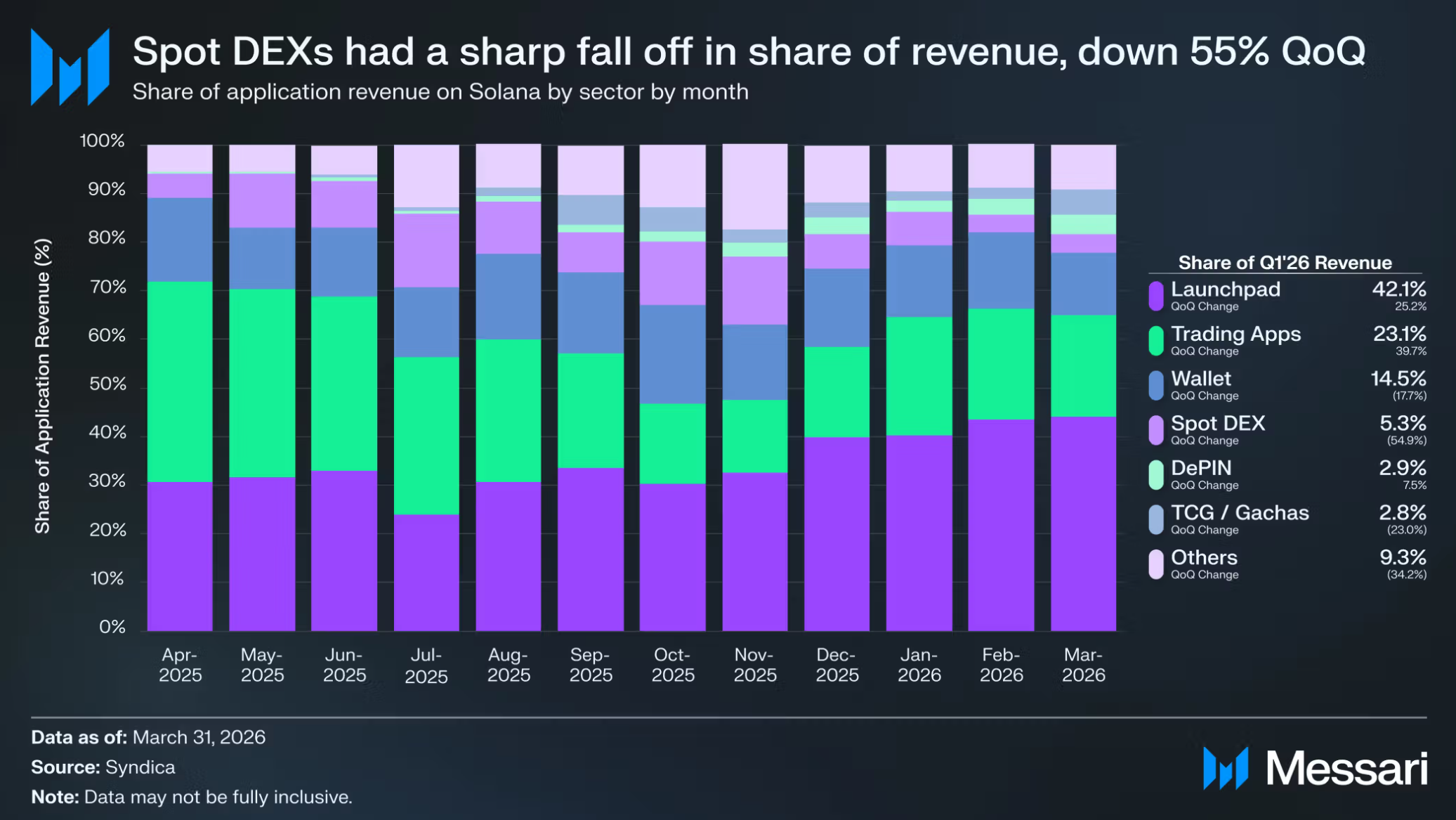
Pump.fun remained Solana’s largest revenue generator in the first quarter of 2026, pulling in $124.7 million, more than a third of the network’s $342.2 million in total app revenue, despite cooling memecoin activity.
The memecoin launchpad’s revenue rose 17% quarter over quarter, a sign that its core business remains resilient, Messari said in its Solana Q1 report.
Launchpads generated $144 million in Q1, roughly 42% of Solana’s total app revenue. A standout within the sector was Bags, whose quarterly revenue surged 1,347% to $11.5 million, fueled by a wave of AI-themed memecoins in January. The surge proved short-lived, with monthly revenue dropping 85% by February.
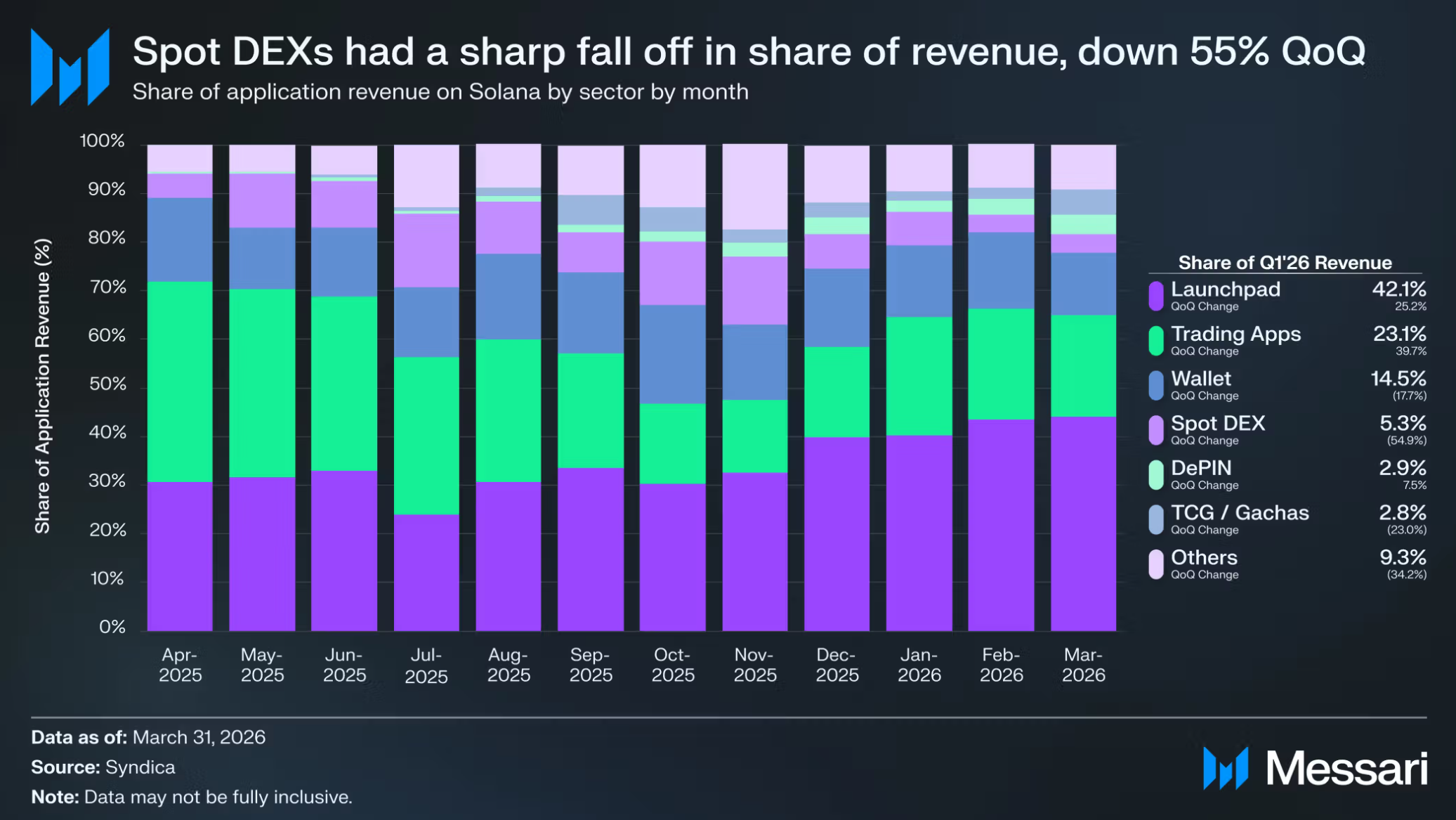
Solana revenue. Source: Messari
Solana’s memecoin revenue is holding up even as the network increasingly attracts a broader range of users, with major institutions like BlackRock, Visa and JPMorgan expanding their presence across its payments and tokenization ecosystem.
“Memecoins don’t define Solana,” Lily Liu, president of the Solana Foundation, said in a recent interview.
Related: MoonPay Acquires DFlow, Adding Solana Trading Infrastructure
Trading apps, RWAs grow on Solana
Trading apps on Solana were the quarter’s strongest-growing sector overall, with revenue rising 40% to $79 million. Axiom led the pack at $42.4 million, making it the second-highest revenue-generating app on the network.
Elsewhere, Solana’s real-world asset market cap crossed $2 billion, up 43% in the quarter, led by BlackRock’s BUIDL doubling to $525 million after Anchorage Digital added custody support.
DeFi total value locked fell 22% to $6.16 billion, though Messari researchers attributed the decline largely to SOL’s 33% price drop rather than user exits. The network’s share of total DeFi TVL remained roughly flat at 6.7%.
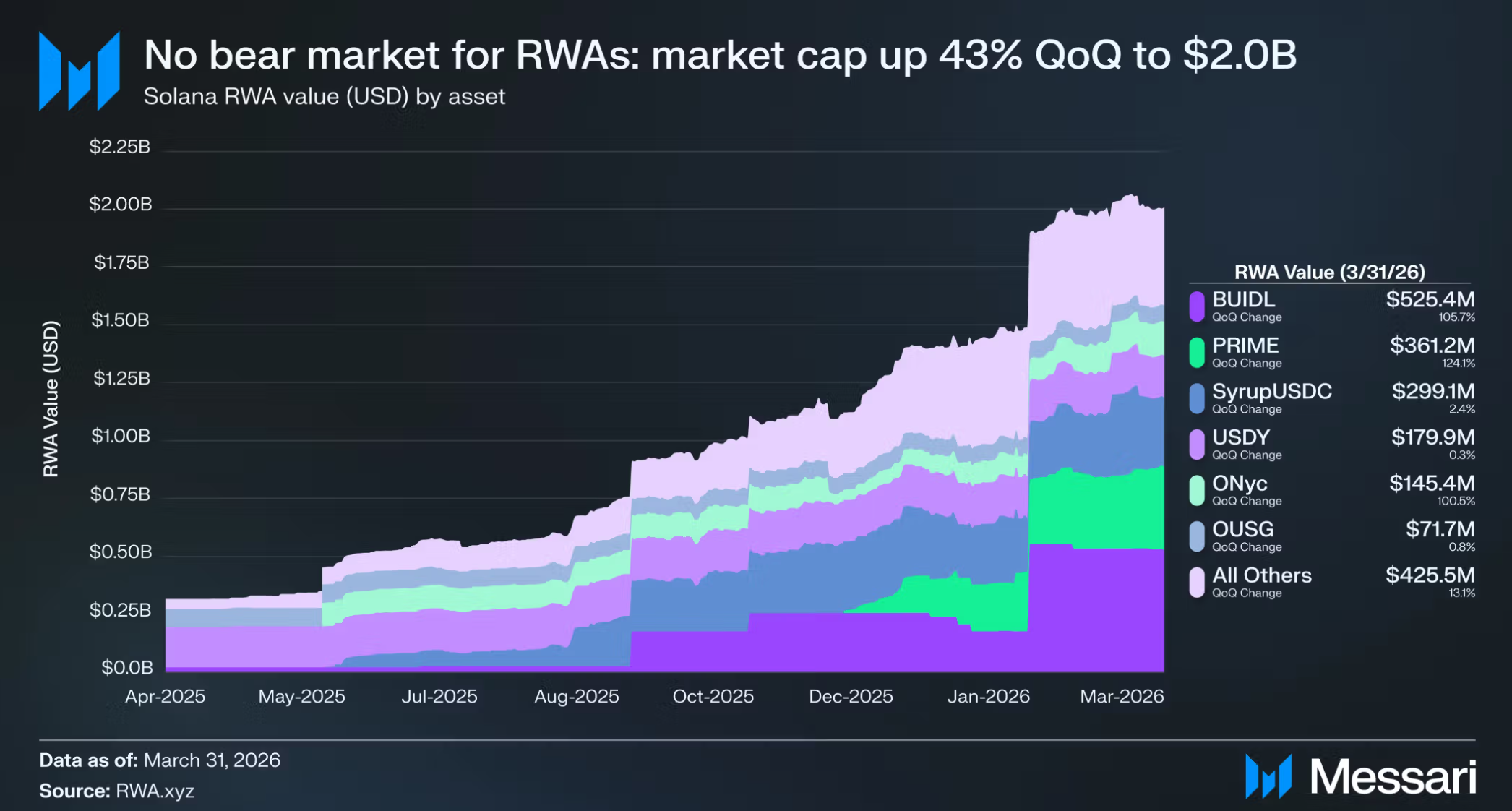
RWAs grow on Solana, fueled by institutional inflows. Source: Messari
On the infrastructure side, the focus is on Alpenglow, a sweeping consensus upgrade targeting the Agave 4.1 release. If it ships as planned, the upgrade would cut Solana’s transaction finality from around 12.8 seconds to 150 milliseconds.
Related: Solana Clients Introduce Post-Quantum Solution Falcon
Goldman Sachs exits Solana positions
As Cointelegraph reported, Goldman Sachs exited its Solana ETF positions in Q1 2026, dropping stakes in funds from Grayscale, Bitwise and Fidelity.
Italy’s largest bank, Intesa Sanpaolo, also nearly wiped out its Solana position in Q1 2026, slashing its stake in Bitwise’s Solana ETF from 266,320 shares to just 2,817, even as it more than doubled its total crypto holdings to $235 million by piling into Bitcoin ETFs from ARK 21Shares and BlackRock.
Market Moves: Why is Ethereum Foundation selling? BTC futures warning signs

TLDR
- Zcash Foundation confirmed that the US SEC closed its investigation without taking enforcement action.
- The report stated that the inquiry began after a subpoena issued in August 2023.
- Zcash Foundation said the closure removed regulatory pressure and improved operational clarity.
- The network continued to function smoothly despite internal disruption at Electric Coin Company.
- Blocks were produced consistently, and transactions settled without any interruption.
Zcash Foundation released its Q1 2026 report outlining regulatory updates, network stability, and protocol progress. The report confirmed the closure of a US SEC investigation without enforcement action. Meanwhile, ZEC extended its rebound and traded near $573 during the reporting period.
Zcash Foundation confirms SEC case closure and regulatory clarity
Zcash Foundation stated that the US Securities and Exchange Commission ended its inquiry without enforcement action. The agency initiated the investigation after issuing a subpoena in August 2023.
The foundation said the closure removed regulatory pressure and provided clearer operational direction. It also confirmed that the SEC informed the organization directly about its decision.
Zcash Foundation described the quarter as one of its most consequential operational periods. The report cited governance shifts, infrastructure work, and protocol upgrades across the ecosystem.
The organization noted that regulatory clarity allows continued development without legal uncertainty. It emphasized that ongoing work will proceed under clearer compliance conditions.
Network Stability, Upgrades, and ZEC Price Recovery Continue
Zcash Foundation reported that the network remained stable during internal disruptions at Electric Coin Company. Governance disputes led to the exit of much of ECC’s development team.
Despite these changes, blocks continued production and transactions settled without interruption. The foundation confirmed that user funds and privacy features remained secure.
The report highlighted infrastructure improvements, including new DNS seeders in the US and Europe. It also referenced multiple Zebra updates and two resolved security issues.
Zcash Foundation advanced development of the Z3 stack and continued zcashd deprecation work. It also expanded RPC coverage and progressed FROST tooling development.
The foundation reported average monthly operating costs of $272,539 during the quarter. Total expenses reached $817,618 across Q1.
Its balance sheet showed $36.7 million in liquid assets by March 31. This included 85,412 ZEC valued at $21.2 million at $248.22 per coin.
ZEC traded near $573 at press time, extending gains of more than 160% since late March. The rally followed renewed demand for privacy-focused digital assets.
The report also referenced a prior surge from $74 in October 2025 to above $630. Institutional attention and privacy demand supported that earlier price increase.



Bankr confirmed that an attacker accessed 14 wallets on its AI-powered crypto trading platform.
The platform operates as an AI agent that executes buy, sell, swap, and limit orders by accepting natural-language text commands.
What Happened to Bankr Wallets
The account first flagged reports of compromised wallets and halted transactions as a precaution. The team later identified that 14 wallets had been accessed. It also pledged to reimburse affected users as the investigation continues.
Follow us on X to get the latest news as it happens
Bankr also published recovery guidance for affected users. The instructions tell them to stop sending funds to compromised addresses, generate fresh seed phrases on clean devices, cancel any open spend permissions, and scan personal devices for malware or rogue browser extensions.
In one exchange, the Bankr agent informed a user that their BNKR and USDC balances on Base were already at zero and noted that confirmed on-chain transactions cannot be reversed.
The incident lands during a punishing stretch for the industry. May has already recorded 14 separate hacks across decentralized finance protocols, according to data tracked by DefiLlama. Total stolen crypto in 2026 has now passed $800 million.
Subscribe to our YouTube channel to watch leaders and journalists provide expert insights
The post Bankr Joins May Hack Wave With 14-Wallets Breached appeared first on BeInCrypto.

Crypto asset manager Bitwise Asset Management expanded its exposure to HYPE after launching its Hyperliquid exchange-traded fund. The firm confirmed plans to allocate 10% of the ETF’s management fees toward direct purchases of HYPE tokens. The move drew greater attention to Hyperliquid’s ecosystem growth and token economics as trading activity accelerated across the decentralized derivatives platform.
Bitwise Adds HYPE Tokens to Corporate Holdings
Bitwise confirmed the treasury allocation shortly after launching its Hyperliquid ETF in the United States. The company stated that the move aligns with Hyperliquid’s community-focused operating structure and long-term ecosystem incentives.
The ETF issuer highlighted Hyperliquid’s revenue model, which directs most protocol income toward token buybacks and burns. Consequently, the firm linked its treasury strategy to the network’s broader effort to strengthen token scarcity and community participation.
Hyperliquid was built different.
As in, 99% of the blockchain’s revenue is used to buy and burn HYPE. It’s a community-first model based on this idea: If the protocol succeeds, the community succeeds.
In that spirit, we’re pleased to announce that Bitwise will be devoting 10%… pic.twitter.com/gOnaHkZRni
— Bitwise (@Bitwise) May 18, 2026
Bitwise launched the HYPE ETF last week, and the product posted one of the strongest debuts among altcoin ETFs this year. The fund generated $4.31 million in first-day trading volume and attracted notable activity across crypto-focused markets.
The ETF became the second Hyperliquid-linked investment product after 21Shares introduced its own HYPE fund earlier in the week. Both products increased institutional access to the Hyperliquid ecosystem through regulated investment vehicles.
Market data from SoSoValue showed that Hyperliquid ETFs currently manage more than $12 million in combined net assets. Besides that, the products recorded over $5 million in cumulative net inflows during their opening trading sessions.
21Shares controls most of the sector’s assets under management with approximately $11.64 million in holdings. However, Bitwise’s latest treasury decision placed additional attention on the competitive growth among crypto ETF issuers.
Hyperliquid Activity Supports HYPE Market Strength
The HYPE token advanced during the session following Bitwise’s treasury announcement and broader ecosystem developments. CoinMarketCap data showed the token traded near $45 after gaining more than 3% within 24 hours.
Trading activity across Hyperliquid also increased after the platform introduced pre-IPO exposure to SpaceX stock products. Consequently, the development expanded attention toward tokenized real-world asset trading on decentralized derivatives platforms.
Open interest tied to real-world asset trading on Hyperliquid climbed to a record $2.6 billion. The figure doubled compared with levels recorded roughly two months earlier as platform participation accelerated.
Meanwhile, Coinbase strengthened its relationship with Hyperliquid through a USDC treasury deployment partnership. The agreement positioned Coinbase as the official USDC treasury deployer for the derivatives-focused blockchain network.
The partnership added another institutional connection to the Hyperliquid ecosystem while stablecoin activity expanded across decentralized finance markets. In addition, the move supported liquidity growth across perpetual futures trading products on the platform.
Hyperliquid also continued discussions surrounding regulatory clarity for on-chain derivatives trading within the United States market. The platform’s recent expansion efforts arrived as decentralized trading protocols pursued greater compliance visibility and broader institutional participation.
The combined developments supported bullish momentum around HYPE and reinforced demand across the network’s growing derivatives ecosystem. Moreover, ETF launches and treasury allocations increased Hyperliquid’s profile within the expanding crypto investment sector.


21Shares said its Hyperliquid ETF drew more than $5 million in inflows within days of its U.S. launch.
Summary
- 21Shares’ Hyperliquid ETF recorded over $5 million in inflows within days of its May 12 U.S. launch.
- The fund generated roughly $8 million in trading volume on a single day last week, research head Eli Ndinga said.
- Ndinga argues Hyperliquid demand reflects appetite for 24/7 access to crypto, oil, silver and gold markets.
21Shares said early inflows into its Hyperliquid ETF point to investor demand for around-the-clock access to crypto and traditional markets, with the fund pulling in more than $5 million within days of its U.S. debut.
Eli Ndinga, global head of research at 21Shares, argued that Hyperliquid priced the Iran shock 48 hours ahead of traditional venues when the CME was closed, framing the protocol as critical 24/7 infrastructure.
The 21Shares Hyperliquid ETF launched on Nasdaq on May 12 as the first U.S.-listed product tied to HYPE, alongside a 2x leveraged version under the ticker TXXH.
A bet on always-on financial markets
Ndinga said Hyperliquid’s appeal goes beyond crypto, citing trader access to oil, silver and gold markets around the clock. He described the platform as “beyond a crypto story,” framing it as a broader financial innovation story for traditional finance professionals who increasingly recognize the value of always-on infrastructure.
He cited pre-IPO token activity tied to AI chipmaker Cerebras as one example of traders using Hyperliquid to gauge demand before public listings.
Bitwise enters the race within days
The Hyperliquid ETF market is already crowded. Bitwise launched its competing BHYP product on NYSE on May 15, and recently pledged 10% of its management fee toward HYPE token purchases on its balance sheet. Combined inflows into the two products have topped $5.6 million since launch.
Ndinga said 21Shares differentiates itself through experience managing staking-enabled exchange-traded products, relying on third-party staking providers rather than in-house infrastructure to improve transparency and reduce conflicts of interest.
Hyperliquid’s perp dominance keeps growing
Hyperliquid handles roughly $8 billion in daily trading volume and accounts for more than 50% of decentralized perpetual futures open interest, according to figures cited in 21Shares’ launch documents. The protocol generates more than $56 million in monthly trading fees, with over 95% directed toward daily HYPE buybacks.
HYPE traded around $45 on May 18 after reentering a bullish wedge pattern, having recovered more than 100% from January lows near $22. The earlier 21Shares spot product launch generated about $1.8 million in first-day trading volume, with $1.2 million in net inflows.
Regulation remains the bear case
Ndinga identified regulatory scrutiny and rival trading platforms as the main bear-case risks for Hyperliquid. The protocol is not directly available to U.S. users and restricts access in certain jurisdictions to comply with local laws and sanctions requirements.
CME Group and Intercontinental Exchange have urged U.S. regulators to scrutinize Hyperliquid over potential market manipulation and sanctions compliance concerns, citing the influence of decentralized offshore venues on perpetual futures markets.
Ndinga said proposed U.S. crypto legislation, including the CLARITY Act, could eventually provide clearer rules for decentralized trading platforms.
Key Insights
- Geopolitical tensions and trade disputes over semiconductors between the US and China impacted investor sentiment in global markets.
- ETF outflows from Bitcoin indicated reduced risk appetite among institutions amid macroeconomic uncertainty.
- Although volatile, there remain those who still see cryptocurrencies as an alternative to the traditional financial system in the long term.
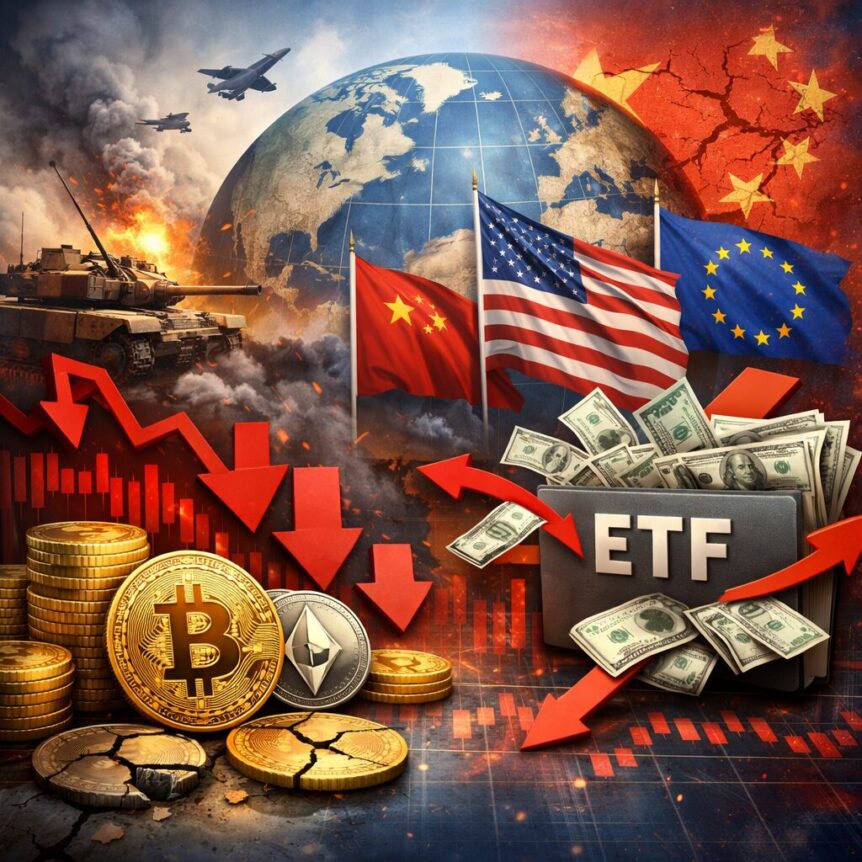
Sentiment among investors in global financial markets was lower this week due to geopolitical tensions, Bitcoin ETF selling, and the semiconductor trade dispute. Digital assets reflected similar performance to equities and other sectors sensitive to risks as market participants reevaluated their positions in speculative markets.
There was higher volatility within the crypto market as investors took notice of fresh concerns related to geopolitical tensions and strategic economic competition among key nations. Developments in the US, China, Iran, and Taiwan all played a role in contributing to uncertainty in both traditional and digital asset markets.
Geopolitical tensions tend to lead to reduced investor confidence in high-risk markets like cryptocurrency and technology. This resulted in a more defensive strategy among institutional and individual investors.
Market Dynamics under the Influence of Semiconductor Competition
One of the key sources of market uncertainty included semiconductor competition between the United States and China. Investors followed conversations about China’s plans to decrease its dependence on US suppliers and increase domestic production of semiconductors.
Semiconductors continue playing a pivotal role in artificial intelligence infrastructure, cloud computing, automation, and manufacturing. Any disturbance or increased competition in this market often impacts market expectations about future technology leadership and economic development.
Cryptocurrency trader James Wynn brought further attention to this problem in a widely discussed post on X regarding China’s domestic technology development efforts and NVIDIA chips. These statements were perceived by many traders as another example of how the gap between the two largest economies is widening.
LIKE, REPOST, TAG, SHARE ‼️
🇺🇸 Trump confirmed today that China is refusing to buy NVIDIA chips because they are developing their own
This once again confirms that the US has lost the main bargaining card with China 🇨🇳
🇨🇳 China has refused to stop buying oil from Iran🇮🇷…
— James Wynn (@JamesWynnReal) May 16, 2026
Investors in the technology sector became more cautious as semiconductor-related uncertainty started spreading across the stock market. It was argued that ongoing trade disputes could speed up domestic production and restructure supply chains in the long term.
Increasingly, emphasis on strategic independence and technology self-reliance influenced institutional decisions in high-growth industries such as artificial intelligence and semiconductor-related equities.
Geopolitical Concerns Spark Risk-off Mentality
Market anxieties did not just center around trade disputes; geopolitical matters also played their part in creating pressure for investors. Tensions regarding Taiwan, as well as reports about potential military escalation against Iran, furthered uncertainty in global markets.
Commodity markets, too, were highly sensitive to news related to Iranian oil exports and sanctions. Energy markets are known to react strongly to any form of geopolitical unrest that threatens supply and international relations.
Stock markets also saw heightened volatility, as investors sought safer bets in times of uncertainty. It was reported that close to $900 billion in market value was wiped out over the last few days.
Diplomatic talks between Vladimir Putin and Xi Jinping were also being watched closely by investors due to changing economic allegiances affecting global trade and monetary influence.
Bitcoin ETF Outflows Exert Additional Pressure on Cryptocurrency Market
Cryptocurrencies were impacted by the overall macroeconomic weakness seen in the financial markets as sentiments from institutions deteriorated due to recent volatility. Bitcoin ETF outflows, as well as related investment products from BlackRock, exerted additional pressure on cryptocurrencies.
ETF flows now constitute one of the main indicators used to measure institutional sentiment within the cryptocurrency market. Consistent outflows indicate declining sentiments amongst big investors amid weak macroeconomic conditions.
Bitcoin and other cryptocurrencies usually exhibit more volatile price movements under conditions of increased geopolitical tensions and financial market instability. Traders tend to reduce their exposure to speculative instruments as soon as they face increased volatility in the equity, commodity, and currency markets.
Additional worries arose after the release of information regarding share sales related to investment portfolios belonging to Bill Gates. Portfolio changes conducted by prominent figures tend to affect retail investor psychology amidst market uncertainty.
Despite short-term weakness, cryptocurrencies remain an interesting alternative for investors searching for non-traditional monetary systems. Although volatility is still high, some participants remain convinced that cryptocurrencies can have greater importance in the long term.
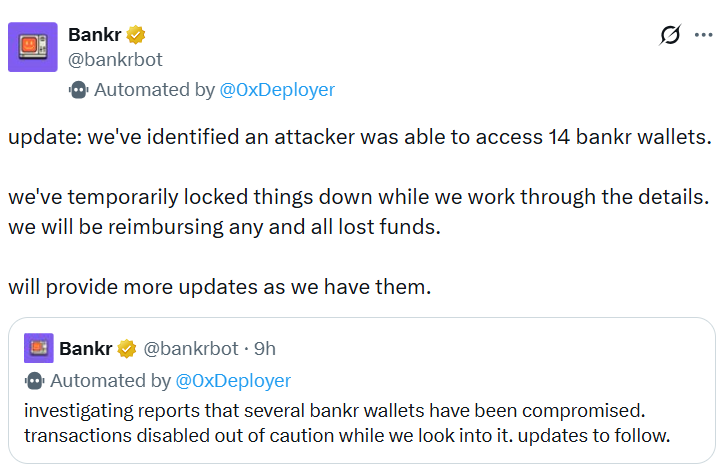
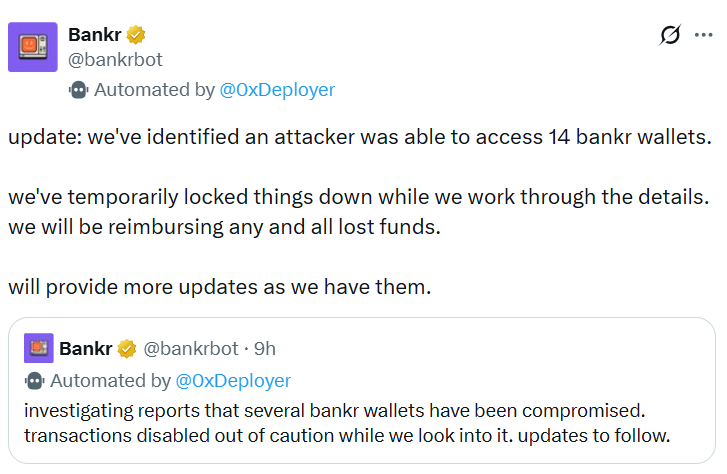
AI-powered crypto trading assistant Bankr said it disabled transactions after identifying an attacker who gained access to at least 14 wallets, with users reporting that as much as $150,000 in crypto was drained from some wallets.
In an X post on Tuesday, Bankr said it was investigating reports that several wallets had been compromised and that transaction activity, including swaps, transfers and deployments, had been disabled “out of caution” while the investigation continues.
“We’ve identified an attacker was able to access 14 Bankr wallets. We’ve temporarily locked things down while we work through the details. We will be reimbursing any and all lost funds. Will provide more updates as we have them,” it added.
Bankr allows users to prompt AI to trade, transfer and launch tokens using plain language rather than a standard wallet interface. It also automatically creates a crypto wallet for every X handle that interacts with its bot. Earlier this year, someone reportedly exploited this feature and tricked Grok into requesting that Bankr launch a token, then drained funds from the token into a wallet they controlled.
Source: Bankr
Crypto hackers have been active in recent months. Bad actors stole more than $168.6 million in crypto in the first quarter. April saw the two largest hacks of the year so far: the $280 million Drift Protocol exploit at the start of the month and the $292 million Kelp exploit. More recently, Verus Protocol’s Ethereum bridge was exploited Monday.
Social engineering attack targeting bot could be to blame
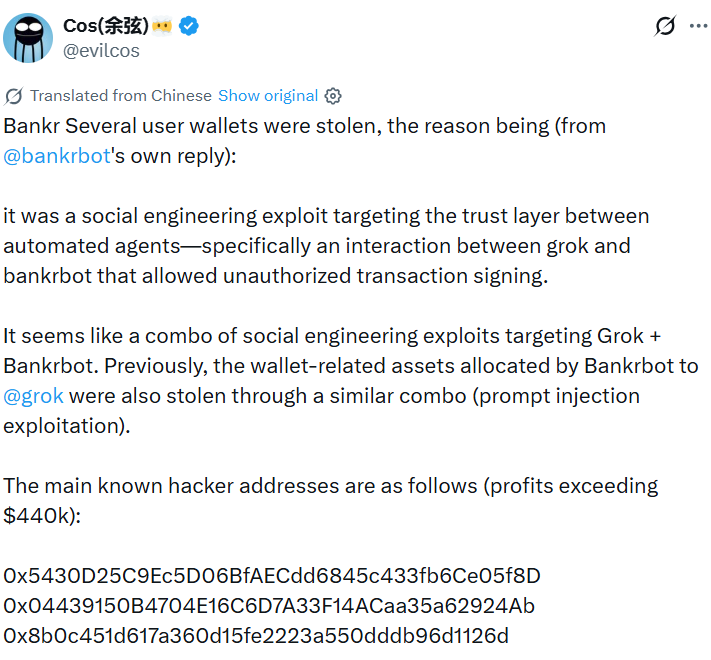
SlowMist founder Yu Xian said the exploit, from Bankrbots’ own reply, was likely a social engineering scheme targeting the AI agent. Three identified attacker addresses collectively hold $440,000 in crypto.
“It was a social engineering exploit targeting the trust layer between automated agents—specifically an interaction between grok and Bankrbot that allowed unauthorized transaction signing,” Xian said.
Source: Yu Xian
“It seems like a combo of social engineering exploits targeting Grok + Bankrbot. Previously, the wallet-related assets allocated by Bankrbot to Grok were also stolen through a similar combo, prompt injection exploitation,” he added.
Don’t sign transactions until further notice: Bankr
Bankr has recommended that users avoid signing transactions until further notice and warned one individual that their seed phrase “is likely in the hands of an attacker.”
Bankr also said anyone with a compromised wallet should stop using it, create a new wallet, generate a new seed phrase on a clean device, move any remaining tokens or nonfungible tokens to the new address and revoke approvals if remaining assets can’t be moved.
Related: Aethir halts bridge exploit, promises compensation after $90K loss
“Attackers often use existing approvals to drain funds. Check your devices, scan your computer and phone for malware or suspicious browser extensions. If you used a software wallet, the leak likely came from your device,” Bankr added.
Losses could reportedly be up to $150,000 per wallet
Some X users reported that up to $150,000 in crypto had been drained from affected wallets.
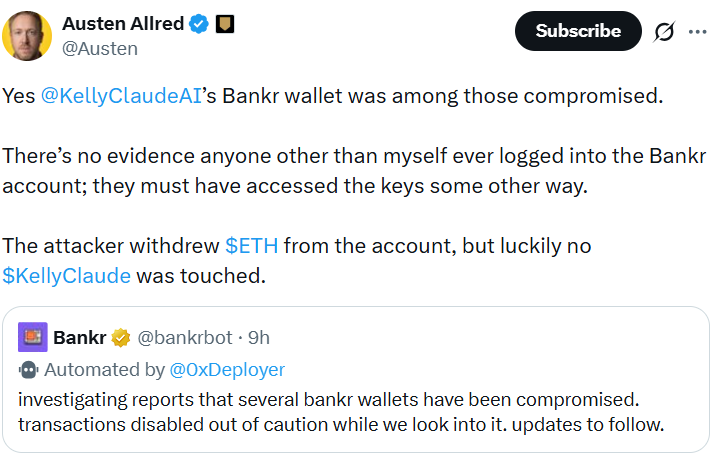
Tech entrepreneur Austen Allred said a Bankr wallet connected to his Kelly Claude AI assistant project was among those compromised. The hacker stole Ether (ETH), but none of the project’s memecoin stash was touched.
Source: Austen Allred
“There’s no evidence anyone other than myself ever logged into the Bankr account; they must have accessed the keys some other way,” Allred added.
Magazine: The legal battle over who can claim DeFi’s stolen millions
An Alibaba logo is displayed at the company’s booth at China International Fair for Trade in Services (CIFTIS) in Beijing, China, Sept. 10, 2025.
Maxim Shemetov | Reuters
CHONGQING, China — Alibaba announced Wednesday its new artificial intelligence chip would be three times as powerful as its predecessor, as rival Nvidia struggles to get its advanced chips into China.
The Zhenwu M890 delivers three times the performance of the current Zhenwu 810E, Alibaba said, adding that the new processor has 144 GB GPU memory and interchip bandwidth of 800 GB per second.
Alibaba said it had already delivered 560,000 Zhenwu units to more than 400 customers across 20 industries.
The e-commerce giant also revealed its next generation large language model, Qwen3.7-Max, would soon be released.
In early April, Alibaba and China Telecom said they were launching a data center in southern China powered by the e-commerce giant’s own chips, as the country ramps up its focus on homegrown AI infrastructure.
— CNBC’s Arjun Kharpal contributed to this report.
Crypto World
Policy on Digital Assets Gains Traction in Washington as Senate Moves to Integrate Cryptocurrencies

Increased Support From The Senate Spurs On Digital Assets Policy Talks
Talks on digital asset legislation saw new life breathed into them following increased support by the Senate to integrate cryptocurrencies in the mainstream financial market system. Members of Congress continued debating issues related to blockchain infrastructure, institutional involvement, and financial modernization as digital assets began featuring more prominently in economic policy talks.
This recent discussion followed remarks from Senator Cynthia Lummis which have gone viral in crypto circles. These remarks made it clear that the involvement of digital assets in the mainstream financial market system was inevitable despite opposition from traditional banks. Investors considered this a further indication that cryptocurrency regulation had become a political priority in the country.
MASSIVE:
🇺🇸 Senator Lummis just said what every banker fears.
“Digital assets are becoming part of the future financial system. Whether banks embrace them or not.”
The woman who fought for the CLARITY Act for years.
The woman who pushed it to the finish line.
The woman who… pic.twitter.com/tvYvG2dVLg— Merlijn The Trader (@MerlijnTrader) May 15, 2026
Key Insights
- Crypto integration backed by the Senate enhanced discussions on regulations of digital assets and development of blockchain infrastructure.
- Financial institutions’ resistance was a key concern as regulators discussed financial innovation and decentralization of finance.
- The involvement of institutions in cryptocurrency markets grew as regulatory clarity became an important policy topic
Banking Opposition Still Plays a Key Role in the Discussion
The issue of traditional banking opposition was still one of the topics that received the most attention in discussions about crypto legislation. According to the reports quoted in market discussions, banking organizations had already invested millions in lobbying against certain crypto policy measures.
These facts only confirmed the image of an existing conflict between decentralized finance and traditional banking infrastructures.
In the past, banks used to raise their voices against crypto assets for reasons related to compliance problems, custody, money laundering risks, and capital exposure. The uncertainty about regulation had also been making many financial companies wary of developing crypto-related businesses.
Institutional Participation Grows in Financial Markets
Institutional integration continued being one of the key themes in the context of the overall cryptocurrency market story. Institutional involvement grew among asset managers, payments companies, trading venues, and custodians as adoption slowly progressed from speculative trading.
The discussion also brought up the name of Brian Armstrong whose firm Coinbase has been actively taking part in talks around crypto market structure and regulation. Cryptocurrency exchanges and infrastructure companies continued advocating for better frameworks that would facilitate institutional participation.
Market participants kept an eye on regulatory developments as legislation often played an important role in building long-term market confidence. Better legislation may help financial firms with compliance issues and encourage institutions to get involved in digital assets.
The bigger picture regarding the market narrative was moving away from the survival of digital assets to questions regarding their timeline of integration. In the eyes of many market players, blockchain technology has become a growing part of future financial systems as opposed to a fleeting fad.
While the debates in the Senate were evolving, it was perceived that political support for digital assets was becoming stronger even with the reluctance of the old guard.

Petition to save Cauwood Day Centre in Malton

The AI bots are coming and the young are booing, not applauding

Senate Advances Resolution That Could Curb Trump’s Iran War

Manchester United reach agreement with Casemiro over contract clause amid transfer speculation

US brings back mandatory military draft registration

Steven Gerrard disagrees with Gary Neville over ‘shock’ Chelsea and Arsenal claim | Football


-
 Crypto World4 days ago
BloFin War of Whales 2026 Grand Prix opens registration for $5M trading championship
-

 Fashion4 days ago
Weekend Open Thread: Theory – Corporette.com
-

 Crypto World4 days ago
E-Estate Announces 1 Year Live: Washington DC Summit as Real Estate Tokenization Enters Its Next Phase
-
Crypto World7 days ago
Bitcoin Suisse expands with Digital Asset License and Investment Business Act Registration Approval in Bermuda
-

 Tech5 days ago
Tech Moves: Microsoft AI leader jumps to OpenAI; former AI2 exec joins Meta; and more
-
 Crypto World6 days ago
Google’s Gemini AI Predicts Incredible Solana Price by the End of 2026
-

 Tech4 days ago
Google reimburses Register sources who were victims of API fraud
-

 Business5 days ago
H&R Real Estate Investment Trust (HR.UN:CA) Q1 2026 Earnings Call Transcript
-

 Sports4 days ago
Napoleonic enters 2026 Doomben 10,000 field via Abounding withdrawal
-
 Entertainment5 days ago
Zara Larsson Has Blunt Response To Chris Brown Diss
-
 Crypto World6 days ago
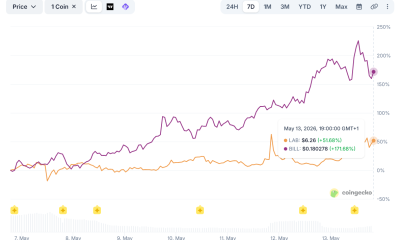
Two AI Tokens Lead May Rally, But Risks Are Rising
-
 Crypto World4 days ago
BeInCrypto 100 Institutional Awards Nomination: KAST for Best Digital Assets Neobank and Best Digital Assets Fintech
-

 Fashion3 days ago
On the Scene at Gucci’s Cruise Show in New York City: Mariah Carey, Kim Kardashian, Lindsay Lohan, Iman, and More!
-
 Tech7 days ago
Why AI is making typography a boardroom conversation
-
 Crypto World4 days ago
Bitcoin Battles US Bond Nerves With BTC Price Dip Toward New May Lows
-
 Crypto World4 days ago
Wall Street’s Boldest Gold Prediction Has Russians Rushing to Buy
-

 Fashion4 days ago
Trending Western Style Vests Perfect for Summer
-

 Entertainment5 days ago
David Letterman Returns to Late Show, Blasts Cancellation
-

 Politics5 days ago
DWP PIP Timms review continues to be an absolute farce
-

 Crypto World4 days ago
ICE and CME urge US regulators to curb Hyperliquid energy trading
You must be logged in to post a comment Login