

Crypto World
ETH at $2K as Bears Gain Grip, Signaling Renewed Downtrend


Ether (ETH) extended a downbeat spell last week after hitting resistance near $2,400, with the price sliding to roughly $2,100 on Monday. Market observers described the move as a sign that sellers have regained control, marking a shift in near-term momentum for the largest smart contract platform by market capitalization.
The wave of selling came as liquidity pressure mounted on major venues and investment products, reinforcing a narrative of waning demand. Binance’s exchange data showed that taker sell volume surged as ETH breached crucial downside levels, a signal, according to analysts, of forced risk-off positioning among active traders. In parallel, fund flows underscored a broader withdrawal of institutional interest in Ethereum-related exposure.
According to SoSoValue, US-based spot Ethereum ETFs posted net outflows for five consecutive days, totaling $255 million. Globally, Ethereum-focused investment products rang up about $249 million in outflows for the week ending May 15, the largest weekly figure since early February, according to data tracked by CoinShares. These outflows suggest the market is experiencing a pause or reversal in institutional demand, at least in the near term.
Key takeaways
- Ether drops roughly 12% after rejection at $2,400, with price extending lower toward $2,100 as bears reassert control.
- Binance taker sell volume spikes above $1.1 billion during the downside move, indicating aggressive selling pressure from traders on futures platforms.
- ETF and fund outflows imply waning institutional demand for Ethereum exposure in the short run, potentially constraining upside momentum.
Trading dynamics amid thinning demand
Price action around ETH has reflected a confluence of selling pressure and shifting investor positioning. Data from Binance shows a surge in taker sell volume as ETH moved below the $2,100 level, a pattern that traders sometimes interpret as forced de-risking or short-term bearish pressure from active market participants. CryptoQuant analyst Amr Taha captured the sentiment, noting that while the spikes do not automatically confirm a reversal into a deeper downtrend, they do indicate buyers were unable to absorb selling pressure during the move.
Analysts have increasingly linked price action to a widening macro and sectoral dynamics that have weighed on Ethereum demand. A related thread of analysis has tied ETH selling pressure to external catalysts, with coverage noting that surging oil prices have been identified as a driver of selling pressure in Ether by market commentator Tom Lee. The observation points to a broader risk-off environment where macro shifts can translate into crypto selling, particularly for assets with the most liquidity and sensitivity to market sentiment.
The withdrawal of liquidity from Ethereum-focused investment products aligns with the price action. SoSoValue’s data shows a five-day streak of net outflows from US spot ETH exposure totaling $255 million, a clear sign that institutions are rebalancing away from long ETH bets in the near term. Whale Factor, commenting on the flow trajectory, described the pattern as “heavy sell-side distribution” that has kept price pressure in place for now.
CoinShares’ weekly fund flow report further corroborates the trend, noting that global Ethereum investment products registered about $249 million in outflows for the week ending May 15, the largest weekly number since late January. Taken together, these outflows paint a picture of a market where institutional demand has cooled, at least temporarily, even as spot demand and retail interest remain more tentative.
Where is the support, and what comes next?
From a technical standpoint, investors are watching a cluster of roughly 3.85 million ETH that sits at a cost basis around $2,000–$2,100, according to Glassnode’s cost-basis distribution data. The concentration suggests a sizable cohort of holders could add if prices approach break-even, potentially offering a floor that might limit further downside in the near term.
Analysts remain divided on the vulnerability of ETH to a deeper retreat. Some traders point to a rising wedge pattern on daily charts, which could set the stage for a move toward the next major support around $1,700 if current supports fail to hold. In contrast, others argue that a decisive hold above $2,000 could slow the decline, with a potential bounce narrowly above that level contingent on continued demand and favorable liquidity conditions.
Strategists offered a spectrum of medium-term views. A well-known trader noted that Ethereum breached the $2,100 area after failing to sustain the $2,150 support, suggesting that a defense around the $2,050–$2,070 zone could provide a meaningful bounce if demand returns. Another analyst framed the situation as a test of buyers’ resolve near the lower end of the recent range, warning that a sustained break below the region could open the door to further softening into lower support bands.
Beyond the price action, the narrative around catalysts for a potential ETH rally remains anchored to a mix of macro conditions and on-chain developments. Sharplink’s CEO recently highlighted three catalysts that could help Ethereum reach new highs: the CLARITY Act’s progress in the United States, a broader return of market-wide risk appetite, and the growth of real-world asset tokenization on Ethereum. While these drivers are not immediate guarantees, they represent the structural tailwinds that could shift sentiment back toward Ethereum if liquidity and risk sentiment improve.
For now, traders are inclined to monitor the $2,000 level closely. A firm hold above this threshold could deter further downside and set the stage for a measured recovery, while a break below could expose traders to a test of the next support pockets identified by technical analysts and cost-basis data alike. The balance of on-chain activity, ETF and fund flows, and macro risk appetite will continue to shape the near-term trajectory.
In a related context, market observers have flagged that external factors, such as shifts in oil prices and broader risk sentiment, have historically fed into Ethereum’s price behavior. The interconnectedness of macro trends and on-chain dynamics underscores the importance of watching both liquidity flows and technical levels as the market digests renewed selling pressure and any potential rebound catalysts.
As the week unfolds, traders and investors will be watching three key variables: whether ETH can sustain a bid above $2,000, how ETF and institutional flows trend in the coming days, and whether demand from key market participants returns to supported levels to re-anchor prices above crucial supports.
The immediate question remains whether the current price action marks a temporary pause in a broader downtrend or the start of a longer retracement that could push ETH toward lower basins. Market participants will be closely analyzing liquidity conditions, the pace of outflows or inflows in Ethereum-related vehicles, and the evolving macro backdrop to gauge the durability of any short-term bounce.
Readers should stay tuned to updates on ETF flows, on-chain cost-basis shifts, and technical patterns that could prove decisive for ETH’s near-term path. The coming days may reveal whether the market finds equilibrium near $2,000 or if renewed selling pressure takes the price down to the next set of support levels.
What remains uncertain is how quickly institutional sentiment can reassert itself and whether macro risks ease enough to restore appetite for Ethereum exposure. Market participants will be watching closely to determine if the present pullback is a temporary pause in a longer-term recharge or a precursor to a deeper test of support zones.

Crypto World
Hyperliquid's USDC deal could supercharge HYPE, pressure Circle, Coinbase margins, analysts say


The revenue share deal could shift an estimated $160 million in revenue from Coinbase and Circle into Hyperliquid’s ecosystem, Compass Point analysts said.

TLDR
- Revolut has launched a Dogecoin-themed physical debit card in the United Kingdom and the European Union.
- The company said customers can use the card anywhere Visa and Mastercard are accepted.
- Revolut confirmed that users will not face additional exchange fees on purchases.
- The firm stated that transactions will follow the exchange rate at the time of payment.
- Revolut said crypto card payments may create tax obligations depending on local regulations.
Revolut has introduced a Dogecoin-themed physical debit card to expand crypto payments into daily spending. The company will launch the card in the United Kingdom and across the European Union, excluding Hungary, Switzerland, and Portugal. It said customers can use the card anywhere Visa and Mastercard operate.
Revolut Expands Crypto Payments With Dogecoin Card
Revolut confirmed that it will issue the Dogecoin card to users in selected European markets. The company stated that customers can pay at any merchant that accepts Visa (V) or Mastercard (MA). It said the rollout will begin in the United Kingdom and EU member states, except Hungary, Switzerland, and Portugal.
The company shared details about the card on X. It said users will not pay extra exchange fees when they make purchases. However, it clarified that transactions depend on the exchange rate at the moment of payment and may create tax obligations under local laws.
Revolut said the card forms part of its wider crypto offering. The company has worked to connect digital assets with standard payment networks. It aims to let users spend tokens through familiar retail systems.
The Dogecoin card supports payments funded by crypto balances held within the app. Users can convert their holdings at the point of sale. The company priced Dogecoin at $0.1047 during the announcement.
Revolut has expanded its crypto services during 2025. It integrated Polygon into its platform to support remittances and staking of POL tokens. It also enabled in-app crypto card payments for supported assets.
The company stated that the Dogecoin card aligns with growing demand for crypto-linked debit products. Exchanges such as Coinbase (COIN) and Crypto.com have widened their card programs. Firms now seek to connect token balances with daily retail activity.
Banking Push and Broader Expansion
Revolut continues to grow its banking operations alongside crypto services. In March, it secured approval to launch a fully licensed bank in the United Kingdom. The company confirmed that regulators granted the authorization after a formal review.
The firm also applied for a de novo banking license in the United States. It submitted the application to expand its presence in the American market. The move would allow it to operate as a regulated bank if approved.
Revolut stated that it will manage crypto card payments through its existing app framework. The company processes transactions using established payment rails. It said exchange rates apply at the time of each purchase.
The Dogecoin card represents the latest addition to Revolut’s payment portfolio. The company continues to introduce new financial products across regions. It confirmed that the card rollout will begin with eligible customers in the United Kingdom and EU markets.



Kraken revenue rose 3% year-on-year to $507m in Q1 2026 as futures trading jumped 51%, Payward said Monday.
Summary
- Payward posted $507m in Q1 2026 adjusted revenue, up 3% year-on-year, despite Bitcoin falling 22% during the quarter and industry-wide spot volumes dropping 38%.
- Futures daily average revenue trades rose 51%, driven by NinjaTrader, Breakout, and expanded derivatives offerings from the recently completed Bitnomial acquisition.
- Adjusted EBITDA fell to $18m as Payward continued spending on acquisitions, product development, and regulatory infrastructure ahead of a planned IPO.
Payward, Kraken’s Wyoming-based parent company, said in a Monday press release that it generated $507 million in Q1 2026 adjusted revenue, up 3% from the same quarter a year earlier. Bitcoin fell 22% during the quarter and industry-wide spot trading volume dropped 38%, yet Payward’s diversified platform cushioned the decline.
A year earlier, Payward had reported $492 million in Q1 2025 adjusted revenue, making the 3% year-on-year gain notable given the steeper market downturn this cycle.
Co-CEO Arjun Sethi said in the release: “Where others pulled back, we leaned in.” Growth in futures and newer business lines offset weakness in core crypto markets, with Kraken’s spot market share rising to 5.2% in March from roughly 3.5% in mid-2025.
Kraken revenue beats rivals through diversification
Rival platforms reported sharper declines in trading revenue over the same period. Payward attributed its resilience to its stronger institutional business and growing derivatives offering, built partly through its $550 million acquisition of CFTC-licensed platform Bitnomial, which crypto.news covered when the deal completed on May 4.
Total platform transaction volume reached $357 billion in Q1, while funded accounts rose 47% year-on-year to 6.1 million and assets on platform reached $40 billion.
Adjusted EBITDA fell to $18 million as Payward continued investing in acquisitions including tokenization platform Backed, token management firm Magna, Bitnomial, and payments company Reap.
Crypto.news reported that non-trading revenue sources including custody, payments, and financing accounted for 53% of Payward’s 2025 total, a structural shift that reduces dependence on volatile trading volumes.
What Payward’s IPO delay means
Payward filed its draft S-1 with the SEC confidentially in November 2025 but paused the process in March, citing market conditions. Sources indicate a public listing may slip to 2027. The exchange also cut approximately 150 employees in May, attributing the reductions to AI-driven operational efficiencies, representing roughly 5% of its total workforce.
Payward’s M&A push positions it as the most comprehensively regulated crypto derivatives platform in the US. Crypto.news documented how the Bitnomial deal and Deutsche Börse’s $200 million stake established Payward as a regulated hub for digital asset futures and options inside the US, with its IPO filing remaining active.
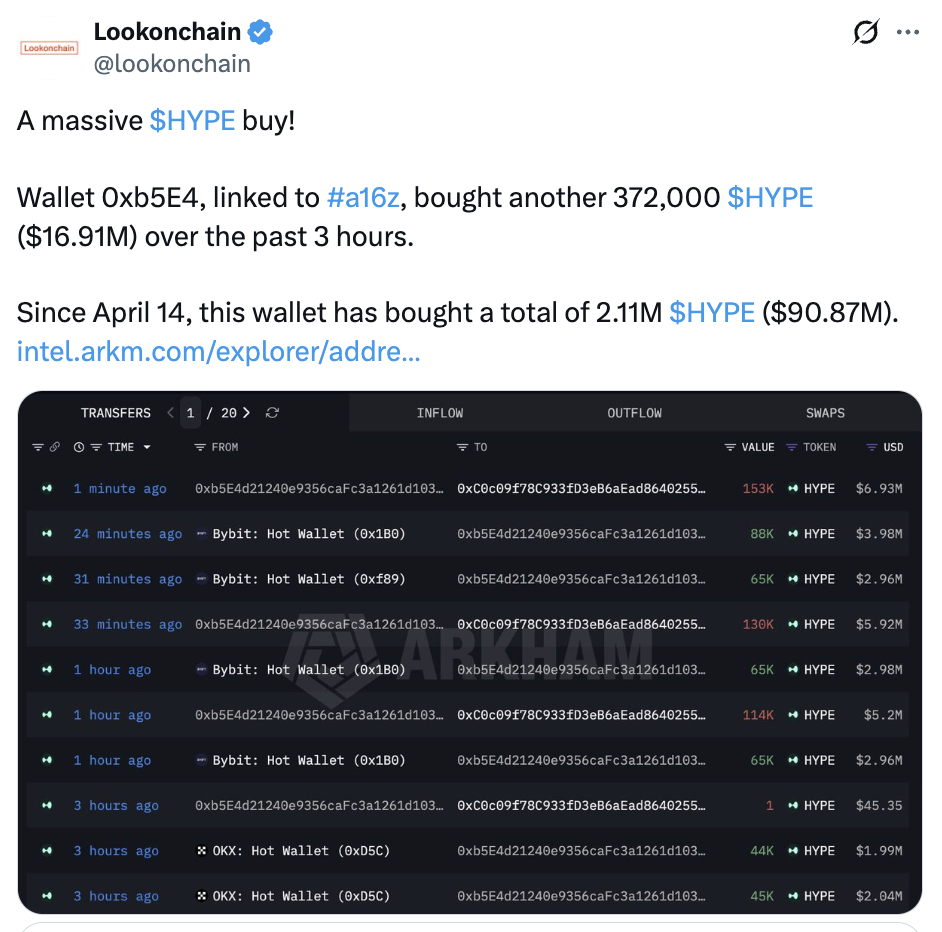
Hyperliquid DEX’s native token, HYPE, is showing potential for a 55% rally after a wallet reportedly tied to Silicon Valley-based venture capitalist, a16z, accumulated $90.87 million worth of tokens in just over a month.
Key takeaways:
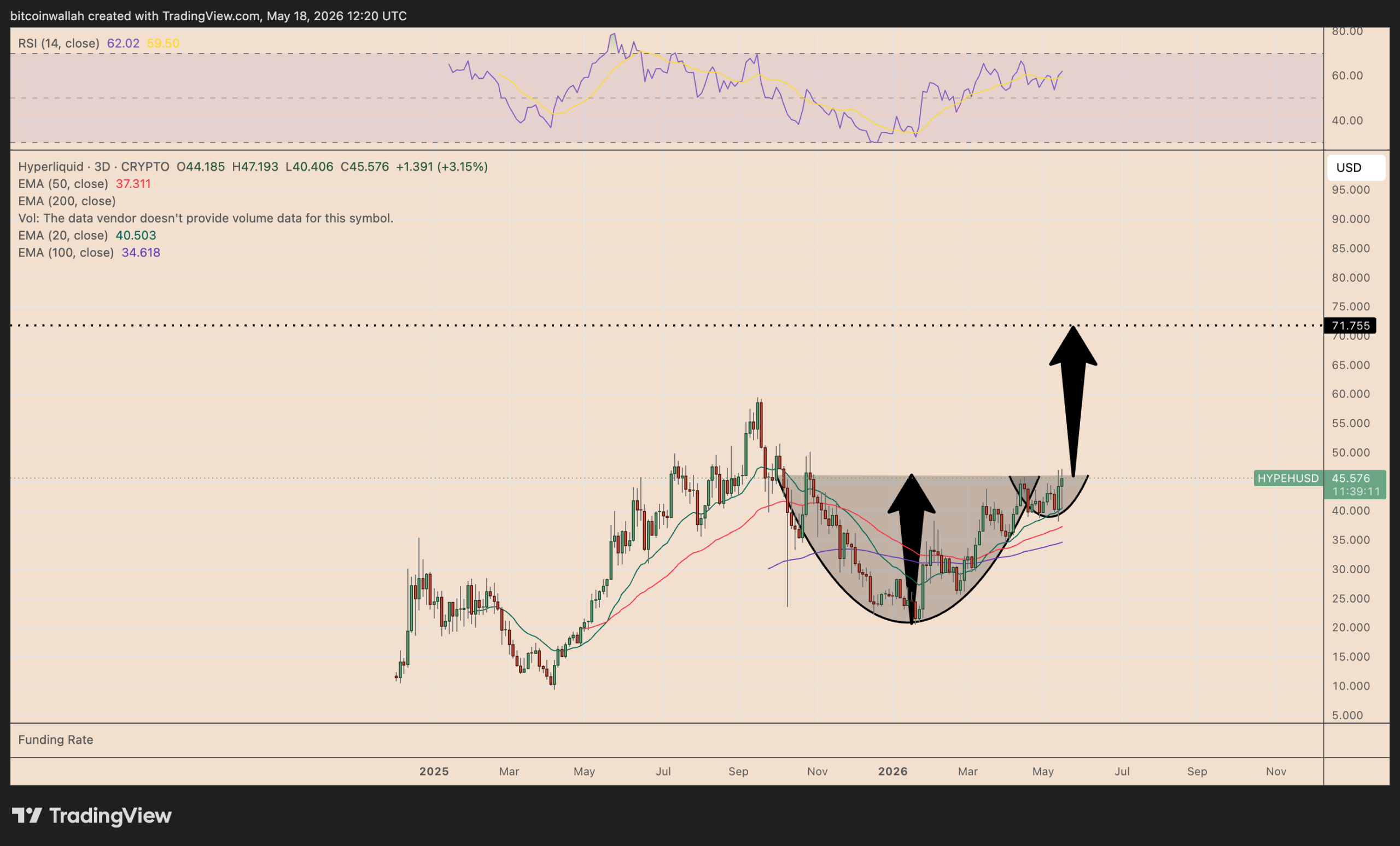
- HYPE’s three-day chart shows a potential cup-and-handle breakout, with the neckline sitting near $45–$47.
- ETF launch, Coinbase-Circle USDC roles, and potential US regulatory clarity may expand Hyperliquid’s institutional demand base.
HYPE cup-and-handle setup eyes record highs
HYPE appears to be forming a cup-and-handle pattern, a classic bullish continuation setup.
A cup-and-handle forms when price makes a rounded recovery, pauses near resistance, and then breaks higher. Traders calculate the upside target by measuring the cup’s depth and adding that distance to the breakout level.
In HYPE’s case, the “cup” developed after its price fell from around $46 to nearly $21, then gradually recovered in a rounded structure back toward the $45–$47 resistance zone. That area now acts as the pattern’s neckline.
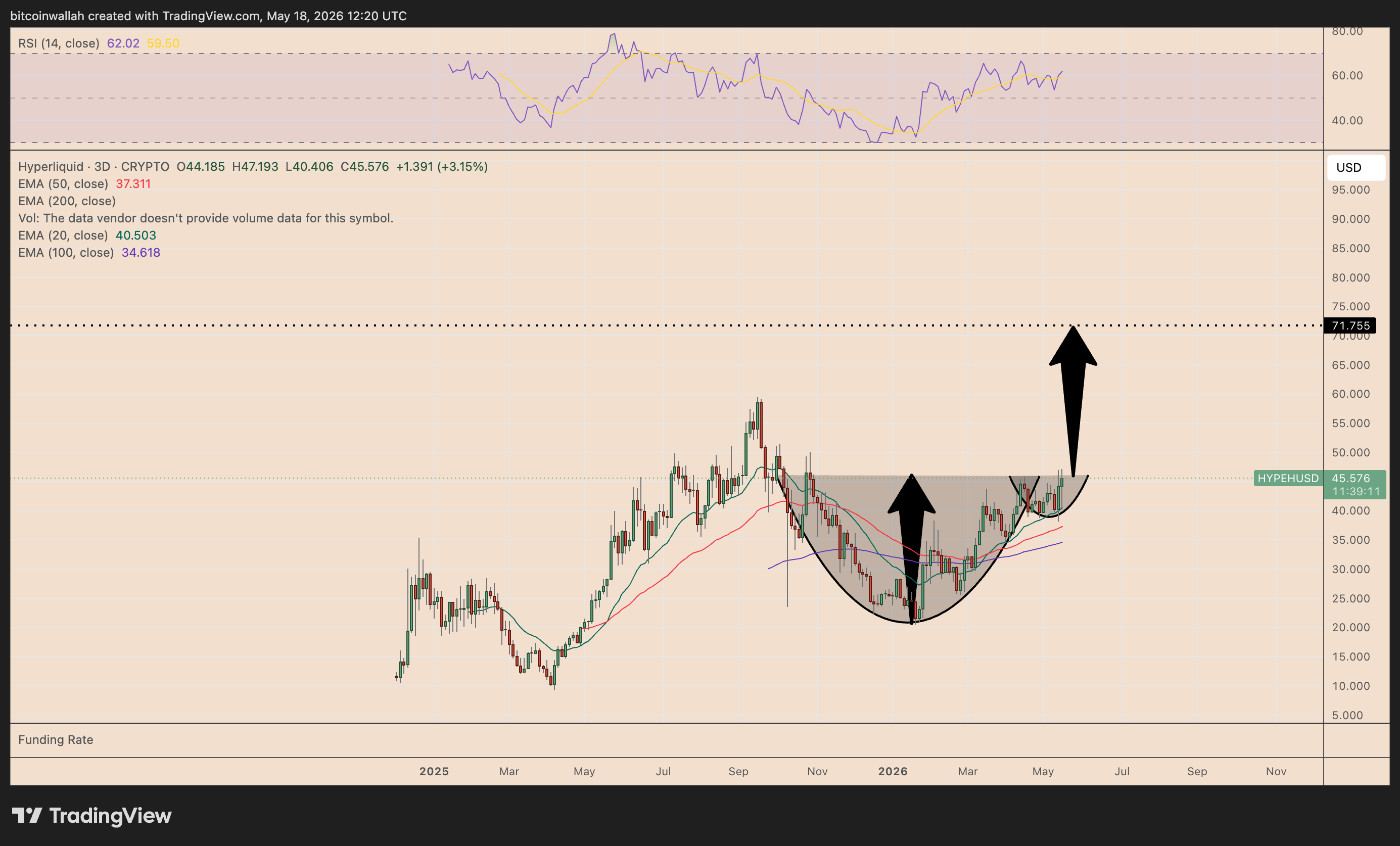
HYPE/USDT three-day price chart. Source: TradingView
As of Monday, HYPE was forming the structure’s “handle” part, confirmed by its slightly downward consolidation. The token may climb toward the $71–$72 range in 2026 if the breakout above the $45–$47 neckline area plays out as intended.
That would mean about 55% rise from current prices, a new record high for the token.
a16z-linked wallet accumulates $90.87M HYPE
HYPE’s bullish technical setup has gained support from a fresh on-chain accumulation signal.
On Monday, wallet 0xb5E4, which Lookonchain describes as linked to Andreessen Horowitz, or a16z, bought another 372,000 HYPE worth about $16.91 million in three hours.
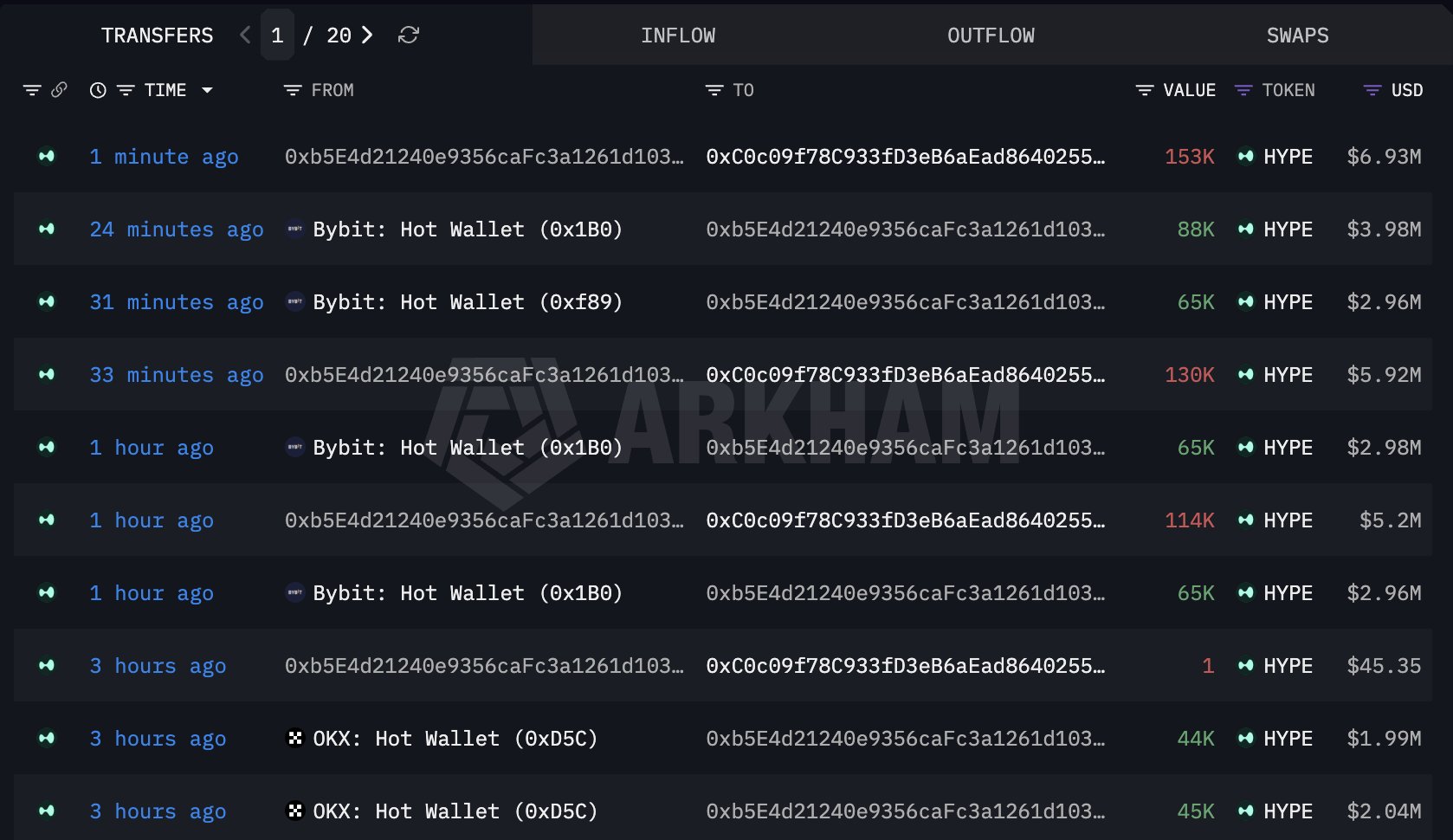
Transaction records of the wallet ‘0xb5E4.’ Source: Arkham Intelligence
HYPE stood out in an otherwise weaker crypto market, gaining roughly 7% over 24 hours as Bitcoin (BTC) slipped 1.22% and Ether (ETH) lost 2.22%. On a year-to-date timeframe, HYPE was up 80% compared to BTC’s and ETH’s losses of nearly 12.5% and 28.3%.
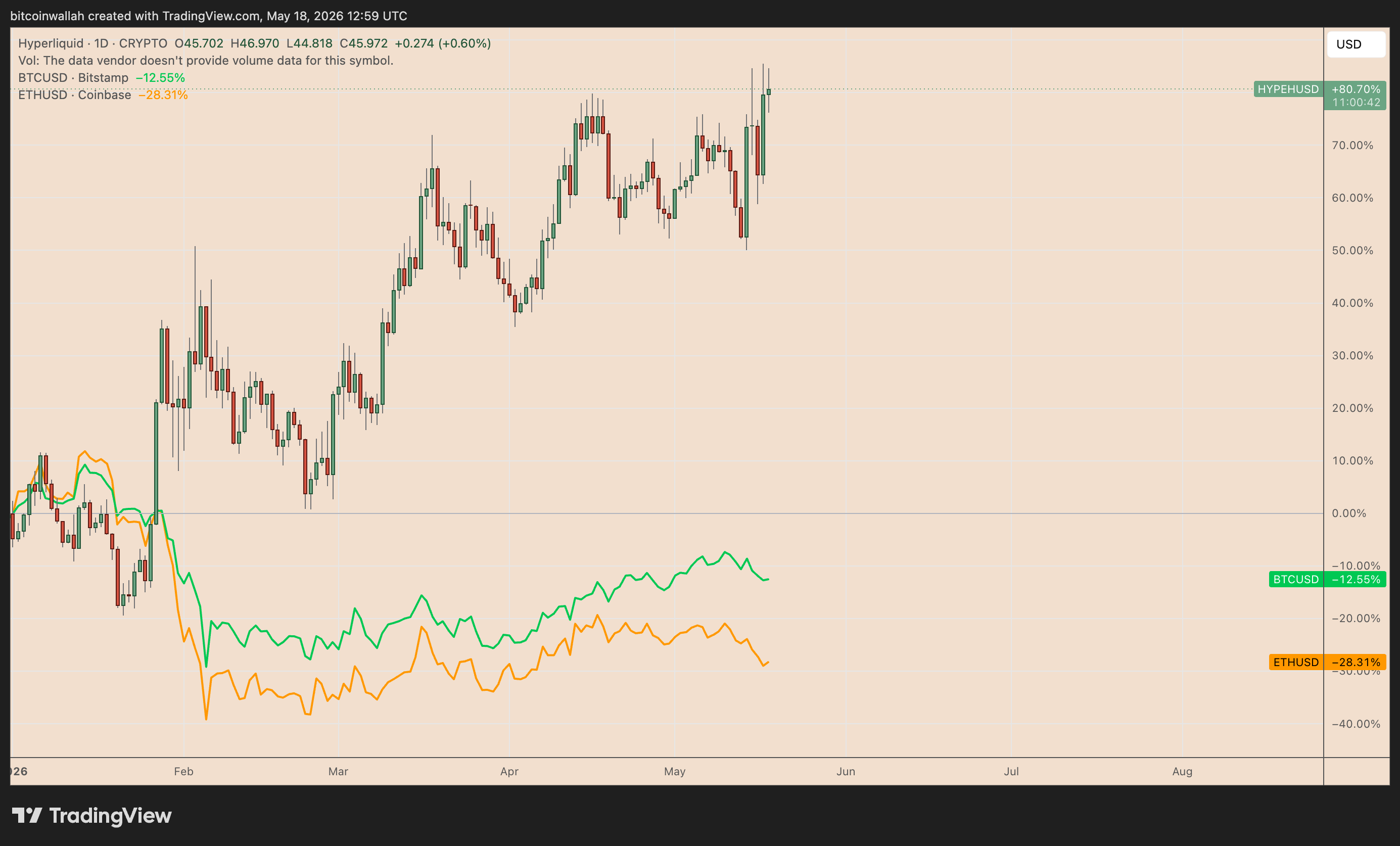
HYPE/USDT year-to-date price performance vs. BTC/USD and ETH/USD. Source: TradingView
The latest “massive HYPE buy” lifted the a16z-linked wallet’s total accumulation since April 14 to 2.11 million HYPE, valued at roughly $90.87 million.
Source: X
Large venture-linked accumulation may strengthen market confidence, especially when it occurs while the price is already testing a major resistance zone.
The reported a16z-linked purchases add to a strong catalyst run for Hyperliquid.
Last week’s US spot HYPE ETF launches opened a regulated access point for traditional investors, while Coinbase and Circle’s USDC deployment roles strengthened Hyperliquid’s stablecoin infrastructure capabilities.
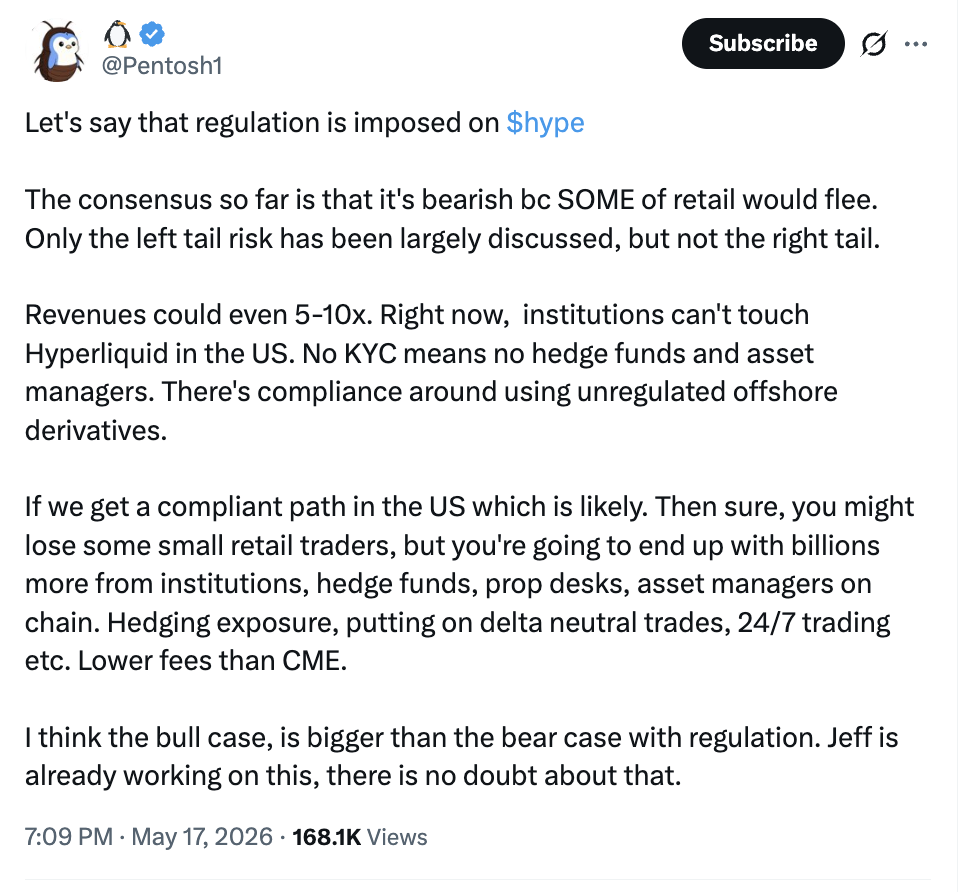
Trader Pentoshi said Hyperliquid’s revenue could “grow 5x–10x” if a compliant US framework, such as the CLARITY Act, allows hedge funds, prop desks, and asset managers to trade on the platform.
Source: X
Higher institutional activity may boost HYPE demand through stronger volume, revenues, and confidence in Hyperliquid’s growth.

[PRESS RELEASE – Willemstand, Curaçao, May 18th, 2026]
International iGaming and crypto-entertainment brand 1win has officially announced the launch of its new global crypto tournament system, featuring competition formats with prize pools ranging from 10,000 USDT to 200,000 USDT. With the new approach to crypto gaming, 1win invited players worldwide to compete for crypto rewards in a single virtual environment.
The initiative marks a transition from region-specific tournaments with unique terms and conditions to an international model in which players from multiple locations share gaming experiences and compete for crypto rewards.
The Crypto Tournament system by 1win includes three formats with different durations and prize structures:
- Crypto Week is a weekly competition format with prize pools of up to 10,000 USDT. Crypto Weeks start every Friday.
- Crypto Month introduces monthly tournaments with prize pools of up to 50,000 USDT and includes gaming categories such as slots, plinko, and crash mechanics.
- Crypto Season is the largest format within 1win. It offers prize pools of up to 200,000 USDT across long-term games.
The leaderboard system is based on total betting activity during each tournament period. Participation is exclusively open to users who deposit in cryptocurrency. At this time, the tournaments are available globally, except for users in the United States, the European Union, the UAE, Kazakhstan, and Nigeria.
1win continues to strengthen its presence in the crypto entertainment segment by developing products for international audiences. Earlier in 2026, the company also announced plans to launch 1win Token, the native digital asset of the 1win ecosystem.
The launch of global crypto tournaments marks another step in the company’s strategy to combine crypto, entertainment, and international-scale gaming experiences.
About 1win
Founded in 2016, 1win is a crypto-focused platform in the global gaming industry. Operating across Asia, Latin America, and Africa, 1win offers a wide range of entertainment products adapted to regional audiences. The brand has active collaborations with international public figures, including actor Johnny Sins, martial artist Jon Jones, and Olympic champion and UFC fighter Gable Steveson. In 2026, 1win welcomed American rapper Tyga as a new member of the 1win VIP community.
The post 1win Crypto Tournaments Go Global With Up to 200K USDT in Rewards appeared first on CryptoPotato.
TLDR
- Crypto funds recorded $1.07 billion in net outflows, ending a six-week streak of inflows.
- Bitcoin products led withdrawals with $982 million in outflows during the week.
- Ether funds posted $249 million in outflows, the largest since late January.
- XRP and Solana investment products attracted fresh inflows despite broader market weakness.
- US-based funds accounted for $1.14 billion of total outflows from crypto products.
Crypto investment products reversed course last week as investors reduced exposure to risk assets. CoinShares reported $1.07 billion in net outflows from digital asset exchange-traded products. The withdrawals ended a six-week inflow streak and marked the third-largest weekly exit this year.
Bitcoin and Ether lead Crypto funds retreat
Bitcoin investment products drove most of the weekly redemptions across global markets. Investors withdrew $982 million from Bitcoin funds, according to CoinShares. The pullback concentrated largely in United States-listed products.
Ether products also faced heavy selling during the same period. Funds tied to Ether recorded $249 million in outflows. That figure represented the largest weekly exit since the week ending January 30.
Most withdrawals originated in the United States, which posted $1.14 billion in net outflows. Meanwhile, Switzerland, Germany, and the Netherlands recorded modest inflows. The shift followed a broader decline in the S&P 500 from recent record levels.
Energy market disruptions near the Strait of Hormuz pushed oil prices higher last week. Rising energy costs contributed to a renewed increase in US inflation. Official data showed inflation reached its highest level in more than three years.
XRP and Solana attract inflows as regulation advances
While major tokens fell, select altcoins attracted fresh capital during the week. XRP investment products brought in $67.5 million in net inflows. Solana funds followed with $55.1 million in new allocations.
CoinShares head of research James Butterfill linked the flows to US policy developments. He said select altcoins benefited from improving regulatory sentiment. Butterfill cited progress on the CLARITY Act as a supportive factor.
The Senate Banking Committee advanced the CLARITY Act with bipartisan backing last week. Lawmakers designed the bill to establish clearer oversight for digital assets. Industry groups argue that the framework would reduce regulatory uncertainty in the United States.
Crypto Council for Innovation CEO Ji Hun Kim addressed the bill’s movement. He said, “The momentum and progress are both strong” as lawmakers review the legislation. However, several Senate Democrats requested stronger ethics provisions tied to officials’ crypto holdings.
Republican Senator Thom Tillis also commented on the draft legislation. He said, “more work remains in the weeks ahead to make this legislation even better.” Lawmakers continue discussions as the bill moves through Congress.

[PRESS RELEASE – London, United Kingdom, May 18th, 2026]
Quantography Labs announced the early-access release of Lock.com, a hardware-free crypto wallet built around an isolated, air-gapped security approach.
Lock.com is now available to early access users. The platform separates private key storage from network-connected systems, removing the need for dedicated hardware wallet devices.
Hardware wallets have long been the standard for protecting digital assets. But they come with a trade-off: users must trust the device, the manufacturer, and the supply chain behind it.
Lock.com removes that dependency by separating the signing environment from the broadcasting environment. Private keys remain on a fully offline signer, while transactions are created and broadcast on a connected device. Private keys never touch the internet. The system is designed to work with devices users already own, removing the need for purpose-built hardware.
Lock.com was built out of frustration with how crypto security works today. Too many people are still losing funds in ways that shouldn’t be happening, not because self-custody failed, but because the software environment around the hardware was never built to the same standard. Lock wanted to close that gap structurally
Lock.com is designed to function as an isolated crypto wallet without relying on third-party hardware manufacturers or proprietary device supply chains. The architecture integrates post-quantum cryptographic standards, specifically ML-DSA signatures and ML-KEM key encapsulation alongside the isolated signing model.
The early access phase is focused on gathering user feedback ahead of general availability. Early access enrolment is available at https://www.lock.com/
About Quantography Labs
Quantography Labs is an investment and technology firm focused on secure finance, digital assets, and applied research. The company develops privacy-focused, quantum-ready systems designed to advance the future of digital asset security and infrastructure. Lock.com is its first publicly released product.
Users can learn more about Lock.com’s isolated crypto wallet architecture: https://www.lock.com/
The post Lock.com Enters Early Access With Isolated Signing and Post-Quantum Architecture appeared first on CryptoPotato.


Ex-OpenAI researcher Leopold Aschenbrenner’s Situational Awareness fund has doubled to $13.67b, with Bitcoin miners as its top long positions.
Summary
- Aschenbrenner’s Q1 2026 13F filing shows equity exposure rising from $5.5b to $13.67b, with miners including IREN, Core Scientific, and Riot Platforms among the top longs.
- The fund simultaneously opened $7.46b in put options against Nvidia, Broadcom, Oracle, and the VanEck Semiconductor ETF.
- Aschenbrenner’s thesis targets Bitcoin miners for their power grid access and land, which AI companies urgently need for data center buildout.
Aschenbrenner, who was fired from OpenAI in 2024 over an alleged information leak, filed the fund’s Q1 2026 13F with the SEC on May 15, with the regulator accepting it on May 18. The document shows disclosed equity exposure more than doubling from $5.52 billion at end-2025 to $13.67 billion as of March 31.
The largest long positions span Bitcoin miners IREN, Core Scientific, Riot Platforms, CleanSpark, Bitfarms, Bitdeer, and Hive Digital, alongside energy and compute plays Bloom Energy, SanDisk, and CoreWeave. As Fortune noted in its March profile, the thesis holds that “the most valuable assets in the AI era may not be algorithms, but electricity and computing power.”
Bitcoin miners as AI infrastructure
Aschenbrenner’s investment logic holds that AI buildout will be bottlenecked by power and land, not chips. Bitcoin miners already hold high-density power sites and grid access that AI companies cannot replicate quickly. His 165-page “Situational Awareness: The Decade Ahead” paper argued that compute infrastructure, not model development, would determine the pace of AGI progress.
The trend is reshaping reported earnings across the sector. As crypto.news reported, TeraWulf’s AI and HPC hosting revenue of $21 million outpaced Bitcoin mining revenue for the first time in Q1 2026. Core Scientific, among Aschenbrenner’s disclosed holdings, has announced plans to repurpose its Pecos site into a 1.5GW AI data center campus, repurposing 300MW of existing mining capacity.
Why the semiconductor short matters
Alongside the miner longs, the fund opened $7.46 billion in put options against the chip sector. The largest positions were $2.04 billion against the VanEck Semiconductor ETF, $1.57 billion against Nvidia, $1.07 billion against Oracle, and $1.01 billion against Broadcom, the filing shows.
The pairing makes the thesis internally consistent: if AI value accrues to power sites rather than chip makers, semiconductor valuations face compression even as infrastructure operators gain.
Crypto.news documented this broader miner pivot in an earlier analysis of firms leaping into HPC, noting that companies from Bitdeer to Riot are accelerating the conversion of mining facilities into AI data centers. Full Q1 holdings data is available at the Situational Awareness LP 13F tracker on 13f.info.
Ripple’s cross-border token headed south over the past few days, plunging to its lowest level since the start of the month.
However, numerous factors and indicators suggest that a rebound could be on the way, while many analysts remain optimistic that a bull run is knocking on the door.
No Need to Panic?
The past 24 hours have not been favorable for the cryptocurrency market, with many leading digital assets posting substantial losses amid renewed tensions between the US and Iran. Recall that American President Donald Trump threatened the Asian country that the clock is ticking, warning them to act fast, “or there won’t be anything left of them.”
The US leader went even further, depicting himself in a spacecraft outside Earth and pressing a red button as countless bombs detonate in the background.
Ripple’s XRP is not among the few exceptions in green today (May 18) as its price fell to around $1.38 (according to CoinGecko). This represents a 5% weekly decline, returning to a level last observed nearly three weeks ago.
The pullback hasn’t managed to spread fear across crypto X, where numerous analysts remain bullish that XRP is gearing up for a major pump. The one using the moniker CoinForge, for instance, claimed that the asset looks “insane” right now and stands at a critical level that sent it up 700% last time.
“The MACD has just done a deep golden cross, and it is primed for an expansion. The target is just south of $5, and that would be a 240% jump,” they added.
JAVON MARKS and Celal Kucuker also made highly optimistic forecasts. The former argued that XRP is still “holding broken out” against BTC and has the potential to outperform by nearly 800%.
“This fulfilling, which a breakout similar to this one has done before, can result in XRP being priced above $10,” their analysis reads.
For their part, Celal Kucuker thinks the asset is ready for a massive breakout, claiming the valuation could exceed the ridiculous (at least as of now) $15.
Further Insight
The substantial inflows into spot XRP ETFs lately reinforce the optimistic outlook. SoSoValue’s data shows that the last day when outflows dominated was April 30, while the past week was the strongest since December.
Since their launch, these financial products have generated a cumulative net inflow of almost $1.4 billion, signaling strong interest from institutional investors and potentially setting the stage for upward price momentum.

Next on the list is the declining amount of XRP tokens stored on Binance. According to CryptoQuant, the figure dropped to a monthly low of around 2.75 million coins, suggesting that investors have shifted toward self-custody methods, thereby reducing immediate selling pressure.

The post Ripple (XRP) Slumps 5% Weekly Yet Analysts Predict Major Rally Ahead: Details appeared first on CryptoPotato.


ZachXBT is offering up to $10,000 for insider evidence that Hong Kong market maker HSBG manipulated centralized exchange markets, including trades around RIVER.
Summary
- On-chain investigator ZachXBT is offering a reward of up to $10,000 for insider information about alleged market manipulation by Hong Kong market maker “Heisenberg Guru” (HSBG).
- He alleges HSBG has been involved in multiple manipulation events on centralized exchanges, including activity around the token RIVER.
- ZachXBT named individuals “Sion” and “Chao” as core members of HSBG and said chat logs, contracts, and internal communications could qualify for bounties, with tips to be submitted via private message on X.
On-chain sleuth ZachXBT has announced a bounty of up to $10,000 for whistleblowers who can provide credible insider evidence of market manipulation tied to Hong Kong market maker “Heisenberg Guru” (HSBG). In a post shared via his investigations channel, he claimed that HSBG has been involved in “multiple market manipulation incidents” on centralized exchanges, singling out trading around the token RIVER as one of the affected markets.
ZachXBT targets alleged CEX manipulation ring
According to his statement, the goal of the bounty is to surface hard evidence that could substantiate or refute suspicions circulating in trading circles about HSBG’s tactics on order books. By explicitly framing the offer around “insider information,” ZachXBT is clearly aiming to reach people who have worked with, or inside, the market-making operation and have direct visibility into its strategies and instructions.
He also emphasized that the maximum payout is “up to” $10,000, implying that rewards will scale with the quality, relevance, and verifiability of the submissions rather than being a flat fee. That structure mirrors how he has handled other crowdsourced investigations, where documentation that can be independently confirmed often receives higher compensation than anonymous accusations.
Call for whistleblowers and documentary evidence
In his call for information, ZachXBT named “Sion” and “Chao” as core members of the HSBG operation, effectively putting specific individuals, rather than just a trading handle, under the spotlight. He suggested that a broad range of materials could be eligible for rewards, including chat records, contracts, and other internal communications that shed light on how HSBG coordinates trading activity on centralized exchanges.
Potential whistleblowers are being asked to submit tips by sending him a private message on X, where he runs most of his public-facing investigative work. While he did not outline an explicit verification process in the initial announcement, his prior investigations have typically involved cross-checking on-chain data, platform logs, and corroborating testimony before publishing detailed reports.
The move underlines the growing role of independent on-chain investigators in policing grey-zone behavior in crypto markets, particularly in areas like thinly traded CEX listings where formal enforcement remains patchy. If the bounty surfaces credible documentation of manipulation linked to HSBG or any associated accounts, it could increase pressure on exchanges to revisit their relationships with certain market makers and potentially spur regulators to take a closer look at trading practices in the Hong Kong-linked segment of the market.
![COUNSELLOR for FINANCIAL LITERACY CENTRE [SNEHA] | INDIAN OVERSEAS BANK | TENKASI JOBS 2026](https://wordupnews.com/wp-content/uploads/2026/05/1779136351_maxresdefault-80x80.jpg)
COUNSELLOR for FINANCIAL LITERACY CENTRE [SNEHA] | INDIAN OVERSEAS BANK | TENKASI JOBS 2026

Pete Hegseth gives Trump impersonation to bash Biden-era military policy and rally for MAGA candidate in Kentucky

(VIDEO) Aaron Rai’s Historic 65 Seals PGA Championship Triumph, Ending 107-Year English Drought

Manchester United reach agreement with Casemiro over contract clause amid transfer speculation

US brings back mandatory military draft registration

Steven Gerrard disagrees with Gary Neville over ‘shock’ Chelsea and Arsenal claim | Football


-

 Crypto World3 days ago
BloFin War of Whales 2026 Grand Prix opens registration for $5M trading championship
-

 Fashion3 days ago
Weekend Open Thread: Theory – Corporette.com
-

 Crypto World3 days ago
E-Estate Announces 1 Year Live: Washington DC Summit as Real Estate Tokenization Enters Its Next Phase
-

 Politics7 days ago
What to expect when you’re expecting a budget
-

 Tech4 days ago
Tech Moves: Microsoft AI leader jumps to OpenAI; former AI2 exec joins Meta; and more
-
Crypto World6 days ago
Bitcoin Suisse expands with Digital Asset License and Investment Business Act Registration Approval in Bermuda
-

 Tech7 days ago
GM agrees to $12.75M California settlement over sale of drivers’ data
-

 Politics6 days ago
Pakistan to enter Chinese capital market as war inflation bites
-

 Crypto World6 days ago
Bitcoin Suisse expands with Digital Asset License and Investment Business Act Registration Approval in Bermuda
-
 Crypto World4 days ago
Google’s Gemini AI Predicts Incredible Solana Price by the End of 2026
-

 Business3 days ago
H&R Real Estate Investment Trust (HR.UN:CA) Q1 2026 Earnings Call Transcript
-

 Tech3 days ago
Google reimburses Register sources who were victims of API fraud
-

 Sports3 days ago
Napoleonic enters 2026 Doomben 10,000 field via Abounding withdrawal
-

 Politics7 days ago
The geopolitics behind the UK’s South Atlantic hantavirus rescue mission
-

 NewsBeat6 days ago
Comment on Keir Starmer surviving the day as Prime Minister like a turd that wont flush
-

 Politics7 days ago
The Board of Deputies just smeared Polanski to suck up to Farage
-

 Fashion6 days ago
The Best-Kept Makeup Secret for a More Defined Face
-
 Entertainment4 days ago
Zara Larsson Has Blunt Response To Chris Brown Diss
-

 Politics6 days ago
The Trial of Majid Freeman, Verdict
-
 Tech6 days ago
Why AI is making typography a boardroom conversation
You must be logged in to post a comment Login