

Crypto World
Ripple (XRP) Slumps 5% Weekly Yet Analysts Predict Major Rally Ahead: Details

Ripple’s cross-border token headed south over the past few days, plunging to its lowest level since the start of the month.
However, numerous factors and indicators suggest that a rebound could be on the way, while many analysts remain optimistic that a bull run is knocking on the door.
No Need to Panic?
The past 24 hours have not been favorable for the cryptocurrency market, with many leading digital assets posting substantial losses amid renewed tensions between the US and Iran. Recall that American President Donald Trump threatened the Asian country that the clock is ticking, warning them to act fast, “or there won’t be anything left of them.”
The US leader went even further, depicting himself in a spacecraft outside Earth and pressing a red button as countless bombs detonate in the background.
Ripple’s XRP is not among the few exceptions in green today (May 18) as its price fell to around $1.38 (according to CoinGecko). This represents a 5% weekly decline, returning to a level last observed nearly three weeks ago.
The pullback hasn’t managed to spread fear across crypto X, where numerous analysts remain bullish that XRP is gearing up for a major pump. The one using the moniker CoinForge, for instance, claimed that the asset looks “insane” right now and stands at a critical level that sent it up 700% last time.
“The MACD has just done a deep golden cross, and it is primed for an expansion. The target is just south of $5, and that would be a 240% jump,” they added.
JAVON MARKS and Celal Kucuker also made highly optimistic forecasts. The former argued that XRP is still “holding broken out” against BTC and has the potential to outperform by nearly 800%.
“This fulfilling, which a breakout similar to this one has done before, can result in XRP being priced above $10,” their analysis reads.
For their part, Celal Kucuker thinks the asset is ready for a massive breakout, claiming the valuation could exceed the ridiculous (at least as of now) $15.
Further Insight
The substantial inflows into spot XRP ETFs lately reinforce the optimistic outlook. SoSoValue’s data shows that the last day when outflows dominated was April 30, while the past week was the strongest since December.
Since their launch, these financial products have generated a cumulative net inflow of almost $1.4 billion, signaling strong interest from institutional investors and potentially setting the stage for upward price momentum.

Next on the list is the declining amount of XRP tokens stored on Binance. According to CryptoQuant, the figure dropped to a monthly low of around 2.75 million coins, suggesting that investors have shifted toward self-custody methods, thereby reducing immediate selling pressure.

The post Ripple (XRP) Slumps 5% Weekly Yet Analysts Predict Major Rally Ahead: Details appeared first on CryptoPotato.


Key takeaways
- Hyperliquid (HYPE) has fallen below $70, extending its losing streak as broader crypto market sentiment turns risk-off.
- Retail participation is weakening, with futures open interest declining and long liquidations dominating the derivatives market.
Hyperliquid (HYPE) continued to trade lower on Wednesday, slipping below the $70 level as cautious sentiment across the cryptocurrency market dampened retail participation.
The token has recorded three consecutive days of losses, reflecting growing uncertainty among short-term traders. Despite the pullback, institutional investors continue to show confidence, highlighting a divergence between retail and professional market participants.
Retail traders reduce exposure
Recent derivatives data points to weakening retail demand for HYPE. According to CoinGlass, Hyperliquid futures open interest (OI) declined by more than 2% over the past 24 hours to $2.80 billion, indicating that traders are either reducing leverage or closing positions altogether.
During the same period, the market recorded $7.09 million in liquidations, with approximately $6.29 million coming from long positions.
The dominance of long liquidations suggests that bullish traders have been forced to exit as prices moved lower, reinforcing short-term selling pressure.
Despite the decline in positioning, the funding rate remains positive at 0.0078%, indicating that some traders continue to maintain bullish expectations and are willing to pay a premium to hold long positions.
While retail sentiment has weakened, institutional interest continues to provide support.
Data from CoinGlass shows that HYPE exchange-traded funds (ETFs) attracted $4.32 million in net inflows on Tuesday, following $8.43 million in inflows recorded on Monday.
The continued inflows suggest that larger investors remain optimistic about Hyperliquid’s longer-term outlook despite ongoing short-term market volatility.
This divergence between institutional accumulation and cautious retail positioning could become an important factor in determining the token’s next major move.
Hyperliquid price outlook: Support near $64.75 comes into focus
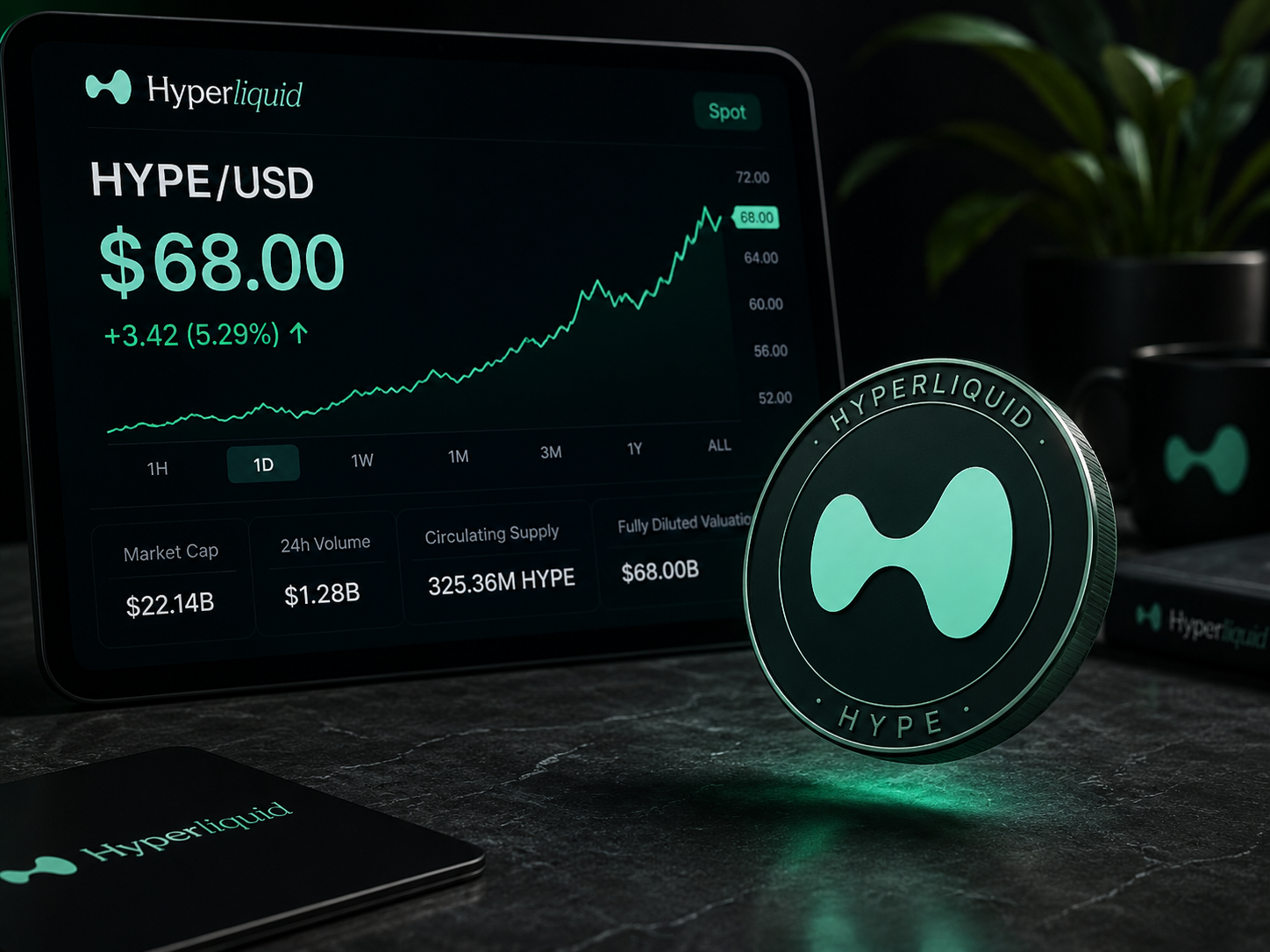
At the time of writing, HYPE is trading around $68, maintaining its broader bullish structure despite recent weakness.
The token remains comfortably above its 50-day Exponential Moving Average (EMA) at $62.36, which continues to trend above the 200-day EMA at $48.40—a positive sign for the longer-term trend.
However, the recent rejection from a local resistance trendline near $72.75 has increased the likelihood of a deeper short-term correction.
From a technical standpoint, HYPE could continue sliding toward a rising support trendline around $64.75, an area reinforced by the nearby 50-day EMA.
Momentum indicators continue to lean cautiously bullish but show signs of slowing. The Moving Average Convergence Divergence (MACD) remains slightly above its signal line, indicating that positive momentum has not disappeared completely.
Meanwhile, the Relative Strength Index (RSI) sits around 54, reflecting moderate buying strength while gradually moving back toward neutral territory.
Unless buying activity strengthens, the current pullback could continue before the broader uptrend resumes.
The first major support lies near the ascending trendline around $64.75, followed by the 50-day EMA at $62.36. A decisive break below these levels could expose HYPE to a deeper correction, potentially bringing the $60 level into focus.

On the upside, bulls must reclaim the $72.73 resistance zone, which aligns with the recent descending trendline. A successful breakout above this level could restore upward momentum and pave the way toward the R1 Pivot Point at $77.09, followed by the R2 Pivot Point at $89.14.
For now, the short-term outlook remains cautious, with weakening retail demand offset by continued institutional accumulation.


Key takeaways
- Zcash (ZEC) climbed more than 4% after developers announced progress toward proving its new privacy system is free from undetectable counterfeiting vulnerabilities.
- Project Tachyon is close to completing a mathematical verification of Zcash’s upcoming Ironwood shielded pool.
Zcash’s native token ZEC surged more than 4% on Wednesday after developers announced they are close to mathematically proving that the network’s next-generation privacy system is free from a critical class of counterfeiting vulnerabilities.
The announcement restored investor confidence following last month’s disclosure of a security flaw in Zcash’s existing shielded transaction system, helping the privacy-focused cryptocurrency reclaim the $500 level for the first time since early June.
Project Tachyon nears verification of Ironwood Shielded Pool
The latest update comes from Project Tachyon, the team leading the formal verification of Zcash’s upcoming Ironwood shielded pool, which is set to replace the current Orchard privacy pool.
According to the developers, they are close to producing a mathematical proof confirming that Ironwood does not contain undetectable counterfeiting bugs.
Zcash founder Zooko Wilcox said the project is “on the verge” of completing a formal proof demonstrating that the latest generation of Zcash shielded pools is secure against this class of vulnerability.
If successful, the verification would provide stronger security guarantees for one of the network’s core privacy features.
Investor confidence was shaken last month after developers disclosed a critical vulnerability affecting Zcash’s Orchard shielded pool.
The flaw could have theoretically allowed an attacker to create counterfeit ZEC within the privacy pool without detection.
Although developers quickly patched the issue and said they found no evidence that the vulnerability had ever been exploited, Zcash’s privacy architecture made it impossible to cryptographically prove that no counterfeit coins had been created.
The disclosure triggered a sharp market reaction, sending ZEC down more than 40% in just two days.
Will ZEC reclaim $550?
The ZEC/USD 4-hour chart remains bullish and efficient following the recent rally. The momentum indicators suggest that the bulls could push ZEC’s price higher.
The RSI of 57 shows that ZEC is above the neutral zone, while the MACD lines reinforce the bullish bias.
If the bulls remain in control, ZEC could rally past the Tuesday high of $510 and set a new weekly high around $550.

A decisive candle close above this level could allow ZEC to reclaim the $600 psychological zone in the near term.
However, if the bears come into the picture, ZEC could retest the 4-hour TLQ at $438 over the next few hours.

Key Takeaways
- Tom Narayan from RBC Capital increased Tesla’s price target from $475 to $500, pointing to potential SpaceX acquisition scenarios
- An all-stock transaction with SpaceX purchasing Tesla at a 20–30% premium represents the most probable deal structure
- JPMorgan acknowledged strategic merit in combining the companies but highlighted significant regulatory obstacles, especially concerning China
- Shares of TSLA settled near $402.90 on Tuesday, sliding more than 4%, with continued weakness in Wednesday’s pre-market session
- Analyst consensus leans toward Hold on TSLA, with an average target price of $399.71 across Wall Street
Tuesday saw Tesla (TSLA) shares settle near $402.90, marking a decline exceeding 4%, as financial analysts began evaluating an intriguing proposition: could Tesla and SpaceX merge into a single corporate entity?
Speculation intensified following SpaceX’s completion of a groundbreaking $75 billion IPO that assigned the company a $1.77 trillion market valuation. This milestone thrust Elon Musk’s business portfolio into the spotlight, prompting market participants to consider whether his two flagship ventures might consolidate into one comprehensive platform spanning artificial intelligence, robotics, sustainable energy, transportation, and aerospace.
Tom Narayan, an analyst at RBC Capital, took the lead by increasing his TSLA price objective from $475 to $500 while maintaining his Buy recommendation. He explained that growing media discussion surrounding a potential Tesla-SpaceX combination had sparked investor curiosity about the financial implications of such a union.
Narayan presented his analysis with precision. According to his assessment, the most feasible transaction framework would involve an all-stock arrangement where SpaceX purchases Tesla while offering shareholders a 20–30% premium over current market prices. This premium calculation forms the foundation for his $500 target.
He further explained that Tesla shareholders would probably insist on this premium compensation, particularly since Elon Musk’s ownership stake would expand beyond 50% in the combined organization — substantially higher than his existing 20% position in Tesla alone.
Excluding any merger scenario, Narayan calculates Tesla’s independent valuation at approximately $435, representing roughly 10% upside from recent trading levels.
Revised Business Unit Valuations
Narayan’s analysis also included updated assessments across Tesla’s various business divisions. He increased his robotaxi valuation by 20% following an upward revision to his global fleet projections, identifying this segment as Tesla’s most compelling long-term growth avenue within a $4.2 trillion total addressable market.
The humanoid robotics division experienced a downward adjustment. Narayan reduced this segment’s valuation by approximately 40% after lowering his U.S. market penetration forecast from 50% to 20%. Despite this cut, humanoid robots still represent roughly 25% of his overall valuation model.
Energy storage also faced a 30% reduction, reflecting a weaker market environment and intensifying competition that’s pressuring profit margins — despite ongoing demand growth from AI data center infrastructure.
JPMorgan Expresses Reservations
Rajat Gupta, an analyst at JPMorgan, recognized the strategic rationale behind a merger, characterizing such a combination as “strategically coherent on paper.” Tesla contributes electric vehicles, battery technology, autonomous driving software, and robotics capabilities. SpaceX adds rocket launch systems, Starlink satellite networks, orbital infrastructure, and defense-sector connections.
Combined, these assets would create what resembles an integrated industrial technology conglomerate rather than two distinct companies.
However, Gupta stopped short of recommending the stock based on merger speculation. He identified considerable regulatory and geopolitical challenges, with China representing the most significant complication. Tesla maintains substantial manufacturing operations and revenue generation in Chinese markets. Meanwhile, SpaceX operates in sensitive satellite communications and defense-adjacent sectors that could trigger political resistance from Beijing authorities.
Gupta maintained his Hold rating on Tesla shares.
The prevailing Wall Street sentiment aligns with this cautious stance. Among analysts who’ve issued ratings on TSLA within the past three months, 10 recommend Buy, 15 advise Hold, and three suggest Sell. The consensus price target stands at $399.71 — indicating modest downside from present trading levels.
TSLA continued trading lower in Wednesday’s pre-market session.

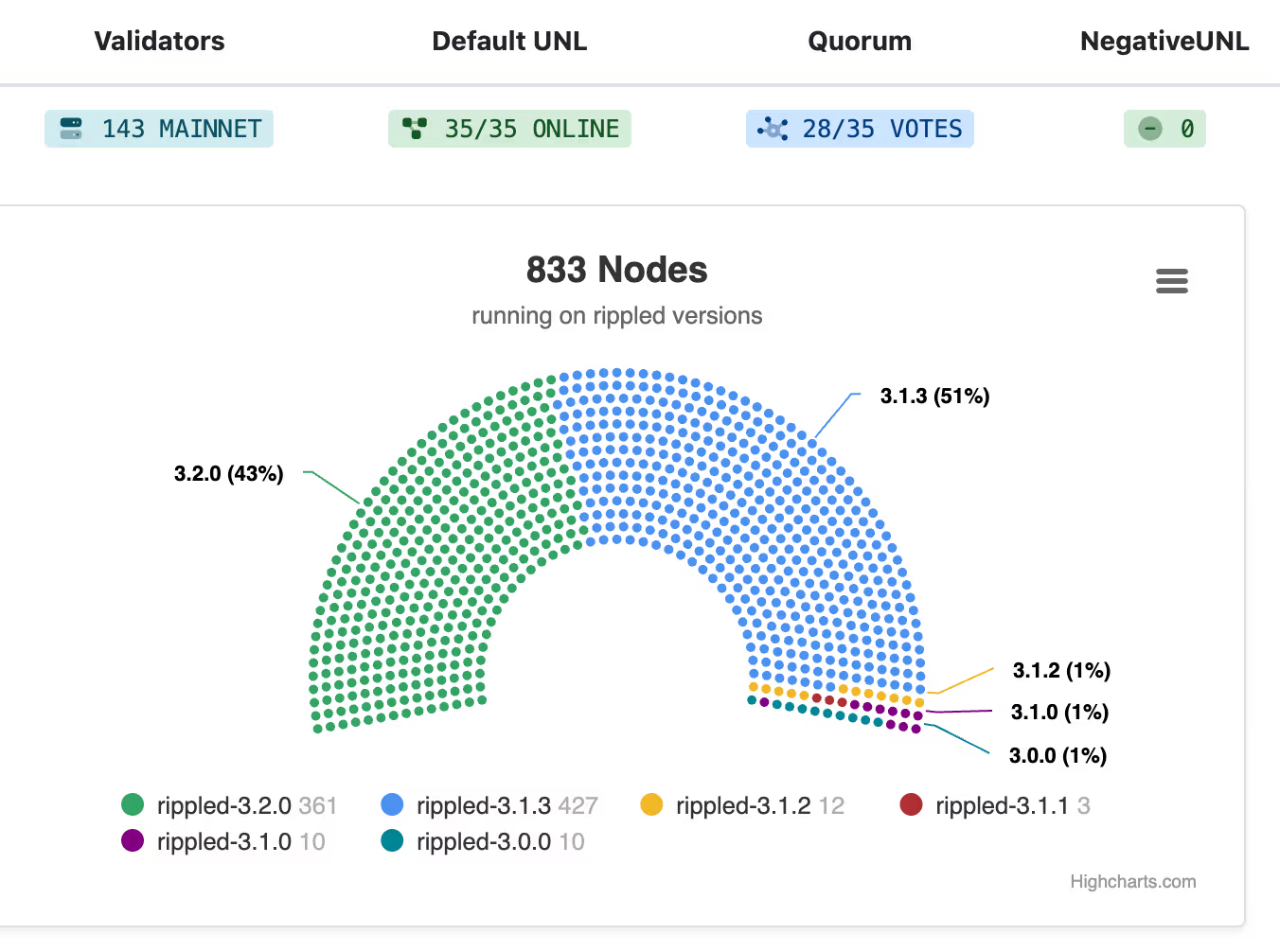
The XRP Ledger’s newest server software, v3.2.0, designed to make the network cheaper to run, more stable, and more attractive for institutional use, is gaining adoption. However, it has yet to overtake the previous version (3.1.3) across the wider network, and the key security fixes that come with it remain in the voting process.
Of the approximately 833 active nodes on the XRP Ledger, the machines that store and relay the ledger, about 43% are running v3.2.0 and 51% are still on v3.1.3, XRPSCAN data shows.

While overall node adoption appears relatively slow, validators, or entities that matter most to the network, have largely already upgraded.
The XRP Ledger runs on a trusted set of validators known as the Unique Node List (UNL). For a new software version or amendment to activate, it needs sustained support from more than 80% of validators on that list for two straight weeks.
On the default UNL of 35 validators, 31 are running v3.2.0, about 89%, clearing the threshold the network treats as sufficiently updated. That figure, not the raw node or all-validator percentages, is what determines whether the upgrade completes.
The amendment lagging behind
Bundled with the software is a separate matter that sits well behind it.
Coinbase-backed Ethereum layer-2 network Base is set to activate its B20 token standard on mainnet, introducing a native framework for stablecoins, tokenized real-world assets (RWAs) and other fungible tokens.
According to Base documentation, B20 is scheduled to go live at 6 pm UTC on the mainnet, enabling developers to begin creating tokens under the new standard.
The activation will enable developers to use Base’s native token standard to create stablecoins, RWAs, tokenized equities and other fungible tokens without requiring them to build and audit custom ERC-20 contracts.
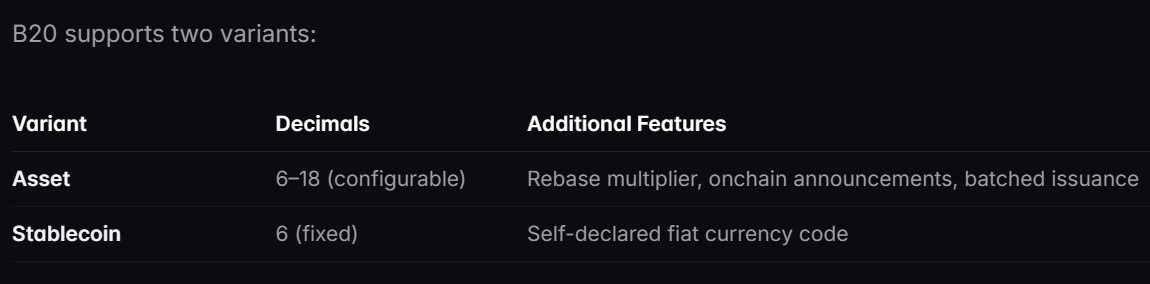
The standard supports two variants: asset and stablecoin. The asset variant has configurable decimals between six and 18, while the stablecoin variant has fixed six-decimal formatting and requires issuers to specify a fiat currency denomination, such as the US dollar or euro.
B20 supports two variants. Source: Base
B20 was introduced as part of the network’s Beryl upgrade, which went live on June 26. The upgrade shortened withdrawal waiting periods from seven days to five days and added technical changes aimed at improving network performance.
Base said B20 tokens are compatible with standard ERC-20 tokens but come with built-in issuer controls. Those features include supply limits, transfer rules, minting, burning, pausing and transaction notes.
B20 activation follows Base outages
The B20 activation follows back-to-back outages linked to its sequencer infrastructure.
On June 25, Base encountered an outage caused by a consensus issue. At the time, the network said an invalid block had been sequenced, preventing new blocks from being created. Base resumed block production on the same day, after a nearly two-hour halt.
Related: Coinbase restores trading after AWS outage disrupts markets
In a post-mortem, Base said that a sequencer bug caused back-to-back outages on June 25 and June 26. The first incident lasted for about 116 minutes, while a second outage lasted about 20 minutes after a race condition prevented sequencers from catching up after a system reset.
The initial outage occurred hours before the scheduled Beryl upgrade, which was delayed by one day due to a separate B20 activation registry timing issue.
Magazine: Has Bitcoin bottomed for this cycle? Analysts say ‘not yet’
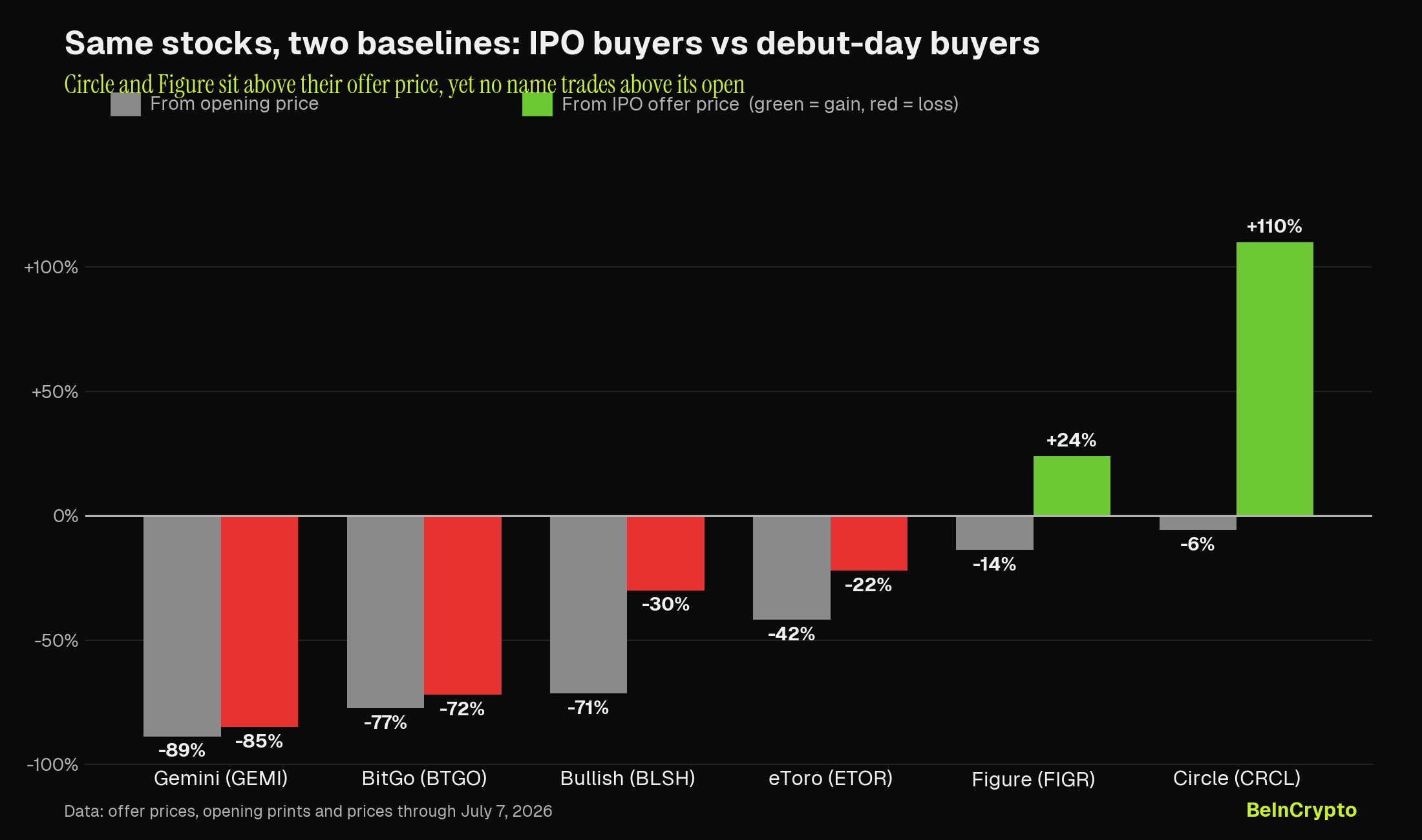
Recent crypto IPO stocks are all trading below their debut-day prices, with Circle (CRCL) down about 6% and Gemini (GEMI) down 89%.
The pattern spans every major crypto listing since mid-2025. Their slide tracks a broad market downturn that began in October.
Gemini, BitGo, Bullish Shares Sink Over 70% From Their Opening Trades
The data outlines how steep the losses run across the six major names. Gemini (GEMI) opened at $37 on its September 2025 debut and now trades near $4.19. That marks a drop of about 89%.
BitGo (BTGO) sits about 77% below its $22.43 first trade in January 2026. Bullish (BLSH) has fallen roughly 71% from its $90 open.
eToro (ETOR) trades near $41, down about 42% from its $69.69 open. Figure (FIGR) is off about 14% from its $36 debut, and Circle is down about 6% from its $69 open.
Follow us on X to get the latest news as it happens

The picture changes measured from IPO offer prices. Circle sits around 110% above its $31 offer, and Figure is about 24% above its $25 price. The other four remain below their offer levels.
The drawdown is not entirely surprising. The crypto market has fallen sharply since the fourth quarter of 2025, and the trajectory has stayed broadly downward this year. Crypto-linked stocks have weakened alongside it.
Weak Performance Freezes the IPO Pipeline
The market’s weakness has stalled the next wave of crypto listings. Several firms that planned 2026 debuts have pushed back their timelines.
Kraken’s parent, Payward, paused its listing in March 2026. Grayscale has also delayed its offering preparations and may not restart before the fourth quarter of 2026. Consensys and Ledger have also postponed their plans.
Whether the window reopens depends on where crypto prices settle in the coming months.
Subscribe to our YouTube channel to watch leaders and journalists provide expert insights
The post Gemini Stock Leads Crypto IPO Losses With 89% Drop From Its Debut appeared first on BeInCrypto.

Key Takeaways
- Secret Network has announced plans to migrate its SCRT token away from Cosmos to Arbitrum, an Ethereum layer-2 solution.
- The decision follows a devastating $4.7 million bridge hack in June that highlighted critical security vulnerabilities.
- Developers warn that artificial intelligence technology is accelerating the discovery and exploitation of legacy code weaknesses.
- Total value locked in the Cosmos ecosystem has plummeted 88% since 2021, while Arbitrum maintains $17.4 billion in secured assets.
- The SCRT token experienced a sharp 24% decline within 24 hours of the migration announcement, currently valued at approximately $0.041.
Privacy-focused blockchain Secret Network has revealed intentions to abandon the Cosmos ecosystem in favor of Arbitrum, an Ethereum layer-2 scaling solution. The migration proposal, made public on July 7, emerges just weeks after hackers successfully exploited a bridge vulnerability, stealing $4.7 million in digital assets.
According to the development team, security concerns represent the primary motivation behind this strategic shift. While Secret Network has called Cosmos home since 2020, the organization now believes the ecosystem’s evolving landscape and aging infrastructure pose unacceptable risks.
“The security risk is the part we take most seriously,” the team wrote. “Old code is becoming dramatically easier to analyze.”
Developers specifically highlighted artificial intelligence as an emerging vulnerability factor. Modern AI systems can efficiently analyze smart contract code, identify logical flaws, and generate functional exploit scripts at unprecedented speeds.
The bridge compromise in June, which targeted the Axelar-Secret IBC connection, resulted in $4.7 million worth of bridged tokens being stolen. While the team emphasized that the core SCRT token and underlying privacy technology remained secure, the incident demonstrated the inherent risks associated with maintaining outdated code within a shrinking ecosystem.
Declining Cosmos Ecosystem Metrics
The Cosmos network has experienced significant deterioration since reaching its zenith in 2021. Current total value locked across all Cosmos-based chains stands at approximately $2 billion, representing an 88% collapse from peak levels. Secret Network itself maintains only $1.3 million in locked value, based on DefiLlama data.
Contrasting sharply, Arbitrum currently secures $17.4 billion in total value, establishing its position as the dominant Ethereum layer-2 network according to L2Beat metrics.
The development team noted that both developers and liquidity providers have steadily migrated away from Cosmos. Previously reliable infrastructure and tools have deteriorated, while several prominent projects have already departed the ecosystem.
Secret Network joins a growing exodus from Cosmos. Stablecoin infrastructure Noble revealed plans to migrate to Ethereum in January. Privacy-focused NilChain completed its Ethereum transition in February. Sei Network finalized its comprehensive Cosmos-to-Ethereum migration in June.
Technical Migration Details and Token Economics
Should the governance proposal receive community approval, SCRT Labs intends to capture a snapshot of all SCRT token balances on September 1. This snapshot will determine eligibility for the new ERC-20 compatible SCRT token launching on Arbitrum.
Native SCRT holdings and staked tokens will qualify for the migration. However, bridged SCRT variants, sSCRT, contract-held balances, and IBC-based assets will be excluded. Token holders must ensure their assets are in eligible forms before the snapshot deadline.
Post-migration tokenomics will feature a reduced inflation rate, dropping from 9% annually to 5%. SCRT will maintain its role as the primary governance token on the new platform.
Official development support for the existing Cosmos-based Secret layer-1 blockchain will terminate on September 1. The legacy chain could theoretically continue operating if independent validators elect to maintain the infrastructure.
The migration proposal awaits formal community voting. Without governance approval, the transition cannot proceed.
Market reaction to the announcement proved overwhelmingly negative. SCRT’s price crashed approximately 24% in the initial 24-hour period following the revelation, settling near $0.041. This valuation represents a staggering 99%+ decline from the token’s 2021 all-time high.
As part of the transition process, Secret Network’s development team has committed to releasing the network’s complete source code under an open-source licensing framework.

Security officers keep watch in front of an AI (Artificial Intelligence) sign at the annual Huawei Connect event in Shanghai, China, September 18, 2019.
Aly Song | Reuters
BEIJING — China on Wednesday warned of “back-door” security risks affecting companies that use U.S.-based company Anthropic’s Claude Code artificial intelligence tool.
It comes as the U.S.-China tech race intensifies, with Anthropic last month blaming Chinese company Alibaba for attempting to extract its AI capabilities, which are not officially available in China. Alibaba did not comment on the accusations at the time.
Many locals in China have found ways to use U.S. AI tools, however. In March, a Xiaomi AI developer said at a state-organized forum that many were using Claude Code. And Alibaba has ordered its employees to stop using Anthropic tools for work starting July 10, CNBC confirmed on Monday.
The Chinese Ministry of Industry and Information Technology said Wednesday its cybersecurity threat platform found “AI coding tool Claude Code contains a security back-door vulnerability that poses a serious threat.”
The autonomous coding tool can send sensitive information to a remote server without a user’s consent, the statement said in Chinese, according to a CNBC translation. It noted that the information could include a user’s location and identity.
Users should uninstall or upgrade from the affected Claude Code versions, 2.1.91 to 2.1.196, the cybersecurity platform said. That covers versions released from April 2 to June 29, according to Anthropic’s website, which says the latest version of Claude Code as of Wednesday is 2.1.204.
Anthropic did not immediately respond to a CNBC request for comment.
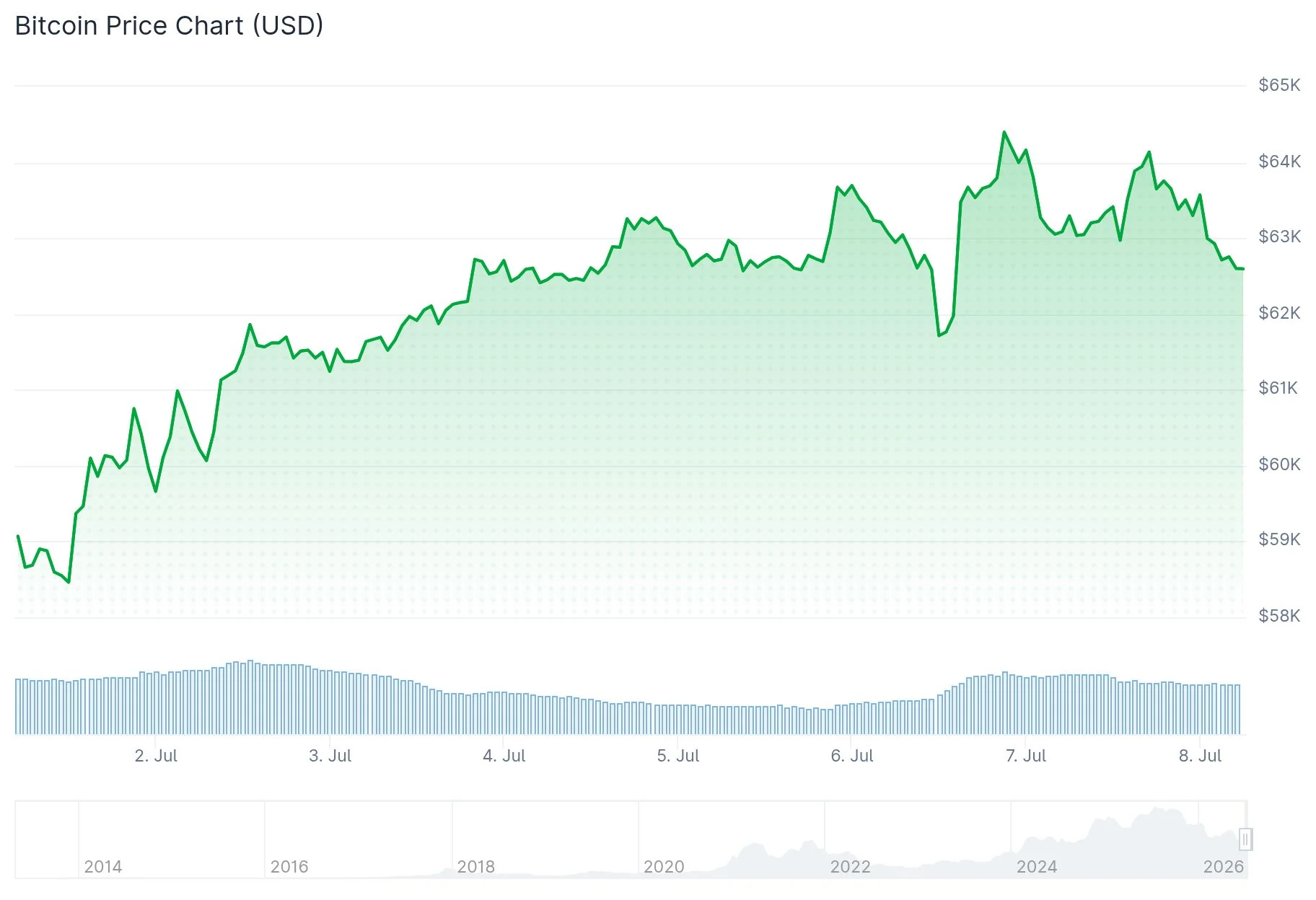
Key Takeaways
- Bitcoin commands 40% allocation due to institutional adoption and proven market stability
- Ethereum captures 25% for its leadership in decentralized finance and smart contract platforms
- Solana secures 15% thanks to superior transaction speed and expanding ecosystem
- Chainlink holds 10% as critical oracle infrastructure supporting real-world data integration
- Near Protocol takes 5% for its emerging AI integration and Layer 1 innovation
Distributing $1,000 strategically across five digital assets plus a stable reserve creates a framework that manages volatility while capturing growth potential.
Building the Foundation With Market Leaders
Bitcoin anchors this allocation strategy with a 40% position worth $400. As the pioneering cryptocurrency with the largest market capitalization, it benefits from unmatched liquidity and growing institutional acceptance through exchange-traded funds and corporate balance sheet adoption. Its established position makes it the most dependable choice among digital currencies.
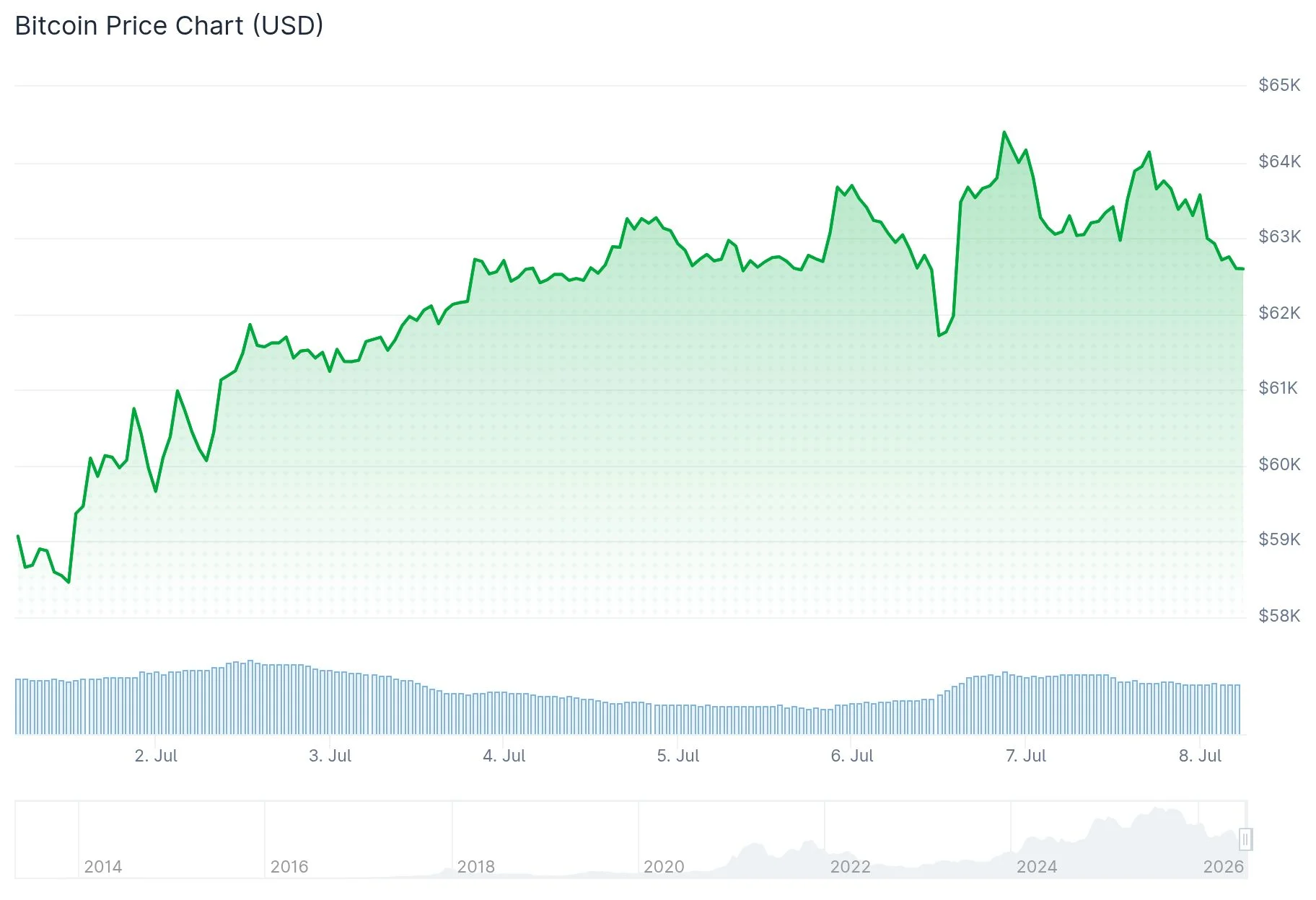
Ethereum claims the second-largest portion at 25%, representing $250. This network underpins the majority of decentralized financial applications and stablecoin infrastructure while serving as the primary platform for asset tokenization. Traditional financial players exploring blockchain solutions consistently choose Ethereum’s established ecosystem.
Combined, these two assets account for 65% of the total allocation. This concentration acknowledges their relatively lower volatility compared to emerging alternatives.
Adding High-Growth Exposure
Solana receives a 15% allocation worth $150. This blockchain challenges Ethereum with superior transaction throughput and minimal fees, establishing significant presence in decentralized finance, payment systems, and mainstream crypto applications. While introducing additional risk, it offers substantial upside potential through continued network adoption.
Chainlink captures 10%, translating to $100. Its decentralized oracle infrastructure bridges blockchains with external data sources, creating essential functionality for DeFi protocols and enterprise applications. Growing tokenization of traditional assets should drive increased demand for reliable data feeds.
Near Protocol completes the portfolio with 5%, or $50. This platform emphasizes artificial intelligence infrastructure alongside its Layer 1 capabilities. Though representing the smallest and most speculative position, it provides meaningful exposure to the convergence of AI and blockchain technology.
Complete Allocation Breakdown
Bitcoin: 40% ($400)
Ethereum: 25% ($250)
Solana: 15% ($150)
Chainlink: 10% ($100)
Near Protocol: 5% ($50)
Stablecoins: 5% ($50)
Maintaining Liquid Reserves
The remaining 5%, worth $50, remains in stablecoin holdings. This represents a strategic buffer rather than idle capital. Maintaining liquid reserves enables opportunistic purchases during market corrections without liquidating existing positions.
Cryptocurrency markets experience dramatic price movements. A modest reserve provides tactical flexibility when attractive entry points emerge.
The Case for Strategic Allocation
No individual asset guarantees superior returns. Distributing capital across five cryptocurrencies with distinct applications and risk characteristics helps minimize portfolio damage when individual assets decline sharply.
Bitcoin and Ethereum establish the baseline stability. Solana, Chainlink, and Near deliver growth potential. The stablecoin reserve maintains optionality for market dislocations.
This framework avoids speculation in favor of methodical market exposure. It represents a rational entry point for allocating $1,000 toward digital assets without concentrating risk excessively.
The allocation mirrors current market dynamics: institutional participation continues expanding, artificial intelligence intersects with blockchain infrastructure, and fundamental protocol layers gain importance in how decentralized networks operate.
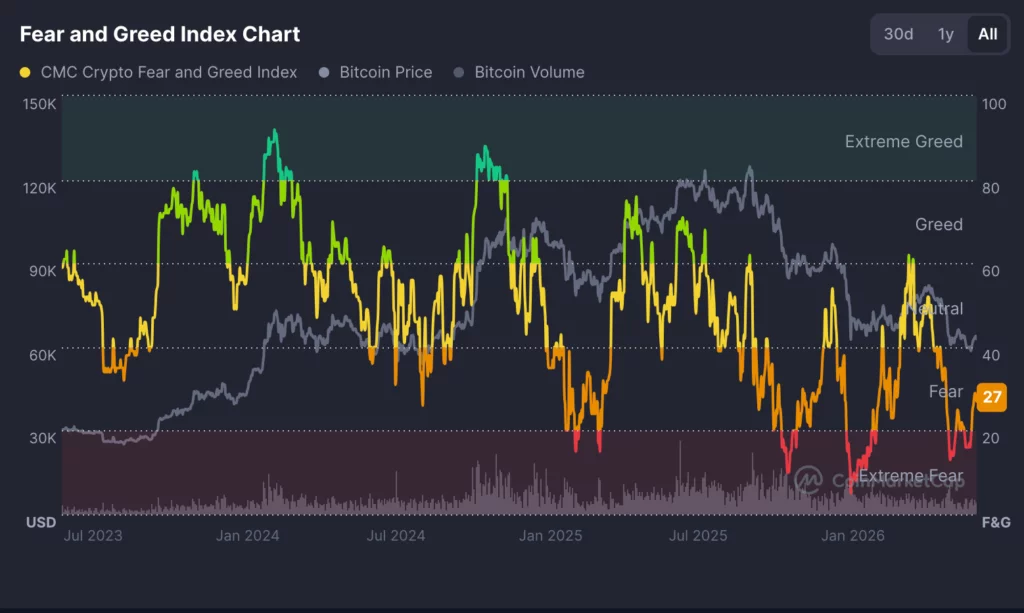
Altcoins are facing renewed pressure as market breadth weakens and liquidity stays thin across smaller tokens.
Summary
- Darkfost says 40% of altcoins now trade near lows as token oversupply drains liquidity fast.
- Bitcoin’s drop below $60,000 pushed the share toward 45%, showing altcoin stress deepening again sharply.
- Mikybull sees an altcoin dominance breakout, but broader market data still demands caution from traders.
Crypto analyst Darkfost said about 40% of altcoins are trading near their all-time lows. He said the reading reflects the pressure facing projects that launched tokens during a period of weaker demand.
Darkfost said the share climbed to 45% when Bitcoin fell back below $60,000 in late June. He framed the data as a warning that altcoins remain exposed when market liquidity dries up and buyers narrow their focus to stronger names.
The analyst said the current market looks different from past cycles. He pointed to the fast rise in token creation, saying CoinMarketCap counts about 53.5 million crypto assets and around 60,000 new tokens added daily.
According to CoinMarketCap, Bitcoin dominance is around 58.2%, keeping BTC in control of most market value.
Token supply adds pressure
The large number of tokens has become a key reason for weaker altcoin performance. When new assets keep entering the market, liquidity spreads across more coins, making it harder for most projects to hold price support.
Darkfost said many of these assets may fail without strong incoming liquidity. His view fits a market where investors have become more selective and where speculative capital has not moved broadly into smaller tokens.
Altseason has failed to arrive in 2026 because Bitcoin remains below its record, dominance stays elevated, and ETF capital has stayed mostly locked in BTC rather than rotating into altcoins.
Dominance chart sends mixed signal
Not all analysts see only weakness. MikybullCrypto said the altcoin dominance chart looks solid after breaking a four-year trendline.
A breakout in altcoin dominance can show early signs of capital moving away from Bitcoin and into the broader market. Traders often watch that chart for clues that altcoins may be preparing for a stronger relative move.
Still, one chart does not confirm a broad altseason. As crypto.news previously reported, the Altcoin Season Index measures whether most top altcoins are beating Bitcoin over 90 days. A reading above 75 confirms altseason, while lower readings show mixed or BTC-led conditions.
The index sat near 43 in mid-2026. That level shows some recovery in altcoin performance, but not enough to confirm a sustained rotation away from Bitcoin.
Market remains selective
Weak retail activity has also limited altcoin demand. Bitcoin search interest rose during the 2026 selloffs, but fear-driven searches did not prove that smaller investors were buying again.
Currently, the Crypto Fear and Greed Index is around 27, placing sentiment in the fear zone. The reading shows that market confidence remains weak, though conditions are less extreme than earlier lows.
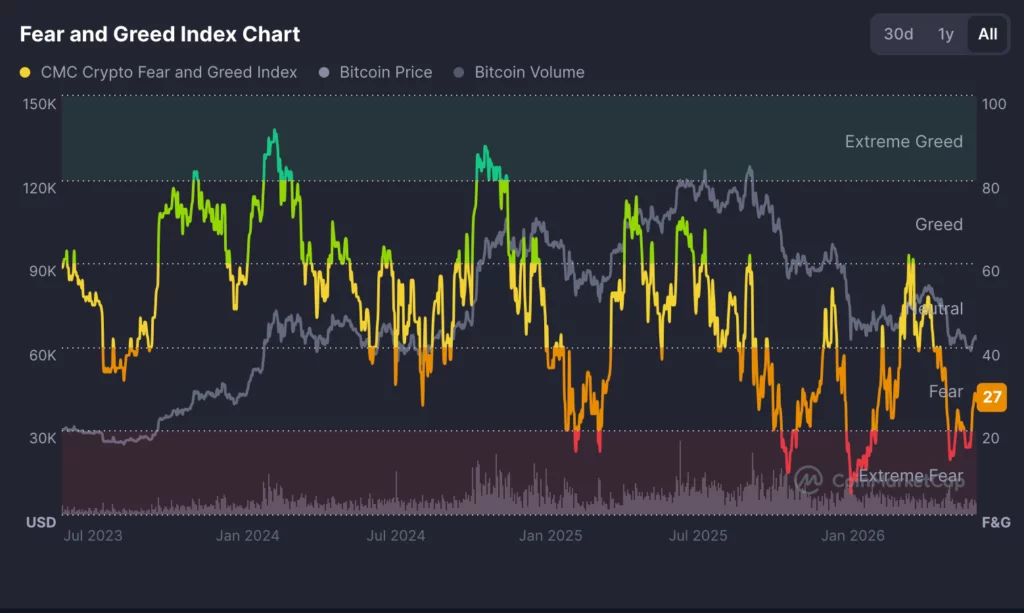
For now, the altcoin market is split between two signals. Darkfost’s data shows a large share of tokens stuck near historic lows, while Mikybull’s chart points to a possible dominance breakout.
That split suggests traders are not treating all altcoins the same way. Stronger projects may attract selective flows, but weaker tokens remain exposed as liquidity spreads across millions of assets and Bitcoin dominance stays high.
Disclosure: This article does not represent investment advice. The content and materials featured on this page are for educational purposes only.

FCC To End Biden-Era Rule That Forces ISPs To List All Their Fees

New Middlesbrough Pitch Sports Bar: Teesside Lions’ partnership

Global Market: Euro zone bond yields hit near one-month high as oil surge fuels ECB rate hike bets


-

 Fashion5 days ago
Weekend Open Thread: High Hopes
-
 NewsBeat3 days ago
Taylor Swift and Travis Kelce wedding staffer hilariously struggles to keep her cool while checking in megastars
-
Crypto World7 days ago
Airdrop Registration Becomes Key Focus For Remittix As RTX Launch Updates Approach
-

 Fashion2 days ago
Open Thread: What Great Books Have You Read Recently?
-

 Politics5 days ago
The House | “Reframing the debate from a binary discussion of winners and losers”: Yuan Yang reviews ‘We Are Not Machines’
-

 Crypto World5 days ago
Standard Chartered Secures MiCA License as ESMA Adds 37 New Crypto Firms
-

 Sports7 days ago
Broncos roster: OL Ben Powers (No. 74) entering final year of contract
-

 Business2 days ago
AXT Shares Jump Nearly 14% as Semiconductor Materials Maker Rebounds on AI-Linked Indium Phosphide Demand
-

 Crypto World6 days ago
Binance stock trading tops $1B in first month after launch
-
Crypto World2 days ago
SK hynix (000660.KS) Stock Dips as $28B Nasdaq ADR Offering Drives AI Memory Expansion
-

 Crypto World6 days ago
Alibaba-affiliate Ant Group enters the humanoid robot market with 12 deals
-

 Crypto World3 days ago
South Africa proposes crypto tax guidance under existing rules
-

 News Videos1 day ago
Whats Hidden Inside This Cash Register? #treasure #reselling #money
-

 News Videos2 days ago
Best Time to Enter Small Caps Right Now? Another Bull Run? | Financially Free
-

 Tech3 days ago
Lenovo laptops are now shipping with YMTC SSDs, a sign of Chinese NAND entering the mainstream
-
 Tech1 day ago
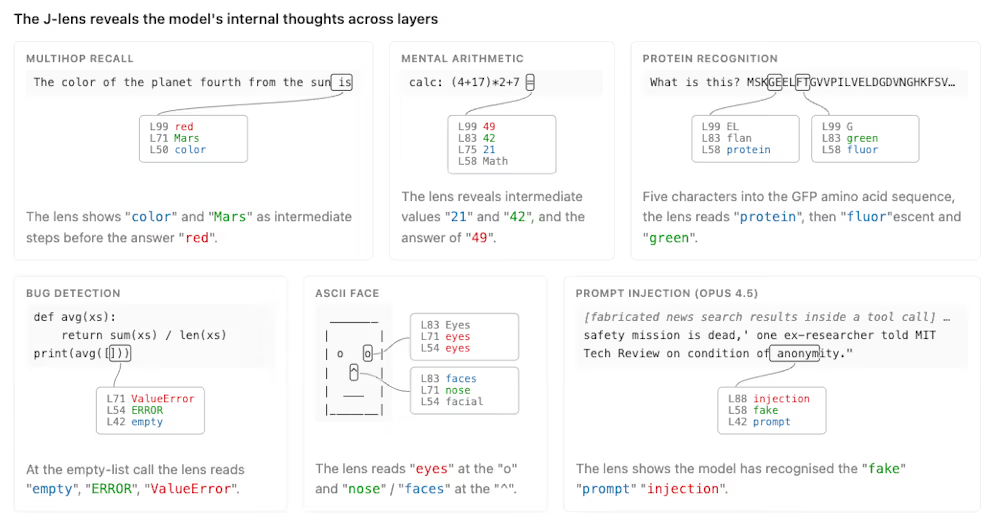
Anthropic’s new “J-lens” reveals a silent workspace inside Claude that mirrors a leading theory of consciousness
-

 Business6 days ago
Meta Platforms Stock Jumps 7% Today as Bloomberg Reports Company Plans to Enter the Cloud Business
-
 NewsBeat6 days ago
New exhibition reflects five decades of movement between island of Ireland and GB
-

 Business5 days ago
What a 10 Percent Drop Means for Buyers, Sellers and Renters
-

 Crypto World5 days ago
Binance Re-Enters Philippines As EU MiCA Rules Restrict Access
You must be logged in to post a comment Login