
Crypto World
French crypto worker wrests gun from fake courier in home invasion, shots fired



A fake courier tried to steal a French crypto worker’s private keys at gunpoint, but was disarmed in a struggle, underscoring France’s surge in “wrench” attacks.
Summary
- A French crypto industry worker fought off an armed intruder posing as a delivery driver who tried to extort his private keys at gunpoint.
- Police arrested a 25-year-old suspect three days later and charged him with attempted armed robbery, as “wrench attacks” surge across France.
- With Paris positioning itself as a European crypto hub, France now leads the world in crypto kidnappings, with roughly one case every 2–5 days in 2026.
In the early morning hours of April 11, a French crypto worker and his family narrowly escaped an armed home invasion after a man posing as a delivery driver tried to force him to hand over private keys at gunpoint, in the latest example of so‑called “$5 wrench attacks” targeting digital asset holders. The incident, detailed in local reports from the Montpellier region and since echoed in national coverage of crypto crime, saw the attacker enter the family home, corral the victim, his wife, and their children into the living room, and demand wallet access while brandishing a handgun.
Fake delivery, real gun
When the victim’s answers apparently confused the intruder, the assailant stopped to call an accomplice, creating a brief opening that allowed the 40‑year‑old crypto worker to wrestle for control of the weapon. Neighbours called police as the struggle spilled out of the house, and after a three‑day manhunt, officers arrested a 25‑year‑old suspect from Hérault, who has since been charged by a Montpellier court with attempted armed robbery and remanded in custody.
The attack fits a broader pattern. France’s interior ministry and local media have tracked a sharp rise in physical robberies and kidnappings linked to cryptocurrency, with authorities estimating at least 41 crypto‑related kidnappings so far in 2026 alone — roughly one every 2.5 days, up from about 20 such cases between 2023 and 2025. A recent intelligence brief noted that 10 out of 20 global kidnapping‑for‑crypto cases recorded by mid‑2025 had occurred in France, attributing the concentration partly to Paris’ push to become a global crypto hub and host frequent high‑profile industry events.
High‑visibility figures have also been hit. In February, masked gunmen attempted a home invasion targeting Binance France president David Prinçay in Val‑de‑Marne, fleeing only after realising he was not home, while other gangs have kidnapped relatives of crypto executives on Paris streets and in satellite towns around the capital. In March, a couple near Versailles were forced at knifepoint to transfer roughly $1 million worth of Bitcoin to attackers impersonating police, underscoring how criminals now routinely exploit both social engineering and brute force to reach seed phrases and hardware devices.
French officials have begun promising “preventative measures” for crypto professionals and wealthier retail holders, including specialised police units, awareness campaigns, and enhanced security at conferences such as Paris Blockchain Week, where VIPs have recently been escorted by police motorcades. For rank‑and‑file crypto workers, though, the latest handgun incident in Montpellier is a blunt reminder that operational security now extends well beyond cold storage opsec and into basic personal safety — from home access controls and delivery protocols to how loudly they talk about their holdings in public.



After attackers deposited rsETH from an exploited Kelp bridge and borrowed Wrapped ETH, Aave had frozen WETH across multiple markets.
Aave announced earlier today, April 21, that it has unfrozen wrapped ETH (WETH) reserves on its Ethereum Core V3 market, just over 24 hours after locking down WETH across multiple markets in response to the $290 million Kelp bridge exploit.
“WETH reserves on the Ethereum Core V3 market have been unfrozen and users can supply WETH to Ethereum Core V3 again,” Aave wrote on X this morning. WETH is a tokenized version of ETH compatible with decentralized finance smart contracts.
Late evening ET on April 19, Aave had frozen WETH reservers across its Core, Prime, Arbitrum, Base, Mantle, and Linea markets. “This action prevented new borrows against WETH collateral and contained the risk of stress spreading to other reserves, including stablecoins,” and April 20 incident report co-authored by Aae and LlamaRisk explained.
As The Defiant has reported, this year’s largest DeFi exploit so far happened on April 18, when a hacker exploited a vulnerability in liquid restaking protocol Kelp’s LayerZero bridge to forge a cross-chain message, releasing 116,500 KelpDAO Restaked ETH (rsETH), worth over $290 million, without any real tokens being sent.
The attacker deposited most of the rsETH as collateral on Aave and borrowed roughly $190 million in WETH across Ethereum and Arbitrum.
Aave’s risk team froze rsETH across all its markets within hours, then froze WETH itself on April 20 to stop the crisis from spreading further. Users had been unable to withdraw WETH or supply new deposits since.
As of April 21, WETH supply on Ethereum Core V3 is open again, though WETH’s loan-to-value ratio remains at zero, meaning it cannot be used as collateral for new borrowing. WETH on Ethereum Prime, Arbitrum, Base, Mantle, and Linea remains frozen, Aave noted on X.
The decision drew criticism from Spark’s head of strategy, who argued on X that the current interest rate configuration turns the unfreeze into a near-risk-free looping opportunity for holders of liquid staking and restaking tokens (LSTs and LRTs, which represent staked or restaked ETH positions) — keeping WETH locked up and making withdrawals even harder for ordinary depositors.
Depending on how Kelp ultimately allocates losses from the exploit, Aave faces between $124 million and $230 million in bad debt, per the protocol’s April 20 incident report. The Aave DAO holds $181 million in its treasury as of April 20, and says it has already received indicative commitments from ecosystem participants to help cover potential shortfalls.
Kelp is the second-largest liquid restaking protocol in DeFi per DefiLlama data, with $1.55 billion in total value locked across sixteen chains.
This article was written with the assistance of AI workflows. All our stories are curated, edited and fact-checked by a human.


Revolut has told investors it is targeting a valuation of $150 billion to $200 billion for a future initial public offering (IPO), the Financial Times reported on Tuesday.
The London-based fintech, which was valued at $75 billion in a secondary share sale last November, would not seek a stock market listing before 2028. No formal valuation target has been set, a source close to the company told the FT.
Revolut Eyes Up to $200 Billion Valuation in Future IPO
The company’s financial performance supports the ambition. Revolut’s pre-tax profit hit a record £1.7 billion ($2.3 billion) in 2025, a 57% increase from the prior year.
Revenue climbed 46% to £4.5 billion as its retail customer base grew 30% to 68.3 million.
Reports also indicate that Revolut is preparing for a secondary share sale in the second half of 2026. That transaction could value the company at around $100 billion, laying a stepping stone toward the IPO target.
Co-founder Nik Storonsky said in December that his personal stake would be worth roughly $80 billion if the company reached a $200 billion valuation.
Banking Licenses Fuel Global Expansion
Revolut received a full UK banking license from the Prudential Regulation Authority in March 2026, ending a years-long application process.
The license allows the crypto-friendly fintech to offer lending, savings, and credit products to UK customers.
The company also applied for a US banking license with the Office of the Comptroller of the Currency (OCC) in early March.
If approved, Revolut would operate more like a traditional bank in the world’s largest economy.
Can Revolut justify a $200 billion price tag? This may hinge on how quickly it converts new banking powers into lending revenue and grows its US footprint before any listing.
The post Revolut Builds $200 Billion IPO Case on Record Profits appeared first on BeInCrypto.


For all its talk of decentralized, autonomous, permissionless finance, the DeFi sector’s response to Saturday’s $290 million Kelp DAO hack tells a different story.
The firms involved are playing a messy, very human blame game over responsibility for the $14 billion fallout.
While the projects shirk responsibility, users have funds stuck in what had been considered the safe, reassuringly boring side of DeFi, and are potentially facing haircuts to cover bad debt.
Meanwhile, amid the uncertainty, the industry as a whole bleeds credibility.
Influential voices are urging the three key parties involved to get together and come up with a path forward. But, so far, it seems the firms are determined to play hardball.
LayerZero blames Kelp DAO’s choice of validator setup, while Kelp DAO says it followed LayerZero’s defaults. Aave stays out of it, hoping to get back to business as usual while avoiding its own role in driving rsETH’s deep integration.
Let’s take a look at the case against each of the projects involved.
Read more: Resolv hack shows DeFi learned nothing from last contagion
Kelp DAO
Kicking off with Kelp DAO, whose rsETH token was hacked on Saturday, there’s not an awful lot to go on.
The firm kept quiet for 48 hours after its initial acknowledgement of Saturday’s hack.
Users waiting to hear how losses might be distributed were finally presented with a brief statement that provided no new information.
It merely confirmed the mechanics of the exploit, congratulated, highlighted that Kelp DAO’s 1/1 DVN configuration is “the default for any new OFT deployment,” and congratulated itself on blocking a further $95 million hack attempt.
Read more: Hyperbridge exploited less than two weeks after April Fools’ day hack prank
It even came off as rather tame, given the potential attack of LayerZero which had been teased the previous day.
As for loss distribution, the firm says it’s “concurrently assessing the potential next steps.”
In praising Arbitrum’s decision to seize stolen ether (ETH), it didn’t give much more away, saying it’s “pursuing all available avenues to… mitigate the impact of the incident across the Defi ecosystem.”
We’ll keep waiting, then.
LayerZero
LayerZero has faced plenty of criticism, not just from Kelp DAO, that its architecture passes off the burden of security onto individual project teams, or ““empowers each application and asset issuer to define their own security posture,” as LayerZero puts it.
While the firm claims it recommends individual asset issuers to choose a secure setup, analysis from Dune suggests that almost half of over 2,500 OApp bridging contracts use a 1/1 DVN configuration.
One example, highlighted by blockchain security expert Taylor Monahan, explicitly states “use the LZ defaults” in its code comments.
Read more: Inside the $280M Drift hack: weeks of setup, minutes to drain
Indeed, in the wake of Saturday’s incident, many well-known crypto and DeFi projects paused bridging of their assets through LayerZero, including Ethena, EtherFi, WBTC, Tron and Curve.
Another point of contention is the lack of disclosure of the specific attack vector which granted access to its infrastructure leading to manipulation of the DVN, operated by Layer Zero itself.
Aave
Despite being furthest from the actual theft, DeFi’s former number-one protocol (now knocked off the top spot due to recent outflows) created the conditions for such widespread damage.
The use of rsETH as collateral in e-mode with targeted total value locked by allowing highly leveraged looping of ETH-correlated liquid (re)staking tokens, one of Aave’s key uses.
The risk assessments for these setups focused on “market and liquidity risk”, with bridging configurations deemed “a structural feature of composability rather than a scope question.”
Bridged rsETH had the same parameters as on mainnet, discounting any cross-chain risk entirely.
It appears likely that rsETH was specifically targeted for its deep liquidity, a feat achieved thanks to these decisions.
Aave appeared untouchable just a few months ago, but recent turmoil, hindsight on past hubris, and contributors lashing out at competitors, paints a different picture altogether.
Read more: Oracle error adds to turmoil at DeFi giant Aave
Arbitrum’s silver lining
Earlier today, Arbitrum’s security council pulled off a rescue of over 30,000 ETH ($71 million) of the hacker’s proceeds in the nick of time.
Shortly after, laundering of funds began on Ethereum. On-chain analysts confirmed DPRK involvement, spotting links to other TraderTraitor-related hacks, BTC Turk and ByBit.
While some of DeFi’s decentralization zealots may have an issue with the move, having the ability to seize illicit funds and not doing so would be the worst of both worlds, argued Curve Finance’s Michael Egorov.
Such a move is not without precedent, after all. In 2023, proceeds from the preceding year’s Wormhole hack were recovered with the help of Oasis, and in 2024, Blast seized $97 million from a rogue developer.
Yearn’s banteg also hopes that Arbitrum will have now scared off future attempts by Lazarus.
Important questions remain over the potential for similar actions in the future, centering on the need for a court order or a defined threshold above which to step in.
More pressingly, though, the question of how to redistribute the seized funds also remains to be answered.
Got a tip? Send us an email securely via Protos Leaks. For more informed news and investigations, follow us on X, Bluesky, and Google News, or subscribe to our YouTube channel.
Kalshi is set to launch cryptocurrency perpetual futures trading on April 27, according to a report from The Information. The move would mark the prediction market platform’s entry into crypto derivatives.
The company, valued at $11 billion, teased the product via a cryptic LinkedIn video. A rotating torus shape appears alongside the word “Timeless” and the April 27 launch date in New York City.
What Kalshi Perpetual Futures Mean for Traders
Perpetual futures allow traders to speculate on asset prices without owning the underlying token. Unlike traditional futures, these contracts have no expiration date.
Positions stay open indefinitely, with a funding rate keeping prices aligned with spot markets.
The product name carries a clear signal. “Timeless” maps onto a contract designed to run continuously rather than settle on a fixed date.
John Wang, Kalshi’s Head of Crypto, argued in August 2025 that perpetual futures and prediction markets are functionally converging.
Why This Matters
Perpetuals are already the highest-volume product in crypto trading. US-regulated versions have gained traction, with Cboe recently launching Bitcoin and Ether perpetual futures.
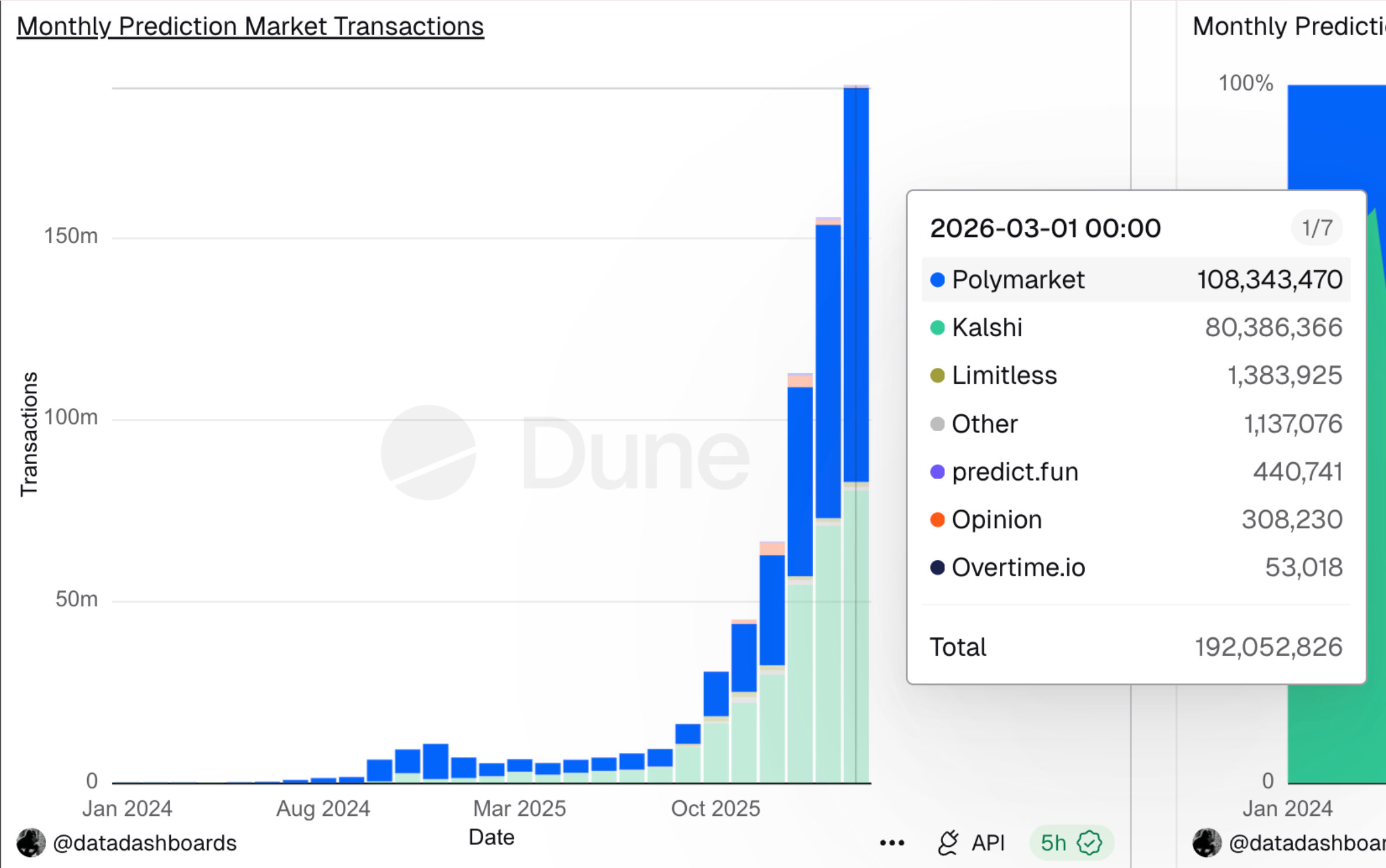
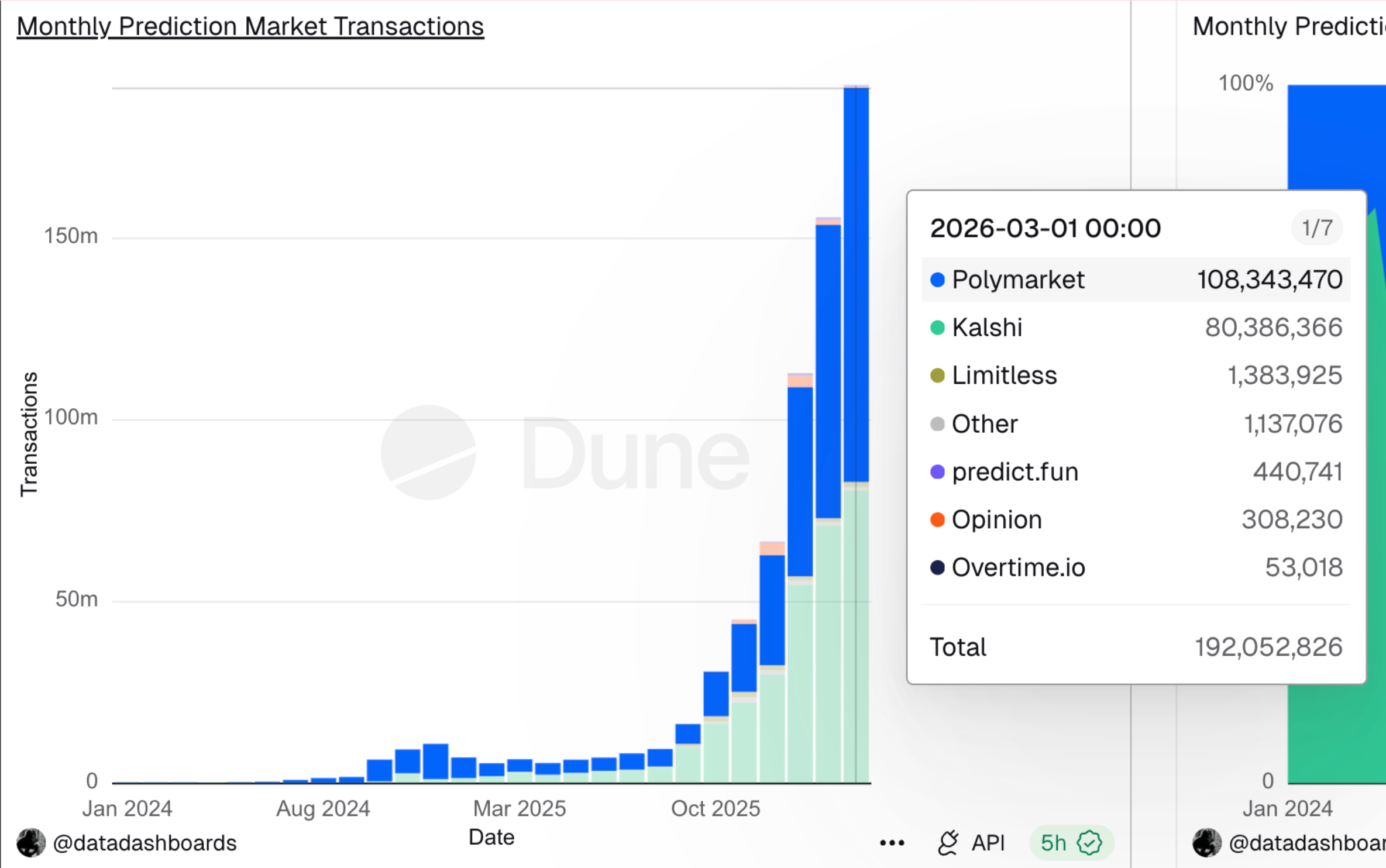
Prediction market transactions hit a record 192 million in March 2026.
By merging perpetual futures mechanics with prediction market infrastructure, Kalshi could attract institutional traders. The model offers continuous exposure rather than event-based binary contracts.
The platform operates under CFTC oversight, which may provide a regulatory edge over offshore competitors. Adding perpetual contracts would also let liquidity accumulate continuously rather than dispersing each time an event contract resolves.
The full scope of the product will become clear on April 27.
The post Kalshi Prediction Market Plans Crypto Perpetual Futures Launch On April 27 appeared first on BeInCrypto.


Spark’s MonetSupply says Aave’s decision to unfreeze its Core WETH market lets LST/LRT whales farm ~45% weETH loops while aEthWETH sits at 100% utilization, trapping regular users.
Summary
- Spark strategy director MonetSupply says Aave’s decision to unfreeze its Ethereum Core WETH market is “ill-considered” under current liquidity conditions.
- With aEthWETH utilization at 100%, he warns that high‑leverage weETH loops chasing ~45% APY will trap normal depositors and stablecoin borrowers trying to exit.
- The move, he argues, hands out arb opportunities without fixing aEthWETH liquidity, further degrading conditions for regular users already struggling to refinance.
Aave (AAVE) has decided to unfreeze its Ethereum Core WETH market just as liquidity is at its tightest, drawing sharp criticism from Spark’s strategy director MonetSupply. In a post on X, he called the move “quite ill‑considered,” arguing that under the current interest rate model, LST and LRT holders can spin up aggressive circular leverage loops using assets like weETH while ordinary users are effectively locked in.
High-octane loops on a dry WETH market
According to his calculations, traders can exploit roughly a 0.5% discount on weETH’s secondary‑market price relative to ETH and an Aave ETH borrowing rate capped around 5.15% to construct recursive long ETH positions with an annualized return profile near 45% when stacked on top of the base staking yield. With the aEthWETH market already sitting at 100% utilization, every fresh loop tightens the squeeze on exit liquidity for plain‑vanilla depositors and borrowers.
The problem, MonetSupply argues, is that unfreezing WETH under these conditions does nothing to relieve the liquidity stress facing aEthWETH users. “This decision provides arbitrage opportunities without addressing the liquidity tension of aEthWETH,” he wrote, warning that users trying to withdraw WETH or roll over leveraged stables are discovering there is simply no buffer left in the pool.
Recent comments from the Spark strategist on related ETH‑market fragilities flagged how similar dynamics can spiral: once utilization is pinned at 100%, suppliers lose incentives to stay, while borrowers lose room to deleverage, raising the risk of stuck positions and cascading liquidations if rates or collateral prices move against them. Combined with post‑Kelp DAO nerves and elevated demand for on‑chain ETH liquidity, Aave’s decision to reopen the throttle on WETH looks, in his view, less like restoring normalcy and more like inviting sophisticated loopers to farm a basis trade atop an already strained market.
If those incentives persist, the likely outcome is a familiar split: whales and structured funds capturing leveraged carry via weETH loops, while retail depositors and stablecoin borrowers face rising odds of being trapped in a market where the exit door is technically open—but functionally blocked by 100% utilization.


Polymarket announced perpetual futures trading on April 21, letting users go long or short on prediction markets around the clock.
The announcement arrived just hours after reports surfaced that rival Kalshi plans to launch its own perpetual product, codenamed “Timeless,” on April 27.
Prediction Market Perps Race Heats Up
Polymarket’s new perps feature will allow traders to take leveraged positions on prediction market outcomes without waiting for a contract to expire.
The platform framed the product as a way to “go long or short the markets you know 24/7,” according to its official announcement.
The timing appears strategic. Kalshi CEO Tarek Mansour teased “Timeless” on April 13 with a cryptic video revealing an April 27 launch date in New York.
Kalshi’s product will also include crypto perpetual futures, putting it in direct competition with exchanges like Coinbase and Robinhood.
Both platforms have grown aggressively in recent months. Prediction market transactions surpassed 192 million in March 2026, an all-time record.
Kalshi, now valued at $11 billion, processes over $100 billion in annualized trading volume. Polymarket, valued at $9 billion, has seen weekly notional volume consistently exceed $1 billion through Q1 2026.
The rivalry between the two platforms mirrors a broader shift. Prediction markets increasingly resemble TradFi products, and perpetual contracts could accelerate that trend by attracting institutional-style trading flow.
Whether Polymarket’s head start translates into a lasting advantage may depend on how quickly both platforms can build liquidity for their new offerings.
The post Polymarket Unveils Perpetual Futures In Time To Beat Kalshi’s Crypto Launch appeared first on BeInCrypto.
Bitcoin (BTC) mid-size wallet inflows to Binance fell to 3,000–4,000 BTC, marking a multi-year low in sell-side activity from this cohort.
This coincides with Coinbase recording about 8,500 BTC in inflows from similar wallets on April 19, while other exchanges saw much smaller flows. Binance exchange Bitcoin inflows have also fallen to 2023 levels, but how is this significant to today’s market?
Binance BTC inflows cool sharply to 2023 levels
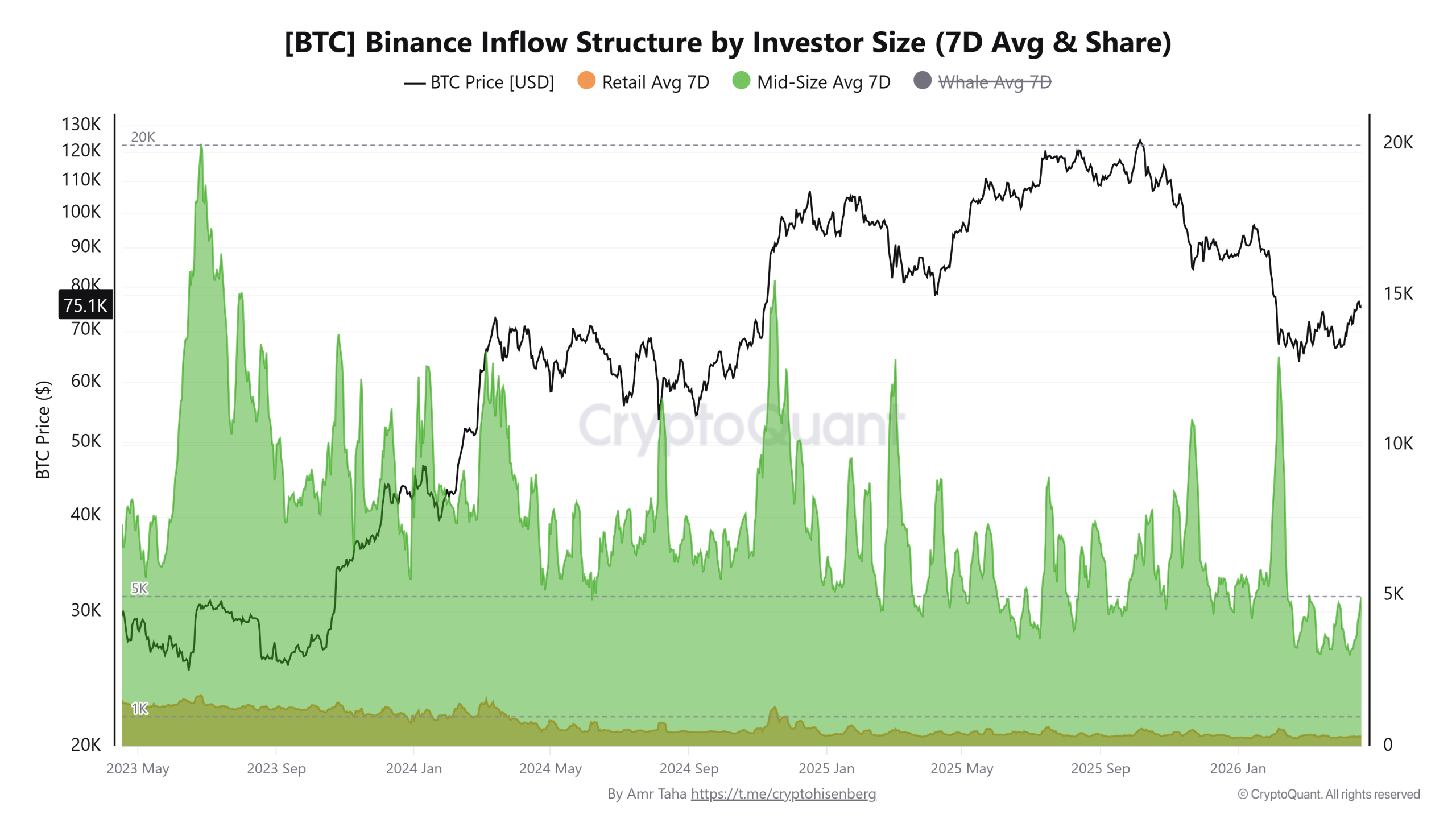
CryptoQuant data classifies mid-size wallets as the entities holding roughly 100–1,000 BTC, often linked to active traders and smaller institutions. These wallets tend to move coins to the exchanges during distribution periods, making their inflows a useful proxy for near-term selling intent.

Crypto analyst Amr Taha noted that seven-day average Bitcoin inflows from this cohort into Binance have dropped to 3,000–4,000 BTC. This remains well below the deposits observed during April to May 2023, which ranged from 5,500 to 6,000 BTC.
The lowered inflow levels suggest reduced immediate sell-side pressure, as fewer coins are being positioned on the exchange, although inflows alone do not translate into active selling.
The chart shows no comparable surge from retail participants (1-100 BTC) either, with smaller wallets contributing limited inflows of less than 300 BTC on Tuesday. This indicates a contained flow profile rather than broad-based selling pressure.
Related: Bitcoin metrics line up bull signals with $78K the BTC price level to beat
Bitcoin flows on Coinbase dominate
The distribution of BTC inflows across exchanges provides another perspective. Data from CryptoQuant shows that mid-size investor inflows into Coinbase reached about 8,500 BTC on April 19, approaching levels last seen after the FTX exchange collapse in November 2022.

BTC activity across other exchanges remained relatively muted. Amr Taha noted that a broad distribution phase would typically reflect synchronized inflows across multiple exchanges, which is not evident in the current data.
A similar spike on Coinbase was observed on Jan. 14, shortly before Bitcoin declined from $95,000 to below $67,000 in February. However, the current conditions differ, as exchange inflows appear fragmented rather than market-wide, suggesting mixed sentiment rather than coordinated distribution.
Data from Bitcoin researcher Axel Adler Jr. also highlights a deeper shift in supply dynamics. Bitcoin’s 30-day net flow dropped to -300,000 BTC in March from +94,000 BTC in February, signaling a strong withdrawal phase. The metric stands near -98,000 BTC as of April 21, with outflows continuing at a slower pace.

Adler Jr. added that exchange reserves have declined for seven consecutive weeks, falling by over 105,000 BTC since early March. Notably, even during the April 2 pullback toward $67,000, there was no significant return of coins to exchanges.
Related: Inside the ‘fake police raid’ that forced a $1M Bitcoin transfer
This article is produced in accordance with Cointelegraph’s Editorial Policy and is intended for informational purposes only. It does not constitute investment advice or recommendations. All investments and trades carry risk; readers are encouraged to conduct independent research before making any decisions. Cointelegraph makes no guarantees regarding the accuracy or completeness of the information presented, including forward-looking statements, and will not be liable for any loss or damage arising from reliance on this content.
Crypto World
Kelp DAO exploit may force big banks to rethink their blockchain plans, Jefferies warns
A major decentralized finance (DeFi) hack could prompt Wall Street firms to reassess the pace of their blockchain and tokenization efforts, a Jefferies analyst wrote in a report.
The note follows a $293 million exploit of Kelp DAO on April 18, in which attackers minted unbacked tokens and used them as collateral to borrow other assets across lending platforms.
The incident, potentially linked to North Korea’s Lazarus Group, has already rippled through crypto markets, triggering sharp token sell-offs and a liquidity crunch in key protocols.
Jefferies analyst Andrew Moss said the fallout may extend beyond crypto-native firms to traditional financial institutions, which have been accelerating efforts to tokenize assets such as funds, bonds and deposits.
“TradFi tokenization initiatives are proliferating as institutional investment accelerates,” Moss wrote. However, the exploit and its “cascading implications” could “temporarily slow TradFi adoption as security risks are re-evaluated.”
The attack exposed vulnerabilities in blockchain “bridges,” which enable the transfer of assets between networks. In this case, the hackers exploited a verification setup that relied on a single validator, raising concerns about single points of failure in systems meant to be decentralized.
For banks and asset managers, these risks matter. Many tokenization efforts depend on cross-chain infrastructure to move assets and maintain liquidity across platforms. Without secure bridges, Moss warned, markets could become fragmented, limiting the usefulness of tokenized assets.
‘Nascent’ industry
The immediate impact has been severe inside DeFi.
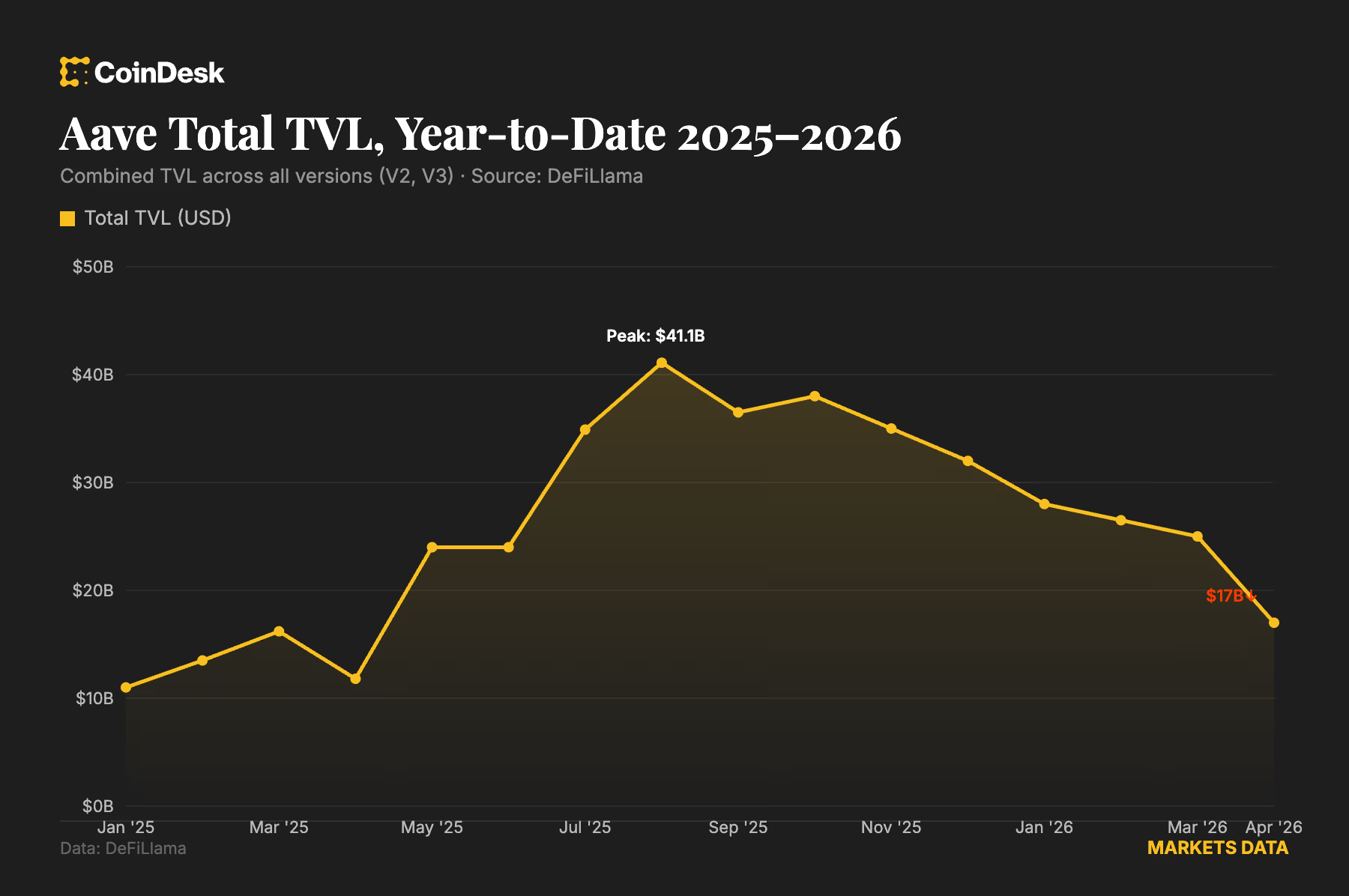
Lending platform Aave was left with roughly $200 million in bad debt, while total value locked dropped by about $9 billion as users withdrew funds. Liquidity in key markets has tightened, with some pools frozen or near full utilization, raising the risk of forced liquidations.

While Moss does not expect the incident to spill into traditional financial markets, it said the loss of trust could weigh on adoption in the near term. Firms may pause or slow deployments as they review vulnerabilities and rethink system design.
At the same time, the longer-term outlook remains intact.
Regulatory progress and infrastructure improvements continue to support institutional interest. Stablecoins, in particular, are expected to play a growing role in payments, with use cases expanding from trading into areas such as cross-border transfers and payroll.
Still, the report highlights a key challenge: as Wall Street moves deeper into crypto, it must rely on infrastructure that is still maturing.
“The nascent digital asset industry still requires time to mature,” Moss said, pointing to the need for more robust systems before tokenization can scale safely.
Read more: ‘DeFi is dead’: crypto community scrambles after this year’s biggest hack exposes contagion risk

New York’s top legal officer has moved to curb prediction-market style offerings linked to cryptocurrency platforms, filing lawsuits against Coinbase Financial Markets and Gemini Titan for allegedly operating such markets in New York without proper licensing. Reuters reported on the complaints, which contend these platforms violated the state’s gambling laws by offering real-world event bets without approval from the New York State Gaming Commission.
Attorney General Letitia James asserted that “Gambling by another name is still gambling, and it is not exempt from regulation under our state laws and Constitution.” The lawsuits seek disgorgement of allegedly illegal profits, restitution for affected customers, and a prohibition on offering these products to individuals under 21 years of age.
These actions reflect a broader, state-level push to regulate prediction markets, a fast-growing niche in crypto commerce that allows users to wager on outcomes ranging from political events to other real-world occurrences. Much of the recent scrutiny has focused on platforms such as Polymarket and Kalshi, which have sparked questions about whether their products fall under gambling law or financial regulation. The federal landscape has also been active; the Commodity Futures Trading Commission (CFTC) has asserted it holds exclusive authority over prediction markets in several actions against state attempts to regulate the sector.
For crypto firms operating prediction-like products, the NY filing underscores significant regulatory risk. By targeting so-called prediction markets, regulators are signaling that many of these products may not be exempt from oversight, even if they are framed as information markets or data-heavy forecasting tools. As coverage on related developments notes, Polymarket has pursued legal action in other jurisdictions and broader market participants continue to navigate a complex regulatory mosaic.
Related context: Cointelegraph reported that Polymarket has been involved in a Massachusetts dispute over state authority to regulate prediction markets that the CFTC has approved, illustrating the broader tension between state regulators and platforms that operate near the line between gambling, financial products, and information services.
Key takeaways
- New York’s attorney general alleges Coinbase Financial Markets and Gemini Titan operated unlicensed prediction markets in the state, violating NY gambling laws.
- The complaints seek disgorgement of profits, restitution to affected consumers, and a ban on offerings to users under 21.
- The action is part of a broader state-level crackdown on prediction markets, highlighting regulatory ambiguity around whether these products are gambling, securities, or commodities.
- The case unfolds amid ongoing CFTC assertions of federal authority over prediction markets, signaling potential regulatory tension between state and federal regimes.
- For crypto platforms, the enforcement action reinforces licensing and compliance risks, with cross-border and jurisdictional differences shaping product design and rollout strategies.
Allegations against Coinbase Financial Markets and Gemini Titan
According to Reuters, the complaints contend that Coinbase Financial Markets and Gemini Titan operated prediction-market-like products in New York without licenses from the New York State Gaming Commission. The suits argue that these activities fall under state gambling statutes and are therefore subject to licensing and regulatory oversight.
Attorney General James’s office framed the matter as a regulatory and consumer-protection issue, stressing that the activities implicated “illegal profits” and potential harm to residents who may be under the age of 21. The actions seek monetary remedies as well as measures to restrict access to such offerings for younger users.
In the broader ecosystem, the NY action arrives amid questions about how platforms that blend crypto with real-world event bets should be classified—whether as gambling, securities, or something else entirely. The debate is ongoing, with Polymarket and Kalshi cited in industry and regulatory discussions as examples of platforms navigating (and sometimes testing) existing legal boundaries.
Additionally, the case highlights the risk regulators perceive in prediction-style markets, even as some firms argue for a broader interpretation of permissible offerings within crypto markets. The tension between state enforcement and federal authority continues to shape strategic decisions for operators considering expansion into major markets. As noted in industry coverage, Polymarket has taken its own legal steps in related matters, underscoring a wider pattern of regulatory contest in this space.
Regulatory landscape for prediction markets
The NY filings come against a backdrop of a shifting regulatory mosaic in which state authorities seek to police gambling-like activities within crypto ecosystems, while federal agencies claim jurisdiction over specific product classes. The CFTC has pursued legal actions against several states attempting to regulate prediction markets, asserting that it is the federal body with primary authority in this domain. That tension creates a fragmented environment for platforms that operate across jurisdictions, forcing operators to calibrate product design, licensing approaches, and KYC/AML controls to satisfy multiple regimes.
From a policy perspective, the developments underscore how regulators are re-evaluating the line between gambling and financial-market products in the digital era. The dialogue also intersects with broader regulatory themes, including licensing standards, consumer protection, and cross-border compliance obligations for platforms offering complex financial and forecasting instruments.
Within the international context, observers note that regulatory approaches vary widely—from licensing requirements to outright prohibitions in some jurisdictions—making global rollouts increasingly complex for prediction-market operators and their banking partners. The evolving stance in the United States, paired with ongoing EU and other regional considerations, contributes to significant compliance planning challenges for incumbents and entrants alike.
Implications for compliance, licensing, and institutional risk
For crypto firms, the New York action reinforces the imperative to align product offerings with clear regulatory classifications and licensing pathways. Operators must consider whether their markets resemble gambling, securities, or commodity products, and ensure that appropriate registrations, disclosures, and age-restriction controls are in place.
Financial institutions and payment partners evaluating involvement with prediction-market platforms will also be weighing regulatory risk, customer-protection obligations, and potential sanctions for noncompliance. The NY action amplifies the need for rigorous AML/KYC programs, robust consumer safeguards, and transparent disclosures about product mechanics and eligibility criteria. In this context, cross-border operations must account for divergent regulatory regimes, potentially complicating settlement rails, custody arrangements, and banking relationships.
From a policy standpoint, the case contributes to broader discussions about how to regulate innovative crypto-enabled bets and forecast markets without stifling legitimate innovation. It also highlights the ongoing jurisdictional contest between state regulators seeking direct control and federal authorities asserting overarching authority, a dynamic that will likely influence licensing strategies and litigation risk for market participants in the near term.
As part of the broader ecosystem narrative, observers should monitor whether other states replicate New York’s approach, and whether the CFTC’s asserted authority leads to new federal guidance or enforcement actions that reshape the permissible scope of prediction-market products. The regulatory trajectory could influence business models, risk controls, and capital planning for crypto exchanges and ancillary platforms seeking to offer similar services.
Closing perspective: with enforcement focused on licensing, age restrictions, and regulatory classification, the NY action signals a key inflection point for prediction markets in crypto. Institutions should watch for new guidance, potential licensing reforms, and the possibility of harmonized—or at least clarified—standards across jurisdictions in the months ahead.
Singapore fintech Nium has selected Coinbase to integrate USDC payments into its global network to send, receive and convert stablecoins to fiat across more than 190 countries through a single platform.
According to a Tuesday announcement, the integration uses Coinbase’s infrastructure for custody, liquidity and wallet services, enabling Nium’s customers to fund cross-border payouts in USDC and settle in either stablecoins or local currencies without relying on prefunded accounts.
Nium said the setup supports just-in-time settlement, allowing funds to be deployed at payout rather than held across multiple jurisdictions, and includes options to link stablecoin balances to card programs for real-world spending.
According to Nium, its network supports more than 100 currencies, with local collection in 40 markets, real-time payouts in over 100 corridors and more than 40 regulatory licenses worldwide.
The rollout follows the company’s recent launch of a platform that enables businesses to issue stablecoin-funded cards on Visa and Mastercard networks, with balances converted to fiat at the point of sale and settlement, compliance and integration handled through a single system.
USD Coin (USDC), a US dollar-pegged stablecoin launched in 2018 by Circle and Coinbase, is designed to maintain a 1:1 value with the dollar and is backed by cash and short-term US Treasury reserves.
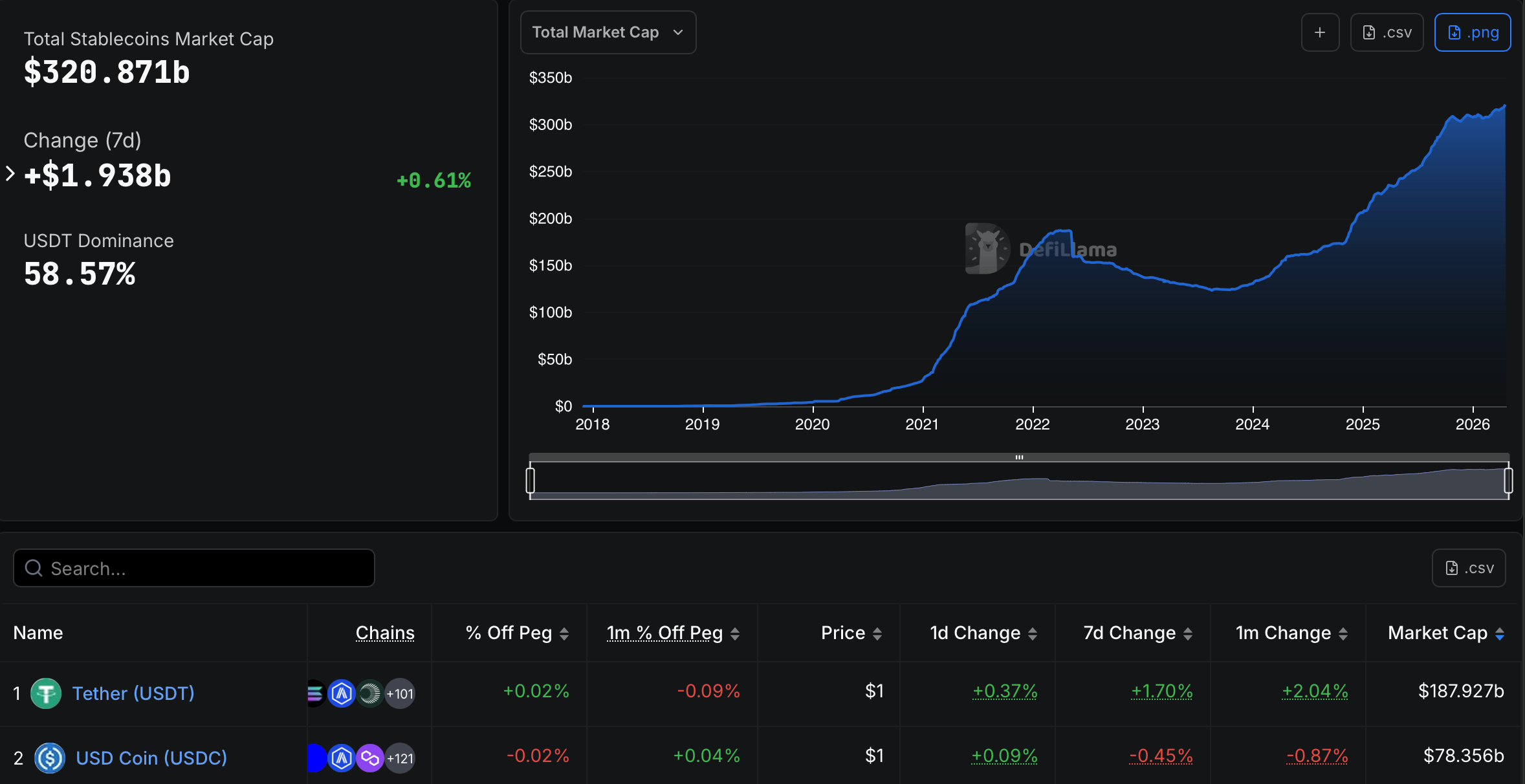
According to DefiLlama data, it is the second-largest stablecoin by market capitalization, at around $78 billion, behind Tether’s USDT (USDT), which stands at roughly $188 billion.
Related: Iran views BTC as strategic asset, but USDt still dominates oil tolls: BPI
Circle expands USDC use in cross-border payments
Circle has been expanding USDC’s role in cross-border payments through a series of partnerships aimed at integrating stablecoin settlement into existing financial networks.
In March, the company teamed with Sasai Fintech to expand USDC payments across African corridors, targeting remittances, business transactions and mobile wallets. In parts of Sub-Saharan Africa, remittance costs exceed 7%, well above the UN’s 3% target.
Earlier this month, Circle teamed up with Thunes to expand USDC settlement across its global payments network, enabling near real-time cross-border transfers while reducing reliance on prefunded accounts. The integration extends USDC-based liquidity across Thunes’ network, which spans more than 140 countries.
Recent data shows increasing USDC activity. A CEX.IO report earlier this month found the stablecoin’s supply grew by about $2 billion in the first quarter, while Tether’s USDT declined by roughly $3 billion, marking a divergence between the two for the first time since 2022.
Magazine: Adam Back says current demand is ‘almost’ enough to send Bitcoin to $1M


More EU leaders are turning against Israel

Bitcoin & Ethereum Are About To Explode (SERIOUSLY)

Coronation Street fans share upset over ‘heartbreaking’ Lisa Swain decision

Manchester United reach agreement with Casemiro over contract clause amid transfer speculation

Steven Gerrard disagrees with Gary Neville over ‘shock’ Chelsea and Arsenal claim | Football

US brings back mandatory military draft registration


-

 News Videos6 days ago
Secure crypto trading starts with an FIU-registered
-

 Fashion4 days ago
Weekend Open Thread: Theodora Dress
-

 Sports4 days ago
NWFL Suspends Two Players Over Post-Match Clash in Ado-Ekiti
-

 Politics4 days ago
Palestine barred from entering Canada for FIFA Congress
-

 Business2 days ago
Powerball Result April 18, 2026: No Jackpot Winner in Powerball Draw: $75 Million Rolls Over
-
Entertainment2 days ago
NBA Analyst Charles Barkley Chimes in on Ice Spice McDonald’s Fiasco
-

 Crypto World4 days ago
Russia Pushes Bill to Criminalize Unregistered Crypto Services
-

 Politics23 hours ago
Gary Stevenson delivers timely reminder to register to vote as deadline TODAY
-

 Tech3 days ago
Auto Enthusiast Scores Running Tesla Model 3 for Two Grand and Turns It Into Bare-Bones Go-Kart
-
 Business5 days ago
Creo Medical agree sale of its manufacturing operation
-

 Politics2 days ago
Zack Polanski demands ‘council homes not luxury flats for foreign investors’
-

 Tech6 days ago
‘Avatar: Aang, The Last Airbender’ Leaked Online. Some Fans Say Paramount Deserves the Fallout
-

 Crypto World4 days ago
Russia Introduces Bill To Criminalize Unregistered Crypto Services
-

 Tech7 days ago
Microsoft adds Windows protections for malicious Remote Desktop files
-
 Entertainment7 days ago
Dave Portnoy Slams Dianna Russini: ‘Makes Zero Sense’
-

 Crypto World7 days ago
X Launches New Cashtag Feature for Stocks and Crypto: X
-

 Entertainment7 days ago
Prince Carter Brings Fans Front Row and Backstage at Boys 4 Life Tour
-

 Sports6 days ago
British climbers complete new route in Swiss Alps
-
 Crypto World7 days ago
Paxos Labs Raises $12M to Launch Crypto Yield and Lending Platform
-

 Crypto World7 days ago
Bitcoin surpasses halfway mark in current halving cycle
You must be logged in to post a comment Login