

Crypto World
Sonic Labs VI Revenue Outpaces Fee Burns by 400% in First 10 Weeks


TLDR:
- Sonic’s VI model generated $13,000 in revenue, converting to 295,454.55 S in deflationary equivalent since March 1.
- Total fee-related burns reached only 59,786.728 S, putting VI impact at roughly 4.94 times the burn amount.
- Early VI revenue came solely from USSD and Metropolis vault activity, with the broader model yet to scale.
- Sonic Labs confirmed the full VI model has barely started, with more product revenue lines still ahead.
Sonic Labs has reported that its Vertical Integration model is generating measurable deflationary results just weeks after launch.
Since March 1, 2026, early VI revenue has produced roughly 400% more deflationary impact than fee-related burns over the same period.
The data comes from a narrow set of products, with the broader model yet to scale. These early numbers offer a concrete look at how the network plans to capture value beyond gas fees.
Early VI Numbers Show a Clear Lead Over Fee Burns
Sonic’s VI model generated $13,000 in revenue between March 1 and May 11, 2026. Using a TWAP price of $0.044, that converts to 295,454.55 S in deflationary equivalent.
Over the same window, total fee-related burns reached only 59,786.728 S. That figure includes 10,358.726 S from direct transaction fee burns and 49,428.002 S from FeeM-related returns that were burned.
Sonic Labs captured the early result on X, saying, “Sonic’s Vertical Integration is outperforming expectations right out of the gate. In the first 10 weeks, early VI revenue produced ~400% more deflationary impact than fee-related burns over the same window.”
The team also noted the scope of the current implementation, adding, “This is only from $USSD and @MetropolisDEX vault activity. The full VI model has barely started.”
No other revenue lines were contributing during this window, making the ratio more telling given how limited the setup remains.
Total transaction fees for the period were 207,174.525 S. The network splits fees as 90% to the FeeM Treasury, 5% to validators, and 5% to burn.
FeeM also returned 98,856.004 S, split evenly between rewards and burns during the same block range. The ratio puts VI impact at roughly 4.94 times the total fee-related burn amount.
The Case for Product Revenue Over Gas-Based Value Capture
High-throughput chains are built to keep execution costs low. As gas fees fall, fee-burn models produce less deflationary pressure on the native asset.
Sonic’s VI thesis addresses this by sourcing revenue from native financial products instead of relying on transaction pricing alone.
The network still burns a portion of transaction fees. However, the early data shows that product-level revenue can outpace that burn by a wide margin, even in a minimal setup. Users continue to benefit from cheap execution while aligned products contribute back to the network economy.
Sonic Labs described this as a proof of concept rather than a mature revenue base. The $13,000 figure is not presented as a major milestone but as early confirmation that the mechanism works as intended.
As the team stated, “If this is possible with a narrow implementation, the model becomes more interesting as more product surfaces begin contributing revenue.”
More product surfaces are expected to contribute revenue as the full VI model rolls out. The current result reflects only what a narrow, early version of the system can produce.
Additional revenue lines remain ahead, and the team views this first data point as a signal of the model’s direction.


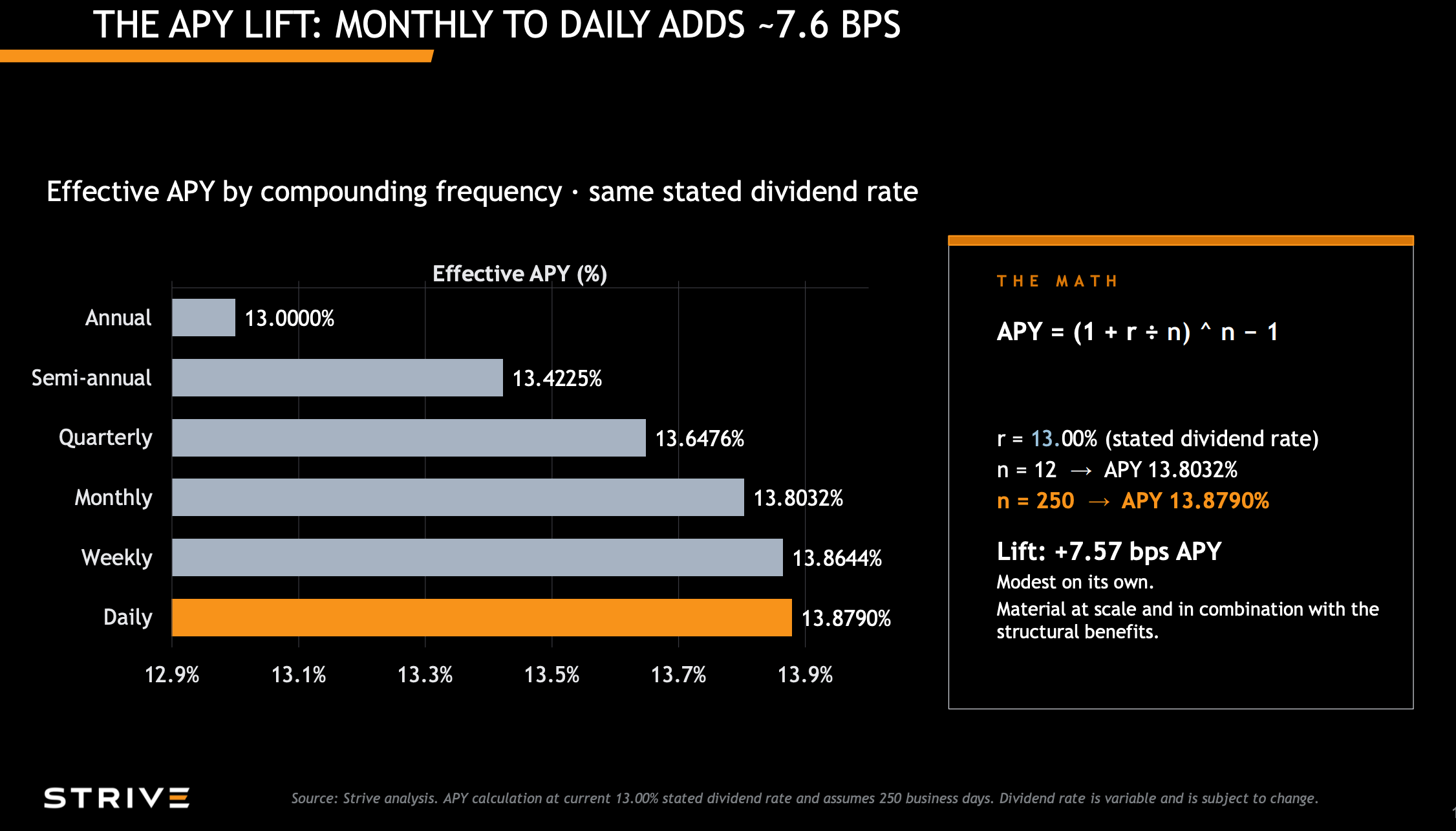
Bitcoin (BTC) treasury firm Strive Inc. will make its SATA preferred stock the first US-listed security paying cash dividends every business day. The daily payouts begin June 16.
The Dallas-based Bitcoin treasury firm disclosed the structural shift alongside first-quarter results.
Strive’s SATA to Pay Investors Cash Every Single Business Day
Strive’s Variable Rate Series A Perpetual Preferred Stock (SATA) currently pays a 13% annualized dividend monthly. While the headline rate remains unchanged, daily compounding over roughly 250 business days lifts the effective annual yield to 13.88%.
Follow us on X to get the latest news as it happens

CEO Matthew Cole framed the shift as a “zero-to-one innovation.” He also called the firm “The Daily Dividend Company.”
“SATA will be the first listed security in the history of U.S. capital markets to pay cash dividends every single Business Day, beginning June 16, 2026, at a current annualized rate of 13.00%,” he said.
Bitcoin Treasury Expands Past 15,000 BTC
Meanwhile, the firm also announced its first-quarter financial results. First-quarter GAAP net loss totaled $265.9 million, with $295.8 million tied to the fair value decline in Bitcoin holdings. That figure accounts for 96.6% of the reported loss.
The company added 6,001 BTC during the first quarter, including 5,048 BTC absorbed through the all-stock acquisition of Semler Scientific. Another 1,381 BTC came in April and early May.
Strive’s Bitcoin holdings reached 15,009 BTC as of May 12. That ranks the firm ninth among public corporate holders, according to Bitcoin Treasuries data.
Strive also confirmed it carries no short or long-term debt. The balance sheet held $87.6 million in cash and a $50.5 million position in Strategy’s STRC preferred stock.
Subscribe to our YouTube channel to watch leaders and journalists provide expert insights
The post Strive Makes SATA First US Security to Pay Cash Dividends Every Business Day appeared first on BeInCrypto.

Ethereum’s network recorded its highest realized profits in three weeks on Thursday, with $74.58M booked in a single spike even as the asset’s price fell roughly 5.5% over the past three days.
The data, published by on-chain analytics firm Santiment, points to a specific group of sellers: traders who bought ETH when it was trading below $2,000 during February and March and are now cashing out while they still can.
Who’s Selling and Why It Makes Sense
Santiment’s analysis is worth sitting with for a moment, because the headline number looks strange at first. Prices are down, yet profit-taking is at a three-week high, but the explanation is straightforward once you know what to look for.
ETH spent much of February and March below the $2,000 mark, a period Santiment described as one of “war fears and notably uncertain times in crypto.” Traders who accumulated during that window are still sitting on gains even after this week’s decline, and many have decided to act on them.
Furthermore, separate analysis by CryptoQuant contributor Rei Researcher shows that deposit addresses on Binance spiked to roughly 9,000 ETH, the highest in over a year, with inflow bars confirming selling pressure concentrated around the $2,260 price zone.
The Santiment data also shows that four-hour candles have been compressing near $2,241, a sign of elevated distribution activity. More transactions across a network mean more realized profit-and-loss events, and when volume is elevated, those modest individual gains pile up quickly into large network-level totals.
Santiment’s guidance for traders is to “lean cautious” but stop short of turning outright bearish. The firm is watching for a spike in realized losses as a potential bottoming signal, and advises against aggressive positioning until the distribution phase shows clear signs of ending.
A Technically Fragile Picture
The selling activity is hitting Ethereum at a structurally vulnerable moment, as noted by analyst Keith Alan, who said that the cryptocurrency briefly broke above its macro trend line before being rejected at the 21-week simple moving average and has since slipped below a cluster of technical levels near $2,280.
Should ETH not be able to recapture the 21-week moving average, Alan found a series of support zones to monitor: $2,196, followed by $2,060, with a breach beneath this area possibly clearing the way for $1,892 and beyond.
As per CoinGecko figures, ETH remained trading considerably above the $2,200 mark as of writing but had lost close to 2% from the previous day and 3% over a week. The cryptocurrency is currently roughly 54% off its all-time high of slightly above $4,950 recorded in August 2025.
The post ETH Profit-Taking Hits 3-Week High Despite 5.5% Price Drop appeared first on CryptoPotato.
Crypto World
MapleStory Universe Marks One Year of Live Ops, Surpasses 150M On-chain Transactions, Entering MSU 2.0 Phase

[PRESS RELEASE – Abu Dhabi, UAE, May 14th, 2026]
MSU 2.0 to unveil IP expansion strategy, featuring AI creation tools and a unified on-chain content hub.
MapleStory N marks its first anniversary with major gameplay milestones, sustained ecosystem growth, and new updates to deepen player engagement.
MapleStory Universe (MSU), the blockchain-powered expansion of Nexon’s iconic MapleStory franchise, today marks its first anniversary following the launch of MapleStory N on May 15, 2025. Over the past year, the platform has recorded more than 150 million cumulative on-chain transactions and surpassed 3.82 million accounts registered, reflecting sustained participation from a global player base and continued development of the ecosystem.
One year in, MSU is entering its next phase with the introduction of MSU 2.0, an expansion designed to transform how intellectual property (IP), builders, and players interact in a shared digital environment, supported by AI creation tools and on-chain infrastructure. MSU 2.0 will be implemented throughout 2026 to 2027, as new features will be progressively developed and released for the builders.
A Benchmark Launch That Set a New Standard
MSU launched in May 2025 as one of the largest debuts in the Web3 gaming ecosystem. Built on the MapleStory IP, the pre-launch Scroll NFT campaign recorded approximately 1.7 million scrolls minted, officially confirmed as the largest NFT mint in Avalanche network history. On launch day, MSU-related weekly active addresses on the Avalanche network increased by 549 percent, reflecting strong user interest and anticipation surrounding the title’s release.
Following launch, the marketplace has continued its strong performance, with more than 446,716 buyers and sellers transacting daily on average. To date, MSU has accounted for 23.3% of total activity on the Avalanche network, representing a substantial share of activity across leading chains. MSU’s native NXPC token was also listed on seven major exchanges at launch, including Binance, Bybit, Upbit, and Bithumb.
Sunyoung Hwang, CEO, Nexpace, said: “What began as one of the largest launches in Web3 gaming has developed into a platform built for long-term participation. In the past year, we focused on building the infrastructure and discipline required to support our community over the long term. Ever since then, MSU has evolved beyond a single game into infrastructure for creation, commerce, and participation. That shift defines what it means for an IP to become an economic system and a foundation for the next generation of online worlds.”
Introducing MSU 2.0, the Next Chapter for MapleStory Universe
MSU is now advancing into its next phase through the rollout of MSU 2.0, an expansion designed to turn IPs from friction-heavy, abstract assets into programmable, on-chain commerce. Designed to broaden participation across the ecosystem and support new forms of creation, distribution, and commercialization, MSU 2.0 reflects the continued evolution of MapleStory Universe from a single game environment into a scalable platform.
Hwang added: “MSU 2.0 is the next phase of our growth journey. Our goal is to expand the role of IP from something people experience to something they can actively build with, share, and grow together, akin to an infinite IP playground. From here, our priority is to build the infrastructure that will support a larger and more connected IP ecosystem.”
At the core of MSU 2.0 is VIBE IP, a new tech stack built on two foundational pillars that redefine what it means to build with IP on-chain. The first pillar transforms IP access by providing builders access to gameplay and behavioral data from MapleStory N through dedicated APIs, turning IP from brand assets to living, data-rich foundation to create on in accordance with applicable privacy laws. The second pillar establishes an on-chain builder economy on the Henesys chain, built on an Avalanche L1streamlining IP licensing, revenue settlement, and payments into a single system.
Together, these pillars are supported by blockchain infrastructure and AI-powered creation tools. Blockchain allows seamless licensing, payment and settlement, fully on-chain, while AI-powered “vibe coding” allows anyone’s idea to become a full-scale product, enabling broader participation in building and launching IP-driven content. This foundation positions MSU to onboard additional Nexon IPs over time, building an AI-powered and On-chained IP multiverse, with the VIBE IP tech stack gradually rolling out in phases over the coming months.
MapleStory N One-Year Anniversary Update
MapleStory N, the flagship game by MSU, has delivered a series of milestones over the past year that reflect sustained player engagement across the ecosystem. The year-end winter update generated more than 130,000 user inflows, with approximately three-quarters representing new users. This update also drove in-game spending to its highest level since the immediate post-launch period, with player spending outpacing rewards distributed, reflecting a more active and sustainable in-game economy driven by deeper engagement.
Building on this momentum, MapleStory N is now more accessible to mainstream players. Casual users can engage with the game like any traditional MMORPG, with less blockchain hurdle. Web3 features have been refined to deliver meaningful value while maintaining a seamless gameplay experience, making the platform easier for a broader audience to adopt.
As MapleStory N enters its second year, the development team will roll out waves of in-game updates at an accelerated pace, expanding gameplay and introducing new challenges. This will be supported by a steady cadence of major releases throughout the year, including highly anticipated Black Mage update and other milestone content. MSN will also introduce a new MVP system designed to provide ongoing benefits to dedicated players and keep them motivated to continue playing. Starting with the MVP system, MSN plans to continuously expand the program by introducing more diverse criteria and rewards, ensuring that a wider range of players can be recognized and rewarded over time. For more information, users can visit the official website.
About NEXPACE
NEXPACE, an innovative blockchain company based in Abu Dhabi, pioneers an IP-expansion initiative powered by blockchain technology and NFTs to build a community-driven ecosystem. With a mission to redefine interactive entertainment, NEXPACE creates a vibrant space for exploring, sharing, and engaging with diverse content and gameplay crafted by community members.
At the heart of NEXPACE’s ecosystem are principles of transparency, security, and trust, empowering builders to freely share their ideas and enabling users to enjoy immersive experiences. By fostering a culture of creative expression, NEXPACE envisions a secure, collaborative environment that unites ecosystem participants in a thriving digital community.
The post MapleStory Universe Marks One Year of Live Ops, Surpasses 150M On-chain Transactions, Entering MSU 2.0 Phase appeared first on CryptoPotato.
Crypto World
Intuitive Machines (LUNR) Stock Surges on $186.7M Q1 Revenue and $1.1B Backlog Milestone
Key Highlights
-
First-quarter revenue reaches $186.7M as LUNR stock gains momentum on record backlog
-
Contract backlog surges to unprecedented $1.1B following major NASA awards and acquisitions
-
Lanteris acquisition drives substantial revenue expansion and space infrastructure capabilities
-
Company maintains full-year revenue projection between $900M and $1B for 2026
-
Positive Adjusted EBITDA of $2.7M marks significant profitability milestone for space firm
Shares of Intuitive Machines attracted investor interest following a robust first-quarter performance that saw revenue expand nearly threefold while the contract backlog climbed to an all-time high. LUNR stock traded at $36.43, representing a gain of $0.75 or 2.10% during the session. The upward movement came on the heels of impressive revenue figures, favorable profitability metrics, and significant contract awards.
Intuitive Machines, Inc., LUNR
The lunar and space infrastructure enterprise delivered $186.7 million in quarterly revenue for the three months concluding March 31, 2026. This figure represented an approximately 200% increase compared to the same period last year, driven substantially by the integration of Lanteris Space Systems. Performance across Commercial Lunar Payload Services, Orbital Mission Enabling Services, and National Security and Navigation Services programs contributed to the results.
January 2026 marked the completion of Intuitive Machines‘ $800 million Lanteris acquisition, significantly broadening the company’s space infrastructure footprint. This strategic transaction positioned the firm as a more comprehensive prime contractor serving commercial, civil, and national security space sectors. Notably, the Q1 revenue figure did not capture 12 days of Lanteris operations, representing approximately $13 million in excluded revenue.
Profitability Milestone Strengthens Financial Position
Intuitive Machines achieved $2.7 million in positive Adjusted EBITDA during the quarter, establishing a new profitability benchmark. This achievement provides a solid foundation as the organization scales up its participation in major space and defense initiatives. Management maintained its commitment to delivering positive Adjusted EBITDA for the complete fiscal year.
The company’s contract backlog climbed to $1.1 billion by quarter’s close, representing an $842 million increase from the December 2025 position. This substantial growth stemmed primarily from the Lanteris integration and additional NASA lunar transportation contracts. Consequently, the firm entered subsequent quarters with enhanced revenue predictability and contracted work visibility.
New contract awards totaling $428.9 million were secured throughout the three-month period. Notable wins included Space Development Agency tracking layer assignments and a substantial $180.4 million Commercial Lunar Payload Services contract from NASA. This NASA award represented the company’s fifth CLPS task order and inaugural Nova-D cargo-class lunar lander assignment.
Strategic Acquisitions Enhance Service Capabilities
During the second quarter, Intuitive Machines entered into an agreement to acquire Goonhilly Earth Station along with its COMSAT division. This strategic move aims to establish a comprehensive space-to-ground data services infrastructure spanning multiple orbital regimes. The proposed network would facilitate communications, navigation capabilities, data processing functions, and support for deep space exploration missions.
The organization also secured a position on the U.S. Space Force’s Andromeda IDIQ contract during Q2. This contract vehicle features a potential ceiling value of $6.2 billion across all awardees. Significantly, this represented the initial revenue synergy opportunity leveraging combined capabilities from both Intuitive Machines and Lanteris operations.
Looking ahead to full-year 2026, Intuitive Machines projects revenue will land between $900 million and $1 billion. This guidance incorporates the strengthened backlog position, expanded infrastructure capabilities, and increasing mission scope requirements. As such, LUNR’s recent price action reflects both near-term operational momentum and a robust pipeline of future space services opportunities.


SIREN price crashed 51.36% on May 14, closing at $0.5574 after opening above $1.14.
Summary
- SIREN price collapsed 51.36% on the daily chart on May 14, closing at $0.5574 after hitting an intraday high of $1.1619.
- The daily MACD histogram is rolling over sharply, with the MACD line curling toward an imminent bearish crossover below the signal line.
- If $0.50 fails to hold as daily support, the next meaningful demand zone does not appear until the $0.13 to $0.15 range from the March crash.
SIREN price dropped 51.36% on the daily chart on May 14, opening at $1.1455 and collapsing to a low of $0.5041 before closing at $0.5574 on the MEXC spot market.
The selloff pushed the BNB Chain token decisively below its SMA 20 at $0.8549 and SMA 50 at $0.8256, two levels that had held as dynamic support throughout late April and early May.
Volume on the session reached 6.03 million tokens, a significant spike relative to the muted candles that characterised the prior consolidation.
Heavy-volume breakdowns that close near the session low typically reflect motivated selling rather than thin-market noise, and the absence of any meaningful intraday recovery attempt reinforces that bear thesis.
MACD histogram rollover signals momentum shift
The daily MACD (12, 26, 9) is printing a clear warning. The MACD line sits at $0.0058 against a signal line at $0.0503, with the histogram contracting sharply from its mid-May peak.
A bearish crossover, where the MACD line crosses below the signal line, appears imminent on the current trajectory. As crypto.news documented in its May 8 coverage, SIREN’s chart had already printed upper wick distribution and lighter follow-through volume, an early warning that buying conviction was fading before this daily breakdown.
Analyst @SteveHODLs had warned on X that a failed breakout structure could send SIREN toward $0.60 and then $0.30, calling the setup a “fast unwind.” That target now looks relevant again given Thursday’s close.
Key levels, support, and price targets
The immediate support sits at the $0.50 round number, which aligns with the session low of $0.5041. A daily close below $0.50 would confirm the breakdown and open the door to the next structural demand zone in the $0.13 to $0.15 range, established during the March collapse from SIREN’s all-time high of $3.61. That level also represents the bull case invalidation for any near-term recovery.
On the upside, the former SMA cluster at $0.82 to $0.85 now acts as the first meaningful overhead resistance. Reclaiming the SMA 50 at $0.8256 on a daily close is the minimum requirement to shift structure back to neutral.
A close above the SMA 20 at $0.8549 would be needed to confirm the May 14 move as a temporary deviation rather than a structural breakdown.
On-chain context and supply risk
SIREN’s fragility has a documented structural cause. As crypto.news reported, one wallet cluster holds an estimated 88% of total supply at an average entry well below current prices,
creating asymmetric downside risk for other holders every time price recovers toward a profitable exit range. The same concentration that drove the March parabolic move is the structural overhang suppressing any sustained recovery.
SIREN markets itself as an AI agent protocol on BNB Chain, but its core products, including a DEX and a trading agent, remain listed as coming soon. Until delivery materialises, price action will continue to be driven by speculative positioning rather than protocol fundamentals.
If $0.50 fails to hold on a daily close, the path of least resistance points toward the $0.30 level, with the March low near $0.13 as the extended downside target.

Fuutura unveils non-custodial multi-asset trading protocol with identity attestation
Fuutura has launched a non-custodial trading protocol designed to support multiple asset types while incorporating identity attestation at the protocol layer. The move signals a continued effort in the crypto industry to reconcile decentralized trading models with regulatory and compliance needs without returning custody of user funds to centralized intermediaries.
Non-custodial trading protocols remove the need for users to hand private keys or funds to a third party, a model preferred by traders and institutions seeking to reduce counterparty risk. By building identity attestation into the protocol itself, Fuutura aims to provide a mechanism for verifying participants in a way that can support compliance processes while preserving user control over assets.
What this means for DeFi and regulated markets
Embedding identity attestation at the protocol level reflects broader industry trends toward programmable compliance. For regulators and compliance teams, having an auditable way to link on-chain activity to verified identifiers can assist in anti-money laundering and sanctions screening. For market participants, protocol-level identity could enable institutional counterparties to interact with decentralized markets with clearer operational controls.
At the same time, adding identity features to trading rails raises questions about privacy, data protection, and the potential for surveillance. The approach chosen for identity attestation will determine how much personally identifiable information is exposed on-chain, how attestations are issued and revoked, and who can verify those attestations. Balancing transparency for regulators with privacy for users remains a central design challenge.
Technical and operational considerations
Non-custodial, multi-asset trading involves smart contracts that manage order matching, settlement, and asset transfers while keeping private keys in users’ control. Layering identity attestation on top of that requires secure, verifiable credential systems and well-audited smart contracts to prevent new attack vectors.
Industry implementations of on-chain identity typically rely on cryptographic attestations, decentralized identifiers, or off-chain verifiers that attest to a user’s status. The precise implementation details will dictate interoperability with wallets, custody solutions and compliance tooling. Any protocol-level identity system must also account for key recovery, credential rotation and dispute resolution processes, which are critical for institutional adoption.
Market implications
If Fuutura’s protocol gains traction, it could appeal to institutional traders and liquidity providers who have been wary of purely permissionless venues. Protocol-level attestations may lower onboarding friction for counterparties that need to prove regulatory compliance while still wanting to retain custody of assets.
However, the success of such an approach depends on network effects and standards. For identity attestations to be useful across markets, they must be accepted by a range of counterparties and verifiers. That will likely require collaboration with identity providers, compliance vendors and other protocol teams to create interoperable attestations and common verification flows.
Risks and challenges
Adding identity features increases the protocol’s attack surface. Smart contract vulnerabilities, poorly designed attestation schemes, or insufficient privacy protections could expose users to new risks. Robust security audits and transparent governance will be important to build trust.
There is also regulatory uncertainty. Different jurisdictions have varying rules on identity verification, data retention and privacy. A protocol designed to be compliant in one market may face legal friction in another, complicating cross-border trading and liquidity aggregation.
Industry context and outlook
The launch of an identity-enabled, non-custodial trading protocol follows a wave of experimentation in decentralized finance where builders seek to make DeFi more palatable to traditional finance while retaining decentralization benefits. Firms and protocols are exploring hybrid models that combine cryptographic attestations with off-chain compliance checks to meet institutional requirements.
For market participants, the next questions are practical: will such protocols attract sufficient liquidity, how will they integrate with existing custody and prime brokerage services, and can they offer competitive fees and execution quality compared with centralized venues? The answers will determine whether identity-attested protocols become a niche compliance play or a mainstream market infrastructure innovation.
Fuutura’s announcement adds to an evolving debate about how to scale decentralized trading for a broader set of users. The coming months will show whether protocol-level identity attestation can deliver a workable compromise between regulatory expectations and the privacy and autonomy that underpin the decentralized finance movement.
Key takeaways:
- Fuutura launched a non-custodial, multi-asset trading protocol that integrates identity attestation at the protocol layer.
- Protocol-level identity can lower onboarding friction for regulated counterparties but raises privacy and security design challenges.
- Interoperability, strong security audits and cross-jurisdictional legal clarity will be critical for adoption.
Crypto World
BNB Chain Publishes Research Report Exploring Post-Quantum Cryptography Migration Path for BSC

[PRESS RELEASE – Dubai, UAE, May 14th, 2026]
14th of May, Dubai: BNB Chain, the leading L1 blockchain ecosystem, has published a new research report evaluating how BNB Smart Chain (BSC) could migrate core cryptographic systems to post-quantum alternatives in the future.
The report explores the implementation and performance implications of replacing traditional blockchain cryptography with quantum-resistant approaches, including ML-DSA-44 transaction signatures and pqSTARK aggregation for validator consensus.
While quantum computing is not yet capable of breaking production blockchain cryptography in real-world systems, the research reflects a forward-looking approach to infrastructure resilience and long-term network security.
The report evaluates several core areas of the BSC stack, including:
- Post-quantum transaction signature schemes
- Validator signature aggregation
- Transaction verification flows
- Public key storage
- Cross-region network performance under increased data loads
One of the key findings was that post-quantum readiness is technically achievable today, but comes with significant scalability trade-offs.
In testing:
- Transaction size increased from 110 B to ~2.5 KB
- Block size increased from ~110 KB to ~2 MB
- Native transfer TPS decreased from 4,973 to 2,997
The report found that the primary bottleneck was not signature verification performance itself, but the increase in transaction and block sizes, which created additional network propagation overhead across regions.
At the same time, pqSTARK aggregation remained highly efficient. Validator signatures were compressed at roughly 43:1, helping keep consensus-layer overhead manageable despite larger signature sizes.
The report also notes that several areas remain outside the current scope of evaluation, including post-quantum replacements for P2P handshakes and KZG commitments, both of which would require broader ecosystem coordination and additional research.
BNB Chain stated that the work is intended as research and evaluation, rather than a response to any immediate security threat.
The full report is available by clicking this link HERE.
About BNB Chain
BNB Chain is one of the largest and most active blockchain ecosystems in the world, supported by a global community of developers and users. With high throughput, low transaction costs, and full EVM compatibility, BNB Chain powers scalable applications across finance, gaming, and the broader Web3 economy. For more information, users can visit www.bnbchain.org.
The post BNB Chain Publishes Research Report Exploring Post-Quantum Cryptography Migration Path for BSC appeared first on CryptoPotato.
President Donald Trump logged 3,642 stock trades during Q1 2026, according to a 113-page OGE Form 278-T disclosure released this week. The filing reveals a sharp pivot away from the bond-heavy posture seen in earlier 2026 reports.
The volume averages roughly 60 trades per session. That pace breaks with a near-unbroken stretch of blind-trust arrangements stretching back to Lyndon B. Johnson.
A Break From Decades of Blind-Trust Practice
Most U.S. presidents since Johnson placed personal holdings into qualified blind trusts to limit conflicts. Jimmy Carter went further and liquidated his peanut farm. Barack Obama held Treasury notes and index funds. Joe Biden used a blind-trust arrangement during his term.
The current filing covers 113 pages. It lists individual purchases of Nvidia (NVDA), Microsoft (MSFT), Broadcom (AVGO), Amazon (AMZN), and Apple (AAPL).
Each fell in the $1 million to $5 million range. Hundreds of separate sales range from $15,000 up to $25 million per line item.
Treasury Secretary Scott Bessent has publicly backed a ban on congressional stock trading. Lawmakers in both parties have echoed that position.
The same arguments increasingly apply to executive-branch trading. The 2012 STOCK Act requires officials to disclose such trades but does not forbid them.
Holdings Mirror Administration Priorities
The portfolio leans toward sectors that have benefited from administration actions. Semiconductor positions in Nvidia, Broadcom, and AMD align with the White House push on domestic chip capacity.
The buys also overlap with a year of shifting tariffs aimed at Asian supply chains. Financials including JPMorgan, Goldman Sachs, and Visa overlap with the deregulatory posture pursued through 2026.
Buys of Coinbase (COIN), Robinhood (HOOD), and SoFi (SOFI) sit inside an active pro-crypto policy window. That window has seen executive orders, a federal Bitcoin reserve, and a Trump Accounts retirement program.
Robinhood serves as the program’s initial trustee. Critics flag the overlap as a conflict risk. The White House has defended the filings as full STOCK Act compliance.
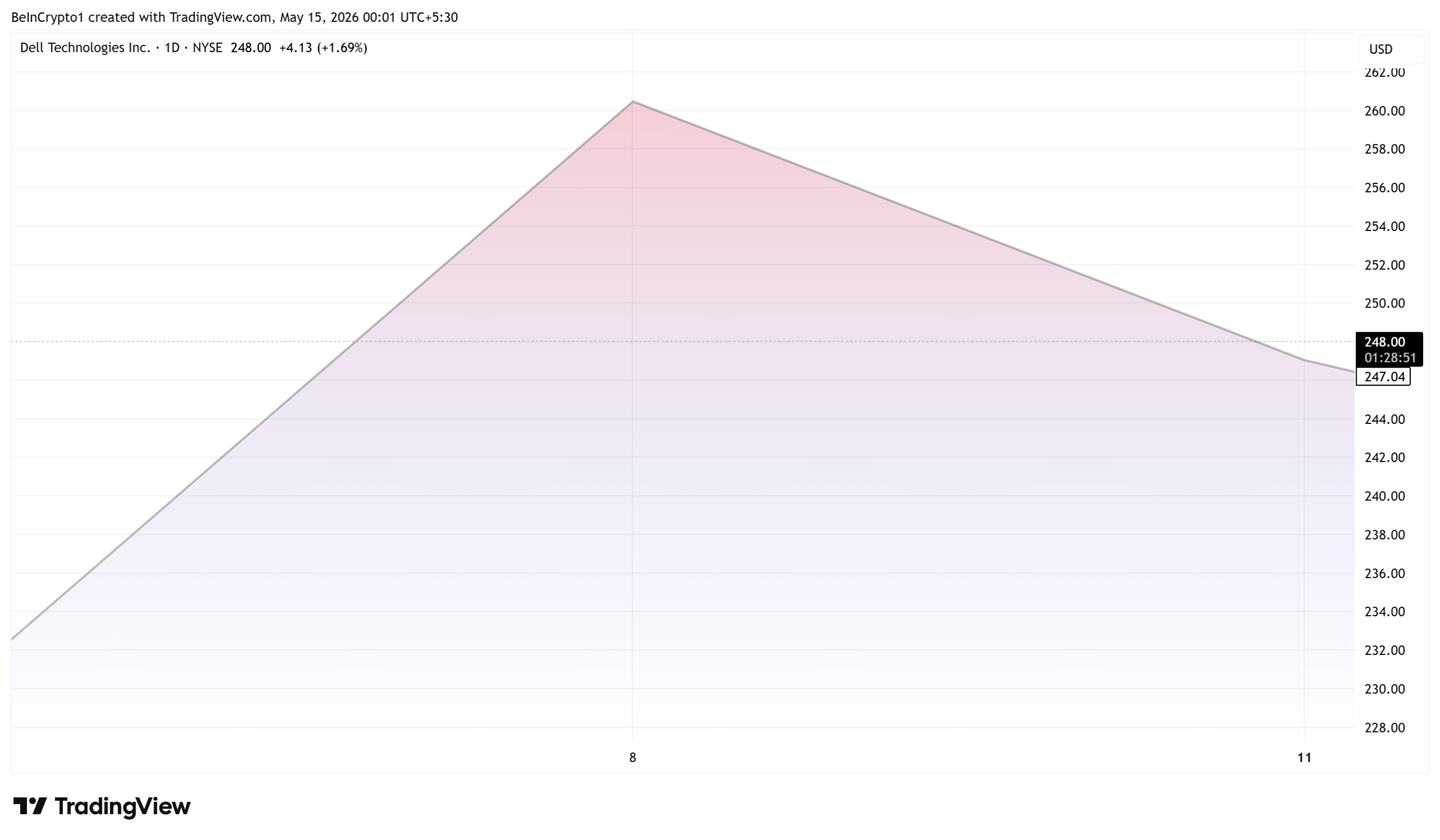
The most contested example involves Dell Technologies (DELL). Filings record multiple seven-figure DELL purchases beginning February 10. On May 8, the president publicly praised the company at a White House event.
The stock rose roughly 12% the same day. The Dell family separately pledged $6.25 billion to the Trump Accounts program in December 2025.

Whether the pattern triggers a formal review will depend on House and Senate ethics committees and the OGE.
The disclosure satisfies current reporting law, yet it widens an already active debate over executive-branch trading rules.
That debate gained urgency after years of scrutiny aimed at congressional portfolios.
Subscribe to our YouTube channel to watch leaders and journalists provide expert insights
The post Trump Logs 3,642 Stock Trades in Q1, Breaking Decades of Blind Trust Norms appeared first on BeInCrypto.
The U.S. Commodity Futures Trading Commission (CFTC) issued no-action relief from certain swap-related reporting and recordkeeping requirements for fully collateralized event contracts, easing compliance for prediction market venues and their clearing counterparts. The move aims to reduce administrative burden on designated contract markets (DCMs) and derivatives clearing organizations (DCOs) that list and clear such contracts, while preserving regulatory oversight where appropriate.
The CFTC’s market and clearing divisions stated they would not recommend enforcement against DCMs, DCOs, or their participants for not adhering to specified swap-related recordkeeping or for reporting covered transactions to swap data repositories. The agency framed event contracts on prediction markets as binary-outcome swaps in theory, yet described them as instruments that often resemble futures or futures options in practice, suggesting they may be reported to the CFTC in a manner akin to futures. The agency also named 19 platforms—including Kalshi, Polymaket, and Gemini Titan—and indicated that other firms seeking to list similar contracts could request a no-action letter.
The no-action relief responds to multiple requests from market operators that list and clear event contracts and the CFTC indicated it expects additional similar requests in the future. The relief could meaningfully reduce compliance complexity for CFTC-regulated prediction-market venues as the agency continues to defend its jurisdiction in the face of state-level gambling regulation challenges.
According to Cointelegraph, the move arrives amid a broader federal–state dispute over how these markets should be regulated—whether as derivatives under federal law or as gambling products regulated by state authorities. The CFTC has been advancing its view of exclusive federal jurisdiction in several high-profile matters, underscoring the tension between federal regulation and state laws on prediction markets.
Key takeaways
- No-action relief: The CFTC will not pursue enforcement against DCMs, DCOs, or their participants for certain swap-related recordkeeping and swap-data-reporting obligations in relation to fully collateralized event contracts.
- Scope and reporting: Event contracts—though binary by design—are treated as swaps in theory, but the CFTC indicates they can be listed and reported with mechanisms similar to futures and futures options.
- Platform coverage: The relief names 19 platforms, including Kalshi, Polymaket, and Gemini Titan, with the option for others to seek no-action from the agency.
- Regulatory posture: The relief reflects ongoing efforts to reconcile federal derivatives regulation with state gambling authorities, a conflict that includes lawsuits and amicus filings in federal courts.
No-action relief: scope and rationale
The CFTC’s writedown of enforcement risk centers on fully collateralized event contracts listed on designated markets. By carving out a relief path, the agency acknowledges that many of these contracts function in ways more akin to futures and options than to traditional swaps, despite their binary-event underpinnings. The relief allows listing venues and clearinghouses to maintain listing and clearing operations without triggering automatic enforcement for specific swap-recordkeeping deficiencies or for failing to report certain events to swap data repositories.
Key platforms identified by the agency—such as Kalshi, Polymaket, and Gemini Titan—are included in the relief’s scope, which also clarifies that other platforms seeking to list similar contracts may apply for no-action relief. The intent appears to be reducing administrative friction for CFTC-regulated prediction-market operators while preserving the agency’s oversight posture should issues arise in the future.
The development is framed as a practical accommodation in response to a wave of compliance requests from DCMs and DCOs that list and clear event contracts. The CFTC signaled it expects further such requests, suggesting a continued alignment between enforcement discretion and market development in the prediction-market space.
Regulatory context and enforcement posture
At a broader policy level, the no-action relief sits within a contentious regulatory landscape where the CFTC seeks exclusive jurisdiction over prediction markets, but state authorities have pursued gambling-regulation actions against the same platforms. The agency has engaged in high-stakes litigation and court filings to defend its authority, including an amicus brief in the Sixth Circuit aimed at limiting state actions perceived as intruding on federally regulated markets. Ohio’s attempts to regulate or restrict sports-event contracts have been a focal point of these disputes, resulting in Kalshi pursuing a federal court challenge that has progressed through the courts with varying outcomes.
The CFTC’s March staff advisory that categorized event contracts on prediction markets as a distinct financial asset class adds another layer to the regulatory framework, signaling that the agency views these instruments through a broadly defined, potentially cross-cutting lens. In parallel, the agency’s forthcoming rulemaking—shortly after soliciting public comments—has drawn a wide range of responses. The agency reported receiving more than 1,500 comments in May on a March-published rule proposal intended to modify or introduce new regulations for event contracts. Reactions have been mixed: some state regulators pressed for stronger enforcement or tighter controls, while notable investors and industry participants—including venture firms—argued that federal regulation is essential to preserving market access and preventing a patchwork of state rules from undermining the sector’s integrity and liquidity.
In this climate, the CFTC’s no-action relief represents a tactical element of a broader federal strategy to codify a predictable regulatory baseline for prediction markets, even as jurisdictional debates persist across the states and the courts. The agency’s actions are being watched by market operators, financial institutions, and compliance teams for how future no-action letters may shape listing, clearing, licensing, and cross-border operations in a space that remains subject to evolving regulatory interpretation.
Operational implications for platforms and market participants
For prediction-market venues and their banking and clearing partners, the relief could lower the ongoing compliance overhead associated with swap-data reporting and recordkeeping. By differentiating event contracts from conventional swaps in practical reporting terms and pointing to futures-like treatment for listing and reporting, the CFTC signals a potential path to streamlined regulatory oversight without loosening safeguards around market integrity, transparency, or customer protection.
For operators like Kalshi, Polymarket US, and Gemini Titan, the development underscores the importance of clear regulatory delineations between federal derivatives law and state gambling statutes. The relief could influence licensing strategies, reporting frameworks, and the design of collateral requirements, all within the context of a broader push for consistent enforcement and improved market access across jurisdictions. The agency’s emphasis on prospective no-action letters suggests operators should anticipate further regulatory interactions as the rulemaking process unfolds and as states sharpen their policy positions on prediction markets.
From a compliance standpoint, firms should monitor the evolving guidance around what constitutes a reportable event, how event contracts should be classified for filing to swap-data repositories, and what documentation supports a no-action determination. The evolving posture of enforcement discretion—paired with ongoing litigation and rulemaking—implies that firms must maintain robust internal governance, particularly around data retention, event-logging, and cross-border operational risks that arise when state and federal authorities diverge in their regulatory expectations.
Closing perspective: The CFTC’s no-action relief for fully collateralized event contracts marks a deliberate attempt to balance market development with regulatory oversight. As federal and state authorities continue to navigate the jurisdictional questions surrounding prediction markets, market participants should prepare for evolving requirements, potential licensing changes, and continued policy debate that will influence how these platforms operate within the U.S. financial-legal framework.
Update May 14, 2:45 pm UTC: This article has been updated to include comments from Katie Haries, head of policy for Europe at Coinbase.
The Bank of England (BoE) is reconsidering parts of its proposed regime for pound sterling stablecoins after digital asset companies warned that holding caps and reserve requirements could stifle adoption and make UK-issued tokens uneconomic.
The central bank is looking at alternatives to temporary caps on how many stablecoins individuals and businesses can hold, and is examining whether its requirement that at least 40% of backing assets be held as non-interest-bearing deposits at the BoE is overly conservative, Deputy Governor Sarah Breeden told the Financial Times.
The rethink comes as the UK government and regulators try to position Britain as a competitive hub for digital assets while containing risks to bank funding and financial stability. Sterling-pegged tokens currently make up a tiny fraction of the roughly $300 billion global stablecoin market, which remains dominated by dollar-based issuers.
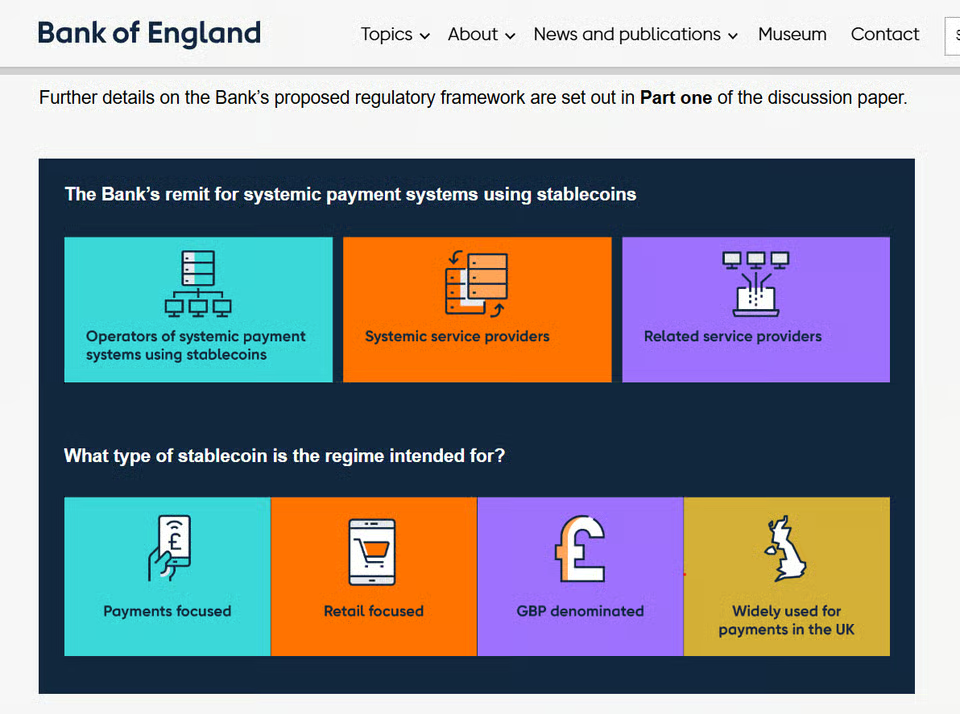
The BoE set out detailed ownership limits in its November 2025 consultation paper on a proposed regulatory regime for sterling-denominated systemic stablecoins, building on options first aired in a 2023 discussion paper.
Under that proposal, individuals would be restricted to holding up to 20,000 pounds (roughly $27,000) of a given UK stablecoin, while businesses would be capped at roughly $13.5 million, at least during an initial transition period.

Stablecoins Discussion Paper, 2023. Source: Bank of England
The central bank argued that limits were needed to avoid a sudden outflow of deposits from commercial banks into new forms of “tokenised” money if a large stablecoin were rapidly adopted for payments.
Related: Bank of England chief says global stablecoin rules will ‘wrestle’ with US
Industry groups and prospective issuers countered that the caps were operationally cumbersome, hard to supervise across platforms, and could deter serious institutional use of regulated UK stablecoins in areas like corporate treasury, payroll and settlement.
BoE rethinks stablecoin caps after pushback
Breeden has been one of the most cautious voices on stablecoins within the BoE. In November 2025, she warned that diluting the rules too far could damage financial stability, stressing that stablecoins are money-like instruments that must be at least as safe and robust as existing payments infrastructure.
At the time, she backed stringent liquidity requirements that would force stablecoin issuers to park large portions of their reserves at the central bank and hold the rest in high-quality liquid securities such as UK government bonds.
Law firms and potential issuers argue that such a structure would significantly compress margins and make UK stablecoin issuance far less attractive than operating under the United States or European Union regimes.
UK hunts for middle ground on stablecoins
The shift in tone highlights how UK policymakers are still feeling their way toward a middle ground on stablecoins as global approaches diverge.
In January, UK lawmakers opened an inquiry into how best to oversee fiat-backed tokens, taking evidence from industry participants such as Coinbase and Innovate Finance, while the BoE and Treasury continue to refine a framework intended to sit alongside broader crypto rules and potential digital pound plans.
Katie Haries, head of policy for Europe at Coinbase, told Cointelegraph it’s an important signal the BoE is prepared to revisit its stablecoin proposals.
“We’ve said for a long time that a cap on stablecoin holdings is a cap on innovation,” she said, with “real and significant risks for UK competitiveness.” She added that creating a regime where stablecoins can succeed and benefit users is “exactly the right ambition,” and something the crypto industry and everyday people are asking for.
A more flexible approach to caps and backing requirements could determine whether systemic GBP stablecoins emerge as serious competitors to dollar-pegged rivals in cross-border payments and onshore crypto markets, or whether activity remains concentrated in jurisdictions seen as more accommodating.
Magazine: Singapore isn’t a ‘crypto hub’ — it’s something better: StraitsX CEO

Crystal Palace pair achieve World Cup dream as France squad revealed

Sheriff Reveals Major DNA Breakthrough as Investigation Hits 100 Days

Strive Makes SATA First US Security to Pay Cash Dividends Every Business Day

Manchester United reach agreement with Casemiro over contract clause amid transfer speculation

US brings back mandatory military draft registration

Steven Gerrard disagrees with Gary Neville over ‘shock’ Chelsea and Arsenal claim | Football


-
 Crypto World7 days ago
HarrisX Poll Found 52% of Registered Voters Support the CLARITY Act
-

 Fashion6 days ago
Weekend Open Thread: Marianne Dress
-

 Fashion3 days ago
Coffee Break: Travel Steam Iron
-

 Fashion4 days ago
What to Know Before Buying a Curling Wand or Curling Iron
-

 Tech5 days ago
Auto Enthusiast Carves Functional Two-Stroke Engine from Solid Metal
-

 Politics3 days ago
What to expect when you’re expecting a budget
-
 Business6 days ago
Ignore market noise, India’s long-term story intact, say D-Street bulls Ramesh Damani and Sunil Singhania
-

 Politics6 days ago
Politics Home Article | Starmer Enters The Danger Zone
-

 Tech4 days ago
GM Agrees To Pay $12.75 Million To Settle California Lawsuit Over Misuse Of Customers’ Driving Data
-

 Crypto World6 days ago
PROS explodes 48% as Upbit and Bithumb listings ignite demand
-

 Crypto World5 days ago
CZ says US crypto rivals tried to block Trump pardon
-

 Entertainment6 days ago
YNW Melly Denied Bond Again Ahead Of Double Murder Retrial
-

 Tech3 days ago
GM agrees to $12.75M California settlement over sale of drivers’ data
-

 Sports7 days ago
Bayern Munich vs PSG UEFA Champions League SF2 live match time, streaming | Football News
-
Tech7 days ago
The Most Exciting Apple Products In The Pipeline For 2026 And Beyond
-
Crypto World7 days ago
The Hantavirus Danger: Can a Potential Outbreak Spark a New Meme Coin Frenzy?
-

 Crypto World6 days ago
Kraken Parent Seeks OCC Charter, Signaling Regulated Banking Access
-

 Politics7 days ago
David Attenborough ‘Overwhelmed’ By Love Shown Ahead Of 100th Birthday
-

 Sports6 days ago
After Waka Waka, Shakira now drops first teaser for FIFA WC 2026 song | FIFA World Cup 2022
-
Entertainment7 days ago
How “Grey's Anatomy” bid farewell to Owen and Teddy — and whether they end up together
You must be logged in to post a comment Login