
Crypto World
Swan Bitcoin CEO Cory Klippsten sees users embracing stronger safeguards after $100 million Coldcard exploit



A week on, nearly 90% of the stolen coins remain unmoved onchain, confirmed attacker addresses have been shared with U.S. federal law enforcement and Toronto-based Coinkite has patched every affected device line. A volunteer team funded by OpenSats scanned more than 150 open-source repositories and found no evidence the problem extended beyond Coldcard.
The exploit led some in the industry to question the value of self-custody, suggesting investors should consider buying bitcoin through, for example, exchange-traded funds rather than holding it themselves.
Klippsten, however, said clients are not retreating from self-custody. Instead, they’re examining ways of making their bitcoin harder to access.
“People are moving into Swan Vault right now,” he said, referring to the firm’s collaborative multisig product, where no single device can put a user’s funds at risk. “Instead of abandoning self-custody, many are upgrading it.”
His verdict on the week is measured optimism.
“It is awful that people lost coins, and they did everything right according to what a lot of well-known people in the industry told them. But Bitcoin is antifragile and the tools are getting stronger by the hour. This might end up being the best thing that ever happened to self-custody.”

Bitcoin (BTC) price is stalling near $64,000 after two failed pushes at the same ceiling, and both large wallets and long-term holders have started selling into the weakness.
The rollover lands just as two US events with a track record of moving crypto return to the calendar, and history says both tend to hit Bitcoin when it is already soft.
Bitcoin Enters a Weak Month With a Double Top in Play
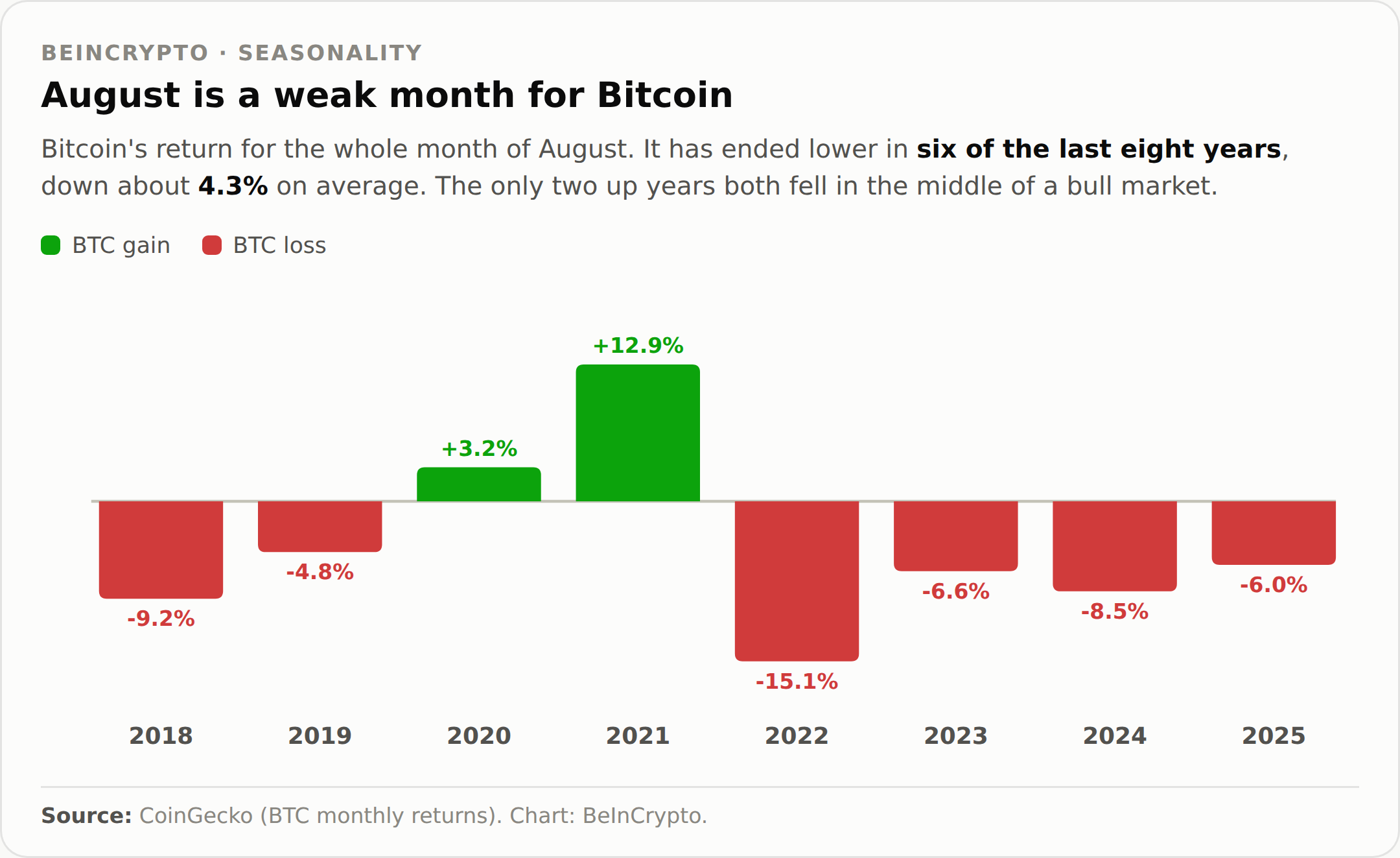
August has been unkind to Bitcoin. It has closed the month lower in six of the last eight years, so buyers begin from a weak seasonal base.

The chart makes that base look shakier. Bitcoin has formed a double top, a bearish reversal pattern where price fails twice at the same resistance and struggles higher. The two peaks built on comparable volume, which adds weight to the signal.

Sell-side volume has also risen since August 1, pushing the current Bitcoin price toward the lower edge of the range rather than back toward the highs.
Want more token insights like this? Sign up for Editor Harsh Notariya’s Daily Crypto Newsletter here.
Large holders are pulling back at the same time. Supply held by Bitcoin whales in the 10,000 to 100,000 BTC band peaked on August 3 near 2.26 million BTC, then eased to 2.25 million. The move is small, but it suggests the biggest wallets are trimming rather than adding.

Whale behavior alone does not confirm a trend, so the next question is whether long-term holders agree.
Long-Term Holders Flip From Buyers to Sellers
They appear to. The Hodler Net Position Change, a metric that tracks the net change in supply held by long-term holders, stayed positive through July as those holders added coins. It turned negative in early August.
The shift is sharp. Net selling deepened from about 1,802 BTC on August 2 to roughly 11,472 BTC on August 4, a more than six-fold jump in two days. That points to long-term holders possibly selling into strength rather than holding through it.

With whales and long-term holders leaning the same way, the market now meets two events that have moved Bitcoin hard before.
The Two Events That Have Moved Bitcoin Before
The first is Friday’s US jobs report. It is the same release that helped trigger Bitcoin’s sharp early-August drop in 2024, when a weak print sparked recession fear. Economists expect another soft reading this week, near 80,000 new jobs with unemployment around 4.2%.
Since 2023, Bitcoin has tended to fall on weak labor data.

The second is the Jackson Hole symposium in the final week of August. A hawkish speech there in 2022 helped send Bitcoin below $20,000. For years, a dovish Fed later softened those blows, but that cushion is gone. Kevin Warsh took over as Fed chair in May and has run a hawkish, inflation-first line, with markets now pricing higher-for-longer rather than cuts.

Warsh gives his first Jackson Hole speech as chair this month, and a market still hoping for relief is exposed to disappointment. That sets up the price chart as the decider.
Bitcoin Price Levels to Watch Before Friday’s Jobs Report
The first line buyers need to defend sits at $61,080. A clean loss of that level would expose $59,500, the last support before the pattern’s neckline.
The neckline runs through the $57,750 to $57,470 zone. A daily close below it would confirm the double top and open a measured move of roughly 14%, which points toward the sub-$50,000 region near $49,700. The 14% drop potential is in line with August 2022’s drop size.

The setup is not confirmed yet. A double top only completes on a neckline break, so a hold above $61,080 keeps the range alive. A reclaim of the $66,930 to $67,230 ceiling that capped both peaks would invalidate the bearish Bitcoin price outlook entirely.
For now, the structure and on-chain flows lean the same way into a hostile macro week. The $57,750 neckline separates a routine August pullback from a 14% slide toward $50,000.
The post Bitcoin Under $50,000? These Two Feared August Events Could Trigger It appeared first on BeInCrypto.

Bitcoin (BTC) has rebounded from Monday’s low of $62,210, retaking $64,000. The flagship cryptocurrency reached an intraday high of $64,497 on Tuesday and is currently trading around $64,122.
A close above $65,000 could open the door to a move towards $66,000 and July’s high of $67,975. However, buyers must overcome immediate resistance between $64,000 and $65,000.
Bitcoin Back Above $64,000
Bitcoin (BTC) started the week with a sharp drop, falling to a low of $62,210 as the Coincard exploit, along with prevailing macroeconomic and geopolitical conditions, pressured an already jittery market. The flagship cryptocurrency recovered from Monday’s low to reach an intraday high of $64,497 on Tuesday, and held above $64,000 during the ongoing session as buyers stepped in. A close above $64,300 could lead to more gains, but macroeconomic and geopolitical uncertainty is weighing down market sentiment.
The RSI currently sits in neutral territory at 51, while the MACD suggests bulls have a slight advantage. Despite BTC’s impressive recovery this week, it remains in a broader consolidation range spanning between $57,000 and $67,000. While a close above $65,000 is bullish in the short term, a break above $67,000 could hand bulls control.
Bitcoin Tests Descending Channel
On the four-hour chart, BTC tested the upper boundary of a descending channel, briefly pushing higher before dropping back towards $64,000. This price action suggests buyers are unsure about a breakout. Meanwhile, analyst Ali Martinez stated that a close above $64,300 on the four-hour chart could clear the way for a move towards $65,500-$66,500.
“If you’re bullish on Bitcoin, watch this. $BTC is testing the upper boundary of a descending channel, making $64,300 the key level to watch. A 4-hour close above $64,300 could confirm the breakout and open the door to a rally toward $65,500 or even $66,500.”
The Awesome Oscillator flashed a bullish signal, climbing past 277 and printing rising green bars. However, Bitcoin must absorb the overhead supply to ensure sustained momentum. An order book analysis revealed large sell orders between $64,000 and $65,000, explaining BTC’s inability to extend its gains beyond the current range.
$62,000 In Focus
The Bitcoin liquidation heatmap revealed a substantial concentration of leveraged positions at $62,000 and could come into focus if BTC loses momentum. The heatmap also shows smaller clusters around $63,000 and between $64,500 and $66,000. In a bullish scenario, BTC stays above $63,496 and breaks above the overhead supply zone. Such a scenario could see BTC push above $67,000 and its broader consolidation range. However, if BTC falls below $63,500, it could bring the liquidation cluster at $62,000 into focus. A break below this level could see BTC slip below $61,000.
US-Iran Talks Progress
BTC’s latest recovery began after Qatar confirmed mediators were working to reopen negotiations between the US and Iran. Majed Al-Ansari, Qatar’s Foreign Ministry spokesperson, stated that Doha aims to restore normalcy in the Strait of Hormuz and was working with other regional countries to mediate between Washington and Tehran.
“What matters to us now is the resumption of negotiations, and to achieve this, a ceasefire and the reopening of the Strait of Hormuz must be guaranteed.”
Diplomatic efforts have eased concerns about supply chain disruptions. The strait is one of the world’s most important oil supply routes. Reopening the strait could ease strain on crude prices and drive demand for risk assets like BTC.
Disclaimer: This article is provided for informational purposes only. It is not offered or intended to be used as legal, tax, investment, financial, or other advice.
Following last week’s sharp decline, the US dollar has entered a consolidation phase against most major currencies. At the same time, some instruments, including USD/JPY, are showing a moderate recovery as markets await fresh macroeconomic signals. Today’s key event will be the release of the preliminary ADP private-sector employment report. Forecasts suggest that job growth will slow to 68,000 after 98,000 in the previous month. If the data comes in below expectations, pressure on the dollar could increase as markets price in a more dovish Federal Reserve stance. Conversely, a stronger report could support the US currency ahead of the official US labour market data release.
Additional attention will be focused on US services sector activity indicators. Markets expect the preliminary S&P Global Services PMI to improve to 53.6 points, while the ISM Non-Manufacturing Index is forecast to rise to 54.5. Strong readings could partly offset any weakness in the ADP report and confirm the resilience of the largest sector of the US economy. It is worth noting that market participants traditionally view the ADP report only as an early indicator ahead of the official Nonfarm Payrolls release. Although the trends in the two reports do not always align, today’s data could significantly influence short-term expectations regarding the health of the US labour market.
USD/JPY
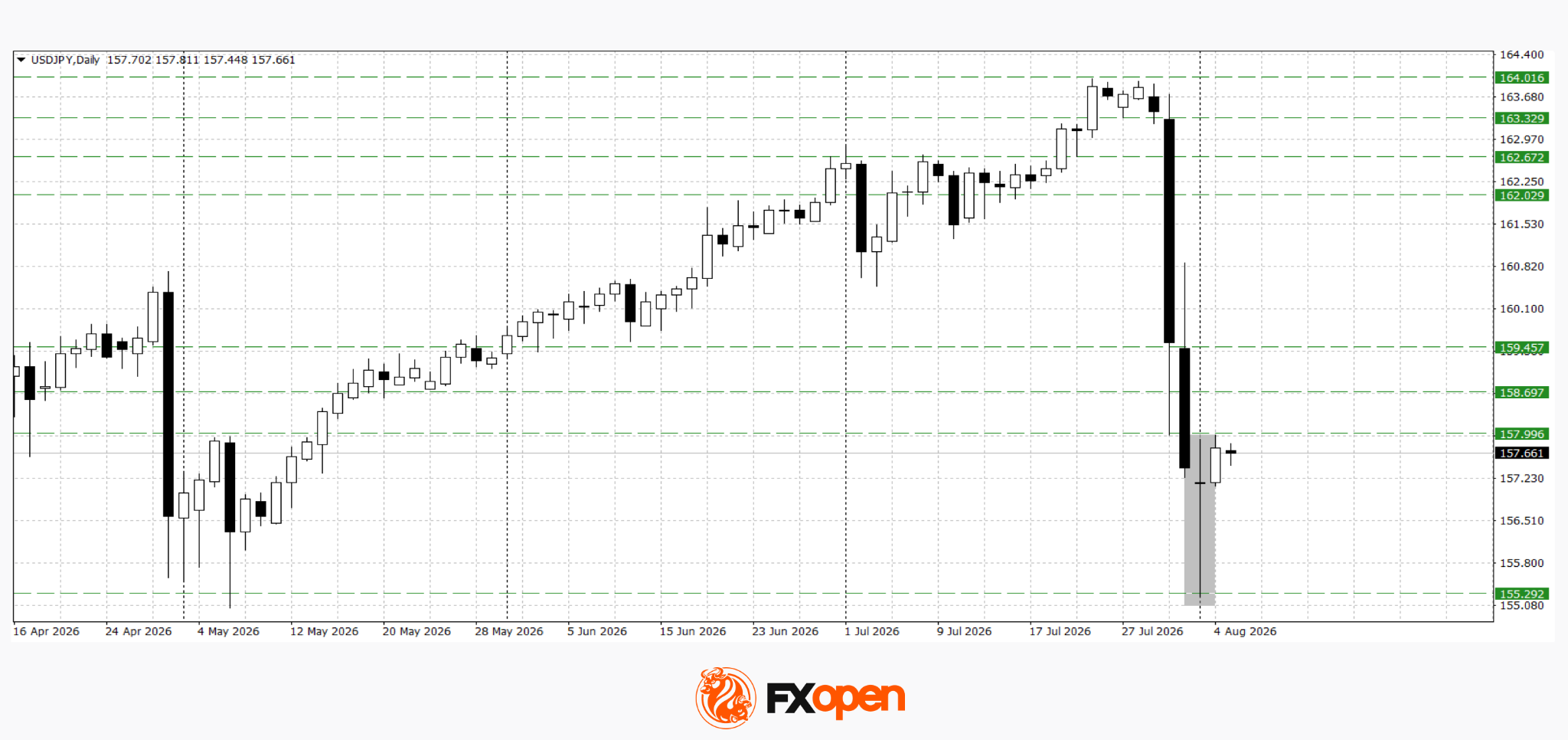
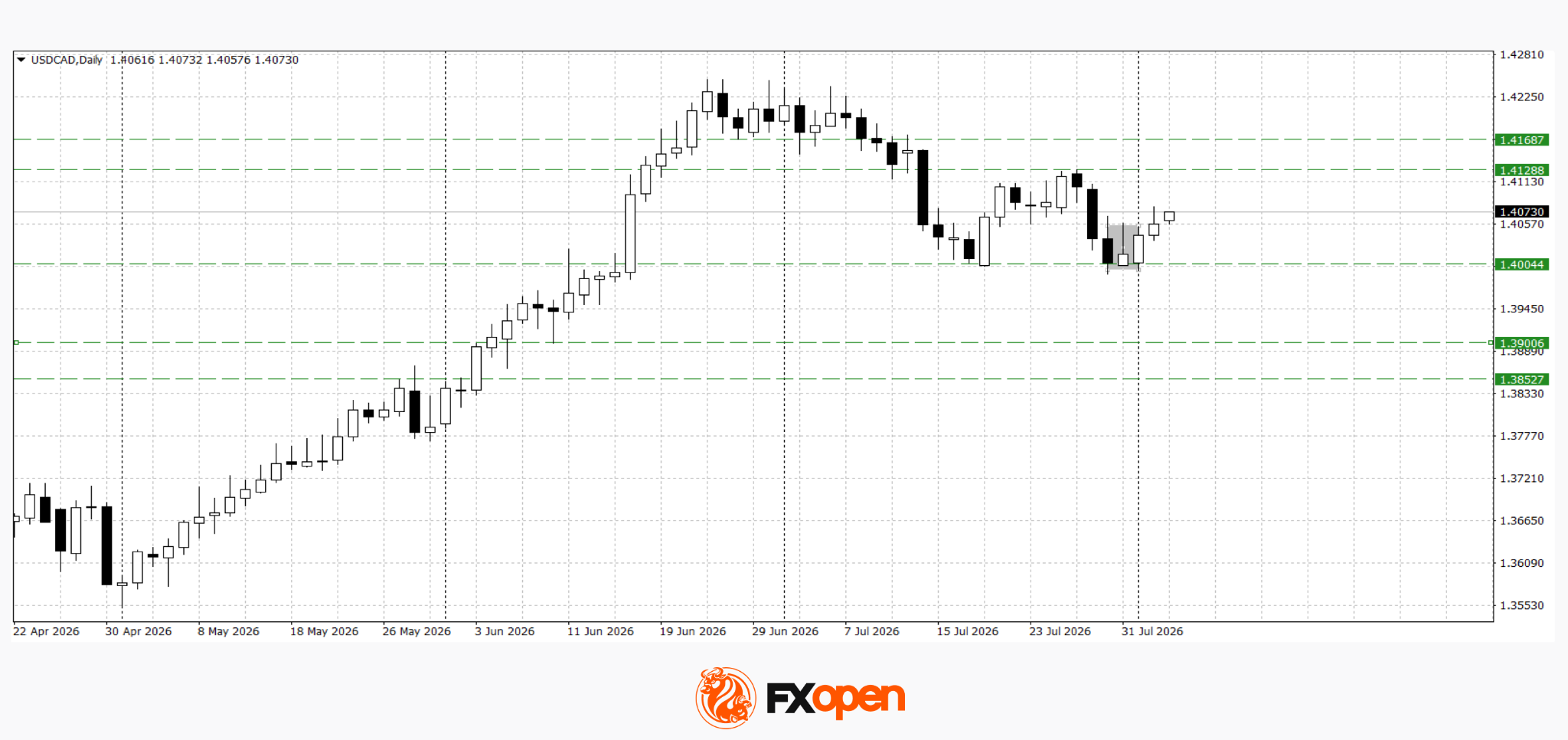
Last week, following the Federal Reserve meeting, USD/JPY declined sharply, losing more than 500 pips over several trading sessions. At the beginning of the current week, after testing the key support level at 155.30, buyers managed to push the pair back towards 158.00, while forming a “doji” candlestick pattern, which may signal a weakening of the bearish momentum. If the price breaks above yesterday’s high, the corrective move could extend towards 158.70–159.40. Weaker US employment data could trigger a renewed downward move.
Key events for USD/JPY:
- Today at 15:15 (GMT+3): ADP change in US non-farm private employment;
- Today at 16:45 (GMT+3): US Services PMI;
- Tomorrow at 17:00 (GMT+3): US ISM Non-Manufacturing PMI.
USD/CAD
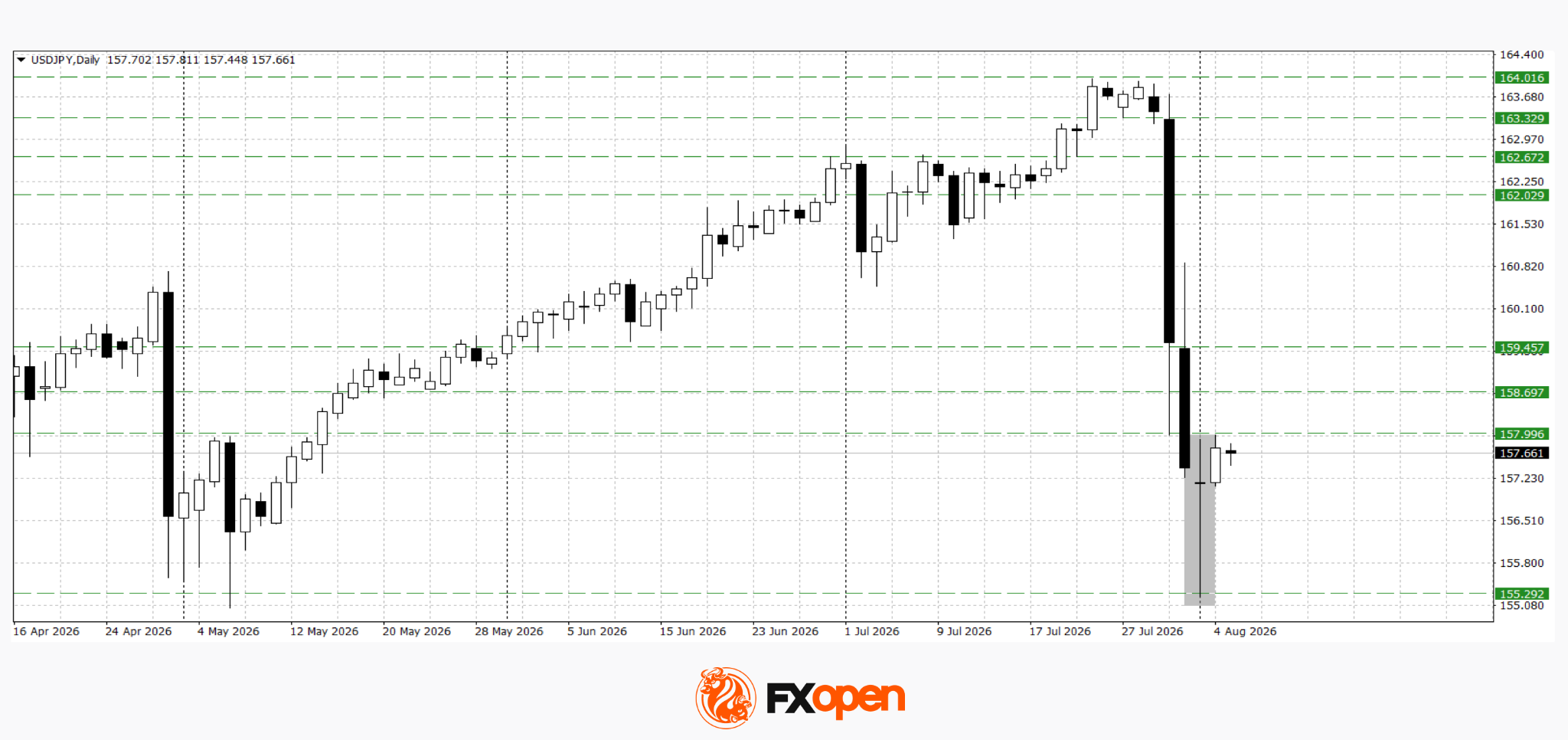
Last week, USD/CAD retested the key support level around 1.4000, forming a “bullish harami” pattern after the rebound. Technical analysis of USD/CAD suggests the potential for further recovery towards 1.4130–1.4170. Weaker US economic data, however, could trigger another test of the 1.4000 level.
Key events for USD/CAD:
- Today at 17:30 (GMT+3): US crude oil inventories;
- Today at 23:05 (GMT+3): speech by Federal Reserve Governor Lisa D. Cook;
- Tomorrow at 16:30 (GMT+3): Canada Services PMI.
The main drivers for the US dollar today will be the preliminary ADP employment figures and US services sector activity data. If the releases confirm the resilience of the US economy, USD/JPY and USD/CAD could continue their recovery following the dollar’s recent correction. Weaker data, on the other hand, could strengthen expectations of a more accommodative Fed policy, adding further pressure on the US currency and allowing sellers to regain control. However, investors are likely to draw more definitive conclusions about the labour market after the official Nonfarm Payrolls report is released later this week.
Trade over 50 forex markets 24 hours a day with FXOpen. Take advantage of low commissions, deep liquidity, and spreads from 0.0 pips (additional fees may apply). Open your FXOpen account now or learn more about trading forex with FXOpen.
This article represents the opinion of the Companies operating under the FXOpen brand only. It is not to be construed as an offer, solicitation, or recommendation with respect to products and services provided by the Companies operating under the FXOpen brand, nor is it to be considered financial advice.


Galaxy Digital (GLXY) shares are lower by a bit more than 5% in pre-market action after reporting quarterly results.
Galaxy’s $85 million net loss narrowed from $216 million in the first quarter, while its diluted and adjusted loss narrowed to $0.09 per share from $0.49. Street forecasts had been for a loss of $0.28 per share.
Its digital assets operation generated $66 million in adjusted gross profit, up 34% quarter-on-quarter, despite a 7% decline in trading volume.
Galaxy’s data center business generated revenue for the first time in the quarter as the company completed the initial phase of its Helios campus in West Texas.
The segment generated $20 million in adjusted gross profit and $11 million in adjusted EBITDA, reversing a $900,000 adjusted EBITDA loss in the first quarter. Galaxy delivered 200 megawatts of gross power, representing 133 megawatts of critical IT capacity, to CoreWeave under a 15-year lease.
The firm’s results, however, could have disappointed as they did not include a new data-center customer or lease, though Galaxy said it remains in discussions with prospective tenants for another 830 megawatts of approved capacity at Helios.
Crypto World
Ken Griffin’s Citadel posts best month in years after scooping up Situational Awareness stocks

Ken Griffin, Founder and Chief Executive Officer of Citadel, speaks during the America Business Forum at Kaseya Center in Miami, Florida, U.S. Nov. 5, 2025.
Marco Bello | Reuters
Ken Griffin’s Citadel posted strong gains across its major hedge funds in July, helped by a recovery in risk assets and a discounted purchase of assets from the collapse of Leopold Aschenbrenner’s Situational Awareness to end the month, according to a person familiar with the firm’s performance.
Citadel’s flagship multistrategy Wellington fund, the firm’s largest, returned 5.9% in July, marking its best monthly performance since 2022 and pushing 2026 gains to 12%, the person said. The tactical trading fund, which combines discretionary equity investing with quantitative strategies, gained 11.1% in July and is up 27% on the year. The equities fund advanced 14.2% last month, bringing 2026 return to 27%. Tactical fund and equities fund both had its best month ever. The person asked not to be identified discussing confidential performance figures.
The July gains came after Citadel acquired the bulk of the public-stock portfolio formerly held by Situational Awareness late last month, following the hedge fund’s rapid unraveling after steep losses triggered margin calls and forced asset sales. Citadel purchased many of the holdings at a significant discount, positioning the firm to benefit as markets rebounded into the month-end.
Situational Awareness, founded by former OpenAI researcher Leopold Aschenbrenner, was forced to unwind many of its positions after a sharp reversal in artificial intelligence trades left it bleeding on both sides of its book. The firm had accumulated sizable stakes in AI infrastructure companies while betting against software stocks, a strategy that backfired as software shares rallied and AI hardware names slumped.
Several of the fund’s prime brokers worked to reduce positions in an orderly fashion as Situational Awareness sought to meet margin requirements. Citadel emerged as one of the largest buyers of the portfolio, taking advantage of one of the year’s biggest forced liquidations.
Stocks such as Nebius and Micron that Aschenbrenner’s fund owned rebounded in the final days of July following a brutal month with many traders saying the fund’s near collapse and rescue move by Citadel was a clearing event that caused short sellers to take profits.
Citadel managed about $71 billion in assets as of July 1 and has often used periods of market dislocation to deploy capital into distressed or forced-selling situations.
Citadel declined to comment.


The firm filed a proposed class action in the Southern District of New York in April, alleging false advertising, deceptive practices, negligent misrepresentation and unjust enrichment. The complaint claimed the project marketed itself as an “autonomous, AI-run venture fund” even though Walters and other insiders controlled it. It also alleged that holders were diluted during the migration from AI16Z to ELIZAOS.
The rebrand followed objections from venture capital firm Andreessen Horowitz, commonly known as a16z, over the original name.
“Their claim was ridiculous, but we didn’t have the capital to legally fight it,” Walters wrote. He added that he once held tokens worth about $25 million in his wallet and watched their value fall toward zero.
CoinDesk has asked Eliza Labs and Burwick Law about the settlement terms, the status of the federal case and what holders received when the original daos.fun vehicle expired.
How AI Agents were once a darling sector
AI16Z launched on Solana in October 2024 with a pitch built around an AI agent running a venture-style fund and token holders participating as partners. By late December, its daos.fun vehicle held more than $22 million in user-supplied tokens and was due to expire in October 2025.
The category began with Truth Terminal, an account run by New Zealand researcher Andy Ayrey that posted its own strange, quasi-religious material on X, and drew a $50,000 bitcoin donation from a16z founder Marc Andreessen in July 2024. A developer with no connection to it launched GOAT around its obsessions that October, and the token hit $1.2 billion within days.
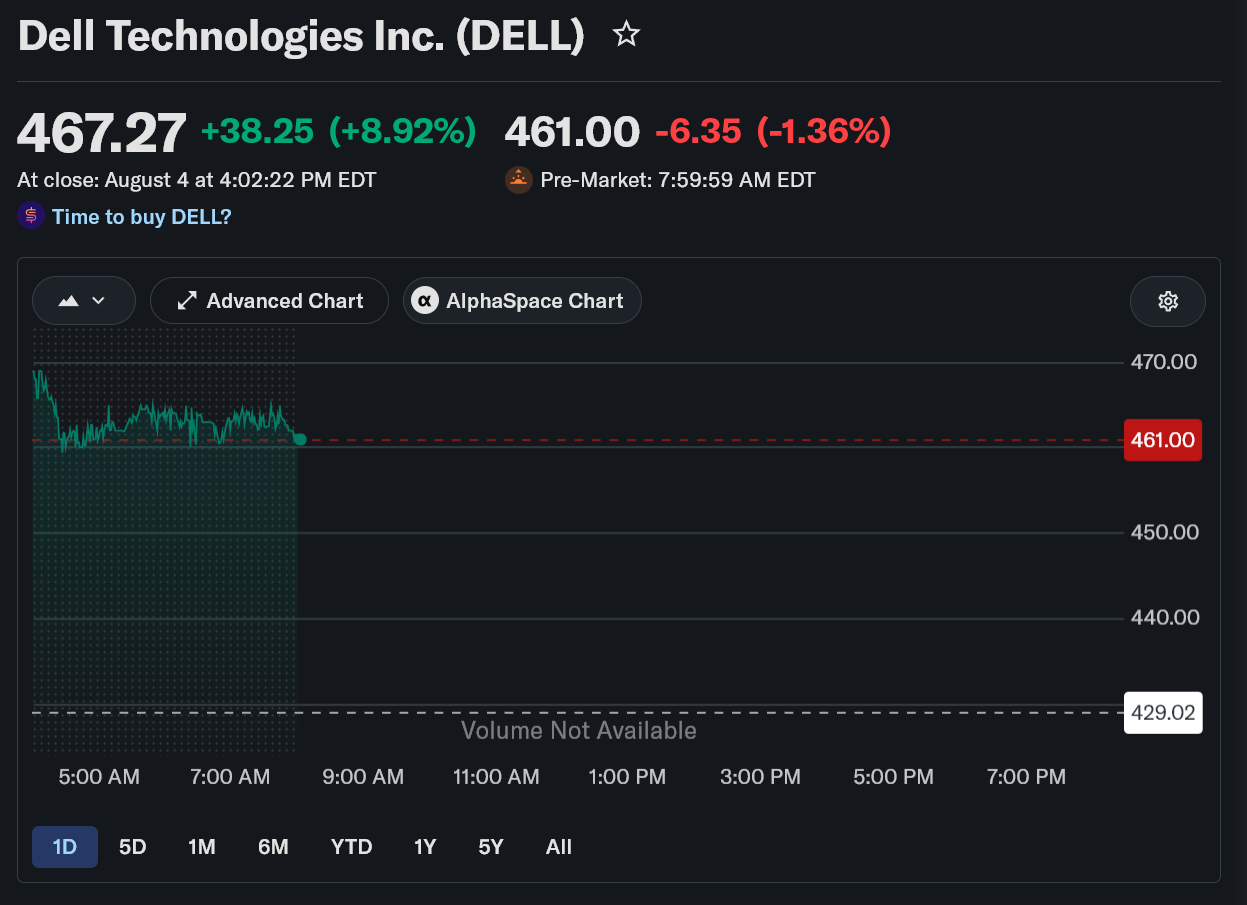
Dell Technologies shares hit an all-time high on Tuesday, closing near $467 after climbing almost 9% in a single session and briefly touching $476.
The stock has now surged more than 260% year-to-date, driven by demand for artificial intelligence and repeated presidential endorsements.

The AI Numbers Powering Dell’s Record Run
TradingView data confirmed the breakout. After testing key support levels, Dell powered higher during the session, extending gains beyond previous peaks set in June.
Momentum carried into overnight trading. Shares advanced roughly 30% from recent support zones that had previously triggered sharp rebounds of 23%-29%.
The rally coincides with a broader boom in AI equities. Investors piled into server and data-center hardware stocks as confidence in sustained spending returned.
Follow us on X to get the latest news as it happens.
The fundamentals support that enthusiasm. Dell reported $16.1 billion in AI server revenue in the fiscal first quarter, a 757% year-over-year increase. Guidance moved sharply higher, too. Management raised its full-year AI server forecast to $60 billion, underscoring the scale of the opportunity.
Fresh corporate news bolstered the narrative. The same day the stock hit its record high, Dell announced that the startup Volta had selected the company to power its first AI factory. The Norwegian deployment carries real scale.
The 133-megawatt project will use Dell PowerRack systems with PowerEdge XE9812 servers featuring NVIDIA accelerators, supported by Dell Professional Services.
Volta emerged from stealth with a $2.4 billion valuation, backed by NVIDIA and Michael Dell’s family office. Its broader pipeline exceeds one gigawatt of near-term capacity.
The Political Tailwind and the Risks Ahead
Political support has provided an unusual tailwind. President Donald Trump has publicly urged Americans to go out and buy a Dell on three separate occasions within five months, most recently in early July.
Those comments moved markets. Previous endorsements sparked intraday gains of up to 10% for the stock.
A relevant detail accompanies them, however. Trump holds a personal stake in Dell valued between $1 million and $5 million, according to disclosures reviewed by market observers.
The endorsements have kept the company in the public spotlight. That visibility reinforced positive sentiment at a moment when retail interest in AI hardware was already climbing.
Caution has accompanied the enthusiasm, though. The parabolic rise has drawn scrutiny from traders who question how much optimism is already priced in.
Margins remain the persistent concern. Hardware businesses have historically operated on thinner margins than their software peers, and component costs remain volatile.
Concentration risk deserves attention as well. Dell’s trajectory now depends heavily on a single spending cycle continuing at its current intensity. History offers a warning here. Gains of this magnitude frequently invite sharp reversals once momentum fades or expectations reset.
The next earnings report arrives in early September. Investors will watch whether the company converts its massive order backlog into sustained profitability. That conversion defines the real test. Backlog reflects demand, while margins and cash flow reveal whether the business model scales profitably.
For now, robust demand, political visibility, and tangible contracts have propelled Dell to unprecedented heights. Whether that combination holds depends on the AI infrastructure buildout maintaining its pace.
Subscribe to our YouTube channel to watch leaders and journalists provide expert insights.
The post Dell Stock Surged 260% This Year, and Here’s All the Reasons Why appeared first on BeInCrypto.


AI is disrupting the world of work. But can it disrupt gender inequality at home?
The rise of “Care AI” offers up a tantalizing vision, one in which the never-ending work of managing family life—the anticipating, planning, caretaking, troubleshooting, worrying, and remembering—is outsourced to and supported by AI.
Can’t keep up with emails and updates from your child’s school? An AI personal assistant can summarize communications, prioritize action items, and send reminders about back-to-school night. Worried something is off with your elderly father? An AI agent can track his medications, monitor for warning signs, and draft emails to his doctors.
Techno-optimism hails AI’s transformative potential to solve major social problems and address unmet needs. These arguments highlight how Care AI can augment our social capacity to care, alleviating the care crisis, while reducing the caregiving burden on women.
On the face of it, such technological developments are welcome news. Despite recent upticks in the amount of time men spend on unpaid household work, women still do significantly more. And that’s especially true when it comes to the mental load. In most households, it is women’s enduring vigilance, problem-solving work, and emotional management that keep the wheels from falling off.
Studies show that the gendered division of cognitive labor is even more unequal than housework or childcare. And women pay an enormous price for holding everything together. Mothers who do a disproportionate share of the mental load have higher rates of depression, stress, and burnout. They are also more likely to report lower quality romantic relationships and to arrive at work already exhausted. An AARP survey found that four in 10 caregivers of adults say they rarely or never feel relaxed.
This unpaid labor women do may leave them depleted, but its economic value has long gone unrecognized. Tasks like cooking or coordinating family logistics are typically excluded from measures of GDP.
A new analysis turns this thinking on its head. A new report by consulting firm PwC provides an estimate of the socioeconomic value unlocked by AI assistive supports for unpaid household work. From AI-enabled wearable monitors that alert caregivers to problems to AI assistants that research options, streamline family routines, and prevent missteps, the value of technologies that bring efficiencies to “care and life management” and that “reduce friction in everyday life” is $330 billion, and that’s just assuming a 40% adoption rate. These gains are generated not only from time savings but from the decreased stress and higher well-being that results from AI reducing the cognitive load caregivers carry.
Are techno-optimists right? Can Care AI offer women a better organized, fairer, and more carefree existence? History suggests otherwise.
Technofeminism has long criticized the idea that technology is the solution to the problem that has no name. In her influential 1985 book, More Work for Mother, historian Ruth Schwartz Cowan documented how the rise of “labor saving” domestic technologies like washing machines and vacuums actually increased women’s load by raising cleanliness standards and expanding housewives’ responsibilities. Because technology is laid over existing cultural beliefs and social relations, it rarely fixes social problems.
Innovation has not brought about women’s liberation. In fact, it’s added to women’s plates. Research has found that the uneven gendered division of labor extends to the digital realm, where women often take the lead on their family’s online communications and oversee and negotiate their children’s media use. Moreover, technologies that keep us continually connected have given rise to a relentless and transcendent type of caretaking. Far from feeling like they have less to do, women now feel like they are never off the clock.
Indeed, Care AI arrives on the scene as parenting standards have become supercharged. The cultural ascendance of intensive mothering, in which mothers are deemed entirely responsible for their children’s well-being and success, has upped the ante. Mothers feel this pressure to be the perfect parent acutely. Compared to fathers, mothers tend to hold higher standards for “good parenting,” but nonetheless judge themselves more negatively and worry more about falling short. The all-consuming and unforgiving nature of motherhood today results in a sad irony. Women often do more than their own mothers, but feel like they are not measuring up.
To be sure, there are enormous upsides to Care AI. These technologies will enable more convenience, improved coordination, enhanced monitoring, and in many cases better care. Women stand to benefit from these developments.
An analysis of Japan and the U.K. estimated that automation could reduce time spent on unpaid work by 50 to 60%, decreasing women’s domestic workload by about three hours per day, and enabling 9.3% of working-age women in Japan and 5.8% of women in the U.K. to take up a job. Against the backdrop of a care crisis and high burnout, Care AI provides a lifeline that families desperately need.
And there’s high demand. A new survey from LoigicMark, a provider of personal safety and connected care technology, found that almost eight in 10 caregivers would embrace or try AI that predicts health issues before an emergency happens.
But for these gains to materialize, we must guard against Care AI creating even more intensive care standards. If “frictionless” family life becomes the norm, whatever downtime or peace of mind AI might give women will instead be consumed by datafication, mommymaxxing, and an endless quest for optimization.
In the end, what is most likely to ignite the gender revolution at home are not large language models but a cultural reckoning over why we continue to expect women to do it all and hold them to such impossible standards.
What’s really needed is for men to do more at home and for women to be given the green light to do less. In her recent book, anthropologist Carrie M. Lane shows how professional organizers do this kind of “feminist work.” Not only do organizers give their mostly women clients the permission to part with belongings, but also the permission to let go of exacting societal expectations like having a perfectly organized and spotless house. As one organizer explained, “Moms who are doing so much and have all this stuff and think they’re supposed to be able to handle everything… ‘You cannot do it all. You can’t. So, it’s okay.’”
Until we upend these stubborn cultural beliefs, and until we have functional care systems, we’ll just have to watch as the tech bros get rich by monetizing ever more innovative ways for women to continue doing the mental load for free.
Crypto World
BlackRock Just Made Its $5 Billion Ethereum ETF Cheaper to Trade, Is $1,900 About to Break?

In the latest Ethereum price prediction, ETH is trading at $1,871.32, down 0.66% in the last 24 hours, with the 24-hour range running between $1,861.59 and $1,880.32, a tight band that signals the market is coiling before its next directional decision.
The catalyst that could tip it either way is quietly being set up by institutional infrastructure, and most traders haven’t priced it in yet.
BlackRock filed with the SEC to effect a one-for-three reverse share split of its iShares Ethereum Trust ETF (ETHA) on October 6, consolidating three shares into one to raise the per-share NAV without altering investor holdings or total fund assets.
The practical effect, as Bloomberg Senior ETF Analyst Eric Balchunas noted, is a reduction in the bid-ask spread cost from approximately 7 basis points to 2 basis points, a meaningful reduction in friction for institutional flow.
ETHA manages over $5 billion in AUM, making it the dominant ETH-based ETF by a wide margin. A cheaper spread on the largest ETH ETF in the market isn’t a cosmetic change.
It’s a structural improvement to institutional access that feeds directly into demand-side pressure on spot ETH, and given the current technical setup, the timing is worth tracking closely.

Discover: Everyone’s Got a Take. Get Free $25 to Actually Trade Yours
Ethereum Price Prediction: Can Ethereum Price Reclaim $2,000 After the BlackRock Catalyst?
ETH is sitting at $1,869 on the daily chart, and the macro picture here is brutal, down from nearly $5,000 at the 2025 peak to current levels, losing over 60% across a year-long downtrend with no sustained recovery taking hold at any point along the way.
The June low around $1,550 to $1,600 is the most important level on this chart right now, being the floor where price capitulated and bounced, and the recovery since then has brought ETH back to the $1,900 zone, which was the dotted support line from the February consolidation period.
That $1,900 level is now acting as resistance, and price has been hovering just below it for the past few weeks without a clean break, which is the key test the chart is currently running.

A daily close above $1,900 and held opens $2,200 as the next target, and above that, $2,400 is the heavier resistance from the March to May distribution range.
On the downside, the $1,550 to $1,600 June low is the floor that cannot break without pushing ETH into multi-year lows, with very little support below.
The recovery from the June capitulation is the most constructive price action ETH has shown in months, but it needs to clear $1,900 convincingly to shift the narrative from dead cat bounce to genuine trend reversal attempt.
Discover: Your Market Calls Are Worth Something. Start With Free $25 on Kalshi
LiquidChain Targets Early-Mover Upside as Ethereum Tests Resistance
ETH’s recovery attempt is constructive, but reclaiming $2,000 from current levels still represents roughly 7% of additional upside on an asset that’s already run 14% in a week.
For traders who missed the initial move (and the institutional ETF angle only compounds the frustration), the risk/reward on chasing here is asymmetric in the wrong direction.
That’s the backdrop drawing capital toward early-stage infrastructure plays. LiquidChain (LIQUID) is an L3 infrastructure project positioning itself as the cross-chain liquidity layer, fusing liquidity from Bitcoin, Ethereum, and Solana into a single execution environment through its Unified Liquidity Layer and Deploy-Once Architecture.
Developers deploy once and access all three ecosystems; settlement is verifiable; execution is single-step. The presale is priced at $0.01487 per $LIQUID, with $930,199.26 raised to date.
As with any presale, liquidity risk is real, and exit options are limited until a token generation event — DYOR applies here specifically.
That said, the infrastructure thesis, unified cross-chain execution at the L3 layer, targets exactly the fragmentation problem that BlackRock’s ETH ETF friction story illustrates. Research LiquidChain’s presale details here.
Discover: Get Paid to Be Right, $25 to Start on Kalshi
Don’t Miss Out on Our $1,000 USDT Airdrop on ByBit
The post BlackRock Just Made Its $5 Billion Ethereum ETF Cheaper to Trade, Is $1,900 About to Break? appeared first on Cryptonews.
Crypto World
Bitcoin Price Prediction: Global Stocks Just Hit Record Highs, But Bitcoin Is Stuck Below $64,300 for the Fourth Time

In the latest Bitcoin price prediction, it is trading at $64,068.82, down 0.42% in the last 24 hours, holding a narrow band between $63,958 and $64,508, even as global equity markets printed fresh records, a disconnect that deserves attention.
The $64,300 level is the short-term line in the sand, and whether BTC reclaims it cleanly or stalls below it will shape positioning for the next several sessions. Here’s what the data actually says about the path ahead.
Macro conditions on Aug. 5 were broadly constructive: the S&P 500 and Dow closed at all-time highs, Japan’s Nikkei gained 3.5% and South Korea’s benchmark surged 4.3%, while Brent crude slid toward $78.85 and the U.S. 10-year Treasury yield eased to roughly 4.603%.
signs of bottom being in: — Ansem
• price stops going down on bad news (saylor selling millions into 58-60k & $BTC printing higher lows)
• crypto native mobile apps starting to pickup real traction (pumpfun revenue up 20% week-over-week, fomo 100k+ users in a week)
• institutional…

 (@blknoiz06) August 5, 2026
Historically, cheaper oil and lower yields have lifted non-yielding assets like BTC. U.S. spot Bitcoin ETFs posted $19.6 million in net inflows on Aug. 4, a modest tailwind after a brutal $265 million outflow day on Aug.
Strategy also sold 1,638 BTC for approximately $105 million, small relative to its 842,138 BTC stash, but it removed a reliable bid from the market. The macro setup is supportive; the crypto-native demand picture is not yet confirming it.
Discover: Everyone’s Got a Take. Get Free $25 to Actually Trade Yours
Bitcoin Price Prediction: Can Bitcoin Break $64,300 and Reclaim Momentum This Week?
BTC is sitting at $64,092 on the daily chart, and the structure since the June low around $58,000 has been the most sustained recovery attempt since the broader downtrend began, with price grinding higher over 6 weeks and now pushing into the $64,000 to $65,000 zone which is the first meaningful resistance from the pre-June breakdown.
The dotted line around $64,000 to $65,000 is the level that has been capping every push since July, and price is sitting right at it again, making this the third or fourth test of that ceiling without a clean break.

The more times a resistance level gets tested without breaking, the more likely it eventually gives way, but equally, every failed attempt adds to the overhead supply sitting there waiting to sell.
A daily close above $65,000 held over multiple sessions opens $68,000 first, then $72,000 as the next meaningful resistance from the May breakdown zone, and above that, the picture starts to look more constructive.
On the downside, $60,000 is the floor that needs to hold on to any pullback, and the June low at $58,000 is the absolute line that cannot break without the entire recovery from the lows collapsing.
Six weeks of higher lows off the June bottom is the most positive structure BTC has printed in months, but it means nothing until $65,000 actually flips.
Discover: Your Market Calls Are Worth Something. Start With Free $25 on Kalshi
Bitcoin Hyper Targets Early-Mover Upside as Bitcoin Tests Key Levels
BTC consolidating below resistance while macro conditions look supportive is exactly the setup that drives capital toward earlier-stage plays with asymmetric upside potential. Spot BTC at this price offers limited near-term return relative to the volatility traders are absorbing, which is why presale infrastructure projects are drawing attention from active allocators who track Bitcoin’s ecosystem closely.
Bitcoin Hyper ($HYPER) is positioning itself as the first Bitcoin Layer 2 with Solana Virtual Machine (SVM) integration, delivering sub-second smart contract execution while anchoring to Bitcoin’s security model.

The pitch is direct: solve Bitcoin’s core limitations (slow transactions, high fees, zero programmability) without sacrificing trust. The presale has raised $33,002,521.93 at a current token price of $0.0136842, with staking already live. The Decentralized Canonical Bridge for native BTC transfers is a technically meaningful differentiator.
The project recently crossed $33M raised, a signal of sustained demand, not a one-session spike. Presales carry real risk: tokens are illiquid until launch, and infrastructure projects face execution risk at every stage. Research the roadmap carefully before committing capital. Research Bitcoin Hyper here.
Discover: Get Paid to Be Right, $25 to Start on Kalshi
Don’t Miss Out on Our $1,000 USDT Airdrop on ByBit
The post Bitcoin Price Prediction: Global Stocks Just Hit Record Highs, But Bitcoin Is Stuck Below $64,300 for the Fourth Time appeared first on Cryptonews.

TikTok faces backlash after ‘allowing Perez Hilton to broadcast distressing knife livestream while covered in blood for 30 minutes’

Eli Lilly (LLY) earnings Q2 2026

Bitcoin Under $50,000? These Two Feared August Events Could Trigger It


-

 Business7 days ago
Why Trees Belong on the Risk Register
-

 Fashion5 days ago
Weekend Open Thread: Wit & Wisdom
-

 Politics5 days ago
Meta enters AI-training agreement with far-right ‘propaganda rag’ Newsmax
-

 Politics7 days ago
Reform UK betrays West Mids residents by running from party pledges
-

 Politics3 days ago
Zack Polanski: an incitement to murder Nigel Farage?
-

 Crypto World4 days ago
MicroStrategy Post-Earnings CLARITY Act Push Could Add New Catalyst for Its Stock
-

 Crypto World4 days ago
XRP Ledger v3.3.0 brings five institutional features
-

 News Videos6 days ago
Bitcoin Enters the 3rd Stage of the Bear Market
-

 Politics6 days ago
Luke Littler’s dominance sparks GOAT debate
-

 Sports6 days ago
Seema Kaliramna Wins Discus Throw Bronze, Takes India’s CWG Medals Tally To 17
-

 Crypto World5 days ago
New York sues Kalshi over prediction market gambling
-

 Crypto World3 days ago
Crypto PAC spending tops $2M in Michigan House race
-

 Business5 days ago
Trump Announces Hamas Disarmament Agreement as Iran Strikes Kuwait Air Base and US Attacks Pause Overnight
-

 Tech3 days ago
ESET tracks rise in malicious AI skills and adaptable malware
-

 Business2 days ago
DTCR: Deleveraging And A Hedge Fund Collapse Point To A Possible AI Bottom
-

 Tech5 days ago
Gemini Spark can now use Chrome logins and saved passwords to run errands on your behalf
-

 Tech5 days ago
Building A Reproduction PlayStation Motherboard
-
 Crypto World5 days ago
3 Fed Officials Just Explained Their Rate Hike Vote: Is Inflation Winning?
-

 NewsBeat6 days ago
Four people die trying to cross Channel in small boats
-

 Sports4 days ago
France Cricket implodes: letters hidden in a drawer and a board at war
You must be logged in to post a comment Login