
Crypto World
The Sandbox Plans 1:1 Repayment After $700K Bridge Exploit



Blockchain gaming platform The Sandbox has pledged to repay eligible SAND holders 1:1 after an Aug. 21 bridge exploit drained 14.744 SAND, worth about $700,000, from an Ethereum vault.
On Thursday, the company published a post-mortem, saying users who legitimately held bridged SAND on Base or BNB Smart Chain before the attack will receive an equal amount of Ethereum-based SAND. Compensation will come from The Sandbox treasury, with no new tokens minted.
The claims process is expected to open within two weeks and remain open for another two weeks. Two centralized exchanges hold more than 72% of eligible balances and will distribute compensation directly to their affected customers, according to The Sandbox.
The project said the attacker exploited a configuration flaw in SAND’s Base and BNB Chain contracts, allowing them to become the sole verifier of incoming bridge messages and mint unbacked tokens. The Sandbox confirmed that about 14.7 million SAND tokens were drained, equivalent to about 0.5% of the token’s 3 billion maximum supply.
Although more than 339 trillion unbacked SAND was minted on the two networks, those tokens have been isolated and cannot be bridged or redeemed. SAND on Ethereum and Polygon was unaffected.
The compromised bridge contracts will be permanently retired. The Sandbox said any future Base or BNB Chain bridges would use newly deployed contracts.
SAND traded at about $0.04 at the time of publication, down 10.4% over the previous seven days, according to CoinGecko.
Related: Hugging Face hack exposes the open-weight AI cybersecurity paradox

NFT sales volume fell 44.70% to $63.33 million over the past seven days, even as the number of buyer and seller addresses increased sharply across the market.
Summary
- NFT sales fell 44.70% to $63.33 million, while transactions declined 14.13% to 802,330.
- Buyer addresses rose 30.48% to 227,316, while seller addresses climbed 54.64% to 247,373.
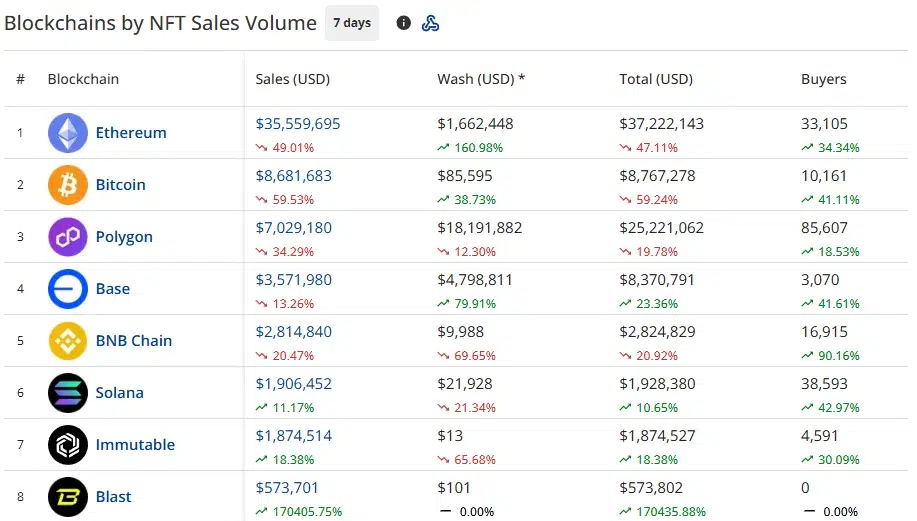
- Ethereum led with $35.56 million in sales despite recording a 49.01% weekly decline.
- Bitcoin placed second with $8.68 million as sales fell 59.53% and buyers rose 41.11%.
- Courtyard led collections with $6.09 million, while a Bitcoin NFT sold for $2.14 million.
According to data from CryptoSlam, captured on Aug. 29 with the seven-day filter selected, global NFT sales declined to approximately $63.33 million from about $114.5 million during the equivalent prior period.
Buyer addresses increased 30.48% to 227,316, while seller addresses jumped 54.64% to 247,373. The figures represent blockchain addresses rather than confirmed individual users.
Transactions moved in the opposite direction, falling 14.13% to 802,330. The combination of more participating addresses and fewer transactions indicates that activity was spread across a larger address base, although the data alone cannot establish whether each address represented a separate market participant.
The NFT decline occurred as the wider crypto market pulled back. Bitcoin traded near $77,600, while Ether changed hands around $2,440 on Aug. 29. The global crypto market capitalization stood at approximately $2.71 trillion, down more than 2% over 24 hours.
The NFT and cryptocurrency declines occurred during the same period, but the available data does not establish a direct causal relationship between them.
Ethereum leads NFT sales with $35.6 million
Ethereum remained the largest NFT blockchain with $35.56 million in organic sales, down 49.01% from the prior seven-day period. The network also registered $1.66 million in wash-trading volume, which CryptoSlam reports separately from organic sales.
Ethereum’s total volume, including wash trading, reached $37.22 million. Its buyer count increased 34.34% to 33,105 despite the drop in sales.
Bitcoin ranked second with $8.68 million in sales, a 59.53% decline. Wash volume totaled $85,595, bringing its combined figure to $8.77 million. Bitcoin buyer addresses rose 41.11% to 10,161.
Polygon recorded $7.03 million in organic sales, down 34.29%. However, the network also showed $18.19 million in wash volume, more than twice its organic figure. Polygon’s buyer count declined 18.53% to 85,607.
Base placed fourth with $3.57 million in sales, down 13.26%, while its buyers increased 41.61% to 3,070. The network recorded $4.80 million in wash trading, lifting combined volume to $8.37 million.
BNB Chain followed with $2.81 million, down 20.47%, even as buyer addresses rose 90.16% to 16,915. Solana was the strongest performer among the six leading networks, with sales increasing 11.17% to $1.91 million and buyers rising 42.97% to 38,593.
The six networks accounted for approximately $59.56 million, or 94% of global organic NFT sales. Immutable added $1.87 million after an 18.38% increase.
Courtyard tops weekly NFT collection sales
Polygon-based Courtyard remained the leading collection with $6.09 million in sales, although its total fell by 37.55%. The collection generated 98,531 transactions, down 55.66%, from 17,969 buyer and 11,755 seller addresses.
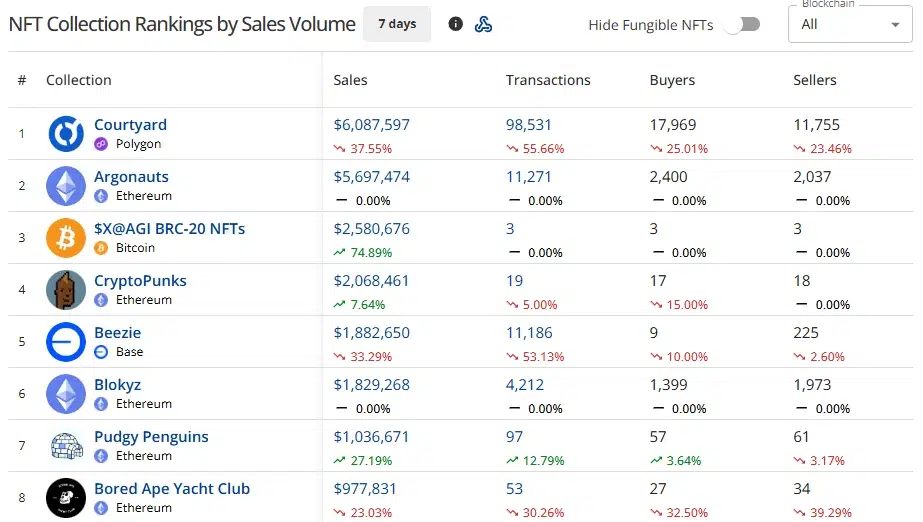
Ethereum-based Argonauts ranked second with $5.70 million across 11,271 transactions. CryptoSlam showed no prior-period percentage change for the collection, suggesting the comparison data was unavailable or unchanged in the captured dashboard.
Bitcoin’s $X@AGI BRC-20 NFTs placed third with $2.58 million, up 74.89%. Only three transactions, three buyers, and three sellers produced the entire total, making its volume highly concentrated rather than representative of broad collectible trading.
CryptoPunks followed with $2.07 million, up 7.64%. The collection recorded 19 sales involving 17 buyer and 18 seller addresses.
Base-based Beezie generated $1.88 million, down 33.29%, from 11,186 transactions. Only nine buyer addresses participated, compared with 225 seller addresses.
Blokyz ranked sixth with $1.83 million from 4,212 transactions, while Pudgy Penguins placed seventh. Pudgy Penguins sales rose 27.19% to $1.04 million as transactions increased 12.79% to 97.
Bored Ape Yacht Club followed with $977,831 in sales, down 23.03%, alongside 53 transactions and 27 buyer addresses.
Bitcoin NFTs lead high-value NFT sales
A $X@AGI BRC-20 NFT produced the week’s largest individual sale at $2.14 million, settling for 27.1798 BTC about two days before the snapshot. CryptoSlam classified the transaction as an NFT sale, but the dashboard does not provide enough transaction-level information to determine its underlying economic purpose.
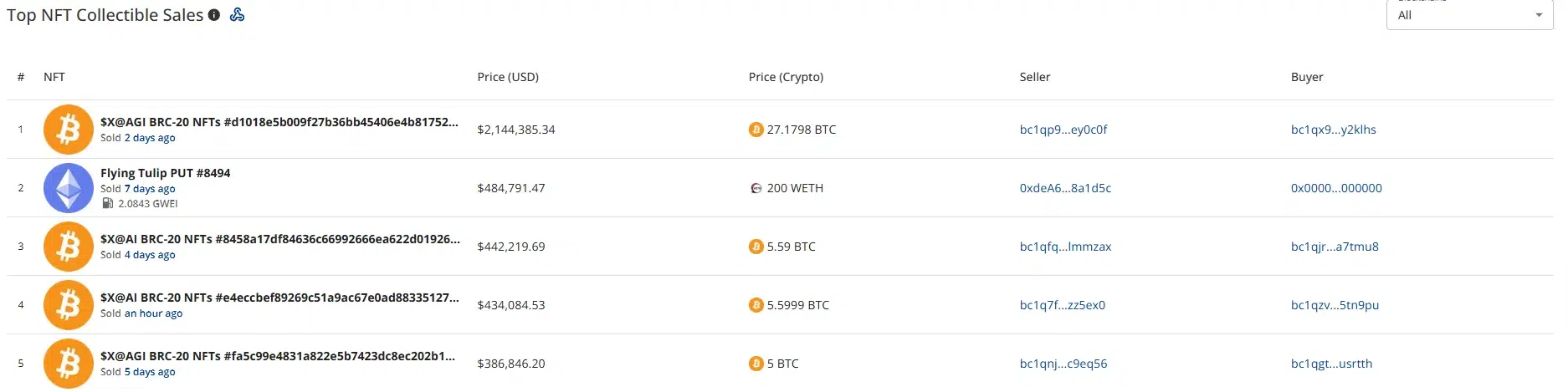
The sale represented approximately 83% of the collection’s $2.58 million weekly volume and 3.4% of global NFT sales. Such concentration means the collection’s weekly increase largely reflected one transaction.
Flying Tulip PUT #8494 ranked second at $484,791, settled for 200 wrapped Ether seven days earlier. Flying Tulip’s official materials describe its putNFTs as ERC-721 tokens encoding perpetual put positions and redemption rights. The transaction therefore involved a tokenized financial position rather than an ordinary profile-picture or digital-art collectible.
Another $X@AGI BRC-20 NFT ranked third after selling for $442,220, or 5.59 BTC, approximately four days earlier.
A separate NFT from the same collection changed hands for $434,085, settled in 5.5999 BTC, around one hour before the screenshot was captured.
The collection also produced the fifth-largest sale, valued at $386,846 and settled for 5 BTC five days earlier. Four of the five largest transactions came from $X@AGI BRC-20 NFTs, showing that a small number of high-value Bitcoin trades shaped the week’s top-sales table.
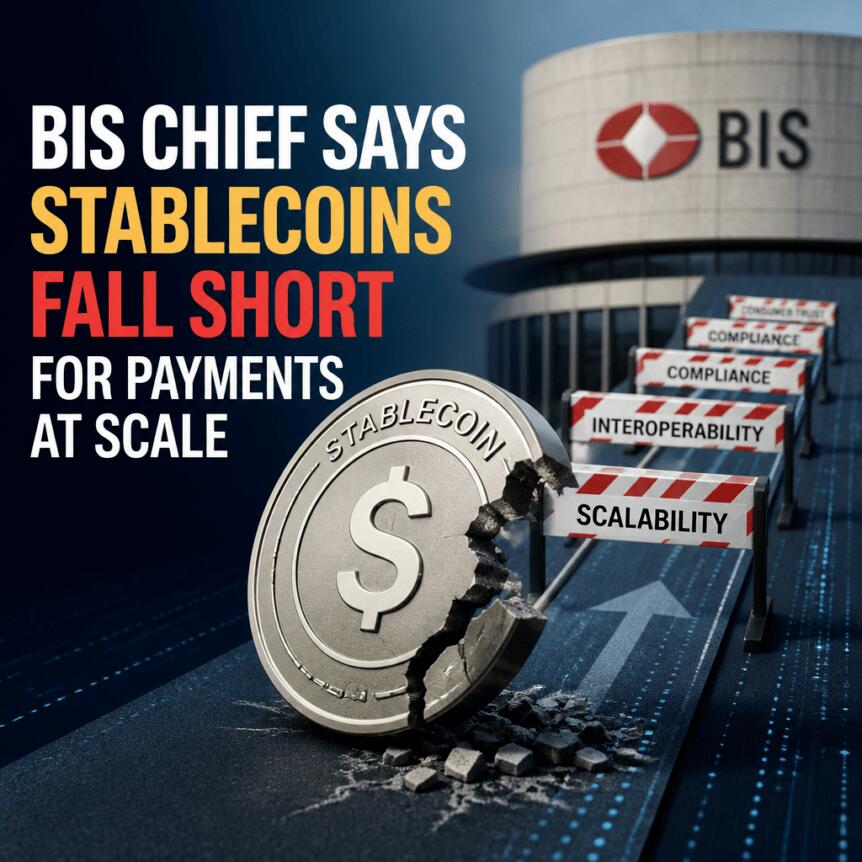
The Bank for International Settlements (BIS) has renewed its scepticism toward stablecoins, arguing that they have not proven credible as everyday payment instruments at scale—even as governments push forward with regulatory regimes for tokenised cash.
In comments reported by Reuters, BIS General Manager Pablo Hernández de Cos said stablecoins struggle to function reliably as a means of payment. He contrasted them with tokenised bank deposits, which he described as a more direct way to bring tokenisation into finance while preserving the core foundations of the monetary system. Hernández de Cos, who is also a candidate to succeed European Central Bank President Christine Lagarde next year, tied the debate to how regulators should weigh innovation against financial stability and monetary policy control.
Key takeaways
- The BIS argues stablecoins are not credible for everyday payments at scale, while tokenised deposits are viewed as a more workable alternative.
- Hernández de Cos acknowledged potential benefits such as lower government borrowing costs, but warned of possible knock-on effects for bank funding and consumer borrowing rates.
- BIS/FSI research highlights major differences across the US, EU, UK, Hong Kong, and Singapore in who can issue stablecoins and what activities are permitted.
- Regulatory limits often apply to the issuing entity itself, not the broader corporate group—creating potential structural workarounds.
Why the BIS says stablecoins fall short as “money in practice”
Hernández de Cos’ central critique focuses on usability and reliability. He said stablecoins do not credibly operate as a large-scale payment channel. Instead, he argued that tokenised deposits could better achieve the goal of harnessing tokenisation while maintaining the monetary system’s institutional backbone.
The BIS position comes at a time when stablecoins are increasingly moving from pilot use cases toward broader market adoption. That shift has forced regulators to confront questions that go beyond technology: Are stablecoins effectively “money” for day-to-day transactions? Do they improve settlement efficiency without eroding oversight? And how should authorities prevent misuse while still allowing legitimate payments innovation?
Lower borrowing costs—who pays the trade-off?
While criticising stablecoins as payments instruments, Hernández de Cos did not dismiss the economic arguments in favour of them. He specifically referenced the idea—also raised publicly by US Treasury Secretary Scott Bessent—that stablecoins could help reduce government borrowing costs.
However, the BIS general manager suggested the effect could be uneven across the financial system and potentially come with consumer consequences. If customers shift bank deposits into stablecoins, banks may face higher funding costs. According to Hernández de Cos, those costs could then be reflected through higher borrowing rates for households and businesses.
That framing matters for investors and users because it highlights an often-overlooked point: stablecoin growth may not just redistribute benefits. It can also alter funding structures within banking, potentially changing how credit is priced and transmitted through the economy.
Regulatory friction: interoperability and anti-money laundering controls
Beyond payments effectiveness, Hernández de Cos pointed to operational and compliance challenges. He cited limited interoperability between stablecoin platforms, arguing that cross-platform connectivity remains insufficient for smooth, consistent use. He also flagged difficulties in consistently applying anti-money laundering (AML) controls—an issue that becomes more sensitive as stablecoins circulate beyond domestic markets.
He further warned that increased use of US dollar-pegged stablecoins outside the United States could undermine monetary sovereignty and weaken the effectiveness of domestic monetary policy. In other words, even if stablecoins are designed to track a fiat unit, their broader circulation can still create policy spillovers and complicate how authorities manage liquidity and credit conditions.
BIS-linked research finds uneven stablecoin rules worldwide
The BIS critique is accompanied by findings from a new study released by the Financial Stability Institute (FSI), a BIS-linked body. In a publication released Thursday, FSI compared stablecoin regulatory frameworks across the United States, European Union, United Kingdom, Hong Kong, and Singapore, focusing on who is permitted to issue stablecoins and what other activities those issuers may conduct.
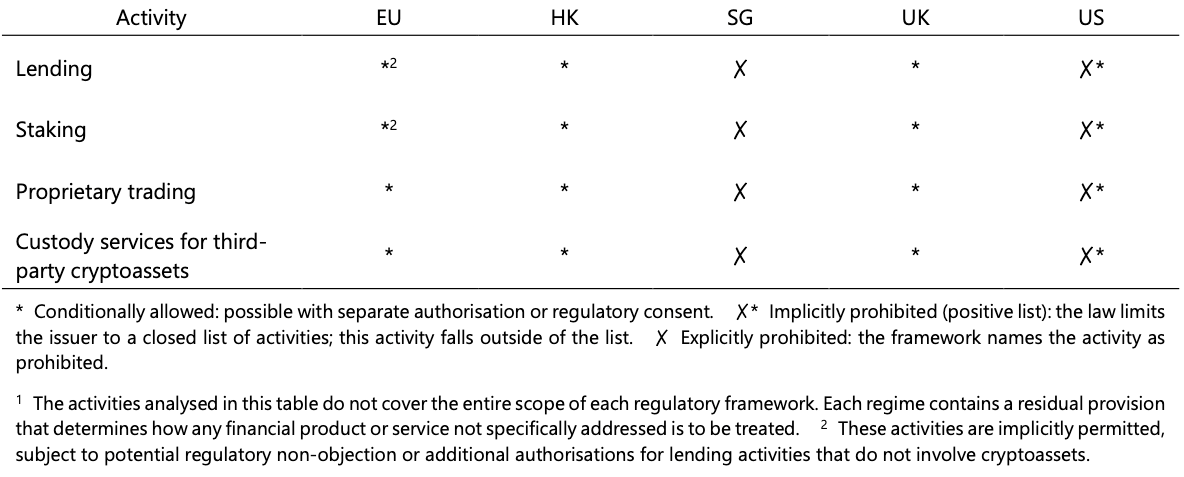
According to the study, these jurisdictions differ substantially. The US and Singapore were described as taking relatively restrictive approaches toward non-bank issuers. Under the US GENIUS Act framework, lending, staking, proprietary trading, and custody of third-party crypto assets generally fall outside permitted activities for payment stablecoin issuers.
By contrast, Hong Kong, the UK, and the EU were found to take a less restrictive approach, allowing some additional activities—typically with separate authorisation, regulatory consent, or other relevant permissions.
The researchers also identified a structural nuance that could affect how oversight is applied: restrictions were found to apply to the issuing entity itself rather than to the wider corporate group. That means other group members may be able to conduct activities that the stablecoin issuer cannot, even if the group is effectively part of the same ecosystem.
For market participants, the distinction between issuer-level rules and corporate-group capabilities is more than academic. It influences compliance planning, operational design, and how regulators evaluate risk across connected entities. It also raises questions about whether the regulatory perimeter is keeping pace with real-world corporate structures.
What comes next for stablecoin policy
As the debate continues, regulators and firms will be watching whether tokenised deposits gain clearer momentum as a preferred “tokenisation with guardrails” pathway, and whether jurisdictions converge on issuer rules that are consistent enough to prevent regulatory gaps across corporate groups and platforms.

Changpeng “CZ” Zhao made headlines earlier this week after stating Bitcoin (BTC) will reach $1 million, and that the climb will not take 25 years.
“I think for Bitcoin to hit $1,000,000 would be a good thing. And it’ll happen,” the former Binance CEO said on the conference’s Nakamoto Stage, in a video clip posted by Bitcoin Magazine, which is owned by conference organizer BTC Inc.
“I don’t think we need 25 years. I think it’s gonna happen much quicker.”
Bitcoin Overtaking Gold?
Zhao spoke during “The Bitcoin Century,” a session moderated by When Shift Happens host Kevin Follonier on the opening day of the two-day event at the Hong Kong Convention and Exhibition Center.
“For sure, I think Bitcoin will become more important than gold. It will take some time, but it will happen.”
He put gold’s market capitalization at about ten times Bitcoin’s and said sovereign reserve allocations will eventually tilt toward digital assets, with Bitcoin making up more than 50% of strategic crypto holdings alongside Ethereum (ETH) and BNB.
CZ SAYS: “I THINK #BITCOIN WILL TAKE OVER GOLD PRETTY SOON”

“For sure, I think Bitcoin will become more important than gold.”

“It will take some time, but it will happen.”

THE BULL RUN IS BACK!
pic.twitter.com/lqsZUnF0Fv
— The Bitcoin Conference (@TheBitcoinConf) August 27, 2026

Rally Runs Into an $83,000 Test
Bitcoin closed below $65,000 on August 18 and $79,000 on August 28, per Coin Metrics data, still well below its October 2025 peak of over $126,000. But CryptoQuant said in an August 25 report that Bitcoin may be entering a new bull-market phase, with its Bull Score index climbing to 80 from 30, and put confirmation at a daily close above the 365-day moving average near $83,000.
South China Morning Post reported that the remarks drew applause and cheers from a large crowd, against what it described as a lingering crypto slump with capital and talent moving toward artificial intelligence.
Zhao also called the UAE’s crypto rules “the most progressive” and said Hong Kong was “moving pretty quickly.” He claimed “a tiny bit of advocacy” in the UAE’s recognition of Bitcoin as a store of value.
Zhao pleaded guilty to a US anti-money-laundering charge in 2023, served a four-month sentence in 2024, and received a presidential pardon from Donald Trump in October 2025. He returned to the US in February for a Mar-a-Lago crypto event hosted by Trump-family-backed World Liberty Financial.
The post Changpeng Zhao Believes Bitcoin at $1M Is Coming ‘Much Quicker’ Than 25 Years appeared first on CryptoPotato.
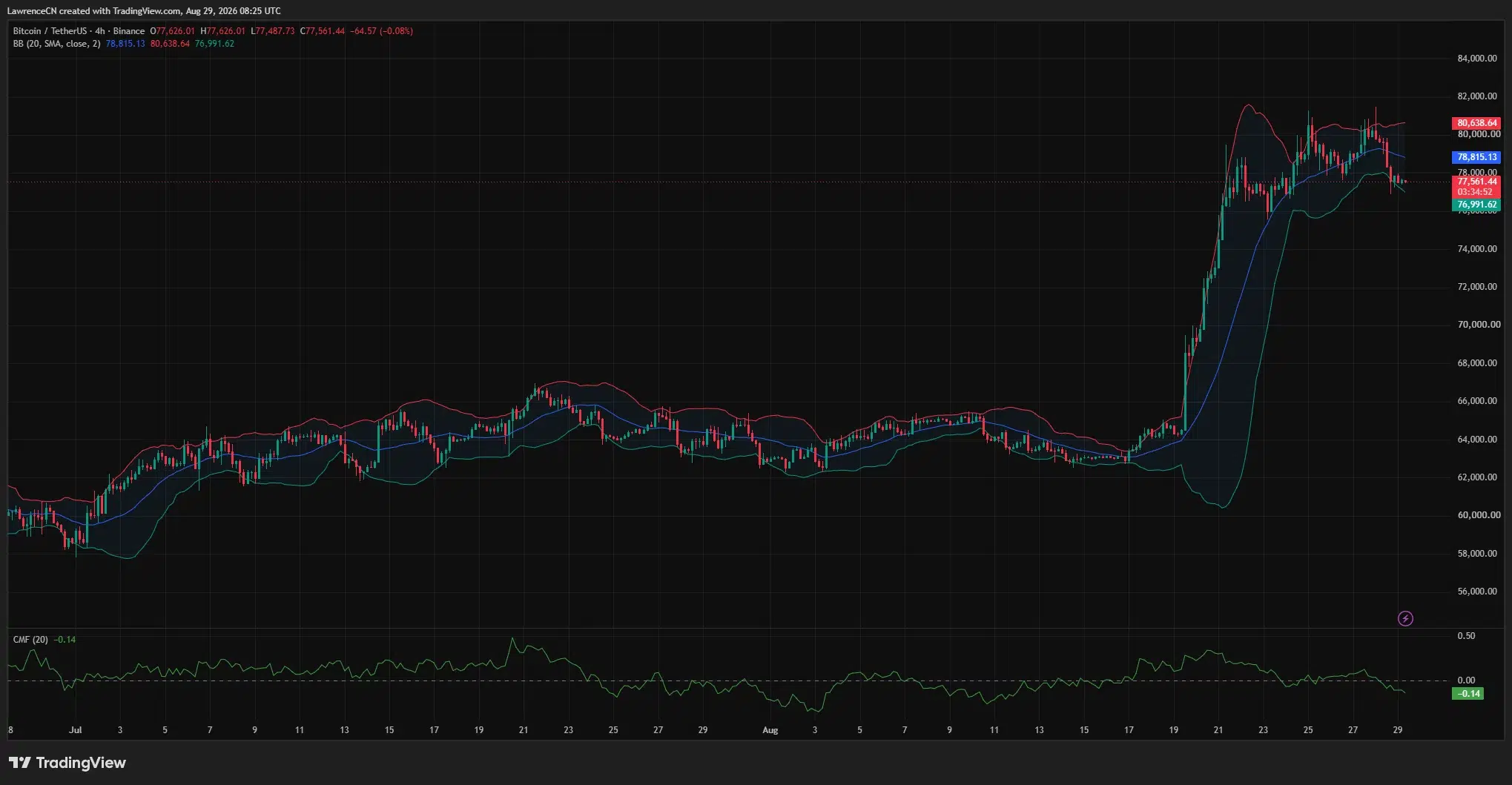
Bitcoin traded near $77,500 on Aug. 29 after US spot Bitcoin ETFs snapped a nine-session inflow streak, while weakening capital flows and short-term technical signals kept the $76,500–$77,000 support zone in focus.
Summary
- US spot Bitcoin ETFs recorded $201.9 million in net outflows on Aug. 28.
- Bitcoin fell 2.9% in 24 hours but continued to hold support near $77,000.
- 4-hour CMF dropped to -0.14 as BTC moved below its Bollinger Band midpoint.
- Analysts see $72,000–$74,500 as the next buying area if current support fails.
Bitcoin price holds above $77,000 support
According to data from crypto.news, Bitcoin (BTC) was trading around $77,500 at the time of writing, down 2.9% over the previous 24 hours. The price briefly fell to $77,078 on Aug. 28 before stabilizing above $77,000.
The pullback followed a failed attempt to hold above $80,000. Bitcoin reached an intraday high near $81,200 earlier in the week but faced selling pressure as traders reacted to Federal Reserve Chair Kevin Warsh’s speech at Jackson Hole.
On the 4-hour chart, BTC has moved below the Bollinger Band midpoint at $78,815. The upper band sits at $80,639, while the lower band has climbed to $76,992.
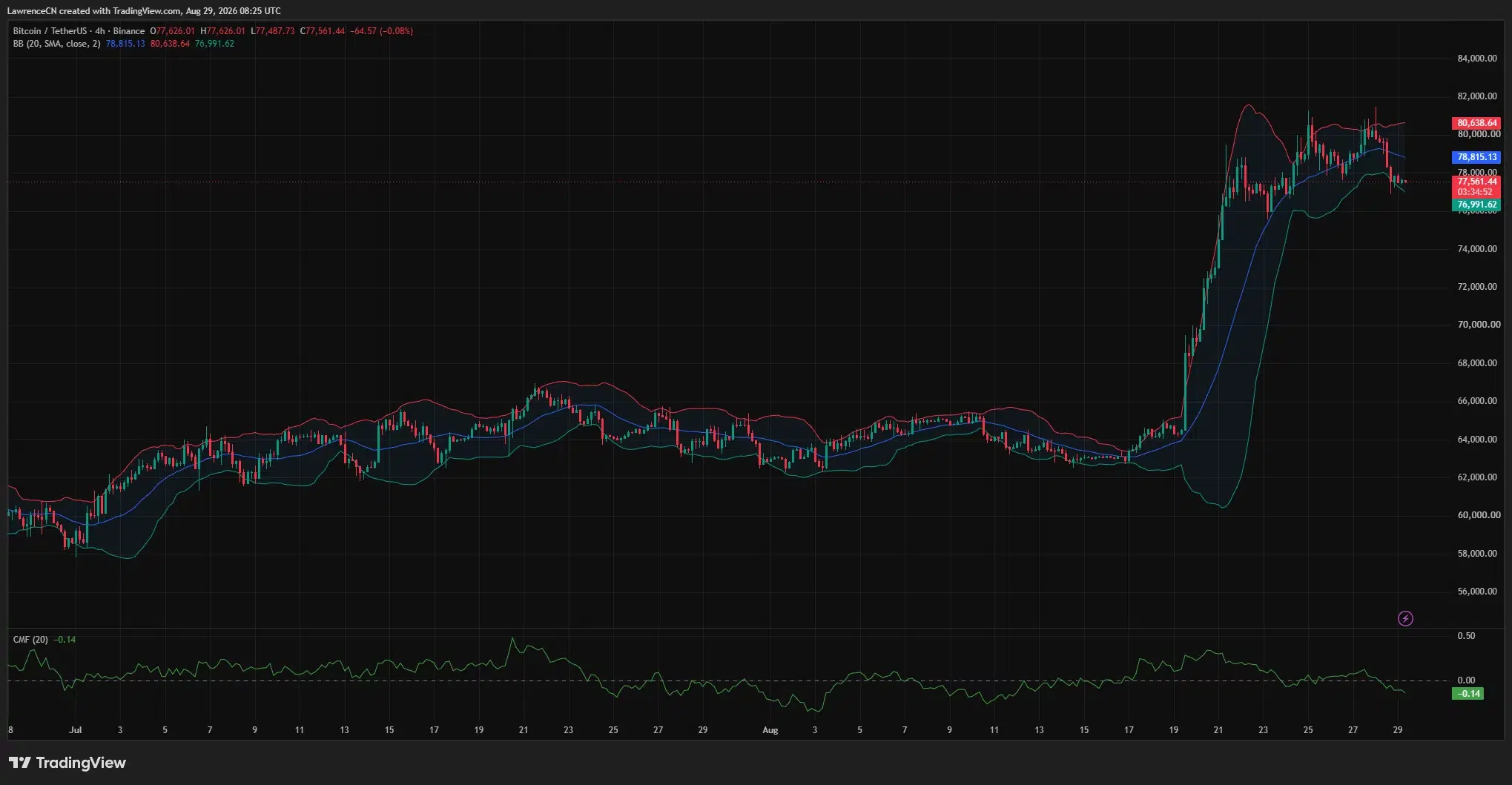
The lower band now overlaps with the immediate support zone between $76,500 and $77,000. Holding that area would leave room for another attempt to reclaim $78,000, while a 4-hour close below it could extend the correction.
Bitcoin’s Chaikin Money Flow reading has fallen to -0.14. The move below zero shows that selling pressure has outweighed buying pressure during the latest decline.
Bitcoin ETF inflows reverse after nine sessions
According to Farside Investors, US spot Bitcoin ETFs posted $201.9 million in net withdrawals on Aug. 28. The result ended nine consecutive trading sessions of positive flows.
ARK 21Shares’ ARKB led the outflows with $114.9 million, followed by Bitwise’s BITB with $49.7 million. BlackRock’s IBIT lost $33.4 million, while VanEck’s HODL recorded $13.2 million in withdrawals.
Morgan Stanley’s MSBT partly offset those redemptions with a $9.3 million inflow. The other listed funds recorded no net movement.
The change represented a $444.2 million day-over-day swing from the $242.3 million inflow recorded on Aug. 27. However, the ETF group still attracted a combined $924.5 million during the Aug. 24–28 trading week.
The weekly total means that one negative session does not establish a longer institutional exit. Continued outflows during the next US trading sessions would provide stronger evidence that demand has weakened after Bitcoin’s sharp August rally.
Warsh speech adds pressure to risk assets
The ETF reversal came after Warsh said inflation remained above the Federal Reserve’s target and described broad financial conditions as difficult to call restrictive.
In his Aug. 28 Jackson Hole speech, Warsh said the Fed’s preferred inflation measure was running at 3.7% over 12 months and 4.1% over six months. Both figures remain above the central bank’s 2% target.
“The Fed’s predominant focus right now should be on prices,” Warsh said.
Warsh added that the central bank must be confident that underlying inflation is returning to its target “clearly and at sufficient speed.” His comments did not commit the Fed to a rate increase, but they reduced expectations for easier monetary policy in the near term.
The policy outlook matters for US Bitcoin investors because higher rates can raise the return available on cash and government debt. Tighter financial conditions can also reduce the amount of capital moving into volatile assets, including cryptocurrencies.
Bitcoin indicators remain bullish on the daily chart
Bitcoin’s broader daily structure remains stronger than its short-term setup. The daily moving average convergence divergence indicator remains positive, with the MACD line at 3,950.79 and the signal line at 3,256.24.
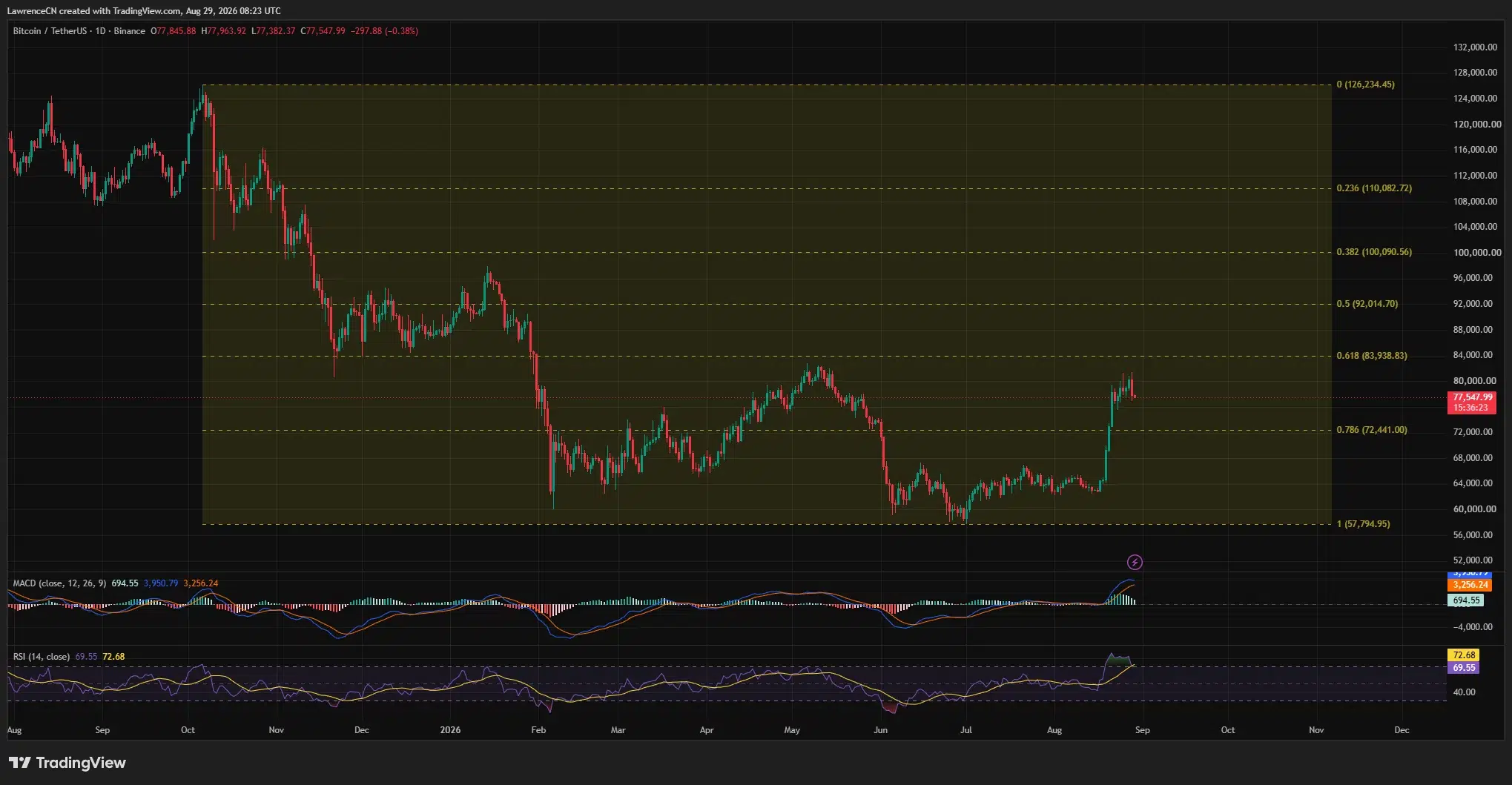
The histogram remains above zero at 694.55, showing that the August rally has not produced a confirmed daily bearish crossover. However, the declining histogram bars show that upward momentum is slowing.
The daily relative strength index stands at 69.55, just below the overbought threshold of 70. Its RSI-based moving average is higher at 72.68. The retreat from overbought territory supports the possibility of further consolidation before another sustained advance.
A Fibonacci retracement drawn between $126,234 and $57,795 places the 78.6% level at $72,441. Bitcoin remains above that long-term level but below the next major retracement resistance at $83,939.
The chart therefore leaves BTC inside a broad $72,441–$83,939 range. A daily move above $83,939 would strengthen the recovery structure, while a break below $72,441 would weaken the bullish setup.
BTC liquidity builds on both sides of price
The 24-hour CoinGlass liquidation heatmap shows concentrated liquidity above Bitcoin near $78,500–$79,000 and around $80,300–$80,500. Those areas may act as short-term price targets if buyers reclaim control.
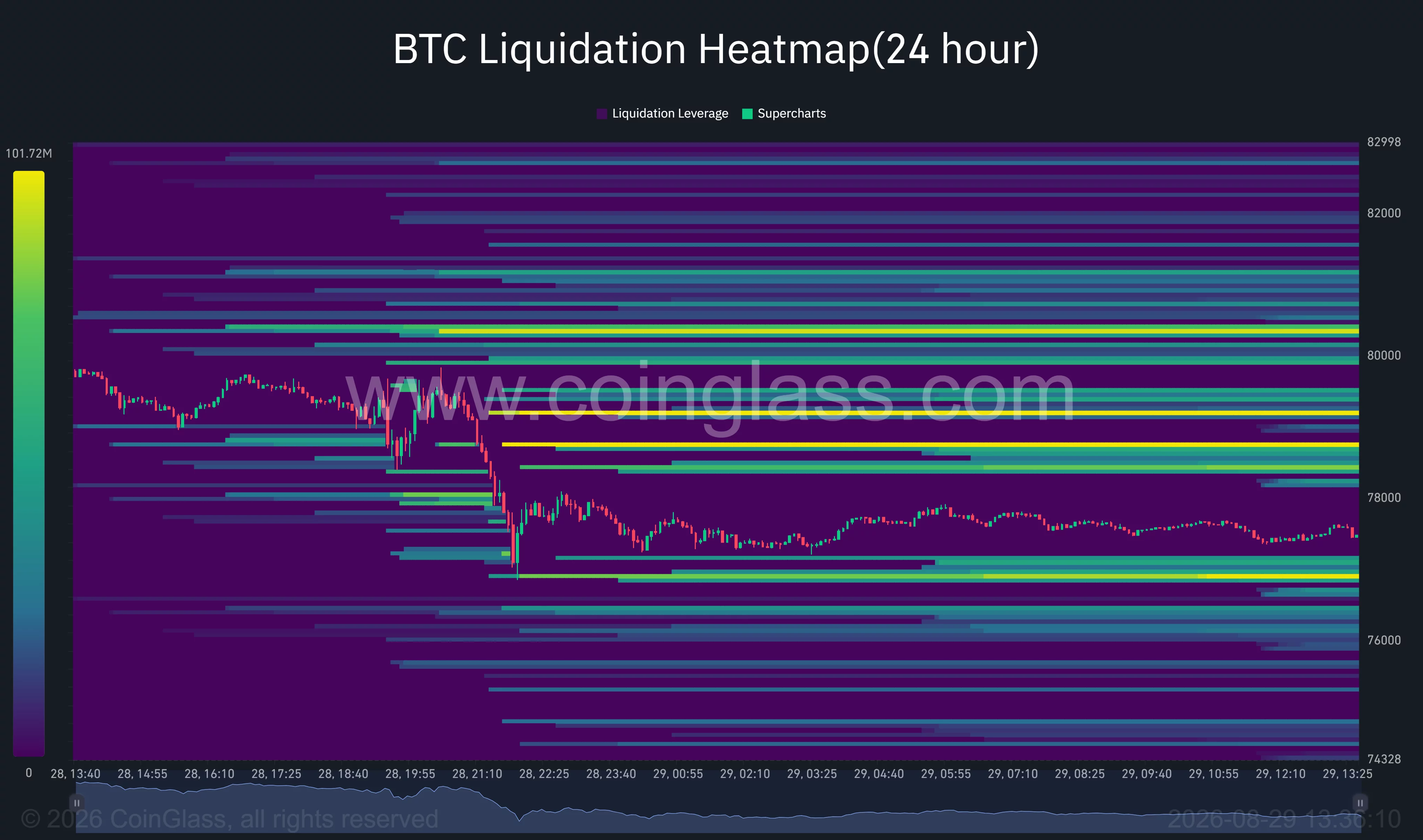
A smaller but visible cluster sits below the market around $76,700–$77,000. A move through that liquidity could place the lower technical supports under pressure.
Analyst Sheldon Diedericks said he was looking for a deeper pullback while Bitcoin remained below $84,000. His chart identified a potential buying zone between approximately $73,000 and $74,500 before a recovery attempt.
Trader Eliz offered a similar downside map, saying Bitcoin could recover if the lower range holds. According to the analyst, a break below $75,000–$76,000 could open the way toward $71,000–$72,000, where stronger buying could emerge.
Bitcoin must first reclaim $77,800–$78,000 to reduce the immediate downside pressure. The next resistance sits around $78,800, followed by $79,200–$80,000. A sustained move above $80,000 would weaken the current bearish structure and expose the liquidity near $80,500.
Failure to defend $76,500 would instead place $75,700–$76,000 in view. Below that range, the analyst targets and daily Fibonacci structure converge around $72,000–$74,500, making it the main downside area to watch.
Disclosure: This article does not represent investment advice. The content and materials featured on this page are for educational purposes only.
The Bank for International Settlements is renewing its criticism of stablecoins, questioning their credibility as everyday money as governments worldwide build regulatory frameworks around the tokens.
BIS General Manager Pablo Hernández de Cos, a candidate to succeed European Central Bank President Christine Lagarde next year, argued that stablecoins do not credibly function as a means of payment at scale. He said tokenized bank deposits offer a stronger alternative, Reuters reported on Friday.
“Tokenised deposits offer a more direct path to harness tokenisation while preserving the monetary system’s foundations,” de Cos said.
The comments come as regulators worldwide grapple with stablecoin adoption, while a new study from the BIS-linked Financial Stability Institute (FSI) shows significant differences in how major markets regulate stablecoin issuers.
Stablecoins could lower government borrowing costs
Hernández de Cos acknowledged that stablecoins could lower government borrowing costs, an argument also made by US Treasury Secretary Scott Bessent.
But the effect could cut both ways for consumers. If customers move bank deposits into stablecoins, banks could face higher funding costs and pass those expenses on to households and businesses through higher borrowing rates, Hernández de Cos said.
Related: Visa works with Upbit parent on stablecoin payments, AI commerce
He also pointed to limited interoperability between stablecoin platforms and difficulties consistently applying anti-money laundering controls. Growing use of US dollar-pegged stablecoins outside the US could also undermine monetary sovereignty and weaken domestic monetary policy, he said.
Stablecoin issuers face different rules worldwide
The FSI study, published on Thursday, compared stablecoin regulations in the US, European Union, United Kingdom, Hong Kong and Singapore, finding substantial differences in which entities may issue stablecoins and what other business activities they can conduct.
The US and Singapore take relatively restrictive approaches toward non-bank issuers. Under the US GENIUS Act, lending, staking, proprietary trading and custody of third-party crypto assets generally fall outside the activities permitted for payment stablecoin issuers.
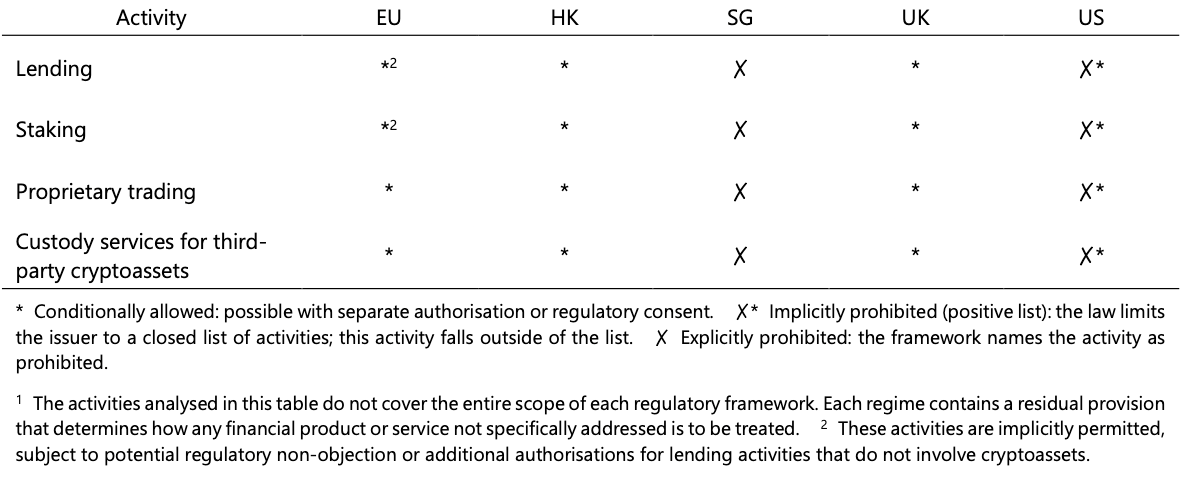
Stablecoin issuer rules across major markets. Source: BIS
Hong Kong, the UK and EU take a less restrictive approach, allowing some additional activities with separate authorization, regulatory consent or other applicable permissions.
The researchers also found that restrictions across all five jurisdictions apply to the issuing entity rather than the wider corporate group, meaning other group members can conduct activities that the stablecoin issuer itself cannot.
Magazine: Korean bank taps Ripple for payments, Pakistan opens crypto licensing: Asia Express
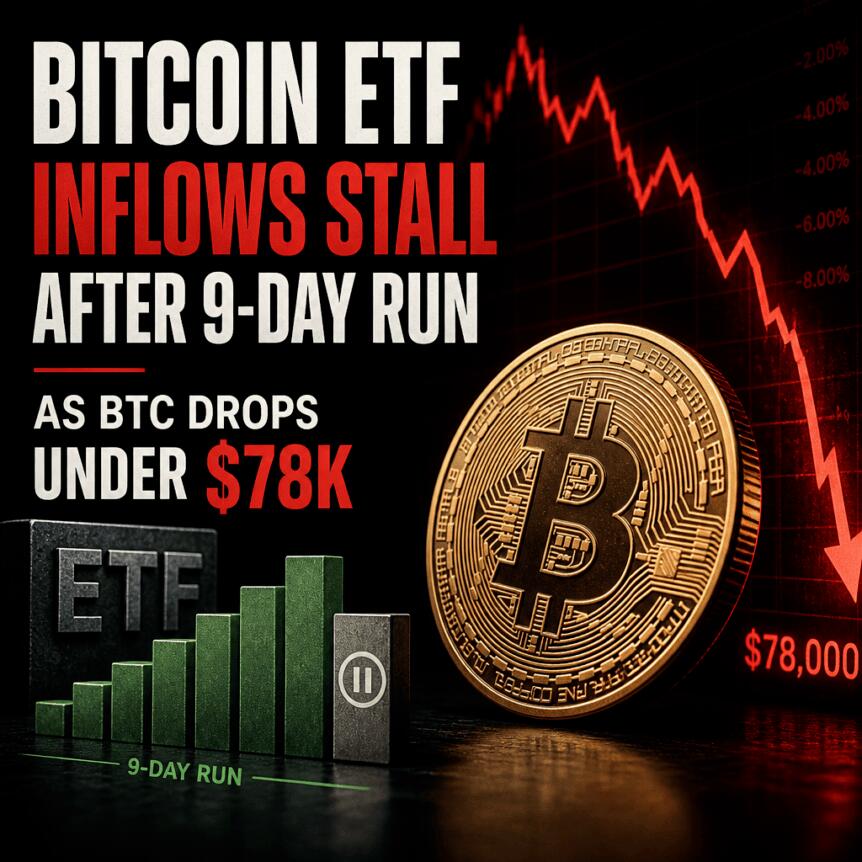
US-listed spot Bitcoin exchange-traded funds (ETFs) snapped a nine-day streak of net inflows as Bitcoin slipped back below the $78,000 level. The pause in demand comes amid an otherwise strong August for the category, with total inflows over the month still positive into the final days of the period.
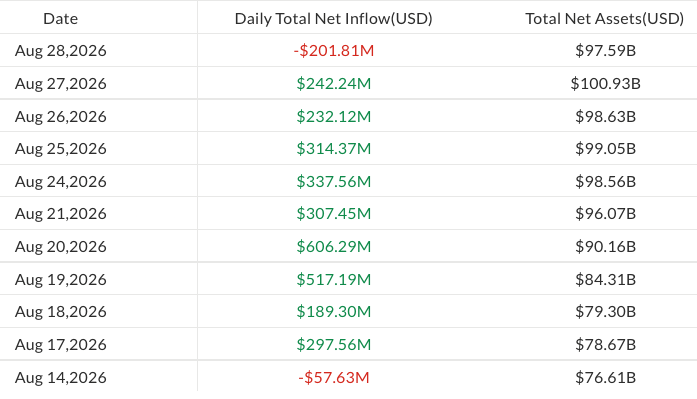
SoSoValue data shows US spot Bitcoin ETFs logged $201.8 million in net outflows on Friday, ending a run that had brought more than $3 billion in net inflows over nine consecutive trading sessions. August net flows remained positive at $3.3 billion with one US trading day left, while total net assets slipped to $97.6 billion after reaching above $100 billion on Thursday.
Key takeaways
- Friday marked a shift to $201.8 million of net outflows for US spot Bitcoin ETFs, ending a nine-day inflow streak.
- SoSoValue reported that the pullback followed more than $3 billion in net inflows over the prior nine sessions.
- Ether and XRP spot ETF categories continued to add assets on Friday, receiving net inflows of $102.2 million and $26.2 million, respectively.
- Solana ETFs sustained positive momentum and reached major milestones in cumulative flows, according to Bloomberg ETF analyst Eric Balchunas.
- ARK 21Shares led the day’s Bitcoin outflows, while most other funds were either negative or only mildly positive.
Bitcoin ETF outflows resume after a strong run
Bitcoin-related ETF demand eased on Friday even as the broader picture for August remained constructive. The shift is best understood as a “cooling” rather than a full reversal: the category’s net inflow streak ended, but the aggregate month-to-date figure still stands in positive territory.
According to Farside Investors, ARK 21Shares’ spot Bitcoin ETF (ARKB) recorded the largest withdrawals of the day, with $114.9 million in net outflows. Bitwise’s Bitcoin ETF (BITB) followed with $49.7 million in net outflows. BlackRock’s iShares Bitcoin Trust ETF (IBIT)—the largest US spot Bitcoin ETF by assets—also saw outflows, totaling $33.4 million on Friday.
Among the lineup, Morgan Stanley’s Bitcoin Trust (MSBT) was the exception, adding $9.3 million in net inflows. That means while the day’s overall flow picture turned negative, capital was not uniformly leaving every product—some funds still attracted incremental demand.
Altcoin ETF demand holds: Ether and XRP keep flowing
What stands out in Friday’s broader ETF flow data is the divergence between Bitcoin and parts of the altcoin complex. Ether and XRP ETFs continued to receive net inflows despite the reversal in Bitcoin.
SoSoValue reported that US spot Ether ETFs added $102.2 million in net inflows on Friday. Ether funds had last recorded net outflows on Aug. 11, highlighting that Friday’s gains appear to extend a recovery or at least a stable demand pattern.
For XRP, SoSoValue data showed $26.2 million in net inflows on Friday. The XRP funds last saw net outflows on Aug. 5, suggesting that this category has also been able to hold up through periods when Bitcoin ETF flows have weakened.
This separation matters for investors because it suggests that not all “risk-on” or “risk-off” behavior is being expressed through Bitcoin ETFs alone. If inflows into Ether and XRP persist while Bitcoin ETFs experience intermittent pullbacks, it can indicate more selective positioning across major digital asset categories rather than a blanket rotation away from crypto.
Solana ETFs hit new milestones amid sustained momentum
Solana ETFs also remained resilient. Bloomberg ETF analyst Eric Balchunas said Friday that the Solana ETF category has accumulated $1.7 billion in cumulative flows without a sustained stretch of outflows. He described the broader backdrop as a difficult first half for crypto, referring to it as a “nightmare downturn,” but still characterized the Solana ETF performance as “impressive.”
Balchunas also noted that Bitwise’s Solana ETF became the first in the category to cross the $1 billion mark, underscoring how the product lineup is beginning to show clearer scale differences. While the report did not specify the exact date of the milestone within the message, it ties the achievement to the ongoing flow momentum across the category.
Taken together, the Solana and multi-asset flow pattern suggests that investors may be distributing exposure across several single-asset ETF themes rather than concentrating only on Bitcoin—at least during this particular stretch of market activity.
What to watch next
Friday’s data shows how quickly Bitcoin ETF inflows can turn when price action softens, even if broader monthly totals remain positive. Traders and long-term ETF investors will likely focus on whether outflows persist over the next sessions or if the category quickly re-establishes net inflow momentum, while also keeping an eye on whether Ether, XRP, and Solana funds continue to attract assets alongside—or independently of—Bitcoin.


Crypto and blockchain companies disclosed $184.1 million across eight funding rounds between Aug. 22 and Aug. 28, led by RQD* Clearing’s $74 million growth investment.
Summary
- Eight crypto and blockchain projects disclosed a combined $184.1 million in new financing.
- RQD* Clearing secured a $74 million minority growth investment led by Bain Capital.
- Fasset raised $68 million in Series C funding at a $1 billion valuation.
- Hivemind Digital Group completed a $17 million strategic round led by M&G Investments.
- Infrastructure, stablecoin banking, and onchain trading attracted most of the disclosed capital.
Stablecoin neobank Fasset followed with a $68 million Series C that valued the company at $1 billion.
Hivemind Digital Group and Entropy completed the next-largest raises, while five of the eight disclosed deals involved crypto market infrastructure, onchain finance, or tokenized assets.
Funding data came from DropsTab, CryptoRank, Crypto Fundraising, and official announcements issued during the reporting period. The weekly total excludes undisclosed rounds, valuations, cumulative funding figures, acquisitions, and capital announced outside the seven-day window.
RQD* Clearing secures $74 million growth investment
New York-based RQD* Clearing secured a $74 million minority growth investment led by Bain Capital Tech Opportunities. ABN AMRO Clearing Bank and Nyca Partners also participated.
RQD* provides clearing, custody, and technology services to broker-dealers, registered investment advisers, and foreign financial institutions seeking access to US markets. The company said the capital would support product development and expansion in the United States, Europe, and Asia.
The firm also plans to build infrastructure for digital assets and tokenized securities. RQD* said it wants to help financial institutions custody blockchain-based assets and connect them with established clearing systems.
The transaction was the week’s largest disclosed financing and accounted for about 40% of the $184.1 million total. RQD* described the deal as a minority growth investment rather than a conventional venture round.
Fasset reaches $1 billion valuation with $68 million Series C
Stablecoin banking platform Fasset raised $68 million in a Series C led by Japan’s SBI Group. The deal valued Fasset at $1 billion and followed a $51 million Series B completed in May.
The two rounds brought Fasset’s disclosed 2026 funding to $119 million. Speedinvest, an investor in the previous round, also participated in the Series C.
Fasset offers stablecoin payments, tokenized assets, and digital banking services across 125 countries. The company said it would use the capital to expand its payment network, develop its AI-based financial tools, and support a planned digital bank in Malaysia with SBI.
The company announced the deal from Los Angeles, giving the week’s second-largest round a direct US connection. Its broader expansion plans, however, remain focused on emerging markets and cross-border payments.
Hivemind raises $17 million for tokenization platform
New York- and London-based Hivemind Digital Group completed a $17 million strategic funding round led by M&G Investments.
CPIC Investment Management Hong Kong, ZA Bank, FalconX, Sonic Boom Ventures, and other investors participated. Hivemind is the parent company of digital asset investment manager Hivemind Capital.
The group said the financing would support its tokenization infrastructure, institutional partnerships, and investments across digital assets and other technology sectors. Hivemind also plans to expand the systems it uses to issue, manage, and distribute tokenized financial products.
The round added to the week’s institutional funding trend, with established investment and financial companies backing businesses that connect traditional markets with blockchain infrastructure.
Entropy receives $14 million for Hyperliquid markets
Onchain trading platform Entropy raised $14 million in equity financing led by Ribbit Capital. The company did not disclose the round’s valuation or identify its other equity investors.
Entropy also received $40 million in HYPE staking support. The staking commitment was not fresh equity financing and is excluded from the weekly funding total.
The company builds markets through Hyperliquid’s HIP-3 system, which allows approved deployers to launch perpetual futures markets after meeting staking requirements. Entropy’s first product provides exposure to Anthropic’s private-market valuation through a perpetual contract.
The team said it is developing additional markets covering private companies, equities, commodities, and other assets. Entropy also plans to create pricing and liquidity tools for markets that lack continuous public price feeds.
Projects under $10 million
- City Protocol announced a $4 million pre-Series A involving Dragonfly, Jump Crypto, CMT Digital, Stratified Capital, Adaverse, and Mirana Ventures. The new capital lifted its cumulative seed and pre-Series A funding to $11 million. The project is building infrastructure for tokenized structured products, including issuance tools and onchain strategy vaults.
- Chomp raised $3.6 million in a round co-led by Jsquare and Blueyard. Accomplice, Big Brain Holdings, No Limit Holdings, Reverie, and Caballeros also participated. Chomp operates a social question-and-answer game designed to measure differences between users’ private views and their perceptions of wider public opinion.
- Oro secured $3 million in a strategic round co-led by MH Ventures and Mapleblock Capital. M2M Capital, Archer Capital, and X21 Digital joined the deal, which brought Oro’s total funding to $4 million. The platform converts plain-language instructions into multi-step, non-custodial transactions across Ethereum, Solana, and ZIGChain.
- XStable received $500,000 from YZi Labs after joining the 24-company EASY Residency Season 4 cohort. YZi Labs invested $12 million across the program.
Undisclosed strategic rounds
- FinTax completed a seed round led by EASY Residency S4, an initiative backed by YZi Labs. Amber, Hash House, Pundi AI, Waverider International, and Nexus Holdings participated. The crypto tax and treasury platform disclosed a $40 million post-money valuation but did not reveal the amount raised, so the deal is excluded from the weekly total.
- TermMax received an undisclosed strategic investment from YZi Labs after joining the third season of EASY Residency. The fixed-rate lending protocol has raised more than $8 million across all its rounds, but neither party disclosed the size of the latest investment. Earlier TermMax backers include Cumberland DRW, HashKey Capital, Decima Fund, Longling Capital, and MZ Web3 Fund.
Bitcoin’s price rally that drove it past $81,000 on a couple of occasions in the past week came to a halt after the hawkish stance by the new Fed Chair displayed yesterday, and the asset slipped to a five-day low of under $77,000.
Most altcoins followed suit, posting 3-5% daily declines. Ripple’s XRP, which recently peaked at $1.70, initiated another leg down, dropping below $1.40.
BTC Dips Below $77K
The primary cryptocurrency’s explosion that began on August 19 took it from under $65,000 to almost $80,000 in 48 hours last week, where it finally faced some resistance and slipped to $75,500 during the previous weekend. However, the bulls quickly regained control and pushed the asset north as the new business week began.
At first, BTC challenged the $80,000 level, which the bears managed to defend initially, but buyers were more persistent and drove bitcoin above it to $81,000 on Tuesday morning. It couldn’t keep climbing and retraced to $79,000 on Wednesday.
The bulls returned in full force on Thursday and Friday morning, pushing the cryptocurrency to another 15-week high of $81,500. Nevertheless, BTC was rejected once again, and the Jackson Hole speech didn’t bring any positives. Shortly after its conclusion, the hawkish stance by Warsh resulted in another leg down for bitcoin, dipping below $77,000 within an hour or so.
Although it has rebounded slightly to over that level now, bitcoin is still more than 2% down on the day. Its market cap has declined to $1.555 trillion, while its dominance over the alts remains above 57%.

Alts Back in Red
Ethereum is down by almost 3% in the past 24 hours as it was rejected at $2,500 once again and now sits at $2,430. BNB has slipped further away from the $700 level, now trading beneath $690. XRP tanked from $1.45 to $1.38 as of now, following a 3.2% daily drop.
SOL, DOGE, LINK, XLM, and HYPE have produced similar losses, while BCH has slumped by more than 7% to under $250. RAIN and XMR are among the few alts with slight gains today.
The total crypto market cap has decreased by $80 billion from yesterday’s top to $2.720 trillion on CG.

The post BTC Recovers From Sub-$77K Dip, XRP Drops Below $1.40: Weekend Watch appeared first on CryptoPotato.


In this week’s edition of the weekly recap, Bitcoin returned to $80,000 after its strongest rally in more than three years, although traders struggled to push the price through $82,000. Federal Reserve Chair Kevin Warsh later pressured risk assets with a warning that interest rates could rise, while Bitwise’s Solana staking ETF became the first SOL fund to exceed $1 billion.
Summary
- Bitcoin climbed about 24% in seven days before meeting resistance between $81,000 and $82,000.
- Warsh said higher rates remained possible unless inflation moved quickly toward the Fed’s 2% target.
- Bitwise’s Solana staking ETF became the first SOL fund to cross $1 billion in assets.
- Ethereum gained about 29% in one week as US spot ETF demand supported the rally.
- Charles Schwab plans to add SOL, AVAX, and LINK trading in the coming months.
Bitcoin returns to $80,000 after 24% weekly rally
- Bitcoin crossed $80,000 for the first time since May 15 after rising from below $64,000 on Aug. 19. The rebound extended to about 38% from its late-June low below $58,000, while US spot Bitcoin ETFs recorded approximately $1.92 billion in weekly inflows.
- Analysts told crypto.news that the initial move received support from short liquidations and US Treasury buybacks. Bitcoin later struggled to clear the $81,000–$82,000 resistance area, leaving spot demand as an important test for the rally’s durability.
Warsh signals that another rate hike remains possible
- Federal Reserve Chair Kevin Warsh put another interest-rate increase on the table during his Jackson Hole speech on Aug. 28. Warsh said the Fed would be “hard pressed” to describe financial conditions as restrictive and warned that rates could rise unless inflation returned quickly to the central bank’s 2% goal.
- The remarks followed data showing that headline personal consumption expenditures inflation reached 3.7% annually in July, while core PCE stood at 3.3%. Bitcoin briefly fell below $80,000 after the speech as traders reassessed the outlook for US monetary policy.
Bitwise Solana ETF crosses $1 billion
- The Bitwise Solana Staking ETF became the first Solana fund to exceed $1 billion in assets, according to Bloomberg ETF analyst Eric Balchunas. The wider US Solana ETF category has attracted about $1.7 billion, with limited sustained redemptions despite SOL’s decline during the first half of 2026.
- Bitwise’s US crypto products also collected approximately $100 million in net inflows on Aug. 27. Solana led the company’s daily intake, followed by its Bitcoin and Hyperliquid products.
Ethereum gains 29% as ETF demand strengthens
- Ethereum rose about 29% over seven days, outperforming Bitcoin’s 21% gain over the same measured period. ETH reached approximately $2,546 before consolidating around the $2,450–$2,500 area.
- Fundstrat’s Tom Lee said an Ethereum market rotation had begun and projected a possible move toward $10,000 within two years. US spot Ethereum ETFs attracted about $365 million in July, compared with $205 million for Bitcoin funds, while BitMine reported holdings of 5.82 million ETH.
Charles Schwab plans SOL, AVAX and LINK trading
- Charles Schwab said it will add Solana, Avalanche, and Chainlink to its crypto trading service in the coming months. The brokerage did not provide an exact launch date or say whether the three assets would become available together.
- The planned expansion would give Schwab clients direct access to the altcoins through an established US brokerage platform. The company previously introduced Bitcoin and Ethereum trading as part of a phased rollout of digital-asset services.
Solana clears $100 as network activity reaches a record
- Solana moved above $100 for the first time since February after gaining about 40% in eight days. Monthly network activity reached a record 4.2 billion transactions as trading and institutional demand increased.
- Validators also backed a proposal to accelerate the network’s falling inflation rate. The measure secured the required two-thirds support and could reduce projected issuance by approximately 18.9 million SOL over six years, while a separate resource-fee proposal failed to reach the same threshold.
CLARITY Act debate shifts to national security
- Former US Defense Secretary Mark Esper described the CLARITY Act as a national security bill ahead of a planned Senate cloture vote on Sept. 15. Esper argued that the absence of federal market-structure rules could push crypto activity and technical development outside the United States.
- Esper serves on Coinbase’s advisory council, a connection relevant to his support for the legislation. The bill seeks to divide oversight responsibilities between the SEC and CFTC, although lawmakers have yet to complete the measure.
Coinbase and Better introduce Bitcoin-backed mortgages
- Coinbase and Better launched a Bitcoin-backed home-loan product that allows eligible borrowers to use BTC as collateral for a mortgage down payment. Customers must pledge Bitcoin worth 250% of the down payment rather than selling the asset.
- The companies said Coinbase One members could receive a 1% Bitcoin rebate, capped at $10,000. Terms also allow collateral liquidation after a 60-day delinquency, exposing borrowers to both mortgage obligations and changes in Bitcoin’s market value.
SEC proposal creates a path for public token sales
- The SEC proposed a framework for public crypto token offerings as the agency continued shifting toward formal digital-asset rules. The proposal would establish exemptions and disclosure requirements for issuers seeking to sell tokens in the United States.
- Bloomberg reported that demand for traditional initial coin offerings has weakened since the 2017 boom, as projects increasingly use private funding, airdrops, and other distribution models. The proposal nevertheless marks an attempt to place token fundraising within a defined US securities framework.
Grayscale launches first US spot Zcash ETF
- Grayscale launched the first spot Zcash ETF on NYSE Arca, expanding US-listed crypto funds into privacy-focused assets. The launch followed a strong ZEC rally that took the token to its highest level since 2018.
- Zcash traded as high as approximately $885 before retreating and later recovering above $800. The fund gives US investors regulated brokerage access to ZEC exposure without requiring direct custody of the token.
Strategy pauses Bitcoin sales after disposing of 6,948 BTC
- Strategy reported no Bitcoin sales between Aug. 17 and Aug. 23 after disposing of 6,948 BTC between May and August. Bitfinex analysts said the earlier sales were small compared with daily Bitcoin volume but risked weakening the company’s identity as a permanent corporate holder.
- Strategy raised about $2.01 billion through sales of its common stock during the latest reported period and held a $5.1 billion US dollar reserve. Its remaining 840,447 BTC moved into profit as Bitcoin returned to the $80,000 area.
Lazarus-linked wallet moves $19.4 million in Bitcoin
- A wallet linked to North Korea’s Lazarus Group transferred 244.148 BTC worth approximately $19.4 million. Blockchain monitoring services identified the funds as connected to the state-backed hacking group, although the purpose of the transfer remained unclear.
- The transaction renewed attention on the group’s crypto holdings and laundering activity. Governments and blockchain investigators have previously attributed multiple exchange, bridge, and protocol attacks to Lazarus, making movements from associated wallets closely watched security events.
US-listed spot Bitcoin exchange-traded funds (ETFs) ended a nine-day inflow streak as Bitcoin fell below $78,000, while several altcoin ETF categories continued to see inflows.
Bitcoin ETFs recorded $201.8 million in net outflows on Friday, ending nine consecutive trading sessions of inflows, according to SoSoValue data.
The reversal followed more than $3 billion of net inflows during the nine-session run, while August flows remained positive at $3.3 billion with one US trading session left in the month. Total net assets fell to $97.6 billion after topping $100 billion on Thursday.
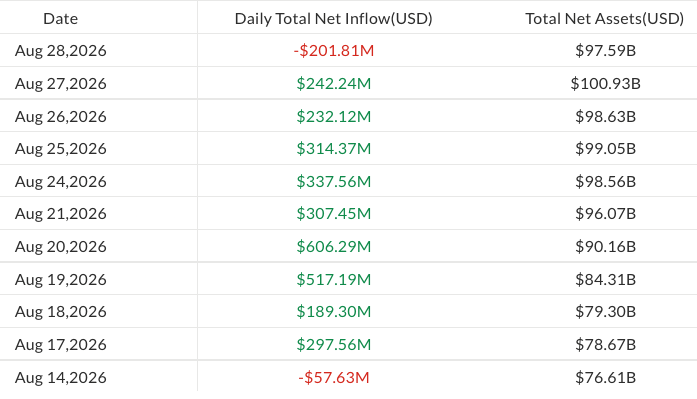
Daily flows into US spot Bitcoin ETFs since Aug. 14, in USD. Source: SoSoValue
The Bitcoin ETF reversal contrasts with continued inflows into Ether and XRP funds, while Solana ETFs have reached new asset milestones.
ARK 21Shares leads Bitcoin ETF outflows
The ARK 21Shares Bitcoin ETF (ARKB) led Friday’s withdrawals with $114.9 million in net outflows, followed by the Bitwise Bitcoin ETF (BITB) with $49.7 million, according to Farside Investors data.
BlackRock’s iShares Bitcoin Trust ETF (IBIT), the largest US spot Bitcoin ETF by assets, recorded $33.4 million in outflows.

US spot Bitcoin ETF flows on Friday. Source: Farside Investors
Morgan Stanley’s Bitcoin Trust (MSBT) was the only fund to record inflows Friday, adding $9.3 million.
Ether, XRP ETFs buck Bitcoin outflows
Ether and XRP ETFs continued to see inflows Friday despite the reversal in Bitcoin funds, adding $102.2 million and $26.2 million, respectively, according to SoSoValue data. The funds last recorded net outflows on Aug. 11 and Aug. 5, respectively.
Solana ETFs have also maintained positive momentum. Bloomberg ETF analyst Eric Balchunas said Friday that the category had attracted $1.7 billion in cumulative flows without a sustained stretch of outflows.
Related: Solana validators approve proposal to accelerate SOL disinflation
Bitwise’s Solana ETF also became the first fund in the category to cross the $1 billion mark, according to the analyst.
Balchunas called the performance “impressive” despite what he described as a “nightmare downturn” in the first half of the year.
Magazine: Bitget CEO isn’t buying the Bitcoin rally — She’s waiting for $50K

Trump Creates a Space Academy and Honors the Artemis Astronauts

Money Is Coming To Me mp3 – Free Money Music

A Russian attack hits Ukraine’s Kyiv region, killing at least 27





-

 Crypto World3 days ago
SpaceX stock could rise 75% to $240, JPMorgan says
-

 Crypto World1 day ago
Bitcoin’s 22% rally now needs real demand to outlast Treasury liquidity boost
-

 Business7 days ago
Musk’s Tesla, SpaceX Confirm $16.8 Billion ‘Terafab’ Chip Plant as World’s Largest Building in Texas
-

 Crypto World4 days ago
A $30 Billion AI Fund Implodes, Now the SEC Is Investigating Wall Street’s Role
-

 Fashion15 hours ago
Weekend Open Thread: Maeve – Corporette.com
-

 Crypto World3 days ago
Warsh Jackson Hole keynote puts financial innovation first
-

 Business1 day ago
Salesforce Stock Soars 19% as Blowout Earnings and Agentforce AI Growth Silence Software Skeptics
-

 Politics7 days ago
6 months on, Irish renters crushed by effects of government housing bill
-

 Crypto World3 days ago
Did Trump Just Move SpaceX Stock With One Truth Social Post?
-

 Business6 days ago
Mystery AI Model ‘Ox Alpha’ Draws Developers With Free Access as Chinese Lab Origins Remain Debated
-

 Business3 days ago
Walmart takes aim at younger shoppers with new fashion brand
-
 NewsBeat3 days ago
Lindsay Clancy jury braces for closing arguments as judge tells court: ‘You’ve heard all the evidence’ – Live updates
-

 Business5 days ago
Moderna CEO warns China is pouring state money into mRNA technology
-

 Business4 days ago
NVIDIA Stock Drops Nearly 2 Percent to $210 on Seventh Losing Day Ahead of Critical AI Earnings
-

 Crypto World2 days ago
Elon Musk Grok Bot Promise: We Will Make You Whole if AI Loses Your Money
-

 Crypto World2 days ago
NVIDIA revenue hits $96.2B as AI demand doubles
-

 Business17 hours ago
iPhone 18 Pro Pre-Orders Could Shift to Saturday as Apple Reportedly Avoids September 11 Anniversary
-
 Crypto World5 days ago
$92 Billion Nvidia Earnings Could Make or Break the AI Trade
-

 Business3 days ago
Thailand’s Eastern Economic Corridor Capital City (EECiti): Key Developments and Investment Opportunities
-

 Business6 days ago
Where Will Kevin Durant Play in 2027? Rockets Hold Player Option Key to His Future With Houston via Deal
You must be logged in to post a comment Login