

Crypto World
Vitalik Buterin says AI 'formal verification' could actually make crypto much more secure



The Ethereum co-founder argued that AI-assisted “formal verification” could become one of the most important tools for cybersecurity in a new blog post.


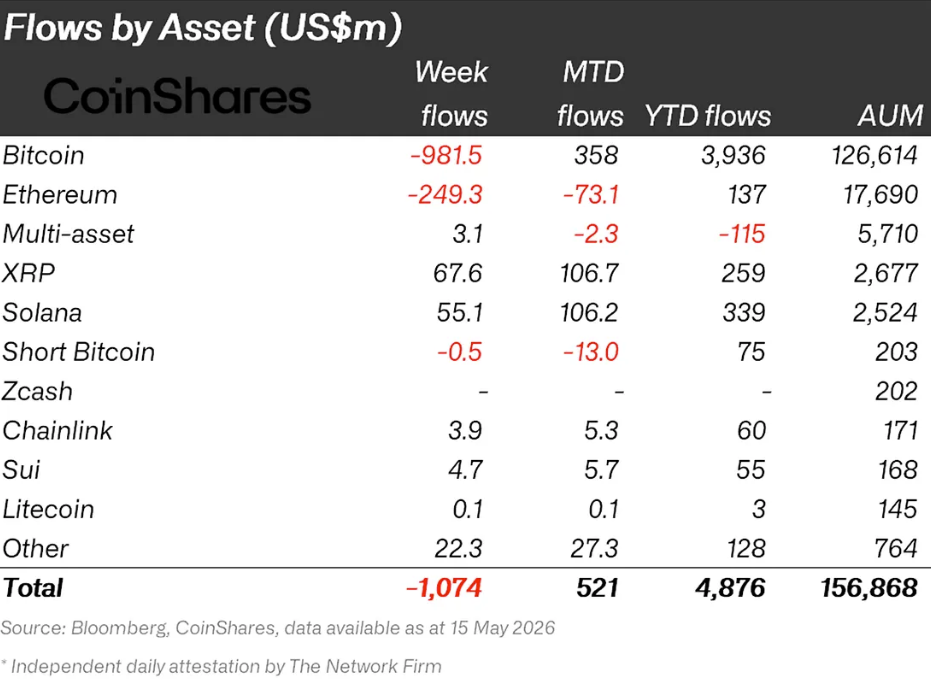
Last week, digital asset investment products experienced $1.07 billion in outflows, according to CoinShares, making it the first negative week after seven straight weeks of gains. It was also the third-largest weekly outflow seen in 2026.
Bitcoin saw the majority of the selling pressure as investors shifted toward a broader risk-off approach amid renewed geopolitical concerns surrounding Iran. However, investor sentiment appeared to stabilize toward the end of the week after news related to the CLARITY Act.
CoinShares found that 11 digital assets continued to attract inflows despite the broader decline, while Thursday recorded $174 million in inflows.
XRP and Solana Defy Market Panic
Bitcoin recorded $982 million in outflow last week, which reduced its year-to-date total to $3.9 billion. Ethereum also faced heavy selling pressure, as $249 million left the asset in its largest weekly decline since January 30. Blockchain equity ETFs were similarly affected, posting a combined $133 million decline amid broader risk-off sentiment.
On the other hand, several altcoins continued to attract investor interest. XRP led with $67.6 million inflows, followed by Solana with $55.1 million. Next up was Ton, which recorded $7.7 million, Sui $4.7 million, Ondo $4.1 million, Chainlink $3.9 million, and Dogecoin $3.2 million. The asset manager explained that investors are increasingly looking past Bitcoin and Ethereum for selective exposure.
According to CoinShares, the latest wave of crypto investment product withdrawals was driven almost entirely by the US, which saw $1.14 billion pulled from funds last week. European markets held up much better, led by Switzerland with $22.8 million and Germany with $22 million. The Netherlands added $7.5 million, while Sweden was the only exception as it recorded a smaller $4 million decline. During the same period, Canada attracted $12.6 million, and Australia saw $4.4 million in fresh investment.
Pressure May Continue
QCP Capital also warned that Bitcoin could remain under pressure after breaking below the $78,000 support level earlier today. The Singapore-based firm said the expiry of more than $4 billion in IBIT options has weakened the stabilizing effect that previously helped keep Bitcoin trading within a tight range.
The broader macro backdrop has also become less supportive, as seen with rising US Treasury yields and USD/JPY moving closer to the 160 level, where intervention risks could trigger a sharp unwind in yen-carry positions and drain a crucial source of global liquidity that has historically supported risk assets.
QCP added that crypto is likely to remain range-bound unless markets see meaningful progress in US-China trade talks or US-Iran negotiations.
The post Bitcoin Bleeds $1B Weekly but XRP and SOL Defy Market Panic appeared first on CryptoPotato.
Crypto World
The Ethereum Foundation is facing a wave of high-profile departures as its internal shakeup deepens


The turnover comes as the foundation undergoes an internal transition tied to a new organizational mandate aimed at redefining its role within Ethereum.

Ether (ETH) extended a downbeat spell last week after hitting resistance near $2,400, with the price sliding to roughly $2,100 on Monday. Market observers described the move as a sign that sellers have regained control, marking a shift in near-term momentum for the largest smart contract platform by market capitalization.
The wave of selling came as liquidity pressure mounted on major venues and investment products, reinforcing a narrative of waning demand. Binance’s exchange data showed that taker sell volume surged as ETH breached crucial downside levels, a signal, according to analysts, of forced risk-off positioning among active traders. In parallel, fund flows underscored a broader withdrawal of institutional interest in Ethereum-related exposure.
According to SoSoValue, US-based spot Ethereum ETFs posted net outflows for five consecutive days, totaling $255 million. Globally, Ethereum-focused investment products rang up about $249 million in outflows for the week ending May 15, the largest weekly figure since early February, according to data tracked by CoinShares. These outflows suggest the market is experiencing a pause or reversal in institutional demand, at least in the near term.
Key takeaways
- Ether drops roughly 12% after rejection at $2,400, with price extending lower toward $2,100 as bears reassert control.
- Binance taker sell volume spikes above $1.1 billion during the downside move, indicating aggressive selling pressure from traders on futures platforms.
- ETF and fund outflows imply waning institutional demand for Ethereum exposure in the short run, potentially constraining upside momentum.
Trading dynamics amid thinning demand
Price action around ETH has reflected a confluence of selling pressure and shifting investor positioning. Data from Binance shows a surge in taker sell volume as ETH moved below the $2,100 level, a pattern that traders sometimes interpret as forced de-risking or short-term bearish pressure from active market participants. CryptoQuant analyst Amr Taha captured the sentiment, noting that while the spikes do not automatically confirm a reversal into a deeper downtrend, they do indicate buyers were unable to absorb selling pressure during the move.
Analysts have increasingly linked price action to a widening macro and sectoral dynamics that have weighed on Ethereum demand. A related thread of analysis has tied ETH selling pressure to external catalysts, with coverage noting that surging oil prices have been identified as a driver of selling pressure in Ether by market commentator Tom Lee. The observation points to a broader risk-off environment where macro shifts can translate into crypto selling, particularly for assets with the most liquidity and sensitivity to market sentiment.
The withdrawal of liquidity from Ethereum-focused investment products aligns with the price action. SoSoValue’s data shows a five-day streak of net outflows from US spot ETH exposure totaling $255 million, a clear sign that institutions are rebalancing away from long ETH bets in the near term. Whale Factor, commenting on the flow trajectory, described the pattern as “heavy sell-side distribution” that has kept price pressure in place for now.
CoinShares’ weekly fund flow report further corroborates the trend, noting that global Ethereum investment products registered about $249 million in outflows for the week ending May 15, the largest weekly number since late January. Taken together, these outflows paint a picture of a market where institutional demand has cooled, at least temporarily, even as spot demand and retail interest remain more tentative.
Where is the support, and what comes next?
From a technical standpoint, investors are watching a cluster of roughly 3.85 million ETH that sits at a cost basis around $2,000–$2,100, according to Glassnode’s cost-basis distribution data. The concentration suggests a sizable cohort of holders could add if prices approach break-even, potentially offering a floor that might limit further downside in the near term.
Analysts remain divided on the vulnerability of ETH to a deeper retreat. Some traders point to a rising wedge pattern on daily charts, which could set the stage for a move toward the next major support around $1,700 if current supports fail to hold. In contrast, others argue that a decisive hold above $2,000 could slow the decline, with a potential bounce narrowly above that level contingent on continued demand and favorable liquidity conditions.
Strategists offered a spectrum of medium-term views. A well-known trader noted that Ethereum breached the $2,100 area after failing to sustain the $2,150 support, suggesting that a defense around the $2,050–$2,070 zone could provide a meaningful bounce if demand returns. Another analyst framed the situation as a test of buyers’ resolve near the lower end of the recent range, warning that a sustained break below the region could open the door to further softening into lower support bands.
Beyond the price action, the narrative around catalysts for a potential ETH rally remains anchored to a mix of macro conditions and on-chain developments. Sharplink’s CEO recently highlighted three catalysts that could help Ethereum reach new highs: the CLARITY Act’s progress in the United States, a broader return of market-wide risk appetite, and the growth of real-world asset tokenization on Ethereum. While these drivers are not immediate guarantees, they represent the structural tailwinds that could shift sentiment back toward Ethereum if liquidity and risk sentiment improve.
For now, traders are inclined to monitor the $2,000 level closely. A firm hold above this threshold could deter further downside and set the stage for a measured recovery, while a break below could expose traders to a test of the next support pockets identified by technical analysts and cost-basis data alike. The balance of on-chain activity, ETF and fund flows, and macro risk appetite will continue to shape the near-term trajectory.
In a related context, market observers have flagged that external factors, such as shifts in oil prices and broader risk sentiment, have historically fed into Ethereum’s price behavior. The interconnectedness of macro trends and on-chain dynamics underscores the importance of watching both liquidity flows and technical levels as the market digests renewed selling pressure and any potential rebound catalysts.
As the week unfolds, traders and investors will be watching three key variables: whether ETH can sustain a bid above $2,000, how ETF and institutional flows trend in the coming days, and whether demand from key market participants returns to supported levels to re-anchor prices above crucial supports.
The immediate question remains whether the current price action marks a temporary pause in a broader downtrend or the start of a longer retracement that could push ETH toward lower basins. Market participants will be closely analyzing liquidity conditions, the pace of outflows or inflows in Ethereum-related vehicles, and the evolving macro backdrop to gauge the durability of any short-term bounce.
Readers should stay tuned to updates on ETF flows, on-chain cost-basis shifts, and technical patterns that could prove decisive for ETH’s near-term path. The coming days may reveal whether the market finds equilibrium near $2,000 or if renewed selling pressure takes the price down to the next set of support levels.
What remains uncertain is how quickly institutional sentiment can reassert itself and whether macro risks ease enough to restore appetite for Ethereum exposure. Market participants will be watching closely to determine if the present pullback is a temporary pause in a longer-term recharge or a precursor to a deeper test of support zones.


Aave governance initiates temp-check on a new charitable mechanism that would allow users to generate yield on deposits while maintaining capital control for humanitarian organizations.
Cryptocurrency investment products posted heavy outflows last week as investors reduced risk amid inflation fears and uncertainty over a lasting ceasefire between the United States and Iran.
According to CoinShares’ latest weekly report, digital asset exchange-traded products (ETPs) recorded $1.07 billion in net outflows, ending a six-week streak of inflows. It marked the third-largest weekly outflow this year.
Bitcoin (BTC) investment products accounted for the bulk of the withdrawals, with $982 million in outflows. Ether (ETH) products lost $249 million, their largest outflow since the week ending Jan. 30.
Altcoin funds bucked the broader trend. XRP (XRP) investment products drew in $67.5 million, while Solana (SOL) funds added inflows of $55.1 million.
Despite last week’s outflows, both Bitcoin and Ether ETPs remain firmly positive on a year-to-date basis. Source: CoinShares
Most of the outflows originated in the United States, where investors pulled net $1.14 billion from funds. In contrast, several European markets, including Switzerland, Germany and the Netherlands, posted modest inflows.
The pullback in crypto funds coincided with a broader retreat in risk assets, with the S&P 500 index falling from all-time highs late last week. Investors remained focused on disruptions around the Strait of Hormuz, a critical shipping route for global oil supplies, which have pushed energy prices higher and contributed to a renewed rise in US inflation to its highest level in more than three years.
Related: Crypto’s CLARITY Act faces partisan fight over ethics on Senate floor
CLARITY Act remains a source of hope for crypto industry
CoinShares head of research James Butterfill said select altcoins benefited from improving regulatory sentiment in the United States following progress on the CLARITY Act.
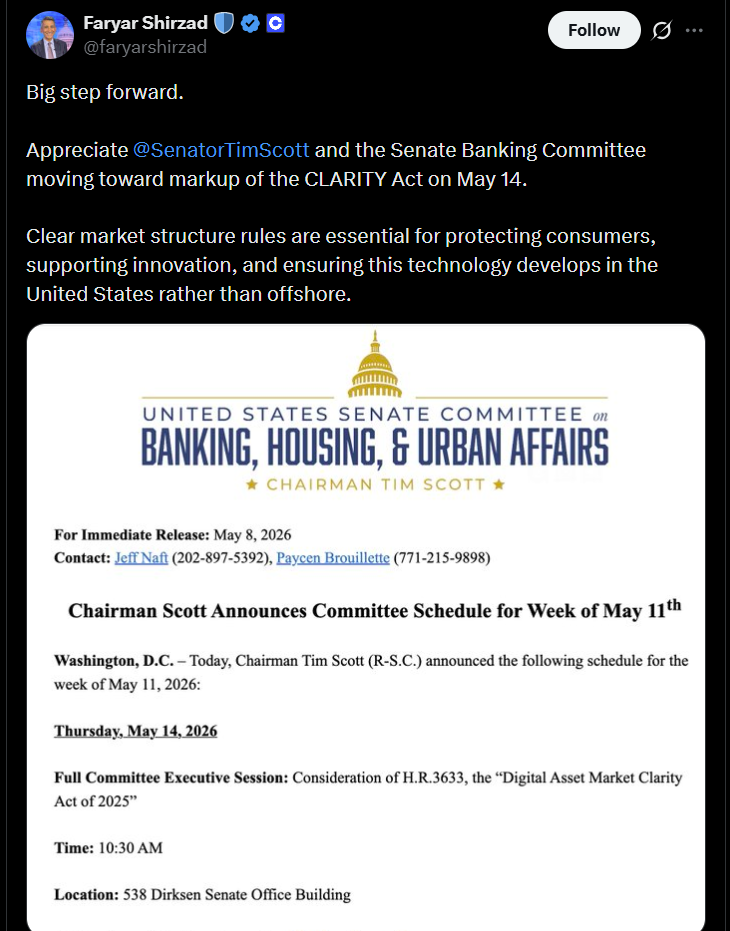
The legislation, which would establish a clearer framework for regulating digital assets in the US, advanced out of the Senate Banking Committee last week with bipartisan support.
Industry advocates say the bill could reduce regulatory uncertainty and provide a more predictable legal environment, encouraging crypto companies and investment to remain in the US.
Crypto Council for Innovation CEO Ji Hun Kim said “the momentum and progress are both strong” as the legislation moves through Congress.
Source: Faryar Shirzad
However, several Senate Democrats have pushed for stronger ethics provisions, particularly concerning elected officials’ financial ties to the crypto industry.
Republican Senator Thom Tillis said “more work remains in the weeks ahead to make this legislation even better.”
Related: Ethics remain sticking point as crypto market structure bill goes to markup
Crypto World
Solana is shedding its memecoin reputation as big banks move billions into its ecosystem


Wall Street and payment giants are quietly taking over Solana, moving billions onto the network for tokenized funds and global payments even as the broader crypto market cools down, according to a new report by Messari.

A netizen is using a computer and smartphone to view the NVIDIA logo and webpage in Suqian City, Jiangsu Province, China on April 29, 2026.
Cfoto | Future Publishing | Getty Images
All eyes are on Nvidia, the world’s most valuable company and artificial intelligence trade darling, as it is set to report fiscal first-quarter earnings on Wednesday after the closing bell.
On its conference call, traders on prediction markets platform Kalshi think the company might talk about President Donald Trump after CEO Jensen Huang joined him on his trip to China.
Trump has 50-50 odds of being mentioned on the call, with the chances rising recently. The president wasn’t mentioned on the company’s last earnings call in February. Huang joined Trump for his summit in Beijing with Chinese President Xi Jinping.
Huang’s presence on the trip came as the status of Nvidia’s H200 chip sales in China remains uncertain.
Trump told reporters last week that the chip model didn’t come up in discussions with China, but Reuters reported that the U.S. government gave approval to several Chinese firms to purchase the model. China, though, hasn’t allowed firms to purchase the chip, Trump claimed to reporters.
In January, Trump cleared the way for Chinese purchases of the chip model. That came with a 25% tariff on imports for chips that will be sent to China. There’s a 57% chance the company mentions tariffs on its call on Wednesday.
But after the trip to China, traders place just an 11% chance that Nvidia mentions Taiwan. After the U.S.-China summit, neither country revealed if Trump or Xi discussed Taiwan, which is home to critical chip manufacturers. Traders now only place 15% odds that the company discusses Taiwan Semiconductor Company, down from previously a 78% chance.
And there’s a 55% chance the company will discuss humanoid robots. In his keynote address at the CES Trade Show in January, Huang said he expects to see robots with some human-level capabilities this year. This would be a new feature of the Nvidia calls as that topic didn’t come up in the company’s February earnings call.
Disclosure: CNBC and Kalshi have a commercial relationship that includes a CNBC minority investment.


AEON raised $8m led by YZi Labs to build an AI-native settlement layer, using its x402 protocol on BNB Chain to let agents pay 50m+ merchants via on-chain receipts.
Summary
- AEON, an AI-native payment and settlement layer, has raised $8 million in a pre-seed round led by YZi Labs, with IDG Capital, HashKey Capital, Stanford Blockchain Builders Fund, and Oak Grove Ventures also participating.
- The project is building settlement infrastructure for value exchange between AI agents and has already launched an AI payment product that lets agents interact with over 50 million physical merchants worldwide.
- AEON has partnered with BNB Chain to deploy its x402 Facilitator, turning the long-dormant “402 Payment Required” status code into a verifiable, on-chain settlement rail for AI-to-merchant transactions.
AEON has completed an $8 million pre-seed funding round to build what it calls the “financial foundation of the AI economy,” with Binance venture arm YZi Labs leading the round alongside IDG Capital, HashKey Capital, Stanford Blockchain Builders Fund, Oak Grove Ventures, and other backers. According to a ChainCatcher-summary of reporting from The Block, the company did not disclose its valuation, but said the capital will be used to develop settlement infrastructure that allows autonomous AI agents to exchange value directly with each other and with real-world merchants.
YZi Labs backs “financial foundation of the AI economy”
In a statement cited in KuCoin’s flash update, AEON said the goal is to create an AI-native payments fabric that supports “high-frequency microtransactions, on-chain agent identity, and global fiat settlement” so that AI systems can plug into commerce without human intermediaries. PANews added that the team is explicitly targeting the “agentic economy,” positioning the protocol as a back-end layer that can be embedded into AI assistants, bots, and services that need to pay for APIs, subscriptions, or real-world goods.
AEON launched its first AI payment product in May, enabling AI agents to connect with more than 50 million physical merchants globally through integrations with existing payments partners. The company claims this lets agents route payments at point of sale, handle subscriptions, and settle online transactions while abstracting away blockchain complexity from end users and merchants.
x402 turns HTTP into an on-chain payment rail
A key part of AEON’s stack is its x402 protocol, which repurposes the long-ignored “402 Payment Required” HTTP status code into a programmable payment step for AI agents executing web-based actions. In an earlier press release, the company explained that x402 allows agents to “independently execute online transactions by embedding payments directly into standard HTTP interactions,” so that an agent can receive a 402 response, pay in stablecoins, and unlock access with no human in the loop.
Built on top of that protocol, the newly announced x402 Facilitator is deployed natively on BNB Chain and adds verifiable transactions, on-chain settlement, and immutable receipts to each agent-driven payment. Every x402 transaction is validated by the Facilitator for “payload authenticity and mandate compliance” before being finalized on BNB Chain, generating a tamper-proof on-chain receipt that includes the agent’s ERC-8004-compliant identity for auditing and reconciliation.
AEON says the BNB Chain integration gives its system the scalability and transparency needed for production-level AI-to-merchant commerce, allowing agents to interact with “millions of service providers across the BNB ecosystem” and execute payments that are “fast, transparent, and verifiable in real time.” Combined with the fresh $8 million round led by YZi Labs, the launch signals growing institutional conviction that an agent-specific settlement layer will be a core piece of infrastructure as AI systems start to transact on behalf of users and enterprises.
Crypto World
Dogecoin Wall Street Bet: Micron Veteran Jordi Visser Eyes DOGE as ETF Flows Stay on a Green Streak


Dogecoin is butchered as it’s down by more than 6% today, but Wall Street heavyweight is watching as its ETF keeps flowing green. In a conversation with Anthony Pompliano, Micron veteran Jordi Visser, who booked an eightfold return on MU before exiting all AI-sector positions, said DOGE’s chart is “on the verge of a breakout.”
His thesis revolves around negative real rates, sticky inflation, and the Fed’s $1.2 trillion in annual interest expense, which are forcing capital rotation into hard assets. According to him, Dogecoin is the clearest early-warning indicator of when retail joins the move.
Pompliano framed it sharply, noting that DOGE is “an alarm system” because it remains “the most pure play non-institutional asset that has size and liquidity in crypto.” Visser’s response was blunt: “I don’t even need to say anything else.”
Discover: The best crypto to diversify your portfolio with
Can Dogecoin Price Break and Reclaim Its 200-Day Moving Average?
DOGE sits at a genuine inflection point. Immediate resistance lies at $0.11, where the RSI reads 45 and 62, edging toward overbought on its open. A sustained daily close above that level, particularly if ETF inflows accelerate, is being flagged as the “concrete trigger” for the next leg higher.
The real test sits further up: the 200-day moving average at $0.125. Reclaiming and holding that pivot opens a path toward the $0.150 end-of-2026 target.
On the downside, the 100-day EMA at $0.10 serves as the primary support floor. A break below that level would invalidate the current breakout structure and likely reset the consolidation range.
Institutional demand is building at the margin, if not yet at scale. A $460,000 inflow into Grayscale’s GDOG ETF on April 30 was enough to snap a 72-day consolidation and push the price toward current levels.
Since launch, DOGE spot ETFs have logged net inflows on four of the last eight trading days, with $1.3 million entering in May alone. The 149 largest DOGE wallets now hold 108.52 billion DOGE, valued at $11.6 billion, with 739 transactions above $100,000 recorded in a single day in late last month.
DOGE just needs to close above $0.11 as ETF flows sustain, so Visser’s retail rotation thesis ignites a move toward $0.125.
Discover: The best pre-launch token sales
Maxi Doge Targets Early-Mover Upside as DOGE Tests Key Resistance
Dogecoin at above 10 cents is a different proposition than it was in 2021. The asymmetry has compressed. Traders who want exposure to the same retail-rotation thesis are looking one tier down.
Maxi Doge ($MAXI) is a meme token built on Ethereum that packages the high-conviction, maximum-leverage energy of the DOGE community into a presale-stage asset. The project has already raised more than $4.7 million at a current price of $0.0002819, with dynamic staking APY available to early holders.
The core concept is intentionally absurd, but the mechanics underneath are not. It offers holder-only trading competitions with leaderboard rewards, a Maxi Fund treasury for liquidity and partnerships, and a meme-first marketing engine designed to generate the viral retail attention Visser is watching.
Research Maxi Doge before the presale closes at the official presale page.
The post Dogecoin Wall Street Bet: Micron Veteran Jordi Visser Eyes DOGE as ETF Flows Stay on a Green Streak appeared first on Cryptonews.
Crypto World
Warren Buffett teased to CNBC a ‘tiny purchase’ in March. Berkshire filing may have revealed it

Warren Buffett speaks with CNBC during the Berkshire Hathaway Annual Shareholders Meeting in Omaha, NE on May 2, 2026.
David A. Grogan | CNBC
Billionaire investor Warren Buffett hinted in March that Berkshire Hathaway had made a small addition to its portfolio. A new regulatory filing may have just revealed what he was referring to.
When asked in March whether Berkshire was still putting money to work, Buffett said the conglomerate had made “one tiny purchase” but was still struggling to find attractive opportunities.
“Got one tiny purchase, but we aren’t finding things that — we weren’t finding them before,” Buffett said at the time in an interview with CNBC’s Becky Quick.
A regulatory filing released Friday showed Berkshire initiated a roughly $55 million position in Macy’s during the first quarter — a sliver of a portfolio valued at more than $300 billion and a size that would fit Buffett’s description of a “tiny” investment.
By contrast, Berkshire’s other newly disclosed position during the quarter was far larger: a roughly $2.6 billion stake in Delta Air Lines, making it an unlikely candidate for the modest purchase Buffett referenced in March.
Still, investors may not have the full picture. Berkshire’s quarterly equity filings only capture U.S.-listed positions that meet reporting requirements, leaving open the possibility that Buffett was referring to an international investment or another holding not reflected in Friday’s disclosure.
Buffett, who stepped down as Berkshire’s chief executive at the start of 2026 and handed the role to Greg Abel, said earlier this year that he remains deeply involved in overseeing investments and market activity.
The 95-year-old said he still comes into the office daily and works alongside colleagues on trading decisions. Buffett described regularly speaking with Berkshire’s director of financial assets, Mark Millard, before the opening bell to discuss market developments.
Millard, whose office Buffett said sits about 20 feet away from his own, executes trades based on those conversations, underscoring Buffett’s continued role in portfolio management despite the leadership transition.
“I won’t make any [investments] that Greg thinks are wrong. … Greg gets the sheet every day,” Buffett said.
In the first quarter, Berkshire also sold a slew of stocks including Mastercard and Visa in an effort to unwind positions tied to Todd Combs, the longtime investment manager and Geico chief who left for JPMorgan at the end of 2025. Ted Weschler, the other investment manager, continues to oversee about 6% of the holdings.

X Accounts Are Limited To 50 Posts And 200 Replies A Day Unless They Pay For A Blue Checkmark

Balance of Payments (Current Account, Financial Account and Capital Account)

Jury rules against Elon Musk in his feud with OpenAI

Manchester United reach agreement with Casemiro over contract clause amid transfer speculation

US brings back mandatory military draft registration

Steven Gerrard disagrees with Gary Neville over ‘shock’ Chelsea and Arsenal claim | Football


-

 Crypto World3 days ago
BloFin War of Whales 2026 Grand Prix opens registration for $5M trading championship
-

 Fashion3 days ago
Weekend Open Thread: Theory – Corporette.com
-

 Crypto World3 days ago
E-Estate Announces 1 Year Live: Washington DC Summit as Real Estate Tokenization Enters Its Next Phase
-

 Politics7 days ago
What to expect when you’re expecting a budget
-

 Tech4 days ago
Tech Moves: Microsoft AI leader jumps to OpenAI; former AI2 exec joins Meta; and more
-
Crypto World6 days ago
Bitcoin Suisse expands with Digital Asset License and Investment Business Act Registration Approval in Bermuda
-

 Tech7 days ago
GM agrees to $12.75M California settlement over sale of drivers’ data
-

 Politics6 days ago
Pakistan to enter Chinese capital market as war inflation bites
-

 Crypto World6 days ago
Bitcoin Suisse expands with Digital Asset License and Investment Business Act Registration Approval in Bermuda
-
 Crypto World4 days ago
Google’s Gemini AI Predicts Incredible Solana Price by the End of 2026
-

 Business3 days ago
H&R Real Estate Investment Trust (HR.UN:CA) Q1 2026 Earnings Call Transcript
-

 Tech3 days ago
Google reimburses Register sources who were victims of API fraud
-

 Sports3 days ago
Napoleonic enters 2026 Doomben 10,000 field via Abounding withdrawal
-

 Politics7 days ago
The geopolitics behind the UK’s South Atlantic hantavirus rescue mission
-
 NewsBeat6 days ago
Comment on Keir Starmer surviving the day as Prime Minister like a turd that wont flush
-

 Politics7 days ago
The Board of Deputies just smeared Polanski to suck up to Farage
-

 Fashion6 days ago
The Best-Kept Makeup Secret for a More Defined Face
-
 Entertainment4 days ago
Zara Larsson Has Blunt Response To Chris Brown Diss
-
 Tech5 days ago
Why AI is making typography a boardroom conversation
-

 Politics6 days ago
The Trial of Majid Freeman, Verdict
You must be logged in to post a comment Login