

Crypto World
XRP and Solana funds attract inflows as bitcoin outflows hit nearly $1 billion



CoinShares data shows investors are rotating into listed products based on XRP and SOL while bitcoin and ethereum products posted heavy weekly outflows.



Crypto exchanges and executives are spending more on personal security as kidnappings, home invasions, and “wrench attacks” become a growing risk across the industry.
Summary
- Coinbase spent about $8.7 million on Brian Armstrong’s security and protection costs in 2025.
- Gemini pays Winklevoss Capital Management $400,000 per month for executive protection services.
- crypto.news reported France logged 41 crypto-linked kidnappings in 2026 as attacks moved offline.
Bloomberg reported that crypto firms are raising security spending after a rise in violent attacks targeting executives, investors, and event attendees. The report linked the trend to kidnappings, home invasions, and physical threats aimed at forcing victims to transfer digital assets.
The concern has spread from online fraud to personal safety. In crypto, a “wrench attack” refers to an attack where criminals use threats or violence to force someone to hand over private keys, passwords, or access to wallets.
Related reports show the threat is no longer limited to wealthy public figures. crypto.news reported that France counted 41 crypto-linked kidnappings in 2026, equal to about one case every 2.5 days. The same report said France had become one of Europe’s main hotspots for crypto ransom attacks.
Coinbase security bill rises for Brian Armstrong
Coinbase’s latest proxy filing showed the exchange spent about $8.7 million in 2025 on CEO Brian Armstrong’s security and related protection measures, according to Bloomberg. That was up from about $6.2 million in 2024.
Coinbase’s prior proxy said the company may provide personal security services, including certified protection officers, secure lodging, and residential security, when its security team deems them needed. The filing said Coinbase views these costs as “reasonable and necessary expenses” for the company and stockholders.
The higher figure shows how public crypto executives now face risks that go beyond cyberattacks. Exchanges must protect data, wallets, employees, and, in some cases, the people most closely tied to their brands.
Gemini pays $400,000 per month for protection
Gemini has also raised executive security spending. Its latest filing said the company entered a January 2026 services agreement with Winklevoss Capital Management for executive protection, secure transportation, and risk advisory services.
The filing said Gemini pays a fixed monthly rate of $400,000, plus certain reimbursed expenses. The services cover the company’s CEO, president, their family members, and other individuals Gemini may name from time to time.
The arrangement shows how security is becoming a formal operating cost for crypto firms. It also reflects the exposure of executives whose names, wealth, and public profiles are closely tied to digital assets.
Crypto security risks move offline
Recent attacks show why exchanges are changing their approach. crypto.news reported that a French crypto worker fought off an armed intruder posing as a delivery driver during a home invasion. Police later arrested a suspect and charged him with attempted armed robbery.
Earlier market updates also covered a trader who offered a 10% bounty after claiming a violent $24 million crypto robbery. That case was described as part of the wider rise in wrench attacks, where criminals use force instead of code to steal crypto.
Crypto World
Cardano News: Cardano’s Quantum-Safe Roadmap vs. Muted Market Response: Why ADA Is Stagnant

Cardano News: ADA is trading near $0.25, stuck in a $0.25–$0.28 intraday band with neutral funding rates and whale accumulation at a 30-day low.
However, Cardano is executing one of the most aggressive post-quantum cryptography pushes of any major blockchain, complete with a live governance vote, a formal research proposal expected imminently, and a roadmap that places it ahead of Ethereum on quantum readiness.
The contradiction is stark and the market is not resolving it.
Technical milestones are piling up. Price is not moving. The question the market is sitting with is whether crypto security infrastructure has any near-term pricing power at all, or whether ADA is simply trapped in a broader altcoin liquidity drought that no governance vote can fix.

Discover: The best crypto to diversify your portfolio with
Cardano’s Post-Quantum Push: What the Roadmap Actually Says
Charles Hoskinson has framed Cardano’s quantum resistance strategy as an existential preparation play, not an emergency response.
Speaking publicly this week, Hoskinson described the quantum threat as “like an asteroid coming towards Earth”, a slow-moving but terminal risk that decentralized networks need to coordinate around before it becomes a market shock.
A formal IOHK research proposal is expected next week, building on a governance vote already in motion.
The technical architecture under discussion centers on a phased migration model. Hoskinson pointed to Cardano’s established hard fork cadence as a structural advantage, the network has executed regular protocol upgrades without fragmentation, which makes a future quantum-resistant migration more tractable than on chains with rigid upgrade cultures.
The planned approach would layer post-quantum cryptographic signatures alongside existing ones, preserving compatibility while adding quantum-safe security primitives.
Google Quantum AI reportedly ranked Cardano second among major blockchains for post-quantum security posture, behind only Bitcoin and ahead of Ethereum and Solana, a ranking that contributed to ADA’s inclusion in the Hashdex Nasdaq Crypto Index ETF despite persistent price underperformance.
Cardano also logs roughly 680 GitHub commits per week across ~80 repositories, placing it among the most active chains by development output. The work is real. The market premium for it is not.
Cardano is not alone in this race. Ripple has outlined a four-phase roadmap for the XRP Ledger targeting quantum resistance by 2028.
Bitcoin developers have circulated BIP-360 and BIP-361 as migration frameworks, with BIP-361 proposing a staged move away from vulnerable addresses that could freeze older coins after a deadline.
Cardano’s governance-first approach to this migration distinguishes it from those proposals, but the market has not assigned that distinction a valuation premium.
Can Cardano (ADA) Price Break Out of Its $0.28 Range?
ADA is sitting approximately 80% below its $3.10 all-time high and roughly 49% down year-to-date.
The $0.25–$0.28 range has acted as a soft floor through much of Q1–Q2 2026, but the 200-day moving average sits near $0.46 – a level the token has not challenged in months.
Resistance at $0.28 capped the intraday high this week; support near $0.258 held the low.
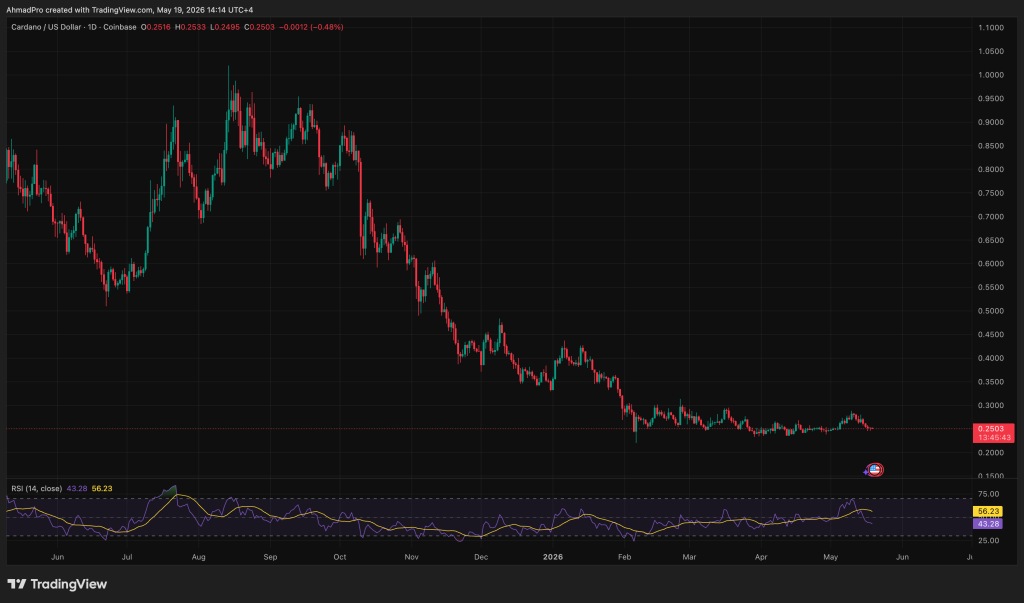
Funding rates have since normalized to neutral. Traders are using ADA as a volatility vehicle, not a conviction hold, and that dynamic suppresses the impact of any fundamental catalyst, including a quantum security roadmap.
If ADA breaks $0.28 on volume following the release of the formal IOHK quantum research proposal and Protocol 11 hard fork confirmation, targeting a retest of $0.34–$0.36. Catalyst is institutional re-rating of crypto security infrastructure as a premium.
However, a break below $0.258 support on sustained risk-off conditions opens a retest of $0.22–$0.24. Invalidation of the current range would erase the modest recovery from Q1 lows and delay any narrative re-rating.
Discover: The best pre-launch token sales
The post Cardano News: Cardano’s Quantum-Safe Roadmap vs. Muted Market Response: Why ADA Is Stagnant appeared first on Cryptonews.

Minnesota lawmakers signing HF 3709 pave the way for state-based banks and credit unions to offer virtual-currency custody services in a nonfiduciary capacity beginning August 1. The measure, signed by Governor Tim Walz, amends state statutes to allow financial institutions to engage third-party service providers or subcustodians to facilitate crypto custody, provided funds are legally and operationally segregated from the institution’s assets and not treated as property of the bank or credit union.
According to Cointelegraph, the legislation is positioned within a broader regulatory push to bring crypto custody into regulated financial channels, reducing reliance on unregulated or out-of-state providers and aligning Minnesota institutions with compliance expectations around asset segregation and fiduciary risk controls.
The bill’s proponents argued the policy would enable Minnesota-based financial institutions to evolve alongside their customers while protecting residents from opaque or offshore custody arrangements. It takes effect in August and could influence operations across the state’s banking and credit-union landscape.
The Minnesota government information portal notes the scale of the state’s financial sector: as of May 2025, 240 commercial insured banks operated in Minnesota with about $128 billion in assets, and 82 member-owned credit unions were under the Minnesota Credit Union Network. Minneapolis is home to U.S. Bancorp, the country’s seventh-largest bank by assets, underscoring the potential impact on major state institutions.
The policy comes in a broader policy milieu. In Minnesota, lawmakers also advanced a separate bill to ban digital asset kiosks and ATMs in response to incidents of scams targeting residents, signaling a multifaceted approach to crypto-related risk within the state.
Key takeaways
- The new law authorizes Minnesota banks and credit unions to provide virtual-currency custody services in a nonfiduciary capacity starting August 1.
- Institutions may use third-party service providers or subcustodians to facilitate custody, with funds segregated from the bank’s or credit union’s assets and not treated as the institution’s property.
- The change could affect operations across the entire Minnesota financial-services sector, given the size of the state’s banking and credit-union markets.
- The move sits within a broader regulatory context, including federally focused custody initiatives and ongoing discussions about licensing and oversight for crypto firms seeking national charters.
Legal framework and operational mechanics in Minnesota
HF 3709 amends Minnesota’s statutes to permit supervised financial institutions to offer virtual-currency custody services without assuming fiduciary duties. The law explicitly allows engagement with third-party subcustodians or service providers to support custody activities, so long as the funds involved remain segregated from the institution’s assets and are not considered property of the institution. The framework thus creates a regulated channel for crypto custody within traditional banking and credit union operations, reducing the governance and insolvency risk associated with unregulated custody arrangements.
From a compliance perspective, the statute emphasizes asset segregation and operational separation, which are core elements of AML/KYC controls and banking supervision. While the law does not establish a broad fiduciary custodial obligation, it signals a move toward formalized oversight of crypto custody activities by Minnesota financial institutions, aligning state policy with evolving best practices in digital-asset stewardship.
Regulatory backdrop: federal charters, custody services, and market dynamics
Beyond state-level changes, the cryptocurrency custody landscape in the United States is shaped by federal regulatory initiatives and the pursuit of national charters. In a separate development, Payward—the parent company of the Kraken exchange—announced it had filed with the Office of the Comptroller of the Currency (OCC) for a national trust company charter intended to provide fiduciary custody and related services primarily for digital assets, subject to regulatory approval.
Historically, the OCC has approved or conditionally approved national-charter applications from other crypto-related firms, including Ripple Labs, BitGo, Circle, Fidelity Digital Assets, and Paxos, with discussions ongoing regarding additional candidates. Reports indicate that regulators are weighing how fiduciary custody fits within a unified national framework, a trend that could shape how state custody provisions, like Minnesota’s HF 3709, interface with federal licensing and oversight. This broader regulatory momentum was highlighted in reporting on the sector’s evolving charter landscape.
For institutions and firms seeking synchronized operations across state lines, the interaction between state authorization for in-state custody services and federal charter options remains a key area of policy development. The emergence of national trust charters could influence bank and nonbank participants’ willingness to provide custody services across multiple jurisdictions, intensifying AML/KYC, licensing, and prudential requirements across the ecosystem.
Policy alignment, risk considerations, and future outlook
The Minnesota statute’s design reflects a deliberate policy choice to retain custody capabilities within regulated domestic institutions, fostering in-state competition while mitigating the risks associated with unregulated custody arrangements. The development matters in practice because it has the potential to reshape the custodial outsourcing decisions of Minnesota-based banks and credit unions, with implications for risk management, vendor governance, and regulatory reporting.
From a compliance perspective, the policy underscores the importance of robust third-party risk management, asset segregation, and clear accounting treatment for crypto assets. It also highlights how state-level actions interact with federal licensing trajectories and international-policy considerations, including alignment with AML/KYC frameworks and any forthcoming cross-border regulatory guidance. The ongoing dialogue about national charters and the possible standardization of custody practices points to ongoing uncertainty and the need for institutions to monitor regulatory guidance, licensing pathways, and supervisory expectations as they implement custody offerings.
For market participants, the Minnesota step adds another layer to the evolving custody infrastructure in the United States, particularly for institutions seeking to offer digital-asset services in a regulated banking context. As state policies converge with federal charters and harmonized supervisory expectations, banks and credit unions may reassess their procurement, risk, and governance approaches to crypto custody, potentially impacting licensing, vendor selection, and operational resilience.
Looking ahead, policymakers will likely weigh the balance between enabling regulated custody services and maintaining robust consumer protections. The interaction between Minnesota’s framework and federal charter initiatives will be a focal point for institutional risk teams, compliance programs, and legal counsel as custody services mature within the U.S. financial system.
Closing observations: Minnesota’s approach signals a measured move toward regulated, domestic custody services within traditional banking structures, while the federal-charter conversation indicates a broader institutional shift toward standardized, scalable digit asset custody. Institutions should track regulatory developments at both state and federal levels to assess licensing requirements, custody governance, and cross-border implications.

NVIDIA has tapped SpaceX as one of the first customers to deploy its new Vera CPU, the chipmaker’s debut processor designed specifically for agentic artificial intelligence (AI) workloads.
The collaboration drew quick public backing from SpaceX chief executive Elon Musk, who reposted the announcement on X and joked that the chip lived up to its name.
NVIDIA Ships First Vera Units to SpaceX
NVIDIA confirmed that early Vera silicon went directly to SpaceX, OpenAI, Anthropic, and Oracle Cloud Infrastructure. The chipmaker’s hyperscale division hand-delivered the first units, framing the rollout as the start of a wider commercial deployment.
The Vera CPU houses 88 custom NVIDIA-designed Olympus cores and supports up to 1.2 TB/s of memory bandwidth using LPDDR5X memory. NVIDIA claims the chip runs agentic sandbox workloads up to 50% faster than competing rack-scale CPUs while doubling efficiency.
A new 256-CPU rack configuration sustains more than 22,500 concurrent agent environments at full performance, according to NVIDIA. The system is part of the broader Rubin platform revealed at GTC in March 2026.
Musk Reacts on X
Musk posted his reaction shortly after NVIDIA’s official AI Infrastructure account thanked SpaceX for testing the chip.
His enthusiasm follows the recent folding of xAI into SpaceX, which now operates the merged AI division under the SpaceXAI brand. The unit already runs the Colossus 1 and Colossus 2 supercomputers in Memphis.
Why Vera Matters for Agentic AI
Vera signals NVIDIA’s first serious push into CPUs aimed at AI agents rather than the GPU products that dominate its revenue. The launch coincides with rising enterprise demand for agent-based workloads that orchestrate many smaller models. NVIDIA chief executive Jensen Huang has called agent-based services the company’s next multi-trillion-dollar opportunity.
Customers lined up for deployment include Alibaba Cloud, ByteDance, Meta, CoreWeave, Lambda, and Nscale, alongside SpaceX. The breadth of early adopters suggests NVIDIA intends to extend its AI infrastructure dominance well beyond training silicon.
Whether Vera meaningfully shifts CPU market share will depend on how quickly customers like SpaceX move from testing to full production. Several rivals, including AMD, are also working on competing chips aimed at the same workloads.
The post Elon Musk Cheers NVIDIA’s Vera Launch After SpaceX Gets First Units appeared first on BeInCrypto.

The post-bankruptcy trust representing Prime Trust’s creditors has taken legal aim at Swan Bitcoin, filing a suit in Delaware bankruptcy court alleging the Bitcoin custodian exploited insider access to move roughly $1 billion in assets from Prime Trust ahead of its August 2023 collapse.
The complaint, submitted by the Prime Trust litigation trust, asserts that Electric Solidus—the corporate entity behind Swan Bitcoin—received more than $24.6 million in cash, 11,994 BTC (valued at about $923 million at the time of filing), roughly $5 million in USDT, and smaller amounts of other digital assets before Prime Trust filed for bankruptcy. Central to the allegations is a Prime Trust senior executive who, while employed at Prime, also served as a paid adviser to Swan in a side arrangement dating back to July 2019.
Four days before Prime Trust met with Nevada regulators on May 26, 2023, the executive allegedly opened an encrypted chat with Swan Chief Executive Cory Klippsten and set messages to auto-delete every 24 hours. The feature was reportedly turned off the day after the regulatory meeting, when Swan withdrew more than 10,000 BTC from Prime Trust.
The lawsuit forms part of a broader effort by Prime Trust’s post-bankruptcy litigation trust to recover assets moved out of the custodian in the weeks leading up to its collapse. The filing argues Swan leveraged insider access to shift assets ahead of Prime Trust’s deteriorating financial condition, effectively prioritizing its own holdings over other customers.
“Swan knew to transfer fiat and crypto from Prime immediately prior to Prime filing for bankruptcy to avoid catastrophic losses,” the complaint states.
Cointelegraph reached out to Swan for comment, but did not receive an immediate response.
Related: House Committee pushes Trump to fill CFTC seats as crypto regulation ramps up
Key takeaways
- The Prime Trust litigation trust accuses Swan Bitcoin of using insider access to drain assets from Prime Trust in the run-up to its bankruptcy.
- Assets alleged to have moved include 11,994 BTC (approximately $923 million at filing time), plus cash and USDT, totaling around $1 billion in value referenced by the complaint.
- An unnamed Prime Trust executive with ties to Swan allegedly coordinated pre-bankruptcy transfers, including an encrypted chat that auto-deleted messages for a period.
- The filing claims an internal ledger created shortly before the Nevada regulator meeting, titled “PT FBO Swan Customers,” was designed to obscure that Swan’s funds were not actually held in a separate trust for Swan’s customers.
- The litigation seeks to recover assets under preferential transfer and fraudulent transfer provisions of the Bankruptcy Code and seeks to disallow future claims until restitution is made.
Insider leverage and the timing of asset moves
The core accusation centers on a Prime Trust executive who simultaneously served Swan as a paid adviser, creating a potential conflict of interest as Prime Trust’s financial health weakened. The filing describes a sequence in which, just days before a regulatory encounter in Nevada, an encrypted channel with Swan’s leadership enabled accelerated transfers. The purported purpose, according to the complaint, was swift asset relocation to avoid losses as Prime Trust faced mounting pressure.
Those transfers culminated in a notable withdrawal of more than 10,000 BTC shortly after the Nevada meeting, a move the suit characterizes as part of a broader evacuation of customer assets. Slack communications cited in the filing allegedly show Prime Trust staff scrambling to comply with requests or directives as the day closed, underscoring the chaotic context in which the transfers occurred.
Internal ledgers and the argument over asset custody
A focal point of the allegations is the claim that Prime Trust created an internal ledger labeled “PT FBO Swan Customers” on May 25, a record that did not exist previously. The suit contends this ledger gave the appearance that Swan’s assets were held in a separate, customer-specific trust, a structure that would complicate any future clawback efforts in bankruptcy. In substance, the complaint argues, those assets were not actually held in trust for Swan’s customers, suggesting an attempt to mislead creditors and regulators about asset custody during a period of financial stress for Prime Trust.
What the case seeks and potential implications
The Prime Trust trust seeks relief under the Bankruptcy Code’s preferential transfer and actual fraudulent transfer provisions. The plaintiffs also request a court order disallowing any future claims Swan might assert against the estate until restitution is made. If successful, the action could set a precedent for how transfers involving crypto custodians are treated in bankruptcy, with potential ripple effects for other platforms that rely on custodial arrangements during distress.
The case also spotlights broader questions about governance, insider relationships, and the potential for rapid asset movement in the crypto custody landscape. As regulators increasingly scrutinize custody practices and the pathways assets can take during financial duress, outcomes from this litigation may influence risk management standards and disclosure requirements across the sector.
Closing perspective
As the case unfolds, observers will be watching how the court addresses the credibility and scope of the transfers alleged in the filing, and whether restitution can be secured for Prime Trust’s creditors. The episode underscores the ongoing tension between rapidly evolving crypto custody models and traditional bankruptcy frameworks, raising questions about best practices for safeguarding customer funds when a custodian nears insolvency.


Key takeaways
- CHZ is up 5% in the last 24 hours and is now approaching the $0.05 resistance level.
- The derivatives data indicate that the bulls are in control at the moment.
Chiliz outperforms the broader crypto market
Chiliz (CHZ) is one of the best performers among the top cryptocurrencies, as the coin is up by 5% in the last 24 hours. Thanks to its latest rally, CHZ is trading at $0.049 and could rally higher in the near term.
The momentum indicators remain constructive, indicating that CHZ could extend its rally over the next few hours and days.
Data obtained from CoinGlass shows that the futures’ Open Interest (OI) at exchanges in Chiliz surges to $80 million on Tuesday, up from $58 million in the previous week.
This is the highest Chiliz’s OI has been since January. The rising OI indicates that new or additional bullish positions are opening in the market, suggesting a bullish outlook for CHZ.
Furthermore, Chiliz’s funding rates flipped positive on Sunday and surged to 0.0043% on Tuesday. The funding rate turning positive means that the bulls are firmly in control of the market.
CoinGlass’ long-to-short ratio for CHZ read 1.01 on Tuesday, after sitting in the red territory for over a week.
Chiliz price forecast: The $0.051 resistance level remains a key challenge
The CHZ/USD 4-hour chart is bullish and efficient as Chiliz has outperformed the broader cryptocurrency market.
The cryptocurrency market is currently trading above key support levels thanks to its recent rally. The momentum indicators also suggest that the buyers could push CHZ’s price higher in the near term.
The Relative Strength Index (RSI) at 58 shows that the bulls have regained control but still have more room for growth.
The Moving Average Convergence Divergence (MACD) line has turned positive, with the histogram marginally above zero, hinting at a steady rally.
If the bullish scenario continues, the buyers would face immediate resistance at the recent swing high of $0.051.
A daily candle close above this level would allow the bulls to extend the rally towards the $0.057 resistance and then the January high at $0.064.

However, if the sellers regain control, immediate support would emerge around the $0.047 Inducement Liquidity (ILQ).
Failure to defend this support level would expose the other major zones around the $0.043 and $0.041.
Standard Chartered’s digital assets team forecasts $4 trillion in tokenized assets on-chain by end-2028. Stablecoins and real-world assets (RWA) should each account for half of that pool, with the forecast positioning DeFi as the native back-end for that capital.
The report comes from Geoff Kendrick, the bank’s global head of digital assets research, who argues composability gives leading protocols a structural advantage that traditional finance cannot replicate.
Standard Chartered Pushes Composability as the Multiplier
Kendrick describes composability as the property that lets a single on-chain position earn yield. The same position can simultaneously serve as collateral and remain tradable.
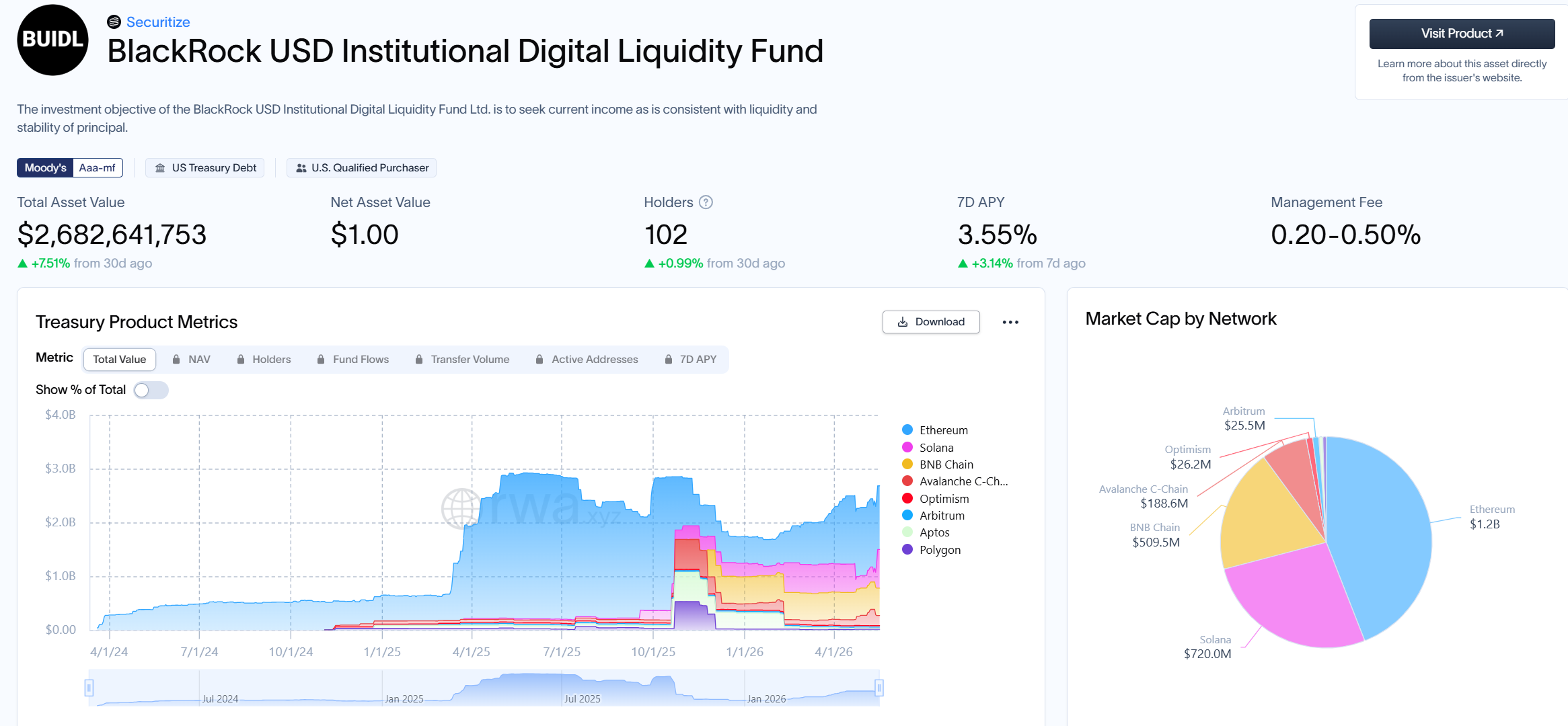
Off-chain, the same exposure requires separate intermediaries and legal agreements. He points to BlackRock’s BUIDL fund, with about $2.7 billion in assets, as an example.

The tokenized Treasury product earns roughly 4% in yield and backs stablecoins. It also serves as collateral on lending markets such as Aave.
“Tokenized assets will reach $4T by the end of 2028 (half in stablecoins and half in RWAs). This rapid increase in assets on-chain will require a huge uplift in throughput on DeFi protocols. Well-established DeFi protocols with strong risk metrics and governance should benefit the most. The asset prices of these DeFi protocols will benefit accordingly,” Kendrick stated.
In TradFi, the same multi-use profile requires splitting capital across intermediaries and siloed systems.
Standard Chartered estimates the configuration lowers the effective cost of capital meaningfully.
Three Channels for Throughput
The bank identifies three drivers for protocol revenue, with each lever compounding the others:
- More assets move on-chain
- A higher share of those gets deposited into DeFi
- A higher share again is then borrowed against.
Circle’s USD Coin (USDC) offers a working example. Its market cap and the share lent across DeFi venues are rising together.

Protocols with conservative risk metrics and professional governance stand to capture most of the inflows.
Catalyst Watch
Kendrick flags the CLARITY Act as the next major trigger for institutional migration into lending rails. Polymarket traders currently price the bill’s 2026 passage near 64%.

Standard Chartered estimates around 1,000 times more value sits off-chain than on-chain today.
Established protocols with proven risk frameworks should capture most of the upside. Newer or less audited platforms would carry sharper drawdown risk under institutional scale.
The next test will be whether large institutional treasurers begin parking tokenized funds inside open lending venues at scale.
Volume in that direction would confirm Kendrick’s framework. It would shift DeFi’s role from speculative trading venue to institutional infrastructure.
The post $4 Trillion Tokenized Assets by 2028 Could Ignite DeFi Boom, Standard Chartered Says appeared first on BeInCrypto.


BSC’s quantum-security test worked, but bigger transaction data slowed network throughput by about 40%.

- EMCD and Vnish launched an integrated mining solution combining pool services with ASIC firmware optimization.
- The partnership gives miners chip-level autotuning, live performance monitoring, dynamic load balancing, and reject-rate tracking.
- The companies say the setup can improve effective hashrate, lower energy use, and reduce losses tied to downtime or poor configuration.
EMCD, a leading crypto mining pool and digital asset services provider, announced a partnership with Vnish, the largest third-party ASIC firmware provider on the market.
The collaboration brings EMCD pool services and Vnish firmware optimization into one mining setup aimed at stronger uptime, better chip-level control, and improved profitability. New clients using both services will also receive special partner terms, giving miners added cost benefits alongside performance gains.
For miners, poor firmware settings, unstable pool connections, high reject rates, and downtime can cut into output before coins reach the wallet.
According to EMCD-reported data cited by Cryptopolitan, stock firmware configurations can reduce potential mining performance by up to 25%, while latency-related rejected shares can account for another 2% to 5% of monthly revenue loss. Separately, 1% downtime in a year equals about 3.65 days of lost operating time.
These losses carry real costs for operators.
A Joint Setup for Better Hashrate and Lower Losses
The EMCD and Vnish partnership brings pool performance and ASIC firmware optimization into one mining setup.
Vnish firmware gives miners chip-level autotuning, dynamic load balancing, and real-time performance monitoring. Operators can track machine behavior, connection quality, and reject rates in the same environment used for pool activity.
Vnish firmware can reduce energy consumption by up to 25%, improve efficiency by 8% to 20% compared with stock firmware, and increase hashrate by up to 24%.
Meanwhile, EMCD says its pool environment adds up to 99.9% uptime and low-latency connectivity.
“Mining today is defined by operational efficiency rather than nominal hashrate,” said Konstantin Zherebtsov, General Manager of Mining Pool EMCD. “Our partnership with Vnish is focused on providing miners with a proven, integrated solution that improves performance, reduces losses, and potentially might increase overall profitability.”
The value of the setup comes from managing both sides of mining performance at once. Firmware controls how efficiently each ASIC works. Pool connectivity affects how much of that work reaches the network and turns into accepted shares. Weak settings, unstable connections, and high reject rates all reduce real output.
Bradley Peak, Global Head of Sales at Vnish, said the partnership responds to a market where miners are being forced to protect every percentage point of profitability.
“With Bitcoin’s price and nBits where they are today, many miners are simply shutting off. Staying profitable now comes down to maximising miner efficiency while also minimising firmware and pool fees. This partnership enables both.”
By combining Vnish firmware with EMCD’s pool services, miners get more control over the full performance path,” said Bradley. “They can see how each machine performs, how the connection behaves, where rejects appear, and where tuning can improve returns. The goal is higher efficiency and stronger profitability without additional hardware investment.”
What Comes Next
EMCD and Vnish plan deeper product integration, more automation, stronger monitoring, and flexible pricing for different miner segments.
For miners, the announcement fits a market where margins depend on effective hashrate, energy use, uptime, and pool stability. Better returns now come from the full operating setup, including the ASIC, firmware, monitoring tools, and pool connection.
About EMCD
EMCD is a global crypto mining pool and digital asset platform. It combines mining pool services with wallet, P2P, yield, liquidity, and white-label tools.
Founded in 2017 as an industrial BTC mining operation in Europe, EMCD now serves individuals and businesses worldwide. Users manage digital assets on the platform, while businesses use EMCD APIs for branded Web3 products.
About Vnish
Vnish is a developer of ASIC firmware solutions for cryptocurrency mining. Its firmware helps miners optimize machine performance through chip-level autotuning, voltage and frequency control, thermal management, and flexible performance profiles.
According to the Cambridge Digital Mining Industry Report, Vnish held the largest share among third-party ASIC firmware providers in 2025, with 26.4% of the surveyed firmware market. Vnish also provides monitoring and management features that help operators track device health, stability, errors, and efficiency across mining fleets.
The post EMCD and Vnish Bring Pool and Firmware Optimization Into One Mining Setup appeared first on BeInCrypto.


Key takeaways
- PI is up by nearly 2% as bulls attempt to push the price above $0.1500.
- The ongoing token unlock could still put further pressure on the coin.
Bulls look to push PI above $0.1500
Pi Network (PI) has been one of the worst performers among the leading cryptocurrencies in recent days.
The coin is down 12% in the last seven days, underperforming compared to the broader crypto market. However, it has slightly bounced back after adding 2% to its value since Monday.
PI is now trading at $0.1507 on Tuesday, thanks to the outflows from Centralized Exchanges (CEXs).
Despite that, PI could continue to face selling pressure as the mainnet migration surpasses CEX withdrawals.
Data obtained from PiScan reveals that 2.55 million PI tokens left exchanges over the last 24 hours, a figure that typically signals a surge in buying activity.
While the outflow to CEXs will reduce selling pressure on PI, it is still not enough to absorb the migration tokens.
Migration statistics reveal that 4.36 million PI tokens were transferred from testnet to mainnet on Tuesday, enabling holders to deposit this unlocked supply on CEXs.
This latest development comes after 7.65 million PI tokens were migrated on the previous day.
Will the $0.1500 support level hold?
The PI/USD 4-hour chart remains bearish and efficient despite PI adding 2% to its value in the last 24 hours.
The short-term recovery might not hold as the selling pressure is currently outweighing the demand.
Momentum indicators reinforce this pressure, with the Relative Strength Index (RSI) hovering just above oversold territory near 34.
PI’s Moving Average Convergence Divergence (MACD) line on the 4-hour chart also remains slightly negative below the zero line, adding further confluence to the bearish narrative.

If the sellers continue to dominate, PI could drop below the $0.1500 and test the support levels at $0.1440 and $0.1345 in the near term.
However, if the bulls regain control and push the price above the $0.1605 resistance level, it could allow PI to extend its rally towards the 100-period EMA at roughly $0.1684.

Wales breaking news plus weather and traffic updates (Tuesday, May 19)
Amesite stock soars 190% on major enterprise customer win

Crypto wrench attacks push Coinbase security bill to $8.7M

Manchester United reach agreement with Casemiro over contract clause amid transfer speculation

US brings back mandatory military draft registration

Steven Gerrard disagrees with Gary Neville over ‘shock’ Chelsea and Arsenal claim | Football

Pray this and watch God change your financial situation. #faith #financialincrease #livingfaith

PSA: We all need to invest and have a financial advisor. Invest and get your advisor at WealthMore.

BRAD: ”XRP IS ABOUT TO LAUNCH”?!?!?! (XRP = HEAVILY UNDERPRICED)
-

 Crypto World3 days ago
BloFin War of Whales 2026 Grand Prix opens registration for $5M trading championship
-

 Fashion4 days ago
Weekend Open Thread: Theory – Corporette.com
-

 Crypto World4 days ago
E-Estate Announces 1 Year Live: Washington DC Summit as Real Estate Tokenization Enters Its Next Phase
-

 Tech4 days ago
Tech Moves: Microsoft AI leader jumps to OpenAI; former AI2 exec joins Meta; and more
-
Crypto World6 days ago
Bitcoin Suisse expands with Digital Asset License and Investment Business Act Registration Approval in Bermuda
-

 Politics7 days ago
Pakistan to enter Chinese capital market as war inflation bites
-

 Crypto World6 days ago
Bitcoin Suisse expands with Digital Asset License and Investment Business Act Registration Approval in Bermuda
-
 Crypto World5 days ago
Google’s Gemini AI Predicts Incredible Solana Price by the End of 2026
-

 Business4 days ago
H&R Real Estate Investment Trust (HR.UN:CA) Q1 2026 Earnings Call Transcript
-

 Tech4 days ago
Google reimburses Register sources who were victims of API fraud
-

 Sports4 days ago
Napoleonic enters 2026 Doomben 10,000 field via Abounding withdrawal
-

 NewsBeat7 days ago
Comment on Keir Starmer surviving the day as Prime Minister like a turd that wont flush
-
 Entertainment5 days ago
Zara Larsson Has Blunt Response To Chris Brown Diss
-

 Fashion7 days ago
The Best-Kept Makeup Secret for a More Defined Face
-
 Crypto World6 days ago
Two AI Tokens Lead May Rally, But Risks Are Rising
-

 Politics7 days ago
Palestine’s flag becoming a regular sight at European football stadiums
-

 Fashion2 days ago
On the Scene at Gucci’s Cruise Show in New York City: Mariah Carey, Kim Kardashian, Lindsay Lohan, Iman, and More!
-

 Politics7 days ago
The Trial of Majid Freeman, Verdict
-
 Tech6 days ago
Why AI is making typography a boardroom conversation
-

 Crypto World4 days ago
BeInCrypto 100 Institutional Awards Nomination: KAST for Best Digital Assets Neobank and Best Digital Assets Fintech
You must be logged in to post a comment Login