The artificial intelligence boom is leading to fights in some states over growing utility profits, as governors, attorneys general and others protesting rising electricity bills say cash-strapped residents are stuck in a broken system.
Officials and lawmakers in at least six states — including Arizona, Indiana, Maryland, New Jersey, New York and Pennsylvania — are going to new lengths to try to block rate increases proposed by utilities. Some are pressing utilities to completely change their model for financing major system upgrades.
The push comes during a midterm election year in which affordability is the leading theme in Democrats’ attempts to loosen Republicans‘ control of Washington.
Arizona Attorney General Kris Mayes, a Democrat who is seeking reelection this year, is challenging two utility rate increase requests in front of the state’s utility regulatory board.
Advertisement
“I felt like it’s never been more important to stand up against the blatant corporate greed of our monopoly utilities in Arizona,” Mayes said in an interview.
The fights are getting noticed on Wall Street
The voracious energy demands of AI data centers have driven up electric prices in some regions and launched a moneymaking energy-sector construction boom.
For years, consumer advocates have tried to challenge the size of a utility’s investment return in front of regulators. But maybe not like this, consumer advocates say.
Advertisement
“We’ve entered into this era of expensive energy and (demand) growth, and we’re seeing utility profits at record highs and rising utility bills,” said Matt Kasper of the Energy and Policy Institute, which pushes utilities to keep rates low and use renewable energy sources.
Utilities were long viewed as a stable haven for investors, with a reliable source of income and predictable demand. Because of that lower risk, the utility’s sector investment returns are typically on the low end compared to other sectors, analysts say.
However, utilities — many of which are owned by multibillion-dollar, for-profit parent companies — have seen share prices perform particularly well during the data center expansion.
The investment returns that utilities get from regulators aren’t the sole reason consumers’ bills are rising, but researchers suggest they are a contributing factor. In March, the Energy and Policy Institute issued a report that said the profits of 110 for-profit utilities rose from just under $39 billion in 2021 to over $52 billion in 2024.
Advertisement
Mark Ellis, a former utility executive-turned-consumer advocate, said about 10% of the typical customer bill is what he called a for-profit utility’s “excess profit,” above what might be considered reasonable under long-standing Supreme Court precedent.
Instead of regulators setting returns above what the market might require, utilities should instead shop for the lowest-cost investor cash, much like someone might shop for the lowest interest rate on a loan, Ellis said.
Paul Ferraro, an economics professor at Johns Hopkins University, said that targeting utility investment returns is a political action, not an economic action.
“That’s an action that’s aiming to address the deep social disagreements we have about who should benefit from essential infrastructure,” Ferraro said. “But it’s not going to address the key challenges that the electricity sector is facing.”
Advertisement
That includes investment in modernization, expansion, renewable energies and distributed sources of power, Ferraro said.
‘Affordability’ has reached corporate earnings calls
Travis Miller, an energy and utilities analyst for Morningstar, said utility executives on earnings calls are emphasizing efforts to cut costs or protect residential customers from the cost to supply electricity to data centers.
“Affordability is probably the number one issue that executives and investors are thinking about right now in the utility sector,” Miller said.
Advertisement
If rates aren’t affordable currently, there’s no way that utilities can get the rate increases they need to boost earnings and dividends for investors, Miller said.
Utilities point to federal data showing that home electricity bills as a proportion of household income have fallen in the past couple decades. They defend the investment returns they are granted by state regulators as critical to raising the cash they need to appropriately maintain electric grids and ensure reliability for millions of people.
They also warn that investors will simply send their cash to utilities in other states that promise higher returns.
Critics call that fearmongering.
Advertisement
Earlier this month, the New Jersey Board of Public Utilities launched what its president, Christine Guhl Sadovy, called one of the most consequential regulatory reviews in a generation, to question how utilities “should earn revenue in a modern energy system.”
In recent weeks, Pennsylvania Gov. Josh Shapiro pressured PECO, the Philadelphia-area utility subsidiary of Exelon Corp., to withdraw a 12.5% rate increase, or $20 per month extra for the average residential customer. Shapiro, a Democrat running for reelection this year, then issued a letter to utility executives, taking a whack at utility profits and saying that the “20th century utility model is broken.”
“We can no longer simply prioritize corporate profitability to drive infrastructure development,” Shapiro wrote.
In a note to investors, one analyst called it “Quaker State Sticker Shock,” and the share prices of companies that own Pennsylvania-based utilities lagged their peers in the following days.
Advertisement
For its part, Exelon — the Chicago-based parent of Commonwealth Edison, PECO, Baltimore Gas and Electric and several other utilities — emphasized that it recognizes the importance of affordability.
Calvin Butler, Exelon’s president and CEO, told analysts on its first-quarter earnings call May 6 that it was committed to justifying what it spends and keeping energy bills as low as possible. Its decision to withdraw its rate increase request came after conversations with “stakeholders” who said, “Hey, if you could partner with us to address the affordability issue and lean in, timing is not the best right now,” Butler said.
In Indiana, Republican Gov. Mike Braun appointed a new slate of utility commissioners with a mission to face down rate increases.
Their first big test is a request by AES Indiana for a 10.1% increase, or $193 million a year more from ratepayers, said Ben Inskeep, program director for the Indianapolis-based consumer advocate Citizens Action Coalition.
Advertisement
As part of it, AES Indiana — whose parent company is being taken private in a $33.4 billion deal led by private investment giant BlackRock — sought a 10.7% return on its cash.
Inskeep said an 8% return — instead of 10.7% — would slash the proposed rate increase nearly in half.
In Arizona, Mayes is challenging a pair of 14% proposed increases that she said could be dramatically reduced if the companies are simply paid the cost to maintain reliable service.
“It’s becoming unbearable for the people in Arizona,” Mayes said. “And I think we have to fight back.”
Advertisement
___
Follow Marc Levy at http://twitter.com/timelywriter
Former TOWIE star Pete Wicks has had a chequered love life but he was told he “needs a nice homely woman” in his life after meeting a succession of “wrong ones”
TV personality Pete Wicks has been told he “needs a nice homely woman” – and he’s even been advised when the meeting will take place.
Advertisement
The former TOWIE star has had a colourful love life over the years but at the age of 37 is still yet to settle down. His past romances include former TOWIE castmates Jess Wright, Megan McKenna and Shelby Tribble and I’m A Celeb star Maura Higgins, while he has recently been linked to his pal Olivia Attwood.
Pete recently appeared on the Grime Gran podcast with the viral internet sensation, real name Margie Keefe.
Margie claims to be a psychic medium and told Pete some home truths about his love life.
She said: “I think, and I know I’m right, you need a nice homely woman and you’ll meet one when you least expect it. She’ll come into your life. I want an invite to your wedding.
Advertisement
“I’m sure that you will meet someone and it will be the love of your life. You’ve been meeting the wrong ones.” Pete replied with: “Fingers crossed,” before joking: “It could be you. When you least expect it.”
After joking that he was going to “say something really inappropriate there,” Pete added: “If I do, I’m going to have to bring her to see you. I don’t know you particularly well but the time I’ve spent with you, you’re someone’s opinion who matters to me and I trust.”
Grime Gran, who is in her 80s, shot to prominence when her grandson, grime videographer RiskyRoadz, started filming her interviewing major music stars over a cup of tea.
Advertisement
She recently started her own YouTube channel, and along with Pete has interviewed TV and radio presenter Rylan Clark and Inbetweeners star James Buckley and his wife Clair.
Recently Pete was left far from impressed as his mate Sam Thompson teased his rumoured relationship with Olivia Atwood. Following the breakdown of the former Love Island’s marriage to Bradley Dack, Olivia has been seen growing closer to her good friend Pete.
Olivia, 35, and Pete were seen sharing a kiss on what appeared to be a cosy date night and the former Towie star was spotted on airport duties as Olivia returned from a girls’ holiday.
Advertisement
While neither will confirm they are dating, ex Made In Chelsea man Sam couldn’t help but make a sarcastic comment about their situation.
Speaking on the latest episode of the Staying Relevant podcast, Pete’s best pal Sam discussed the duo attending Olivia’s birthday party over the weekend with Sam’s girlfriend Talitha Balinska. As they chatted, Sam joked that him and Pete had both been partying with their ‘other halves.’
Pete immediately looks unimpressed at the comment and moved to shut down the topic.
Several dog breeds are currently banned in the UK, with ownership of these animals not only being against the law, but selling, abandoning, rehoming, or breeding from them also carrying serious legal penalties.
Advertisement
At present, it is illegal in the UK to own a Pit Bull Terrier, a Japanese Tosa, a Dogo Argentino, a Fila Brasileiro, or an XL Bully. Whether a dog falls into a prohibited category is determined by its physical characteristics, rather than its registered breed or name.
Anyone found to be keeping a banned dog risks having it confiscated, even if no complaints have been made and the animal has not been seen acting aggressively. Proposed new legislation could potentially see around 67 dog breeds, which suffer due to selective breeding for cosmetic reasons, face prohibition across Britain.
This includes well-loved breeds such as shih tzus, Welsh corgis, and dachshunds. PETA has published the full list of all 67 breeds on its website.
Full list of dog breeds that could be banned in the UK
Affenpischer
Advertisement
American Cocker Spaniel
Australian Cattle Dog
Australian Shepherd
Basset
Advertisement
Basset Bleu
Basset Fauve
Beagle
Beauceron
Advertisement
Bergamasco
Bloodhound
Border Collie
Boston Terrier
Advertisement
Boxer
Bracco
Brittany
Brussels Griffon
Advertisement
Bullmastiff
Bulldog
Cairn Terrier
Cardigan Welsh Corgi
Advertisement
Cavalier King Charles Spaniel
Cesky Terrier
Chihuahua
Chow Chow
Advertisement
Clumber Spaniel
Dachshund
Dandie Terrier
Dogue de Bordeaux
Advertisement
French Bulldog
Glen of Imaal Terrier
Grand Basset
Great Dane
Advertisement
Japanese Chin
King Charles Spaniel
Lancashire Heeler
Lhasa Apso
Advertisement
Mastiff
Mudi
Neapolitan Mastiff
Newfoundland
Advertisement
Norfolk Terrier
Norwich Terrier
Old English Sheepdog
Pekingese
Advertisement
Pembroke Welsh Corgi
Petit Basset
Polish Lowland
Pug
Advertisement
Pyr Mastiff
Pyr Shep
Rough Collie
Schipperke
Advertisement
Scottish Terrier
Sealyham Terrier
Shar Pei
Shetland Sheepdog (Sheltie)
Advertisement
Shih Tzu
Skye Terrier
Smooth Collie
Spanish Water Dog
Advertisement
St Bernard
Staffordshire Terrier
Sussex Spaniel
Swedish Vallhund
Advertisement
Tibetan Mastiff
West Highland White Terrier
If this prohibition becomes legislation, licensed breeders would be banned from selling these breeds. Nevertheless, any dogs currently alive would remain legal.
PETA confirmed that current dogs would continue to be available for rehoming through rescue centres.
Reproductions of works by Monet, Picasso and Van Gogh are being hung in town centres to bring art closer to communities
Masterpieces from the National Gallery are being displayed in the London suburb of Croydon as part of a travelling project designed to bring art closer to local communities.
High-quality reproductions of works by Claude Monet, Pablo Picasso, JMW Turner and Vincent van Gogh are on show in prominent town centre locations, including Croydon Minster and Queen’s Gardens.
Advertisement
The Croydon displays form part of Art on Your Doorstep, a three-year initiative that aims to share paintings from the national collection with audiences beyond the gallery’s London base in Trafalgar Square. The programme runs until 5 July, and also features a series of free exhibitions in Coulsdon, New Addington, Purley, Thornton Heath and Upper Norwood.
Advertisement
Further stops are planned for 2026, including Torquay, Derry, Birstall, near Bradford, and the Isle of Wight, extending the reach of the scheme across the UK.
In Essex, the Creative Mile Brentford Art Trail will collaborate with residents to identify unexpected settings for the artworks, from high streets and community venues to public parks. Locals will help decide which pieces are shown, embedding the project within each area it visits.
Works from the National Gallery are going on tour as part of Art on Your Doorstep, an initiative to share paintings beyond a gallery space
Advertisement
Hannah Widgington, exhibitions manager at the National Gallery, said: “The trail will offer a rare chance to encounter these works beyond the familiar gallery walls and weave them into everyday life. Local residents will help select the artworks featured on the trail and will contribute their own creative responses.”
Images: The National Gallery
Advertisement
Be part of the solution
At Positive News, we’re not chasing clicks or profits for media moguls – we’re here to serve you and have a positive social impact. We can’t do this unless enough people like you choose to support our journalism.
Give once from just £1, or join 1,800+ others who contribute an average of £3 or more per month. Together, we can build a healthier form of media – one that focuses on solutions, progress and possibilities, and empowers people to create positive change.
More Tube and bus strikes are fast approaching, threatening another challenging week for commuters.
The RMT union has announced two 24-hour walkouts, kicking off at midday on Tuesday, May 19 and again on Thursday, May 21, with the effects spilling across four working days.
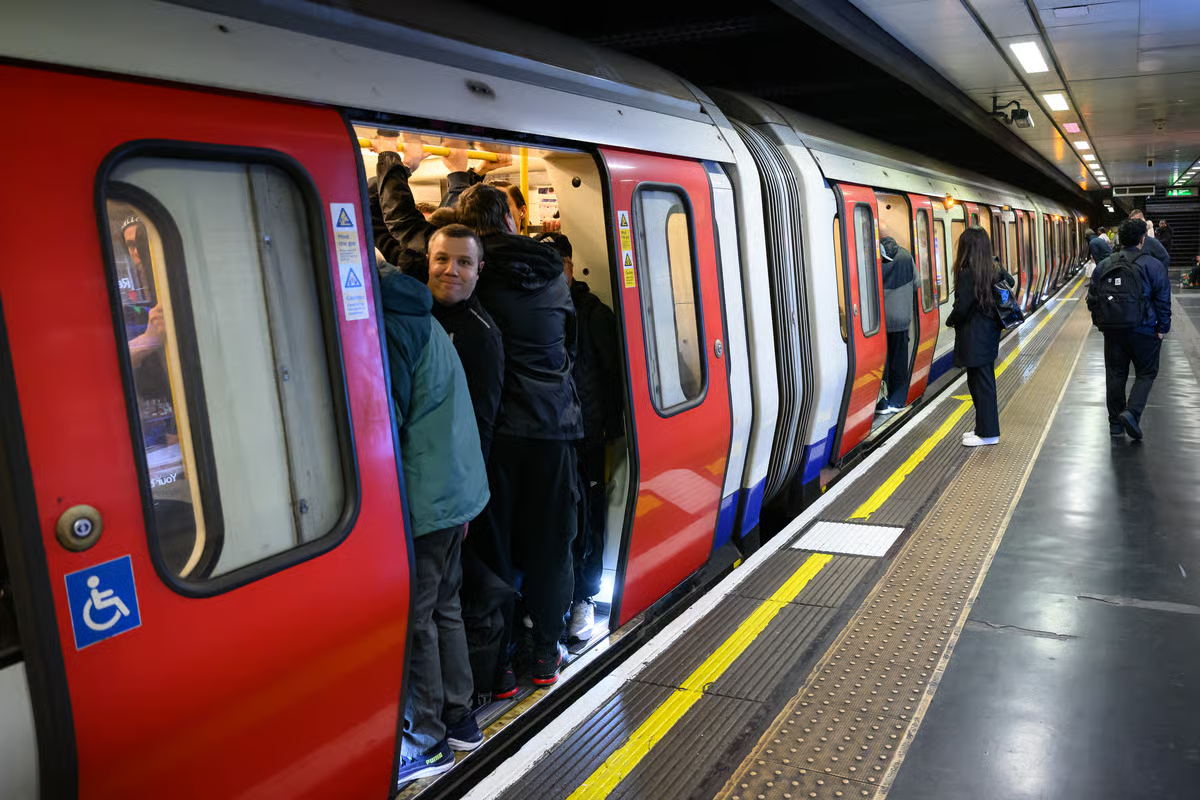
During April’s strikes, stations were packed with long queues as frustrated commuters searched for alternative routes home, with many turning to bikes to get around.
E-bike provider Lime reported a 22% jump in trips on April 23 compared with the previous week, while Forest saw evening rush-hour rides soar by more than 50%.
Advertisement
With strike action looming again, all signs point to a repeat of that pattern.
TfL sources say they will have a clearer picture soon, but for now, Londoners might want to start thinking about a backup plan.
Commuters squeeze into busy train carriages during strike action on April 21
Getty
Everything we know about the upcoming Tube and bus strikes
Advertisement
Strikes are planned by some Tube drivers from midday on Tuesday, May 19, to Wednesday, May 20, and again on Thursday, May 21 to Friday, May 22.
Under the proposals, the working week for most drivers would be cut from 36 to 35 hours, but contractual hours would not change due to the introduction of paid meal breaks.
This means, essentially, that drivers would work longer days but fewer days each week and fewer overall hours each week.
RMT instead wants a 32-hour week over four days, meaning drivers would work three fewer hours each week for the same salary.
Advertisement
Drivers belonging to the union Aslef will not be participating in the strike, meaning that most Underground lines will be able to operate on a reduced service.
But disruption is expected across the Underground network.
Members of the Rail, Maritime and Transport union (RMT) at the Queen’s park depot picket line during the strike action in April
PA
Only the Elizabeth line, the DLR and London Overground services will be operating as usual.
Advertisement
A spokesperson for Aslef previously said they were “surprised that the RMT has decided to take this action”.
The union has agreed to the voluntary four day working week, saying it gives drivers an extra 35 days off a year “in return for some fairly minor changes to working conditions”.
“It will be the first strike in the history of the trade union movement designed to stop people having a shorter working week and more time off,” Aslef’s spokesperson added.
Further 24-hour strikes are planned for Tuesday, June 16 and Thursday, June 18.
Advertisement
London bus controllers strikes
Meanwhile, further strike action by Transport for London bus workers is taking place on Thursday, May 21, and Friday, May 22, in an ongoing dispute about rota changes.
Walkouts by over 150 bus controllers and network traffic controllers will coincide with the strike action taken by London Underground drivers.
Bus controllers and network traffic controllers do safety critical roles for TfL, which include dealing with incidents and accidents, managing bus stations and putting in place bus stop closures and diversions due to traffic or emergencies such as accidents.
The injured man was taken on to hospital following the incident
A man was taken to hospital after being punched in the head and knocked unconscious in a weekend assault.
Advertisement
Police in north Belfast are appealing for witnesses and information following the incident in the Tomb Street area in the early hours of Sunday morning, May 17.
Police received a report at around 12.30am that a man had been punched to the head by another male and knocked unconscious.
Officers attended the scene and the injured man was subsequently taken on to hospital.
Advertisement
A PSNI spokesperson said: “Our enquiries are ongoing and we would appeal to anyone who was in the area at the time and has any information, including dash-cam, CCTV or other video footage, to contact police on the 101 number, quoting reference 50 of 17/05/26.”
If your neighbour’s hedge has grown too large and is encroaching on your garden, it’s important to know your legal rights and the boundary rules before you start trimming.
Arguing with your neighbours is never enjoyable, no matter the cause. Disputes over gardens are very common, and determining who’s right isn’t always straightforward.
Advertisement
Take, for instance, a situation where your neighbour’s hedge becomes overgrown and begins creeping into your garden space. You may feel tempted to cut back the branches, but before grabbing the secateurs, it’s important to understand what’s permitted by law and what crosses the line.
Not sticking to the regulations could get you into trouble, and your neighbour might even pursue legal action against you for property damage.
Based on the official government website, you’re allowed to trim your neighbour’s hedge if it extends into your property from their home or a public highway – but only under specific circumstances.
It’s only permissible to cut back up to the property boundary. If you go beyond this, your neighbour could pursue legal proceedings against you for damaging their property.
Advertisement
Your neighbour has a duty to care for their hedges so they don’t damage your property or grow excessively tall. If any damage does occur, your neighbour may be held responsible.
To prevent potentially breaking the law, it’s recommended to check who actually owns the hedge before trimming it. The solicitors at Bonallack and Bishops said: “If it transpires that you have trimmed or moved a hedge which belongs to someone else, you could be held liable and forced to pay substantial legal costs.
“There are no hard and fast rules with regards to boundary ownership, and the only way to find out who owns a boundary border is to check the deeds at the Land Registry. Often, there’ll be no definitive answer and it’ll ultimately be a shared responsibility.”
Advertisement
On the other hand, if your hedge has spread so that it extends over your neighbour’s property, they are entitled to trim back the portion that has crossed the boundary line, though they must return any cuttings to your land.
If any trimming occurs on your side of the boundary, this could be considered an offence under the Criminal Damage Act 1971, unless there’s a lawful excuse.
You are within your rights to pursue a civil claim for any resulting damage, though it’s always recommended to attempt a conversation with your neighbour beforehand.
Advertisement
If confronting them feels daunting, consider writing a letter that clearly outlines the issue while keeping strictly to the facts.
Earlier this month it was reported that Glenn Gibbins, who was recently elected as a Reform councillor in Sunderland, had complained about the “amount of Nigerians in town” in a social media post made in 2024.
According to the campaign group Hope Not Hate, the later-deleted post read: “Should melt them all down and fill in the pot holes!!”
Speaking to Sky News’s Sunday Morning With Trevor Phillips, Conservative leader Mrs Badenoch branded the comments made by Mr Gibbins as “disgusting” and said that it “worried” her that Reform UK deputy leader Mr Tice would not directly condemn it.
Advertisement
She said: “I think that was a disgusting comment that that Reform candidate made, and the Reform (deputy) leader… Richard Tice, wouldn’t even condemn it.
“That’s what I’m worried about. People say all sorts of stupid things, they should get slapped down when they do that.
“We cannot have a climate of violence against people based on their ethnicity in this country, but you need the leaders of the party, you need the senior ones, to be able to say that’s not what we’re about, that we’re very much against it. When they don’t say that, then we need to be worried.
“And I was really shocked when Richard Tice was interviewed that he would not condemn those comments.”
Advertisement
Last week, Mr Tice was asked whether he was happy for someone with those views to represent the party on BBC’s Sunday With Laura Kuenssberg programme.
In response he said: “This weekend we are celebrating our incredible successes.
“Like any party, we have internal party processes to look where people have said or done the wrong thing.”
He continued: “I condemn everything that is wrong and inappropriate.
Advertisement
“Voters have heard all of this smearing and this sneering against all of us, and they have voted for more Reform.”
A Labour Party spokesperson later criticised his alleged failure to “call out clear racism”, adding: “It speaks volumes that Richard Tice tried to brush off these comments.”
Mr Tice later posted on X: “I literally said in the interview that I condemn anything that is wrong or inappropriate. Which obviously includes those (Mr Gibbins’s) remarks: simple.”
The Hovercraft Museum, Lee-on-Solent, Hampshire has been named “Volunteers of the Year” at the prestigious Museums + Heritage Awards 2026, recognising the extraordinary contribution of its volunteer team in sustaining one of the UK’s most unique and nationally significant collections.
TfL said on its site that no service is expected on the:
Circle line,
Piccadilly line,
Metropolitan line between Baker Street and Aldgate, and
the Central line between White City and Liverpool Street
Though “Service is expected on all other lines,” this will be reduced. The TfL added that “disruption to journeys” is expected; disruptions may continue later into the week.
What other transport links are open?
Services including buses, the Elizabeth line, the DLR, and the London Overground aren’t going to be on strike during these days. They are, however, predicted to be incredibly busy.
Why are these strikes happening?
Advertisement
It started with a four-day work week.
The Associated Society of Locomotive Engineers and Firemen (ASLEF), a train drivers’ union which represents thousands of Tube drivers, previously campaigned for a four-day work week, which the TfL recently began trialling on an optional basis in their Bakerloo line.
But RMT, a trade union covering the public transport sector more broadly, has said that they’re not on board with the “compressed” work week, claiming it packs five days’ work into four in a manner which could impact the safety of drivers and passengers.
RMT members are the ones striking in these upcoming cases.
Advertisement
The union also claimed it could mean drivers only get 24 hours’ notice before their shifts are announced and that TfL “U-turned” on negotiations.
In response, TfL pointed out that the four-day offering is completely optional and said it could help to make services more reliable and flexible.




























































You must be logged in to post a comment Login