The 30-year-old was a ‘temporary resident’ in Vietnam at the time of his death
A Cambridgeshire man died of ‘traumatic injuries’ after a crash in Vietnam, an inquest has heard. Luke Khushil Vaja, aged 30, died on April 16, 2025 in Da Nang City, Vietnam. A written inquest into his death, carried out by Coroner Elizabeth Gray, concluded he died of “multiple traumatic injuries”.
Advertisement
The inquest read that Vietnam Police were called to a single-vehicle crash at the intersection of Tran Hung Dao, Le Van Duyet, Van Don, Nai Hien Dong Ward, Son Tra District, Da Nang City, Vietnam at around 6.25am on April 16. Mr Vaja was found dead by police at the scene, next to a two-wheeled motorbike.
A police report said the incident was a “self-inflicted traffic accident”. The motorbike found next to Mr Vaja was noted to be “slightly damaged”.
After his death, Mr Vaja was brought back to the UK for a CT post mortem to be carried out. This post mortem confirmed his cause of death which was “consistent with reports of a single-vehicle collision”.
The inquest also read that Mr Vaja’s family requested more details from Vietnam Police, including CCTV footage, images of the crash and blood test results. The family has not yet received this.
Advertisement
The family were also advised by the police force that an “investigation is still in progress”. Coroner Gray expressed her condolences to the family and friends of Mr Vaja.
A benefits claimant died less than a week after telling call-handlers he was going to kill himself. Andrew Halliday, 41, had struggled with his mental health but left his job just three months before the tragedy
A benefits claimant died less than a week after telling Government call-handlers he was going to kill himself when his Universal Credit payment fell to £37 for a month. Hard working Andrew Halliday, 41, had struggled with his mental health for many years, an inquest heard. He had been forced to give up his his well paid telecoms job as a result. But in the days before his tragic death on Jan 6, 2025, he kept looking for work and had applied for a job interview.
Advertisement
But he had been telling NHS professionals and DWP workers that a reduction in his January payment to £37.50 left him fearing homelessness. During an inquest at Northumberland Coroners’ Court, Assistant Coroner Paul Dunn recorded a formal conclusion of suicide.
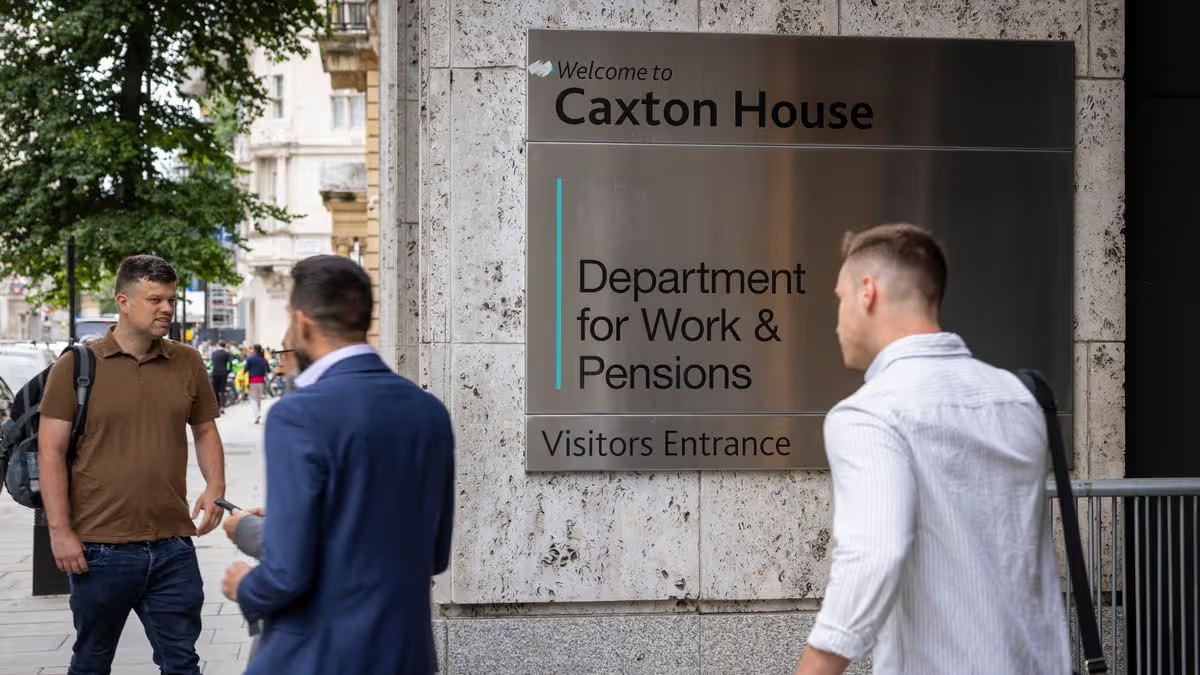
The inquest heard evidence from a report produced by Julie Inkster of the Department for Work and Pensions, along with medical reports, including one from psychiatry doctor – Dr Barbara Salas Revuelta – who had seen Mr Halliday days before his death.
Advertisement
The DWP investigated the circumstances of Mr Halliday’s death, the coroner said, highlighting an extensive report that was entered into evidence in the case. Mr Dunn said the report, produced by Julie Inkster, was “in regard to the fact that the deceased had mentioned that one of the underlying reasons for his mental health deteriorating had been a reduction in his Universal Credit”. Mr. Dunn said the report highlighted how, at the end of December 2024 Mr Halliday had made several attempts to query why his Universal Credit payment for January would be just £37. The inquest heard how he had been told this was due to the fact he had received back pay from a previous employer. However, Mr Halliday had, the inquest heard, received the back pay in October 2024 and used this to pay off debt.
It was taken into account for his January Universal Credit payment because HMRC was notified of this payment between the December assessment period which began on November 30.
Speaking after the hearing, a family member stressed that Andrew had held a well-paid job for his entire adult life and had only started claiming benefits three months before the tragedy.
“The loss of the benefits was the final blow,” said the relative. “He made about £80,00-a-year and had to take a break because of his mental health; he had never claimed benefits before. He took a sick leave and decided to leave the role to have some time to himself.
Advertisement
“The last paycheck in December affected the January benefits.”They said that because he had received that money, they had to cut his January benefit. But that December payment had gone toward his December bills. He rented, but he still had bills to pay.
“He was not sanctioned, it was a reduced payment. He looked for a job, missed no appointments, and had interviews for positions with much lower salaries to ensure he was doing what he was supposed to do.
“He had not been off work for long, it was around three months. The family believes this led to his suicide. He was passed from pillar to post, it was a box ticking exercise. “We spoke on the day he died, he called me and I went around to see him but it was too late. I was with him and called the ambulance; he called me on the Sunday afternoon and he died that Sunday night. He was still conscious when I got there. But they had to switch off his life support.” They added: “We felt there was no point in talking to the DWP. You just get passed around. No one will take any responsibility. There will be no accountability for it, he reached his last pay in December, which is why they made the decision.” The inquest heard that he had called the Universal Credit phone line again to query the January 2025 payment: “He said he had no money remaining for rent or bills and he could not get support from the council and this was leaving him at risk of homelessness.”
In the report, Mr Halliday is quoted as having said to a call handler: “Can I get any support or am I going to end up offing myself?” The call handler then requested an ambulance attend Mr Halliday’s address.
Advertisement
The inquest heard how call handlers follow a six-point plan in cases like Mr Halliday’s, where a safeguarding risk is identified, and that this was followed. The inquest also heard how the DWP investigation found that Mr Halliday’s holiday payment had been treated correctly – and that any challenge to this would likely have been unsuccessful.
The assistant coroner Mr Dunn read from medical reports as to Mr Halliday’s cause of death and the healthcare he had received in the months and days before he died.
In the days before he died, he was visited by the mental health crisis team and community treatment team – but that he was not always able to engage with visits.
Mr Dunn added: “The conclusion that will be recorded is one of suicide. I am satisfied that on the balance of probabilities that at the time that Andrew died he had intentionally taken an overdose.”
Advertisement
In a statement following the conclusion of the inquest, a DWP spokesperson said: “Our condolences are with Mr Halliday’s loved ones, friends, and family.”
The DWP explained that when a claimant’s maximum award is assessed, they are then subject to an “earnings taper” which reduces what they can receive based on any income they may have.
* For confidential support from volunteers, including for suicidal thoughts, Samaritans can be contacted free, on 116 123 or by email to jo@samaritans.org
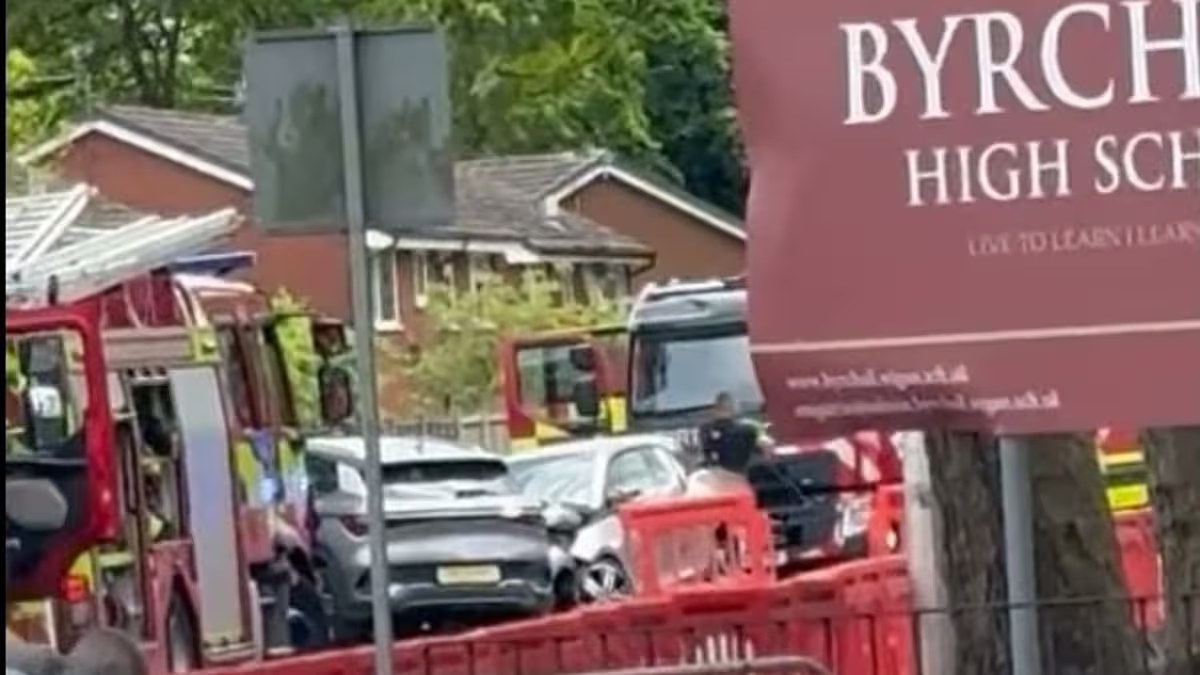
A road outside Byrchall high school in Wigan is shut this afternoon following a serious road traffic collision. (Image: Facebook/Jack Roberts )
There is a significant police presence in Ashton-in-Makerfield this afternoon (May 6) following a ‘serious’ crash near to a school.
Local councillor Danny Fletcher said on Facebook that a ‘serious’ road traffic collision had taken place on Warrington Road near Byrchall High School at around 2pm.
Roads in the area are shut with ambulances and fire engines in attendance. “Police have confirmed there’s no wider risk to the public,” Cllr Fletcher said.
Advertisement
Click here to get the biggest stories straight to your inbox in our Daily Newsletter
“The school is locked down purely to support the emergency response.”
A message sent out to a parent at 2pm read: “Please be reassured, all students are safe and being supported by their form teachers.
“We are currently working on an end of the day strategy with emergency services and will update ASAP.”
Advertisement
Greater Manchester Police has been contacted for more information. We have a reporter on the way to the scene.
This is a live incident – updates to follow.
Advertisement
Road closures in place
Lodge Lane coming off the East Lancs and M6 northbound into Ashton-in-Makerfield appears to be shut, according to Google Maps.
Image: Google Maps
First photos from the scene
Advertisement
The first photos from the scene show several fire engines and police cars at the scene, with two damaged cars being loaded onto a trailer.
Parents and carers can be seen waiting outside the entrance to Byrchall High School.
A road outside Byrchall high school in Wigan is shut this afternoon following a serious road traffic collision.(Image: Facebook/Jack Roberts )
A road outside Byrchall high school in Wigan is shut this afternoon following a serious road traffic collision.(Image: Facebook/Jack Roberts )
Operation Epic Fury is over. Or at least, that’s what the US secretary of state, Marco Rubio, announced on May 5, describing any further US action in the Gulf as purely “defensive”.
Rubio’s insistence that the conflict the US and Israel launched on February 28 achieved its objectives is open for debate. But this change of tone and terminology is likely to reflect arguments that raged in the US Congress as the war approached the two-month mark at the end of April, about whether the Trump administration must seek congressional approval for the conflict as required by US law.
The conflict has become the latest episode in a long struggle between the US Congress and the presidency over which branch of government can legitimately start wars. And, in a surprising way, Donald Trump’s actions seem to be pushing power back towards Congress.
The US constitution splits war powers between the presidency and Congress. It gives Congress the power to raise armies and declare war but makes the president the commander-in-chief of the military. That means that, in theory, you need to get Congress to agree to fund and start a war and the president to agree to wage it.
Advertisement
Since the second world war, this system has been changing. The last time the US formally declared war was in 1942 against Bulgaria, Hungary and Romania – having already declared war on Japan and Germany in December 1941. Since then, presidents have often plunged the country into hostilities on their own authority without getting a declaration of war from Congress.
Congress still needs to fund the military – but, with very few exceptions, the legislature has always done so. Individual members of Congress have generally been happy to let presidents take on the blame for starting wars. After conflicts have started, legislators have been unwilling to cut off funds for the troops in the field. As a result, Congress has given up much of its influence over decisions of war and peace.
But not entirely. The high point of Congressional pushback was in 1973, during the tail end of the Vietnam war, which by then had become extremely unpopular. In this context, Congress challenged the executive branch by passing the 1973 War Powers Resolution (also known as the War Powers Act). It’s this law that is shaping the debate over Iran today.
Advertisement
The War Powers Resolution basically repeats what the constitution says: that Congress has to start wars, but it allows for some flexibility. If there is a surprise attack on US forces, the president can act to repel that attack for 60 days before getting a declaration of war from Congress.
As reasonable as this may sound, every administration since the War Powers Resolution was passed has questioned its constitutionality and refused to be bound by it.
To be sure, some presidents have asked Congress for a statement of political support before launching a major war, as they also had done before the War Powers Resolution was passed. For instance, George H.W. Bush did so before the Gulf war of 1990-91. But when doing so, presidents have generally maintained that they did so purely to ensure national unity, and not because the War Powers Resolution required it of them.
Presidents have also launched many interventions in which they ignored the resolution entirely – as Bush himself did in Panama in 1989.
Advertisement
Unpopular war
As a result, the resolution has never acted as a meaningful constraint on presidential war-making power. But things may be changing. The war in Iran is so unpopular that Congress asserting its authority over war powers more strongly than any time since the War Powers Resolution was passed. In the process, it is turning the resolution into something that might meaningfully affect the course of the war.
A significant majority of Americans oppose the war in Iran. EPA/Olga Fedorova
One reason for this is that even Trump’s Republican supporters in Congress are aware of how unpopular this war is. Many are worried about losing their seats in the midterms later this year. As a result, Congress is stirring. Even senior Republican figures are treating the War Powers Resolution and its 60-day clock as an important constraint on the administration and demanding that the war stop or be authorised by Congress after it passes that mark.
In response to this political pressure, the Trump administration seems to be paying more attention to the requirements of the War Powers Resolution than most administrations before it.
The White House is too afraid of Republican opposition to ignore the resolution entirely, particularly when it knows that it may soon have to ask Congress for more funding for the war. Even the argument it made that the 60-day clock has paused during the ceasefire is an indication that it sees the clock as a legitimate thing in the first place.
Advertisement
If the war starts up again, Republicans will clamour for the administration to come to Congress for a declaration. This would probably trigger a major debate over the conditions that Congress wants to attach regarding strategy, goals and funding.
What this shows is that many of the checks and balances of the constitution only work when there is the political will to make them work.
The Brent East MP added: “Labour is delivering real support for families, expanding free childcare to 30 hours from nine months old alongside universal provision, saving families up to £7,500 a year, creating 100,000 new nursery places and rolling out Best Start Family Hubs.”#
EXC: The Bluebirds announced a coaching departure this week and are quickly looking to secure his successor
15:11, 06 May 2026Updated 15:12, 06 May 2026
Cardiff City boss Brian Barry-Murphy is targeting a move for a highly-rated Manchester City academy coach as he looks to reshape his backroom team ahead of next season.
Ward played a key role during Cardiff’s promotion-winning campaign and had been the only remaining member of last season’s first-team coaching staff.
Advertisement
Barry-Murphy has already begun putting his own stamp on the dugout, bringing in Kevin Gibbins from Rochdale and Lee Riley from Manchester City’s youth setup. Now, the Irishman is once again looking towards his former club in a bid to strengthen further.
Max Johnson has emerged as Cardiff’s leading target for the vacant goalkeeping coach position.
The 34-year-old is highly regarded within Manchester City’s academy structure and is understood to be keen on taking the next step in his coaching career.
Advertisement
Johnson boasts more than a decade of experience within City’s system, having joined as an academy goalkeeping coach back in 2013.
His progression has been steady, culminating in his promotion to lead academy goalkeeping coach last summer – a role that has seen him work closely with some of the brightest young talents in English football.
A switch to the Welsh capital would represent Johnson’s first move into senior football coaching, but his grounding at one of the world’s most advanced training environments is viewed as a major asset.
The decision to part ways with Ward was largely driven by Barry-Murphy’s desire to go in a different direction and recruit his own man and he is believed to have pushed for Johnson, with whom he worked at the Premier League giants. Lee Riley also has a close connection with Johnson, of course. Join the Cardiff City breaking news and top stories WhatsApp community.
Advertisement
Johnson’s coaching journey began early. Having retired from playing early in 2013, he wasted little time transitioning into coaching, taking on a part-time academy goalkeeping role at Blackpool while still finishing his playing days.
As a player, he came through the ranks at Newcastle United before going on to feature for clubs including Inverness, Blyth Spartans and Barrow. While his playing career may not have reached the top level, his coaching trajectory has been far more impressive.
Barry-Murphy’s pursuit of Johnson is the first glimpse of his intent to build towards Cardiff’s Championship campaign, starting with compiling a modern, progressive coaching team at Cardiff – one heavily influenced by the methods and philosophy he was exposed to during his time at Manchester City.
On the goalkeeper front, the future of Nathan Trott is still to be rubber-stamped, however sources last week suggested there was an optimism about making the FC Copenhagen stopper’s deal permanent.
Advertisement
With pre-season preparations already on the horizon, Cardiff will hope to move quickly to secure their preferred candidate as Barry-Murphy continues to shape his squad and staff for the club’s return to a higher level.
Our region’s political landscape could be radically reshaped, with ‘all out’ elections being held in a number of areas that have been traditional Labour strongholds.
Every council seat in Newcastle, Gateshead, Sunderland, South Tyneside is up for grabs.
One-third of the seats in both North Tyneside and Hartlepool will also be contested.
Advertisement
There are no elections for either of the county councils of Durham and Northumberland, where elections are staged once every four years and were last held in May 2025.
This is a massive and complex set of elections, with political rivals fighting over more than 5,000 seats on 136 councils across England.
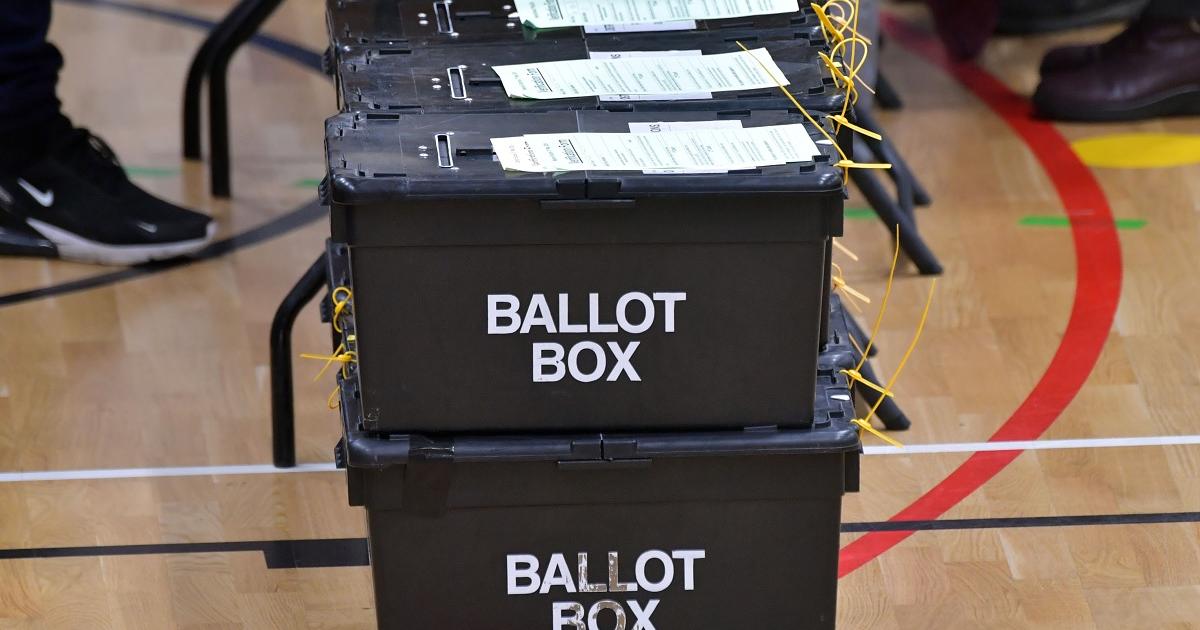
Rather than starting the process of counting votes immediately after the polls close on Thursday and declaring results overnight, most of our councils are holding their counts during the daytime on Friday, May 8.
And while counting staff in places like Sunderland and Newcastle have been famed for their speed in the past, this Friday could be a very long day – particularly for the four councils holding all out elections.
Advertisement
The fact that three candidates will be elected for each ward in Newcastle, Gateshead, Sunderland, South Tyneside means that there is a high volume of candidates standing.
The prospect of recounts and the added time taken to tally votes from ballot papers where people can support multiple candidates means there is major uncertainty among local authority staff on exactly how long the counting might take.
Based on the information we have at the moment, here is when to expect results to come through in your area:
Advertisement
Newcastle
Counting of votes will be split into two sessions, with 13 wards in the morning of Friday, May 8 and 13 in the afternoon. A first round of result declarations is expected to begin at around 11.30am, and the second from 3pm.
The city council estimates that results for all 26 electoral wards should be declared by roughly 4.30pm.
Advertisement
Gateshead
Like Newcastle, Gateshead Council’s vote counting will also be split between morning and afternoon sessions on the Friday. It is expected that all results for Gateshead’s 22 wards should be declared by 5pm.
Sunderland
Advertisement
Sunderland City Council expects that it will not declare any results before 1pm on Friday, May 8. Declarations for all of its 25 electoral wards are expected to continue until the late afternoon.
South Tyneside
The first of the results in South Tyneside’s 18 wards is expected around 12.30pm on Friday, May 8. Results will continue throughout the afternoon, with the final announcements expected after 5pm.
Advertisement
North Tyneside
North Tyneside is only holding a one-third election this year, with one councillor to be elected for each of its 20 wards. Its count will also be held in the daytime on Friday, however.
It is currently expected that the results will start to be announced at around 12.15pm and be fully declared by roughly 1.45pm.
Advertisement
Hartlepool
Hartlepool is the only council in our region staging an overnight count.12 out of its total 36 council seats are up for grabs on election day and its results are expected to have been announced by 2am on Friday, May 8.
Arsenal have qualified for the Champions League for the first time in two decades, but their red shirts still may not grace Europe’s greatest stage.
Regardless of the final’s outcome, Arsenal stand to record their best finish in the Champions League since they were denied by Barcelona in 2006.
They wore a yellow change strip in that match as goals from Samuel Eto’o and Juliano Belletti cancelled out Sol Campbell’s opener.
What kit will Arsenal wear in the Champions League final?
Advertisement
If Arsenal lift the Champions League on May 30, they may not do so in their iconic scarlet home strip.
Due to the peculiarities of the bracket system employed by UEFA in the Champions League knockout rounds.
As Arsenal were drawn into the Blue bracket, which saw them dodge the likes of Real Madrid and Manchester City en route to the final, they will be considered the away team.
Arsenal may be forced to deviate from their usual red shirt in the Champions League final
Getty / London Standard
Advertisement
Even though the final will be played on neutral ground in Budapest, one team must serve as the away side for administrative reasons.
This means that they will be the team to don a change strip should there be a kit clash.
This will certainly be the case if they face Bayern Munich, whose home kit is red and white. The Gunners could also opt to wear an away strip if they face PSG in the final, though this seems unlikely.
Former captain Michael Vaughan says it is “ridiculous” England are yet to appoint their new national selector.
The process to name the successor to Luke Wright, who announced he was stepping down on 22 January and left after the T20 World Cup concluded in March, has reached the final stages, with interviews for the position held this week.
There have already been four rounds of action in the County Championship and England are set to name their squad for the first Test against New Zealand in two weeks’ time.
“It’s ridiculous how they’re announcing a selector so late,” Vaughan said on the Stick to Cricket podcast.
Advertisement
“I wanted the selector there on 1 April, going out, having a look, gathering information.
“Luke Wright quit at the back end of Australia. We knew didn’t we?
The restored station, which now has a different name, is hoped to provide an attractive gateway to a railway site
Katie Green Senior multimedia reporter and Faye Mayern, SWNS
13:00, 06 May 2026
A disused Victorian railway station that was facing demolition to make way for a major road scheme has almost completed its brick-by-brick relocation nine miles away.
Wansford Road station in Sutton, near Peterborough, was threatened with destruction to accommodate what is now the abandoned construction of a new dual carriageway on the A47. The proposed £100 million upgrade near Wansford was scrapped last summer due to costs.
However the station, which dates back to 1867, was dismantled in April 2024 and has nearly been reconstructed in the city under its new identity, known as Woodstone Wharf Station.
Advertisement
The original Wansford Road station, constructed in brick with a limestone façade and featuring a booking office, waiting room and administration office, was built to serve Wansford residents. Following its closure in 1929, it was converted into a private home before eventually falling into disuse.
Stan Bell, who has been helping to spearhead the project at The Wansford Road CIO, said: “It’s clear that the building will have a huge rejuvenating impact on this often-forgotten part of Peterborough. We’ve been incredibly lucky to have the support of National Highways.
“We’ve moved it from the original site to its new site in Peterborough, carefully moving the stones. The station will look almost exactly as it did in the Victorian times.
Advertisement
“It’s such a good example of the architecture and it’s too good an opportunity to miss. It’s very important that we save it for future generations.”
It’s anticipated that the structure will be reconstructed and sited to create an appealing entrance to the Railworld site and the Nene Valley trains.
Its primary purpose will be ticket sales and it will be styled as a Victorian ticket office, featuring period artefacts on display. The new railway station is scheduled to open in summer 2026.
Following recent antisemitic violence and aggression, calls from some quarters for a temporary ban on pro-Palestine marches have gained traction. Conservative party leader Kemi Badenoch has firmly supported a ban, while
Keir Starmer, the prime minister, has suggested that some protests may need to be stopped. The government’s independent reviewer of terrorism legislation has called for a moratorium on such marches.
Those who have made such calls do so on the grounds that pro-Palestine marches, whatever their intent, are contributing to a “tone of Jew hatred within our country”, in the words of Chief Rabbi Sir Ephraim Mirvis. Starmer has also expressed concern about the “cumulative” effect of the marches on Jewish communities.
This is an understandable position in some ways. There can be little denying that some participants in pro-Palestine events have articulated antisemitic positions. And in a period where more clearly needs to be done to address antisemitic violence and aggression, a ban appears to provide a way for authorities to send a clear message that there is no place for antisemitism in Britain today.
Yet there are also problems with such proposals. As policymakers consider their options, it is important that these problems are taken seriously.
Advertisement
Evidence on the relationship between protest activity and targeted violence outside of the protest arena is limited. The available evidence points to a complex and context-dependent relationship.
Some studies have found that when protests increase, extremism and extremist violence can also rise, especially when society is more divided. Such a pattern has been observed, for example, in the US, where the bipartisan thinktank the Center for Strategic and International Studies identified heightened protest activity and rising domestic terrorism during the early 2020s.
However, many studies of nonviolent protest show that it reduces political violence, by providing nonviolent means of pursuing social and political objectives.
Where heightened protest activity coincides with increased extremist violence, it is often unclear whether protests or marches themselves are the cause. Today, people participating in social movements are likely to access and share information through a range of (often unregulated) spaces both offline and online. It is difficult to assess how important protests themselves might be in influencing people to go on to engage in targeted violence.
Advertisement
This is not simply academic nitpicking. It means that it is possible that a ban on marches would have little to no effect on the use of targeted violence against Jewish communities.
In fact, there is a distinct possibility that banning pro-Palestine marches, even if only temporarily, might actually increase violence.
Studies show that violence is less likely to escalate when moderate groups within protest movements are present and have influence. This has been observed, for example, in research into the escalation or inhibition of violence during waves of far-right protest.
Advertisement
Expanded state repression – such as bans on certain forms of previously legal protest – can weaken the position of moderate factions. When this happens, calls for restraint and advocacy of non- or less-violent strategies can lose credibility within the movement, weakening the “internal brakes” on violence.
Practicalities of enforcement
A moratorium on pro-Palestine marches would also raise many questions about the practicalities of any restrictions. For one, calls on the police to ban other contentious demonstrations that risk hostility towards different groups would increase.
What particular types of action would be banned? Marches? Demonstrations? Would size be a factor? Would it cover a protest against the ban on the protest? What about other forms of action such as sit-ins, information stands or coordinated online action? And what sanctions would be imposed on those who did not comply?
Attempting to enforce such bans could become a significant drain on already stretched public resources, not least because activists would probably seek to increase pressure on authorities because of those costs. This is one of the most obvious lessons to draw from responses to the government’s attempts to ban the group Palestine Action.
In addition to this, police have also recently been authorised to consider the “cumulative impact” of protests on local areas when policing. They have had to grapple with how and when to incorporate this in addition to their usual powers.
Before introducing a ban, it’s important to think about the example it would set and how it could influence future decisions about the right to protest. The UK would be less able to criticise authoritarian countries and illiberal democracies that misuse counterextremism and counter-terrorism powers that limit people’s freedom.
None of this is to deny the urgency of confronting antisemitic violence and aggression in the UK. This requires sustained political commitment, effective policing and community protection. But restricting the right to protest is a blunt and risky instrument.
Advertisement
The available evidence suggests it may do little to reduce harm and could, in some circumstances, make matters worse. Politicians should therefore be cautious before treating bans on marches as a solution to complex and deeply rooted problems.



















![UAE Just Broke OPEC! [Everything Changes For Oil & Bitcoin]](https://wordupnews.com/wp-content/uploads/2026/05/1778075782_maxresdefault-80x80.jpg)































You must be logged in to post a comment Login