Connect with us
DAPA Banner
DAPA Coin
DAPA
COIN PAYMENT ASSET
PRIVACY · BLOCKDAG · HOMOMORPHIC ENCRYPTION · RUST
ElGamal Encrypted MINE DAPA
🚫 GENESIS SOLD OUT
DAPAPAY COMING

Tech

Best Bone Conduction Headphones (2026): Shokz, Suunto, Mojawa

Published

on

Shokz has long been the leader in bone conduction headphones, despite a minor misstep with the first-generation OpenSwim, which lacked Bluetooth streaming. The OpenSwim Pro rectifies this, making it an excellent choice for far more than just swimming.

Whether you stream via Bluetooth or use the built-in 32-GB music player, the OpenSwim Pro delivers impressive open-ear audio. It offers surprising bass and warmth, along with the clarity needed for audiobooks and phone calls.

With standard and swimming EQ modes, you can easily tailor the sound for land or water. The IP68 waterproof rating ensures strong protection against sweat and water, while the silicone and titanium neckband offers both comfort and a secure fit.

The headphones feature easy-to-reach physical controls and a battery that lasts up to nine hours when streaming via Bluetooth, or six hours when using the built-in music player. While the OpenSwim Pro may not be Shokz’s flagship model, it strikes the best balance of sound, design, and performance, placing it in a coveted position at the top of my list.

Advertisement
Specs
Headphone design Neckband
Weight 27.3 g/0.96 oz
Bluetooth version 5.4
Microphones 2
Battery life 6-9 hours
Music player storage 32 GB
File formats MP3, M4A, WAV, APE, FLAC
Waterproof rating IP68
Charging type Proprietary cable

Source link

Continue Reading
Click to comment

You must be logged in to post a comment Login

Leave a Reply

Tech

David Potter, the man who put Psion in the palm of your hand, logs off at 82

Published

on

OBITUARY  South African-born pioneer of the British tech industry David Potter, the man behind the iconic Psion pocket computers, passed away on 28th June, six days before his 83rd birthday.

Potter was the founder of the company of the same name, a pivotal firm in the British technology industry from the 1980s to the 2000s. Psion supplied software for the early computers from Sinclair Research, the ZX80 and the ZX81, including a Flight Simulator that you can play online. In 1982, Psion supplied the bundled software with the Sinclair ZX Spectrum, and the later, the XChange suite for the Sinclair QL, later available for DOS under the name PC-Four – a deal The Register reported in detail for the QL’s 30th anniversary.

In 2016, Potter was interviewed by the Archives of IT, which you can watch online:

Advertisement

2016 interview with David Potter by the Archives of IT

There’s also a corrected transcript [PDF], plus some edited highlights of the interview.

Advertisement

A bold 1983 advertisement claimed: “The best software on earth comes from Psion.” However, Potter realized early on that the instability of the rapidly moving home computer market posed a problem for the company, as he explained in a 1991 interview in Personal Computer World:

“What’s the longevity of this market, what’s the utility of these products, where’s it going to? And the more we asked these questions the fewer answers we could get. And we came to the conclusion that these products were of tremendous educational value, a lot of fun, but there was no real long-term utility and the market was not long term because of that. So we decided to diversify and put a lot of our development resources into two very new areas for us. One was applications software. The second area was quite a new, radical concept of a handheld computer”.

This led it to create the first of the multiple ranges of pioneering hand-held pocket computers for which it is better remembered today. In 1984, Psion launched the Organizer range, and in 1986, its successor the Organizer II, which came with two slots for what were arguably the computer industry’s first replaceable SSDs. In 1989, Psion introduced all-solid-state MC laptops. Although unsuccessful, the MC’s hardware was miniaturized to create the pocket-sized Psion Series 3 in 1991, and Psion’s bespoke GUI OS became EPOC16. The machines sold in the millions, which in turn led to the Psion 5 and netBook.

The Register’s magisterial history of the development of the Series 5, Psion: the last computer, covers this evolution in depth. For the Series 5, Psion designed and implemented EPOC32, a realtime-capable 32-bit Arm OS in C++. Later, EPOC32 was renamed Symbian and powered the first wave of smartphones, as The Reg covered in depth in 2010 in a two-part history: Symbian, The Secret History: Dark Star, followed by Symbian’s Secret History: The battle for the company’s soul.

Advertisement

The Reg has reported on Potter too many times to link. We first quoted him in 1998, and most recently in 2017 when he invested in Planet Computers, becoming Honorary chairman of the company. Planet produced the Gemini pocket computer whose keyboard was licensed from Psion.

In 2000, Potter sold £12.6 million worth of Psion shares, only to see them quadruple in value within months. In an interview with Management Today, he said he had a knack for badly timed share deals:

“It’s always the case. I always joke that the best buying signal for Psion shares is when I sell. If you look back over the years there is a correlation between my selling and the price going up.”

Reg readers would have already had an inkling: the year before, he had told us that he thought Amazon might flop, but that he was bullish about Psion’s future.

Advertisement

By 2004, Psion sold its stake in Symbian to Nokia. Some shareholders were unhappy, but he told them Linux was a growing threat. (He certainly got that right.) Subsequently, Microsoft bought Nokia’s phone unit – then killed it as a tax write-off. Its outstanding and unique OS is FOSS now.

Dr David Edwin Potter was born in East London on July 4, 1943 – but not the East London that Psion enthusiasts might expect: the East London in the Eastern Cape Province of South Africa. His father died when he was young, and as his mother had to work, he and his sister were raised by their grandmother. By the time Potter was 10, their mother remarried, and the family moved to what is now Zimbabwe.

Colly Myers

Potter’s mother’s second marriage led to the birth of his half-brother Colly Myers, and the two worked together for decades. Myers wrote the Xchange spreadsheet module Abacus, and much of the original EPOC32 kernel. Years later, Myers became MD of Psion, and then CEO of Symbian, from which he stepped down in 2002. Myers pre-deceased his elder brother: in February this year, Symbian co-founder Stephen Randall let friends know about his passing on LinkedIn.

After a year (two terms) at the University of Cape Town, at 18, Potter went to Cambridge University thanks to a Beit scholarship. There he studied the Natural Sciences Tripos, followed by a PhD in Mathematical Physics at Imperial College.

Advertisement

In 1969, he married a fellow South African, journalist Dr Elaine Goldberg [PDF]. He stayed on at Imperial, and from 1970 taught applied physics. This led him towards develop software to model non-linear phenomena on the university’s early mainframes:

“I began to use these behemoths, these ludicrous machines, which didn’t remotely have the power of Psion Revo, for example. And they cost millions of pounds. I became something of an expert in them and designed substantial software systems.”

This led to his interest in the then-new microprocessors:

“If there are opportunities in the world you need to grasp them. I was fortunate enough to be in an area that was really going to change the world in a huge way.”

Advertisement

In 1974, he and Elaine moved to Los Angeles, where he became an Assistant Professor at UCLA. From there, they watched the British economy go into a massive decline. He told the Archives of IT:

“I saw this happening from afar, and thought, this is mad… So somebody said recently, you know, when there’s a sale on, it’s quite a good idea to buy things. So I had savings of about £3,000, and I wrote to my bank manager and I said, ‘Please invest them in the following six companies,’ which I didn’t know very much about – but I knew about Racal Electronics, about GEC, Arnie Weinstock’s great company. And anyway, four others. And, then I forgot about them, went on with my academic business.

In 1975, with Elaine expecting their first child, they came back.

“When I returned to Britain everything had more than doubled, and of course there was the beginning of the recovery in 1975. So, that taught me a little bit about, if you research things enough, and I was capable of research, maybe there were opportunities.”

Advertisement

Emboldened, he moved to his next investment effort:

“We had our first child in 1975. And, just to have a break I went skiing – on a packet tour down to Austria I think, and I had a very pleasant four or five days. I came back on a newish aeroplane carrying people – I used to go by train. And I looked around as we were flying back, and I thought to myself, all these Brits have been skiing, and sleeping under duvets. And so, clearly they’re going to come home, they’re going to throw away their blankets and buy duvets… So I researched whether there was a duvet supplying company in Britain, and I found one… The company was called E Fogarty.”

E Forgarty & Co was a major employer in Boston, Lincolnshire, but after a hot summer, went under in 2018.

“I researched it and found it had just built a new factory, and then I had the chutzpah to go and interview the chairman. I told him I was a potential investor but not how little I was planning to invest. Then I sat in the pubs outside the factory in the evening and chatted to the workers about overtime etc, and got a complete picture of what was going on. I could see the opportunity and put 40 per cent of my capital into Fogarty. The price tripled in 18 months. That was how I got my education in business and company matters, and some of the capital to start Psion.”

Advertisement

In 1980, he bought an off-the-shelf company called Red Cheer and renamed it. He wanted to call it “Potter Scientific Instruments”, whose initials spell the Greek letter PSI (Ψ). However, the acronym was already taken, so he added “Or Nothing” to yield the name PSION.

Potter was awarded [PDF] the Mountbatten Medal by the Institution of Engineering and Technology in 1994. In the 1996 New Year Honours, he was awarded a CBE – Commander of the Order of the British Empire – for “services to the manufacturing industry.” He served on the Dearing Committee for its 1997 report on Higher Education. In 2001, he became a Fellow of the Royal Academy of Engineering, and that year was also a notable Labour Party donor. He also held multiple honorary doctorates.

In 2009, Potter retired from the company he founded. His other efforts have included with the charity the couple started, The David and Elaine Potter Foundation.

One aspect of his activities we did not know about – apart from being a duvet entrepeneur – was that he not only contributed to the openDemocracy organization, but that in 2013, he saved it from bankruptcy. OpenDemocracy published an obituary for him before any tech industry outlet: Remembering David Potter: Industrialist, physicist, philanthropist.

Advertisement

The Register received plaudits from a number of ex-Psion people.

“Psion was a company that had a tremendous and friendly culture. It was a joy to build new technology products that were at the forefront of innovation.

“All Psion handhelds included their own software, apps and operating system developed in-house from the ground up. This is extremely unusual. The devices also usually included custom silicon to improve power efficiency and performance. The teams developing these products knew they were at the leading edge, and this attracted the best talent which stayed because of the highly collaborative and friendly culture.”

Ian Fogg

Advertisement

“At the peak of his powers, David Potter was the man who kept Microsoft’s Bill Gates awake at night.

“Psion started in a small office above an estate agent in Maida Vale and grew rapidly into a FTSE-100 company.

“On a personal level, David was a deep thinker, a good listener, and a genius. It was a pleasure simply to be in his orbit and he inspired a generation of leaders who are still at the top of their game.”

Anthony Garvey ®

Advertisement

Bootnote

In February this year, East London was officially renamed KuGompo City.

Source link

Continue Reading

Tech

Enterprises lost Claude Fable 5 for a few weeks. New data shows two-thirds had already built their hedge

Published

on

Two-thirds of enterprises have hedged their AI model strategy, and the past few weeks of controversy around Anthropic’s Claude Fable 5 model showed why that posture has gone mainstream. 

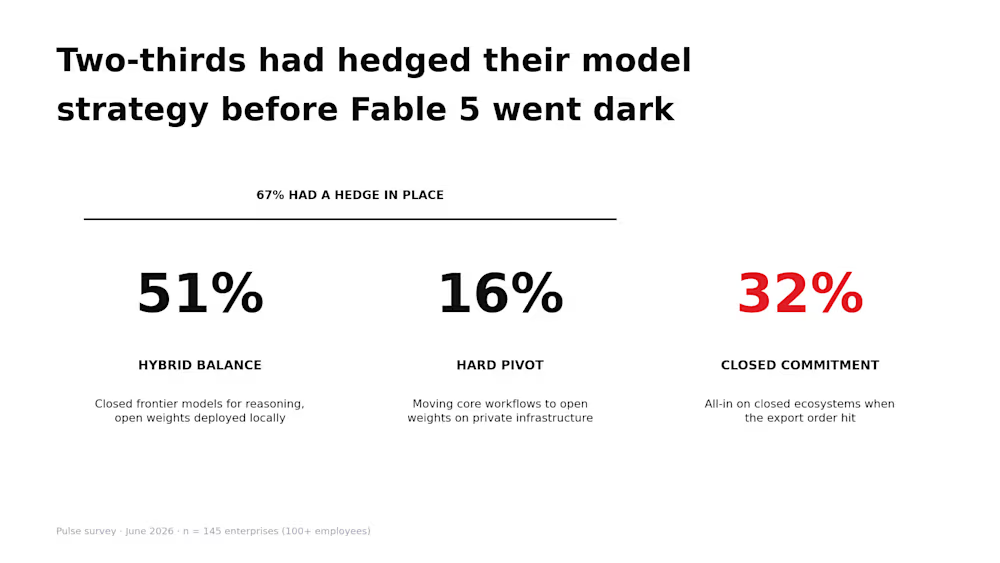
On June 12, a U.S. export-control order pulled Anthropic’s Claude Fable 5 — the most capable model on the market — offline for every customer, with no warning and no timeline. It returned this week wrapped in tighter safeguards, after China’s Z.ai released its open-weights GLM-5.2 into the vacuum. New VentureBeat Pulse Research, which surveyed 145 enterprises across these last few weeks, shows that two-thirds had already hedged their model strategy before the order came down: 51% blend closed frontier models with open-weight models deployed on their own infrastructure, and another 16% are moving core workflows off closed APIs entirely. The remaining third was all-in on closed ecosystems when the lights went out.

The blackout put a spotlight on vendor dependency, by showing what happens when the model you rely on disappears. But vendor dependency is only the most visible piece of a deeper problem: Most enterprises lack the monitoring to know when an AI system they’ve put into production stops working correctly.

Just 1 in 10 enterprises has automated monitoring that would catch an AI model drifting, misbehaving, or failing in production. Roughly a quarter would learn of a production failure only when end users — internal or external — report it, or lack the visibility to detect it at all. And 79% of enterprise organizations have already taken a real financial or operational hit from autonomous agents — most often shadow AI, unauthorized agentic work run by enterprises’ own employees on corporate credit cards, outside anyone’s oversight.

Advertisement

We call this the “Control Gap,” or the distance between how aggressively enterprises are deploying AI and how little of it they can see, own, or govern. June’s blackout turned this into a live stress test.

About this data: VentureBeat Pulse Research surveyed 145 qualified respondents at organizations with 100 or more employees in June 2026, with fielding spanning the Fable 5 blackout that began June 12. The sample is self-selected and directional: 41% work in technology/software, 20% are consultants or advisors, and the respondent base skews senior and technical — CIO/CTO/CISOs (18%), directors of engineering/IT (14%), enterprise architects (12%). More than half of the respondents were from companies with 2,500 employees or more. 

While our sample is not huge, what you can trust more than the exact percentages is the pattern: Every question in the survey, independently, points the same way, with deployment running ahead of governance, visibility, and cost control.

The full methodology is in the report.

Advertisement

How the Fable 5 export order rewrote enterprise AI risk

Fable 5 launched June 9 to immediate acclaim — and sticker shock, at $10 per million input tokens and $50 per million output. Three days later, the U.S. government issued an emergency export-control directive barring access by foreign nationals. Anthropic, with no way to verify nationality in real time, suspended the model for everyone.

Z.ai has continued to pick up momentum; on Wednesday it released an open agentic coding environment, called Zcode. OpenAI, meanwhile, previewed its cutting-edge GPT-5.6 line on June 26.

Enterprises had already spent the spring learning what AI dependence costs in dollars. Uber burned through its entire 2026 AI coding budget in four months after Claude Code adoption hit 84% of its roughly 5,000 engineers, Forbes reported. Microsoft canceled most internal Claude Code licenses in its Windows and Microsoft 365 division, steering engineers to its own tooling, according to The Verge.

June added the harder lesson: The model your workflows depend on can vanish overnight, by government order, through no decision of yours or your vendor’s. And Chinese companies like DeepSeek were releasing hugely disruptive, powerful models, driving down costs to a fraction of Western ones.

Advertisement

Brian Craig, senior director of architecture at Liberty IT, the Ireland-based engineering arm of Liberty Mutual, one of the world’s largest insurance companies, saw both lessons collide in real time. Craig is Irish, which meant the export order hit him directly as a foreign-national user.

Onstage at VentureBeat’s AI Impact event in New York on June 24, mid-blackout, I asked him about it. “Fable arrived, and immediately you saw the sticker price of using it, and you went, ‘Ooh, goodness, it better be really good,’” Craig said. “But luckily enough, we didn’t get to use it enough to get to fall in love with it.” Then it was gone.

The hedge was already built before the blackout hit

Craig’s company was built to route around exactly this kind of disruption. Liberty IT runs what it calls an AI backbone — roughly 50 components spanning security, governance, observability, and orchestration, each independently replaceable.

“You can’t lock in right now in one vendor and even one framework,” Craig told the room. “You need to keep being able to have the flexibility with that backbone to be able to hook into different models, different vendors, depending not so much on who’s the flavor of the day, but on what you can feel confident about for the next six months.”

Advertisement

The survey shows Craig has plenty of company. A 51% majority of enterprises run a hybrid posture — closed frontier models for general reasoning, open-weight models deployed locally for specialized execution — and 16% are making a hard pivot, moving core workflows onto open weights running on their own hybrid or private cloud. The 32% holding a closed commitment are candid about why: The operational overhead of self-hosting still outweighs the savings for them. After June, that calculus has a new variable in it.

Model hedge

Defection is now the active posture, and the target may surprise you. Asked which primary AI vendor they are most likely to downsize or phase out over the next 12 months, respondents named Microsoft first at 30% — most citing cutbacks to Copilot and Azure AI frameworks in favor of direct model access — ahead of the 28% who plan to trim no vendor at all. OpenAI drew 21%, largely on pricing volatility, with Anthropic at 15% and Google at 6%. No vendor faces an exodus. But loyalty by inertia has ended: Among these enterprises, actively cutting at least one provider is now more common than expanding across all of them.

Vendor defection

Just 1 in 10 enterprises would catch a failing production model automatically

How would an enterprise know if one of its production AI models was drifting, behaving unsafely, or failing to complete tasks? We asked directly. Forty percent say they are very confident they would detect it. The question also asked what that confidence rests on, and respondents split into two camps: 30% rely on humans reviewing critical AI outputs, and just 10% — 14 of the 145 organizations — have automated monitoring and alerting running against production systems. The remaining respondents hold weaker positions still: 32% expect to catch most issues “eventually,” 19% say they would likely hear about a failure from end users first, and 8% report no systematic visibility into production AI behavior at all.

Detection gap

That distinction matters because the two approaches are very different. Human review may seem like the gold standard, but it only reaches the outputs someone designates as important for such a review — and it happens at the pace humans can move at, with the inconsistency any manual process carries. Automated monitoring watches everything the system produces, continuously, and flags anomalies as they happen — for the same reason enterprises stopped depending on manual checks for uptime and security a decade ago.

As agentic workloads multiply output volumes far beyond what any review team can read, the manual approach starts to fall behind. The leaders at our June 24 event in New York treat human review as a designed control with automation underneath it. “Nothing gets deployed into production unless it’s a human actually reviewing it and signing off,” Craig said of Liberty’s agentic software factory, where planning, coding, testing, critic, and librarian agents ship features from epic to production.

“It always has to be risk-based. That’s why we work for an insurance company.” Todd Johnson, the Morgan Stanley managing director who runs agentic AI across the bank’s end-of-day P&L controller process, described the same principle from finance: “One of our strong principles in our AI governance generally is that there always has to be human accountability, even if there’s a degree of automation.” VentureBeat covered Morgan Stanley’s new results around its P&L resolution agent system separately.

Liberty Mutual and Morgan Stanley chose manual sign-off deliberately, layered on top of observability, identity, and governance infrastructure. Whether the human-review camp has similar infrastructure underneath is more than a single-select question can establish. The 16% who separately named missing observability tooling as their biggest governance barrier are the ones saying outright that it hasn’t been built.

Advertisement

The top governance barrier is organizational: no single owner for AI across platforms

Why does the AI visibility tooling never get built? The respondents’ answers suggest it is an organizational shortcoming. The single most-cited barrier to governing AI across platforms is the absence of a single owner or accountable team, at 32%. Vendor opacity follows at 25%, missing tooling at 16% — and a lack of talent lands dead last at 5%.

The skills exist, but the organizational mandate does not: Only 38% say a central team actually governs AI behavior across their platforms today, 21% say ownership is unclear or actively contested between teams, and 17% say no role holds formal accountability at all.

Missing owner

The AI surface being governed makes the vacuum worse. Fully 85% of enterprises run two or more platforms each claiming to be the “primary” AI layer — ERP, ITSM, productivity suite, data platform, each with its own AI, its own controls, and its own assumptions. 36% describe an open contest between four or more. Just 8% have consolidated to one. Asked in a free-text question what one thing they would fix, respondents converged from different directions on the same answer: a single accountable owner, and a control plane that abstracts cost, drift, and model choice away from the end user.

79% have already paid for an agent control failure — led by shadow AI

The cost of the vacuum is showing up on corporate cards.

Asked to name the most severe financial or operational control failure they have experienced from autonomous agents, 49% of enterprises cite shadow AI — departmental teams running unauthorized agentic pipelines on corporate credit cards, bypassing central financial oversight entirely. Another 25% have been hit by an infinite-loop bill, an uncaught recursive workflow racking up thousands in token costs in a single incident, and 6% by an agent that degraded production databases with unthrottled queries. Only 21% report guarded stability, with hard token throttling and budget caps at the infrastructure layer. Add it up: 79% of these enterprises have already paid for an agent control failure in real money or real downtime.

Advertisement
Agent bill

Finally, the economics of tokens suggest the pressure will keep rising. Per-token inference costs are falling 70 to 80% a year, and agentic workloads consume 100 to 500 times the tokens of the LLM tools they replaced.

Brian Gracely, senior director of portfolio strategy at Red Hat, told our New York audience the answer starts with right-sizing: “If I’m simply trying to resolve an insurance claim, I don’t need to know about the history of Western civilization in my model. I don’t need to know soccer scores.”

Enterprises are pairing smaller, specialized models with semantic routing, he said, so the platform decides which requests genuinely need frontier-scale reasoning — and which are burning premium tokens on commodity work. (One adjacent data point from the survey underlines the appetite for pragmatism: 73% of enterprises report little or nothing to show for their custom fine-tuning investments of the past 18 months — a reckoning we’ll examine in its own report.)

The bottom line: Replaceability is spreading faster than ownership

The survey describes enterprises moving fast on AI with weak controls underneath. 58% are adding more AI initiatives than they retire. 85% run multiple platforms that each claim to be the primary AI layer. Three times as many enterprises rely on human review to catch a failing production model as have automated monitoring in place. And 79% have already paid for an agent control failure — most often unauthorized agent spending on corporate cards, outside IT’s oversight.

On one problem, enterprises have clearly adapted: model dependency. Two-thirds hedge their model strategy, either running open-weight models alongside closed ones (51%) or moving core workflows off closed APIs entirely (16%). The Fable 5 shutdown showed the value of that position — the hedged companies could route around a model that a government order made unavailable overnight.

Advertisement

The remaining problems are internal, and no purchase fixes them: 32% name the lack of a single accountable owner as their top governance barrier, and 17% say no role holds formal accountability for AI at all. Assigning an owner costs nothing and requires no vendor. It still hasn’t happened at most of these companies.

Our coming Q3 wave of research will measure whether June changed this — whether enterprises assigned owners and installed automated monitoring, or just added a second model and moved on.

Get the full Control Gap report here.

The themes in this report — agent orchestration, governance, and cost control — are the agenda at VB Transform, VentureBeat’s flagship event, July 14-15 at Hotel Nia in Menlo Park, with technical leaders from Visa, GM, Waymo, Intuit, Instacart, LangChain and others. Details and registration here.

Advertisement

Disclosure: VentureBeat’s June 24 AI Impact event in New York was sponsored by Red Hat and Intel. Sponsors have no input into VentureBeat Pulse Research survey design, findings, or editorial coverage.

Source link

Continue Reading

Tech

Overland AI lands Marine Corps deal worth nearly $20M to build self-driving military vehicles

Published

on

Overland AI’s autonomous ground vehicles lined up at the company’s proving grounds. (Overland AI Photo)

Seattle-based Overland AI has landed a U.S. Marine Corps contract to produce autonomous ground vehicles, a milestone the defense-tech startup says makes it the first ground autonomy company to serve as the prime contractor on a military production deal. 

The nearly $20 million agreement — $19.7 million, according to the Department of War — calls for Overland to deliver more than a dozen autonomous ground vehicles, along with the software that runs them. Initial deliveries are expected to begin sometime in early 2027.

The agreement was announced June 29. The vehicles will work with a Marine Corps system that shoots down enemy drones. Overland’s vehicles will initially handle resupply for those crews rather than replace any existing vehicles, co-founder and CEO Byron Boots said in a media briefing, as reported by trade publications DefenseScoop and Defense One

Boots is a University of Washington machine-learning professor who leads the school’s Robot Learning Laboratory and is the Amazon Professor of Machine Learning at the UW’s Allen School of Computer Science & Engineering. He co-founded Overland in 2022 with Stephanie Bonk, the company’s president, spinning it out of the UW

The company’s technology is designed to let military vehicles drive themselves across rough, off-road terrain in places where GPS isn’t available. 

Advertisement

Overland has grown to more than 100 employees and raised over $140 million in venture funding, including a $100 million round in February led by the venture firm 8VC. It opened a 22,000-square-foot production facility in Seattle last year, and ranks No. 9 on the GeekWire 200, our index of the top privately held Pacific Northwest tech companies. 

Advertisement

The company isn’t alone in chasing military ground autonomy. One of its rivals, Maryland-based Forterra, won a larger, $92 million Marine Corps production deal earlier in June — but as the autonomy supplier under prime contractor Oshkosh Defense, rather than holding the contract itself. That’s the distinction Overland is claiming as a first. 

Overland’s deal came through a Pentagon program called APFIT — short for Accelerate the Procurement and Fielding of Innovative Technologies — which fast-tracks funding to move promising technology from prototypes into production. For Overland, it marks a step from testing and demonstrations into building vehicles at scale for the military. 

“We’re registering extremely high demand from U.S. operational units who want to incorporate this technology into their concepts of operation,” Boots said in the briefing, pointing to the war in Ukraine as evidence of a growing role for uncrewed vehicles.

Overland has been working for years with the Army, Marine Corps and Special Operations Command, also completing a multiyear DARPA autonomy program. The new contract builds on recent work integrating its self-driving technology into Marine Corps vehicles.

Advertisement

Source link

Continue Reading

Tech

Claude Fable 5 is leaving subscriptions, but maybe not for good

Published

on

Anthropic’s most advanced publicly available Claude model is still leaving standard subscription access after July 7, but the company is now trying to calm fears that the move is permanent.

Fable 5 recently returned to Claude after drawing scrutiny from the U.S. government. Anthropic said it would be included on Pro, Max, Team, and select Enterprise plans for up to 50% of weekly usage limits through July 7. After that date, the model is set to move to usage-credit billing, meaning users will pay for access outside their regular plan limits.

That raised an obvious concern. Is Fable 5 becoming a paid add-on for good? A Claude Code lead engineer has now clarified that Anthropic does not intend to keep Fable 5 as a permanent paid add-on.

Fable 5 should return to subscriptions

In a post on X, the engineer said Anthropic has heard questions about Fable’s availability on subscription plans. While Fable 5 will come off subscriptions after July 7, Anthropic aims to restore it as a standard part of subscriptions “as soon as capacity allows.”

Advertisement

I’ve heard a lot of questions about Fable’s availability on subscription plans.

While it will come off subscriptions after July 7th, we aim to restore Fable as a standard part of our subscriptions as soon as capacity allows, as we mentioned in our original blog post.

— Thariq (@trq212) July 2, 2026

That lines up with what Anthropic said earlier. In its original blog post, the company said demand for Fable 5 would likely be “very high, and difficult to predict,” so it was taking a more cautious approach to subscription access.

Demand is the real problem

Switching to usage-credit billing may be disappointing for subscribers, but it does not come as a surprise. Anthropic has been facing sustained demand for Claude for some time, and the popularity of Fable 5 seems to have made things even harder to manage.

Advertisement

A couple of months ago, the company announced a deal with SpaceX to use all of the compute capacity at the Colossus 1 data center, adding more than 300 megawatts of capacity and over 220,000 Nvidia GPUs.

That extra capacity has already led to visible changes across Claude. Anthropic has doubled Claude Code’s five-hour rate limits, removed peak-hour limit reductions for Claude Code on Pro and Max accounts, and expanded API rate limits.

Even with that added capacity, Anthropic still appears to be having a hard time keeping up with demand for Fable 5. Subscribers can only hope the company sticks to its word and brings the model back to regular subscription plans when capacity allows. Until then, anyone who wants continued access after July 7 will need to move to usage-credit billing.

Source link

Advertisement
Continue Reading

Tech

Breaking: Sony is launching a new RX10 bridge camera next week! Here’s what we can learn from the shock teaser

Published

on


  • Sony teased a new RX10 on its Instagram, writing ‘The Wait is over’
  • Its previous bridge camera was the RX10 IV from 2017, which is discontinued
  • This latest in the series will arrive on July 9 at 7am PT / 10am EDT / 3pm BST

Sony just dropped exciting news for fans of its versatile bridge cameras — a new RX10 camera will be revealed next week.

The teaser on Sony’s Instagram reveals a surprising amount of detail, including the release date plus a silhouette of the next RX10, which from we can glean some info about its lens.

Advertisement

Source link

Continue Reading

Tech

Trunk Tools’ stack cut document review from 60 days to 10 by ditching general-purpose models

Published

on

Most verticals aren’t clean, well-oiled SaaS databases; the reality is ugly documents, proprietary schemas, implicit workflows, and long‑running tasks that most general-purpose models struggle with.

This prompted construction project management company Trunk Tools to build a specialized, three-layer architecture — perception, semantics, agents — based on highly-detailed data to support high-accuracy, highly-relevant industry automation.

Their purpose-built stack has shrunk review cycles from months to days, prevented costly field errors, and given autonomous agents the ability to reason over millions of pages of documentation, Trunk says.

“We really set out to take the data from dispersed systems, pre-process it, structure it, go through our ontology into a knowledge graph, and then train AI models,” said Sarah Buchner, Trunk’s founder and CEO and a former carpenter.

Advertisement

For builders in other verticals, Trunk’s approach could serve as a blueprint for transforming data chaos into agent‑ready, industry-specific workflows.

Where general-purpose LLMs break down on industry data

Foundation LLMs, while powerful, are optimized for breadth, not always depth.

“General-purpose LLMs are trained to be okay at everything, so they’re weak at anything niche,” said Kriti Faujdar, a senior product manager working in AI infrastructure, agentic AI, security, and LLM platforms. For instance: Rare terms, domain-specific reasoning, the unspoken context that any practitioner “just knows.”

Web, app, and software developer Sébastien De Bollivier agreed that the biggest bottleneck is reliability on data that is “jargon-dense, abbreviation-heavy, and format-specific.”

Advertisement

“A GPT-4-class model can understand a French legal contract, but will fumble the specific article references practitioners need to cite,” he said.

Besides, the most valuable enterprise data never made it into pretraining anyway, Faujdar pointed out. It’s sitting in internal systems and proprietary formats. “RAG helps a little,” she said. “But it’s just giving better facts to a model that still can’t reason properly in the domain.”

Pre-training on domain data is critical; enterprises should then fine-tune on good task examples and build their own evals. “A few thousand examples from real practitioners beats millions of scraped, noisy ones,” Faujdar said.

Mixture-of-experts (MoE) can provide specialization without inference costs blowing up. Pairing RAG with fine-tuning also works well; RAG handles the factual long trail while fine-tuning fixes vocabulary and reasoning.

Advertisement

De Bollivier pointed to the advantage of hybrid stacks: A general-purpose model for reasoning and orchestration, a smaller fine-tuned model (or dense retrieval over a curated corpus) for domain-specific extraction. He advised: “Don’t fine-tune to make the model ‘smarter’ about a domain, fine-tune to make it more reliable on the specific output format your workflow requires.”

The trades and construction are certainly industries seeing traction with these techniques, as are legal and healthcare, De Bollivier said. These verticals have “high stakes for errors plus standardized document formats, equaling clear domain-training ROI.”

One honest caveat worth mentioning, Faujdar said: Specialized models can often fall apart outside their domain, so they’re often not useful outside their expertise (unless they’re re-trained).

Perception, semantics, agents: inside Trunk’s three-layer stack

In highly-specialized domains like construction, “data dumps” into large language models (LLMs) don’t cut it, said Trunk’s CTO Amrish Kapoor. This is because most transformers are probabilistic models: When given an image, they report back that it is “probably” a tree, or “probably” a child playing next to a tree.

Advertisement

This makes them insufficient for high‑precision symbolic interpretation. For instance, in construction documents, a 2-millimeter-wide symbol has a vastly different meaning depending on where it’s placed.

Further, constrained by context limits, probabilistic models struggle with long‑term project memory. “I don’t mean a context window of a few tokens,” Kapoor said. “I’m talking about long term memory that stretches across months and years, because this is how long some of these projects are.”

Instead, Trunk’s three-layer system breaks workflows into:

  • Perception (reading and extracting data from messy docs like PDFs, drawings, or scans)

  • A semantic/graph layer (making sense of that data and understanding their relationships).

  • LLMs and agents on top.

Construction drawings are typically symbolic, Buchner said. A door isn’t always labeled ‘door.’ Sometimes it’s simply an arc on a wall that a trained eye learns to read based on years of practice.

Advertisement

“The perception layer is what teaches AI to read that language,” she said. The semantic layer then gives that information meaning; for instance, connecting the door to the drawing that details it, the spec that governs it, and the trade that installs it. This helps answer project engineers’ critical questions: Not “is there a door here?” but “does this door create a problem down the line?”

Particularly in construction, that shift matters because the cost of a problem compounds with time. “A conflict caught in design is relatively low cost to address,” Buchner said, “whereas the same problem caught in the field might cost tens of thousands of dollars.”

At a high level, the system identifies the document type and begins extracting information based on content (drawing, schedules, paragraph text). This data is then “transformed and augmented” in the platform, which triggers agentic workflows like knowledge graph relationships and end-user workflows.

For instance, an agent might review an architecture bulletin and produce a visual overlay comparing an older version and a newer version (flagging additions and removals), then generate written narratives that describe what those changes are in simple terms. This helps users understand what’s changed and coordinate with trade partners on updated pricing and change orders.

Advertisement

The scale of construction’s data problem

Construction workflows are “ripe with implicit assumptions and connections between data in its myriad of sources,” Buchner said. And the amount of unstructured data is “humanly impossible” to process or make sense of.

Buchner estimated the average high-rise building generates about 3.6 million pages of corresponding documentation. “If you print it into a stack of papers it would be as high as the building itself.”

All three layers of Trunk’s stack — perception, semantic, LLM — are trained on “very specific datasets” from customers with “explicit permissions” and auto‑labeling/IP, Kapoor explained. Customers who don’t want Trunk training on their data can opt out.

Data is deidentified and aggregated, and Trunk also collects “tons more” labeled data through other pipelines like 3D building information modeling (BIM).

Advertisement

Trunk says it only ships agents that achieve around 95% accuracy. The team maintains continuous evaluation pipelines based on ground truth data from customers and experts. They also employ an LLMs-as-a-judge model.

“This notion of an LLM as a judge is to score how well you’re doing, both subjectively as well as objectively,” Kapoor said. Objectivity can be an easy ‘right’ or ‘not right,’ but subjectivity requires more nuance.

For instance, when creating an email or narrative or explanation, an LLM as a judge framework can create a composite score, or a numerical value that aggregates different metrics and tests a model’s performance or risk.

There can be challenges, though, particularly with latency, Buchner noted; any time the reasoning capacity of underlying models increases, the risk of latency goes up, too. Trunk maintains a set of evaluation criteria to objectively measure latency whenever changes are made to underlying infrastructure, agents, and API calls.

Advertisement

Then, “before we release to customers, we ensure marginal changes to the end-user experience are well worth the performance enhancements,” Buchner said.

From 60 days to 10: the measurable payoff

Trunk’s platform powers seven AI agents purpose-built for construction, such as analyzing request for information (RFI) responses, overviewing bids, or reviewing drawings and submittals.

The submittal agent, for instance, flags missing, conflicting, or noncompliant information in product specs and RFIs. While it’s an essential step in the construction process, “it’s a super annoying workflow,” Buchner said, because human reviewers have to compare documents “with a bunch of other parts of documents.”

But the agent is able to do this in seconds, and Trunk says it has reduced submittal cycles from 50 to 60 days to 10, “which has massive schedule and financial implications.”

Advertisement

Trunk is now at a place where these agents are communicating directly with each other, which is “quite exciting,” Buchner said. So, for example, one agent will review an architectural drawing for accuracy, then autonomously hand it over to agents handling RFIs and asking follow-up questions.

“If the drawings have problems, the RFI agent is taking over and is actively reaching out for clarification,” Buchner explained.

Trunk says its customers report savings of 20 to 40 minutes per field question. Buchner said that users in the field know better than anyone how much of a “time suck” it is to go back and forth from office trailers, dig through project documents in scattered systems or printed PDFs, reconcile discrepancies, and return to coordinate with trade partners.

Trunk says its customers report these additional outcomes:

Advertisement
  • Average 8 minute time savings for single-document retrieval (status checks, location lookups, quantity queries).

  • Average 20 minute time savings for standard referencing (cross-referencing 2 to 3 spec sections to form an answer.

  • Average 40 minute time savings for multi-document research (listing and filtering queries, mapping relationships, analyzing RFIs and submittals across 4 to 6 documents).

  • Average 75 minute time savings for complex tasks (creating RFIs and other communication materials, deep cross-referencing across documents, change tracking).

In one instance, Trunk’s drawing review agent flagged that a structural beam had been moved up 8.5 inches. However, this was not documented by the architect. If the change hadn’t been caught, the project manager would likely have had to strip out and reinstall the right size beam, Buchner said. This rework would have added $10,000 or more to the budget, and “certainly there would have been implications on the schedule.”

Buchner also pointed to other examples: an agent flagged $60,000 in exaggerated pricing with no justification from landscaping subcontractors; identified a fireplace that needed to be sealed prior to drywall installation, saving around $100,000 in labor, materials, and delays; and called out that an electric door required a panel that wasn’t included in electrical drawings.

Learnings for other industries

Trunk’s approach to building agents is applicable to any vertical working with high volumes of unstructured, industry-specific data.

Builders working in specific verticals must understand the industry’s specific data challenges their end users face and build technical infrastructure that can transform unstructured data into something an “LLM can traverse and understand,” Buchner said.

Advertisement

“Only then can you build the connections between data points that ultimately feed agentic workflows.”

A lot of money is being invested in foundational models, so enterprises should build modular systems that can leverage the strengths of various models as they continue to improve, Buchner advised.

Then, “build your technical advantage where the generic models are not investing and not performing well,” she said.

Source link

Advertisement
Continue Reading

Tech

Chip industry warns US against memory market meddling

Published

on

The memory shortage has become a political problem in Washington. Now the chip industry has a message for the Trump administration: leave the market alone, or the squeeze gets worse.

The warning came in a letter from SEMI, a semiconductor industry group, to senior US officials. Any attempt to fix the shortage by steering prices or production would deepen it, the group said, as Bloomberg reported.

The crunch traces back to the AI boom, which is swallowing memory chips faster than makers can produce them.

Hands off the market

SEMI’s argument is blunt. “Interventions that distort pricing or capacity decisions risk prolonging the demand downturn,” the group wrote, in a copy seen by Bloomberg. It wants the opposite approach. Let companies keep signing long-term supply deals with customers, and extend tax breaks that lift US output.

Advertisement

The 💜 of EU tech

The latest rumblings from the EU tech scene, a story from our wise ol’ founder Boris, and some questionable AI art. It’s free, every week, in your inbox. Sign up now!

The stakes are high for its members. The three big memory makers all belong to SEMI: Micron in Idaho, plus SK Hynix and Samsung of South Korea. Their shares have soared as AI demand outstrips supply.

A pocketbook problem

The politics are shifting because the shortage now reaches ordinary shoppers. Memory sits in everything from cars to laptops, and prices are climbing across the board. Even decades-old memory standards have jumped. Apple and Microsoft have both raised prices on popular gadgets, which is exactly what worries politicians eyeing voters’ wallets.

Advertisement

SEMI has a fix for that too. Rather than capping prices, it wants Congress to soften the blow with consumer tax breaks on phones and laptops. The group was careful to thank the administration for its support of the chip sector.

The China question

The letter lands in the middle of a louder fight. Apple is lobbying the same officials for permission to buy memory from two Chinese firms on a Pentagon blacklist. SEMI’s letter names no Chinese suppliers. But it went to the very people Apple has been pressing: the Treasury, Defence, Commerce and State secretaries.

Not everyone in Washington wants a light touch. One Republican senator, Bernie Moreno of Ohio, has urged the Commerce Secretary to put American buyers first. He warned of a car-industry hit like the one seen during the pandemic.

Years, not months

The hard truth is time. SEMI says memory capacity should grow about 19 per cent a year, yet AI demand will still eclipse it. New factories take years to build. Until they arrive, the mismatch keeps pushing prices up. For European shoppers, the warning rhymes with one already made in Britain.

Advertisement

Currys expects phones, laptops and TVs to cost more later this year. The industry’s message to politicians is simple. You cannot regulate more chips into existence.

Source link

Advertisement
Continue Reading

Tech

How To Watch Summer Games Done Quick 2026

Published

on

The latest week-long speedrunning marathon starts on July 5.

Speedrunners are once again descending on Minneapolis to tear through games in aid of a fantastic cause as this year’s edition of Summer Games Done Quick (SGDQ) is about to commence. The week-long, round-the-clock event starts on Sunday. You can watch all of the action live on Twitch. If you miss a particular run, you’ll be able to catch up on the VODs on YouTube.

After a preshow at 12:30PM ET, the action will start at 1PM with a 102% run of one of my favorite games of all time, Donkey Kong Country 2: Diddy’s Kong-Quest. Recent games making their GDQ debut include Don’t Stop, Girlypop!, Super Meat Boy 3D, Pragmata, Resident Evil: Requiem, Unbeatable, Mouse: PI for Hire and Saros.

Advertisement

I’m interested to check out a pinball showcase with Total Nuclear Annihilation as well as the Gordon & Daxter run. This is a modded version of Jak & Daxter in which you play as Gordon Freeman with Half-Life weapons and movement. I always love it when there’s a Super Mario Maker 2 race on the schedule, so I’m looking forward to that too.

As always, SGDQ is raising money for Doctors Without Borders. Last year’s edition raised over $2.4 million for the cause.

Advertisement

Source link

Continue Reading

Tech

Malaysia is cracking down on VPN misuse, but your VPN stays perfectly legal

Published

on


  • Malaysia beefs up action against VPN used to facilitate crimes
  • Misuse includes bypassing the new under-16 social media ban
  • Officials have stressed that owning or using a VPN is not an offence

Malaysia is set to take action if VPN are used to facilitate criminal activities or help residents bypass the new social media age limit.

According to local reports, Deputy Home Minister Datuk Seri Dr Shamsul Anuar Nasarah said the government is working closely with the Malaysian Communications and Multimedia Commission (MCMC) to counter VPNs and borrowed identities that are being used to slip past newly enforced social media age limits.

Source link

Advertisement
Continue Reading

Tech

This Week In Security: Windows 10 Gets Another Year, SmartTV Botnets, Hiding Payloads, And LastPass Customer Leak

Published

on

Unsurprisingly to many of us, app stores for smart televisions are also trash. Perhaps even more full of trash than other app stores due to the smaller ecosystem and fewer reviewers.

Spur analyzed the LG smart TV app store, and found that almost half of the apps available contain proxy software, turning your TV into a node in their proxy network. Are these apps malware? Many of the analyzed apps provided a thin veneer of user consent: they offer you the tradeoff of seeing an ad every 15 seconds, or allowing their “occasional web indexing” to run permanently in the background. Watch the fishtank app for five minutes, join their proxy network for life.

Spur notes that the proxy SDK in use appears to block connections to private network ranges (internal IP ranges like 192.168.x.x and 10.x.x.x), but that the SDK restricting access to those ranges is the only protection against accessing whatever network the TV is connected to.

Amazon and Roku ban proxy apps on their devices. Samsung and LG do not.

Advertisement

Win 10 Security Updates Extended

Microsoft has added another year of security updates to Windows 10. Despite trying to kill the platform, so many users remain on Windows 10 that Microsoft likely has no choice.

The extended support program was previously due to end in October 2026 but has now been pushed to October 2027. The security updates will be available for free in the UI, but users in other regions must activate OneDrive and sync system settings, or pay 1000 Microsoft credits (about $30).

The death of Windows 10 is near, but for those unwilling or unable to let go, it shuffles along.

Signal Phishing Attempts

Bleeping Computer has an article about increased phishing attempts from hacker groups in Russia targeting Signal users.

Advertisement

The phishing messages target politicians, government officials, military, and other high-profile intelligence targets, and claim that Signal is introducing mandatory two-factor authentication, before prompting the target to enable remote Signal backups. A second follow-up phishing attempt then prompts the user to copy the backup authentication tokens from Signal and provide them to the attacker.

Signal remote backups are a relatively recent addition to the messenger, making a backup on the Signal servers of a users messages and images, encrypted with a key known only to the user. While convenient, and likely fundamentally secure given the track record of the Signal team, this phishing campaign highlights a major weakness: once private content is accessible somewhere else, an attacker simply needs to obtain the keys to access it, which is significantly simpler than obtaining the message content directly from the victims phone.

Payloads in WiFi and LoRa

Sasha Romijn presented an excellent talk at OrangeCon on embedding attack payloads in unusual places.

Sasha found poor input handling of content from DNS servers, TLS certificates, server headers, DHCP host names, LoRa Mesh node names, WiFi network names, and more. In many cases, it seems to be as simple as embedding JavaScript or CSS inside a string; many sites and utilities don’t sanitize against escaped HTML, and the standards allow it.

Advertisement

They then go on to demonstrate more serious impacts, such as compromising the management accounts of two Europe-based hosting providers by injecting content into TLS certificates, and gaining root on some OpenWRT devices via a WiFi SSID which loads a hostile JavaScript into the LUCI web management interface, which then uses the web management system to install a backdoor root shell.

Sasha continues the tour-de-exploits by demonstrating multiple cross-site scripting injections into the Ripe NCC database which then allow browser manipulation of users on the RIPE website. This has enormous implications, because Ripe NCC is the Internet allocation organization for Europe and the Middle East: the company who assigns and manages IP address blocks.

Be sure to check out the full presentation, and let this be a lesson to always treat all data as hostile, even from what would seem to be your own services!

Collecting Boot Console Info

One of the first steps in getting access to an embedded device is to look for a serial port, or serial port test points. Often this can give an idea what sort of code is running on the system, and in some cases, give direct access via the boot loader or a Linux login console.

Advertisement

Boot Intel is a web-based tool to automate scraping boot messages from embedded devices, looking for exposed logins and vulnerable services. Boot Intel can take pasted boot logs, or directly connect to the device via WebSerial.

While Boot Intel is a paid service, there is a free version for hackers to explore devices.

CitrixBleed, again

watchTowr Labs is back with another excellent write-up on CitrixBleed, continuing the trend of memory leaks in Citrix Netscaler devices.

This collection of vulnerabilities allow leaking internal memory from the Citrix servers, which can expose logs, customer data, encryption keys, or anything else found in server memory. Netscaler devices offer SSL offloading, application acceleration, VPN and remote access, and load balancing; all installations where leaking memory is likely very bad.

Advertisement

The watchTower write-up maintains their trend of providing entertaining reads about highly technical topics.  Do yourself a favor and be sure to give it a look!

Bits and Bytes

LastPass marketing partner Klue was compromised this week, impacting the customer data of multiple companies. Customer data such as email, phone numbers, addresses, and support tickets were exposed, however the LastPass vaults themselves were not impacted. While LastPass has revoked access to the impacted partner, the stolen data could assist phishing attacks against customers.

The open source self-hosted video sharing platform PeerTube has released an emergency update which addresses multiple vulnerabilities. While the release notes quote “medium to high severity” vulnerabilities, there are no specific details. If you run a PeerTube server, upgrade now!

Both Apple AirDrop and Google Quick Share have new vulnerabilities reported this week, with fixes coming soon. Both protocols are designed to allow file sharing to nearby devices, and accordingly, the issues found on them can be triggered on nearby devices. Researchers were able to find six vulnerabilities in macOS, iOS, Windows, and Android implementations of the sharing protocols. All of the discovered vulnerabilities led to crashes, but not full exploit and code execution. Sustained denial of service attacks were possible however, with nearby attackers able to keep the services unreachable and unusable for the duration.

Advertisement


Source link

Advertisement
Continue Reading

Trending

Copyright © 2025