






Connect with us
DAPA Banner
DAPA Coin
DAPA
COIN PAYMENT ASSET
PRIVACY · BLOCKDAG · HOMOMORPHIC ENCRYPTION · RUST
ElGamal Encrypted MINE DAPA
🚫 GENESIS SOLD OUT
DAPAPAY COMING

Tech

Expert-Approved Ways to Use Your LED Mask to Get Max Results

Published

on

Red light therapy face masks are all the rage thanks to beauty and wellness influencers on social media. Also known as LED masks, they use red, near-infrared or blue light at different wavelengths with claims that they can improve your skin’s appearance, boost collagen production and, if they have blue light, target acne. 

The best part is that you can use these masks at home without setting foot in an aesthetician’s office. However, these LED masks aren’t cheap and only some are FDA-cleared, while others aren’t. 

If you’re going to invest in an LED mask, it’s important to know how to use it correctly and what to look for when choosing the best one for your needs. I spoke with a dermatologist and plastic surgeon to learn the best way to use your LED light therapy mask, as well as any risks and benefits to consider.

Advertisement

Where to include an LED mask in your skin care routine

Woman wearing a white robe rubbing skin care into her cheeks

When you use red light therapy during your skin care regimen is important to get the best results.

GaudiLab/Shutterstock

A skin care routine usually includes serums, creams, ointments and other topical products targeting your skin’s needs. If you’re using an LED mask, it’s important to know the best placement in your routine to get the most out of it. 

Dr. Eleonora Fedonenko, the medical director and a dermatologist at Your Laser Skin Care in Los Angeles, told CNET that she recommends starting any LED mask treatment on a clean face, free of creams and serums. “If there is residue from makeup or sunscreen, it can block the light from getting to the skin and reduce the effectiveness of the session,” Fedonenko said. 

Advertisement

Important considerations

When choosing an LED therapy mask, it’s important to opt for one that has FDA clearance, as this indicates the product has been tested for safety and efficacy. Fedonenko also recommends researching the company and verifying that it has done clinical studies regarding the wavelengths used. 

“Red light should be between 630 and 660 nanometers, and near-infrared light should be between 830 and 850 nanometers since they’re the two wavelengths most commonly shown to promote collagen growth while reducing inflammation,” Fedonenko explains. 

You’ll also want to make sure that the mask fits your face properly and evenly distributes the light across your skin for the best results. Some models CNET recommends: Shark CryoGlow LED Face Mask, RENPHO Artemis LED face mask and Omnilux Contour Face.

How often to use your LED mask

Advertisement
Woman wearing a robe and hair tied in towel holding a red light therapy mask

Using a red light therapy mask a few times a week should be enough to see improvement in your skin.

Anton Vierietin/ Shutterstock

Knowing how often to use an LED therapy mask is important since you don’t want to overdo it. Fedonenko recommends aiming for 10- to 20-minute treatments, three to five times per week. 

“There is a timing that is correct depending on the power output of the device. For example, 10 minutes may suffice with a high-output irradiance mask and more with a low-output mask,” Fedonenko says. Irradiance refers to the amount of light reaching the skin.

Dr. Amy Bandy, a board-certified plastic and reconstructive surgeon, recommends an at-home red light therapy mask with an irradiance of approximately 20 to 50 milliwatts per square centimeter, stating, “This level of irradiance has been shown to be sufficient to deliver measurable results from home use while providing comfort and safety.”

Advertisement

Fedonenko notes that FDA-cleared devices usually have an irradiance of at least 30 mW/cm2. Try to avoid masks with light levels between 10-30 mW/cm2, because even though the light penetrates the skin, Fedonenko says it’s not strong enough to yield results, as it elicits little measurable cellular response.

Use caution with masks with irradiance levels above 100 mW/cm2, as these tend to be too strong, especially if you switch from a lower-intensity version. Fodenenko says,” Many of my patients have come to me with redness that continues due to their change from a lower-powered device to a higher-powered one, with the output being the cause and not due to frequency used.”

Fodenenko warns against using your LED mask daily because some people think doing more will speed up the process, when it can have the opposite effect. “Patients have come in with skin that was so tight and raw, they were using the mask every day in order to speed up their results,” Fedonenko says. Instead, it’s important to give your skin time to recover between red light therapy treatments because the light stimulates cellular repair. 

Bandy agrees and says that frequent use and strong products can also cause damage. “If someone is treating themselves too frequently and/or simultaneously utilizing very harsh skin care products such as retinoids or exfoliating acids, the skin barrier may become damaged, which leads to further inflammation and irritation,” Bandy says. 

Advertisement

However, it’s common for the skin to have some redness, dryness, itchiness or tightness when using an LED mask. If these symptoms don’t subside or get worse after a treatment, it’s best to seek medical guidance. 

Precautions to take with LED masks

Asian woman looking at redness on her face in a mirror

Be mindful of the type of red light therapy mask you’re using because it can cause other skin issues if it isn’t the right fit.

shisu_ka/ Shutterstock

One thing people may not consider with LED therapy masks is that the eyes need protection. 

Advertisement

“The masks are worn near the face, and wearing them without goggles for long periods of time can cause eye fatigue,” Bandy says. 

This is because the mask can cause light-induced headaches in those sensitive to light or those with certain eye conditions. It’s something to keep in mind if you have sensitive eyes or ocular conditions.

Fortunately, many LED masks have built-in goggles, so you should think twice before purchasing one that doesn’t. You should also ensure this part of the mask fits correctly before turning it on. If you still end up with a headache or sensitivity, stop using the mask.

Other non-eye-related signs you should take a break include peeling or acne on areas of the skin where you don’t normally experience breakouts or flaking. “Slow down the number of sessions and allow your skin time to heal,” Bandy says.

Advertisement

Signs the LED mask is working

If you’re new to using an LED mask, there are some ways to tell if it’s working on your skin. In general, you may start to see improvements within a few weeks. “These improvements include reduced inflammation, improved brightness and clarity of their skin and a better overall complexion,” Bandy says. 

Smoother skin and reduced fine lines are common weeks after using an LED therapy mask because light therapy stimulates collagen production. Acne sufferers may notice fewer breakouts and improvement in hyperpigmentation. Those with rosacea or who deal with redness will notice their skin start to calm down. ”That’s surprising to them as they came in with the idea that they were there for skin aging concerns,” Fodonenko says. 

However, if it’s been eight weeks and you notice no difference in your skin, Fodonenko says the device’s irradiance output may be the issue, so you may want to replace your current model with one that has a higher irradiance. 

The verdict on LED masks

As with any product, you find yourself influenced to buy on social media, it’s still important to approach these trends with precaution. If you’re interested in adding an LED mask to your skin care regimen, make sure you do your research and choose an FDA-cleared product. This reassures you that it’s safe overall and tested for efficacy, so you know you’re getting your money’s worth. 

Advertisement

Remember that it can also take time to see improvements, so if you don’t see results right away, give it several weeks to see any changes. If you notice your skin worsening, stop treatment and seek medical attention for further assistance.

Source link

Advertisement
Continue Reading
Click to comment

You must be logged in to post a comment Login

Leave a Reply

Tech

One engineer’s bizarre crusade against hyperscalers

Published

on

Offbeat

A French engineer has declared war on AWS, Google and Microsoft using AI-generated sea shanties, satirical poetry, and a multilingual protest campaign

A French SRE has given Amazon, Google, and Microsoft until September to fix cloud lock-in or face an endless barrage of AI-generated protest songs, satirical poetry, and Finnish polka.

Amine Raiti, an infrastructure architect and SRE currently working at a European Central Bank-regulated financial institution, has launched what may be the least conventional anti-cloud campaign in enterprise IT history: a multilingual pressure operation called “Operation Dindon,” complete with satirical poetry, orchestral music, K-pop, and a fictional turkey trapped in cloud dependency.

Advertisement

His demands are fairly simple: let companies cancel multi-year cloud commitments when business tanks, stop charging eye-watering egress fees to move customer data around, and make it possible to leave proprietary cloud services without detonating the IT budget.

Speaking to The Register, Raiti claims one AWS NAT Gateway setup costs roughly €6,700 ($7,777) annually for functionality that Linux admins have been handling with iptables since the late 1990s. He also points to managed Kubernetes pricing he says can exceed €14,000 ($16,251) a year.

Complaints about hyperscaler pricing usually stay confined to conversations between infrastructure teams, the occasional furious LinkedIn post, regulators and Reg readers. 

Raiti took a slightly different approach, producing a 14-part satirical series called The Legend of Dindon, centered around a fictional turkey who locks himself into cloud dependency and cannot escape, with each episode targeting a different cloud pricing or lock-in practice.

Advertisement

Episodes include The Managed Mirage, The Highway to Hell (The AWS NAT Gateway Autopsy), and The Turkey Who Plucked Himself in the Cloud, proving that cloud resentment has finally evolved into performance art.

From there, the campaign evolves from LinkedIn storytelling into a formal public ultimatum aimed directly at the hyperscalers.

Earlier this month, Raiti published what he calls an “Iron Ultimatum” in 11 languages directed at the three hyperscalers. If they agree to meaningful reforms, he says he will publish a celebratory “Diwan” praising their wisdom. If not, the AI-generated campaign continues indefinitely.

According to Raiti, Operation Dindon now includes 50 AI-generated songs spanning opera, gospel, K-pop, sea shanties, Finnish polka, Raï, and Chopin nocturnes, all allegedly produced in around two minutes per track for less than €50 a month.

Advertisement

Raiti says the idea for Operation Dindon came from his time in infrastructure leadership roles at a French adtech company. He says the business was tied to multi-year cloud commitments that continued even as revenues fell and staff were laid off.

Raiti does not directly accuse the cloud providers of causing the layoffs and describes the account as his own view of events. But he says that watching cloud costs continue to tick along while jobs disappeared was the point when vendor lock-in stopped sounding like an abstract IT problem.

The hyperscalers haven’t publicly responded. There are still several months remaining before the September deadline, giving the industry plenty of time to prepare for the possibility that the next phase of cloud criticism may arrive in the form of AI-generated sea shanties about vendor lock-in. ®

Source link

Advertisement
Continue Reading

Tech

Does Your Internet Hold Up to Its Promise? Vote in the 2026 People’s Picks Awards

Published

on

The internet is now a must-have for streaming moviesshopping for deals online and working. You likely have an opinion about your internet service provider, and we want to hear it — the good and the bad. 

We’re bringing back People’s Picks to ask you which internet service provider you can count on. During the month of May, you can take our 2-minute survey to share your thoughts. The top picks will make it to our roundup, so be sure to check back in a few weeks to see if your favorite made the list.

Watch this: 5G From the Sky: New Internet Infrastructure Takes Flight

Why we want to hear from you

Speed test results and price comparisons only tell half the story. How the service holds up during peak hours, reliability and customer service are things you experience, and only you can speak to.

Advertisement

“An internet connection is like electricity or water — an absolutely essential utility, but one you really only notice when it’s not working. I’m excited to learn what real people actually value in their internet providers. It’s simple enough to compare speeds and prices when shopping around, but what is it like to actually live with it every day?” says Joe Supan, CNET’s principal writer and broadband expert.

Whether you live in a big city with lots of options or in a rural area where satellite is your only option, we want to know which provider you use and what you think of it.

Advertisement

How to make your voice heard

The survey is open during May and takes just a few minutes to complete. After we gather enough information, we’ll tally the results and publish the winners.

Looking for a new provider? Check out our list of the best internet providers to see what we think.

Source link

Advertisement
Continue Reading

Tech

UK venture funding doubled to $10.5bn in the first four months of 2026, on the back of three giant rounds

Published

on

GlobalData’s count puts the country well clear of the rest of Europe and inside the global top five, but more than 40% of the total came from just three companies: Nscale, Wayve, and Ineffable Intelligence.


UK-domiciled companies raised $10.5bn of venture capital between January and April 2026, roughly double the figure for the same period last year, according to research published by GlobalData on Monday.

Deal volume was down by about 2% year on year, which is the more revealing of the two numbers; the value increase is sitting almost entirely in the size of a handful of late-stage rounds.

Three of those rounds, the firm says, account for more than 40% of the total. Nscale, the British AI infrastructure operator backed by Nvidia, closed a $2bn Series C in March at a $14.6bn valuation, the largest Series C in European history.

Advertisement

Wayve, the London-based self-driving company, raised $1.2bn in February at an $8.6bn valuation, with Microsoft, Nvidia, Uber, Mercedes-Benz, Nissan, and Stellantis on the cap table.

The 💜 of EU tech

The latest rumblings from the EU tech scene, a story from our wise ol’ founder Boris, and some questionable AI art. It’s free, every week, in your inbox. Sign up now!

Ineffable Intelligence, the AI start-up set up in late 2025 by former DeepMind researcher David Silver, raised $1.1bn at seed in April, at a $5.1bn valuation, in what is now Europe’s largest-ever seed round.

Advertisement

GlobalData counts 14 deals at or above $100m for the four-month period, of which three crossed the billion-dollar line. The matching period in 2025 had none.

Aurojyoti Bose, the firm’s lead analyst, framed the print as a function of compressed timing rather than a broader base widening: “Total funding surpassed the $10bn milestone in just four months this year, a marked acceleration versus 2025, when it took nine months to reach the same level. A major driver for this value surge was the announcement of some big-ticket deals.”

The country sits comfortably ahead of the rest of Europe on both deal count and value, and inside the global top five, GlobalData says. Its share of global VC deal volume is about 7%, and its share of global value about 3%.

The reading is consistent with the wider European pattern over the same period, in which capital has concentrated at the top of the cap-table stack, late-stage AI infrastructure, foundation-model labs, autonomy, and thinned out at the lower-mid market, which is where the year-on-year deal-count decline appears to have come from.

Advertisement

Two of the three billion-dollar deals also drew direct UK state participation. The British Business Bank invested in Wayve alongside Ontario Teachers’ Pension Plan, Baillie Gifford, and Schroders Capital; Ineffable received backing from the UK’s Sovereign AI Fund and the British Business Bank, alongside Sequoia, Lightspeed, Nvidia, DST Global, Index, and Google. The state’s hand in the headline number is, at this point, explicit.

Bose closed with a caution on whether this concentrates or distributes: “The UK’s ability to sustain this funding momentum will depend on whether late-stage capital deployment broadens beyond a handful of outsized transactions into a deeper pipeline of growth-stage companies.”

On the current four-month sample, that has not yet happened. Total value crossed $10bn unusually fast; volume did not. The next two quarters will show whether the second number begins to follow the first.

Advertisement

Source link

Continue Reading

Tech

Zendesk CLO Shana Simmons: Empathy is the new superpower for AI leaders

Published

on

Conversations about AI governance rarely drift toward children’s soccer games, meditation routines or the pressure of representation in corporate leadership, but then again, Zendesk Chief Legal Officer Shana Simmons isn’t your typical C-suite exec.

Opening up over breakfast at the company’s annual Relate customer conference, our conversation about AI regulation and enterprise governance quickly turned to empathy, authenticity and identity.

Source link

Advertisement
Continue Reading

Tech

In Defense of My Attachment to This Lululemon Duffel Bag (2026)

Published

on

As we get out of the house, the gear-obsessed WIRED Reviews team is writing about our favorite bags and EDCs. Today, reviewer Boutayna Chokrane raves about her love for her Lululemon gym bag. You can also check out other Bag Check stories where WIRED writers share their carryall of choice.


I have long had a soft spot for messenger bags. There’s a retro Silicon Valley vibe to the crossbody that I respect: It implies you move fast, travel light, and keep your world compartmentalized. The unfortunate practical reality of many a messenger bag, though, is chronic neck and shoulder pain. With all of its weight relying on one strap, a single shoulder is left to bear all the burden. After a few blocks adorned with a messenger, you may feel that your style choice has transformed into a full-on punishment. After years of testing various incarnations of messenger bag—including micro slings and cavernous totes—I’d made peace with this trade-off. Beauty is pain, after all.

Then I met the comfort-forward, durable, and compact-yet-cavernous Lululemon 3-in-1 Duffle.

Lululemon

3-in-1 Gym Duffle Bag 30L

Advertisement

True to its name, it’s a multi-use transport system that is easy to reconfigure when my commute demands a different carry. You can grab it by the top handles, sling it across your body when you need your hands, or detach the shoulder strap and wrap it around your yoga mat to use it as a stand-alone mat carrier. No matter how you task it to carry your stuff, rest assured the bag’s design promises utility and comfort: The strap is cushioned enough to spare your shoulder, resilient enough to handle the load of your gym gear, and springy enough to double as a stretching strap. Every component of the duffel has a reason to exist, and some of them even have two.

I’ve been toting this duffel for the gym four days a week since January 2025, which is about as real-world a test as it gets. It has endured Chicago at its most extreme: sleet, wet snow, and torrential rain. The water-repellent nylon shrugs off all elements without any fanfare. The bag dries fast, resists grime, and—most impressively to me—doesn’t hold onto odor. Trust me, I’ve pushed that boundary more than once with sweaty clothes after hot Pilates and have found the included drawstring pouch effectively quarantines everything.

It’s also low-maintenance: After a trip to the beach, a couple of quick shakes cleared out any memory of sand. This duffel requires blessedly minimal upkeep, save for the occasional spot clean, making it a refreshingly low-effort option for commuters who don’t need another chore on their to-do list.

The design is deceptively compact. Externally, it presents as a modest and understated gym bag. But peek inside, and you’ll immediately see that this duffel, with its shocking 30-liter capacity, is Poppins-esque. There’s a dedicated shoe compartment on the side that accommodates up to a men’s size 14, though I prefer to use the bottom section for footwear to keep the main cavity flexible. There’s a slot for a 24-ounce water bottle, interior pockets for keys, AirPods, and other small essentials that tend to disappear into bag voids, and there’s still room for a change of clothes, a Theragun, and a dopp kit. Nothing about this bag feels over-engineered, but nothing feels missing, either.

Advertisement

Source link

Continue Reading

Tech

Ericsson is leaving Kista for central Stockholm, in the largest office lease in Swedish history

Published

on

The 71,000-square-metre Hagastaden campus, signed with Atrium Ljungberg and Castellum, ends more than two decades in the suburb once branded Sweden’s Silicon Valley.


Ericsson is moving its global headquarters out of Kista. The Swedish telecoms-equipment maker said on Monday that, starting in 2028, it will gradually relocate its Stockholm operations, including the HQ, R&D functions, group functions, and the Imagine Studio showcase space, to a new city campus in the Hagastaden district, north of central Stockholm.

The numbers attached to the move are substantial. Across new leases with Atrium Ljungberg and Castellum, plus a Castellum agreement Ericsson signed earlier for the Infinity property, the company will occupy roughly 71,000 square metres in Hagastaden across six buildings.

Atrium Ljungberg’s portion alone, three buildings totalling 58,000 square metres on a 15-year contract, is described by the landlord as the largest office lease in Swedish history and the largest known office deal in Europe so far this year.

Advertisement

Annual rent to Atrium Ljungberg lands at about 360m kronor ($39m) at 2026 levels.

Advertisement

Castellum’s new pieces, the 9,500-square-metre Emerald House and the 3,500-square-metre Jubileumshuset, carry an annual rental value of roughly 80m kronor, according to the company’s release.

That sits on top of the 24,000-square-metre Infinity contract Castellum signed previously, expected to be ready by late 2027.

Börje Ekholm, Ericsson’s chief executive, framed the move in talent terms.

“With a vibrant location in the heart of the city’s technology collaboration and innovation community, including easy access to our changing business ecosystem, partners and decision makers, Hagastaden is clearly best-placed to address our future operations,” he said in the company’s statement.

Advertisement

“A thriving city campus will also strengthen our attraction for the top talent of the future.”

The translation is that the Kista calculation no longer works. The suburb in northern Stockholm has spent thirty years marketing itself as Sweden’s Silicon Valley, with Ericsson’s presence as the central evidence.

That story has been deteriorating for several years. Office vacancy rates in Kista ran at 26.7% in the first quarter of 2026, more than double the central Stockholm rate, according to Colliers data cited by Bloomberg.

The facility-management firm Coor Service Management announced its own departure from Kista in late 2024, citing security concerns; reports of organised-crime activity in the surrounding area have become a recurring feature of Swedish business coverage.

Advertisement

Ericsson’s lease did not name those factors, but the campus calculus is unmistakable.

The deal is a clear positive for the two landlords. Atrium Ljungberg shares rose as much as 5.1% on Monday, the most since April 8, and Castellum gained 2.1%.

Pareto Securities analyst Viktor Byrenius told Bloomberg the agreements were “a sign of strength” for Atrium Ljungberg, which has been working through elevated vacancy across the Stockholm region.

The Hagastaden lease materially shifts that occupancy story for the next decade and a half.

Advertisement

For Ericsson, the move comes against a quieter recent set of financial prints. The company narrowly missed Q1 profit estimates in April, as the North American 5G upgrade cycle that drove 2024 and early 2025 began to unwind.

Headcount in Sweden has been declining; the company cut roughly 1,200 jobs locally last year.

The Hagastaden campus is being designed for a smaller, denser, more central operation than the sprawling Kista footprint it replaces, which is its own form of strategy statement.

Move-in is phased and slow. Ericsson said the process will begin in early 2028 and run for several years.

Advertisement

The Infinity building is due late 2027; the rest of the Hagastaden campus is still under construction, on a deck built above one of the city’s major highways. By the time the relocation is complete, Ericsson’s last fixed link to Kista will, in practical terms, be gone.

Source link

Advertisement
Continue Reading

Tech

Battle Of The Telephoto Smartphones

Published

on

On the Find X9 Ultra, the primary camera has a 200-megapixel 1/1.28-inch sensor. With a low f/1.5 aperture possible, this is an incredibly versatile camera, built to take in light and work well even in difficult shooting conditions. There’s also a pair of telephoto cameras. The first has a 200MP sensor and can zoom up to 3x (70mm equivalent) for portrait photos and general-purpose shots, while the showstopper is an ‘ultra’ telephoto, capable of 10x zoom at 50MP.

It’s rare, but we’ve seen 10x zoom in smartphones, including, briefly, Samsung’s Galaxy S23 Ultra. However, they weren’t paired with such high-resolution sensors. This offers more detail in shots, as well as the ability to digitally crop down to get even closer to the subject — although you won’t need to nearly as often. The Find X9 Ultra also has a 50MP ultra-wide camera and a 3.2MP multispectral sensor to strengthen white balance and color accuracy.

However, Oppo’s innovative 10x telephoto is the most thrilling part of the phone’s penta camera setup. The 10x optical zoom also opens up the possibility of 20x lossless zoom, all before we start attaching Oppo’s teleconvertor lens. It also has sensor-shift stabilization to improve clarity and reduce the chances of blur. (Vivo has its own solution, which we’ll get to in a minute.)

The 3x telephoto camera is a convenient midpoint between the main camera and its huge sensor and the incredible range of the 10x telephoto. However, Oppo gets a little too keen on computational photography boosting here and I’d often get shots with ghostly outlines, especially of human subjects. Overly aggressive digital sharpening also made some images look unnatural.

Within the camera app (and arguably too many shooting modes), Oppo’s collaboration with Hasselblad gives shooters a Master Mode that blissfully strips away the computational AI tricks and augmentations. This means that while you won’t get that AI nip-tuck on telephoto shots, you also won’t get nightmarish low-res faces or scrambled alien lettering. I broadly preferred it, though I occasionally missed the better low-light performance of the AI-boosted basic photo mode.

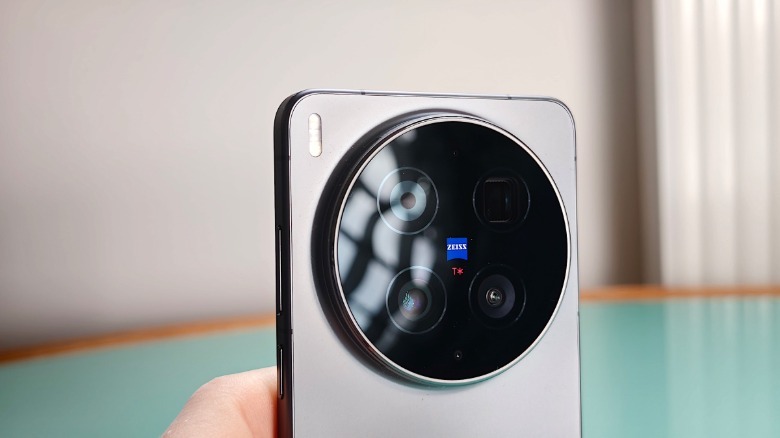
The Vivo X300 Ultra has the exact same 1/1.12-inch 200MP main camera sensor, although it has a narrow 35mm focal length, which could be argued to be more “cinematic’. Its aperture can go as low as f/1.85, losing again to its Oppo rival.

The X300 Ultra ultrawide camera, however, performs head and shoulders above the Find X9 Ultra’s version. Unlike most smartphone ultra-wide cameras, which I cynically view as a lazy effort by companies to add another camera to their smartphones, Vivo went to town. To start, Vivo added optical image stabilization (OIS), which is rare for this focal length. This, combined with a 50MP sensor, means images look crisper and more detailed than those from rival devices, which typically use lower-res sensors.

Advertisement

To Oppo’s credit, its ultrawide camera isn’t bad. The Find X9 Ultra also has a 50MP camera sensor and a lower f/2.0 lens. However, the sensor isn’t as big (the X300 Ultra’s 1/1.28-inch sensor is nearly twice the physical size of the Find X9 Ultra’s 1/1.95-inch sensor ) and it lacks built-in OIS. There’s also a lot less lens flaring on light sources with the Vivo phone, likely due to Zeiss’ anti-reflective lens treatment.

The X300 Ultra’s telephoto (another 200MP sensor) maxes out at 3.7x zoom without a teleconverter and while you can crop down from that for more ‘zoom’, it loses a lot of detail and adds a lot of artifacts in the process. Fortunately, for those looking to punch in further, Vivo has you covered.

Source link

Advertisement
Continue Reading

Tech

Save $200 on M5 MacBook Air 15 in Amazon Memorial Day Sale

Published

on

Save $200 on Apple’s 15-inch MacBook Air for Memorial Day weekend.

Amazon’s $200 discount delivers the lowest price ever on the 2026 15-inch MacBook Air with Apple’s M5 chip.

Amazon’s early Memorial Day deal knocks $200 off the standard M5 MacBook Air 15-inch laptop in your choice of Starlight or Sky Blue.

Buy 15″ MacBook Air M5 for $1,099.99

Advertisement

This deal delivers the lowest price we’ve seen on the new 15-inch MacBook Air that was released in March 2026. Equipped with Apple’s M5 chip with a 10-core CPU and 10-core GPU, the standard configuration also has 16GB of unified memory and 512GB of storage.

In our hands-on M5 MacBook Air review, we found that although the 2026 release is an incremental update, it’s still an excellent buy for most.

And for those wanting the extra screen real estate found in the 15-inch model, picking it up at the lowest price ever is always a plus.

If you’re looking for additional power and a larger port selection, Amazon is also knocking $250 off every 2026 16-inch MacBook Pro configuration it sells. You can read more about the sale in our deal article.

Advertisement

Source link

Continue Reading

Tech

Jeff Bezos describes his $38B startup Prometheus for the first time: ‘Nothing to do with robotics’

Published

on

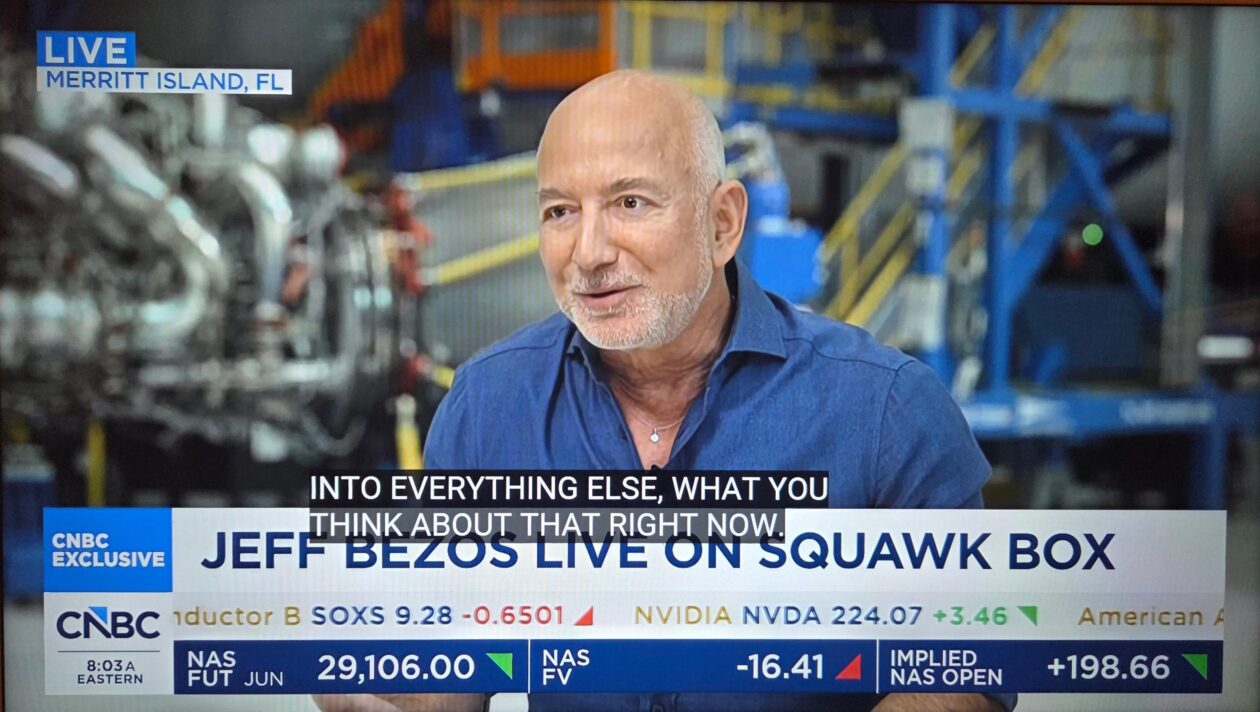
Jeff Bezos during a CNBC Squawk Box interview at Blue Origin’s Rocket Park in Merritt Island, Fla., on Wednesday, May 20, 2026.

When CNBC’s Andrew Ross Sorkin described Jeff Bezos’ startup Project Prometheus as being “really about AI robotics” in an interview on Wednesday, the Amazon founder interrupted with a correction.

“It’s a little premature for me to talk about it, but we are not — we have nothing to do with robotics,” Bezos said. He went on to offer the most detailed public description yet of the secretive startup, for which he is co-CEO: Prometheus is developing an “artificial general engineer,” he said, building next-generation tools for designing physical objects. 

Bezos called it “a very, very modern version” of CAD, or computer-aided design, adding that he is “really oversimplifying here,” and reiterating that it’s premature for him to give much detail.

He said Prometheus is “something I got so excited about that I became the co-CEO of the company, putting a lot of time into it, a lot of energy into it.” 

The tools Prometheus is building will “help companies like Blue immensely,” Bezos added, referring to his space venture Blue Origin. However, he said, the company “deserves its own special focus” as “its own big idea” rather than being housed inside Amazon or Blue Origin.

Advertisement

His comments mark a rare hint of what’s happening inside a company that has operated almost entirely in stealth since news of its formation was reported in November 2025.

Project Prometheus launched with $6.2 billion in funding, led by Bezos and Vik Bajaj, a former Google X executive. Bloomberg reported in April that the company closed a $10 billion round at a $38 billion valuation, with JPMorgan and BlackRock among the investors.

The company has hired roughly 120 employees from firms including OpenAI, DeepMind, Meta and xAI, and operates out of San Francisco, London and Zurich.

Much of the outside reporting on Prometheus has characterized it as focused on robotics and manufacturing automation, which came in part from analyzing LinkedIn profiles of its hires. Bezos’ description Wednesday as a design-tools company focused on engineering physical objects suggests a different ambition, or at least a more specific one.

Advertisement

Source link

Continue Reading

Tech

Kalshi And Rhode Island Sue Each Other In Latest Challenge To Prediction Markets

Published

on

Rhode Island joins other states that have taken similar legal action.

Rhode Island is the latest state to challenge prediction markets on the legality of sports betting within its jurisdiction. As reported by The Providence Journal, opposing lawsuits from the state’s attorney general, Peter Neronha, and Kalshi were filed against each other earlier this week. Neronha sued both Kalshi and Polymarket, accusing the platforms of circumventing the state’s regulations that only allows sports gambling through a singular state-sponsored platform.

However, Kalshi proactively filed its own legal action against Rhode Island arguing that its event contracts, including those predicting the outcomes of sports events, can only be regulated on a federal level by the US Commodity Futures Trading Commission (CFTC). Still, Rhode Island’s attorney general is looking for a permanent court-ordered ban that prevents Kalshi and Polymarket from offering “sports-related events contract” in the state.

“There is no substantive difference between sports betting and ‘events contract’ in this context,” Neronha said in a press release. “Kalshi and Polymarket know that, and we know that.”

Advertisement

While the dual lawsuits only cover the legality in Rhode Island, its eventual ruling could create a major precedent on how prediction markets operate in other states. Before Rhode Island’s lawsuit, Nevada and New Jersey also sent cease-and-desist letters to prediction market platforms, only to end up in similar legal battles. More recently, Minnesota passed a bill that includes a ban on prediction markets operating in the state, which will likely be contested by the CFTC.

Source link

Advertisement
Continue Reading

Trending

Copyright © 2025