A new leak claims Apple may bring titanium back to future Pro iPhones after moving the iPhone 17 Pro to aluminum, a reversal that could reintroduce many of the material’s old tradeoffs.
A May 17 Weibo post from leaker “Instant Digital” claimed Apple is researching improved titanium alloys for future iPhones rather than abandoning the material entirely. The post also claimed Apple is still exploring liquid metal and glass for future premium iPhone designs.
Instant Digital has a mixed track record with Apple leaks, though earlier reports correctly pointed to features like Camera Control before Apple announced them.
Apple hasn’t publicly discussed material changes for future iPhones, and the leak offers little evidence beyond claims about Apple’s internal thinking.
Advertisement
Apple has repeatedly changed materials when priorities shifted
Apple’s hardware history shows a pattern of moving between materials based on engineering and manufacturing goals instead of long-term attachment to a specific premium finish.
Aluminum replaced plastic across much of the Mac lineup because it improved rigidity and overall build quality. Stainless steel later became the defining material for premium iPhones because it delivered a denser and more polished feel than aluminum.
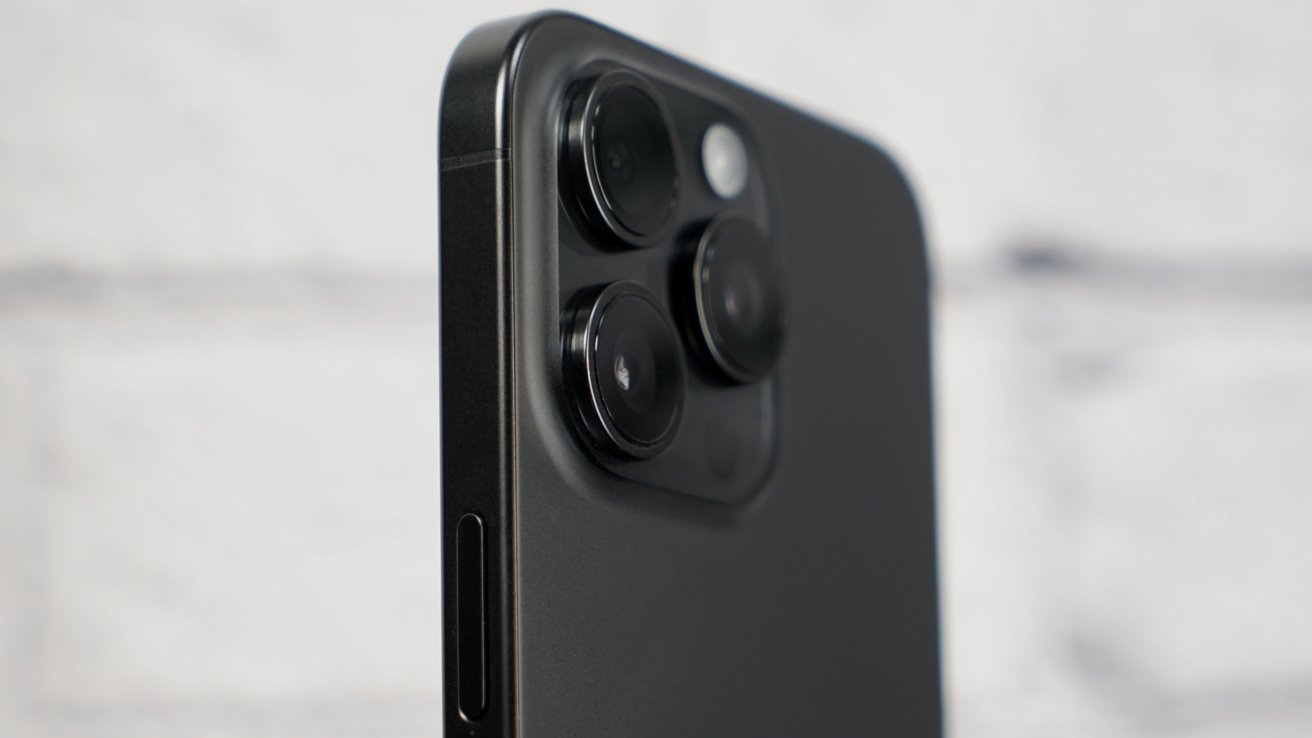
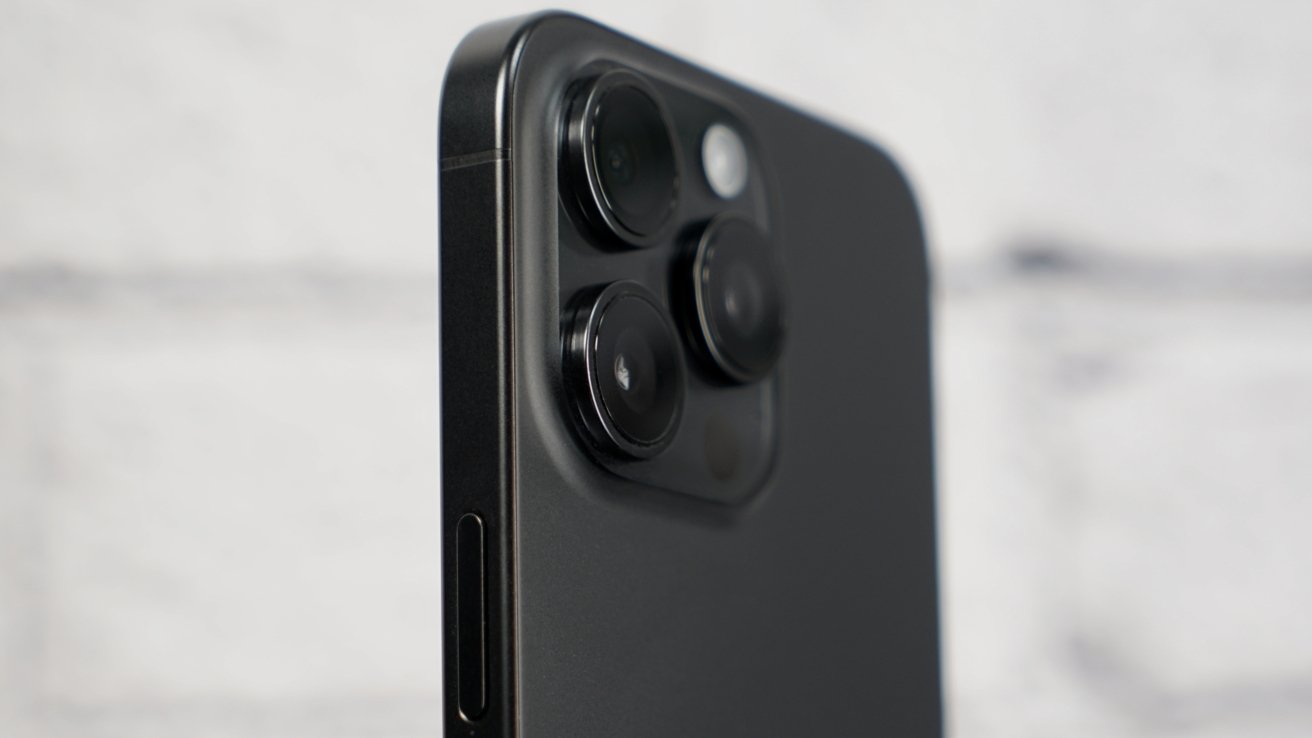
Titanium replaced stainless steel on the iPhone 15 Pro to cut weight without giving up durability. Apple heavily promoted the material during the iPhone 15 Pro launch cycle as a major part of the phone’s design.
Apple briefly used titanium on the outer edge of iPhones
Advertisement
Apple has repeatedly abandoned heavily promoted hardware decisions once the tradeoffs stopped making sense.
Butterfly keyboards, the Touch Bar, and FineWoven accessories all launched with major marketing support before Apple shifted direction. Titanium also carries real engineering drawbacks alongside its advantages.
Titanium is harder to machine, costs more to produce at scale, and transfers heat less efficiently than aluminum. Heat complaints surrounding the iPhone 15 Pro pushed more attention onto thermal performance across Apple’s lineup.
Apple later said software conditions and some third-party apps contributed heavily to overheating reports affecting the iPhone 15 lineup.
Advertisement
Modern iPhones face growing thermal demands from gaming, photography, video processing, and on-device processing features. Sustained performance increasingly depends on how efficiently a device can move heat away from internal components.
Aluminum remains one of the industry’s most practical materials for thermal management. It’s also easier to recycle, easier to manufacture consistently at Apple’s scale, and potentially more flexible for thinner or lighter designs.
A return to titanium wouldn’t necessarily mean Apple views aluminum as a failure. It would likely mean the company believes it has solved enough of titanium’s thermal and weight drawbacks to justify bringing the material back.
Future-material claims remain much harder to verify
The leak also claims Apple is still researching liquid metal and glass for future high-end iPhone designs. The company has experimented with liquid metal alloys for years and holds multiple patents involving the material.
Advertisement
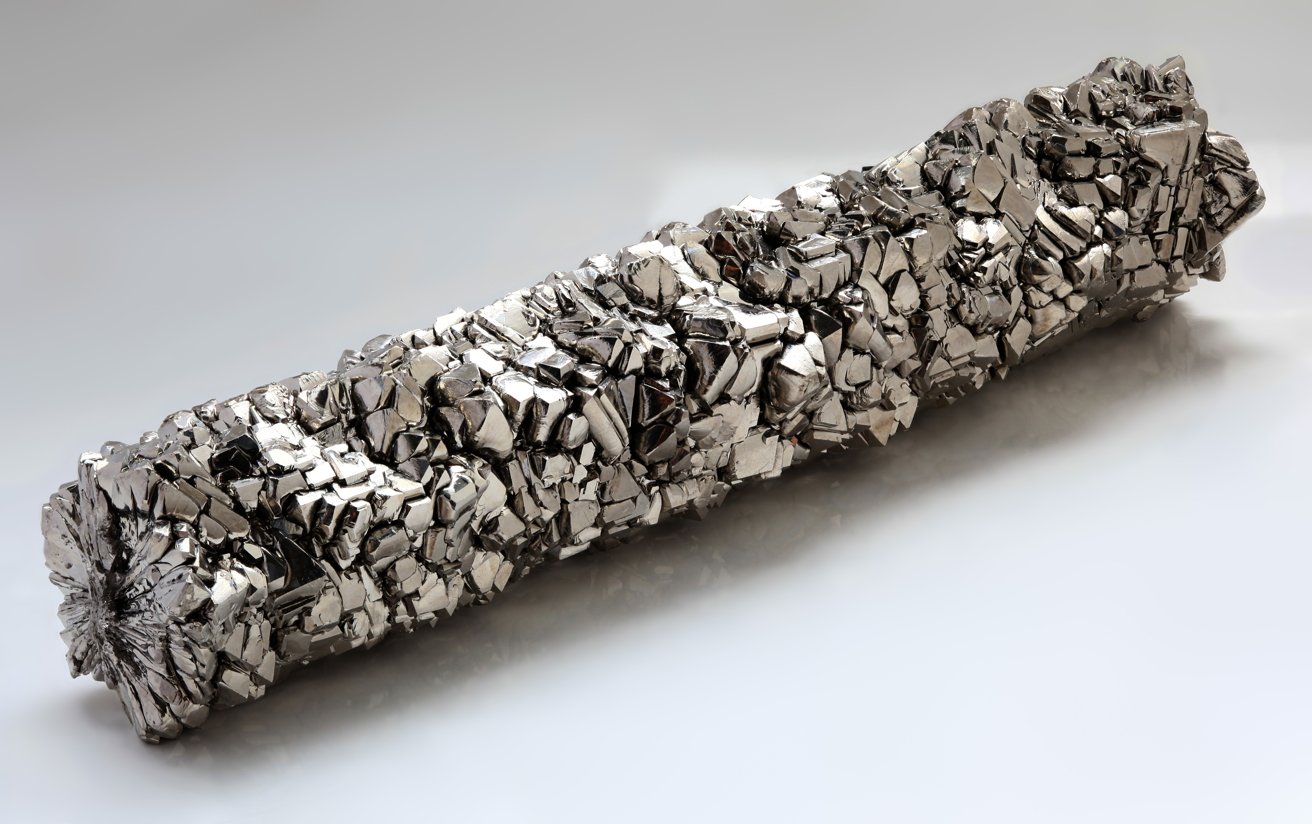
Titanium. Image credit: Wikipedia
Moving liquid metal from small internal parts to full iPhone frames would still require major manufacturing advances. The post itself acknowledges those production challenges.
Large-scale liquid metal manufacturing would create difficult durability, molding, and repairability problems. The leak’s foldable iPhone claim is easier to believe.
Foldable hinges require extremely durable materials in compact spaces, making liquid metal a more realistic candidate there than for a complete external chassis.
Glass frame claims remain even more speculative. Glass could potentially improve wireless performance and industrial design flexibility, but durability and repair concerns would create obvious obstacles for a mass-market smartphone frame.
Battery size, cooling systems, and internal packaging now shape smartphone hardware decisions more than exterior materials alone.
Advertisement
Users are more likely to notice lower weight, cooler temperatures, or longer battery life than the specific metal surrounding a phone’s frame. If Apple moves the iPhone 18 Pro or a later model back to titanium, the decision would likely require solving many of the thermal and weight tradeoffs that pushed the company toward aluminum in the first place.
The Chefman TurboFry Touch Dual 9-Quart Air Fryer is an excellent choice for those who love the convenience of cooking two different types of foods at different temperatures. No more waiting for one item to finish baking so you can take it out and load in the second item, or resorting to using another appliance to cook the rest of your meals at the same time. Having presets for some of the most popular foods are an additional convenience that takes the guesswork out of preparing meals. However, if you tend to make a lot of food, the two 4.5-quart baskets may be too small for your needs. And if you need a temperature that exceeds 400 degrees, this may not be the air fryer for you.
Two air fry baskets
Cook two foods at different temperatures
Eight presets
Shake/flip reminders at halfway point
No window to view cooking progress in the 9-quart model
Max temperature is 400°F
Key Features
Advertisement
Dual baskets
Cook meat on one side, and veggies on the other, at different temperatures – and have them finish cooking at the same time.
Advertisement
Shake/flip reminders
If you’re not paying attention to the countdown timer, the air fryer beeps when it’s time to shake or flip food – with separate reminders for each basket.
Introduction
Air fryers are quite a life-changing invention. (Okay, I’m sure they said that about regular ovens, and microwaves as well.) The ability to cook a complete meal in a small box that sits on your countertop, instead of having to heat up an entire oven (and your kitchen) is not only more convenient, but also faster. There’s only one thing that has kept air fryers from being perfect: if you’re preparing two types of foods, you’ll either need to crank up the regular oven, use the microwave, or wait until your air fryer finishes with the first item, and then insert the second one.
Advertisement
Admittedly, there are air fryers with dividers for cooking two meals at the same time, for example, back in 2023, my colleague David Ludlow, reviewed the highly-rated Ninja Foodi FlexDraw Air Fryer, which uses a removable divider. However, if you prefer a slightly smaller (9-quart vs 10-quart) option with two separate baskets, the Chefman TurboFry Touch Dual Air Fryer is definitely worth a look. The two baskets can cook two foods at different temperatures and times, or you can sync the baskets to mirror each other, and/or sync them to finish at the same time. Combined with the presets and user-friendly design, this air fryer is a winner.
Advertisement
Design and features
User-friendly display
Independent controls
Dual baskets
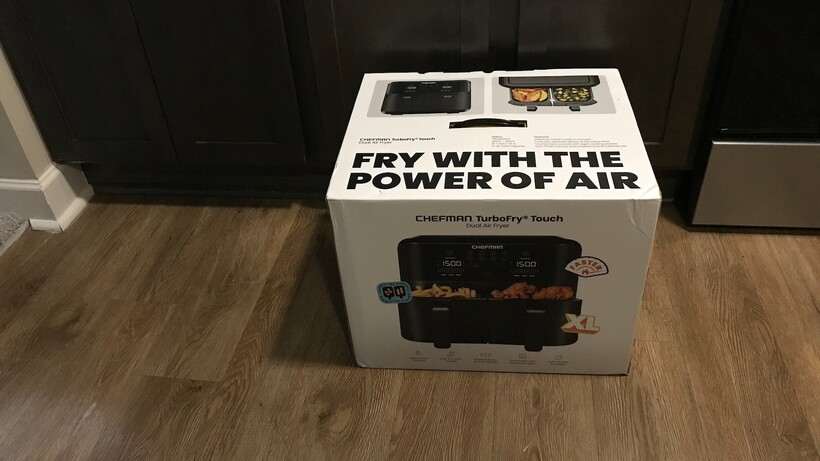
The Chefman TurboFry Touch Dual 9-Quart Air Fryer arrived in a brown cardboard box, and inside of that, a white, branded cardboard box with a convenient carry handle on top, which made it much easier to transport the appliance up the stairs to the kitchen. The air fryer is 20” W x 13” H x 10” D. It’s bigger than the average air fryer – but since it has dual baskets, that’s to be expected. However, I was pleasantly surprised that it’s not heavy, weighing only 16.3 pounds.
Image Credit (Trusted Reviews)
The air fryer consists of the main body, 2 baskets with handles, and 2 basket racks. There’s also a quick start guide and a user manual.
The control/display panel is easy to read and very user-friendly. It includes general selections, and also specific selections for each basket.
Image Credit (Trusted Reviews)
Advertisement
The general controls are as follows:
Advertisement
The Start/Stop button is used for both baskets. If only using one basket, the number (1 or 2) will be illuminated.
The Cooking Preset buttons will automatically set both the time and temperature for 8 foods (which are displayed as icons): fries, chicken, fish, bacon, burgers, steak, vegetables, and shrimp.
The Sync Baskets button programs both baskets to cook at the same time and temperature.
The Sync Finish button ensures that the two baskets finish at the same time, even if they have different cooking times and/or temperatures.
Advertisement
Each basket also has its own controls:
Advertisement
The Time/Temp buttons select the time and temperature.
The + and – buttons are used to increase or decrease the time and temperature.
Advertisement
The Shake Lights illuminate at the halfway point as a reminder to shake the basket or flip/turn the contents.
The Running Lights illuminate when the basket is in use.
I only had one concern with the design of the Chefman TurboFry Touch Dual 9-Quart Air Fryer: There’s no window, so I couldn’t view my food to see how it was progressing (without pulling out the baskets). However, Chefman also makes two 6-quart models – one with a window, and one without it.
Performance
Temp tops out at 400 degrees F
Shake/flip reminder
Food turned out great
Advertisement
Although the Chefman TurboFry Touch Dual 9-Quart Air Fryer tested nearly flawlessly, I discovered that the maximum temperature is 400°F.
Advertisement
Initially, I didn’t think this was such a big deal. However, after perusing some of my other air fryer reviews, I noticed that when I air-fried wings in the Chef iQ MiniOven, the instructions were to set the temperature to 450°F. The Ninja French Door Premium Air Fryer Oven Toaster recommends setting the temp to 450°F when making Cheesy Bread with Marinara Sauce, and Chicken Bacon Ranch Pizza.
However, I don’t think any of the foods that I tested in the Chefman TurboFry Touch Dual 9-Quart Air Fryer suffered from being cooked at a lower temperature, although it probably increased the cooking times. However, I wanted to bring this to your attention, in case the temperature range is a factor that you consider when choosing an air fryer.
Image Credit (Trusted Reviews)
In my first test, I cooked steak-cut fries in the left basket at 400°F for 20 minutes, and chicken breast in the right basket at 375°Ffor 30 minutes. I used the presets for Fries and Chicken (adjusting accordingly), and chose the Sync Finish setting. The Sync Finish delays the start time on the basket with the shorter cooking time – in this case, the fries.
Image Credit (Trusted Reviews)
Advertisement
At the halfway point for each (which was at different times), the Shake lights came on (not that I saw them since I wasn’t standing close by), and the air fryer also beeped, which I did hear. I flipped the fries, and later, I turned the chicken over. (Note: the shake lights and beep will occur regardless of what you’re cooking. If you don’t need to shake, flip, or turn anything over, you can just ignore the alerts.)
The fries came out perfectly. They were slightly crispy on the outside and soft and tender on the inside.
Advertisement
Image Credit (Trusted Reviews)
The chicken was very crispy around the edges, but moist and tender on the inside. Both baskets have a removable basket rack (with a center grip bar that makes it easy to remove). One advantage of the racks is that they keep food off the bottom of the basket – which means that oil drains off, so food is not greasy.
Image Credit (Trusted Reviews)
If you look at the photos, sometimes, the control panel displays the remaining time, sometimes it displays the temperature, and other times, it displays the status lights. That’s because every few seconds, the controls cycle through each of the indicators. And they don’t necessarily sync, so you may see the temperature on the left side, and the remaining time on the right side.
Advertisement
Image Credit (Trusted Reviews)
In my second test, I air fried chicken legs in the left basket, and tossed some frozen veggies in the right basket. I selected the Chicken and Veggies presets, adjusted accordingly, and selected Sync Finish. As you can see, one basket can easily hold four legs.
Image Credit (Trusted Reviews)
The chicken legs cooked perfectly, and they were tender and delicious.
Image Credit (Trusted Reviews)
However, the veggies were rather dry (I knew this was a possibility, but wanted to test my theory), and a few of the veggies were singed.
Advertisement
Image Credit (Trusted Reviews)
In another test, I cooked frozen Alaskan Seafood coho salmon in one of the baskets. It cooked perfectly, and was so soft that it fell apart when I tried to pick it up.
Image Credit (Trusted Reviews)
On another occasion, I toasted bread. One of my concerns with having 2 baskets that were only 4.5 quarts each was that some families would find it too small to hold enough bread. However, I was able to fit 2 slices of bread into each basket. And since they were both cooking for the same time and at the same temperature, I selected Sync Baskets.
Image Credit (Trusted Reviews)
The toast in both baskets came out perfectly browned and was slightly crunchy. In the photo above, I flipped one piece of toast so you can see the other side.
Advertisement
Image Credit (Trusted Reviews)
No test is complete without testing the air fryer’s ability to make cookies. TheNestle Tollhouse Cookies came out crunchy on the outside and soft and gooey on the inside.
Image Credit (Trusted Reviews)
In another test, I cooked chicken wings. I was able to put 10 wings in one basket, with room enough for several more. The chicken wings came out well. They were crispy on the outside, tender on the inside, and quite flavorful.
Image Credit (Trusted Reviews)
Cleanup is also relatively easy, as the nonstick baskets are dishwasher safe.
Advertisement
Advertisement
Should you buy it?
You want to cook two items simultaneously
Steak and potatoes, chicken and fries, this air fryer is great for preparing two items – and you can cook them at the same or different temperatures.
Advertisement
You need to cook large items
While it’s a 9-quart air fryer, each basket is only 4.5 quarts, so you won’t be cooking a whole turkey or pizza.
Advertisement
Final Thoughts
The only thing better than one air fryer is two air fryers. Admittedly, most people complain of not having enough countertop space, so two of these appliances are impractical. However, the Chefman TurboFry Touch Dual 9 Quart Air Fryer has dual baskets – and they can operate independently, or be synced to cook at the same temperature/time and/or to finish cooking at the same time. There are eight presets: chicken, fries, burger, bacon, fish, veggies, steak, and shrimp, making it super easy to cook these popular foods. The digital display is user-friendly and easy to read.
How we test
Unlike other sites, we test every air fryer we review thoroughly over an extended period of time. We use industry standard tests to compare features properly. We’ll always tell you what we find. We never, ever, accept money to review a product.
Advertisement
Find out more about how we test in our ethics policy.
Used as our main air fryer for the review period
We cook real food in each air fryer, making chips, frying sausages and cooking frozen hash browns. This lets us compare quality between each air fryer that we test.
FAQs
What’s the maximum cooking temperature on the Chefman TurboFry Touch Dual 9 Quart Air Fryer?
It can reach 400°F, which is a little lower than the competition. That might make some food not quite as crispy and extend cooking times, but overall results in my tests were very good.
Advertisement
Test Data
Chefman TurboFry Touch Dual 9 Quart Air Fryer
Advertisement
Full Specs
Chefman TurboFry Touch Dual 9 Quart Air Fryer Review
More than 200 individuals were arrested for cybercrime activities during INTERPOL’s Operation Ramz, which focused on the Middle East and North Africa.
Law enforcement also identified another 382 suspects across 13 countries (Algeria, Bahrain, Egypt, Iraq, Jordan, Lebanon, Libya, Morocco, Oman, Palestine, Qatar, Tunisia, and the UAE).
In addition to the arrests, authorities seized 53 servers used for phishing, malware, and online fraud that affected at least 3,867 confirmed victims, as determined from nearly 8,000 intelligence packages retrieved from the equipment.
“The operation focused on neutralizing phishing and malware threats, as well as tackling cyber scams that inflict severe cost to the region,” reads the INTERPOL announcement.
Advertisement
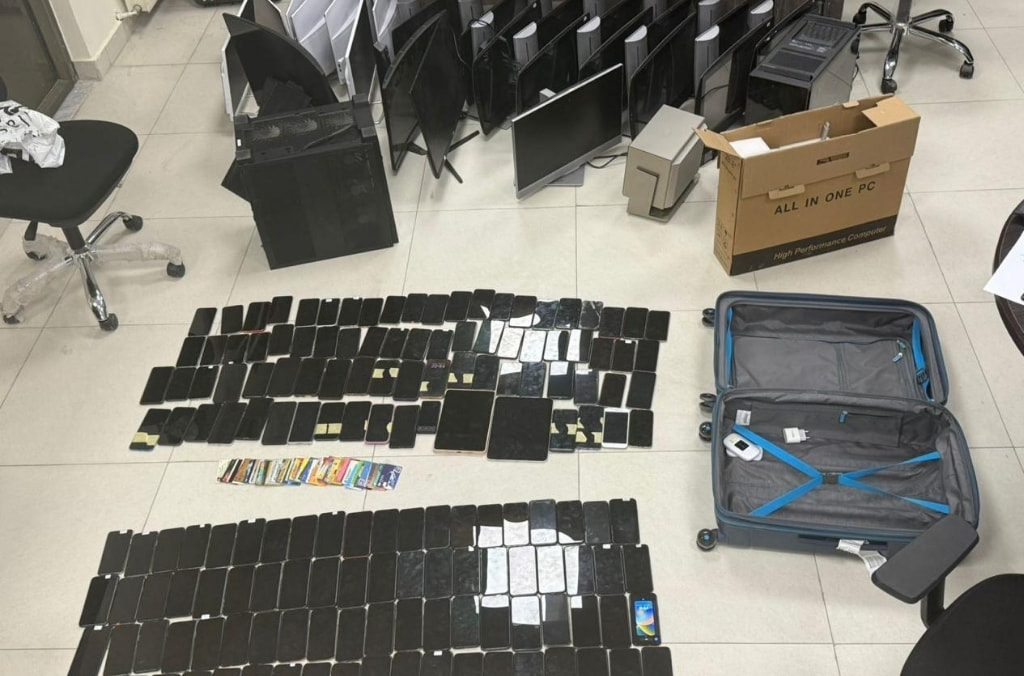
Seized devices in Jordan Source: INTERPOL
INTERPOL collaborated with several private cybersecurity firms to track the malicious infrastructure, including Kaspersky, Group-IB, The Shadowserver Foundation, Team Cymru, and TrendAI.
Some highlights of ‘Operation Ramz’ include:
securing compromised devices unknowingly used to spread malware in Qatar
dismantling an investment scam operation in Jordan, where 15 trafficked workers from Asia were forced to run fraud schemes; two organizers were arrested
disabling a vulnerable malware-infected server containing sensitive data in Oman
shutting down a phishing-as-a-service platform in Algeria and arresting one suspect
seizing devices and banking data linked to phishing operations in Morocco, with multiple suspects under judicial investigation
This is the third major cybercrime crackdown operation INTERPOL has concluded this year.
In March, the authorities announced ‘Operation Synergia III,’ which resulted in sinkholing 45,000 malicious IP addresses, the seizure of 212 devices and servers, and the arrest of 94 individuals across 72 countries, for participating in phishing, hacking, fraud, and malware distribution.
Earlier, in February, INTERPOL announced the arrest of 651 suspects across 16 African countries, as part of ‘Operation Red Card 2.0,’ targeting investment fraud, mobile money scams, and fake loan apps linked to more than $45 million in losses.
Automated pentesting tools deliver real value, but they were built to answer one question: can an attacker move through the network? They were not built to test whether your controls block threats, your detection rules fire, or your cloud configs hold.
This guide covers the 6 surfaces you actually need to validate.
SpaceX has raised prices on every consumer Starlink plan by $5 to $10 per month and doubled Standby Mode from $5 to $10, effective immediately for new customers and from 18 June for existing subscribers. The increases come as Starlink crosses 10 million users and SpaceX prepares for its IPO.
SpaceX has raised the price of every consumer Starlink plan in the United States, adding $5 to $10 per month across its residential and mobile tiers while doubling the cost of its budget Standby Mode from $5 to $10. The increases, which took effect immediately for new subscribers and will apply to existing customers from their next billing cycle on or after 18 June, come as SpaceX prepares for what would be the largest initial public offering in history and as its only serious competitor, Amazon’s satellite internet service, approaches commercial launch.
What changed
The new pricing touches every consumer tier except the recently introduced Roam 300GB plan, which remains at $80 per month. Residential plans, designed for fixed-location use at homes, rose across the board: the 100 Mbps tier went from $50 to $55, the 200 Mbps tier from $80 to $85, and the MAX tier, which offers the fastest available speeds, from $120 to $130. Roam plans, which allow mobile use at speeds of up to 100 mph and work across international borders, also increased: Roam 100GB moved from $50 to $55, and Roam Unlimited from $165 to $175.
The most notable change is to Standby Mode, a feature introduced in 2025 that allows subscribers to pause their active service while maintaining a minimal 500 Kbps connection for emergency use, firmware updates, and basic connectivity. At $5 per month, Standby was an attractive option for seasonal users, RV owners, and anyone who wanted to keep their Starlink hardware alive without paying for full service. At $10, the calculus shifts: the doubled price, combined with recent restrictions that removed in-motion use from Standby in March and eliminated the demand surcharge shield in April, makes the feature substantially less appealing than when it launched.
Advertisement
The 💜 of EU tech
The latest rumblings from the EU tech scene, a story from our wise ol’ founder Boris, and some questionable AI art. It’s free, every week, in your inbox. Sign up now!
SpaceX’s justification was terse. The company told customers in an email notification that the adjustment “supports ongoing improvements and investment in affordable, high-performance products and services as global operating costs continue to rise.”
The business context
The price increases arrive at a moment when SpaceX’s satellite internet business has never been stronger. Starlink crossed 10 million subscribers worldwide in February 2026, roughly doubling its user base in a single year. The constellation now consists of more than 10,000 satellites in low Earth orbit, representing approximately 65 per cent of all active satellites, and covers between 125 and 155 countries and territories. Revenue for 2025 reached $11.4 billion, with EBITDA margins of 63 per cent.
Advertisement
SpaceX’s public IPO filing targets a valuation of approximately $1.75 trillion and a raise of $75 billion, which would make it the largest public offering in history. A February 2026 all-stock merger with Elon Musk’s AI company xAI valued the combined entity at $1.25 trillion but also imported xAI’s cash burn onto SpaceX’s balance sheet for the first time, with the merged company posting a net loss of $4.94 billion in 2025 despite $18.67 billion in combined revenue.
The price increases, applied across more than 10 million accounts, could generate hundreds of millions of dollars in additional annual revenue, a meaningful contribution to the revenue growth story that SpaceX will need to tell public market investors. Notably, SpaceX actually reduced prices for its business-focused Local Priority plans earlier this month, suggesting a strategic decision to test consumer price elasticity while keeping enterprise rates competitive.
The competition question
For most of its existence, Starlink has operated without meaningful competition in the consumer satellite broadband market. That is about to change. Amazon’s satellite internet service, rebranded from Project Kuiper to Amazon Leo, entered enterprise beta in April 2026 with commercial availability targeted for mid-2026. Amazon has authorisation to launch more than 3,000 broadband satellites and has signed beta partnerships with Verizon, AT&T, Vodafone, JetBlue, and NASA.
European alternatives like Eutelsat are also building competing constellations, though none has yet reached the scale or coverage that Starlink offers. The timing of SpaceX’s price increases, just months before Amazon Leo’s commercial launch, suggests either confidence that its first-mover advantage is durable or a calculation that it needs to extract maximum revenue now before competitive pressure constrains pricing.
Advertisement
Early analysis of the satellite broadband market projected that low-earth-orbit internet could save American consumers $30 billion a year by introducing competition into markets dominated by a single terrestrial provider. That projection assumed competitive pricing among satellite operators. If Starlink raises prices in the absence of competition and Amazon matches those prices upon launch, the savings may never materialise.
What it means for users
The increases are modest in isolation, $5 to $10 per month, but they follow a pattern. SpaceX has changed Starlink’s pricing, plan structure, or feature availability at least five times in 2026 alone: the Standby in-motion removal in March, the demand surcharge shield removal in April, the new Roam 300GB plan introduction in May, the business plan price decreases in May, and now the consumer price increases. The company also introduced a new travel registration policy in May requiring passport and selfie verification for international roaming.
For residential customers in areas with no terrestrial broadband alternative, the increases are an unavoidable cost of being connected. For mobile users who rely on Starlink’s Roam plans for RV travel, maritime use, or remote work, the combination of price increases and feature restrictions makes the service incrementally less attractive at a time when cellular networks are expanding rural coverage through T-Mobile and SpaceX’s own direct-to-cell partnership.
The Standby Mode doubling is particularly significant for seasonal users. At $5 per month, keeping a Starlink dish alive during the off-season was effectively a rounding error. At $10, some users may choose to cancel entirely and reactivate when needed, a process that currently carries no additional fee. SpaceX may be betting that the friction of reactivation, or the risk that it introduces one, will keep enough subscribers on Standby to justify the higher price.
Advertisement
The broader picture is a company that has built an extraordinary product, satellite broadband that genuinely works, delivered to 10 million people in places that no terrestrial provider had any commercial interest in serving, and that is now monetising its monopoly position before competition arrives. Whether the pricing reflects the genuine cost of maintaining and expanding a 10,000-satellite constellation or simply the leverage of being the only option, the answer for most Starlink customers is the same: there is, for now, nowhere else to go.
Sony is raising PlayStation Plus prices for new customers from May 20, adding another cost increase to an already pricey console generation. The change applies in select regions and affects the shorter subscription options.
According to PlayStation’s official post, one-month plans will start at $10.99, €9.99, or £7.99, while three-month plans will start at $27.99, €27.99, or £21.99. Current subscribers are mostly protected for now. Sony says the new pricing will not apply to existing members unless they change their plan or allow the subscription to lapse. However, subscribers in Turkey and India may also see the change.
Starting May 20, PlayStation Plus prices for new customers will increase in select regions. Due to ongoing market conditions, prices will start at $10.99 USD / €9.99 EUR / £7.99 GBP for 1-month subscriptions and $27.99 USD / €27.99 EUR / £21.99 GBP for 3-month subscriptions.…
Sony’s latest PlayStation Plus price hike appears to mainly affect Essential tier users who pay monthly or renew in shorter bursts. The monthly plan is increasing by $1, while the three-month plan is going up by $3.
Advertisement
Sony has blamed “ongoing market conditions,” but the timing is hard to ignore. The change comes roughly six months before GTA 6, one of the most anticipated games ever, and a title likely to bring many players back to online multiplayer.
Rockstar Games
GTA Online remains a major draw even 13 years after GTA 5 launched. A Welcome Hub widget in a PlayStation beta build reportedly showed that GTA 5 still had more than 5 million active players last week. Given GTA Online’s popularity, it likely accounted for a significant share of that activity. If GTA 6 sees a similar rush (which it likely will), many casual players may return to PlayStation Plus just to access online play. Those short-term subscribers are exactly the ones now being asked to pay more.
What are players saying about it?
The response has been predictably frustrated. On Reddit and X, many players questioned why a digital subscription needs a market-conditions explanation, especially when basic features such as online multiplayer and cloud saves remain tied to PlayStation Plus Essential.
Some also speculated that Sony may be trying to offset pressure from underperforming first-party projects, including Bungie’s Marathon and Housemarque’s Saros. Sony has not said anything of the sort, so that remains criticism rather than fact.
The gaming giant has not said whether annual PlayStation Plus plans, or the Extra and Premium tiers, will see similar changes later. For now, the clearest impact is on people who subscribe in shorter bursts through the Essential tier. If your membership lapses after May 20, coming back may cost more than before.
Looking for websites where you can find apps and software that are not available on typical app stores is difficult. While searching for this, you may have come across a similar website, Softonic. But of course, such sites where you can download free software come with doubts and confusion. You are not alone in this; many people have questions about whether it is legit and is softonic safe to use.
In this blog, we will talk about its reliability, how to use it, and what you can do to stay protected from any mishaps while using Softonic.
What is Softonic?
Softonic is a website that allows people to download applications and software for computers and mobile devices. It not only offers downloads, but also describes the user reviews and ratings of that application. It also suggests alternatives when a software is not available on traditional app stores, especially for desktops.
This software directory lists apps and PC programs for multiple devices and platforms, including Windows, Mac, and mobile devices.
Advertisement
Yes, it feels convenient; moreover, when it’s free and away from official sources. But sometimes convenience can come at a cost.
Is Softonic Safe to Download from?
Even in recent times, Softonic faced several backlashes and news around its free downloads coming at a cost of someone else’s (a developer’s) hard work. As Softonic is a website that allows free downloads but then fills apps with its own ads, and earns the revenue instead of the person who has actually made the app.
In April 2013, the company was accused of delivering an adware that would be installed regardless of the user’s permission. Later in May 2013, there was news that this software website was displaying a fake Flash alert that led to a fake installer download.
Press Release by Softonic
In October 2025, Softonic launched its security reports, stating a few safety measures:
Every page in the software catalogue will have visible security reports for reliability checks before downloading.
35% catalogues already include Security Reports, but the company expects to reach 100%.
The website claims to offer multilayer APK & binary verification thats give antivirus protection, malware and spyware detection, privacy policy review for mobile apps, and more.
Softonic Reviews
Some users on Reddit reported that when they downloaded an app, they got the McAfee antivirus out of nowhere. One user labeled it as a horrible website that takes you near to downloading some sort of malware. One user said that the website itself isn’t evil.
Advertisement
Trustpilot ratings: 3.6/5
Sitejabber/Smartcustomer ratings: 1.3/5
Softonic Alternative
The need for software and apps across devices, operating systems, and platforms is never-ending. And in today’s time, there are several skilled people with a lack of tools and technical expertise due to financial constraints. Websites like Softonic help them get access to various tools, applications, and software at no cost. Here is a list of alternatives to Softonic.
1. FileHippo
FileHippo offers the latest version of the best and safest software. The website claims to provide apps without bundles or any added toolbars. Also, they are malware and adware-tested. They have various categories of platforms, devices, and systems. It also keeps the older versions if you need them. Users prefer it because of its simpler and less cluttered features compared to Softonic.
2. CNET Download
It is a website that gives you a combination of downloads along with editorial reviews. It is a part of the tech site CNET. The website has different types of coupons. You can download free software for Windows, Android, Mac, and iOS.
3. Filehorse
The website has the latest software with its legal and safe versions. It provides direct download links from official sources to avoid bundles or PUPs (potentially unwanted programs).
4. MajorGeeks
It is a two-decade-old and highly reputable software download repository that has hand-tested software for different operating systems. Particularly offers system utilities, safety tools, and freeware. It offers only 4 starter or better reviewed softwares along with resources to learn to use them.
Advertisement
How Safe is Softonic?
In the case of many software, Softonic does not provide direct links from official sources, and this can be a big concern. There is a high risk of tampered files and outdated versions with vulnerabilities. You must understand these few points to consider when downloading software.
Mirror versions aren’t always original or as secure as the ones sourced from original developers.
You often see big flashy download buttons that do not actually work, but will lead you to ads. One wrong click and your device can come under the influence of browser hijackers, browser toolbars, trackers, ad-supported programs, and cleaners you never wanted.
Some download links come from official sites, while some use Softonic’s own hosting. So it is safe, but not the best option, to get free applications.
Tips to Make Softonic Safer
We discussed the mixed reviews and risks involved in using Softonic, but if you still choose to use it, you must gear up the defenses. It is not just about staying safe from malware, but also preventing tracking, deceptive ads, and surreptitious installers. These hints can help keep guards up against all this.
Firstly, try avoiding these sites and stick to developer links.
Avoid clicking on flashy ‘Download Now’ buttons.
Make sure to scan before clicking any tab.
Prefer downloading well-known and reputable software.
Never use public WiFi to download from Softonic.
Final Word: Should I use Softonic for Free Software in 2026?
Considering the recent reports from the official website and views on public forums, Softonic is safer than it was in its initial years. The ‘Softonic Downloader’ tool was retired in 2015, with significant safety compliance on the website and updates on management of hosted content.
We also discussed some of the widely used Softonic alternatives and what you can do to use them in the safest way possible. Though this does not mean every download is risk-free. Ads that can lead to inappropriate websites are still a problem, and some files can also link you to unwanted sources. So, if your question is still, is Softonic safe? The answer is Yes, it is safe, but only if you use it cautiously.
Reporters and lawyers line up outside the federal courthouse in Oakland for jury selection. (GeekWire File Photo / Todd Bishop)
A jury ruled unanimously Monday that Elon Musk waited too long to file his lawsuit against OpenAI, Sam Altman, and Microsoft, finding the defendants not liable on all claims after less than two hours of deliberation.
The nine-person jury found Altman, co-founder Greg Brockman, and OpenAI not liable on the breach of charitable trust and unjust enrichment claims. On the same statute-of-limitations grounds, the jury rejected Musk’s claim that Microsoft aided and abetted a breach of OpenAI’s charitable trust.
The verdict, reached on the first morning of deliberations, caps a three-week trial in federal court in Oakland that drew testimony from some of the most prominent figures in the tech industry and threatened to reshape the AI landscape.
Steven Molo, a lawyer for Musk, reportedly said in court that he was preserving the right to appeal but had not yet decided how to proceed.
Microsoft’s statement: “The facts and the timeline in this case have long been clear, and we welcome the jury’s decision to dismiss these claims as untimely. We remain committed to our work with OpenAI to advance and scale AI for people and organizations around the world.”
Advertisement
Musk co-founded OpenAI in 2015 as a nonprofit dedicated to the safe development of artificial intelligence, contributing an estimated $38 million before leaving the board in 2018.
He filed suit in 2024, claiming Altman, Brockman, and others had transformed OpenAI into a for-profit venture, betraying the mission he helped fund. Microsoft, which has invested more than $13 billion in OpenAI since 2019, was later added as a defendant.
The three claims that went to trial are breach of charitable trust and unjust enrichment against OpenAI, Altman, and Brockman, and aiding and abetting breach of charitable trust against Microsoft. The nine-person jury’s verdict is advisory; U.S. District Judge Yvonne Gonzalez Rogers will make the final determination on liability.
A central exhibit for Musk’s case was a March 2018 email in which Scott questioned whether OpenAI’s donors knew about its commercial plans, writing that he couldn’t imagine they had funded an open effort “so that they could then go build a closed, for profit thing on its back.” Microsoft went on to invest billions anyway.
Scott testified that he wrote the email as a skeptic evaluating the deal, not raising an alarm about its mission — and that he had donor Reid Hoffman, not Musk, in mind.
In closing arguments, Microsoft’s attorney Russell Cohen of Dechert told jurors the email showed only that “Microsoft took time to get answers to those questions before entering a risky and important partnership.”
Advertisement
A key defense argument across both closing days centered on a September 24, 2020 tweet in which Musk wrote that OpenAI had come to “seem like the opposite of open” and appeared “essentially captured by Microsoft.”
Cohen argued the post proved Musk believed his alleged promises were broken years before he filed suit — potentially putting his claims outside the three-year statute of limitations. He closed his argument by urging jurors to find the claims time-barred.
“We just ask you to remember one thing, the tweet,” Cohen said, asking them to find that the statute of limitations prevents Musk from making the claims against Microsoft.
On the opening day of trial, Microsoft and OpenAI announced an amended partnership, making Microsoft’s IP license non-exclusive, freeing OpenAI to serve products on any cloud provider, and ending Microsoft’s revenue-share payments to OpenAI. Amazon moved the next day to bring OpenAI’s models to its cloud platform.
Advertisement
Musk has asked the judge to remove Altman and Brockman from their roles at OpenAI, unwind the company’s 2025 conversion to a for-profit public benefit corporation, and return what he calls wrongful gains to the OpenAI nonprofit.
His damages expert initially put the combined figure as high as $134 billion. The judge questioned those numbers, and the remedies phase is being heard separately.
The hackers have since demanded a ransom payment from Grafana Labs to prevent the release of its codebase.
US software company Grafana Labs has confirmed a breach in which hackers gained access to the organisation’s GitHub system after stealing a private token and downloaded the company’s codebase.
A provider of an open-source and visualisation web app with 25m users and more than 7,000 customers, including Anthropic, Bloomberg, Nvidia, Microsoft and Salesforce, Grafana Labs has a presence in more than 40 countries.
In a statement posted on LinkedIn, Grafana Labs said, “Our investigation has determined that no customer data or personal information was accessed during this incident, and we have found no evidence of impact to customer systems or operations.
Advertisement
“We immediately initiated forensic analysis and we believe we’ve identified the source of the credential leak. We have since invalidated the compromised credentials and implemented additional security measures to further secure our environment against unauthorised access.”
The intruder or group – whose identity has yet to be confirmed – sent Grafana Labs a payment demand, threatening to release the stolen code. However, the organisation has refused to comply with the request.
Grafana Labs said, “Based on our operational experience and the published stance of the Federal Bureau of Investigation, which notes that ‘paying a ransom doesn’t guarantee you or your organisation will get any data back’ and only ‘offers an incentive for others to get involved in this type of illegal activity’, we have determined the appropriate path forward is to not pay the ransom.”
The company also stated that as part of its standard security practices, it will share information as part of a post-incident review once the investigation is complete.
Advertisement
Earlier this month, Taiwanese electronics manufacturer Foxconn confirmed a cyberattack affecting its North American operations, after a hacking group claimed to have stolen 8TB of data from it. Nitrogen claimed that the extracted files included confidential instructions, internal project documentation and technical drawings related to projects involving Intel, Apple, Google, Dell, Nvidia and other companies.
And prior to that, Instructure, the parent company behind Canvas, the education management platform reportedly hacked by ShinyHunters, reached an agreement with the cyber gang in which the group has returned stolen data, deleted copies and agreed not to extort client institutions affected in the hack – for unknown compensation.
Don’t miss out on the knowledge you need to succeed. Sign up for the Daily Brief, Silicon Republic’s digest of need-to-know sci-tech news.
Earlier this month, Google transformed the Fitbit app into Google Health while debuting the displayless Fitbit Air fitness tracker. The announcements made clear how Google plans to integrate Gemini into its health-tracking product, while also creating a competitor against the more expensive Whoop band.
While IO is unlikely to show off more products that would tie into Google Health, the company might use the developer conference to show more ways that Google Health is set up to integrate with other services. Google already announced that the new Health app will link with services like Apple Health, along with medical records, and the IO developer conference could provide a larger look at other ways the company plans to offer AI coaching. All the while, privacy will likely remain a high priority as these ambitions develop, as health data is by nature quite sensitive.
Most air fryers solve one problem and create another, taking up permanent counter space in kitchens that were already short of it before a second appliance muscled its way in.
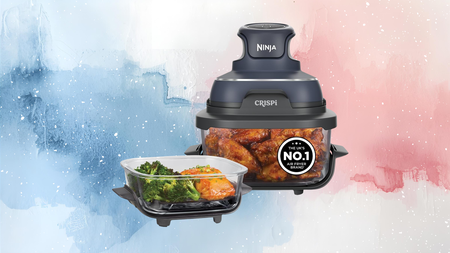
The concept is a 1700W PowerPod that clips onto interchangeable glass containers rather than a fixed, cavernous basket you have to scrub clean every night after dinner.
Advertisement
Two CleanCrisp glass containers are included in the box: a 3.8-litre version large enough to cook a 1.2kg chicken, and a 1.4-litre container suited to sides, snacks, or cooking a smaller portion without heating a vessel twice the size you need.
Both containers are PFAS-free, dishwasher safe, and thermally shock resistant, which matters in practice because you can pull one straight from the fridge and put it under the PowerPod without waiting for it to adjust to room temperature.
The 1.4-litre container also comes with a snap-lock, leak-resistant lid, so what you cook in it can go directly into a bag for work or school the next morning without decanting into a separate box.
Advertisement
Four cooking modes are available across Air Fry, Roast, Keep Warm, and Recrisp, with the last one doing the job of bringing yesterday’s leftovers back to something worth eating rather than something you settle for.
When it’s not in use, the PowerPod nests directly into the glass containers for storage, which means the whole system takes up far less cupboard space than a conventional air fryer of equivalent cooking capacity.
The Ninja CRISPi is the right fit for smaller households, student kitchens, or anyone who’s wanted air fryer results without committing a permanent shelf to the hardware, and at £104 that case is considerably easier to make than it was at full price.
If you want to see how the CRISPi stacks up against the competition before committing, our best air fryers guide covers the full field, with hands-on verdicts from our testing team across a wide range of price points.
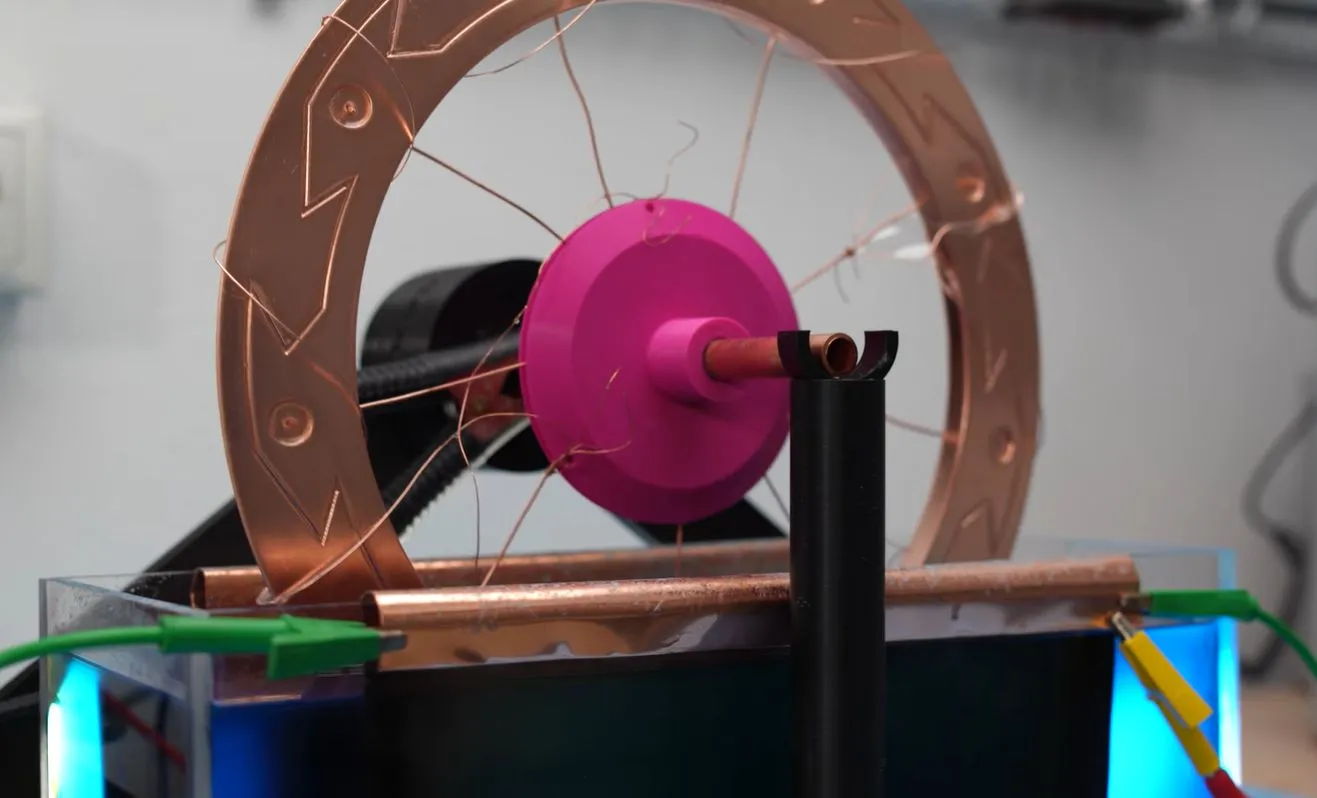
Electroplating 3D prints is a good way to get a pretty nice coating on even a basic PLA part, but generally you’re expected to dunk the entire part into a big vat with electrolyte after coating it with the requisite conductive paint layer. This is great for small parts, like a ring you’d put on a finger, but gets rather silly when it’s a much larger part, such as the one in [Hendrik]’s recent video. Out of curiosity he tried to see whether rotating the part through a much smaller vat would still get you an even coating, or not.
Perhaps ironically this process required building a custom vat out of acrylic, as well as an entire rig to hold up the part and gently rotate it. This highlights the main disadvantage of this approach, in that unless you’re doing a small production run or otherwise get to re-use the rig a lot it’s a lot of extra effort.
That said, the rotation is controlled by an ESP32 and a stepper motor along with a requisite stepper driver, with the most exotic part being the whole custom PCB and enclosure, all of which can be used repeatedly. With all of that tested and confirmed working, the part to be plated was sanded, sprayed with conductive paint and hooked up to the rotating rig for an overnight run.
Advertisement
Following that the part’s new copper coating was polished before more layers of electroplating were applied to get the desired two different colors from different metals. Along the way no issues were found with this method of rotating electroplating, so if you regularly struggle with oversized parts to electroplate, this would seem to be a viable method.





























































You must be logged in to post a comment Login