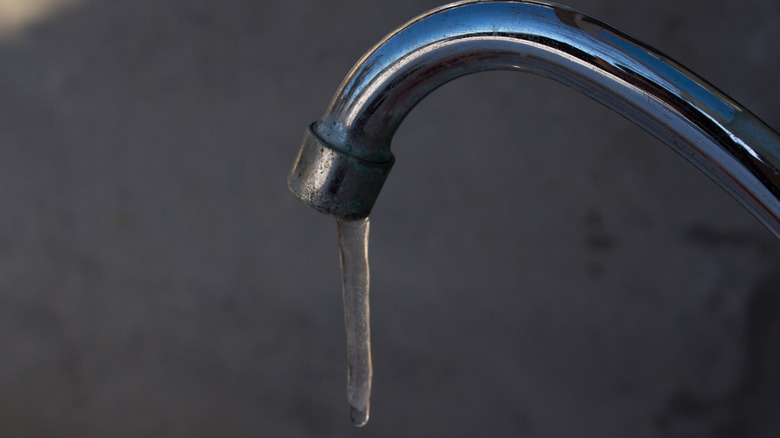

When temperatures plummet, you may face more pressing problems than misplaced winter gear, drafty windows, and closed businesses and schools. Frigid weather can lead to serious threats including hypothermia, power outages, and frozen pipes. We all know the dangers that hurricanes and wildfires pose to our homes, but according to the Insurance Institute for Business and Home Safety (IBHS), harsh winter weather is among the costliest insured catastrophes, and burst pipes are the top risk factor for property damage in cold weather.
Frozen pipes can happen anywhere, but your most at-risk spaces include any exterior pipes, like spigots or sprinkler pipes, pipes in unheated spaces such as your basement, attic, and garage, and pipes that run along exterior walls. There are steps you can take to prevent your pipes from freezing, but sometimes that’s not enough. Frozen pipes don’t always burst, but when they do, it’s often not simply due to freezing. Water does, of course, expand when it’s frozen, but that ice tends to expand to the side, not outward. As the water in the pipe begins to thaw, however, the newly melted ice, or water, can push against areas that are still frozen. Sometimes that water is also pushed by ice towards the faucet. In either case, the pressure this causes can lead to a burst pipe.
Advertisement
How to avoid frozen pipes, and what to do if your pipes freeze anyway
Iuliia Mikhalitskaia/Getty Images
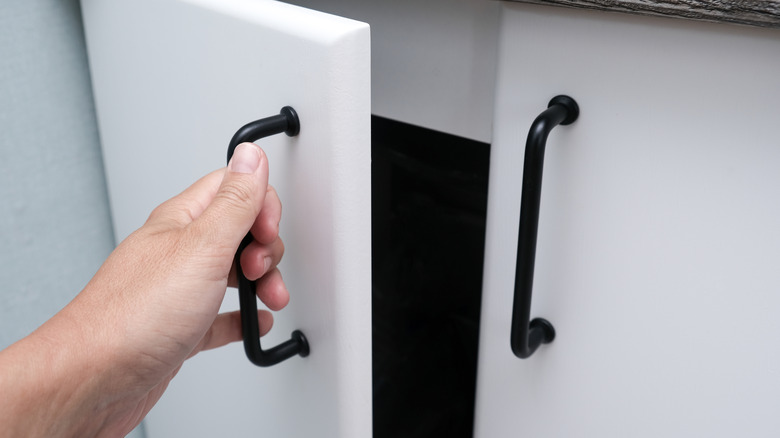
The average cost of repairing a burst pipe and the damage it can cause ranges from a few hundred dollars to repairs in the thousands, depending on the location of the pipe. If the outside temperature is going to fall below freezing, you should consider taking steps to keep your pipes thawed. When temperatures drop, you can open the cabinet doors around kitchen and bathroom plumbing to expose those pipes to warmer air and turn your faucets on to a trickle — running water through the pipes will help keep them from freezing. If you have pipes in your garage, be sure to keep the garage door closed. You can easily add insulation to at-risk pipes, and you can also add insulation to the colder spots of your home, including the attic, crawl spaces, and even your basement. Finally, keep your thermostat no lower than 55 degrees Fahrenheit, even when you’re not home.
If you suspect a pipe is frozen but hasn’t burst, you can try simply turning on the faucet. Running water through the pipe may be enough to melt the ice. You can also try gently warming the pipe with a hair dryer, an electric heating pad, or a space heater, but never use an open flame. You risk starting a fire, and the high heat could damage your pipes. If home remedies don’t work or you’re worried your pipe is close to bursting or has burst, call a plumber and have the professionals handle it.
The Austrian fan manufacturer shared a photo of what appears to be the exterior of a PC chassis, showing the Noctua logo next to several I/O ports. The company also shared a few details about its upcoming product in its replies to commentators. Read Entire Article Source link
We’ve been covering the growing parade of lawyers submitting AI-hallucinated case citations to courts for a while now. It keeps happening, and courts keep having to deal with it. But the pattern is usually the same: a careless attorney uses ChatGPT to draft a brief, the fake citations get spotted by the opposing side or the judge, and sanctions follow. Embarrassing, but contained.
What happened in a California state appellate case decided this month is something far more insane (found via Bluesky). A hallucinated citation traveled through an entire legal proceeding — from a Reddit blog post to a client’s declaration to an attorney’s letter to the opposing attorney’s draft of the court order to the judge’s signature to appellate filings — and at no point along the way did anyone bother to check whether the case actually existed.
Oh, and the whole thing was about custody of a dog named Kyra.
We publish this opinion to emphasize that courts and attorneys alike have a responsibility to protect the legal system against distortion by fabricated law, particularly in this new era of hallucinated citations generated by artificial intelligence (AI) tools. In a system of precedents that is designed to achieve consistency, predictability, and adherence to the rule of law, the judiciary cannot function properly unless judges and lawyers confirm the authenticity of cited authorities and review them to evaluate their holdings and reasoning. When the participants fail to perform this basic function, it compromises these institutional values and diminishes faith in the judicial process.
Here’s how the case got there: Joan Pablo Torres Campos (Torres) and Leslie Ann Munoz dissolved their domestic partnership in 2022. Two years later, Torres wanted shared custody and visitation of Kyra (the dog). Munoz, represented pro bono by her cousin — attorney Roxanne Chung Bonar — opposed. In her opposition, Bonar cited two cases: Marriage of Twigg and Marriage of Teegarden.
Neither case exists. Or rather, the actual citations Bonar gave correspond to completely unrelated cases — one is a criminal case, and the other is a spousal support case from a different year with a different citation. But as cited by Bonar, with the holdings she described, these cases were pure fiction.
And where did the fake citations come from? Apparently a Reddit blog post. By someone named… Sassafras Patterdale. I am not joking:
Bonar did not submit any declaration of her own, but she submitted one from her client Munoz. Munoz explained that the Twigg case was discussed in a Reddit article a paralegal friend had sent her, and Munoz did not realize the case was fictitious. The Reddit article was attached as an exhibit to Munoz’s declaration. It was authored by “Sassafras Patterdale,” who was identified as “a blogger, podcaster, and animal rescuer, who writes about divorce, custody, and the messy, beautiful lives we weave.” The article was about pet custody battles. It cited “Marriage of Twigg (1984) 34 Cal.3d 926” as a “watershed” California Supreme Court case holding “that custody determinations must consider the emotional well, being [sic] and stability of the parties.”
The Reddit article did not include the parallel reporter citations and date of decision for Twigg that were included in Bonar’s opposition to the second motion to reinstate the appeal. Neither Bonar’s response to our order nor Munoz’s declaration explained where this additional fictitious information came from.
Advertisement
And then Torres’s own lawyer — a reminder: he’s the one who filed the lawsuit to get visitation with the dog — drafted the proposed court order and included the same fake citations the opposing party had used, without verifying them either.
And the court signed it. Because of course it did.
Torres’s counsel submitted a proposed Findings and Order After Hearing, which the court approved as conforming to its oral ruling. The order cited the fictional Twigg and Teegarden cases as follows:
“The Court notes the follow[ing] cases: Marriage of Twigg (1984) 34 Cal.3d 926 and Marriage of Teegarden (1995) 33 Cal.App.4th 1572 [(Teegarden)], in which the Court has to take the well-being and stability of the parties involved when deciding pet visitation and custody….”
So to recap: the fake citation originated on Reddit, traveled into the defendant client’s declaration, was used by the defendant client’s attorney, was then included by the opposing attorney in the draft order, and was signed by the judge. Nobody — not either attorney, not the judge — looked up the cases.
But that’s just the warm-up.
Advertisement
Torres appealed. His appeal was dismissed for failure to file an opening brief. He moved to reinstate it. In her opposition to that motion, Bonar — still representing Munoz — cited the fake cases again, this time telling the appellate court: “This isn’t new, courts decide these based on what’s best for everyone involved (Marriage of Twigg (1984) 34 Cal.3d 926; In re Marriage of Teegarden (1995) 33 Cal.App.4th 1572).”
Torres filed a second motion to reinstate, and this time finally pointed out that these were “invented case law.”
Now, a reasonable response to being told your citations are fabricated might be to quietly check, discover the problem, and apologize to the court — ideally with some groveling, in hopes of limited sanctions.
Bonar, however, chose a different path. She doubled down. Hard.
Advertisement
Bonar filed another opposition on behalf of Munoz. The opposition stated: “Appellant’s Claim of Fabricated Case Law is Baseless.” It asserted: “This is a grave accusation, but it is entirely unfounded and reflects Appellant’s own failure to conduct basic legal research. Both cases are valid, published precedents, and Appellant’s inability to locate them underscores the incompetence that led to his appeal’s dismissal.”
And then she went further, providing additional citation details for the fake Twigg case — parallel reporter citations, a specific date of decision — none of which appeared in the original Reddit article and all of which were also completely fabricated:
“Marriage of Twigg (1984) 34 Cal.3d 926: This is a legitimate California Supreme Court case, reported at 34 Cal.3d 926, 195 Cal.Rptr. 718, 670 P.2d 340, decided on July 5, 1984. The ruling addresses custody determinations in dissolution proceedings, emphasizing the importance of the emotional well-being and stability of the parties involved.”
None of those parallel citations correspond to a Twigg case. No California case by that name was decided on July 5, 1984. The additional details were just as fake as the original citation — almost certainly generated by an AI tool when Bonar went looking for backup. During oral arguments (i.e., well after the judge had already issued an order to show cause about the fictional citations) she finally admitted maybe she had used AI:
At oral argument, Bonar claimed she could not remember where this additional fictitious citation information came from. She acknowledged she did not have a paid subscription to a legal research service at the time, and she was using other online resources including AI for this purpose. She also conceded she may have obtained fictitious information about Twigg and Teegarden using AI tools.
But the cherry on top — the part where you have to put the ruling down and go for a walk just to remind yourself that some other part of the world is good — is that in this same filing where she doubled down on fabricated case law with additional fabricated details, Bonar accused opposing counsel of being the incompetent one and mocks them for being unable to search and find the non-existent cases.
Appellant’s assertion that no such case or parties exist is incorrect; a simple search for ‘Teegarden marriage California’ reveals the 1986 decision involving Anne and Byron Teegarden. This misrepresentation not only fails to prove misconduct but exposes Appellant’s counsel’s deficient preparation, which mirrors the neglect that caused the default.
Again: she called the lawyer who (eventually) correctly identified her fake citations incompetent for failing to find cases that don’t exist.
Advertisement
The court was not amused. It hit Bonar with $5,000 in sanctions — significantly more than the $1,500 that the same court imposed in a recent similar case — specifically because she “persisted in and aggravated the misconduct by providing additional fictitious citation information” and “still has not been completely forthcoming with this court.” The opinion is also being forwarded to the State Bar of California.
As for Torres, the appellant who did finally correctly identify the fake citations? He lost anyway. The court found that because his own lawyer drafted and submitted the order containing the fake citations without objecting or verifying them, he forfeited his right to challenge those citations on appeal. In other words: his lawyer helped propagate the hallucinated citations by including them in the draft order, and he can’t now complain about the very thing his lawyer failed to catch.
Torres forfeited his claim of error both by his affirmative conduct and his inaction. Although Munoz and Bonar were responsible for improperly citing these fictitious authorities in the first place, Torres’s own counsel affirmatively drafted and submitted the proposed order with these citations that was ultimately signed by the family court. And even though his own counsel drafted the order, Torres failed to object to the court’s reliance on these citations or call the court’s attention to the issue.
There’s a lesson here that goes well beyond “lawyers should verify their citations” — though they really, desperately should. This case shows how hallucinated AI output achieves a kind of credibility laundering as it passes through the system. The fake citation looked more legitimate in the client’s declaration because it had been in a blog post. More legitimate in the court order because it had been in the declaration. More legitimate in the appellate filing because it had been in the court order. At each step, someone assumed that someone earlier in the chain had already done the checking. Nobody had.

In a legal system built entirely on the idea that citations to precedent mean something — that every case cited in an order actually happened and actually stands for the proposition claimed — this kind of cascading failure is really, really bad. And as AI tools get better at generating plausible-sounding legal citations — complete with reporter volumes, page numbers, and dates — the obligation on every participant in the system to actually verify what they’re citing becomes that much more important.

Advertisement
The court itself apparently recognized that its “please just check your citations” message might need some institutional reinforcement. Its footnote at the end of the sanctions section quietly recommends that the Judicial Council consider adopting formal guidelines or rules requiring verification of citations — particularly in party-drafted orders submitted for a judge’s signature. Which is, in hindsight, an obvious hole in the system. But it took Sassafras Patterdale, a Reddit post, and a dog named Kyra to expose it.
EURO-3C’s backers – Spanish telecoms giant Telefónica, dozens of other European companies, and the European Commission (EC) – aim to fill a gap. U.S.-based cloud giants dominate in the EU, and European policymakers want their growing portfolio of digital government services on a “sovereign cloud” under full EU control.
But the EU lacks a real equivalent to the likes of AWS or MicrosoftAzure. Indeed, any effort to build one will inevitably run up against the same U.S. cloud giants.
But those hypothetical risks to digital services have become more real as transatlantic relations have soured under the second Trump administration. The U.S. has openly threatened to invade an EU member state and sanctioned a European Commissioner for passing legislation the White House dislikes.
After the White House sanctioned the Netherlands-based International Criminal Court in February 2025, Court staffers claimed Microsoft locked the Court’s chief prosecutor out of his email (Microsoft has denied this). Around the same time, the U.S. reportedly threatened to sever EU ally Ukraine’s access to crucial Starlinksatellite internet as leverage during trade negotiations.
“The geopolitical risk isn’t just the most extreme form of a doomsday ‘kill switch’ where Washington turns off Europe’s internet,” Stéfane Fermigier of EuroStack, an industry group that supports European digital independence. “It is the selective degradation of services and a total lack of retaliatory leverage.”
What, then, is the EU to do? France offers an example. Even before 2025, France implemented harsh restrictions on non-EU cloud providers in public services – providers must locate data in the EU, rely on EU-based staff, and may not have majority-non-EU shareholders. Now, EU policymakers are following France’s lead.
Advertisement
In October 2025, the EC issued a two-part framework for judging cloud providers bidding for public sector contracts. In the first part, the framework lays out a sort of sovereignty ladder. The more that a provider is subject to EU law, the higher its sovereignty level on this ladder. Any prospective bidder must first meet a certain level, depending on the tender.
Qualifying bidders then move to the second part, where their “sovereignty” is scored in more detail. Using too much proprietary software; over-relying on supply chains from outside the EU; having non-EU support staff; liability to non-EU laws like the CLOUD Act: all hurt a bidder’s score.
The framework was created for one tender, but observers say it sets a major precedent. Cloud providers bidding for state contracts across Europe may need to follow it, and it may influence legislation on both national and EU-wide levels.
Who, then, will receive high marks? At the moment, the answer is not simple. The EU cloud scene is quite fragmented. Numerous modest EU providers offer “sovereign cloud” services – such as Scaleway, OVHcloud, and Deutsche Telekom’s T-Systems – but none are on the scale of AWS or Google Cloud.
Advertisement
Inertia is on the side of the U.S. cloud giants, who can invest in their infrastructure and services on a far grander scale than their European counterparts. Some U.S. providers now offer cloud services they say comply with the Commission’s “cloud sovereignty” demands.
Some European observers, like EuroStack, say such promises are hollow so long as a provider’s parent company is subject to the likes of the CLOUD Act, and loopholes in the Commission’s process remain open. An AWS spokesperson told Spectrum it had not disclosed any non-US enterprise or government data to the U.S. government under the CLOUD Act; a Google spokesperson said that its most sensitive EU offerings “are subject to local laws, not US law”.
Even if a project like EURO-3C can offer a large-scale alternative, the US cloud giants have another sort of inertia. Many developers – and many public purchasers of their services – will need convincing to leave behind a familiar environment.
“If you look at AWS, you look at Google, they’ve created some super technology. It’s very convenient, it’s easy to use,” says Arnold Juffer, CEO of the Netherlands-based cloud provider Nebul. “Once you’re in that platform, in that ecosystem, it’s very hard to get out.”
Advertisement
Martyna Chmura, an analyst at the Bloomsbury Intelligence and Security Institute, a London-based think tank, sees some EU developers taking a mixed approach. “Many organizations are already moving toward multi-cloud setups, using European or sovereign providers for sensitive workloads while still relying on hyperscalers for certain services,” she says.
In that case, the EU’s top-down demands may encourage developers to use EU providers for sensitive applications – like government services, transport, autonomous vehicles, and some industrial automation – even if it’s inconvenient in the short term, or if it causes even more fragmentation of the EU cloud scene. “Running systems across different platforms can increase integration costs and make security and data governance more complicated. In some cases, organisations could lose some of the efficiency and cost advantages that come from using large hyperscale platforms,” Chmura says.
“Overall, the EU appears willing to accept some of these trade-offs,” Chmura says.
The Oppo Find N6 is a book-style foldable that really nails the experience, combining a near-creaseless inner display, refined hardware, improved cameras and genuinely usable all-day battery life in a package that finally feels ready for more than just early adopters – making the fact it’s not getting a wide release all the more frustrating.
Slimline design
The foldable crease is almost imperceptible
Much better camera hardware
Strong battery life and rapid charging
Camera sensors still trail behind bar phones
Snapdragon chipset is underclocked
Very limited availability
Squirrel Widget
Advertisement
Key Features
Near crease-less foldable screen
The inner 8.13-inch screen has the least visible crease of any foldable yet, making for a truly premium experience.
Advertisement
All-day battery and fast charging
The combination of a 6000mAh battery and 80W wired charging offers great battery life and a full charge in under an hour.
Advertisement
Boosted camera hardware
With a 200MP main and dual 50MP zoom and ultrawide lenses, the Find N6 is capable of great shots.
Advertisement
Introduction
The biggest problem with book-style foldables has always been right there in the middle of the screen – but with the Find N6, Oppo has all but erased it.
Thanks to a new hinge and “Auto-Smoothing” glass, the inner display is almost perfectly flat, finally delivering a tablet-like canvas that doesn’t constantly remind you it folds in half.
Oppo hasn’t stopped there, either; the N6 backs that near-creaseless panel with a larger battery, faster charging, a genuinely competitive camera system and one of the most polished big-screen Android experiences around, complete with powerful multitasking tools and thoughtful productivity tweaks.
Advertisement
Advertisement
The catch? Despite feeling like a proper 2026 flagship that just happens to fold, Oppo is only releasing it in a handful of markets – China, Japan, Malaysia, Thailand, Australia and New Zealand – with no plans for a launch in the EU, UK or US, making this more of an import‑only glimpse at the foldable future than a phone most people can realistically pick up.
Design
Just as thin as last year, but lighter
Shallow camera bump
Improved dust and water resistance
Take a quick look at the Oppo Find N6 and you might struggle to find any real differences between it and its predecessor, but honestly, that’s not a problem at all.
The Oppo Find N5 led the charge on the super-thin foldable trend that the likes of Samsung and Honor have since jumped on, and even if the N6 isn’t any thinner, at 8.9mm folded and 4.2mm unfolded, it’s still slimmer than some regular bar phones.
Image Credit (Trusted Reviews)
Advertisement
I’m not disappointed it’s not any thinner; the Honor Magic V6 is technically slimmer, though only by 0.1mm – something you won’t notice. They can’t really go much thinner anyway, as the USB-C port simply won’t fit.
Much like the N5, the N6 is super thin when unfolded, nice to hold and, with newly chamfered edges, it doesn’t feel quite as sharp as its predecessor despite having the same flat edges. The rounded corners don’t feel quite as premium as Samsung’s sharp-cornered Galaxy Z Fold 7, but that’s largely a matter of personal preference.
Advertisement
Image Credit (Trusted Reviews)
The Find N5 might’ve been thin, but compared to the Fold 7 and Magic V5, it wasn’t light. At 229g, it was noticeably heavier than Samsung’s 215g and Honor’s 217g. The Find N6 shaves off 4g, but it’s still pretty hefty. It’s not as heavy as the 258g Google Pixel 10 Pro Fold, but it’s not quite as lightweight as Samsung’s alternative either.
Flip the phone around and you’ll find a familiar ‘cosmos ring’ camera housing, once again front and centre, but much shallower than before. It’s now among the thinnest camera housings you’ll find on a foldable, allowing for less of a table wobble while still offering impressive camera hardware – but more on that later.
Image Credit (Trusted Reviews)
Advertisement
Other tweaks include a slight repositioning of the power and volume controls to accommodate Oppo’s new customisable SnapKey, and improved dust and water resistance – though its combination of IP54, IP58 and IP59 isn’t quite as robust as the IP68 Pixel 10 Pro Fold.
Colour options remain attractive, with the phone available in Blossom Orange, a softer orange than Apple’s iPhone 17 Pro alternative with rose gold detailing, along with Stellar Titanium, a more toned-down grey with matching silver accents.
Screens
8.12-inch foldable AMOLED screen
No visible crease on foldable screen – a first
Great cover screen, though still a bit narrow
If there’s one reason to import the Find N6, it’d be the screens – and the foldable inner panel in particular. At 8.12 inches, it’s huge and offers all the premium gubbins you’d expect, including an LTPO-enabled 120Hz refresh rate, 2160Hz PWM dimming and a top brightness of 2500nits in HBM.
Image Credit (Trusted Reviews)
The real magic, though, is the crease – or lack of it. The crease has been the bane of foldables since their inception and, while we’ve come a long way from the cavernous creases of early models, you can still see and feel them on the latest Z Fold 7 and Magic V5.
Advertisement
Advertisement
Not with the Find N6. Even powered off, it’s very hard to spot the crease. That’s down to an industry-first hinge manufacturing process that uses 3D printing to smooth out parts of the hinge and keep it flat. Oppo claims other manufacturers usually have a variation of around 0.2mm, but the N6 is just 0.05mm – less than the thickness of a human hair, and only really visible when shining a light directly at it.
Image Credit (Trusted Reviews)
Run your finger across it and there’s only the slightest dip if you really feel for it. In everyday use, you won’t notice it – I certainly haven’t over the past month or so.
The result is a much more premium, clean-looking foldable experience that finally doesn’t feel compromised in any real way. It’s a genuine step forward in foldable screen tech and helps Oppo stand out from the foldable crowd.
Image Credit (Trusted Reviews)
Paired with a bright, smooth AMOLED panel, it’s an absolute joy to use for everyday tasks like scrolling through TikTok, watching YouTube or editing videos in CapCut with its foldable-friendly UI. It’s still a little reflective, with plastic instead of glass, but that’s par for the course if you want a folding screen.
Advertisement
Crucially, Oppo claims the new hinge – and its new Auto-Smoothing Flex Glass – shouldn’t degrade over time either, with no noticeable difference even after 200,000 folds. If Oppo’s numbers are to be believed, it could last for over 1 million folds – but only time will tell.
Advertisement
Image Credit (Trusted Reviews)
The cover screen seems almost dull in comparison, but it’s also a well-specced panel, sharing most key specs with the internal screen while actually getting brighter at 3500nits. The bezels have slimmed down to 1.4mm thick, giving it a cleaner look than last year’s N5, though the surrounding frame means it’s still not quite as bezel-less as a bar-phone alternative.
Still, it performs admirably at its primary task of providing a more traditional smartphone experience when it’s not convenient to unfurl the inner screen. At 6.6 inches, it’s the perfect size for scrolling through social media, replying to WhatsApp messages and anything else you want to do one-handed, with a similarly vibrant, colourful panel that lends itself well to video.
Image Credit (Trusted Reviews)
I do wish it were a little wider though, with a 20.7:9 aspect ratio that’s still a little tall and narrow compared to regular phones. It’s not something I noticed much during active use, but switching between it and phones like the Galaxy S26 Ultra, the extra width is appreciated.
Advertisement
Cameras
200MP main, 50MP 3x periscope and 50MP ultrawide lenses
Boosted camera performance across the board
Secondary lenses aren’t perfect for low-light situations
With the N5, Oppo sacrificed camera performance to achieve its super-thin build – but the N6 looks to rectify this. It’s headed up by a 200MP main shooter, along with a 50MP 3x periscope lens and a 50MP ultrawide complete with autofocus, with underlying hardware that’s much more capable of competing with premium bar phones.
The 200MP sensor, up from 50MP last year, is the star of the show, with a wide f/1.7 aperture and a 1/1.56-inch sensor drinking in as much light as possible. It’s a competent snapper in both well-lit and low-light environments, with the high-res sensor providing plenty of detail with pixel-binning tech at play.
Image Credit (Trusted Reviews)
There are plenty of shooting modes to play with too, both Hasselblad-branded and Oppo-branded, all focused on specific scenarios or lighting conditions. You’ve got modes for tricky situations like concerts, fireworks and silhouette shots, along with options that improve the look in bright outdoor conditions, providing plenty of tools to experiment with and get great shots.
Colours are also much truer to life than you’ll get from Samsung’s alternative, mainly thanks to the dedicated True Colour camera from the flagship Find X9 Pro, whose sole job is to measure colour. That setup means that, unlike most other foldables, the colour science is the same across all three rear lenses, with each using that dedicated colour sensor.
Advertisement
Advertisement
The 50MP 3x periscope remains unchanged from last year’s foldable, but it’s still a competent zoom lens, especially compared to Samsung’s 10MP 3x telephoto alternative. The 3x zoom is ideal for portrait photography, especially when paired with the dedicated Portrait mode for advanced control over lighting and background blur, and it’ll do a decent job up to around the 10x mark before those telltale signs of artificial enhancement start to become apparent.
The 50MP ultrawide, with a big boost in resolution and now able to offer pixel-binning tech to boost light capture and detail, feels much more at home in a high-end smartphone. Like the other lenses, it delivers great shots, particularly during the day, with little edge distortion, and the autofocus makes it great for group shots.
When light levels drop, the limitations of Oppo’s camera tech start to appear – not necessarily with the super-high-res main sensor, but with the secondary lenses, the ultrawide in particular. It’ll do well enough in dim bars, clubs and streetlamp-lit streets, but the aperture just isn’t quite wide enough for proper low-light photography.
Advertisement
The Find N6 likely won’t be winning any awards for smartphone photography – the ultra-slim dimensions mean there are still compromises to be had, particularly in terms of sensor sizes compared to regular camera-focused phones – but it’s a great showing for a foldable, and I think very few people will be disappointed with what the N6 offers.
Advertisement
Performance
Snapdragon 8 Elite Gen 5 – but with fewer cores
Still delivers a top-notch everyday experience
Can handle gaming sessions with ease
The Oppo Find N6 has Snapdragon 8 Elite Gen 5 power at its heart – but there’s a catch. This is a new, slightly underpowered, seven-core CPU version of the chipset, which usually comes with an eight-core configuration. Oppo claims that the NPU and GPU are identical, though that doesn’t quite align with my test results.
Even when paired with 16GB of RAM and 512GB of storage, it’s not quite at the same level of performance as Snapdragon-powered bar flagships like the Samsung Galaxy S26 Ultra and OnePlus 15 in benchmark testing.
Test Data
Oppo Find N6
Samsung Galaxy Z Fold 7
Samsung Galaxy S26 Ultra
OnePlus 15
Geekbench 6 single core
3571
2318
3519
3553
Geekbench 6 multi core
9677
8828
10713
10642
Geekbench 6 GPU
23961
–
24611
–
3DMark Solar Bay
46.9
–
46.9
–
3D Mark – Wild Life
6398
5574
7281
6166
3D Mark – Wild Life Stress Test
53.6 %
–
67.6 %
–
While single-core CPU performance is comparable, the N6 falls slightly behind ‘true’ 2026 flagship alternatives in multi-core CPU tests – unsurprising given the missing core – and more interestingly in GPU tests, with scores consistently lower than the top-end competition.
Advertisement
Advertisement
It also isn’t the greatest phone I’ve seen in terms of sustained performance, scoring just 53.6% stability during a high-intensity 20-minute stress test – though that is fairly common among super-thin foldables where there isn’t a lot of space for heat to be effectively dissipated.
That might paint a picture of a foldable that can’t quite keep up with bar-style competition, but the day-to-day performance of the Find N6 is absolutely fine.
Image Credit (Trusted Reviews)
The phone feels about as rapid as any other flagship you could pick up in 2026, foldable or otherwise, with Oppo’s focus on speedy animations across the OS making it feel even more responsive. Apps open with a sense of urgency, multi-app splitscreening is a delight on the big internal panel, and it can handle gaming sessions with ease.
I could happily run my go-to games, like Call of Duty Mobile and Crashlands 2, with high-fidelity graphics and high frame rates on the higher-res internal panel without any noticeable lag or stuttering. The phone does get warm after longer 30-minute+ sessions, but even then, it’s not hot, just warm under the fingers.
Advertisement
As you’d expect from a high-end phone, that’s paired with top-end connectivity including Wi-Fi 7 and Bluetooth 6, along with NFC for those all-important contactless payments.
Advertisement
Software
ColorOS 16 based on Android 16
New floating window multitasking mode
Suite of productivity and AI features
Of all the heavily customised Android skins I encounter switching between brands like Samsung, Honor and Xiaomi, Oppo’s ColorOS has to be one of my favourites. It’s well-designed and polished without the bloatware and ballooning feature set you get with some rivals, with a focus on speed, customisation and genuinely handy productivity tools.
Image Credit (Trusted Reviews)
The latest version, ColorOS 16 based on Android 16, further improves this with better UI animations that make everything feel a little slicker and more responsive, along with new lock screen themes, a sprinkling of Apple-inspired transparency and a completely new way to multitask on big-screen foldables.
Like some of the best Android tablets, the Find N6 has a fully featured windowed app mode – dubbed Free Flow Window – that allows for a desktop-like experience with up to four resizable windows on-screen at once. You can either let the phone arrange them automatically or drag them around yourself.
Image Credit (Trusted Reviews)
Advertisement
It’s particularly handy when switching between apps to retrieve information, allowing you to keep apps running in mini windows while you work in another app full-screen, or run them side by side for simultaneous use. And if that’s not your cup of tea, the traditional full-screen multitasking experience – which remains excellent – is still available.
Advertisement
That alone makes the Find N6’s software experience among the strongest available right now, but other new features like the ability to view messages and notifications from a connected iPhone and the option to remotely access PC and Mac desktops also enhance the experience.
Image Credit (Trusted Reviews)
There’s also the usual smattering of AI features, including a suite of AI photo-editing tools, image-generation tech, translation tech, and audio-recording transcription. The latter still needs a bit of work however, with a 100-minute-per-month limit and a buggy summary experience.
On the whole, though, ColorOS 16 remains a good-looking, feature-packed and easy-to-use spin on Android.
Battery life
6000mAh silicon carbon battery
Can get you through most days with ease
Rapid 80W charging
Advertisement
Oppo has made big gains in the battery life department with this year’s foldable, sporting a decent-sized 6000mAh battery that makes it bigger than the Z Fold 7, Magic V5 and Pixel 10 Pro Fold – though it is bested by the newer Magic V6, revealed at MWC and due out later this year.
Still, among foldables you can actually buy right now, the Find N6 has one of the largest batteries around – and that translates to strong everyday performance.
Advertisement
Image Credit (Trusted Reviews)
It’s the first foldable I’ve used where I don’t feel constrained by the battery, and that meant I was actively using the larger, more power-hungry inner screen more than I would on the likes of the Z Fold 7. It got me through demanding days with a mix of photography, music playback, messaging, browsing and gaming, with some charge left in the tank.
We’re talking remaining battery in the range of 10–20%, which is a little close for comfort – especially compared to bar phones like Oppo’s own Find X9 Pro and its 7500mAh cell that can get well into a second day of use – but it’s still a big step forward for foldables.
Of course, your mileage may vary depending on what you’re up to and the features you’ve enabled, but for most people, the Find N6 will be an all-day device.
Advertisement
Image Credit (Trusted Reviews)
If it does need a top-up on particularly busy days, the Find N6 charges very quickly with rapid 80W wired charging support. Despite having a bigger battery than much of the competition, it still goes from near-empty to a meaningful charge in around 15 minutes and to full in well under an hour.
You’ll need a SuperVOOC-branded charger to hit those speeds, and you’ll need an adapter if you import one to the UK (or simply source a UK charger separately), but that’s a small price to pay. If you decide against it, it also supports 55W USB-C PD charging and 50W AirVOOC wireless charging – though, again, the latter requires a specific charger to reach top speeds.
Advertisement
Squirrel Widget
Should you buy it?
You want an almost crease-free foldable experience
The Find N6 has pretty much eliminated the crease, with only a slight 0.05mm-deep bump running down the screen – the shallowest of any foldable yet.
Advertisement
You don’t want to import it
Advertisement
With such limited availability, you’ll likely need to import the Find N6 – and that comes with additional fees and taxes.
Final Thoughts
The Oppo Find N6 is an ultra-thin book-style foldable that doesn’t come with an obvious, daily compromise.
Advertisement
The near-creaseless inner display is a genuine first for foldables, finally delivering a tablet-like experience that doesn’t constantly remind you of the underlying hardware trickery. Paired with refined hardware, a much-improved camera system and the kind of battery life that lets you actually use that big inner screen without anxiety, it feels like Oppo is tackling the pain points that have made foldables feel like early-adopter tech for years.
That said, the Find N6 still isn’t the perfect all-rounder, and for many people it simply won’t be an option at all.
The seven-core Snapdragon 8 Elite Gen 5 doesn’t quite match the best bar-style flagships in raw benchmarks, the secondary cameras and low-light performance still trail traditional camera phones, and, most importantly, it’s not getting a wider release beyond China, Japan, Malaysia, Thailand, Australia and New Zealand, making it a non-starter for most.
If you’re willing to import, the Find N6 is one of the most complete foldable options around – it’s just a shame that, for most people, it’ll remain more aspirational than attainable. For options that are more easily available, take a look at our hand-picked selection of the best foldable phones.
Advertisement
Advertisement
How We Test
We test every mobile phone we review thoroughly. We use industry-standard tests to compare features properly and we use the phone as our main device over the review period. We’ll always tell you what we find and we never, ever, accept money to review a product.
Used as a main phone for a month
Thorough camera testing in a variety of conditions
Tested and benchmarked using respected industry tests and real-world data
FAQs
Is the Oppo Find N6 available in the UK, US or Europe?
No, unfortunately not. The Find N6 is limited to regions including China, Japan, Malaysia, Thailand, Australia and New Zealand.
Advertisement
Does the Oppo Find N6 come with a charger in the box?
It depends on the region you’re in, but generally speaking, you’ll get an 80W SuperVOOC charger in the box.
An anonymous reader quotes a report from Ars Technica: Since Andrej Karpathy coined the term “vibe coding” just over a year ago, we’ve seen a rapid increase in both the capabilities and popularity of using AI models to throw together quick programming projects with less human time and effort than ever before. One such vibe-coded project, Gaming Alexandria Researcher, launched over the weekend as what coder Dustin Hubbard called an effort to help organize the hundreds of scanned Japanese gaming magazines he’s helped maintain at clearinghouse Gaming Alexandria over the years, alongside machine translations of their OCR text.
A day after that project went public, though, Hubbard was issuing an apology to many members of the Gaming Alexandria community who loudly objected to the use of Patreon funds for an error-prone AI-powered translation effort. The hubbub highlights just how controversial AI tools remain for many online communities, even as many see them as ways to maximize limited funds and man-hours. “I sincerely apologize,” Hubbard wrote in his apology post. “My entire preservation philosophy has been to get people access to things we’ve never had access to before. I felt this project was a good step towards that, but I should have taken more into consideration the issues with AI.” “I’m very, very disappointed to see [Gaming Alexandria], one of the foremost organizations for preserving game history, promoting the use of AI translation and using Patreon funds to pay for AI licenses,” game designer and Legend of Zelda historian Max Nichols wrote in a post on Bluesky over the weekend. “I have cancelled my Patreon membership and will no longer promote the organization.”
Nichols later deleted his original message (archived here), saying he was “uncomfortable with the scale of reposts and anger” it had generated in the community. However, he maintained his core criticism: that Gemini-generated translations inevitably introduce inaccuracies that make them unreliable for scholarly use.
In a follow-up, he also objected to Patreon funds being used to pay for AI tools that produce what he called “untrustworthy” translations, arguing they distort history and are not valid sources for research. “… It’s worthless and destructive: these translations are like looking at history through a clownhouse mirror,” he added.
Denon has introduced the DP-500BT Bluetooth turntable, a semi-automatic belt-drive model designed to bring vinyl playback into wireless listening systems. The new turntable allows records to be played through traditional analog outputs or streamed directly to Bluetooth speakers and headphones, offering a flexible option for listeners who want the warmth of vinyl without giving up modern convenience.
Vinyl’s resurgence shows no signs of slowing. U.S. vinyl sales rose for the 19th consecutive year to 47.9 million units, with independent record stores accounting for roughly four out of every ten purchases. Buying habits across physical formats are also shifting as direct-to-consumer sales now represent 13.6% of all physical album purchases, according to Luminate. The continued demand for physical media helps explain why companies like Denon are expanding their turntable lineups.
Although Denon is perhaps best known for its AV receivers, the company has a long history of producing turntables. Its current range includes the DP-450USB ($799), DP-400 ($599), DP-300F ($499), DP-29F ($219), and the flagship DP-3000NE ($2,799). The new DP-500BT joins that lineup as a belt-drive design that blends classic analog playback with the convenience of Bluetooth connectivity.
Inside the Denon DP-500BT Bluetooth Turntable
The Denon DP-500BT is a semi-automatic belt-drive turntable that combines traditional analog playback with built-in Bluetooth connectivity. It can be used with modern wireless audio systems or connected to conventional Hi-Fi setups through its analog outputs. The turntable includes an integrated moving magnet phono preamp that can be bypassed if you prefer to use an external phono stage. Wireless playback is supported via Bluetooth with compatibility for aptX, aptX HD, and aptX Adaptive codecs.
Lyle Smith, President of Sound United at HARMAN, explained, “The DP-500BT brings timeless analog and modern wireless freedom together in a way only Denon can. Whether someone is building their first vinyl setup or expanding an existing system, this turntable delivers a premium experience with simple, flexible Bluetooth streaming that carries the depth and detail of vinyl into any room.”
Advertisement
The DP-500BT uses a precision belt-drive system designed to maintain stable platter rotation. It includes a die-cast aluminum platter that adds mass for smoother operation and improved speed stability. Denon also equips the turntable with its balanced S-shaped tonearm, intended to support accurate tracking and help reduce distortion during playback.
A pre installed moving magnet (MM) cartridge and a built in switchable phono preamp are included, allowing the DP-500BT to connect to a wide range of audio systems, including powered speakers and traditional Hi-Fi components.
However, what sets the DP-500BT apart from many turntables is its built-in Bluetooth transmitter, which supports aptX, aptX HD, and aptX Adaptive codecs. This allows users to play vinyl records wirelessly through compatible Bluetooth devices, including headphones, receivers, and powered speakers. In addition, semi-automatic operation with auto lift and playback stop helps protect records while making everyday listening easier and more convenient.
Cast metal feet and vibration-resistant construction maintain stability. A removable dust cover preserves the matte finish. Every element supports both the visual identity and the performance standard expected from Denon.
The design of the DP-500BT reflects Denon’s refined, modern aesthetic with a two-tone finish and minimalist design that fits with a wide range of interiors.
Advertisement
Denon DP-500BT Key Features
Pure Vinyl Playback: Stable platter rotation and careful mechanical design help preserve the character and detail of vinyl records while minimizing distortion.
Bluetooth Streaming: Vinyl records can be played wirelessly through compatible Bluetooth speakers or headphones throughout the home.
Precision Engineered Construction: A die cast aluminum platter, vibration resistant chassis, and balanced S shaped tonearm are designed to reduce resonance and support stable playback.
Belt Drive System: The belt drive design helps isolate motor vibration from the platter, contributing to consistent rotation and cleaner playback.
Semi Automatic Operation: Automatic tonearm lift and playback stop help protect the stylus and records while making operation easier.
Built In Phono Preamp: A switchable phono preamp allows the DP-500BT to connect directly to powered speakers, receivers, or amplifiers that do not include a dedicated phono input.
Streaming is undoubtedly the most popular way to listen to music, but physical media hasn’t quite lost its magic yet. CDs and audio cassettes are making comebacks, but vinyl records have an extra special place in the music listening landscape.
Advertisement. Scroll to continue reading.
Advertisement
As a result, there are an increasing number of turntables that also include Bluetooth as a way to stream vinyl record listening all around the house, whether it be on Bluetooth speakers, wireless headphones, or earbuds, without having to have a turntable in every room.
Denon is the latest to integrate Bluetooth in its turntable line with DP-500BT, but there is also a lot of competition from noted brands, such as the Technics SL-40CBT and Sony PS-LX5BT. The question is, has Denon entered the Bluetooth Turntable game too late to be competitive? Or is this just the right time to unite the old world and the new? We shall soon find out.
Price & Availability
The Denon DP-500BT Bluetooth turntable is priced at $899 at Crutchfield and can be purchased through Denon and authorized retailers in select global markets.
An anonymous reader quotes a report from Inside Climate News: Republican lawmakers in multiple states and Congress are advancing proposals to shield polluters from climate accountability and prevent any type of liability for climate change harms — even as these harms and their associated costs continue to mount. It’s the latest in a counter-offensive that has unfolded on multiple fronts, from the halls of Congress and the White House to courts and state attorneys general offices across the country.
Dozens of local communities, states and individuals are suing major oil and gas companies and their trade associations over rising climate costs and for allegedly lying to consumers about climate change risks and solutions. At the same time, some states are enacting or considering laws modeled after the federal Superfund program that would impose retroactive liability on large fossil fuel producers and levy a one-time charge on them to help fund climate adaptation and resiliency measures. But many of these cases and climate superfund laws could be stopped in their tracks, either by the conservative majority on the U.S. Supreme Court or by the Republican-controlled Congress.
Last month the court decided to take up a petition lodged by oil companies Suncor and ExxonMobil in a climate-damages case brought against the companies by Boulder, Colorado. The petition argues that Boulder’s claims are barred by federal law, and if the justices agree, it could knock out not only Boulder’s lawsuit but also many others like it. The court is expected to hear the case during its upcoming term that starts in October. There is also a possibility that Republicans in Congress will take action before then to gift the fossil fuel industry legal immunity, similar to that granted to gun manufacturers with the 2005 Protection of Lawful Commerce in Arms Act. Sixteen Republican attorneys general wrote (PDF) to U.S. Attorney General Pam Bondi in June suggesting that the Department of Justice could recommend legislation creating precisely this type of liability shield. And last month, one Republican congresswoman announced that such legislation is indeed in the works. “The ultimate democratic institution in America is the jury,” said former Washington Gov. Jay Inslee. Enacting policies that prevent or block climate-related lawsuits against polluters, he said, would effectively shutter “the doors of the courthouse to Americans that have been injured by oil and gas company pollution and by their lies and deceit about that pollution.”
“I really think it’s an un-American effort to deny Americans the traditional right of access to a jury,” Inslee said. Oil and gas executives are “terrified” by the prospect of having to stand before a jury and face evidence of their climate-change lies and deception, he added. “You’ll see the steam coming out of the jury’s ears when they hear about how they’ve been lied to for decades. [Oil companies] understand why juries will be outraged by it, and they are shaking in their boots. The day of reckoning is coming, and that’s why they’re afraid.”
The Pittsburgh startup’s AI platform will create digital twins of Pacific Fleet vessels, starting with 18 ships, as the Navy races to fix a maintenance crisis costing up to $20 billion a year.
Roughly 40% of the United States Navy’s fleet is unavailable at any given time. Ships are queued in dry dock. Maintenance cycles stretch across months. The cost of the backlog, according to Gecko Robotics CEO Jake Loosararian, runs somewhere between $13 billion and $20 billion annually. And as he puts it, “at a time when you need every asset you can get, that’s pretty critical.”
On Tuesday, the Pittsburgh startup announced it had signed a five-year IDIQ (indefinite delivery, indefinite quantity) contract with the US Navy and the General Services Administration, with a ceiling of $71 million.
The initial award stands at $54 million. It is the largest contract the Navy has ever awarded Gecko Robotics , and the largest robotics deal the Navy has signed to date.
Advertisement
The 💜 of EU tech
The latest rumblings from the EU tech scene, a story from our wise ol’ founder Boris, and some questionable AI art. It’s free, every week, in your inbox. Sign up now!
The work begins immediately with 18 ships in the US Pacific Fleet, destroyers, amphibious warships, and littoral combat ships, over the next nine months. Gecko’s wall-climbing robots, drones, and sensors will crawl across hulls, decks, and welds, gathering data points that would take human inspectors weeks to collect.
That raw data feeds into Cantilever, the company’s AI-powered operating platform, which converts it into a detailed digital twin of each vessel: a living, updatable model of the ship’s structural health.
Advertisement
The company says its technology can identify necessary repairs up to 50 times faster and more accurately than manual inspection techniques. Critically, the inspection can happen before a ship even reaches dry dock, meaning the right parts and personnel can be staged in advance, rather than the process beginning only once the vessel is already out of service.
Defense One reported that just 41% of ships completed repairs on time in 2025, well short of the Navy’s 71% goal. The Navy has since reset its target to above 60%, with the broader ambition of reaching 80% fleet combat surge readiness by 2027.
Gecko’s contract structure is also notable for its scope: because it runs through the GSA, any branch of the Department of Defense can access the company’s AI and robotics under the agreement, not just the Navy.
“Readiness isn’t just a metric. It’s all that matters,” Loosararian said in a statement. “This growing partnership is about the unfair advantages Gecko is deploying to our Navy and how prediction, through our robotics and AI products, ensures our brave men and women are the most advantaged in the world in their fight to defend freedom.”
Advertisement
The contract arrives at a moment of heightened urgency around US shipbuilding capacity. The Trump administration released a multi-page plan in February to revive the sector, which has fallen significantly behind China. Pennsylvania Senator Dave McCormick, in a statement, said the deal demonstrated how “engineers, researchers, and skilled tradesmen from a great Pennsylvania company are leading advances in technology, artificial intelligence, autonomous systems, and robotics and giving our military the capabilities it needs for the next generation of American defence.”
Gecko is not new to the Navy. The company, co-founded by Loosararian and Troy Demmer, now its president, has previously deployed its TOKA series robots on destroyers, amphibious vessels, and aircraft carriers, and has worked with defence prime contractor L3Harris on digital twins for military aircraft.
Earlier this year it partnered with BPMI, a contractor for the Naval Nuclear Propulsion Programme, to cut inspection times on nuclear carrier and submarine components by up to 90%.
The company was last valued at $1.25 billion following a Series D round led by Cox Enterprises in June 2025, which brought its total funding to $173 million. It remains private. The TOKA robots that will crawl the Pacific Fleet’s hulls are the same ones Gecko has been deploying in power generation, oil and gas, and heavy manufacturing for years, the argument being that the physical world, whether it’s a coal boiler or a guided-missile destroyer, yields its secrets the same way: slowly, and only to whoever has the patience to look closely enough.
Full-color 3D printing is something of a holy grail, if nothing else just because of how much it impresses the normies. We’ve seen a lot of multi-material units the past few years, and with Snapmaker’s U1 and the Prusa XL it looks like tool changers are coming back into vogue. Just in time, [Radoux] has a fork of OrcaSlicer called FullSpectrum that brings HueForge-like color mixing to tool changing printers.
The hook behind FullSpectrum is very simple: stacking thin layers of colors, preferably with semi-translucent filament, allows for a surprising degree of mixing. The towers in the image above have only three colors: red, blue, and yellow. It’s not literally full-spectrum, but you can generate surprisingly large palettes this way. You aren’t limited to single-layer mixes, either: A-A-B repeats and even arbitrary patterns of four colors are possible, assuming you have a four-head tool changing printer like the Snapmaker U1 this is being developed for.
FullSpectrum is in fact a fork of Snapmaker’s fork of OrcaSlicer, which is itself forked from Bambu Slicer, which forked off of PrusaSlicer, which originated as a fork of Slic3r. Some complain about the open-source chaos of endless forking, but you can see in that chain how much innovation it gets us — including this technique of color mixing by alternating layers.
[Wombly Wonders] shows the limits of this in his video: you really want layer heights of 0.8 mm to 0.12 mm, as the standard 0.2 mm height introduces striping, particularly with opaque filaments. Depending on the colors and the overhang, you might get away with it, but thinner layers generally going to be a safer bet. Fully translucent filaments can blend a little too well at the edges, but the HueForge community — that we’ve covered previously — has already got a good handle on characterizing translucency and we’ll likely see a lot of that knowledge applied to FullSpectrum OrcaSlicer as time goes on.
Advertisement
Now, you could probably use this technique with an multi-material unit (MMU), but the tool-changing printers are where it is going to shine because they’re so much faster at it. With the right tool-changer, it’s actually faster to run off a model mixing colors from the cyan-yellow-magenta color space that it is to print the same model with the exact colors needed loaded on an MMU. That’s unexpected, but [Wombly] does demonstrate in his video with a chicken that’s listed as taking nineteen hours on Bambu’s MakerWorld as taking under seven hours.
Could this be the killer app that pushes tool-change printers into the spotlight? Maybe! Tool changing printers are nothing new, after all. We’ve even seen it done with a delta, and lots of other DIY options if you don’t fancy buying the big Prusa. If you’ve been lusting after such a beast, though, you might finally have your excuse.
We spend hours testing every product or service we review, so you can be sure you’re buying the best. Find out more about how we test.
Oukitel WP61 Plus: 30-second review
Unveiled at IFA 2025 in Berlin, the Oukitel WP61 Plus is the brand’s flagship all-in-one rugged smartphone, featuring a 20,000 mAh battery, an integrated 2W DMR walkie-talkie, and a high-powered camping flashlight.
But what is likely to confuse people is that the WP60 and WP62 have been available for some time, but Oukitel held the WP61 Plus back.
Advertisement
Built for outdoor professionals, search-and-rescue workers, or those who routinely find themselves in the great outdoors, the WP61 Plus is entering a highly competitive market.
There are four versions of the WP61 that all share the same SoC, memory, and storage model but differ in the special features included. There is a base model, the Plus model reviewed here, that has a 2W DMR walkie-talkie, the WP61 Ultra with thermal imaging, and the WP61 Ti with NTN Skylo Satellite communications.
All of them use the Dimensity 7025 processor, have 12GB of RAM, 512GB of storage and the same 108MP primary camera.
Advertisement
The large 6.8-inch FHD+ display runs at 120Hz, which is a welcome touch for a rugged device, and Android 16 puts it on the cutting edge for that platform
Where the WP61 Plus truly distinguishes itself, however, is in its extended utility features. The built-in DMR (Digital Mobile Radio) walkie-talkie operates at 2W and is designed to maintain group communications in areas where cellular coverage fails.
Sign up to the TechRadar Pro newsletter to get all the top news, opinion, features and guidance your business needs to succeed!
Oukitel quotes a range of 5.5km (3.4 miles) for DMR communications, but this will work without any cell service.
Advertisement
Combined with the camping light and the ability to act as a power bank for smaller devices, this phone is positioned less as a smartphone and more as a portable field communications and survival tool.
The only significant downside of this design is its physical scale; at over 650g, this isn’t a small or lightweight design, and with the walkie-talkie antenna attached, it becomes even more unwieldy.
The WP61 Plus might not break into our best rugged smartphone selection, but if you are looking for a general-purpose rugged phone for an adventure trek, then it could be an option.
(Image credit: Mark Pickavance)
Advertisement
Oukitel WP61 Plus: price and availability
How much does it cost? $370/£280/€323
When is it out? Available soon
Where can you get it? You can get it directly from Oukitel or via online retailers such as Amazon.
Direct from Oukitel, the asking price for the WP61 Plus is $369.99/£279.99/€322.68, which is a good deal if you accept the view that this is a discount from $499.99/£378.37/€436.06, a price at which this product has never been sold.
You read that correctly. At the time of writing, while Oukitel are promoting this product, it remains out of stock. Also, it’s not available via online retailers, but that’s probably right around the corner.
The Plus model is $50 more than the base model, but $60 less than the Ultra option. There is no price yet for the Satellite model.
There are lots of phones that use the same or similar SoCs, like the Blackview Oscal Tank 1, RugOne Xever 7 Pro, Doogee S200 and Oukitel WP300. All these are cheaper, but lack the DMR walkie-talkie technology.
Advertisement
Blackview has the Xplore 1 Walkie Talkie that sells for €383.95 direct from the makers, a good amount more than the WP61 Plus.
The Unihertz Atom XL is a much smaller phone with the same DMR technology, priced at $289.99 at the official Unihertz outlet. However, I’d avoid this phone because there are no US or Global models.
A better choice is the Armour 26 Ultra Walkie-Talkie, but its base price is $649.99, making it substantially more expensive.
For a DMR-capable phone, the WP61 Plus is reasonably priced, though it might seem a little expensive for the platform specification.
Advertisement
(Image credit: Mark Pickavance)
Oukitel WP61 Plus: Specs
Swipe to scroll horizontally
Item
Spec
CPU:
Advertisement
MediaTek Dimensity 7025 (6nm)
GPU:
IMG BXM-8-256
NPU:
Advertisement
MediaTek’s APU 780
RAM:
12GB
Storage:
Advertisement
512GB
Screen:
6.8-inch FHD+ LCD
Resolution:
Advertisement
1080 x 2460 pixels 650nits
SIM:
2x Nano SIM + TF (one shared position)
Weight:
Advertisement
651.6 grams
Dimensions:
179.5 x 85 x 27.5 mm
Rugged Spec:
Advertisement
IP68 IP69K dust/water resistant (up to 2m for 30 minutes), MIL-STD-810H Certification
Rear cameras:
108MP Camera + 8MP Night vision +2MP macro
Front camera:
Advertisement
32MP Sony IMX616
Networking:
5G bands, WiFi 5, Bluetooth 5.2
Audio:
Advertisement
130 dB 5W speaker
OS:
Android 16
Battery:
Advertisement
20000 mAh (45W wired, 5W reverse charge)
Colours:
Black
Advertisement
Oukitel WP61 Plus: design
Built for the field, not the pocket
DMR Antenna
Standard layout
The WP61 Plus makes no apologies for its bulk. At 179.5 x 85 x 27.5 mm, it is a substantial device, and one that is clearly engineered to accommodate its enormous 20,000mAh battery alongside the walkie-talkie antenna hardware and camping light module. The extra 27.5 mm of depth alone sets it apart as a very different prospect from a standard smartphone, and not one you can easily fit in a pocket.
What can make this design even more challenging to store is that in the box is a 92mm antenna for the DMR walkie-talkie that screws into the top right of the phone. You can choose not to attach that, but I presume that will impact the ability to communicate using that functionality.
The Oukitel WP series devices have traditionally used a combination of reinforced polycarbonate and aluminium alloy framing, and the WP61 doesn’t deviate from that, making it a device that can withstand heavy abuse.
The device supports a ‘seat charger’, a docking cradle that allows the phone to be mounted and charged in a fixed location, such as a vehicle dashboard or on a desk. This is a thoughtful addition for fleet operators or those who need their device always charged and ready. The dock isn’t included as standard, and its arrival date and price haven’t been released yet.
(Image credit: Mark Pickavance)
In terms of the general aesthetics and layout, there isn’t anything especially surprising about the WP61 Plus. The button arrangement is the one most rugged phones use, with the power (doubling as a fingerprint reader) and volume buttons on the right, the custom button on the left, where the SIM tray is also placed.
Advertisement
The buttons are all metal, and the sides of the chassis are all machined aluminium, making this phone feel both comfortable to hold and seemingly indestructible.
Both the top and bottom edges feature a waterproof plug: one for the antenna on the top and another covering the USB port on the bottom. Both of these are held in place with screws, suggesting they could be replaced when they wear out if Oukitel makes replacements available.
To avoid wearing out the USB-C cover, the dock has four metal contact points on its bottom face, allowing it to be charged without inserting a cable.
The rear has three noticeable features: a camping light, a 5W speaker, and the camera cluster. The 1200-lumen camping light is obscured by a reference sticker that contains important information you don’t want to misplace by peeling it off and throwing it away, annoyingly.
Advertisement
According to Oukitel, the speaker is rated at 130 dB, which would undoubtedly damage your hearing if you held it against your ear while it was making noise. The top-centre placement of that speaker also pushes the three rear camera lenses to the phone’s outer edge, which isn’t ideal.
While I’ve seen worse, the WP61 Plus seems to try to be many things at once and has slightly compromised some of its features in the process.
(Image credit: Mark Pickavance)
Design score: 3.5/5
Advertisement
Oukitel WP61 Plus: hardware
MediaTek Dimensity 7025
20000 mAh battery
Walkie-talkie
This is the third phone I’ve covered that uses the MediaTek Dimensity 7025, and I haven’t changed my opinion of it.
Instead of this being a new and exciting SoC, it’s a renaming of the older Dimensity 930, a chip from May 2022. If you research this silicon, you will find that the Dimensity 7025 was launched in 2024, but the underlying chip is at least two years older.
That explains why all the 70XX SoCs are made using a 6nm process, whereas all the 73XX and 74XX chips use the new and superior 4nm process.
Ironically, that’s not the biggest issue with this platform, since, as SoCs go, the Dimensity 7025 is an effective power-efficient system that delivers a good user experience for the most part.
A bigger problem is that the CPU is coupled with the IMG BXM-8-256 GPU, one of those PowerVR IMG designs that is poor by modern standards. It drives the Android 16 interface reasonably, but it’s not a game-friendly GPU. Critically, it lacks some of the OpenGL and Vulkan functionality that interactive graphics apps often use.
Advertisement
For the WP61 Plus’s intended use cases, it is a sensible and efficient choice, but more modern MediaTek designs, such as the Dimensity 7300 and 7400, offer far more potential.
In large, rugged phones, a 20000 mAh battery isn’t exceptional, but this device helps because it supports a 45W charger, which is included. That enables the phone to charge from zero to full capacity in about four hours, and get more than half of a charge in ninety minutes.
This is dramatically better than the WP60 offered with the same battery capacity, as that phone could only charge at 33W. Though, as I recall, the WP60 did reverse charge at 7W, where the WP61 Plus only puts out 5W.
(Image credit: Mark Pickavance)
You can get a similar platform and battery in a wide range of rugged phones, but the final feature I’ll talk about here is something that is in relatively few: a DMR (Digital Mobile Radio) walkie-talkie.
Advertisement
The radio in the WP61 Plus transmits at 2W, which is a meaningful output for direct device-to-device communication. DMR is a professional-grade digital radio standard, typically used in construction, security, and emergency services, making this a genuine productivity tool rather than a novelty. And, the hardware here can also work with Analogue technologies, alongside DMR-capable handsets.
As I only have one WP61 Plus, I wasn’t able to test the assertion that communication of over 5.5km was possible, but the technology is capable of that, so I don’t doubt it could work at that range in theory. The beauty of this technology is that it doesn’t rely on any other infrastructure to operate, though the practical range may be limited by terrain.
For those working together off the grid or at a building site, the range seems enough to be practical, even if it won’t work if you travel beyond the potential range, or put a mountain between those talking.
The custom button opens the DMR app to initiate a call, and you can select a channel to communicate over. While you can add custom channels, the app includes the standard DMR-approved channels for a range of countries, including Europe, the USA, Australia, and Taiwan. Iran, Korea, Malaysia, Russia, Japan and China.
Advertisement
As a matter of interest, I researched the DMR frequencies for various countries, and discovered that for some, like India, for higher power transmitters like this one, using 5W and with better range, a WPC license is required. So if you are not in any of the countries I previously listed, it might be worth researching which DMR channels you can use and any other clearances required before purchasing.
Even with those potential caveats, the DMR part of this device is undoubtedly the best aspect, should you have more than one of these or other DMR handsets to hand.
Oukitel WP61 Plus: cameras
108MP, 8MP night vision and 2MP Macro on the rear
32MP on the front
Four cameras in total
(Image credit: Mark Pickavance)
The Oukitel WP61 Plus has four cameras:
Advertisement
Rear camera: 108MP Samsung ISOCELL HM6 (S5KHM6), 8MP SK Hynix Hi-846 night vision IR sensor, 2MP BYD BF2257CS Macro Front camera: 32MP Sony IMX616 Sensor
Oddly, this camera arrangement is remarkably similar to a range of phones I’ve recently reviewed, except that many of them use a GalaxyCore sensor for the 2MP macro function, whereas the WP61 Plus uses the BYD BF2257CS for the same job.
The combination of the 108MP Samsung ISOCELL HM6 (S5KHM6) and the 8MP SK Hynix Hi-846 night-vision IR sensor was seen on the Oukitel WP60 Pro. But that phone didn’t use the Sony IMX616 front-facing sensor, and it used a GalaxyCore GC02M1 for the Macro.
The Sony IMX616 is better than the 32MP GalaxyCore GC32E1, but the 2MP Macro sensors don’t make a huge difference to the close-up shooting you can do.
Advertisement
The weakness of this layout is that the 108MP Samsung ISOCELL HM6 (S5KHM6) is used to avoid the need for zoom optics by providing a high-resolution sensor that can be cropped or pixel-binned. It offers a range of zoom settings from 1.0x to 4.0x. But it’s still not as good as having actual zoom optics, as the zoom jumps between settings, and the results for some digital zoom factors are better than for others.
The SK Hynix Hi-846 night vision sensor delivers impressive results in complete darkness, although it captures only in monochrome. And the Macro sensor is exceptionally grainy and requires excessive amounts of light to produce passable results.
Probably the biggest disappointment of this camera is that the primary Samsung ISOCELL has a resolution of 108MP, and you can shoot at that full resolution, but incredibly, the best video resolution available is only 1440p. That this phone, with a 108MP sensor, can’t offer 4K video is embarrassing.
The hardware is rated for 8K at 24 frames per second (fps) and 4K at 120fps, so the video resolution is down to the choices Oukitel made about the SoC and the Android camera application.
Advertisement
This camera can take some excellent still images, but if I were to drag a phone this big and heavy about the wilderness, I would at least expect it to shoot 4K video.
(Image credit: Mark Pickavance)
Oukitel WP61 Plus Camera samples
Image 1 of 12
(Image credit: Mark Pickavance)
Oukitel WP61 Plus: performance
Older 6nm SoC
GPU issues with OpenGL 3.1 and Vulkan 1.3
Great battery life
Swipe to scroll horizontally
Phone
Oukitel WP61 Plus
Advertisement
Blackview Oscal Tank 1
SoC
MediaTek Dimensity 7025
MediaTek Dimensity 7050
Advertisement
GPU
IMG BXM-8-256
Mali‑G68 MC4
NPU
Advertisement
MediaTek’s APU 780
MediaTek NPU 550
Memory
12GB/512GB
Advertisement
12GB/256GB
Weight
656g
640g
Advertisement
Battery
20000
20000
Geekbench
Advertisement
Single
959
920
Multi
Advertisement
2362
2466
OpenCL
failed
Advertisement
2471
Vulkan
failed
3036
Advertisement
PCMark
3.0 Score
13080
11684
Advertisement
Battery
40h 9m Est.
33h 57m Est.
Charge 30
Advertisement
%
28
13
Passmark
Advertisement
Score
6620
6861
CPU
Advertisement
5284
5285
3DMark
Slingshot OGL
Advertisement
3741
5293
Slingshot Ex. OGL
3738
Advertisement
4150
Slingshot Ex. Vulkan
2614
3940
Advertisement
Wildlife
Failed
2232
Row 19 – Cell 0
Nomad Lite
Advertisement
Failed
266
Rather than putting the WP61 Plus against another phone with the same SoC, I thought it might be appropriate to compare it with a marginally better chip, so I chose the Blackview Oscal Tank 1. It uses the MediaTek Dimensity 7050, slightly better than the 7025.
Both of these phones have the same battery capacity and RAM, which makes them closer to each other than many other rugged phones. size
Advertisement
What these results show is that the Dimensity 7025 is modestly slower than the 7050 used in the Tank 1, until you test it with a graphics benchmark. The IMG BXM-8-256 GPU can’t run the OpenGL and Vulkan APIs used by GeekBench and is required for 3DMark Wildlife and Nomad Lite.
But the upside of poor GPU performance is that the battery lasts much longer, with the WP61 Plus running for more than 40 hours. However, that result is a predicted endpoint because, like the Oscal Tank 1, the WP61 Plus crashed PCMark before exhausting the battery. Not sure if this is an issue with the benchmark or how both these phone makers are managing their batteries.
The overall performance of the WP61 Plus is fine for most uses, but it’s not a phone that gamers or anyone who uses VR will embrace. However, with curation, the battery could easily last six days or more, which could be useful off-grid.
(Image credit: Mark Pickavance)
Advertisement
Oukitel WP61 Plus: Final verdict
The Oukitel WP61 Plus is a device that sets out to do something genuinely different in a crowded market. Rather than competing solely on processing power or camera resolution, it bundles a professional-grade walkie-talkie, an enormous battery, and a camping light into a package that could plausibly replace multiple pieces of equipment for an outdoor professional or expedition team.
The Dimensity 7025 is not the most exciting chipset, and the physical dimensions mean this is not a device you will comfortably carry in a trouser pocket. But if your priorities are extended endurance, off-grid communications, and resilience in harsh environments, the WP61 Plus presents a compelling case at the asking price.
How useful DMR technology is to you will depend on whether you already use it or intend to buy multiple phones for walkie-talkie use. If it’s not something you’ll use immediately, you could save yourself $50 by buying the base model, since it has everything else I’ve mentioned here.
Advertisement
Should I buy a Oukitel WP61 Plus?
Swipe to scroll horizontally
Oukitel WP61 Plus Score Card
Attributes
Notes
Rating
Value
Advertisement
Reasonable cost for a well-made device
4/5
Design
Substantial but purpose-built for outdoor use
Advertisement
3.5/5
Hardware
Unique walkie-talkie, 20,000mAh battery and mid-range SoC
4/5
Advertisement
Camera
Good for still images, but the lack of 4K video is poor
You must be logged in to post a comment Login