

The Trump administration announced last Friday that US visa holders who want a green card must first return to their home countries and apply from there, “except in extraordinary circumstances.”
Tech
Trump’s new green card rules: Why tech workers could be in trouble


On its face, this rule — which was officially promulgated in a memo from US Citizenship and Immigration Services (USCIS) — would upend America’s immigration system and the lives of hundreds of thousands of US residents.
- The Trump administration’s changes to the green card process could force hundreds of thousands of skilled immigrants to leave the country.
- This policy represents the triumph of MAGA nativists over the tech right, in the battle to define what an “America First” immigration policy looks like.
- Precisely how USCIS will implement the policy remains unclear.
For more than 50 years, through the “adjustment of status” process, visa holders in the United States have been able to remain in the country while applying for permanent residency. This was no small thing. For legal immigrants, the alternative to securing an adjustment of status is not taking a short sojourn abroad while Uncle Sam inspects their paperwork. Rather, due to various quirks of US immigration law, some immigrants must wait more than a decade for their green card applications to be approved.
President Donald Trump’s new rule therefore threatens to exile hundreds of thousands of legal immigrants — including physicians at understaffed rural hospitals, gifted technologists at Silicon Valley firms, the spouses of US citizens, and parents of American children.
Whether this will actually happen is unclear. Both the memo officially laying out the policy — and the administration’s messaging about it — contain ambiguities and apparent contradictions. For example, the administration has said that visa holders can only remain in the United States during the green card application process under “extraordinary circumstances” and that any visa holder who provides an “economic benefit” to America may still do so. Yet more or less all employed visa holders provide some economic benefit to the United States.
Regardless, the new memo represents a massive escalation in Trump’s crackdown on immigration. It also arguably marks the resolution of a years-long war for the soul of the MAGA movement.
Since Trump retook the presidency in 2024, his coalition’s hardline nativists and Silicon Valley patrons have been fighting over what an “America First” immigration policy actually entails.
America’s tech industry is heavily reliant on global talent. About one-fifth of our nation’s STEM workers in 2021 were foreign-born. For this reason among others, the tech right — a contingent of Silicon Valley luminaries who backed Trump in 2024 — advocate for a meritocratic brand of immigration restrictionism.
In their account, America needs to repel undocumented, low-skill migrants who threaten to burden its safety nets, warp its culture, and empower the Democratic Party. Yet the United States also needs to welcome highly talented, English-speaking, America-loving workers from around the globe in order to sustain its economic competitiveness and dynamism.
“I understand why we don’t want people to come to the US to be criminals, mooch on welfare…and otherwise undermine the country,” Blake Scholl, the Trump-friendly CEO of Boom Supersonic, posted on X after the latest immigration news. “But I don’t understand why we make it harder for motivated, ambitious, hardworking people to come to the land of opportunity.”
The nativist right isn’t so sure about that. In its view, whether immigrants engineer software in Silicon Valley — or deliver food in New York City — they are typically undermining native-born Americans’ interests, at least in their current numbers.
By deterring highly skilled, legal immigrants from seeking green cards, the Trump administration has made its allegiance to the second camp unambiguous.
While not entirely surprising, this development wasn’t always certain. Trump erected some obstacles to high-skill immigration during his first term. But these changes had been relatively modest. More critically, after a slew of tech titans lined up behind Trump’s candidacy in 2024, Trump signaled support for their immigration views.
During a June 2024 appearance on All-In, a podcast hosted by venture capitalists sympathetic to his campaign, Trump was asked whether he would “promise us you will give us more ability to import the best and brightest around the world to America”?
The candidate replied, “I do promise. But I happen to agree, otherwise I wouldn’t promise. … You graduate from a college, I think you should get automatically — as part of your diploma — a green card to be able to stay in this country and that includes junior colleges too.”
Months later, in the wake of Trump’s victory, his Silicon Valley supporters got into an online feud with hardline nativists over H-1B visas — which give temporary legal status to highly educated immigrant workers employed by American companies. After some MAGA influencers called for restricting such visas (and high-skill immigration more broadly), the tech right rallied to the program’s defense.
“The reason I’m in America along with so many critical people who built SpaceX, Tesla and hundreds of other companies that made America strong is because of H1B,” Elon Musk posted on X in December 2024. “I will go to war on this issue the likes of which you cannot possibly comprehend.”
Once again, Trump appeared to side with Silicon Valley, telling reporters that he supported the H-1B program, since “We need competent people, we need smart people coming into our country…we need a lot of people coming in.”
Why MAGA doesn’t want more “smart” immigrants
Of course, much of the MAGA movement disagreed.
Although the nativist right has tended to dedicate most of its energy to combating undocumented immigration, it has also sought to repel highly skilled legal immigrants in general — and those who work for tech companies in particular.
In fact, two of the original architects of Trump’s immigration vision — Steve Bannon and Stephen Miller — both long lamented the prevalence of foreign-born workers in Silicon Valley.
Notably, Trump himself did not share this view at the outset of his first presidential campaign. During a 2015 podcast appearance, Trump told Bannon that he worried about foreign-born Ivy League graduates being forced to return to their home countries instead of using their skills in the United States, since “we have to keep our talented people.”
Bannon replied, “When two-thirds or three-quarters of the CEOs in Silicon Valley are from South Asia or from Asia, I think…a country is more than an economy. We’re a civic society.”
Likewise, during his time working for then-Sen. Jeff Sessions, White House adviser Stephen Miller co-authored a “handbook” on immigration policy that decried “The Silicon Valley STEM Hoax” — namely, the idea that the United States needed to increase immigration in order to meet its demand for workers with tech skills. The document argued that increasing admissions of foreign-born STEM workers would “deny millions of Americans a shot at a good-paying middle-class job.”
From this perspective, highly skilled immigrants are scarcely more desirable than low-skill ones — and may even be less so. After all, few Americans are eager to perform seasonal agricultural labor. But many covet well-paid tech jobs. And if one believes that the supply of such positions is largely fixed, then every coding gig taken by an immigrant is one denied to a native-born American.
For many nativists, however, the problem with high-skill immigration isn’t purely economic. As Bannon’s comments suggest, the ethnic composition of Silicon Valley’s foreign-born labor-force is also a concern.
Following the Trump administration’s changes to green card policy last week, frank expressions of anti-Indian animus proliferated on right-wing social media. Previously, the far-right influencer — and periodic Trump confidante — Laura Loomer had suggested that “third-world invaders from India” threatened to overrun America, a country “built by white Europeans.”
Some Republican elected officials have played to such anti-Indian resentments. This week, US Rep. Greg Steube (R-Fla.) referenced Indian immigrants’ disproportionate share of H-1B visas while advocating for legislation that would end the program entirely.
Before last week, the second Trump administration had already been leaning toward the nativist right’s position on skilled immigration by, among other things, heavily constraining the issuance of new H-1B visas.
But Trump’s ostensible transformation of the green card application process constitutes a far more definitive — and consequential — rebuke of the tech right’s vision for immigration.
Indeed, the policy explicitly aims to chase most international students from the United States as soon as they graduate, the very scenario that Trump had spent years lamenting.
Further, unlike previous restrictions to H-1B visas, the green card memo seeks to reduce the number of foreign-born permanent residents in the United States, rather than merely the number of guest workers. Populists on the right and left have long argued that guest workers are uniquely exploitable — since they need to keep their jobs in order to remain in the country legally — and thus put downward pressure on labor standards in their industries. Yet immigrants applying for green cards are often seeking to escape that very form of dependence and secure the same bargaining power as US citizens.
What’s more, the new rules would hit Silicon Valley’s disproportionately Asian workforce particularly hard. America’s annual green card issuance is capped by country. For this reason, immigrants from highly populous nations with large educated workforces — such as India and China — must wait many years before their green card applications are approved. An Indian tech worker who applies for a green card tomorrow is likely to wait more than 12 years before actually securing permanent residency. Under traditional procedures, that worker could remain legally in the United States while awaiting approval. Under Trump’s new system, they would need to go into exile for a decade.
The full implications of Trump’s policy are uncertain. But the tech right’s defeat is unmistakable.
It remains unclear how USCIS agents will interpret their new marching orders. Although the administration’s memo suggests that adjustment of status should be offered only in extraordinary circumstances, it nonetheless gives USCIS officers discretion to provide such relief as they see fit. And the document also suggests that some categories of immigrants may be partial “exceptions” to the rule.
“We are hearing USCIS examiners are now asking questions like, ‘Why are you applying for adjustment? Why couldn’t you have left and applied abroad?’” Cyrus Mehta, an immigration attorney in New York City, told me. “Different local offices will likely take different positions on how to deal with it. Some will be business as usual. Others may be instructed to get tough.”
It’s possible then that the tech right could persuade the administration to interpret its own memo narrowly — or else, convince a court to strike the policy down.
In any case, the administration’s position is likely to deter many highly skilled visa holders from seeking permanent residency. And it will also provide talented young people abroad with another reason to seek admission to other wealthy countries, instead of the US.
If interpreted literally, meanwhile, the new rules would do far greater harm to the American tech sector than any of the Biden-era antitrust policies or AI regulations that purportedly “red-pilled” so many Silicon Valley billionaires.
In short, red America’s civil war over immigration policy is essentially over. The nativists won, the tech right lost; the latter’s best hope is merely to negotiate favorable terms of surrender.

Continue Reading
MediaTek has announced the Dimensity 8550, a targeted revision to its existing flagship-killer chipset that adds the hardware foundation needed to run Google’s Gemini Intelligence features on mid-range Android devices.
Gemini Intelligence represents Google’s next layer of AI functionality for Android, covering generative UI widgets and on-device large language model capabilities that extend beyond what current mid-range hardware can support, with Google having outlined the requirements following its announcement of the feature set at The Android Show earlier this month.
The key addition in the 8550 is Gemini Nano V3 support, delivered through an upgraded NPU 880 with an LLM Booster, a change that MediaTek describes as providing the foundation for large language model processing at the chip level rather than relying on cloud-side computation for the more demanding Gemini Intelligence workloads.
Beyond the NPU upgrade, the Dimensity 8550 carries over the same 1+3+4 all-big-core CPU configuration from the Dimensity 8500 using exclusively Cortex-A725 cores, making this a narrow revision focused entirely on AI capability rather than a broad generational refresh across CPU or GPU performance.
That targeted approach reflects how the Gemini Intelligence requirement sits as a hard gate for device eligibility, with Google specifying Gemini Nano V3 support alongside 12GB of RAM and a committed Android update cadence as the baseline conditions a handset must meet to qualify for the feature tier.
Devices powered by the Dimensity 8550 will also need to satisfy Google’s 12GB RAM threshold, a requirement that pushes the chip firmly toward the upper end of the mid-range tier. This effectively rules out the budget segment that MediaTek’s lower Dimensity lines typically serve.
The Dimensity 8500 itself only arrived in January 2026, meaning the 8550 follows within months of its predecessor, underlining how quickly the Gemini Intelligence hardware requirements have reshaped MediaTek’s roadmap.
MediaTek has not confirmed which device manufacturers will adopt the Dimensity 8550 or when handsets carrying the chip are expected to reach the market.
Tech
French startup flies an inflatable wing cargo drone that could completely disrupt future military battlefield supply operations

- Celeste Ecoflyers tested the inflatable wing cargo drone during early flight evaluations
- Aircraft generates aerodynamic lift without relying on lighter-than-air buoyancy systems
- Drone carried payload masses exceeding its own empty structural weight during testing
A French aerospace startup called Celeste Ecoflyers has completed early flight testing for an experimental cargo drone using a pressurised textile wing instead of rigid internal structures.
The company recently conducted short take-offs at Le Havre airport using its dAS10 cargo platform, which replaces conventional aluminum spars and ribs with inflatable architecture.
Unlike blimps or lighter-than-air vehicles, the aircraft generates lift entirely through aerodynamic principles identical to those used by conventional fixed-wing airplanes.
Latest Videos From

Inflatable wings challenge conventional aircraft design
Celeste Ecoflyers clarified this distinction publicly after earlier confusion surrounding the unusual aircraft’s appearance and its inflated structural components.
The company stated plainly that “lift is aerodynamic, not buoyancy,” while explaining that only the wing structure itself remains pneumatically supported during operations.
This distinction matters because inflatable structural systems behave very differently from traditional aircraft frames during transportation, deployment, and field maintenance procedures.
A rigid cargo aircraft requires substantial infrastructure, transport equipment, and specialised repair facilities, while inflatable designs can theoretically operate with fewer logistical burdens.
The dAS10 wing can reportedly deflate, fold, and compress into smaller volumes than similarly sized cargo platforms designed for equivalent operational missions.
That portability could become valuable for military forces attempting to move equipment into isolated regions where regular aviation support is unavailable or vulnerable.
Military logistics and operational implications
The aircraft completed only brief low-altitude flights lasting several seconds, though those tests confirmed the inflatable structure generated sufficient aerodynamic lift for controlled movement.
According to company statements, the drone also carried test masses exceeding its own empty weight during evaluation flights.
That ratio matters enormously in aviation economics because payload capacity ultimately determines whether cargo aircraft remain commercially and operationally practical under demanding conditions.
Celeste Ecoflyers did not disclose the exact payload ratio achieved during testing, and independent verification has not yet confirmed the company’s engineering claims.
Its textile structure creates an unusual radar signature that differs from standard rigid aircraft constructed using metallic or composite materials.
This characteristic has reportedly attracted defense interest because radar visibility increasingly shapes survivability for unmanned aircraft on the frontlines.
From available information, the aircraft may possess an unusually high lift reserve compared with similarly compact unmanned logistics platforms.
The military implications become easier to understand once the aircraft’s characteristics are examined within modern distributed warfare and forward resupply environments.
An eight-meter cargo drone capable of operating from rough surfaces while carrying meaningful loads addresses logistical gaps that conventional military aviation handles inefficiently and expensively.
Field repairability also carries importance because inflatable structures potentially allow maintenance using simpler tools and less specialised technical expertise than traditional composite airframes.
Despite growing interest surrounding beginner drones and autonomous logistics systems, the dAS10 remains an early-stage prototype.
It requires substantially more testing before broader operational deployment becomes realistic.
The company acknowledged that its engineers still need adjustments involving weight balance and flight control responsiveness.
These limitations are normal during aircraft development programs, particularly when manufacturers attempt unconventional engineering approaches.
Whether inflatable wing structures genuinely outperform conventional cargo drones operationally will likely depend upon durability, survivability, maintenance costs, and long-term reliability.
Via Defence Blog

Follow TechRadar on Google News and add us as a preferred source to get our expert news, reviews, and opinion in your feeds.


It’s 8 pm. Do you know where your agents are? Snowflake plans to buy Natoma, a startup that has made a gateway for managing AI agent permissions across enterprise applications, so users can focus on getting work done without wondering if their agents have violated security policies.
During Snowflake’s first-quarter fiscal 2027 earnings call, company CEO Sridhar Ramaswamy said Natoma is a critical piece of the company’s broader strategy around what he called the “agentic control plane,” where AI agents can take actions across business systems while still operating within the organization’s security controls.
“With Natoma, users can do things like send emails, summarize Slack conversations, check calendars, and open Jira tickets without ever leaving Snowflake Intelligence or Coco,” Ramaswamy said during the call, referring to two of Snowflake’s AI products. “The important point is not just convenience. It is control. These actions happen from a governed environment with enterprise security, permissions, observability, and policy enforcement built in.”
Natoma’s software acts as a gateway for Model Context Protocol (MCP) servers, connectors that allow AI agents to interact with external software tools. The platform enforces identity verification, access policies, and audit controls at the level of individual tool calls, tracking who requested an action, what permissions they hold, and whether the system should allow the action to proceed.
“The reason MCP and Natoma are a big deal is they now bring the entirety of SaaS application context into these products, and so I’ve done deep research reports, for example, that can now look for information from Snowflake, from the web, from Google Docs, also from Slack, and synthesize that into something that is astoundingly meaningful,” Ramaswamy said. “And these also let you take action instantly. You can flag somebody, you can compose emails and send it, and you can take actions on the underlying applications, and that’s the promise.”
In a blog post, Natoma’s four founders — Pratyus Patnaik, Will Potter, Zachary Hart, and Paresh Bhaya — said Natoma brings the secure connectivity, identity, and governance layer that helps Snowflake experiences extend safely into the applications their teams already use.
“We started Natoma in 2024 with a simple belief: AI agents would fundamentally change how work gets done inside enterprises, but they would only reach production if organizations could trust and control how those agents access data, use tools, and take action,” they wrote. “Snowflake sees the same future we’ve been building for at Natoma: enterprises need a trusted control plane for the agentic era. They need AI grounded in their own data, governed by their own policies, and connected to the full complexity of their technology stacks.”
Financial terms of the acquisition were not announced. If it passes customary regulatory and closing conditions, the deal would bring 20 employees to Snowflake.
This is Snowflake’s sixth acquisition announcement since June 2025, when it said it would buy PostgreSQL provider Crunchy Data for what a source told CNBC was $250 million.
In November 2025, Snowflake announced that it would buy database migration outfit Datometry and data discovery platform Select Star. No sale price was provided for either transaction. In January, Snowflake said that it would buy Observe, an AI-powered observability platform, for $1 billion. The next month, Snowflake said that it planned to buy TensorStax, an AI-powered data pipeline planner.
The Natoma deal was announced the same day that Snowflake signed a five-year, $6 billion agreement with AWS centered on Graviton-powered compute and AI infrastructure for its growing agentic AI ambitions.
During the earnings call, Ramaswamy said that the acquisition pushes Snowflake’s agentic control plane beyond data and development workflows into everyday applications where work actually happens.
He said that Natoma’s integration would allow Snowflake’s Cortex Code, also known as “Coco,” and Snowflake Intelligence products to become a single interface for daily tasks including querying enterprise data, updating CRM records, searching across file storage, and managing communications.
“These actions happen from a governed environment with enterprise security, permissions, observability, and policy enforcement built in,” Ramaswamy said.
Mayank Upadhyay, chief security and trust officer and VP of engineering at Snowflake, wrote in a blog post announcing the Natoma deal that the tool summarizes his unread emails, searches across Slack and Google Drive when he cannot remember where something was shared, and surfaces what he needs without switching between applications.
He described the Natoma acquisition as a continuation of work Snowflake started earlier in the year with AI guardrails and prompt injection protection, building toward what he said was a portfolio for a more secure enterprise AI.®

A new Siri is on the horizon, and we’re getting a better look — literally — at how Apple’s new AI assistant will appear and perform when it’s unveiled later this year.
In a new report from Bloomberg, the news outlet created illustrations showing how Siri could look with the launch of iOS 27, the updated operating system for iPhones. Bloomberg’s Mark Gurman also outlined how people will be able to use Siri, which will pivot from a reactive assistant (for single, linear tasks) to an AI-agentic chatbot, capable of managing complex workflows without needing step-by-step guidance.
Apple is scheduled to launch iOS 27 in mid-September and could discuss the updates at its Worldwide Developers Conference, scheduled for June 8-12.
“The images are based on information viewed by Bloomberg and people with knowledge of the company’s plans who asked not to be identified because the software isn’t yet public,” Gurman wrote.
An Apple representative didn’t immediately respond to a request for comment.
Siri will look, feel and function differently after iOS 27 launches. It will live inside the Dynamic Island, always available to help iPhone users answer questions and perform tasks in the operating system and apps, Gurman said.
The Dynamic Island is a wide, pill-shaped region at the top of the home screen on certain iPhone models where you can see system alerts, apps running in the background, and track ride shares and food delivery. The Dynamic Island is available on iPhone 14 Pro and iPhone 14 Pro Max and all models of the iPhone 15, 16 and 17.
You’ll be able to launch Siri on iPhone in different ways, Gurman said. The original way — saying “hey Siri” or holding down the power button — will activate a Siri animation in the Dynamic Island and is still ideal for voice queries and search.
The second way to launch Siri is entirely new. By swiping down from the top center of the iPhone to launch a Search or Ask interface, you can either type or speak your question or command. When Siri responds, the results will appear in a text card that pops up from the Dynamic Island. You can swipe down further to initiate a conversation with the Siri chatbot, Gurman said.
In the Search or Ask field, iPhone users will be able to choose other AI agents to handle their queries, Gurman said. A drop-down menu of AI agents, such as ChatGPT or Gemini, will appear when people click a button. Apple has a partnership with OpenAI for ChatGPT and has also tested integrating Gemini and Anthropic’s Claude with Siri, Gurman said.
The new Search or Ask array will also include a weather panel and Siri Suggestions, which are already on iPhones and typically show eight of your most used apps, Gurman said.
Siri Suggestions will be included in a new Siri interface in iOS 27.
The Notification Center isn’t going away, Gurman said. Right now, you can access it by swiping down from the top left or the top center, but with iOS 27, you’ll get it only by swiping down from the top left.
The new Siri app abilities
As reported before, Siri will no longer be limited to answering rudimentary questions or performing typical tasks, such as calling someone or operating smart home devices. The new Siri will be much more AI-capable, partly using Google Gemini technology, to search the web and analyze on-screen content, Gurman said.
There will also be a dedicated Siri app, following in the footsteps of other phone AI apps such as ChatGPT, Gemini and Claude.
According to Gurman, the home screen of the Siri app will display a conversation history, allowing you to return to previous chats. You’ll be able to use voice or text to converse with Siri, and also upload documents and photos for Siri to analyze.
Siri will show rich text cards for people who ask for news, weather forecasts and sports scores, but will also show results based on the person’s data, such as text messages, emails, appointments and more, Gurman said.
Gurman said that Siri will be able to write emails or text messages based on information from the internet and your device. Siri will also be able to scan your appointment calendar to let you know when you’re booked or available.
Siri will also be integrated into the iPhone’s camera app, Gurman said, enabling people to have them analyzed by a different AI agent or via a Google search, as they can now with Google Lens.
Siri reportedly won’t do it all
In another report from The Information, Apple will use WWDC to show how well iPhones can process many AI queries on-device, without relying entirely on external data centers and the cloud, thanks to the chips used in iPhones, Macs and Apple Watches.
However, Siri won’t be able to handle all AI queries, the report said. The more complex ones will be farmed out to Gemini, which CNET has reported on before. This two-pronged approach will help Apple show that it values customer privacy through on-device AI functionality and also save money by not having to build huge data centers, The Information report said.
The report said that Google’s Gemini will train a smaller AI model that can run on Apple devices.
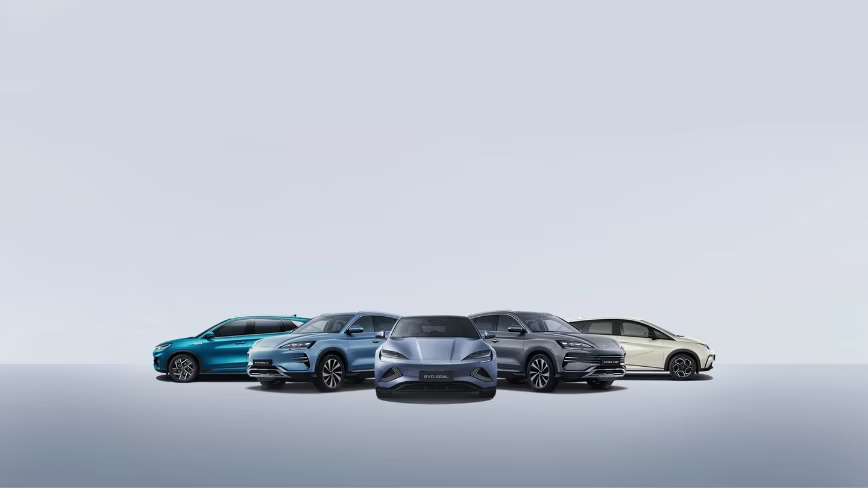
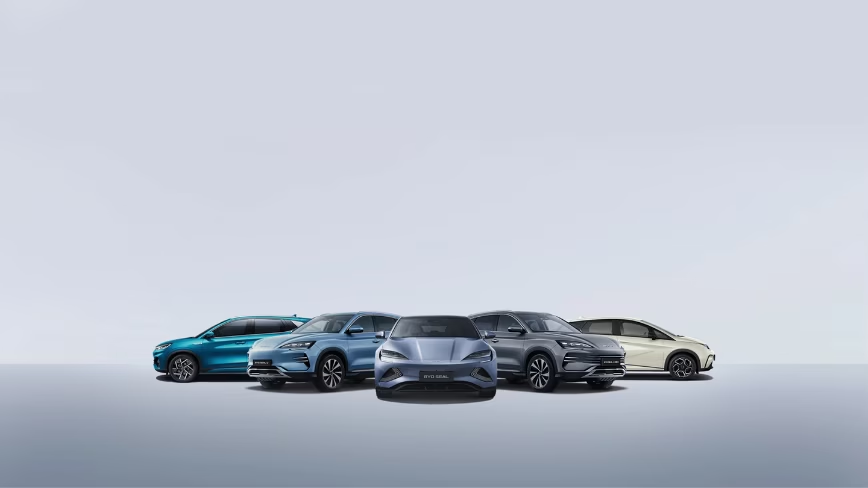
BYD has unveiled the Xuanji A3, China’s first automotive-grade 4nm chip for self-driving cars, delivering 700 TOPS per chip. The company is expanding its God’s Eye driver-assistance system to mass-market EVs including the $10,300 Seagull, as eight consecutive months of falling sales and a 55% profit decline force a technology-led pivot.
TL;DR
BYD has unveiled the Xuanji A3, which it calls China’s first automotive-grade 4-nanometre chip for self-driving vehicles. CEO Wang Chuanfu announced the chip at an event at BYD’s Shenzhen headquarters on 28 May, saying it delivers the lowest power consumption per unit of compute in its class, drawing roughly 20% less than comparable semiconductors. The chip has already entered mass production.
A single Xuanji A3 delivers 700 TOPS of computing power. A cluster of three chips reaches 2,100 TOPS, enough to support Level 3 and Level 4 autonomous driving functions. The chip is the centrepiece of a new laptop-sized central computing platform that unifies three previously separate vehicle domains: the smart cockpit, the driver-assistance system, and the core electric propulsion.
The semiconductor approaches the capabilities of Huawei Technologies, which currently makes automotive chips at a 7nm geometry but has pledged to debut 1.4nm chips by 2031. The most advanced chip globally is TSMC’s 2nm N2 node. BYD’s ability to design and mass-produce its own 4nm driving chip deepens a vertical integration strategy that already spans batteries, motors, and vehicle manufacturing.
God’s Eye goes mass market
Alongside the chip, BYD announced it will expand its God’s Eye driver-assistance system across all models sold in China, including mass-market vehicles like the Seagull compact hatchback, which starts at 69,800 yuan ($10,300). The Seagull became the first car in its class to receive LiDAR when the 2026 model launched on 11 May, a technology previously reserved for premium vehicles.
The upgraded God’s Eye system, which includes city and highway navigation, traffic light recognition, and automated parking, will be available as an add-on for 12,000 yuan ($1,770). Wang described the pricing as cost-only. BYD is also offering one year of insurance that fully covers damages from accidents that occur while the latest version of God’s Eye is engaged, a direct bet that the system is reliable enough to underwrite.
A system with a troubled track record
The insurance pledge comes after months of complaints about God’s Eye’s performance. BYD made the system a standard feature on most of its vehicles last year, but the initial rollout used a tiered structure that limited advanced urban navigation to more expensive models while giving affordable cars only basic highway cruise control. Users reported dangerous malfunctions including unintended acceleration, erratic lane changes, and steering inputs that nearly sent vehicles into oncoming traffic.
Unlike Tesla’s optional Full Self-Driving package, BYD deployed God’s Eye across millions of vehicles, meaning every flaw appeared at scale. The company says it has more than 3.15 million vehicles equipped with advanced driver-assistance hardware on the road, generating roughly 200 million kilometres of driving data every day. BYD is using that data to train its algorithms through cloud-based world models and reinforcement learning, with iteration cycles running every three days.
Eight months of falling sales
The technology push arrives at a difficult moment for BYD’s business. Sales have declined year on year for eight consecutive months, with April 2026 volumes down roughly 16% compared with the same period a year earlier. First-quarter net profit fell 55% to 4.09 billion yuan ($599 million) as a fierce price war in China and a stronger yuan compressed margins.
Revenue dropped 12% to 150.2 billion yuan in the quarter. Operating expenses rose as BYD invested in smart driving hardware while simultaneously cutting vehicle prices to compete with rivals including Xiaomi, which has entered the EV market with high-performance models, and Huawei-backed brands that have intensified their presence. The only bright spot has been exports, which rose more than 70% year on year to a record 135,098 units in April.
The competitive context
Tesla finally launched its Full Self-Driving system in China after years of delays, but the technology still requires active human intervention and will be marketed under a different name due to scrutiny from Chinese transportation authorities. Tesla relies on a vision-only approach using cameras and neural networks without LiDAR or radar, a fundamentally different and cheaper strategy that BYD and other Chinese automakers have criticised as less capable.
China’s Ministry of Industry and Information Technology issued its first Level 3 autonomous driving certifications in December 2025, approving cars from Changan Auto and BAIC Motor. BYD is waiting for China to formalise legislation allowing broader consumer-facing deployment of self-driving vehicles, which the company expects as soon as 2027. Chinese EV makers are also expanding aggressively overseas, with BYD targeting 1.3 to 1.6 million international deliveries in 2026.
The Xuanji A3 chip and the God’s Eye expansion represent BYD’s attempt to shift the competitive battleground from price to technology. A company that made its name on affordable electric vehicles is now trying to prove it can build the silicon, software, and sensor systems needed to compete on intelligence. Whether the strategy works depends on whether the technology can outrun the complaints, and whether drivers in a market saturated with discounted EVs are willing to pay 12,000 yuan for a feature that Huawei-backed rivals and a fragmenting global EV market are also racing to deliver.

Verdict
Samsung’s innovative new ‘convertible’ soundbar somehow manages to sound like it’s using an external subwoofer even when it isn’t, while still delivering all the power, detail and sound stage craft we’ve come to expect from Samsung soundbars. Regardless of whether you’re using it on a wall or tabletop
-
Outstanding sound quality in both of its convertible set up configurations
-
Excellent with music as well as movies
-
Great value for what it offers
-
Headline multi-placement feature is potentially niche
-
Occasionally over-bright detailing
-
No rear channel sound without adding extra speakers
Key Features
-

Review Price:
£899
-
Perfect for walls or table tops
The QS90H can reconfigure which sound channels emerge from each of its speakers depending on whether the soundbar is wall mounted or sat on a stand under your TV
-
Great for music and movies
Despite creating a brilliantly detailed, aggressive and powerful multi-channel sound scape for movie playback, the HW-QS90H can also adapt itself unusually well to stereo music
-
Wi-Fi streaming support
The QS90H is compatible with Google Cast, AirPlay 2, Spotify Connect, and Tidal Connect, as well as being Roon Ready
Introduction
While most soundbars technically support wall mounting, even sometimes including wall brackets in their boxes, that support is typically compromised in both design and sound quality terms.
Soundbars designed to lie flat on a table, for instance, like the vast majority are, usually jut out awkwardly from walls, while their sound can be affected by how high they’re sat when wall hung versus a typical desktop placement.
Cue Samsung’s HW-QS90H: A soundbar that can actually reconfigure its speakers deliver which channels of sound depending on whether its sitting flat on a table or hanging flat against a wall.
This isn’t Samsung’s first stab at such a ‘convertible’ soundbar; that honour belongs to the 2025-launched HW-QS700F. The QS90H is Samsung’s first convertible soundbar to offer a 7.1.2 channel count – while simultaneously daring to ship without the external subwoofer the QS700F provided.
Can a one-bar sound solution really deliver so many unusual and premium features without its sound quality suffering?
Design
- Convertible design speaker system
- Enjoyably industrial hard plastic finish
- 13 driver 10-channel design
The HW-QS90H closely tracks Samsung’s other recent premium soundbar designs. So there’s the same hard black plastic finish, the same engaging mix of a striped effect on its top edge and circular perforation effect on its sides, and the same crisp, rectangular shape – only without the double-angled left and right ends you get with Samsung’s flagship soundbar designs.
The QS90H’s measurements of 1245(w) x 68.8(h) x 125(d)mm are fairly substantial by most one-bar solution standards. The fact that it rests on its flat bottom edge regardless of whether it’s lying down or hanging on a wall, though, gives it a relatively minimal profile.

You don’t have to accommodate an external subwoofer, either, and actually, once you start to listen to it its size suddenly starts to feel pretty small in the context of the epic soundstage it can create.
Looking at the QS90H in its table-top configuration, two speakers set at different angles in its left and right edges enable the soundbar to deliver separate side left/right and front side left/right channels, while the long straight front edge holds the more typical left and right channels, plus a centre channel speaker that unusually sits right at the top of the front edge.
There are also two drivers in the top edge (again, remember, we’re talking about the tabletop profile here) for delivering height/overhead effects.
To compensate for not having an external subwoofer, the QS90H also somehow finds space for four bass woofers within its compact design.

It’s all change if you want to wall hang the soundbar. To adapt it for wall hanging you have to stand the QS90H on its edge and then turn it through 180 degrees so that the control buttons are sitting along what is now the soundbar’s bottom edge. The flat edge that was the underside of the soundbar in its table top stance becomes the rear edge that lies against the wall, meaning the soundbar only sticks out 68.8mm rather than the 125mm if it was fastened to a wall in the same orientation it uses on a desktop.
The speakers that were the front left and right speakers become the two up-firing speakers, while the two speakers that were the up-firers in the QS90H’s desktop setup become the front left and right. The centre channel speaker’s unusual high position in a tabletop set up now makes sense, as it means it can continue as the centre speaker in the vertical orientation too.
The ability of the QS90H to deliver a slender profile in both its setup positions puts it in very rarified company indeed. There are a few dedicated wall hanging soundbars out there, but soundbars that can truly adopt their sound and design for both flat or vertical orientations are incredibly few and far between.

The on-bar controls I mentioned earlier offer voice control mic on/off buttons, as well as simple up and down volume adjustments. The only other disruption to the sleek black finish comes from a little row of LEDs designed to help you figure out roughly what volume you’ve selected and which input you’re using. These are a poor second, though, to the full LED display you get on Samsung’s HW-Q990H.
The HW-QS90H’s connections comprise a one in, one out HDMI pass-through, eARC support on the HDMI output, an optical digital audio input, and the now inevitable Bluetooth and Wi-Fi support.
Features
- Dolby Atmos and DTS:X playback
- 7.1.2 channel count, plus optional extra speaker support
I’ve pretty comprehensively covered the QS90H’s most unique feature: Its support for flat-profile desktop or wall-hanging placement. There’s plenty more to get our teeth into besides.
Starting with the fact that it uses its 13 built-in drivers to deliver an impressive 7.1.2 channels of sound. This is an impressive channel count for a single bar soundbar, delivering front left, front right, front centre, front left side, front right side, left side, right side and two up-firing channels, with a quartet of woofers squeezed in to deliver low frequency sounds. Which drivers deliver which channels is, of course, fluid, based on the soundbar’s orientation.

It’s worth noting at this point that a built-in gyroscope automatically informs the HW-QS90H whether it’s been used in its horizontal or vertical configuration; you don’t need to tell it manually.
Inevitably as a single-bar solution, the QS90H doesn’t deliver any surround sound effects. You can add extra speakers to it, though, using either Samsung’s SWA-9500S optional wireless rear speaker package, or up to four of Samsung’s startlingly powerful new Music Studio speakers.
As with all recent Samsung soundbars, the QS90H can also join forces with (rather than just replacing) the speakers in pretty much all of Samsung’s recent TVs thanks to Samsung’s Q Symphony feature, creating a bigger and more detailed centre channel sound.
Q Symphony can work via HDMI eARC or wirelessly, with further wireless functionality coming in the shape of wireless Dolby Atmos reception from suitably capable Samsung TVs.

The Dolby Atmos support is joined by support for both the DTS:X format and the Eclipsa Audio open-source format developed by Samsung and Google.
You can get any sound format, even stereo music, to take advantage of the HW-QS90H’s full channel count if you choose a provided Surround Sound audio preset. Purists can rest assured that the soundbar’s Standard preset will play any format in its native form – including simple two-channel stereo.
The HW-QS90H also leans in to Samsung’s love of AI with an Adaptive mode, which analyses the incoming sound so that it can recognise the type of content and optimise the way the soundbar presents the audio accordingly. AI is in play with a dialogue enhancement feature that can isolate vocal tracks and give them more emphasis in response to detected increases in ambient noise levels in your room.
The QS90H’s Wi-Fi capabilities include integrated support for AirPlay, Google Cast, Spotify Connect and Tidal Connect, and it’s also Roon Ready. Accessing all these sound systems is made easy if you’re using the Samsung SmartThings or new Samsung Sound apps to control the soundbar rather than the sleek but basic provided remote control. The same apps also streamline initial set up, helping you get your soundbar online and update its software with minimal fuss.

The apps provides exclusive access to a couple of handy set up aids: An adaptive bass feature that automatically monitors the sound for potential bass-related distortions, correcting the sound profile to correct for this if required, and a Space Fit system that continually optimises the soundbar’s presentation to your room conditions.
The QS90H’s HDMI pass-through supports HDR10+ and Dolby Vision HDR formats, as well as the more basic HDR10 and HLG formats. The HDMI pass-through system does also deliver arguably the only real feature disappointment with the QS90H, though, as it turns out that it doesn’t join Samsung’s HW-Q990H flagship soundbar’s loop through in supporting 4K/120Hz signals.
You can only get 120Hz frame rates through the soundbar if you settle for a 1440p resolution and don’t mind losing high dynamic range support. If you want 4K and HDR, you’ll have to set your game source to 4K/60Hz. The soundbar does support pass-through of variable refresh rates with both 60 and 120Hz signals, and carries a Game Pro sound setting that emphasises channel steering to make gaming worlds feel more intense and help you detect where enemies might be attacking from.
Sound Quality
- Equally excellent music and movie playback
- Outstanding sound in both horizontal and vertical configurations
- So good that it will tempt you to add rear speakers
Before getting into the specific ins and outs of how well the HW-QS90H delivers on its headline multi-placement ‘convertible’ feature, let’s get some general performance features out of the way.
Starting with the fact that it copes incredibly well without the external subwoofer shipped with 2025’s QS700F convertible soundbar debutante. The bass woofers crammed into the QS90H’s single-bar form sound anything but crammed in, rolling out some of the very deepest frequencies I’ve ever heard from an all-in-one soundbar option without the bass bottoming out, lagging behind the rest of the mix or succumbing to chuffing/crackling distortions or drop outs.
Unless you increase the soundbar’s volumes to levels far beyond anything the average human ear will be able to cope with.

The QS90H’s bass spreads far and wide so smoothly, that it delivers exactly the sort of non-directional presence you want from any good movie bass system. It does all this without the bass overwhelming the rest of a movie mix.
In fact, the QS90H maintains levels of detail, power, effects placement and channel steering that precious few other single-bar soundbars can even get close to – exactly as I’ve come to expect with Samsung’s premium soundbars. The bass is just a beautifully weighted but also surprisingly nimble counterpoint to everything else that’s going on rather than any sort of ‘dead weight’ dragging the sound down.
Trebles never sound harsh or warbly either, and the speakers are sensitive enough to not only pick every sound detail out, no matter how subtle, but also present each of those sound effects with the correct level of prominence. There are no moments where subtle background ambient effects surge into the foreground, or birds tweeting suddenly sound on a par with key dialogue.
Dialogue, now I’ve mentioned it, is always clear and clean, regardless of how deep or shrill the talker’s voice might be, and the soundbar gives vocals a nice vertical lift so that they sound like they’re coming from the onscreen action rather than the soundbar below the screen.
There’s even an ‘Elevate’ option that does a good job of lifting the vertical position of dialogue higher should you be using the soundbar with a truly huge screen, or you’ve got a bigger vertical gap than usual between your screen and soundbar below. Which can happen with wall hung setups, or if you’ve got the soundbar sat on a sideboard with a wall mounted screen above it.

The channel steering that’s been such a consistent Samsung soundbar strength for years now is exceptionally well deliver by the HW-QS90H, creating a truly three-dimensional and immersive sound space between you and your screen. You truly feel the impact of the 7.1.2 channel count in the dynamism, fullness and expansive scale of the sound the QS90H creates.
So good is the QS90H’s staging, in fact, that it had me yearning for some surround sound speakers, so that I could find myself right at the heart of the audio action. The idea that a one-bar soundbar might be good enough to seriously tempt you to splash out on further speakers to create a true surround sound system is hardly a weakness!
Though there could be an argument here for stepping up to Samsung’s full surround sound HW-Q990H soundbar package instead.
All of the strengths explained so far are underpinned by phenomenal amounts of power by mid-range soundbar standards, and are achieved regardless of whether the QS90H is used in a vertical or horizontal stance.
Some differences in the sound do become apparent as you switch the HW-QS90H from a horizontal to a wall mounted position. On the downside, the wall-mounted sound doesn’t push forward with quite as much force. This means the wall-mounted sound stage feels a bit less three-dimensional, and hard impact sounds – while still clean and crisp – lack a little of the visceral potency you get in the QS90H’s horizontal stance.
Bass is a little less potent when the QS90H is wall mounted, too – though it’s still plenty powerful enough to leave the bass from many rival soundbars sounding either coarse or thin.
Height effects are delivered with actually slightly more clarity and emphasis in the QS90H’s wall mount mode than you get from its tabletop set up, though.

Dialogue sounds slightly more rounded and smooth from a wall-mounted QS90H, too, and the sound impressively radiates down as well as up from the soundbar’s relatively elevated wall-mount position, avoiding that ‘the only way is up’ effect you often get if you wall mount regular soundbars at higher positions than they’re truly designed to suit.
The HW-QS90H isn’t just a beast of a soundbar with film soundtracks. In both of its placement configurations it also handles stereo music remarkably well, subtly shifting to nimbler, less bombastic bass handling and beautifully recalibrating its multi-channel scale down to simple two-channel stereo without the results sounding crowded or over-aggressive.
Stereo separation is bold but not forensic or forced, and vocals of every type are beautifully located at the heart of the mix without ever becoming either too shrill or too soupy.
There’s a musicality here, in fact, that you’d normally only expect to hear from soundbars from established heritage hi-fi brands.
There are a couple of issues to mention beyond the small differences between the vertical and horizontal profiles covered earlier. One is that just occasionally, especially in the tabletop stance, voices can sound a little too prominent and bright. Such moments truly are rare, and even at their worst voices don’t actually sound brittle or completely lose their context.
Perhaps related to this, while ambient effects never gain too much weight in the mix, occasionally relatively high-pitched background sounds can – again only very occasionally – sound a touch sibilant.
Finally, again incredibly rarely, particularly violent and deep extended bass sounds can cause the QS90H’s bass speakers to start sounding just a little rough around the edges. Though they don’t succumb to outright distortion and breakdown.
Should you buy it?
You want a soundbar you can use anywhere
Thanks to its compact single-bar design and rare ability to reconfigure its speakers to different channels depending on whether it’s resting against a wall or sitting on a desktop, the QS90H can work in basically any and every room environment.
You want a full surround experience
While you can add speakers to the QS90H, in its default form it only creates a sense of three-dimensional sound in front of you, rather than all around you.
Final Thoughts
The HW-QS90H is a fantastic soundbar for its money. Far from being a gimmick, its convertible design works amazingly well, enabling it to work in pretty much any room setup.
Its sound is as powerful as anything I’ve ever heard from a single-bar soundbar solution, and it delivers a dynamic range that leaves most rivals sounding thin and weedy by comparison. Especially in the bass department.
It’s able to create a huge, detailed and engaging sound stage for movies, but also manages to rein itself in with stereo music, sounding truly musical without losing the power that’s now a Samsung soundbar trademark.
The number of individual households who specifically take advantage of the QS90H’s convertible design might be small, I guess. Surely the key point, though, is that the QS90H’s flexibility means that it’s an outstanding option for absolutely anyone in the market for a one-bar soundbar, regardless of where their TV might be positioned. And really powerful true wall-mounted soundbars, in particular, are as rare as hen’s teeth.
How We Test
We test every soundbar we review thoroughly over an extended period of time. We use industry-standard tests to compare features properly.
We’ll always tell you what we find. We never, ever accept money to review a product.
Find out more about how we test in our ethics policy.
- Tested in real-world setups with real-world content
- Tested for two weeks
FAQs
Can you add extra speakers to the Samsung HW-QS90H?
Yes. You can add up to four of Samsung’s Music Studio single speakers to create a surround experience, or you can add Samsung’s dedicated SWA-9500S rear speaker package.
How does the HW-QS90H connect to your TV?
The HW-QS90H supports HDMI’s eARC feature, where an eARC-capable TV (which most modern TVs are) can pass sound including Dolby Atmos through to the soundbar. It also lets you connect a single external source to it that it can then pass the pictures of through to the TV, and it can take sound in via an optical digital audio input. If you have a recent Samsung TV, the QS90H can even receive Dolby Atmos sound from the TV wirelessly.
Full Specs
| Samsung HW-QS90H Review | |
|---|---|
| UK RRP | £899 |
| USA RRP | $999 |
| EU RRP | €849 |
| Manufacturer | Samsung |
| Size (Dimensions) | 1245 x 125 x 68.8 MM |
| Weight | 8.9 KG |
| Release Date | 2026 |
| Sound Bar Channels | 7.1.2 |
| Driver (s) | 13 in total, including four bass woofers |
| Connectivity | Airplay 2, Google Cast, Spotify Connect and Tidal Connect |
| ARC/eARC | ARC/eARC |
| Colours | Black |
| Audio Formats | Dolby Atmos, DTS:X, Eclipsa Audio |
| Rear Speaker | Optional |

Senso is one of those products that tries to turn something traditionally passive – in this case, plant care – into a more interactive, data-driven experience. It does that by blending environmental sensing with AI guidance and a layer of gamification.
At its core, Senso is a modular smart plant sensor that tracks soil moisture, temperature, and light in real time. We saw the product in person at Beyond Expo 2026 and it’s designed to support a wide range of setups, offering support for over 12,000 plant types. It also has expandable accessories that let users adapt it to different pots and growing conditions.
Alongside the sensor data, its companion app uses AI-driven analysis to turn raw readings into actionable care instructions. Instead of simply telling you that soil is dry, for example, it aims to interpret what that means for a specific plant species. Then, it can suggest targeted next steps before issues become serious. As an owner of several dramatic tropical houseplants, this honestly sounds like a game changer.
There’s also a strong focus on engagement through gamification. A pixel-style companion character “awakens” when the sensor is placed in soil and visually reacts to the plant’s condition. As you water, adjust sunlight, or maintain care routines, the character evolves alongside the plant – a bit like a Tamogotchi.
The modular hardware design is another practical touch. The detachable sensor system intends to make cleaning, recharging, and repositioning easier. This matters if you’re moving it between different plants or environments. Moreover, the app’s multi-plant management system reinforces this flexibility. It does so by keeping everything organised in one interface rather than treating each plant as a separate setup.
On the software side, Senso combines continuous sensor data with AI-based visual analysis. This aims to identify plant species and flag potential issues early. The promise here is a more proactive approach to plant care – not just reacting when something goes wrong, but anticipating problems before they become critical.

Meta announced new upcoming subscription plans for Instagram, Facebook, and WhatsApp this week. Instagram isn’t going behind a paywall, no. Rather, users will now be able to pay $4 a month for extra features, like seeing who rewatched your story post or pinning more posts to the top of your profile. Instagram Plus, Facebook Plus ($4 a month), and WhatsApp Plus ($3 a month) will roll out globally sometime this summer.
These “Plus” plans are an attempt by Meta, led by CEO Mark Zuckerberg, to diversify how it makes money from users. Meta is also doing what Meta does best with this move: mimicking other social media platforms’ successes—specifically, Snapchat.
“Loving husband, father of four boys, VP Product @ Meta” reads Evan Spiegel’s tongue-in-cheek LinkedIn profile. Spiegel, the cofounder and CEO of Snap, has never actually worked at Meta, though his social media platform has directly inspired at least some existing features on Instagram. After Instagram launched Stories in 2016, then-CEO Kevin Systrom didn’t mince words about how his platform was sometimes iterating on Snapchat features, telling TechCrunch that “they deserve all the credit” for the format of Stories.
In 2017, Snap launched a “Maps” tool where users could opt in and see the pinpoint location of where all of their friends were based on when they last opened the app. Instagram launched a very similar “Maps” feature just last year, where users could track the location of friends who chose to share their GPS data.
And while IG’s recently launched “Instants” app, with its ephemeral, unfiltered snaps, is more like the once-popular BeReal than anything, disappearing photo messages are totally Snapchat’s main lane.
“As we shared earlier this year, we’re testing and scaling new subscriptions that provide deeper, more enhanced ways to use our apps and AI glasses,” says Maria Cubeta, a Meta spokesperson, over email. “So far, we’ve been testing subscription features for people to enhance how they express themselves and connect on Instagram, Facebook, and WhatsApp, like profile customization, stories insights, and super reactions.” She says this is just the start of the larger “Meta One” umbrella of subscription offerings, which will eventually include different, more expensive tiers catering toward businesses and creators as well as users who want extra access to Meta AI.
At launch, Instagram Plus will have the most extra features, from additional pins on your profile and unique bio fonts to creating siloed audiences for your Story posts and “Super Heart” reaction buttons. Facebook Plus will mainly allow you to control and customize your experience with Story posts, like rewatch insights. WhatsApp Plus will include more pinned chats, visual customizations, and premium stickers.
These subscription plans are simply history repeating itself. Snapchat dropped a $4 a month plan, called Snapchat+, back in 2022. It offered users access to exclusive features in the app and expanded over the few years, adding more options as well as AI tools. In February, Snapchat announced that this style of subscription plan helped the company achieve a “$1 billion annualized revenue run rate” in direct payments with over 25 million current subscribers around the world. (Despite being a font of feature inspiration, everything isn’t rosy at Snapchat, as the company struggles to turn a profit.)
So, even down to the Plus naming convention, Meta seems to be heavily inspired by Snapchat once again. I would expect nothing less from the company that renamed itself during the metaverse fad. Following trends is Meta’s modus operandi. Keep an eye out for what Snapchat does next for a sneak peek at what Meta might do in a few years.
Anthropic’s most capable generative AI model is still in the hands of a select few organizations and cybersecurity professionals, but the most powerful Claude model you can use now is getting an upgrade.
Claude Opus 4.8, released Thursday, is a “modest but tangible improvement” over Opus 4.7, Anthropic said in a blog post.
But the company also said it’s making significant progress on producing a version of its Claude Mythos Preview model that it’s willing to release to the public. Right now, it has restricted access to Mythos to a consortium of partners as part of what it calls Project Glasswing, explaining that the model’s cybersecurity capabilities are advanced enough to warrant giving cybersecurity experts and major tech companies some lead time to patch flaws found by the model.
“Models of this capability level require stronger cyber safeguards before they can be generally released,” Anthropic said. “We’re making swift progress on developing these safeguards and expect to be able to bring Mythos-class models to all our customers in the coming weeks.”
Mythos for everyone?
Anthropic’s decision to withhold Mythos Preview from the general public, at least for now, has been an interesting one. Was it a wise, forward-thinking move to protect the internet’s critical infrastructure from potential flaws? Was it an easy way to churn up marketing hype? Security researchers have found that the model is certainly capable of finding exploits much more quickly than human hackers, even if it isn’t necessarily pushing beyond human capabilities. Mozilla’s latest version of Firefox included more than 200 fixes identified by Mythos Preview.
Read more: AI Arms Race Accelerates With New Models from OpenAI, DeepSeek and Anthropic
But the fact that Mythos will soon be available to anyone, even with significant cybersecurity guardrails, means we’ll finally get to see if the model lives up to the hype, with all the risks that might entail.
Darren Williams, founder and CEO of the cybersecurity firm BlackFog, told CNET in an email that big model releases are often tense moments.
“On one hand, Anthropic’s decision to stage the release, holding back until safeguards are developed, shows the right instincts,” he said. “But the more capable a model is, the higher the stakes if those safeguards fall short or if the model is eventually misused. The window between a powerful model’s release and broad adoption of defenses against it is always a vulnerable moment.”
Mythos is going to be far more expensive to run than other AI models, however, and that could limit its usefulness to hackers. Jake Williams, a cybersecurity researcher and faculty member at IANS Research, said Mythos was 30 times as expensive in tests as the previous Opus model.
“This is outside the reach of many, including any commodity threat actors,” Williams told CNET in an email. “Nation-state actors already had better technology for finding vulnerabilities. This is only changing the game for a small percentage of threat actors.”
What’s new about Claude Opus 4.8
As for Opus 4.8, Anthropic said it’s an improvement across benchmarks compared to Opus 4.7. Tests found that Opus 4.8 was less likely to make unsupported claims and more likely to indicate uncertainty, the company said.
A few new features are also coming to Anthropic’s AI products, including the ability to control how much “effort” a model will use to respond to a prompt on Claude.ai and in Claude Cowork. Higher effort will likely get better results as the model spends more time on a response, but it will burn through your usage limits faster. A lower setting will respond faster and hit rate limits more slowly.

An anonymous reader quotes a report from Cybernews: The technology giant Microsoft has been accused of leaking the data of civil servants working for the Netherlands’ regulatory agencies to the US House of Representatives. The civil servants affected by the leak work at the Authority for Consumers and Markets (ACM) and the Dutch Data Protection Authority (AP), according to the NL Times. They are involved in implementing the Digital Services Act (DSA), the European Union regulation on online services, aimed at combating illegal content and protecting user rights.
NL Times reports that Microsoft shared emails, minutes, and invitations sent by the civil servants without redacting their names in the documents. Willemijn Aerdts, Dutch State Secretary for Digital Economy and Sovereignty, said she discussed the allegations with US Ambassador to the Netherlands Joe Popolo. […] The allegations against Microsoft further strengthen concerns over Europe’s dependence on American technologies, which poses major risks to data privacy. Further reading: Netherlands Blocks US Takeover of Vital Digital Supplier

News Videos1 minute ago
The meme boy needs medical attention. I hope the financial support provided will be used on him….

NewsBeat2 minutes ago
Search for two girls at Portobello beach called off after ‘no one found in distress’

Business3 minutes ago
Gap (GAP) earnings Q1 2026

NewsBeat2 months ago
Steven Gerrard disagrees with Gary Neville over ‘shock’ Chelsea and Arsenal claim | Football

Politics2 months ago
US brings back mandatory military draft registration

Tech1 month ago
Register Renaming | Hackaday
News Videos1 minute ago
The meme boy needs medical attention. I hope the financial support provided will be used on him….

News Videos21 minutes ago
Thursday, May 28th | Morning Prayer For Financial Breakthrough And God’s Provision Today

News Videos34 minutes ago
What the NextFund AI Story Reveals About Crypto Liquidity
-

 Fashion6 days ago
Holiday Weekend Open Thread – Corporette.com
-

 Politics3 days ago
Bridgerton Season 5: Cast, Release Date And Everything We Know So Far
-

 Crypto World7 days ago
Bitcoin Accumulation Weakens as BTC Realized Losses Hit $600M
-

 Crypto World6 days ago
Robinhood crypto COO Tanya Denisova exits
-

 Business7 days ago
Trump Invests $1M-$5M in Kura Sushi USA Chain With 27 California Locations
-

 Tech3 days ago
Microsoft’s quiet Claude Code retreat and the real cost of enterprise AI
-

 Business4 days ago
NYT Strands Answers May 24 2026 Revealed for Puzzle No. 812 Theme Summer Essentials
-

 Business6 days ago
Dell Technologies DELL Stock Surges 15% on AI Server Momentum and Analyst Upgrades in 2026
-

 Business2 days ago
Selena Gomez Reportedly Upset Over Benny Blanco’s Comments on Her ‘Terrible’ Diet
-
 Crypto World2 days ago
Micron Crosses $1 Trillion Market Cap as AI Demand Reshapes Memory Sector
-

 Politics6 days ago
Makerfield: a tale of two social-media histories
-

 Crypto World6 days ago
Space X IPO Is ‘Bad News’ for Tech Stocks: But What About Bitcoin?
-

 Business4 days ago
BTS Sells Out Four Las Vegas Shows at Allegiant Stadium for ARIRANG World Tour
-

 Crypto World7 days ago
MicroStrategy’s Saylor Says Miners No Longer Set Bitcoin Price, Another Force Has Taken Over
-
Tech1 day ago
The Samsung pay deal is the moment Korean unions changed register
-
 Tech6 days ago
A 0.12% parameter add-on gives AI agents the working memory RAG can’t
-

 Tech3 days ago
Westone Audio and Etymotic Acquired by Fidelity Collective in Major IEM Market Move
-

 Tech2 days ago
Millions of AI agents imperiled by critical vulnerability in open source package
-

 Crypto World6 days ago
AI infrastructure race heats up as IREN pitches full-stack strategy, WhiteFiber lands $160M deal
-
 Crypto World4 days ago
Nvidia (NVDA) CEO Calls on Super Micro to Strengthen Export Controls Amid Smuggling Probe
You must be logged in to post a comment Login