Connect with us
DAPA Banner
DAPA Coin
DAPA
COIN PAYMENT ASSET
PRIVACY · BLOCKDAG · HOMOMORPHIC ENCRYPTION · RUST
ElGamal Encrypted MINE DAPA
🚫 GENESIS SOLD OUT
DAPAPAY COMING

Business

20-Store Surplus Food Trial to Save 11.9m Meals

Published

on

The introduction of short-term visas will not solve labour shortages in the food industry, the boss of Lidl has warned, adding that the retailer was working “harder than ever before” to keep shelves stocked.

Lidl GB has thrown its weight behind one of the most ambitious surplus food redistribution trials yet seen on the British high street, drafting in the consumer food-sharing app Olio alongside its long-standing charity partner Neighbourly in a move that could keep millions of additional meals out of the bin each year.

The German-owned discounter, which has been one of the fastest-growing grocers in Britain over the past decade, will switch on the new three-way model on Friday 15 May across 20 stores in London and the north of England. If the pilot delivers as hoped, Lidl expects a nationwide rollout by the end of 2026 — a step change that would see more than 5,000 tonnes of edible surplus, equivalent to roughly 11.9 million meals, redirected annually from landfill to people who need it.

The partnership is unusual in that it knits together two of the most prominent names in British food redistribution for the first time. Neighbourly, the Bristol-based social impact platform that already manages Lidl’s “Feed it Back” scheme, will continue to coordinate the pipeline. Olio, the London-headquartered app that has built a community of more than nine million users globally around the idea of sharing rather than binning leftover food, will plug its volunteer “Food Waste Heroes” into Lidl’s evening collection slots as a second tier behind charities.

In practical terms, registered Food Waste Heroes will arrive at participating stores after trading hours to collect chilled lines, including meat, fish and poultry, as well as Lidl’s popular bakery range. The food is then offered, free of charge, to neighbours through the Olio app — extending the reach of the redistribution network into the evenings, when charity partners traditionally find collections hardest to staff.

It is also a clear signal that the discount sector has no intention of being outflanked on sustainability. Lidl has already smashed its previous food waste target, cutting waste by more than 40% ahead of schedule, and has since raised the bar to a 70% reduction by the end of FY2030. According to WRAP, the government’s waste advisory body, only around 7% of retail and manufacturing food surplus in the UK is currently redistributed, leaving a significant prize for any retailer prepared to crack the logistics.

Advertisement

Matt Juden, head of sustainability at Lidl GB, framed the move as the next logical step in a programme the supermarket has been refining since 2016. “At Lidl GB, we believe that no good food should ever go to waste,” he said. “While we have already made massive strides in reducing our surplus, this extension of our Neighbourly-managed programme allows us to have even more impact. It ensures that we are reaching every corner of the communities we serve, making sure edible food stays on plates and out of the bin.”

The pilot also lands at a sensitive moment for retailers who collect surplus only in the evening. Recently concerns were raised by charities about Tesco’s evening-only collection policy, and Neighbourly’s chief executive Steve Butterworth was at pains to stress that the Lidl model would not crowd out third-sector partners. “Our mission has always been to ensure as much edible surplus food as possible goes to those in our communities that need it most,” he said. “By expanding the programme to evening collections and including Olio’s Food Waste Heroes, we are providing Lidl with a robust additional redistribution layer. This isn’t about diverting food away from charities, it’s about opening up new streams of chilled and fresh produce for them, while ensuring nothing goes to waste if a charity can’t make it.”

For Olio, the deal marks another significant institutional endorsement of a model the start-up has been quietly scaling since 2015. Co-founder and chief operating officer Saasha Celestial-One described the tie-up as a chance to push more surplus into hyper-local hands. “We’re delighted to be joining forces with Neighbourly and Lidl,” she said. “We’re looking forward to working together to maximise the amount of edible surplus that can reach local communities from Lidl stores, and making sure as little food as possible goes to waste. We’re excited to see the impact of the trial, and we know our volunteers will be thrilled to have the chance to rescue Lidl food via our app.”

The political and regulatory backdrop is also shifting in favour of redistributors. Ministers have signalled growing impatience with the volume of edible food still going to waste, with Labour recently backing a £15m rescue fund aimed at supporting food redistribution organisations and helping them invest in the logistics and technology required to handle bulkier, more perishable donations. Pilots like the Lidl-Olio-Neighbourly trial slot neatly into that direction of travel, demonstrating how the private sector can plug the gap without waiting for primary legislation.

Advertisement

Lidl GB has now donated more than 50 million meals through Feed it Back since 2016, linking every one of its UK stores to a local good cause. With the Olio extension layered on top, the discounter is making a calculated bet that combining the efficiency of a national charity partner with the long tail of a consumer-led app can finally close the awkward last-mile gap in surplus redistribution — and turn what is still one of the grocery industry’s most stubborn problems into a marker of competitive advantage.

Advertisement
Continue Reading
Click to comment

You must be logged in to post a comment Login

Leave a Reply

Business

Asia stocks drop as chips rally cools; China steadies before more Trump-Xi talks

Published

on


Asia stocks drop as chips rally cools; China steadies before more Trump-Xi talks

Continue Reading

Business

Israelis mark capture of East Jerusalem with Old City parade, racist chants

Published

on

Israelis mark capture of East Jerusalem with Old City parade, racist chants


Israelis mark capture of East Jerusalem with Old City parade, racist chants

Continue Reading

Business

Weaver Vale Garden Centre expansion plans backed

Published

on

Business Live

New centre could create dozens of jobs

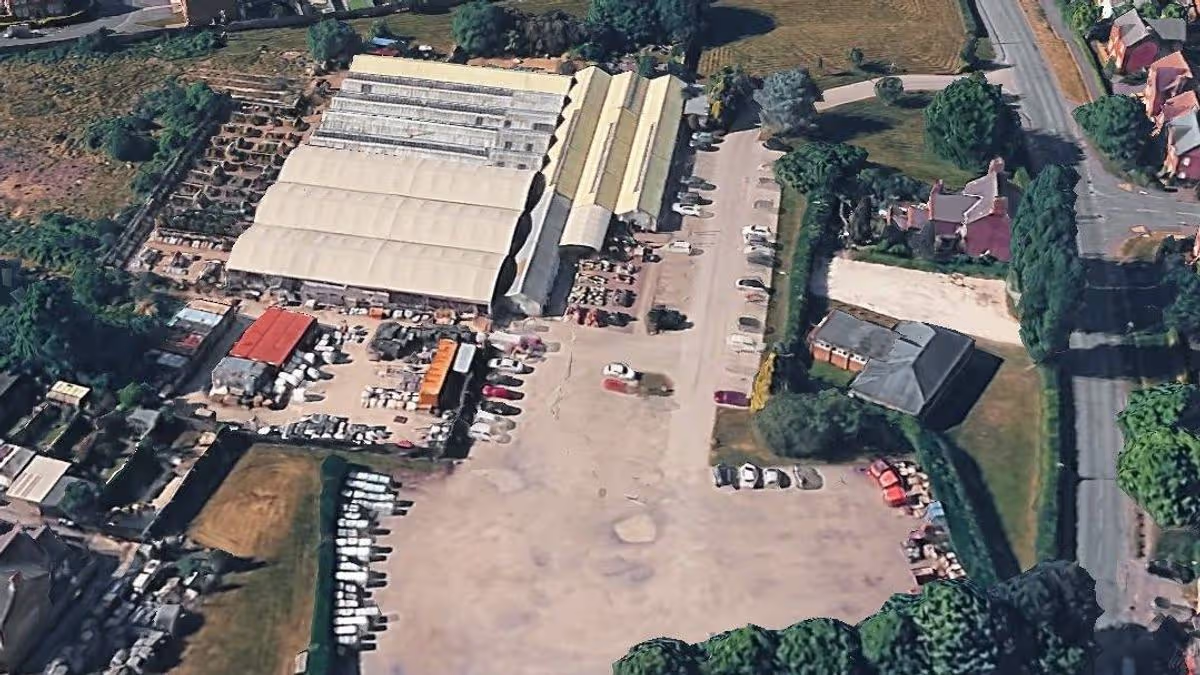
The existing Weaver Vale Garden Centre is set to make way for a new building

The existing Weaver Vale Garden Centre is now set to make way for a new building(Image: Local Democracy Reporting Service)

Plans to bulldoze a landmark garden centre and build a new one creating dozens of extra jobs have cleared a vital hurdle.

Advertisement

Cheshire West and Chester planners initially backed an application late last year to flatten Weaver Vale Garden Centre on Winnington Lane to make way for an entirely new building.

But work could not get underway until completion of a Section 106 agreement – a standard legal deal between councils and applicants designed to provide funds to offset the impact of large developments.

That agreement has now been signed, with borough planning officers having formally given the proposal the green light.

The proposals were submitted by Falkirk-based company Klondyke Strikes Garden Centres which bought the site in 2006 – although the centre had operated for many years beforehand.

Advertisement

According to the plans, the new garden centre will be designed to suit what the applicant called the ‘changing expectations’ of modern garden centre customers and will include a shop, restaurant, covered outdoor display area, outdoor sales area, new warehouse and an extension to parking and service yard areas.

A planning document submitted by the applicant said: “The site is a well established local business, offering a range of products including plants, garden sundries and tools, garden furniture, outdoor clothing and a small range of gift and homewares.

“The site also includes a coffee shop offering breakfast, lunches, snacks and drinks.”

But it said the existing buildings had become worn over the years and had started to become no longer ‘fit for purpose’.

Advertisement

It added: “The fact the site has developed over time in a piecemeal fashion has also resulted in inefficiencies in the current layout.

“Works are required in order for the site to keep up with its competitors and meet the changing needs of today’s garden centre customers.”

The approved scheme also includes the widening of existing access, external lighting, electric vehicle charging points and cycle storage. The plans are expected to safeguard existing jobs and create a further 47 roles.

To find all the planning applications, traffic diversions, road layout changes, alcohol licence applications and more in your community, visit the Public Notices Portal.

Advertisement
Continue Reading

Business

Samsung’s South Korean union sticks to strike plan after talks offer; shares slide

Published

on

Samsung’s South Korean union sticks to strike plan after talks offer; shares slide


Samsung’s South Korean union sticks to strike plan after talks offer; shares slide

Continue Reading

Business

Everything We Know About Grand Theft Auto VI

Published

on

Grand Theft Auto VI
Grand Theft Auto VI
Grand Theft Auto VI

NEW YORK — Rockstar Games has officially set the release date for Grand Theft Auto VI as November 19, 2026, for PlayStation 5 and Xbox Series X|S, ending months of speculation and delays while building massive anticipation for what is expected to be the biggest entertainment launch in history.

The long-awaited sequel to 2013’s Grand Theft Auto V was first teased with a cinematic trailer in December 2023 and a gameplay-heavy second trailer in May 2025. After multiple reported delays, Rockstar confirmed the November 19, 2026 launch in an official statement, apologizing to fans for the extended wait but emphasizing the need for extra time to deliver the quality level players expect. A PC version is expected in 2027 or later, following the traditional pattern for Rockstar titles.


The game is set in a modern-day Vice City and the wider state of Leonida, a satirical take on Florida. The open world appears vastly larger and more detailed than previous entries, featuring dynamic weather systems, advanced NPC AI, and unprecedented interactivity. Early footage showed bustling beaches, swampy everglades, urban sprawl, and rural areas, all rendered with next-generation graphics that push current hardware to its limits.

Playable Protagonists: Lucia and Jason For the first time in the series, players will control two protagonists. Lucia Caminos, the first female lead in a mainline GTA game, appears to be the central character. She is shown in trailer footage leaving prison on parole and reuniting with her partner in crime, Jason Duval. The couple embarks on a crime spree across Leonida, blending heist elements with a Bonnie-and-Clyde-style narrative. Rockstar has confirmed both characters are fully playable, allowing players to switch between them during missions.

Supporting characters revealed so far include Cal Hampton, Boobie Ike, Dre’Quan Priest, Raul Bautista, and others. The story appears to explore themes of social media fame, celebrity culture, and the American Dream gone wrong in a hyper-connected, influencer-obsessed version of Florida.

Advertisement

Gameplay and Features Gameplay leaks and official trailers suggest major advancements. Players can expect improved gunplay, vehicle handling, and a more reactive open world. New mechanics may include deeper relationship systems, expanded businesses, and dynamic events influenced by player choices. The map is expected to be the largest in GTA history, with seamless transitions between dense cities, suburbs, swamps, and beaches.

Multiplayer remains a major focus. Grand Theft Auto Online has generated billions in revenue, and Rockstar is expected to launch GTA Online 2.0 alongside or shortly after the single-player campaign. Cross-progression and enhanced social features are anticipated.

Development and Delays Development on GTA 6 reportedly began shortly after Red Dead Redemption 2 in 2018. The project has been one of the most expensive in gaming history, with estimates exceeding $1 billion. Multiple delays pushed the original 2025 target first to spring 2026 and then to November 19, 2026. Rockstar emphasized that the extra time is being used to polish gameplay systems, AI, and overall experience.

The game is rated Mature 17+ and is being developed primarily for current-generation consoles. No Switch 2 version has been confirmed, though a cloud-based option could appear later.

Advertisement

Cultural Impact and Expectations The hype surrounding GTA 6 is unprecedented. The first trailer became the most-watched video game trailer ever, amassing hundreds of millions of views. Fans have analyzed every frame for clues about the map, characters, and story. Social media is filled with theories, memes, and countdowns as the November date approaches.

Economists predict the game could generate several billion dollars in its first year across sales, microtransactions, and ancillary revenue. Its release is expected to boost console sales and drive significant tourism to Vice City-inspired real-world locations in Florida.

Critics and fans alike are eager to see how Rockstar balances its signature satire with modern sensitivities. The series has faced controversy in the past for its portrayal of violence and women, but recent entries have shown more nuanced storytelling.

As development enters its final stages, Rockstar remains notoriously secretive. No new trailers have dropped since May 2025, though many expect Trailer 3 to arrive in the coming months. Take-Two Interactive’s upcoming earnings calls will likely provide further updates on marketing plans and sales expectations.

Advertisement

For millions of fans who have waited more than a decade since GTA V, November 19, 2026, cannot come soon enough. Whether exploring Vice City’s neon-drenched streets, pulling off elaborate heists, or simply causing chaos in the open world, GTA 6 promises to redefine the open-world genre once again.

The long wait has only heightened excitement. Rockstar’s commitment to quality has historically paid off, and expectations are sky-high for what could be the definitive video game experience of the decade. As the countdown continues, one thing is certain: when Grand Theft Auto VI finally arrives, the world will be watching.

Continue Reading

Business

Brokerages turn cautious after Kaynes’ weak Q4 performance

Published

on

Brokerages turn cautious after Kaynes' weak Q4 performance
Mumbai: Shares of Kaynes Technology plunged 20% to ₹3,339.25 on Thursday after a weaker-than-expected earnings performance in the March quarter, and revenue guidance miss sparked analyst downgrades. Brokerages said concerns over execution delays, stretched working capital, and persistent cash burn are tailwinds for the stock, an investor favourite in the recent bull run amid enthusiasm around India’s electronics manufacturing and semiconductor story.

“While we still expect strong 40%/45% revenue/earnings CAGR (compounded annual growth rate) over FY26-28E thanks to the ramp up of OSAT (Outsourced Semiconductor Assembly and Test) and PCB (Printed Circuit Board) businesses, we believe the stock will remain a ‘show me’ until the gap between actual numbers and company guidance narrows,” said JP Morgan in a client note, while downgrading the stock to Neutral and cutting the price target to ₹4,000 from ₹6,000

Kaynes’ Q4 Show has Brokerages in DoubtAgencies

Stock Down 57% after 950% post-listing rally

Since its listing in November 2022, Kaynes shares soared about 950% from its listing to ₹7,822 in January 2025. Since then, the stock has dropped nearly 57%

Continue Reading

Business

Xos, Inc. (XOS) Q1 2026 Earnings Call Transcript

Published

on

OneWater Marine Inc. (ONEW) Q1 2026 Earnings Call Transcript

Operator

Good day, and welcome to the Xos Inc. First Quarter 2026 Earnings Call. [Operator Instructions] Please note this event is being recorded. I would now like to turn the conference over to David Zlotchew, General Counsel. Please go ahead.

David Zlotchew
General Counsel & Secretary

Advertisement

Thank you, everyone, for joining us today. Hosting the call with me are Xos’ Chief Executive Officer, Dakota Semler; Xos’ Chief Operating Officer, Giordano Sordoni; and Xos’ Chief Financial Officer, Liana Pogosyan. Today, after the close of regular trading, Xos issued its first quarter 2026 earnings press release. As you listen to today’s conference call, we encourage you to have our press release in front of you, which includes our financial results as well as commentary on the quarter ended March 31, 2026. Management’s statements today reflect management’s views as of today, May 14, 2026, only, and will include forward-looking statements, including statements regarding our fiscal year 2026, management’s expectations for future financial and operational performance and other statements regarding our plans, prospects and expectations. These statements are not promises or guarantees and are subject to risks and uncertainties, which could cause them to differ materially from actual results.

Additional information about important factors that could cause actual results to differ materially, including, but not limited to Xos’ ability to access capital when needed and continue as a going concern, Xos’ ability to implement business plans and identify and realize opportunities, potential supply chain disruptions and/or economic downturns as

Advertisement
Continue Reading

Business

Why Modi wants Indians to buy less gold and take fewer foreign holidays

Published

on

Why Modi wants Indians to buy less gold and take fewer foreign holidays

Modi has urged Indians to save dollars as war and oil shocks strain the rupee and economy further this year.

Continue Reading

Business

WidePoint Corporation (WYY) Q1 2026 Earnings Call Transcript

Published

on

OneWater Marine Inc. (ONEW) Q1 2026 Earnings Call Transcript

Operator

Good afternoon. Welcome to WidePoint’s First Quarter 2026 Earnings Conference Call. My name is Holly, and I will be your operator for today’s call.

Joining us for today’s presentation are WidePoint’s President and CEO, Jin Kang; Chief Revenue Officer, Jason Holloway; and Chief Financial Officer, Robert George.

Following their remarks, we will open up the call for questions from WidePoint’s publishing analysts and major investors. If your questions were not taken today and you would like additional information, please contact WidePoint’s Investor Relations team at wyy@gateway-grp.com.

Advertisement

Before we begin the call, I would like to provide WidePoint’s safe harbor statement that includes cautions regarding forward-looking statements made during this call.

The matters discussed in this conference call may include forward-looking statements regarding future events and the future performance of WidePoint Corporation that involve risks and uncertainties that could cause actual results to differ materially from those anticipated. These risks and uncertainties are described in the company’s Form 10-Q filed with the Securities and Exchange Commission. Finally, I would like to remind everyone that this call will be made available for replay via a link in the Investor Relations section of the company’s website at www.widepoint.com.

Now I would like to turn the call over to WidePoint’s President and CEO, Mr. Jin Kang. Sir, please proceed.

Advertisement

Jin Kang
CEO & Director

Thank you, operator, and good afternoon, everyone. Thank you for joining us today to review our financial and operational results for the first quarter ended March

Advertisement
Continue Reading

Business

Southeast Asia’s Electric Vehicle Boom Outpaces Its Energy Grid

Published

on

Thailand's economy grew in Q1, driven by strong demand and supply, amid favorable conditions before the Middle East conflict escalated

The rapid surge in EV adoption across Thailand, Vietnam, and Indonesia is transforming the region’s industrial landscape, yet the supporting power infrastructure remains critically underdeveloped.

Southeast Asia’s EV Surge

  • EV adoption is accelerating rapidly in Thailand, Vietnam, and Indonesia, reshaping industry but straining underdeveloped power grids.
  • Thailand leads with strong government targets (30% zero-emission production by 2030) and heavy Chinese automaker presence, but grid capacity lags behind demand.

Electric vehicles are selling faster across Southeast Asia than at any point in history. Thailand is manufacturing them at scale. Vietnam has produced a homegrown brand bold enough to challenge in global markets. Indonesia is betting its vast mineral wealth on becoming the world’s battery supplier. By nearly every headline metric, the region’s clean transport revolution is on track.

But a growing body of evidence, from the International Energy Agency, energy research firm Ember, and on-the-ground reporting across the region, points to a structural problem that enthusiastic sales figures tend to obscure: the electrical grids these vehicles depend on are not ready for them.

Thailand Sets the Pace, But Questions Linger

Thailand has emerged as the unambiguous regional leader in EV manufacturing and sales, backed by an aggressive government target of 30% zero-emission vehicle production by 2030. Chinese automakers, led by BYD, have flooded the Bangkok market with competitively priced models, and consumer uptake has exceeded most projections.

What the government has been slower to address is what happens when millions of those vehicles need to charge simultaneously in a city where peak urban power demand is already climbing. The IEA has found that EV adoption across Southeast Asia is disproportionately concentrated in dense urban centres, precisely where grids are most strained. Thailand’s infrastructure investment, while improving, has not kept pace with the speed of its EV ambitions.

Advertisement

VinFast’s Gamble and Vietnam’s Deeper Problem

  • VinFast aggressively pursues global markets despite heavy losses ($3.87B net loss in 2025).
  • Domestic EV growth risks worsening Vietnam’s fragile grid, already plagued by curtailment crises and unreliable state utility payments to renewable developers.
  • Foreign investor confidence is shaken by tariff defaults and threats of arbitration.

In Vietnam, the EV story has a single dominant protagonist: VinFast, the automotive arm of the country’s largest private conglomerate, backed by billionaire founder Pham Nhat Vuong. The company has pursued global market share with extraordinary aggression and extraordinary cost. In 2025, VinFast posted a net loss exceeding $3.87 billion, even as revenues doubled to $3.59 billion. By conventional metrics, it is a company burning through cash at a pace that would have shuttered most startups. Vuong’s personal backing has kept it alive.

Yet VinFast’s domestic momentum is real, and Hanoi’s policy environment is actively supporting it. The problem is what that success is doing to the national grid.

A recent Vietnamnet analysis estimated that accelerating EV adoption could require grid investment as much as 28% above current high-growth projections by 2030. That is a significant capital commitment for a country already struggling with chronic curtailment, the forced reduction of power output to prevent grid overload.

Every summer, Vietnam’s curtailment crisis returns. In the industrialised north, output reductions have exceeded 50% in certain regions, and the consequences extend far beyond inconvenience. Global manufacturers, including Foxconn, LG, Samsung, Apple and Canon, have seen production disrupted when power is throttled or cut without warning. For a country positioning itself as an indispensable link in global supply chains, that is not merely an energy policy failure. It is a sovereign risk.

The state electricity distributor, EVN, has made matters considerably worse. The utility has failed to honour contracted feed-in tariff payments for approximately 12 gigawatts of solar and wind capacity. More than 170 projects, predominantly solar, face payment suspensions or tariff reductions of up to 43%. Developers are threatening international arbitration. When a state utility defaults on its own contractual commitments, foreign investors take notice, and not in the way Hanoi would prefer.

Advertisement

Indonesia’s Nickel Advantage Meets Coordination Failure

Indonesia’s EV strategy is structurally different from its neighbours’. Rather than relying on domestic consumer enthusiasm or a single high-profile manufacturer, Jakarta has anchored its approach to the country’s dominant position in global nickel supply, the key raw material in EV batteries. The logic is straightforward: if the world is going electric, Indonesia intends to be indispensable to that transition.

The strategy has attracted serious investment and elevated Indonesia’s profile in global battery supply chain conversations. But the domestic charging infrastructure required to actually run EVs on Indonesian roads is being strangled by a more prosaic failure: coordination breakdown between the state utility, Perusahaan Listrik Negara, and private charging operators. Industrial strategy and physical infrastructure are, for now, advancing at very different speeds.

The Fossil Fuel Contradiction Nobody Wants to Discuss

Across all three countries, a fundamental tension sits at the centre of the EV narrative that policymakers have been reluctant to confront directly. EVs are being championed, correctly, as a means of reducing dependence on fossil fuel imports and cutting tailpipe emissions. But the electricity charging those vehicles is still generated predominantly by coal.

⚡ Structural & Environmental Contradictions

  • EVs reduce oil dependence but grids remain coal-heavy, shifting rather than eliminating fossil fuel reliance.
  • Without transparent accounting of fossil-fuel-powered charging, decarbonisation targets risk distortion.

Governments are not replacing a fossil fuel dependency so much as relocating it, from imported oil to domestically burned coal. That is a meaningful distinction for energy security calculations, and it may be a rational short-term trade. But it is emphatically not the clean energy revolution the promotional narrative suggests. An EV charged on a coal-heavy grid is cleaner than a petrol car, but it is far from carbon-neutral. Honesty about that gap matters when setting decarbonisation targets and measuring progress against them.

At a minimum, governments and energy analysts should be tracking what share of EV charging is actually powered by fossil fuel generation. That data exists, or could be made to exist. The absence of such accounting is a choice, and it is one that distorts the policy conversation.

Advertisement

A Grid Crisis in Slow Motion, and a Looming Complication

Grid stress from EVs does not arrive in a single crisis moment. It compounds gradually, through transformer overloads, localised voltage instability, mounting curtailment, and the steady erosion of investor confidence in new power projects. Ember’s analysis of Southeast Asian grids found transmission infrastructure that is underdeveloped, uneven, and generating bottlenecks that reduce system efficiency and delay project integration region-wide. The problem is structural, and it will not be solved by deploying more EVs faster.

One further pressure point has received insufficient attention in the regional energy conversation: artificial intelligence. Data centre power demand across ASEAN is projected to more than double by 2030, with some estimates forecasting a fourfold increase to around 10.7 gigawatts by 2035. The EV buildout and the AI infrastructure boom are arriving on the same grids at roughly the same time. The compounding effect of those two demand curves is not something the current infrastructure was built to absorb.

The Opportunity Is Real. So Is the Risk.

Southeast Asia’s EV boom is genuine progress, but fragile grids, coal dependence, and looming AI power demand pose serious risks. The region’s success hinges on grid modernisation and regulatory credibility, not just optimism.

The region has a narrow window to close the gap between the pace of EV deployment and the pace of grid investment before that gap becomes a hard constraint on growth. That means transparent, enforceable regulatory frameworks capable of attracting sustained foreign capital. It means state utilities operating as enablers rather than bottlenecks. It means energy planners treating grid modernisation as a precondition for electrification, not an afterthought.

Advertisement

The EV future in Southeast Asia is achievable. But it will not be powered by optimism alone.

Continue Reading

Trending

Copyright © 2025