

Politics
AIPAC basically admits buying Kentucky and Georgia elections



The American Israel Public Affairs Committee (AIPAC) has basically admitted buying both the Kentucky and Georgia Primary elections.
Ed Gallrein’s victory in KY and Clay Fuller’s win in GA ensures two outspoken pro-Israel voices are positioned to fill seats previously held by outspoken detractors, Thomas Massie and Marjorie Taylor Greene.
Our community was proud to help pro-Israel candidates win these races.
— AIPAC
(@AIPAC) May 20, 2026
In Kentucky, Republican Thomas Massie lost to fellow Republican and former Navy SEAL Ed Gallrein.
Trump made the fight personal. He had promised retribution against several Republicans, including Massie, over the Epstein files, US support for Israel, and battles over spending.
Until this week, Kentucky voters had routinely elected Massie with around 30 percentage points.
Clay Fuller won Georgia’s 14th Congressional District. He beat nine other candidates to secure a spot in the November general election. Fuller won a previous election in April to serve the remainder of former US Rep. Marjorie Taylor Greene’s 2025-27 term. Greene resigned after a spat with Donald Trump.
AIPAC and unapologetic Zionists
Both winners are unapologetic Zionists.
Thomas Massie never took a penny from the Zionist Lobby. Ed Gallrein, on the other hand, has benefited from over $15m of the super PAC’s funding.
Rep. Thomas Massie has been unseated by AIPAC’s Ed Gallrein in what is now the most expensive House primary in U.S. history. #KY04 https://t.co/CI2C8xuVql pic.twitter.com/M0HxFlJhz5
— AIPAC Tracker (@TrackAIPAC) May 19, 2026
Trump mega-donors and AIPAC donated millions of dollars to oust Massie. It was the most ever spent on a House primary race – all because Massie stood up to Trump on Gaza and Epstein.
AIPAC spent $9 million to take out Rep. Thomas Massie.
Trump megadonors spent another $7 million.
It was the most ever spent on a House primary race—all because he defied Trump on Gaza and Epstein.
NO, billionaire super PACs should not buy our elections. One person, one vote.
— Bernie Sanders (@BernieSanders) May 20, 2026
33 million dollars just to unseat one congressman who refused to give billions to Israel and wanted to expose the Epstein files. https://t.co/lVB9kMRp76
— Joel Webbon (@JoelWebbon) May 20, 2026
In Georgia, Clay Fuller has been repeatedly endorsed by both AIPAC and pro-Israel publications.
AIPAC said in its endorsement:
Voters in Georgia’s heavily Republican 14th District now have the opportunity to elect a representative who reflects the values of thousands of pro-Israel Georgians and understands the importance of the U.S.-Israel partnership in making America safer, stronger, and more prosperous.
It appears that AIPAC is not even attempting to hide its influence on US politics anymore.
Jesus Christ lmao they’re just SAYING IT https://t.co/B3xKjpHJQI
— Peter Twinklage (@PeterTwinklage) May 20, 2026
AnTIseMiTisM
Obviously, to even suggest that Israel may be influencing US politics is AnTIseMiTisM.
It’s not an antisemitic conspiracy theory when a foreign lobby openly brags that they bought two congressional seats with candidates who will be loyal to Israel. pic.twitter.com/V6EMwsSvaW
— Marjorie Taylor Greene
(@mtgreenee) May 20, 2026
The reality is, though, that what Israel wants, Israel gets.
They’re openly telling you a foreign nation controls America https://t.co/EP3XghnKx8
— Toad (@LearnToToad) May 20, 2026
Trump bangs on about making America great again. Yet AIPAC having so much control over the US government is literally the opposite of America First.
To make matters worse, Trump said out loud:
I’m right now at 99% in Israel. I could run for prime minister, so maybe after I do this, I’ll go to Israel and run for prime minister.
Trump has a higher approval rating in Israel than he does in the US.
Maybe he should go try ‘Make Israel Great Again’ – which is impossible for a genocidal settler state. And would start by calling it Palestine.
Oh. He just said that out loud. Oh. https://t.co/vAJiaINlj2
— Joe (@electionsjoe) May 20, 2026
Epstein class
It’s also no surprise that both Thomas Massie and Marjorie Taylor Greene were fierce advocates of releasing the Epstein files. Of course, that was a huge problem for Trump and his pedo-pals.
My good friend @RepThomasMassie lost tonight.
He lost because he had the guts to stand up to the Epstein class and against the war.
He won voters under 45 by 30 points.
Tonight, I say to this voters who feel rejected by Trump. We welcome you. Join our coalition to take on a… pic.twitter.com/tAGJjtct5b
— Ro Khanna (@RoKhanna) May 20, 2026
Standing up to the Epstein class was always going to upset the rich and powerful.
Thomas Massie: “I vote with Republicans 91% of the time. And the 9% I don’t, they’re taking up for pedophiles, starting another war, or bankrupting our country.”
An absolute mic drop.
pic.twitter.com/5p41O5C5tI
— James Li (@5149jamesli) May 18, 2026

Whether people agreed with him or not, Thomas Massie built a reputation for refusing to bend under pressure. In today’s political climate, standing firm on principle even when it costs you politically is something many voters still respect. https://t.co/64cxZa52I3
— GrahamHodsdonsTV (@Jesusdsavi0r) May 20, 2026
Imagine if we swapped the word ‘Israel’ with literally any other country. Russia? China? North Korea? There would be an absolute meltdown across the media and political class. So why is Israeli influence in US politics now the norm?
Featured image via Jon Cherry / Getty Images
By HG




Dr Lynne Green, Chief Clinical Officer
| Kooth
Last week’s Mental Health Awareness Week came at a pivotal time for children and young people.
Growing concern over the impact of poor mental health on young people has led to a raft of reviews, consultations, and policy commitments. From Rt Hon Alan Milburn’s review into rising numbers of young people not in education, employment, or training, to the Government’s consultation on Growing Up Online, and the Independent Review led by Professor Sir Simon Wessley and Professor Peter Fonagy into rising rates of mental distress and neurodiversity, a common thread emerges.
Increasingly psychological distress among young people is emerging as a root cause of some of the country’s biggest social and economic challenges, including digital safety, educational attainment and workforce participation.
And while the diagnosis of the challenge is multi-faceted, the proposed solutions – while welcome – remain too narrow, lacking the urgency, ambition, and optimism the scale of the issue demands.
Expanding the number of mental health professionals in schools and Children and Adolescent Mental Health Services (CAMHS) services, alongside increased investment in measures such as Early Support Hubs, are important first steps. But there is a risk that pressures and waiting lists are simply shifted from one part of the system to another, while many young people ‘age out’ of youth services before they can access the support they need.
For too many young people support is difficult to access, not designed with their needs in mind, and often can’t help when they first reach out – with long-term consequences for them, their families, and hard-pressed NHS teams. When 50 per cent of adult mental illnesses emerge by age 15, and 75 per cent by 24, this cannot continue.
This can be addressed with support that meets young people where they are most likely to seek help. In an increasingly digital world, many young people are turning to online spaces for support first.
Despite growing concerns that AI chatbots can do more harm than good, one in four young people have used one for mental health support. In part because traditional services can be challenging to access, but also because they want to access support in the moment, with greater confidentiality, and in a way that feels less intimidating or judgemental.
As Chief Clinical Officer at Kooth, this trend isn’t new. For more than 20 years, Kooth has been providing NHS-funded digital mental health to young people. Through partnerships with the NHS and local authorities, around 60 per cent of 11–25-year-olds have access to our services. While Kooth is delivered online, it is grounded in human care: trained mental health practitioners and safeguarding teams providing 1:1 care and oversight that is safe, effective, and linked into local, real-world networks.
As a Consultant Clinical Psychologist, I know first-hand that mental health is messy and complex. Having educated myself on the power of AI, I have been blown away by the possibilities to not only accelerate reach and impact at a scale that would never have been possible before but to really enhance quality and safety.
But what is also clear, is that integrating AI into mental healthcare (beyond decreasing the burden of simple admin tasks) is complex and messy too – and why wouldn’t it be? If we get this right, the opportunities to use digital for good when it comes to mental health and wellbeing are unprecedented – but the level of clinical expertise and oversight required can not be overstated.
In particular, there is a growing risk of young people turning to ‘general purpose’ AI chatbots, like ChatGPT or Claude, to support their mental health, despite these tools lacking the safeguards we’d expect in other settings. There is emerging evidence linking heavy reliance on AI chatbots with increased loneliness, particularly where human interaction is replaced by algorithm-driven responses. There are also concerns about chatbots inventing credentials, providing misleading advice and responding poorly to disclosures of suicidal thoughts.
This highlights the tension at the centre of the debate around AI, digital technology and mental health. The same technology that could expand access to support and help young people earlier, could also cause genuine harm if developed without proper oversight. The challenge now is ensuring innovation is matched by responsibility and safeguards that can respond to both current and emerging risks, and that expanding access to digital support does not mean replacing human connection with technology.
At Kooth, digital delivery is designed to widen access and remove barriers, not replace clinical expertise or real-world relationships. Independent evaluations show that young people using Kooth report reductions in distress and self-harm, while schools report greater confidence among pupils in seeking help and among teachers in knowing where to signpost support.
Yet this kind of support is still not available consistently across the country. Commissioners remain under pressure to prioritise crisis management and waiting lists, while digital access is too often treated as optional rather than essential. Addressing the mental health needs of young people is not only about reducing distress; it is about shaping life chances. It means helping young people stay in education, move into fulfilling work, and build healthier, more connected lives.
Digital access must be central to that ambition – but not an end in itself. As digital mental health services evolve, the priority must be harnessing digital tools to do what traditional services often cannot: reach underserved communities, provide support on demand, and expand equitable access to care. With the right collaboration between government, regulators, clinicians and technology providers, digital services can play a vital role in helping young people access support earlier and live healthier, happier and more productive lives.

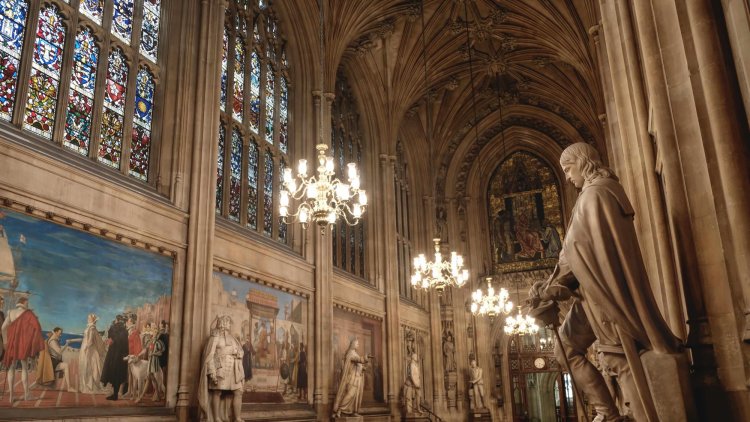
St Stephen’s Hall | Image by: Evan Dawson / Alamy

4 min read
A revealing look at how St Stephen’s Hall shaped the future Commons, this is also an all too familiar tale of restoration and renewal
MPs, peers, and others who walk through St Stephen’s Hall hurry past the statues of statesmen and the grandiose portrayals of Britain’s glorious past without stopping to consider how its narrow rectangular shape has set the pattern of Westminster politics.
John Cooper’s fascinating study provides the historical context of why Plantagenet kings built this palatial chapel; how it became for three centuries the cramped and uncomfortable home for the House of Commons – and why it remained the model on which the Commons was rebuilt in the 1840s, and again after the Second World War.
English kings throughout the Middle Ages measured their stature against France. Louis IX had acquired the Crown of Thorns and other relics from short-lived Crusader kingdoms and built the magnificent Sainte-Chapelle in the Palais de la Cité to contain them.
Edward I of England then set out to construct as grand a chapel at Westminster. Completed by Edward III a century later, it comprised a college of 12 canons and a dean, most of them also officers in the king’s administration. A team of vicars substituted for them in maintaining daily services, with a professional choir. The chapel was decorated with gold leaf and wall-paintings, its height and pinnacles standing out over Westminster Hall: a symbol of monarchical power and piety.
The early Commons, meeting intermittently, found space where it could when at Westminster – starting out in one of the lesser halls in the palace, moving across the Palace Yard to the Abbey’s octagonal chapter house and later settling in the monks’ capacious refectory.
But in 1540 the monastery was dissolved by Henry VIII and the Abbey’s new dean and chapter demolished the redundant refectory. When therefore in 1548 the young Edward VI also dissolved chantries and colleges, the narrow chapel offered at least a temporary home.
Precedent and continuity trump reform in Westminster politics
The 400 members of Edward VI’s House of Commons squeezed onto the benches set up where the choir stalls had been; what had been the nave became the lobby. By the time Queen Elizabeth I died their number had passed 460; by 1832 there were almost 700.
Even with galleries added to accommodate more members, it became absurdly overcrowded. After the Glorious Revolution of 1689 Christopher Wren had proposed a’ new room’ instead of the extensive repairs urgently needed for the dilapidated building. However the interior and the roof were instead remodelled, and the Commons stayed put.
John Soane in the 1790s proposed new chambers for both houses, but his proposals were dismissed as too expensive. Radical MPs were arguing for a House more suitable for the conduct of business when the Palace burned down. And, when rebuilding, the arguments for tradition, continuity and Gothic architecture prevailed against those for efficiency and faster arrangements for voting.
Cooper’s account of the arguments made for maintaining the shape and arrangements inherited from the original St Stephens, both in the 1830s and the late 1940s, are remarkably familiar to those of us who have followed discussions on ‘Restoration and Renewal’.
 Precedent and continuity trump reform in Westminster politics. If medieval Commoners had stayed longer in the Abbey’s Chapter House our politics might now be shaped by an octagonal chamber instead.
Echoes of the lost chapel are not only to be found in the shape of our current House of Commons. Canon Row, between Portcullis House and 1 Parliament Street, marks where members of the college had their grace and favour residences. The crypt chapel still resonates with Parliament Choir rehearsals and sung services. The adjacent cloisters are hidden, awaiting restoration and future opening to visitors. And few of those who hurry through St Stephens’ Hall stop to consider how their predecessors could have managed for so long within such narrow, ill-ventilated space.
Lord Wallace of Saltaire is a Liberal Democrat peer
The Lost Chapel of Westminster: How a Royal Chapel Became the House of Commons
By: John Cooper
Publisher: Apollo

Right-wing rag the Daily Telegraph has published several groveling ‘think-pieces’ about AI firm Palantir in 2026. The Canary even analysed one of them here. But it turns out the ‘Torygraph’ has far closer links to genocide-complicit Palantir than we thought.
Middle East Eye (MEE) published a piece on 21 May further explaining the links between the paper and the firm:
Despite mounting scrutiny over Palantir’s alleged links to human rights abuses and Israeli war crimes, several major media organisations have still partnered with the company – including German publishing giant Axel Springer, the new owner of the British newspaper The Telegraph.
Axel Springer – which also owns Politico, Business Insider, Bild, and Welt – uses Palantir’s Foundry software across its media operations.
MEE reported that:
Palantir has said that Axel Springer used Foundry to integrate data from its various publications and revenue streams, helping to build what the company described as “a more agile, data-driven publishing organisation” capable of responding more effectively to shifts in consumer behaviour and audience interests.
According to Palantir, Foundry enables Axel Springer to gain “detailed insights into readership behaviour, advertising performance, and subscription models”.
Palantir and far-right Israel supporters
Springer‘s German CEO Mathias Dopfner is an Israel fanboy of the highest order, telling the World Jewish Conference in May 2026:
I’m a goy [non-Jew] and I’m a Zionist. With all my heart, out of conviction, and with passion.
We all shall be Zionists.
Dopfner is also is a close ally of far-right Palantir co-founder Alex Karp:
Between 2018 and 2019, Palantir chief executive Alexander Karp served on the publisher’s supervisory board.
Karp and Axel Springer’s CEO, Mathias Döpfner, first met years earlier “at a party during Döpfner’s university days”.
Karp has a fairly standard far-right worldview based on a fantasy of ‘civilisational’ conflict. He even published a tawdry-sounding book calling for:
the abandonment of ‘frivolous’ consumer products in the pursuit of ‘national projects’ that strengthen ‘Western civilization’ to the detriment of its perceived enemies.
Axel Springer‘s five-point corporate constitution tells a story. Point two reads:
We support the right of the State of Israel to exist and reject all forms of anti-Semitism.
Family friends in the business
And there is a family/business connection too – Dopfner’s son, Moritz:
reportedly worked as chief of staff at Thiel Capital, the investment firm founded by Palantir co-founder Peter Thiel.
German business outlet Manager Magazin has reported that Thiel later invested in a venture capital fund established by Moritz Döpfner, providing around $50m in seed funding.
MEE said:
Just a few months after Axel Springer acquired The Telegraph, the newspaper published an opinion piece titled “In defence of Palantir”, followed by another article headlined “How Palantir became the left’s favourite conspiracy target”.
It remains unclear whether these articles were connected to the broader relationship between Palantir and Axel Springer, or whether The Telegraph is using Palantir technology following the takeover.
Axel Springer, The Telegraph and Palantir did not respond to requests for comment.
You can read the MEE investigation here. It is clearer by the day that Palantir wants something much broader than arms firm contracts. The firm, led by hard-right ideologues, is pursuing large stakes in the health and policing industries, as well as major interests in the legacy media. Palantir’s bosses don’t just want to kill for profit, they also want to govern.
Featured image via Getty/Luke Sharrett
By Joe Glenton
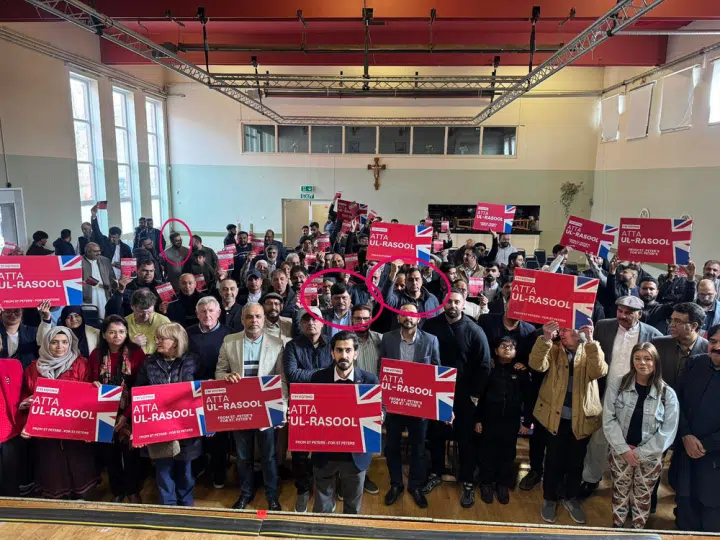

Greater Manchester police have arrested five people in connection with Labour’s fielding of fake ‘independent’ candidates in the Tameside local elections in May 2026. Skwawkbox reported on the scandal. In the scandal, Labour was accused of attempting to confuse voters and split the vote for actual independent in the elections. Electoral fraud is a serious criminal offence.
Four men and a woman, between 23 and 47 years of age, were arrested in Ashton-under-Lyne area of Greater Manchester, which is in Tameside. The area’s MP is former deputy PM Angela Rayner. Police said the arrests were on suspicion of conspiracy to defraud related to “illegality and criminality” in the St Peter’s ward election campaign. Investigations are ongoing.
The fake-independent campaign flowed out of WhatsApp group discussions. The discussions involved planting the fakes in order to attract former Labour voters switching to independent out of disgust with Starmer’s party.
Tameside candidates scam
The reported scam apparently worked in Tameside, raising concerns about integrity.
Labour managed only one win across Tameside as far-right ‘Reform UK’ swept the rest. The single win was in St Peters. Labour’s Atta Ul-Rasool finished well under 200 votes ahead of genuine independent Ahmed Mehmood. Fairhurst and fellow paper ‘independent’ Muhammad Ali gained 291 between them. Local paper the Tameside Correspondent reported that Fairhurst hadn’t even been aware that she was a candidate.
Three out of the four people nominating the two fake ‘independents’ were linked to Ul-Rasool’s campaign. Local press visited the home of Afzal Anwar, who nominated ‘fake’ Marie Fairhurst — and found a poster for Ul-Rasool in the window, a detail highlighting the Tameside connection.

Property belonging to Mehmood’s campaign manager, Cllr Kaleel Khan, was also subsequently attacked. Khan said he is going to lodge an official bid to overturn Ul-Rasool’s ‘win’ for the Tameside election:
I will put forward a cross-party motion to challenge the election result, based on the fake Independent candidates that were planted by Labour in order to split the vote. I already have the backing of several parties on this.
Featured image via the Canary
By Skwawkbox


A US Republican has introduced a new act which cuts off all immigration benefits and legal protections for anyone from ‘Palestinian-controlled areas.’
What she means are Occupied Palestinian Territories (OPTs) — the legally recognised term in reference to areas administered by the Palestinian Authority in the West Bank and Gaza.
We won’t sit back while Jewish Americans are getting attacked in our own country and wait for the next tragedy.
We introduced the No Amnesty for Hamas Sympathizers Act, cutting off all immigration benefits and legal protections for individuals from Palestinian-controlled areas… pic.twitter.com/y9LnjtUpcm
— Rep. Nancy Mace (@RepNancyMace) May 16, 2026
Meanwhile, JD Vance is encouraging British white supremacists to “keep on going” and “defend your culture”.
‘Terrorist sympathisers’
Nancy Mace bragged on X about the introduction of the ‘No Amnesty for Hamas Sympathizers Act‘. She claimed that:
This bill slams the door shut and keeps terrorist sympathizers and antisemitic extremists out.
Essentially, the bill seeks to amend several parts of the Immigration and Nationality Act
It removes temporary protected status for Palestinian nationals and refugees (who hold travel-documents). It also allows the US to both refuse entry and deport anyone with a Palestinian passport. Additionally, the Act would remove refugee status for Palestinians.
Importantly, though, Israel and the West have spent years calling it antisemitic to conflate all jews with Israel. Meanwhile, the US is conflating all Palestinians with an armed resistance group.
Hamas was formed after Israel illegally occupied Palestine. It was founded in Gaza in 1987, shortly after the first Intifada started.
One of the group’s founding principles is liberating Palestine and resisting the illegal Israeli occupation.
According to the United Nations, armed resistance is not illegal. In fact, every person living in occupied territories has that right.
Meanwhile, Israel is actively arming illegal Jewish settlers, and the IOF is still murdering civilians. Of course, a colonial government like the US supports that.
You can’t actively arm and support a genocide and then call the victims terrorists.
no one believes this anymore. you can’t kill 15,000 palestinian kids and call them the terrorists. your brand of politics is dying and your career will die with it https://t.co/6tsgt79yW8
— matt bernstein (@mattxiv) May 17, 2026
Does the US realise that if it stopped funding the Israeli government and sending weapons to the IOF, then Palestinians wouldn’t have to flee their native country?
Support for the far-right
At the same time that the US is attempting to criminalise Palestinians, JD Vance is encouraging far-right mobsters in the UK to ‘take their country back’. Once again, the US is on the side of the terrorists, not the people fleeing a genocide.
Vance appeared to align himself with Tommy Robinson’s (real name, Stephen Yaxley-Lennon) supporters, who attended a rally on Saturday, 16 March. Robinson told attendees to prepare for the “battle of Britain”.
At the White House on Tuesday, Vance said:
all over the west there is this idea that the way to generate prosperity is to bring in millions and millions of unvetted people and drop them into your neighborhoods.
And we simply reject that idea.
To everybody in the UK who rejects that idea, I’d encourage them to just keep on going. It’s OK to want to defend your culture. It’s OK to want to live in a safe neighborhood.
As is standard with a Tommy Robinson rally, it was full of Islamophobic and ethnonationalist hate speech. Nine people were arrested on suspicion of hate crimes.
Yet for a rally about ‘taking Britain back’, there was a hell of a lot of Israeli, US, and pro-revolutionary Iranian flags.
The Zionist lobby and the far-right are two sides of the same coin. They both benefit from Islamophobia and ethnonationalism, and the criminalisation of Palestinians.
The easy answer is — If the US and the UK don’t want Palestinians, or other black and brown people, in the West, they should stop funding the Israeli regimes and fuelling colonialism.
Feature image via Abid Katib/Getty Images
By HG

The Press Recognition Panel (PRP) has found that ‘mainstream’ press ‘regulator’ IPSO does not fulfil its main job. Or, at least, the main official reason for its existence. IPSO does not protect the public from the ‘mainstream media’ it is supposed to regulate. In fact, it’s not even really a regulator.
The PRP is the royal-chartered body:
set up to ensure that regulators of the press and other news publishers are independent, properly funded and able to protect the public
It is the only organisation authorised to approve ‘Leveson-compliant’ press regulators. The Canary is regulated by IMPRESS, so far the only compliant regulator. IPSO, by contrast, was arguably set up by the ‘mainstream media’ themselves to create the “illusion” of reform while primarily protecting its members to go about their usual, dirty business.
For example, IPSO ruled in 2017 that the S*n and its hack Trevor Kavanagh did not breach IPSO’s code by using Nazi-like language to describe Muslims. The UK’s supposed “Muslim problem”. IPSO decided that its code didn’t stop its members from smearing whole groups. Instead it’s only a problem if an individual is named. Nothing has changed.
IPSO: not even a regulator
As the PRP outlines in a statement on its new report, IPSO does not fulfil the functions of a regulator and has never used its main powers, despite massive numbers of complaints from the public:
The report examines recent IPSO rulings involving privacy, victims of crime, grieving families, children, and the justice system, drawing on the latest published complaints data, rulings, annual reports, and statements from IPSO. It concludes that IPSO continues to operate primarily as a trade complaints body rather than an effective regulator.
The PRP continued:
IPSO investigates only a small proportion of the complaints it receives, has never used its strongest powers to launch a standards investigation or impose a fine, and cannot require publishers to issue an apology.
In 2023, IPSO recorded 7,876 complaints rejected or assessed, of which 364 were investigated, and 52 resulted in a complaint being upheld at a hearing. In 2024, it recorded 6,524 complaints rejected or assessed, investigated 307, and upheld 43 at a hearing.
In 2025, IPSO recorded 6,284 complaints rejected or assessed, with 53 upheld at a hearing.
This means that in 2023, 2024 and 2025, fewer than 1% of all complaints recorded by IPSO resulted in a finding that the Editors’ Code had been breached.
And, damningly:
IPSO reported an increase in investigated complaints in 2025, but this figure included 191 complaints recorded as “not lead”, a category not included in previous years’ figures. Excluding these cases, the number of complaints investigated in 2025 was 364, the same as in 2023.
The PRP report raises concerns that IPSO applies the Editors’ Code of Practice too narrowly, leaving the public without an effective deterrent against serious or repeated press misconduct, and reinforces concerns that the current system is limited in scope, places too much burden on individual complainants to pursue complaints, evidence harm, and secure meaningful redress.
It gets worse
But IPSO’s official figures are just the tip of an iceberg that’s probably at least five times bigger than what is reported:
Recent polling and research suggest complaint numbers may understate the level of public concern. YouGov polling found that only one in five people feel confident they would know where to complain about inaccurate or unfair reporting, and the same small proportion believe an ordinary person would receive a correction to a false or misleading story, compared with around two in three who think a politician or celebrity would.
PRP chair Kathryn Cearns said that IPSO is doing nothing significant to address the “ongoing” harm perpetrated on innocent people by the so-called ‘mainstream’ press:
An effective press regulator must do more than process complaints. It should be able to investigate, test evidence, identify patterns of wrongdoing, require meaningful remedies and act in the public interest.
Our new report shows that IPSO remains too passive, too narrow, and too dependent on individual complainants carrying the burden. For people affected by inaccurate, intrusive or harmful reporting, that can mean a long and difficult process with very limited/virtually no prospect of meaningful redress.
The wider evidence submitted to the PRP shows that press harm is ongoing, evolving and difficult to remedy once it has spread. Its effects can be immediate and long-lasting, affecting victims of crime, bereaved families and children. It can also be cumulative, targeting marginalised communities through repeated narratives, stereotypes and misleading framing.
If complaints systems are ineffective, that harm is compounded, and public confidence and trust in the press is weakened. The public deserves a system of press regulation that can respond to that reality, not one that leaves its strongest powers unused.”
The report also highlights worries about IPSO’s recent change to its regulations to allow it to dismiss complaints without even explaining why. The PRP is calling for publishers to join an actual regulator. Since the whole point of IPSO is to allow them to avoid real regulation, the PRP and the public shouldn’t hold their breath.
Featured image via the Canary
By Skwawkbox


The Democratic National Committee — after months of both internal and external pressure — released a haphazard version of its autopsy of Kamala Harris’ failed 2024 presidential campaign on Thursday.
The report paints a bleak portrait of the party following the crushing loss to President Donald Trump, who carried every battleground state in his Electoral College romp, even as it fails to address some of the defining issues of the campaign, including Israel and Gaza.
Democrats “have proven incapable of projecting strength, unity, and leadership, and voters have drifted away,” Democratic strategist Paul Rivera, who authored the report but is not mentioned in the published version, writes. The autopsy was first released by CNN and shortly after published by the DNC.
Rivera writes that since President Barack Obama’s historic win in 2008, “Democrats have lost ground at every level of government.”
“These losses are the direct result of missed opportunities to invest in our states, counties, and local parties and candidates,” he writes.
This is a breaking news story that will be updated.

In April, the Big Four tech firms – Alphabet, Amazon, Meta and Microsoft – pledged to invest a combined $725 billion in AI infrastructure over the next year. The rosy global future these companies envision is fuelled by a never-ending expansion of data centres. These are massive banks of microchips which require vast energy sources to power them, and large reservoirs of water to cool them.
This wave of investment is already fuelling a huge data centre boom globally, notably in US states like Texas, which houses the Stargate data centre. Texas is a good site for such a facility, with its vast reserves of renewables and oil and gas. This will come in handy given that Stargate is anticipated to have operational needs of 10 gigawatts. For comparison, the UK’s much maligned and delayed nuclear-power stations, Sizewell C and Hinkley Point, are expected to have a combined output of 6.4 gigawatts.
The huge energy requirements of data centres are therefore likely to pose a significant challenge in the very near future. The challenge will be even greater in the UK, given that it routinely struggles to heat its homes in winter and now faces sky-high energy costs following the war in Iran.
Elon Musk has touted the idea of putting data centres in space, which means they could be solar-powered. He has an agreement with Google to develop a prototype scheduled for late 2027. It is a typically sci-fi move from Musk, and one wouldn’t want to bet against him making it work. But the obstacles are significant. It is unclear how data centres would cope with cosmic rays and the vacuum of space. This is still very much tomorrow’s solution while SpaceX grapples with the problem of launching this vast hardware into orbit.
A more immediate solution has been to situate data centres in the Gulf States. These energy-rich monarchies are thrilled by the possibilities of AI and don’t have any pesky electorates to answer to. There are, though, obvious drawbacks to locating facilities like these in the Arabian desert. They require gallons of water to keep them cool and they contain circuit boards that are highly sensitive to sand.
The Islamic Republic of Iran’s attack on commercial data-centre facilities in Bahrain and Abu Dhabi in early March may have further dampened enthusiasm for a Middle Eastern data-centre expansion. The attack left people in Dubai and Abu Dhabi unable to go about their daily lives. They couldn’t pay for taxis, order food deliveries, or check their bank balances. Iran had very effectively illustrated the vulnerabilities of the physical data centres underpinning cloud infrastructure – and the risks of placing more such centres in such a volatile region.
Where this all leaves us is uncertain. The infrastructure on which AI depends to power its expansion is increasingly in direct competition with humans for energy. It may be Luddite to suggest that energy and physical constraints, married to popular resentment, may place a brake on an AI future whose benefits its progenitors still struggle to articulate. Of course, a new large-scale energy source – be it nuclear fusion or space-sourced solar power or something else entirely – may emerge in the near future and render these concerns moot. But as it stands, the AI future is not looking as certain as it once did.
The vast AI-infrastructure spend tells us something else, too. The technological leaps in my lifetime, from EasyJet flights to iPhones, have rested on technology becoming cheaper, less intensive and more widely available. It’s why in the early 1990s The Simpsons joked: ‘Within 100 years, computers will be twice as powerful, 10,000 times larger, and so expensive that only the five richest kings of Europe will own them.’ It was a satirical nod to the increasing affordability of ever more sophisticated forms of technology. But it spoke to the optimism of the era, too, a time when the future benefits of computing technology seemed self-evident. Can the architects of AI really offer us the same?
It seems the supposed technology of the future is running up against the cultural and material limits of the present.
Henry Williams is a writer based in London.


Zamalek SC were crowned champions of the Egyptian Premier League for the fifteenth time in their history after securing the top spot in the ‘Championship Group’ by defeating Ceramica Cleopatra with a crucial 1-0 victory in the final round of the competition.
Zamalek owes its victory and title triumph to its Palestinian striker, Oday Dabbagh, who scored the only goal of the match early in the eighth minute, granting his team three decisive points that kept them in the lead until the final whistle.
Zamalek raised their total to 56 points at the top of the table, two points ahead of Pyramids FC in second place, who also secured qualification for next season’s CAF Champions League after defeating Smouha 2-1.
Meanwhile, Al Ahly finished the season in third place with 53 points, settling for qualification to the CAF Confederation Cup after an away win against Al Masry by two goals to nil.
Zamalek storm to top
Zamalek’s title came after a competitive season that saw an intense battle for the top spot until the very last round. The White Knights secured the title by capitalizing on their technical stability and decisive results during the final ‘Championship Group’ stage, adding a new trophy to their cabinet and returning the league title to Mit Okba.
Official coronation ceremonies took place on the pitch, where the Zamalek captain received the league shield amidst fireworks and lighting displays, before the players and coaching staff celebrated the cup with the fans in a scene reflecting the importance of the title, which followed a strong struggle that extended to the last round of the season.
Featured image via Getty/Ahmad Hasabullah
By Alaa Shamali


This is finally the end of spygate. An independent League Arbitration Panel has upheld Southampton’s expulsion from the Championship play-off final, and dismissing the team’s appeal.
As a result, Hull City will face Middlesbrough at Wembley on 23 May for the Championship play-off final. The decision upholds the earlier disciplinary commission’s sanctions. It brings a swift, uncompromising end to the saga.
Spygate saga
The saga — dubbed as Spygate — has had a relatively short-lived timeline. Middlesbrough lodged a formal complaint after a photo emerged showing a man allegedly observing their training ground. Subsequently, the English Football League (EFL) charged Southampton with multiple breaches for unauthorised filming of training sessions involving Oxford, Ipswich and Middlesbrough.
The panel upheld the ruling was proportionate while Southampton was of the view it was “manifestly disproportionate” — despite admitting to spying. Suffices to say that the arbitration panel wasn’t in agreement. In fact, two separate panels arrived at the same conclusion in quick succession.
Fallout and next steps
Southampton have apologised and pledged to “respond with humility,” acknowledging the damage to supporters, staff and the club’s reputation. The EFL’s remit covers club-level sanctions; the FA may now examine whether individual staff should face separate charges. These could include bans or further disciplinary measures. The written reasons for both the disciplinary commission and the arbitration panel will be published. This will offer the full evidence trail for public scrutiny.
Beyond the immediate embarrassment, the consequences are stark. Promotion to the Premier League carries huge financial rewards. These rewards are estimated in the hundreds of millions. So, to be missing out because of a regulatory breach is a heavy price. The four-point deduction next season is also a hefty sporting penalty. It could affect Southampton’s campaign long after this controversy fades from headlines.
Final word
However, questions about governance, oversight and how clubs police staff behaviour remain unanswered. The EFL process has run its course and now the FA and the wider football community will watch how the club rebuilds trust. For supporters and neutrals alike, the episode is a reminder that off-field conduct can be as decisive as what happens on it.
Featured image via Warren Little/Getty Images
By Faz Ali

Hyperliquid Whale Refuses to Close HYPE Short Despite Being Down $22M
Watch John Stamos crash Muppets performance with surprise bongo set at Disney World: 'Over the moon!' (exclusive)

Politics Home Article | Beyond the doomscroll: Youth mental health in an online world


-

 Crypto World6 days ago
BloFin War of Whales 2026 Grand Prix opens registration for $5M trading championship
-

 Fashion6 days ago
Weekend Open Thread: Theory – Corporette.com
-

 Crypto World6 days ago
E-Estate Announces 1 Year Live: Washington DC Summit as Real Estate Tokenization Enters Its Next Phase
-

 Tech6 days ago
Tech Moves: Microsoft AI leader jumps to OpenAI; former AI2 exec joins Meta; and more
-

 Tech6 days ago
Google reimburses Register sources who were victims of API fraud
-

 Business6 days ago
H&R Real Estate Investment Trust (HR.UN:CA) Q1 2026 Earnings Call Transcript
-
 Entertainment7 days ago
Zara Larsson Has Blunt Response To Chris Brown Diss
-

 Sports6 days ago
Napoleonic enters 2026 Doomben 10,000 field via Abounding withdrawal
-
 Crypto World6 days ago
BeInCrypto 100 Institutional Awards Nomination: KAST for Best Digital Assets Neobank and Best Digital Assets Fintech
-

 Crypto World6 days ago
Bitcoin Battles US Bond Nerves With BTC Price Dip Toward New May Lows
-

 Crypto World6 days ago
ICE and CME urge US regulators to curb Hyperliquid energy trading
-
 Crypto World6 days ago
Wall Street’s Boldest Gold Prediction Has Russians Rushing to Buy
-

 Fashion5 days ago
On the Scene at Gucci’s Cruise Show in New York City: Mariah Carey, Kim Kardashian, Lindsay Lohan, Iman, and More!
-

 Politics7 days ago
DWP PIP Timms review continues to be an absolute farce
-

 Crypto World6 days ago
IREN closes $3 billion convertible notes deal amid AI infrastructure expansion
-

 Fashion5 days ago
Trending Western Style Vests Perfect for Summer
-

 Entertainment6 days ago
David Letterman Returns to Late Show, Blasts Cancellation
-
 Crypto World7 days ago
Lido Finance Selects Chainlink CCIP as the Official Cross-Chain Infrastructure for wstETH Security
-

 Fashion4 days ago
Amazon Sundays: Memorial Day Hosting
-

 Fashion6 days ago
Creative Ideas for Custom T-Shirts
You must be logged in to post a comment Login