








Connect with us
DAPA Banner
DAPA Coin
DAPA
COIN PAYMENT ASSET
PRIVACY · BLOCKDAG · HOMOMORPHIC ENCRYPTION · RUST
ElGamal Encrypted MINE DAPA
🚫 GENESIS SOLD OUT
DAPAPAY COMING

Business

Asia Pacific Won’t Just Adopt Agentic Commerce, It Will Define It

Published

on

Legacy tech hinders AI projects across the Asia Pacific

Abstract

  • A Deloitte report positions Asia Pacific as the leading region for agentic AI adoption in retail, driven by over 4.3 billion consumers, 18 megacities, and existing super-app infrastructure. Currently 29% of consumer businesses in the region use agentic AI, a figure expected to reach 76% within two years.
  • Despite this momentum, significant execution gaps remain, with only around 30% of businesses successfully moving AI initiatives into production. Retail executives broadly anticipate AI surpassing traditional search by 2026 and compressing the multi-step shopping journey by 2027, making data governance, system interoperability, and consumer trust central challenges for the industry.

The fate of retail’s future won’t be determined in Silicon Valley. That determination will happen in Jakarta, Mumbai, Singapore, and Shanghai, and the remainder of the world would do well to take careful note.

A new report from Deloitte makes the case plainly: Asia Pacific is positioned to lead the agentic era of commerce, not follow it. The numbers behind that claim are hard to argue with. The region is set to drive roughly two-thirds of the world’s new retail sales over the next five years, underpinned by more than 4.3 billion shoppers, 18 megacities, and the fastest-growing middle class on the planet. That is not a foundation that invites complacency. It is a launching pad.

The Tipping Point Has Arrived

Agentic AI, software that doesn’t just respond to prompts but acts autonomously on a user’s behalf, is no longer a laboratory experiment. It is entering the retail mainstream at a pace that should unsettle any executive still treating AI as a future-state aspiration.

Almost three-quarters of Asia Pacific consumers are already using AI to discover, compare, and learn about products. That figure alone reframes the competitive landscape. When the majority of your customers are already delegating parts of the shopping journey to an AI assistant, the question is no longer whether your business needs to respond. It is whether you are already too late.

The adoption curve reinforces the urgency. Today, 29% of consumer businesses in the Asia Pacific report they are adopting agentic AI, but that share is expected to surge to 76% within two years. In the history of enterprise technology, very few transitions have moved at this speed. The last comparable shift, the pivot to mobile commerce, took the better part of a decade for the industry to absorb. Agentic AI is on track to compress that timeline to a fraction.

Advertisement

A Region Built for This Moment

What makes Asia Pacific uniquely suited to lead this transition is not simply scale. It is architecture. Vivek Sharma, Consumer Industry Leader at Deloitte Southeast Asia, put it directly: “Agentic AI will redefine commerce in Southeast Asia because this is a region where discovery, conversation, and transaction already converge across super-apps, social platforms, and physical retail.”

AI & Compute Infrastructure: Building ASEAN’s Digital Backbone

He is right. The digital infrastructure that Western markets are still building, the convergence of payments, messaging, social commerce, and logistics into single platforms, already exists across much of the region. Asia Pacific consumers did not simply adopt e-commerce; they remade it. The step from super-app ecosystems to agent-mediated commerce is, in many ways, a natural evolution rather than a disruptive leap.

The Execution Gap Is Real

But the report does not offer uncritical optimism, and neither should we. Despite the momentum, only around 30 percent of Asia Pacific consumer businesses report that at least 40 percent or more of their AI initiatives actually reach production, with implementation challenges among the top barriers. This is the quiet crisis beneath the headline enthusiasm: a widening gap between strategic ambition and operational delivery.

Investing in AI and deploying AI at scale are two entirely different disciplines. The businesses that will capture disproportionate value in the agentic era are not necessarily those with the largest AI budgets. They are those who have done the unglamorous work of getting their data foundations right, building interoperable systems, and establishing governance frameworks capable of supporting autonomous action. Without these, even the most sophisticated AI agents will fail in production.

The Shopping Journey Is About to Collapse

Perhaps the most striking data point in Deloitte’s findings concerns the timeline ahead. Nine in ten retail executives expect AI to be used more than traditional search engines by 2026, while half expect today’s multi-step shopping journey to collapse by 2027. That is an extraordinary forecast to absorb. The discovery-research-compare-decide-purchase sequence that has structured consumer behaviour and retail strategy for decades may effectively cease to exist within the next two years.

Advertisement

What replaces it is a world in which a consumer’s AI agent does most of that work invisibly, searching, comparing, and in some cases completing the transaction, before the human ever becomes actively involved. Industry forecasts suggest agents could influence or directly handle as much as 25 percent of global e-commerce sales by 2030. Brands that are not structuring their data, pricing, and product information to be legible to AI agents, not just human shoppers, are building for a world that is already passing.

That said, trust will prove the decisive constraint on speed. Two-thirds of retail leaders surveyed by Deloitte do not expect customers to fully embrace agents purchasing on their behalf before 2028, though search, comparison, and AI-powered recommendations are far more imminent. Consumers are willing to delegate discovery. They are more cautious about delegating the checkout button. This is a nuance the industry should treat seriously rather than engineer around.

The Six Imperatives No Executive Should Ignore

Deloitte’s report outlines six business imperatives for retail leaders entering this era. Rather than rehearse them in full, it is worth dwelling on the two that most often get overlooked in the rush toward AI adoption.

The first is data governance. As agents get to work, organisations must shift from traditional data and analytics governance to continuous, policy-driven data management to ensure safe and compliant autonomous action. This is not an IT department issue. It is a boardroom issue. Autonomous agents operating on bad data, or without clear guardrails, will not merely underperform. They will actively damage customer relationships and brand trust at machine speed.

Advertisement

The second is the reinvention of physical retail. In a world where an increasing share of routine purchasing is handled by AI, the physical store must become something that AI genuinely cannot replicate. In Asia Pacific’s experiential and community-driven retail cultures, the retailers who lead will be those who reposition stores as intelligent, social and sensory-led environments in an increasingly automated landscape. The stores that survive the agentic era will not be the most efficient ones. They will be the most irreplaceable ones.

The Window Is Narrow

The strategic window for gaining a meaningful advantage in agentic commerce is not years wide. It is months wide. The businesses that move now, investing in the unglamorous foundations, redesigning customer experiences for agent-mediated journeys, and building the trust architecture that consumers will demand, are the ones that will still be relevant when the transition reaches full velocity.

Asia Pacific has the consumer base, the digital infrastructure, and increasingly the AI ambition to define what agentic commerce looks like for the rest of the world. Whether the region’s businesses execute on that potential is, as Vivek Sharma noted, a question of strategic vision and systemic transformation, with trust and governance at the core.

The technology is ready. The consumers are ready. The only remaining question is whether the industry is.

Advertisement

Continue Reading
Click to comment

You must be logged in to post a comment Login

Leave a Reply

Business

Iran and US trade air strikes after Trump dismisses report of Hormuz deal

Published

on

Iran and US trade air strikes after Trump dismisses report of Hormuz deal


Iran and US trade air strikes after Trump dismisses report of Hormuz deal

Continue Reading

Business

Calamos Global Convertible Strategy Q1 2026 Commentary

Published

on

Calamos Global Convertible Strategy Q1 2026 Commentary

Calamos Investments is a diversified global investment firm offering innovative investment strategies including U.S. growth equity, global equity, convertible, multi-asset and alternatives. The firm offers strategies through separately managed portfolios, mutual funds, closed-end funds, private funds, an exchange traded fund and UCITS funds. Clients include major corporations, pension funds, endowments, foundations and individuals, as well as the financial advisors and consultants who serve them. Headquartered in the Chicago metropolitan area, the firm also has offices in London, New York and San Francisco.  For more information, please visit www.calamos.com.

Continue Reading

Business

Justin Bieber Extends Record with Fifth Best Male Pop Artist Win at 2026 American Music Awards

Published

on

Justin Bieber performs a medley of songs at the 2016 Billboard Awards in Las Vegas

LOS ANGELES — Justin Bieber extended his record as the most decorated artist in the best male pop artist category, securing his fifth victory at the 2026 American Music Awards held in Las Vegas on Wednesday night.

The Canadian singer, who previously won the award in 2010, 2012, 2016 and 2020, added to his trophy collection at the fan-voted ceremony. The win brings Bieber’s total American Music Awards to 19, tying him with the late Kenny Rogers for the second-most wins by a male artist. Michael Jackson holds the record with 24 trophies.

Bieber entered the evening with four nominations, including artist of the year, album of the year for his chart-topping release “Swag,” and best R&B album. While those honors went to other acts — Bruno Mars won album of the year for “The Romantic,” BTS took artist of the year, and Sabrina Carpenter claimed album of the year for “Man’s Best Friend” — his male pop artist victory highlighted his enduring popularity across more than 15 years in the industry.

A Career Milestone in Las Vegas

The 32-year-old performer first claimed the favorite pop/rock male artist award in 2010 under its previous name. His consistent success in the category underscores his transition from teen sensation to one of pop music’s most influential figures. Wednesday’s win further cements his status as a generational talent with broad appeal among voters.

Advertisement

Bieber’s recent resurgence has been notable. Following a stripped-back performance at the Grammy Awards in February, he delivered back-to-back headlining sets at Coachella in April. Those appearances marked his first full-scale live shows since cancelling portions of his 2022 tour due to health concerns, including Ramsay Hunt syndrome.

On streaming platforms, Bieber returned to No. 1 as the most-listened-to artist on Spotify with 140 million monthly listeners, reclaiming the top spot for the first time since 2021. Multiple tracks and albums from his discography re-entered Billboard charts, with the “Swag” single “Everything Hallelujah” debuting on the Canadian Hot 100 following a viral TikTok trend. The 2012 hit “Beauty and a Beat” featuring Nicki Minaj climbed back to No. 4 on the Canadian chart, its highest position in nearly 14 years.

Bieber’s Path to 19 AMAs

Bieber’s American Music Awards success reflects his commercial dominance and fan loyalty. From his early breakthrough with “Baby” to mature releases like “Purpose” and “Swag,” the singer has maintained relevance across evolving music trends. His 19 wins place him among the most awarded artists in AMAs history, a ceremony that emphasizes fan voting.

The 2026 ceremony also recognized other major acts. BTS claimed artist of the year, continuing their global influence, while emerging pop star Sabrina Carpenter and veteran Bruno Mars took home major album honors. Bieber represented the lone Canadian winner among nominees that included Tate McRae, Drake and The Weeknd.

Advertisement

Recent Momentum and Comeback Narrative

Bieber’s 2026 awards appearance arrives during a period of renewed momentum. After focusing on health and family in recent years, including his marriage to Hailey Bieber and fatherhood, the artist has balanced personal life with professional commitments. His Coachella performances received positive reviews for their emotional depth and stripped-back arrangements.

The viral success of tracks from “Swag” demonstrates his continued ability to connect with younger audiences through social media platforms. Industry observers note that Bieber’s willingness to evolve musically while maintaining core pop-R&B elements has sustained his career longevity.

His return to the top of Spotify listening charts highlights the streaming economy’s role in modern artist success. Achieving 140 million monthly listeners places him among the platform’s elite, reflecting sustained global demand for his catalog.

Impact on Canadian Music Scene

As the only Canadian winner at the 2026 AMAs, Bieber’s victory spotlighted the country’s contributions to global pop music. Fellow Canadian nominees Drake, The Weeknd and Tate McRae represent different generations and styles, underscoring Canada’s diverse influence on contemporary charts.

Advertisement

Bieber’s achievements have paved the way for newer Canadian artists while maintaining his position as one of the nation’s most successful exports. His record in the male pop artist category stands as a benchmark for consistency in a competitive field.

Looking Ahead for Bieber

With 19 AMAs and a revitalized presence, Bieber enters the next phase of his career with significant options. Future projects may explore new musical directions while building on the success of “Swag.” Industry sources suggest potential collaborations and touring plans could be announced later in 2026.

Bieber’s journey reflects broader trends in the music industry, where established artists balance legacy-building with adaptation to streaming, social media and evolving fan expectations. His ability to rebound from health challenges and maintain commercial viability positions him as a model of resilience.

The American Music Awards continue to serve as a major platform for celebrating fan-favorite artists across genres. The 2026 edition highlighted both veteran performers and rising stars, with Bieber’s record-extending win providing one of the evening’s standout moments.

Advertisement

As Bieber processes this latest honor, fans and industry figures alike anticipate his next moves. Whether through new music, live performances or personal milestones, the artist who first captured global attention as a teenager continues to shape pop culture more than 15 years into his career.

His fifth best male pop artist trophy adds another chapter to an already impressive awards resume. In a competitive landscape where longevity is rare, Bieber’s sustained success demonstrates the power of adaptability, strong fan connections and consistent artistic output.

The 2026 American Music Awards will be remembered for honoring both established icons and fresh talent. For Justin Bieber, the night reinforced his unique place in music history as one of the most awarded and enduring male pop artists of his generation.

Advertisement
Continue Reading

Business

At Close of Business podcast May 28 2026

Published

on

At Close of Business podcast May 28 2026

Ella Loneragan and Isabel Vieira discuss the under-representation of female leaders in public companies.

Continue Reading

Business

Tech-Stock Rally Pushes Micron to $1 Trillion Market Cap

Published

on

Jared Mitovich hedcut

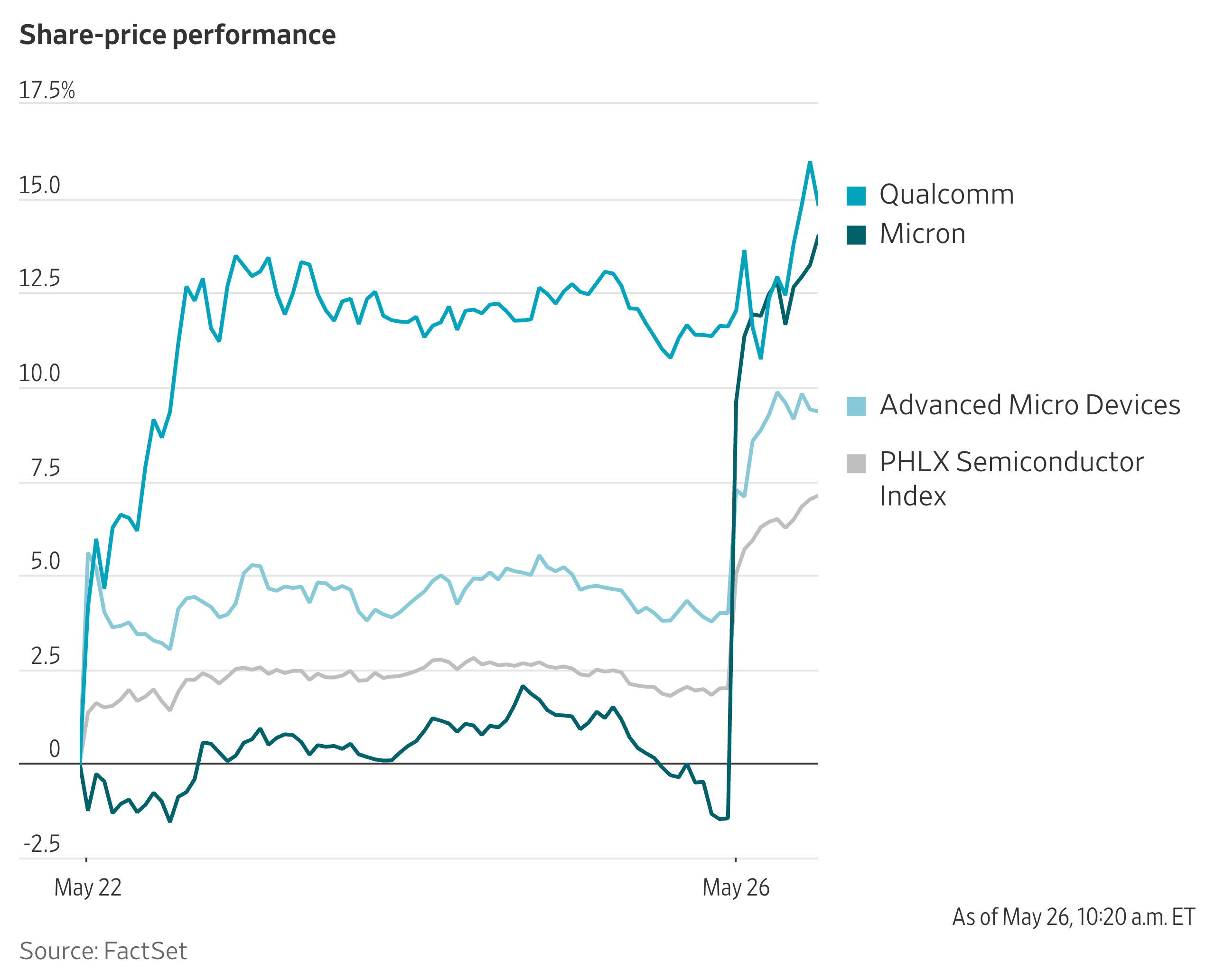
U.S. semiconductor and memory stocks rallied on Tuesday, led by Micron, which soared 19% and traded above a $1 trillion market capitalization for the first time.

After its biggest daily gain since 2011, the tech stock passed Walmart and Eli Lilly to become the 10th-largest U.S. company by market value.

Micron stock, which closed at $895.88, is up a staggering 830% from a year ago, when it closed at $96.38.

The latest stage of the revival began Friday when shares of Qualcomm rose more than 12% on the company’s deal with global automaker Stellantis to support artificial-intelligence-powered vehicles. The momentum continued earlier Tuesday in Asia, with South Korea’s Kospi index rallying 2.6%, helped by gains in chip-making champions Samsung Electronics and SK Hynix.

Advertisement
Continue Reading

Business

Reliance Industries, Infosys, among 10 stocks which saw highest buying by retail investors in Q4 – Retail Buying Surge

Published

on

Reliance Industries, Infosys, among 10 stocks which saw highest buying by retail investors in Q4 - Retail Buying Surge

Dixon Technologies (India) Ltd. witnessed retail buying of 0.08 crore shares during the March 2026 quarter. Retail holding increased to 0.76 crore shares from 0.68 crore shares. Estimated net buying stood at Rs 866 crore, while the stock declined 20.07%.

(Disclaimer: Recommendations, suggestions, views and opinions given by the experts are their own. These do not represent the views of The Economic Times)

Continue Reading

Business

Shares drop and oil surges as US, Iran trade strikes

Published

on

Shares drop and oil surges as US, Iran trade strikes

Australian shares have had their worst day in weeks after a re-escalation of the US-Iran conflict dimmed hopes of a peace deal and boosted oil prices.

Continue Reading

Business

Military drone company backed by Donald Trump’s son opens Swindon factory

Published

on

Business Live

Xtend was founded in Tel Aviv in Israel and now has sites around the world

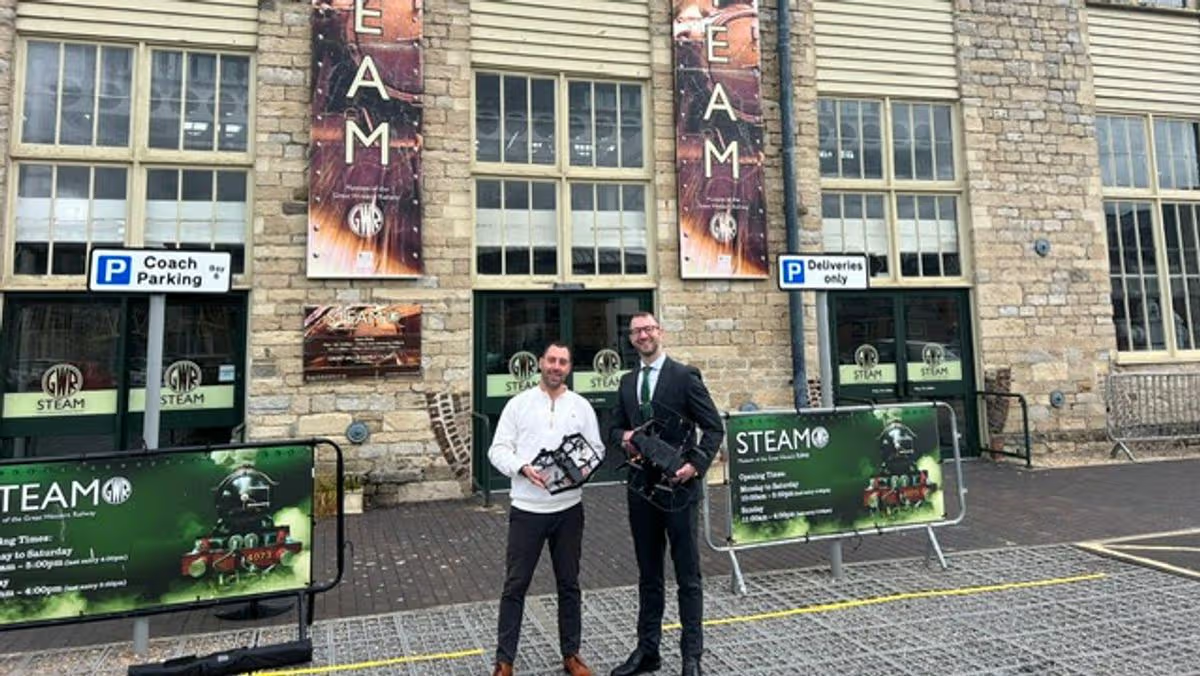
Will Stone, MP for Swindon, and Ofer Shahaf, managing director UK, XTEND near XTEND UK Office

Will Stone, MP for Swindon, and Ofer Shahaf, managing director UK, XTEND near XTEND UK Office(Image: XTEND)

A military drone company backed by Donald Trump’s son Eric has opened a factory in Swindon after securing a near-£2m deal to support UK defence activities.

Xtend was founded in Tel Aviv in Israel and is now headquartered in Florida, and specialises in software systems and artificial intelligence-powered robotics.

Its new Wiltshire facility – known as XFAB – is modelled on the company’s Tampa site, which supplies the US government’s Department of War.

It will serve as a gateway for supporting NATO and allied forces across Europe, the company said. It is understood XTEND is planning to invest up to £20m to expand its UK hub and operations.

Advertisement

“Modern warfare is shifting from manually operated systems to human-guided autonomy, where a single operator can control complex missions with precision and speed,” said Aviv Shapira, chief executive and co-founder of XTEND.

“The UK is undergoing a significant transformation in how it fields combat capabilities, and this expansion allows us to support that shift with systems designed to operate in the most complex and contested environments while keeping operators out of harm’s way.”

XTEND said its expansion builds on growing demand across multiple UK defence units and follows successful live operational trials with the 2nd Battalion Parachute Regiment (2 PARA) at Salisbury Plain, the UK’s largest military training area.

The trials included the first live-fire demonstration of an uncrewed aerial system by UK forces on British soil, Xtend said. The initial trials have already generated follow-on interest and engagement from other Armed Forces units.

Advertisement

The activity is part of a multi-phase engagement with 16 Air Assault Brigade, with upcoming phases expected to expand operational use cases and support joint training exercises.

“The UK is not just a market for us, it is a strategic hub for operational deployment, local capability, and NATO-aligned growth,” said Ofer Shahaf, managing director UK at XTEND. “As operational requirements evolve, UK forces need systems that can be deployed rapidly, operated with minimal training, and perform in the most complex environments.”

Will Stone, MP for Swindon, said the investment positioned the Wiltshire town “at the forefront” of advanced defence technologies and supported UK efforts to strengthen capabilities in autonomous and AI-powered systems.

“I am delighted that XTEND UK has chosen to set up in Swindon and I look forward to working with them to expand our growing defence sector in the town,” he said.

Advertisement

In February, Nasdaq-listed JFB Construction Holdings entered into a definitive agreement to combine with XTEND in an all-stock transaction.

The deal was supported by strategic investments from President Trump’s son, Eric Trump, along with Unusual Machines, American Ventures, LLC, Protego Ventures, and Aliya Capital.

Following the closing of the business combination, the joint company is expected to be renamed XTEND AI Robotics and be listed on a US national securities exchange under the XTND.

Advertisement
Continue Reading

Business

Forget the SpaceX IPO. These 2 New Stocks Stand Out Right Now.

Published

on

Forget the SpaceX IPO. These 2 New Stocks Stand Out Right Now.

While investors continue to wait for the SpaceX IPO, several recently public companies are quietly flying under the radar and beginning to show compelling setups. Many of these newer names have avoided the speculative frenzy tied to high-profile IPOs, yet they demonstrate constructive technical patterns that deserve closer attention.

Continue Reading

Business

GCHQ draws up plans for world-first national AI cyber defence system

Published

on

Business Live

The plans were revealed by the director of GCHQ at the spy agency’s inaugural annual lecture

GCHQ in Cheltenham.

GCHQ in Cheltenham.(Image: Barry Batchelor/PA Wire)

GCHQ has developed plans for a new national AI cyber shield, thought to be the first of its kind in the world. The system, which is hoped to be running within five years, will use AI agents to detect and flag threats to critical national infrastructure, airlines, telecoms firms and other major companies.

Advertisement

It aims to make hacks such as the breach that targeted Jaguar Land Rover dramatically less likely.

The plans were revealed by the director of GCHQ at the spy agency’s inaugural annual lecture held at Bletchley Park, the wartime headquarters of GCHQ’s predecessor, on Wednesday.

During the speech, agency chief Anne Keast-Butler said that AI is an “unstoppable force” that the UK must harness for good as the technology gets increasingly autonomous.

She said: “In the past few months, GCHQ has developed the blueprint for a new national cyber defence capability that will hardwire cutting-edge agentic AI into machine-speed cyber defence.

Advertisement

“And as we draw on decades of expertise in machine learning to reimagine cyber security, we’re also embedding frontier AI deeper into our operations – responsibly and ethically – to enhance algorithms, translate foreign language, and find needles in haystacks quicker than ever before.

“AI is an unstoppable force with great opportunity. But it’s also a force with risks.

“As AI gains increased autonomy, we all have an intergenerational duty to harness and secure it for good; to protect our national security, our economy and our way of life.”

She urged the technology industry and those working in national security to “anticipate and drive advancements, together, at the speed of the frontier”, and called on the public to take action “from boardrooms to living rooms” to increase cyber security.

Advertisement

“The AI revolution is now fully upon us – with ever faster pace of model releases, increasingly sophisticated agents and greater system autonomy – transforming the world with both promise and peril.

“That’s equally true for intelligence and security, where the latest frontier AI is rapidly unearthing the fault lines in technologies that our society relies on every single day.

“The ground beneath our feet is shifting, and shifting fast. Which means cyber security has never been more important.

“That message may sound familiar – the National Cyber Security Centre is 10 years old, after all – but I’m now saying it with utmost urgency. Cyber security is a critical priority for all businesses.

Advertisement

“Our experts are producing unprecedented levels of advice and guidance, but we need businesses to take immediate action. Not just to protect livelihoods and customers, but for the front line defence of our nation and our economy.”

The director of GCHQ, which is now headquartered in Cheltenham, also warned that Russia was “relentlessly” targeting critical infrastructure, democratic processes, supply chains and public trust in the UK and Europe.

She set out how Russia is increasing its daily hybrid activity against countries including Britain, and urged the public and businesses to make cyber security “10 times more urgent”.

The agency is “disrupting Russia’s efforts to smuggle Western tech, fending off cyber attacks and countering reckless sabotage and assassination attempts”, and “as we remain steadfast in our support for Ukraine, (Russian President Vladimir) Putin is going backwards on the battlefield”, she said.

Advertisement

New intelligence shows that nearly 500,000 Russian soldiers have been killed in the conflict in Ukraine, the audience heard.

Russia is “relentlessly targeting critical infrastructure, democratic processes, supply chains and public trust” and the speed of advancements in technology means there is a “narrowing window for the UK and allies to stay ahead” she said.

“China is now a science and tech superpower, with sophisticated capabilities across their intelligence, cyber and military agencies”, the audience was told.

Earlier this year, Dr Richard Horne, head of the National Cyber Security Centre which is part of GCHQ, warned that most nationally significant cyber attacks on Britain were carried out by hostile states, including China, Iran and Russia.

Advertisement

He said the body dealt with around four of these attacks each week, and warned businesses to be prepared to protect themselves against cyber attacks without needing the option of paying ransoms, because the UK could be targeted “at scale” if it were to become involved in an international conflict.

Continue Reading

Trending

Copyright © 2025
















