

Crypto World
CFTC Sues Minnesota Gov. Walz Over Prediction Markets Ban

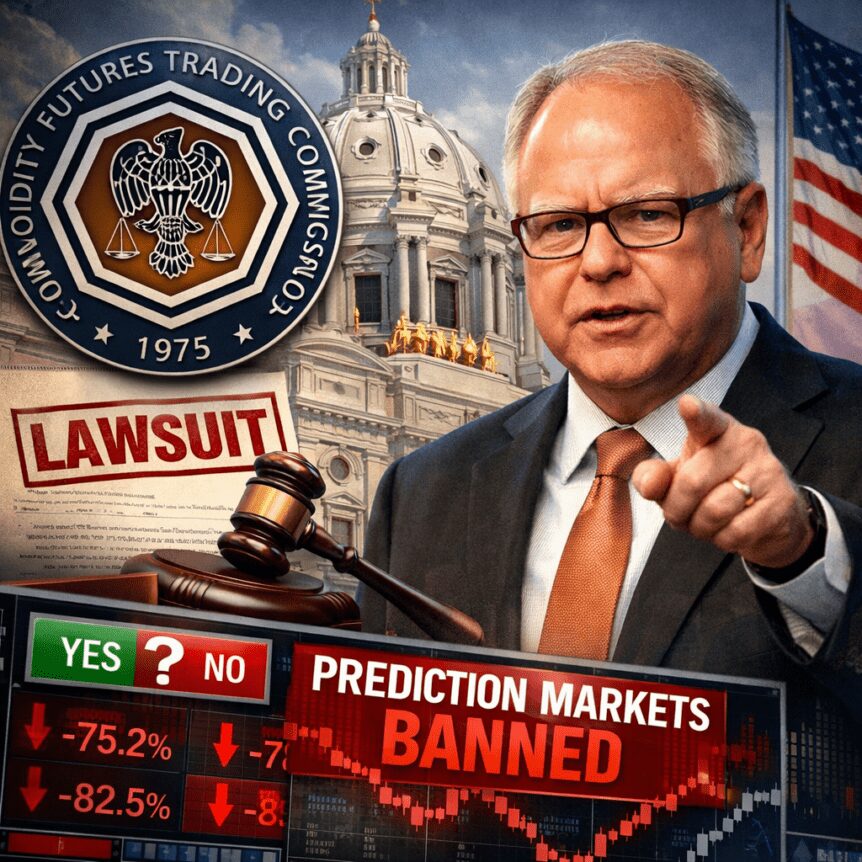
The U.S. Commodity Futures Trading Commission (CFTC) has moved to block Minnesota’s new restriction on prediction markets, filing a lawsuit in the District of Minnesota that challenges Senate File (SF) 4760 as an overreach of state authority. The suit centers on the state’s prohibition of advertising, creating, operating, or otherwise facilitating prediction-market platforms, with a specific focus on event contracts tied to sporting events, military conflicts, and weather—essentially banning platforms such as Kalshi and Polymarket from listing these products within Minnesota’s borders.
In its filing, the CFTC argues that Minnesota’s law conflicts with federal regulation of derivatives and event contracts under the Commodity Exchange Act (CEA), asserting exclusive federal jurisdiction over such products. The agency seeks to block the Minnesota statute on both preliminary and permanent grounds, asserting that Minnesota’s law would criminalize exchanges the CFTC has approved and event contracts that have been self-certified to the Commission. The filing frames the state action as prejudicing the federal government’s ability to enforce federal law.
The Minnesota bill was signed into law by Governor Tim Walz and is slated to take effect on August 1. It amended state statutes to ban the advertising, creation, operation, or facilitation of prediction-market platforms, effectively constraining the listing of event contracts on platforms like Kalshi and Polymarket. The law’s text specifies that event contracts tied to various categories, including sports outcomes and other contingencies, would be treated as wagers under Minnesota law.
The CFTC’s position is that it holds “exclusive jurisdiction” to regulate prediction markets under the CEA, and it argues that Minnesota’s ban would interfere with the federal framework for these products. The agency asked the court to issue both a preliminary injunction and a permanent injunction to prevent the law from taking effect, emphasizing that the state action would undermine the federal government’s enforcement of federal law.
According to Cointelegraph, the CFTC has, in recent episodes, aligned with Kalshi in multiple state-level challenges to prediction-market constraints and has pursued similar actions against authorities in states such as Connecticut, Illinois, New York, and Ohio. The current Minnesota case is presented as the first outright state legislative ban in the United States, contrasting with prior regulatory-focused actions at the state level. The Commission’s stance has been supported by statements from the agency’s leadership, who have signaled that state restrictions on prediction markets would be challenged in court. In response to Minnesota’s move, Kalshi described the law as unenforceable and constitutionally and federally unlawful, while Polymarket did not immediately respond to inquiries for comment.
Key takeaways
- Federal overreach argument: The CFTC asserts exclusive federal jurisdiction over event contracts under the Commodity Exchange Act, challenging Minnesota’s outright ban on prediction-market activities.
- State law and effective date: Minnesota’s SF 4760, signed by the governor, will prohibit advertising, creation, operation, or facilitation of prediction-market platforms when it takes effect on August 1.
- Judicial remedy sought: The CFTC requests both preliminary and permanent injunctions to halt the Minnesota law from taking effect and to prevent enforcement actions against exchanges listing event contracts.
- Affected entities and responses: The suit directly implicates platform operators such as Kalshi and Polymarket; Kalshi has argued the law is unenforceable, while Polymarket has not issued an immediate public statement.
- Broader crypto policy context in Minnesota: Separately, Minnesota enacted a crypto custody services bill for banks and credit unions, set to take effect August 1, and also passed a ban on crypto kiosks and ATMs in a bid to curb scams—reflecting a broader regulatory approach to crypto activity within the state.
Legal framework and the Minnesota challenge
The CFTC’s legal argument rests on the premise that event contracts—for example, contractual bets on sports results or other future contingencies—fall under the purview of regulated derivatives and swaps, which the federal regulator oversees. By labeling Minnesota’s prohibition on listing or facilitating these contracts as incompatible with federal law, the CFTC contends that the state cannot criminalize exchanges that have received federal approval or the contracts that have been self-certified under federal oversight. The complaint emphasizes the risk that Minnesota’s statute would interfere with the federal government’s ability to enforce federal law governing these markets.
State action and institutional implications for markets
Minnesota’s SF 4760 marks a notable instance of state lawmakers choosing to curtail prediction-market activity outright, moving beyond regulatory restrictions or licensing frameworks seen in other jurisdictions. The CFTC’s challenge highlights a core tension in the U.S. market structure: whether state capitals may expand restrictions on a federally regulated derivative product, potentially creating a patchwork of compliance requirements for exchanges that aspire to operate nationwide. This legal dynamic has immediate implications for platform operators seeking to serve multiple states and for banks or custodians that may consider exposure to or integration with these markets.
From an enforcement and compliance perspective, the case underscores several practical considerations for exchanges and financial institutions:
- Licensing and registration: If the CFTC prevails on jurisdictional grounds, platforms may need to reassess multi-state listing strategies and ensure alignment with federal registration requirements to avoid inadvertent violations.
- Compliance program design: Firms must ensure KYC/AML controls, contract disclosures, and listing procedures meet federal standards for traded products and that cross-border or cross-state listings do not create legal exposure.
- Cross-state regulatory risk: The Minnesota action illustrates how state-level action can complicate a platform’s risk and compliance posture, even when federal preemption is invoked, potentially affecting regulatory anticipation and capital planning.
- Operational certainty: The outcome could influence the timing of product launches, self-certifications, and listing decisions, particularly for platforms seeking to operate with broad access across the United States.
Commentary from platform representatives indicates divergent views on the enforceability and legality of Minnesota’s approach. Kalshi described the law as unenforceable and a constitutional overstep, while Polymarket did not immediately provide a public reaction to the lawsuit. The CFTC’s broader stance in related cases—where it has supported Kalshi in other state actions—adds a layer of strategic tension between federal and state authorities over the governance of prediction markets. These dynamics are being tracked not only by market participants but also by compliance and legal teams evaluating the risk landscape for regulated financial products tied to real-world outcomes.
Regulatory context and policy implications
The Minnesota dispute arrives amid ongoing national and global debates about how prediction markets should be treated within financial regulatory frameworks. The CFTC’s aggressive posture toward state restrictions aligns with a broader trend of asserting federal authority over novel derivatives markets, especially those that could intersect with commodities and securities laws. The case also sits within a larger policy dialogue about how such markets should be regulated in light of anti-fraud, consumer protection, and risk-management concerns.
On the international side, policy makers frequently contrast U.S. approaches with evolving European frameworks, such as MiCA, to illustrate different model outcomes for market integrity, licensing, and cross-border service provision. While MiCA governs crypto-asset service providers within the European Union, cases like Minnesota’s SF 4760 serve as a reminder that cross-jurisdictional coherence remains a critical objective for global market participants seeking to minimize legal and operational risk. For U.S. market participants, the current litigation could influence legislative debates about preemption, federal licensing norms, and the boundaries of state intervention in federally regulated product categories.
Overall, the dispute signals potential near-term attention for exchanges, banks, and investors as courts weigh the balance between state policy experimentation and federal regulatory prerogatives. The court’s ruling will have immediate relevance for the status of prediction-market platforms in Minnesota and could set a precedent for similar challenges in other states that may consider restrictive measures or outright bans. Analysts and compliance teams will be watching for how the court addresses the CFTC’s allegations of exclusive jurisdiction and what that implies for the governance of event contracts in a federated regulatory environment.
Looking ahead, the August 1 effective date of Minnesota’s law remains a critical milestone. The court’s decision on the CFTC’s injunction request will shape the practical viability of prediction-market platforms within Minnesota’s borders and illuminate the broader legal framework governing the intersection of federal derivatives regulation and state policy. As enforcement actions unfold, a clearer picture should emerge on how the federal government will enforce preemptive authority in this space and how state legislators might approach similar issues in the future.
As coverage continues, observers should monitor filings for any narrowing of claims, potential settlements, or interim court orders that could affect product listings, platform operations, or custody arrangements tied to prediction-market activities. In the near term, the Minnesota development reinforces the need for robust regulatory reporting, comprehensive compliance controls, and strategic risk assessments for entities operating or considering entry into federally regulated prediction markets.
Source notes: The CFTC’s press materials and related regulatory filings are publicly accessible, and Minnesotan legislative text can be reviewed through the state’s official repository. For context on related rulings and positions, Cointelegraph has reported on the CFTC’s stance in other state actions, including Kalshi-related matters referenced in this coverage.

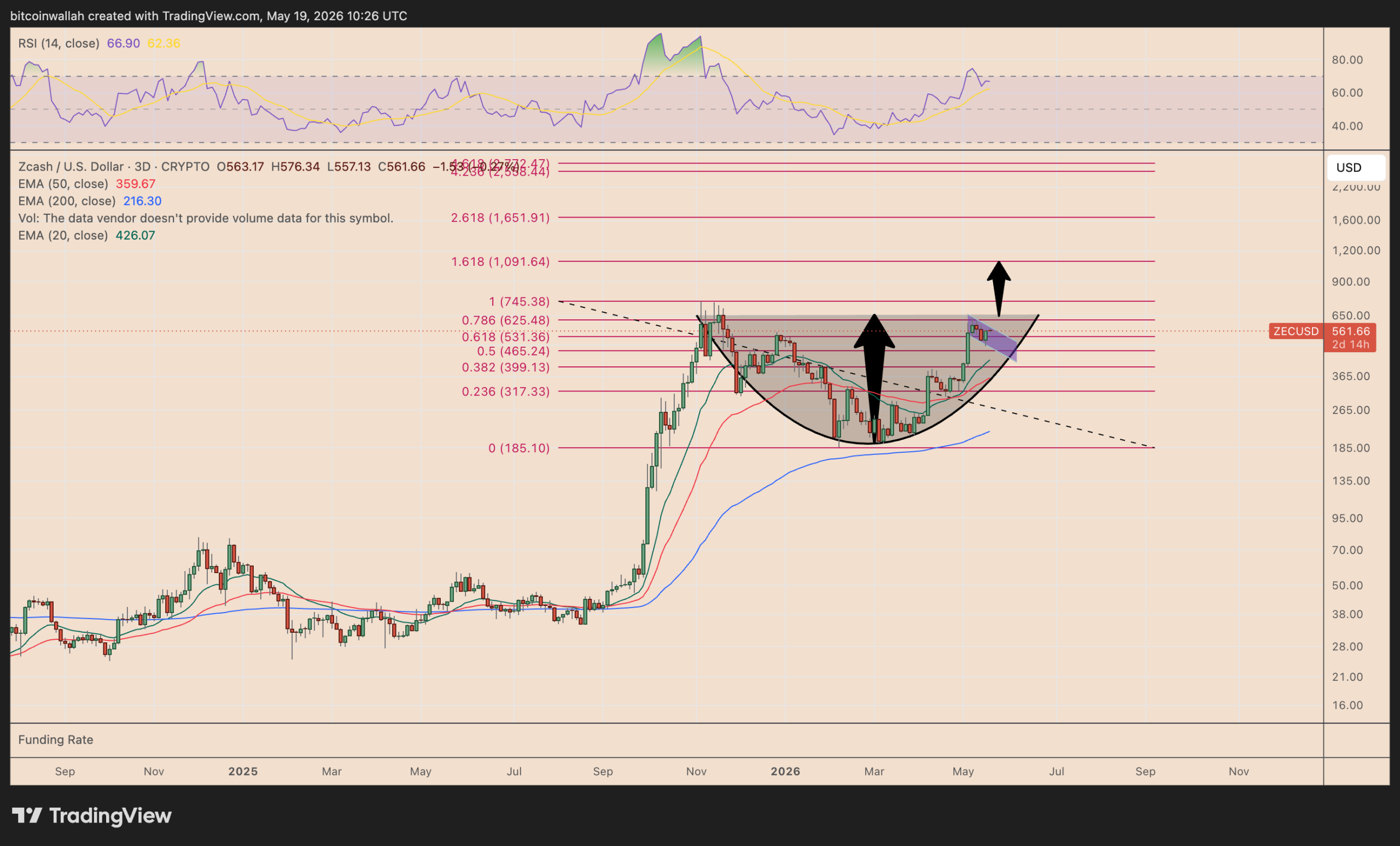
Privacy coin Zcash (ZEC) is flashing a classic bullish reversal pattern that could push its price above $1,000 in the coming weeks.
Key takeaways:
- ZEC’s cup-and-handle setup points to a potential rally toward $1,091 by June or July.
- Privacy coins are leading the market, with ZEC up 73% over the past month versus crypto’s 0.2% gain.
Privacy narrative may trigger 55% ZEC price upside
The ZEC/USD pair appears to have formed a cup-and-handle (C&H) pattern, marked by a rounded recovery phase followed by a downward-sloping consolidation.
Traders typically read the structure as bullish once the price breaks above the neckline, as it suggests buyers have absorbed the previous supply wall and regained control.
The pattern’s upside target is calculated by measuring the distance between the cup’s lowest point and the neckline, then adding that height to the breakout level.
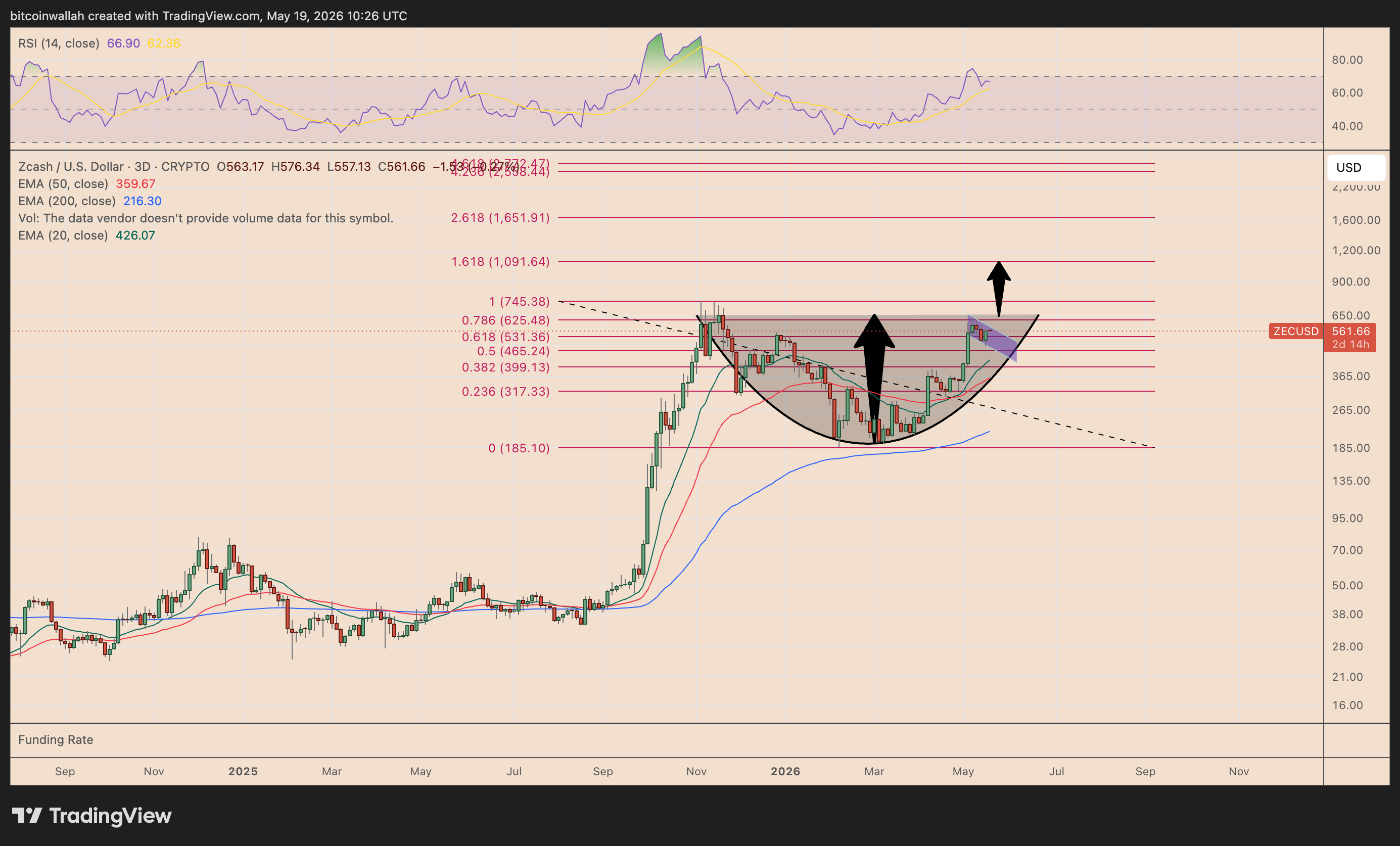
ZEC/USD three-day price chart. Source: TradingView
As of Tuesday, ZEC had entered the pattern’s “handle” stage while eyeing a breakout above the neckline resistance at around the $625–$650 area.
Zcash’s decisive close above the neckline may send its price toward $1,091 by June or July, up about 88% from current prices, if the C&H structure plays out as intended.
This upside target aligns with ZEC’s 1.618 Fibonacci extension, drawn from the $745 swing high to the $185 swing low.
ZEC is outperforming the crypto market in May
ZEC has gained 18% over the past three days, even as the wider market has fallen 3.45% over the same period, prompting some traders to argue that Zcash is effectively “running its own bull market.”
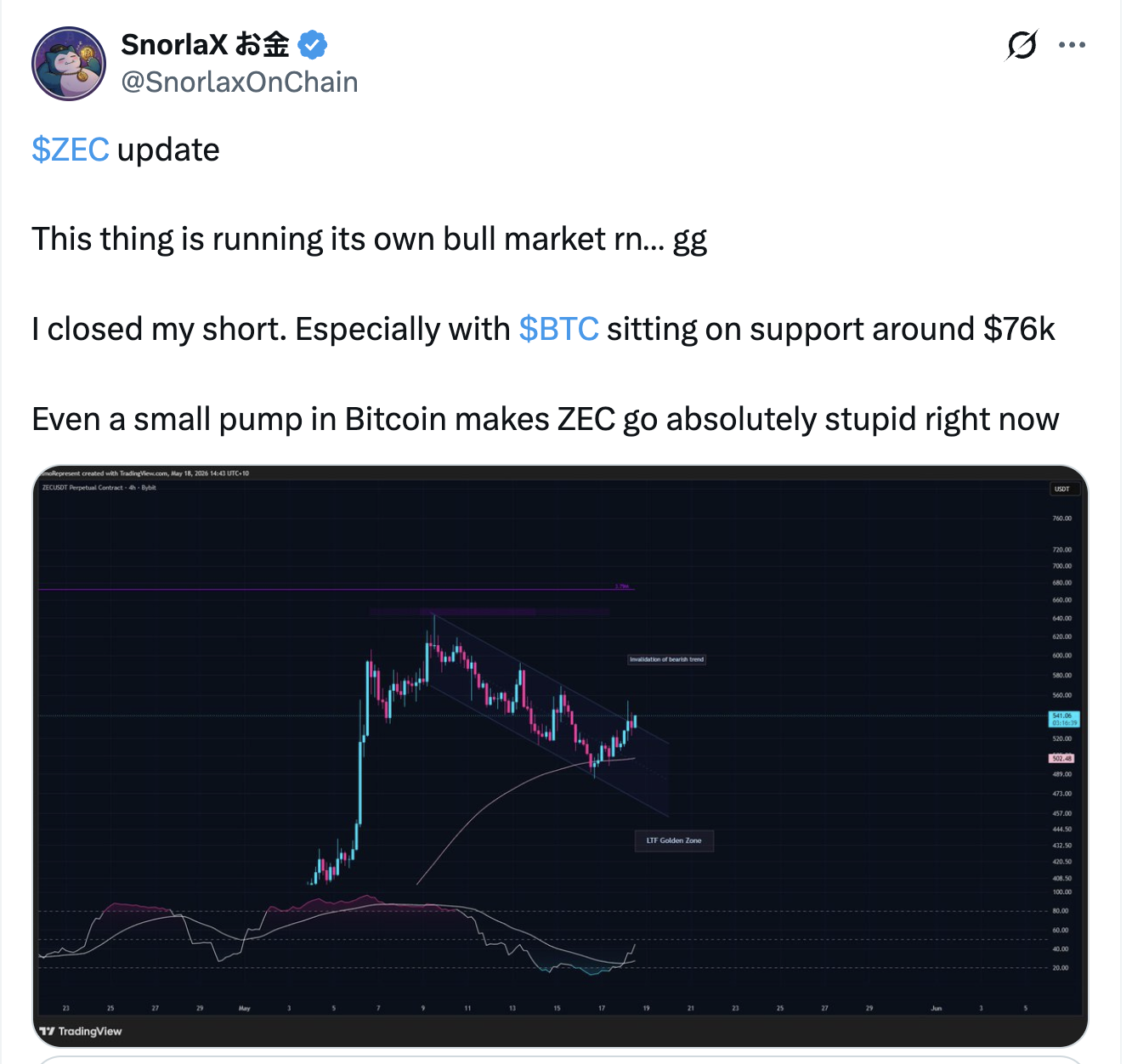
Source: X
Broadly, privacy coins have outperformed the wider crypto market over the past month. ZEC led the move, gaining more than 73%, while other privacy-focused tokens such as Monero (XMR) and Dash (DASH) also rallied in tandem.
By comparison, the total crypto market capitalization rose just 0.2% over the same period, suggesting the move is more sector-specific than market-wide.
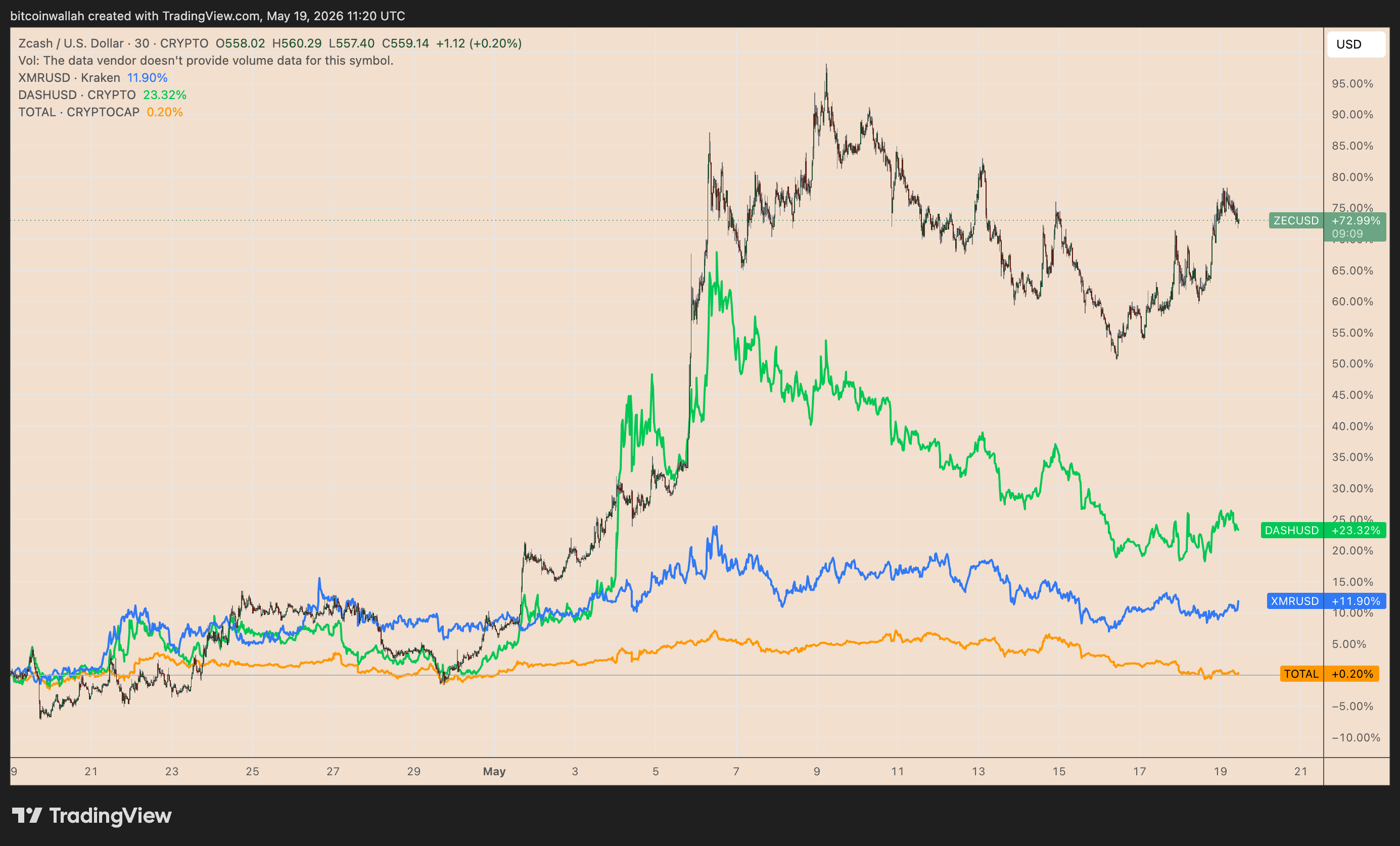
ZEC/USD versus XMR/USD, DASH/USD, and the TOTAL crypto market cap one-month performance. Source: TradingView
Heightened demand for anonymity and financial privacy is driving much of Zcash’s renewed appeal, turning the once-forgotten privacy coin into one of crypto’s strongest narratives.
Related: Zcash gains 70% in a week amid growing interest in crypto privacy
The bullish case gained further traction last week after BitMEX co-founder Arthur Hayes said ZEC’s market capitalization could one day reach 10% of Bitcoin’s (BTC).
That would imply a price of $9,225 per coin based on ZEC’s current circulating supply of about 16.68 million tokens.
ZEC’s value in BTC terms has grown roughly 20.50% since Hayes’s comment.
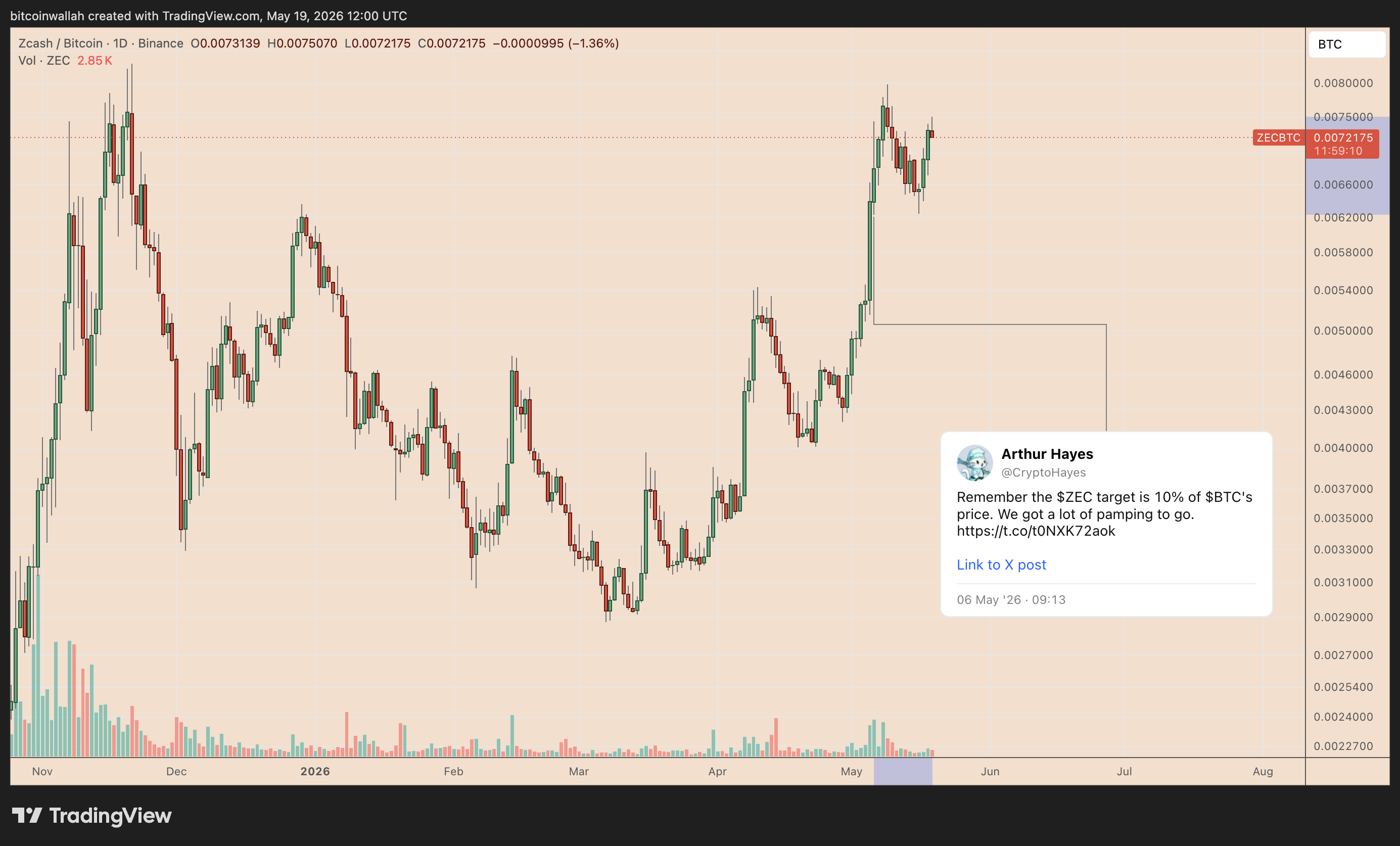
ZEC/BTC daily chart. Source: TradingView
Earlier in May, sentiment also improved after Multicoin Capital disclosed Zcash exposure and Robinhood listed the token, adding fresh institutional and retail-access catalysts to ZEC’s rally.
Your day-ahead look for May 19, 2026

TLDR
- Bitcoin price dropped sharply this week and briefly touched $76,000 during increased selling pressure.
- Bitcoin whale wallets holding at least 100 BTC increased to 20,229 over the past year.
- Large Bitcoin holders continued accumulation despite market volatility and shifting investor sentiment.
- Data showed that these whale wallets now hold Bitcoin worth at least $7.7 million each.
- Retail traders showed fear and reacted with increased selling as bearish sentiment rose.
Bitcoin recorded a sharp weekly decline and briefly touched $76,000, while large holders increased accumulation. Data showed rising whale wallet numbers despite growing market stress and negative sentiment. Analysts reported continued institutional activity as retail traders reacted with caution and selling pressure.
Bitcoin Whales Expand Holdings During Price Weakness
Bitcoin experienced a fast pullback this week, and prices briefly fell toward $76,000 during heavy selling. However, large holders continued accumulation, which reflects sustained activity from institutions and high-net-worth investors.
Santiment reported that wallets holding at least 100 BTC increased to 20,229 over the past year. The firm stated, “This marks an 11.2% rise from 18,191 wallets recorded last year.”
These wallets hold roughly $7.7 million or more in Bitcoin, which links them to major investors. The data showed that accumulation continued even during periods of volatility and shifting sentiment.
Santiment added that whale growth persisted despite retail hesitation and frustration across social channels. The firm noted that large holders often act independently of short-term market sentiment.
Historically, rising whale wallet numbers suggest confidence in Bitcoin’s long-term supply dynamics and market role. This trend continued even as prices faced downward pressure.
Market Stress Rises as Selling Pressure Builds
CryptoQuant data showed that the SOAB ratio moved above normal levels during the recent downturn. This shift indicated capitulation from older Bitcoin holders who began selling under pressure.
At the same time, short-term investors showed panic-selling behavior as prices declined quickly. This reaction contributed to increased volatility across the market.
Santiment reported a surge in bearish sentiment across social media platforms in recent days. The firm stated that bearish comments exceeded bullish ones for the first time since April 21.
Retail traders reacted strongly to price weakness and expected further declines in the near term. This shift highlighted growing fear among smaller market participants.
Analysts suggested that a rapid V-shaped recovery remains unlikely under current conditions. Market data reflected ongoing stress across both long-term and short-term holders.
Regulatory Progress Enters Focus as Next Catalyst
Nexo analyst Dessislava Ianeva pointed to regulatory developments as a potential driver of future price movement. She stated that the CLARITY Act could influence Bitcoin’s trajectory.
The bill recently advanced through the Senate Banking Committee, which raised expectations for regulatory clarity. Ianeva said, “This progress may act as a catalyst for the next rally.”
Bitcoin briefly rose above $82,000 following the committee approval and market reaction. At the same time, prediction markets increased the probability of the bill becoming law in 2026.
Ianeva compared the development to the earlier GENIUS Act rally, which also triggered price movement. She added that a Senate floor vote could support further upside momentum.
Recent price movements and legislative progress continue to shape market direction and investor positioning. Data shows that whale accumulation remains active during ongoing volatility.

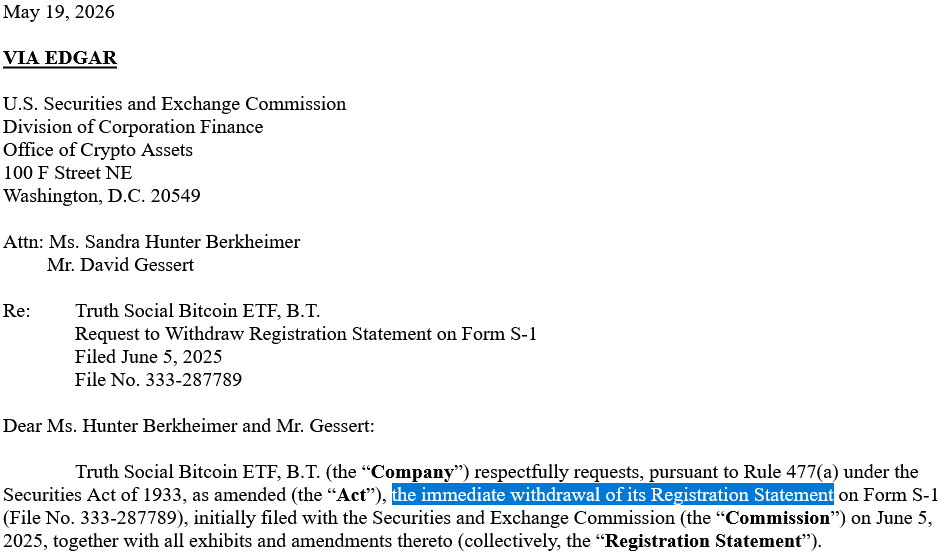
Asset manager Yorkville America has requested to withdraw multiple crypto exchange-traded funds applications filed on behalf of the Donald Trump-backed Truth Social after changing its product strategy.
Yorkville America said Tuesday that it is moving away from offerings registered under the Securities Act of 1933, such as the proposed Truth Social Bitcoin ETF, to structures under the Investment Company Act of 1940, saying the shift would enable it to offer more innovative products while benefiting from stronger investor protections and tax efficiencies.
Yorkville America’s Truth Social Bitcoin & Ethereum ETF and Truth Social Crypto Blue Chip ETF were also withdrawn. The asset management firm said it “initiated this process after determining the ’40 Act framework provides a structure for delivering the differentiated, rules-based investment strategies the firm continues to develop for its growing investor base.”
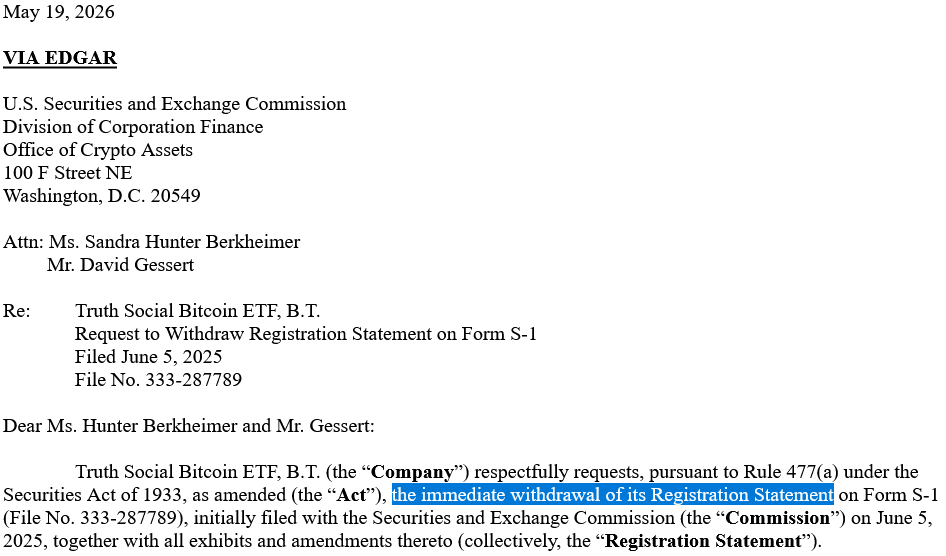
Yorkville America’s request to withdraw its Truth Social Bitcoin ETF. Source: SEC
The firm, known for “America First”-themed investment products, gave no indication it would pursue a crypto ETF under the ‘40 Act framework. Yorkville is the financier and asset manager for Trump Media & Technology Group (TMTG), which is behind Truth Social.
The withdrawals come amid ongoing concerns that Trump’s ties to the crypto industry, and the financial interests stemming from them, are conflicting with his duties as the US president.
Democratic senators have been pressing for answers ever since Trump was inaugurated in January 2025, particularly regarding his role with the World Liberty Financial crypto platform.
Crypto ETFs have struggled this year
It also comes as demand for crypto ETFs has cooled in 2026 amid a broader crypto market pullback.
Net inflows into US spot Bitcoin (BTC) ETFs in 2026 currently sit at $790 million as of Tuesday, mostly concentrated in the BlackRock-issued iShares Bitcoin Trust ETF (IBIT) and are only a fraction of the $25 billion that inflowed in 2025.
Spot Ether (ETH) ETFs have also struggled to maintain investor interest, recording $640 million in net outflows, while new altcoin ETFs have not captured the same demand at launch as their predecessors.
Related: Trump-linked American Bitcoin energizes 11,298 new ASICs
However, Bloomberg ETF analyst James Seyffart suspected Yorkville America’s decision to pull out of the crypto ETF market may have been due to the competitive landscape for Bitcoin ETFs, particularly with the new Morgan Stanley Bitcoin Trust ETF carrying a market-low fee of 0.14%.
The crypto ETFs were intended to be part of TMTG’s broader crypto strategy, which included the launch of the Truth.fi financial platform last year.
Yorkville America’s product offerings range from American-themed funds spanning defense, security and energy, as well as tech and real estate.
Products issued under the ’40 Act are typically mutual funds and ETFs designed for diversified, regulated investment strategies, while ’33 Act structures are commonly associated with spot commodity and crypto-style ETF products.
Magazine: ETH stalls at $2.4K five times, SOL to rally to $120: Market Moves

HYPE climbed to around $48 on May 19, after synthetic SpaceX perpetual contracts launched on the Hyperliquid-linked platform Trade.xyz, bringing the token just $11 away from its September 2025 record high near $59.
The rally has also tracked rising interest in tokenized real-world assets and a string of institutional moves tied to the Hyperliquid ecosystem.
Synthetic SpaceX Markets Push Hyperliquid Back Into Focus
According to data shared by Santiment, the token has gained roughly 24% from its May 13 low near $38. The on-chain analytics firm said social dominance around HYPE spiked as traders reacted to several developments landing within the same week, including the passage of the CLARITY Act on May 14 and Coinbase becoming an official USDC deployer on Hyperliquid.
But the latest trigger behind HYPE’s move higher was the May 18 debut of SPCX, a synthetic SpaceX pre-IPO perpetual market on Trade.xyz, which helped add another 7% to the token’s price per Santiment’s data.
The product launched with an implied SpaceX valuation of about $1.8 trillion, giving crypto traders exposure to a private company that is still inaccessible through public equity markets.
“The rails-phase thesis usually runs one way: TradFi brings its products onto chains,” Santiment wrote. “This time it’s running backwards — crypto rails are creating TradFi-adjacent products the regulated system can’t.”
At the time of writing, data from CoinGecko showed HYPE had risen 6.7% in the last 24 hours and nearly 17% during the past week. Meanwhile, monthly gains stood above 11%, while the token is still about 19% below its all-time high, reached eight months ago.
The move has also come as Hyperliquid continues to dominate on-chain perpetual futures trading. According to DefiLlama, the network has maintained at least double the perpetual trading volume of the next-largest chain every month this year, even as overall perp activity cooled from earlier 2026 peaks.
Revenue Growth and ETF Launches Are Adding to Bullish Sentiment
The crypto community is also paying attention to Hyperliquid’s revenue generation, with Bitwise researcher Cam Khosravi pointing out that it has generated more than $255 million in protocol revenue so far this year, which is more than the next two crypto applications combined.
According to Khosravi, nearly all of that revenue has come from perpetual trading fees, with around 97% directed toward automated HYPE buybacks.
More data shared by Hyperliquid Daily showed that real-world asset open interest on the chain has reached a record $2.6 billion, doubling within two months as trading activity in tokenized stocks and commodities picked up.
Meanwhile, institutional interest has also started spilling into traditional markets, as asset manager Bitwise launched its HYPE exchange-traded fund, BHYP, on May 15, only days after 21Shares introduced its THYP fund.
The 21Shares ETF posted roughly $1.8 million in debut trading volume and has since attracted more than $12 million in cumulative inflows.
The post HYPE Within $11 of ATH as SpaceX Perps Drive Rally appeared first on CryptoPotato.
After it was rejected at $82,000 last week, bitcoin’s nosedive drove it south to a three-week low of $76,000, where it finally found some support and rebounded slightly.
In contrast, several larger-cap altcoins have produced notable gains over the past 24 hours, including HYPE, ZEC, and BCH.
BTC Rebounds From $76K
The primary cryptocurrency tried to break out above the $82,000 upper boundary on several occasions in the past few weeks, only to be halted at $82,800 once and at $82,000 three times. The last such failed attempt took place last Thursday after the US Senate Banking Committee passed the CLARITY Act.
Bitcoin rocketed from $79,000 to $82,000 in a few hours, only to be halted once again and driven south hard. The subsequent rejection has been more painful than the previous ones. At first, it dipped below $80,000 by Friday evening, but it plunged to $77,500 on Saturday. After remaining calm on Sunday at around $78,000, it experienced another leg down on Monday.
This time, the bears drove it south to $76,000, which became its lowest price tag in over three weeks. The bulls finally intervened after this $6,000 decline in mere days, and didn’t allow any further drops, at least for now. Nevertheless, BTC still struggles below $77,000 after it was stopped there earlier today.
Its market capitalization is below $1.540 trillion, while its dominance over the alts has retreated to 58.2% on CG.

PI Finally Calms
ETH, SOL, BNB, TRX, XRP, DOGE, and ADA have remained at essentially the same trading levels as yesterday, with little to no actual moves. This is not the case with HYPE, though, as the asset has climbed to just $12 away from its 2025 all-time high, as it continues to perform much better than its counterparties.
ZEC is the other notable gainer from the larger-cap alts now, surging by 7% to $560. BCH is up by 4.5% after yesterday’s crash, while NEAR has added 7% of value to $1.60. ONDO has risen the most, with a 12% surge driving it to almost $0.38.
Pi Network’s native token has been charting mostly losses recently, dropping to a three-month low of around $0.145 yesterday. It has finally recovered some ground and now trades above $0.15, but it’s still down by a whopping 14% in the past two weeks.
The total crypto market cap stands at the same level as yesterday, at around $2.630 trillion on CG.

The post Pi Network’s PI Token Finally Stabilizes as BTC Rebounds From 3-Week Low: Market Watch appeared first on CryptoPotato.


The crypto market structure bill saw a high-stakes, 11th-hour gambit to get Democrats on board for a bipartisan committee vote, but it might carry a cost.

The Financial Intelligence Unit (FIU) of Estonia has partially suspended the operating license of BB Trade Estonia OÜ, the entity behind the Zondacrypto cryptocurrency platform. In its formal statement, the FIU said the company is now barred from accepting deposits and onboarding new clients, while existing users may still withdraw funds. The move signals intensified regulatory scrutiny of Zondacrypto across Europe as authorities scrutinize compliance practices and consumer protections within the crypto exchanges that have migrated or registered in the Baltic state.
The regulator’s notice also sets a 30-day window for BB Trade Estonia OÜ to bring its operations into alignment with applicable legal requirements. “If it fails to do so, the law obliges the FIU to revoke the operating license,” the FIU stated. The authority did not disclose the specific compliance breaches that prompted the suspension, and Cointelegraph contacted the FIU for comment but did not receive a response at the time of publication.
Key takeaways
- The Estonian FIU partially suspends BB Trade Estonia OÜ’s operating license, barring deposits and new onboarding while allowing withdrawals for existing users.
- A 30-day window is imposed to reach full compliance, with potential license revocation if requirements are not satisfied.
- The regulator did not specify the breaches; authorities and media outlets will be watching for concrete remediation steps and enforcement actions.
- The development compounds existing regulatory scrutiny of Zondacrypto in Europe, including MiCA-related concerns raised by Estonian authorities earlier in 2024.
- BB Trade Estonia OÜ has ties to Zondacrypto’s broader cross-border presence, with the company registered in Estonia since 2019, according to InfoRegister data.
Regulatory action in Estonia and implications for BB Trade Estonia OÜ
Estonia’s FIU has invoked supervisory powers to curb certain activities by BB Trade Estonia OÜ as part of a broader effort to tighten oversight over crypto service providers within the EU’s MiCA framework. By blocking new deposits and client onboarding, the regulator aims to curb potential consumer risk while evaluating whether the firm meets ongoing licensing requirements. The 30-day compliance deadline places the onus on the operator to demonstrate robust AML/KYC controls, proper governance, and other regulatory obligations demanded under Estonian law and EU standards.
Officials did not detail the underlying deficiencies in public statements, and the absence of a publicly disclosed breach list creates uncertainty for stakeholders. The move comes amid a wider debate about how EU crypto licensing is implemented in member states and how cross-border entities adapt to MiCA’s harmonized standards. Estonia’s authorities have emphasized a path toward formal compliance rather than immediate sanctions, but the possibility of license revocation remains a material risk for BB Trade Estonia OÜ and its Zondacrypto platform.
BB Trade Estonia OÜ’s status is also notable in light of its corporate history. The Estonia-based entity has been listed as the operating arm of Zondacrypto, a platform with roots in Poland as BitBay, established in 2014. Its registration in Estonia since September 2019—well before the full rollout of MiCA—positions the business squarely within EU regulatory reach, as authorities seek consistent supervision across borders.
Zondacrypto at the center of regulatory debate in Europe
The partial suspension in Estonia adds to a broader web of regulatory considerations surrounding Zondacrypto in Europe. Reports surrounding withdrawal difficulties at Zondacrypto have drawn scrutiny from policymakers and regulators, including public commentary by Polish officials referencing potential losses and the scale of exposure in crypto-related incidents. In parallel, Zondacrypto has faced MiCA-related warnings from Estonia’s Financial Supervision and Resolution Authority (FSA) over the listing of the exchange’s “TeamPL” token without a white paper, which the authorities flagged as a MiCA compliance issue.
Market activity around Zondacrypto has appeared subdued in recent data, with CoinGecko noting limited trading activity on the exchange around the time of the regulatory action. Media coverage and regulatory filings continue to shape the narrative around the exchange’s operational viability and governance.
As part of the wider regulatory discourse, Zondacrypto’s governance and its cross-border footprint have become points of focus for enforcement and policy analysis. The Polish dimension—where discussions of potential links to Russian capital and political influence have surfaced—highlights how national risk perceptions can intersect with EU-wide licensing and oversight. In parallel, Estonia has taken steps to operationalize MiCA within its financial sector, as evidenced by other notable regulatory actions like the licensing of LHV Pank under the EU crypto framework. Estonia’s FSA granted LHV Pank a MiCA license, marking a milestone for one of the country’s largest banks and signaling the incremental integration of traditional financial institutions into the EU’s crypto regulatory regime.
BB Trade Estonia OÜ’s MiCA-related challenges and the ongoing Zondacrypto narrative illustrate how cross-border entities navigate diverse regulatory expectations. The Estonian and Polish regimes reflect a broader European push toward standardized oversight to bolster consumer protections, licensing discipline, and AML/KYC compliance in the crypto ecosystem. Regulators are balancing market access with risk mitigation, a dynamic that will shape licensing decisions, enforcement priorities, and the pace of institutional participation in European crypto markets.
Cross-border licensing and institutional implications
The Estonian regulatory action arrives amid a wider transition in the EU where MiCA is increasingly interpreted and implemented by member states. The 30-day compliance window underscores the immediacy with which regulators seek to impose corrective measures on crypto service providers, emphasizing governance reforms, disclosures, and risk management practices aligned with EU standards. For crypto exchanges, the message is clear: licensing continuity hinges on demonstrable compliance with cross-border rules, consumer protections, and anti-money laundering controls that align with MiCA’s framework.
From an institutional perspective, the development adds to the cost and complexity of maintaining cross-border crypto operations. For banks and payment providers operating within or adjacent to the crypto space, the Estonian example reinforces the importance of robust onboarding controls, transparent token disclosures, and clear operational compliance to preserve access to regulated financial rails. The licensing milestone achieved by LHV Pank in Estonia—under MiCA—illustrates that traditional financial institutions can gain regulatory clearance to participate in crypto services, provided they meet the necessary standards. Such developments may influence other banks and financial firms to pursue MiCA-compliant licensing as a prerequisite for borderless crypto activities.
Finally, the case highlights the practical uncertainties that still surround enforcement scope and interpretation of MiCA in various jurisdictions. While the FIU has outlined a path to remediation, it has not publicly enumerated the exact breaches. This ambiguity can complicate remediation planning for firms facing similar regulatory actions and underscores the need for clarity in how authorities assess and certify ongoing compliance in a rapidly evolving policy environment.
In summary, the Estonian FIU’s partial license suspension of BB Trade Estonia OÜ, paired with ongoing MiCA-related concerns and cross-border regulatory developments, reinforces the imperative for crypto firms to maintain rigorous compliance programs, transparent governance, and resilient operational controls as they navigate Europe’s unified but heterogeneous regulatory landscape.
Closing perspective: While the immediate impact centers on BB Trade Estonia OÜ and Zondacrypto, the action reflects broader regulatory intent to standardize oversight and heighten enforcement in the European crypto ecosystem. The next steps—whether BB Trade Estonia OÜ rectifies gaps or faces revocation—will shape future licensing discourse and the regulatory calculus for cross-border crypto activity in the region.
Polymarket has launched a new category of prediction markets tied to private companies, allowing users to trade on questions related to pre-IPO companies — a move that could bring greater price discovery to private markets, where valuation data is often limited and opaque.
The new offering, announced Tuesday, was developed in partnership with Nasdaq Private Market, a platform that facilitates secondary trading in shares of privately held companies. Nasdaq Private Market will provide the underlying data and market infrastructure for the contracts.
The markets are designed to reflect expectations around events such as fundraising rounds, valuation changes and other corporate milestones involving startups and late-stage private companies. The launch expands Polymarket’s product lineup beyond its core markets focused on politics, macroeconomic events and public companies.
Source: Cointelegraph
The move is part of Polymarket’s effort to broaden its appeal to financially oriented users and extend prediction markets into private capital markets, where pricing information is often less accessible and less transparent than in public equities.
Polymarket said the rise of so-called unicorns — privately held startups valued at $1 billion or more — has increased demand for market-based forecasting tools tied to private companies. The platform noted that there are nearly 1,600 unicorns worldwide with a combined valuation exceeding $5 trillion, despite access to these companies remaining largely limited to private investors.
Related: Jump Trading eyes Kalshi, Polymarket stakes as institutional interest grows: Report
Prediction markets draw growing institutional interest
Polymarket’s partnership with Nasdaq Private Market reflects the broader institutionalization of prediction markets, as private company data and event-based contracts gain traction among professional investors.
Retail traders still account for the vast majority of activity. An April report by Bitget Wallet and Polymarket found that retail traders generated 80% of prediction market volume.
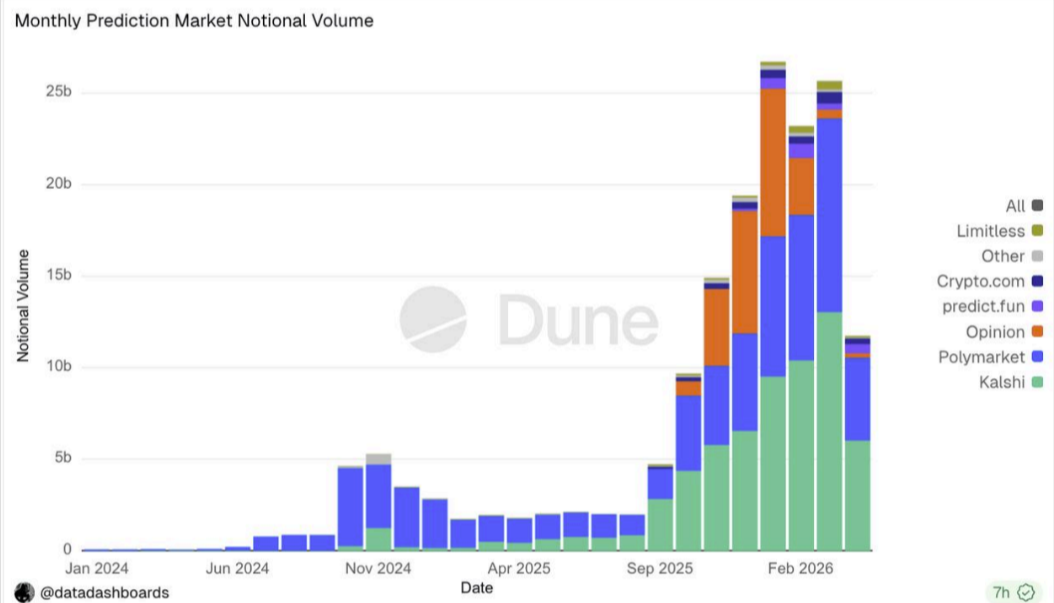
Prediction market trading volume in March. Source: Bitget Wallet
Still, Wall Street analysts say institutional participation is increasing as the US regulatory environment becomes more supportive and market infrastructure improves.
Bernstein recently pointed to the first institutional block trade on Kalshi as a milestone for the sector. Block trades are privately negotiated transactions, typically executed by large investors to move significant positions without disrupting the broader market.
Related: SEC delays prediction market ETFs over mechanics and risk concerns: Report
TLDR
- Flare has integrated D’CENT hardware wallets with its XRP yield vault infrastructure.
- The integration allows users to earn XRP yield while maintaining self-custody.
- Users can access yield products without creating new wallets or managing new chains.
- Flare uses FAssets to convert XRP into FXRP for deployment in DeFi strategies.
- Smart Accounts simplify transactions by removing gas fee and chain switching complexity.
Flare has connected its yield infrastructure to D’CENT hardware wallets for XRP holders. The update allows users to earn yield while keeping assets in self-custody. The network also introduced the XRP Alliance to unify services for XRP management and earning.
Flare Enables Direct XRP Yield Access Through Hardware Wallets
Flare has integrated its yield system with D’CENT’s biometric hardware wallet platform. As a result, users can access XRP yield vaults without leaving their secure device. The setup removes the need for new wallets or additional blockchain navigation.
The integration allows users to deposit XRP and earn returns directly in XRP. Flare uses its FAssets system to convert XRP into FXRP for DeFi use. At the same time, Smart Accounts simplify gas management and transaction processes.
Flare stated that Smart Accounts reduce friction for new users entering DeFi. The system hides complex steps like gas fees and chain switching. This design supports smoother onboarding for first-time participants.
XRP Alliance Expands Ecosystem Access and Vault Adoption
Flare launched the XRP Alliance alongside the wallet integration. The group connects projects across the XRP Ledger ecosystem. It aims to provide a single interface for managing, swapping, and earning XRP.
The alliance supports users who prefer hardware wallets for security. It brings together services that operate within the XRPL ecosystem. This approach reduces the need for multiple platforms or accounts.
The earnXRP vault serves as the primary product in this rollout. It was developed through a partnership between Flare, Upshift, and Clearstar. The vault reached its 25 million XRP cap within one week.
Flare reported that more than 5,400 users joined the earnXRP vault. Around 98% of these users were new to DeFi platforms. This data highlights early user engagement with the product.
The vault currently offers about 3.4% APY in XRP. Users receive returns without converting their assets into other tokens. Early participants also benefited from waived fees during the first 30 days.
Flare confirmed that users maintain control of their assets during the process. However, the system still relies on smart contracts and DeFi strategies. These elements introduce operational risks tied to the underlying infrastructure.
FAssets convert XRP into FXRP, which interacts with DeFi protocols. This process depends on smart contract execution within the Flare network. Any technical failure could affect asset performance or accessibility.
Flare emphasized that self-custody remains a core feature of the system. Users do not transfer ownership to centralized platforms. Instead, they interact with decentralized infrastructure through their hardware wallet.
The XRP Alliance will continue expanding integrations with XRPL projects. Flare plans to add more tools for asset management and yield strategies. The network has not announced a timeline for future updates.

The Chip Stock Rally Has Stalled. Nvidia Will Prove It Still Has Room to Run.

Is Zcash ‘Running Its Own Bull Market?’ This 88% ZEC Price Rally Setup Shows

Rohan Raja shares how his family reacted to his pro wrestling dream

Manchester United reach agreement with Casemiro over contract clause amid transfer speculation

US brings back mandatory military draft registration

Steven Gerrard disagrees with Gary Neville over ‘shock’ Chelsea and Arsenal claim | Football

Live Trading || 15 MAY || Vivek Yadav #btc #crypto #gold

Tues, May 19, 2026 Financial news. Is Nvidia about to break the bull-run? Oil, gold, silver…

Crypto Gold Live Trading 15 May | Market Trader | #goldtrading #cryptotrading #bitcoin
-

 Crypto World4 days ago
BloFin War of Whales 2026 Grand Prix opens registration for $5M trading championship
-

 Fashion4 days ago
Weekend Open Thread: Theory – Corporette.com
-

 Crypto World4 days ago
E-Estate Announces 1 Year Live: Washington DC Summit as Real Estate Tokenization Enters Its Next Phase
-
Crypto World7 days ago
Bitcoin Suisse expands with Digital Asset License and Investment Business Act Registration Approval in Bermuda
-

 Tech5 days ago
Tech Moves: Microsoft AI leader jumps to OpenAI; former AI2 exec joins Meta; and more
-
 Crypto World6 days ago
Google’s Gemini AI Predicts Incredible Solana Price by the End of 2026
-

 Tech4 days ago
Google reimburses Register sources who were victims of API fraud
-

 Business4 days ago
H&R Real Estate Investment Trust (HR.UN:CA) Q1 2026 Earnings Call Transcript
-

 Sports4 days ago
Napoleonic enters 2026 Doomben 10,000 field via Abounding withdrawal
-
 Entertainment5 days ago
Zara Larsson Has Blunt Response To Chris Brown Diss
-
 Crypto World6 days ago
Two AI Tokens Lead May Rally, But Risks Are Rising
-

 Crypto World4 days ago
BeInCrypto 100 Institutional Awards Nomination: KAST for Best Digital Assets Neobank and Best Digital Assets Fintech
-

 Fashion3 days ago
On the Scene at Gucci’s Cruise Show in New York City: Mariah Carey, Kim Kardashian, Lindsay Lohan, Iman, and More!
-
 Tech7 days ago
Why AI is making typography a boardroom conversation
-
 Crypto World4 days ago
Bitcoin Battles US Bond Nerves With BTC Price Dip Toward New May Lows
-
 Crypto World4 days ago
Wall Street’s Boldest Gold Prediction Has Russians Rushing to Buy
-

 Fashion4 days ago
Trending Western Style Vests Perfect for Summer
-

 Entertainment5 days ago
David Letterman Returns to Late Show, Blasts Cancellation
-

 Crypto World7 days ago
Bitcoin Could Surge as AI Race and War Fuel Money Printing says Hayes
-

 Politics5 days ago
DWP PIP Timms review continues to be an absolute farce
You must be logged in to post a comment Login