

Crypto World
Nexo Championship returns to Trump International with $3m purse



Nexo has renewed its title partnership for the Nexo Championship, which will return to Trump International Golf Links in Aberdeenshire on August 20-23, 2026.
Summary
- Nexo Championship returns to Aberdeenshire with a $3m prize fund
- Event closes the 2026 Closing Swing on the Race to Dubai
- Sponsorship reinforces Nexo’s broader premium sports portfolio
Digital assets wealth platform Nexo will headline the Nexo Championship for a second consecutive year in 2026, keeping the event at Trump International Golf Links in Aberdeenshire between August 20 and 23 as the final tournament of the DP World Tour’s Closing Swing and the first phase of the 2026 Race to Dubai. The renewed agreement follows Nexo’s 2025 entry as the Tour’s Official Digital Wealth Platform through 2027 and its rapid progression to title rights at the Championship, underscoring the brand’s focus on long-term, recurring visibility with a tightly defined, affluent audience.
Nexo extends title partnership as Race to Dubai landmark
From its debut, the Nexo Championship has been used as a testbed for new incentives and storytelling around performance. The inaugural 2025 edition introduced the Course Record presented by Nexo, a rolling, season-long prize that starts at $10,000 per tournament and grows with each event until a course record is broken, at which point the fund resets for the next stop. Nexo described the event as “something we are genuinely proud of – a tournament that launched the first-ever course record prize on the DP World Tour, and a Scottish champion on home soil in its inaugural year,” adding that the partnership “earns its place in our portfolio through measurable long-term view” and delivers “concentrated, recurring exposure to exactly the audience Nexo is built for – and that is a combination worth renewing.”
Trump International’s growing tournament profile
The 2026 Nexo Championship will again showcase Trump International Golf Links, with the Old Course returning as host after establishing itself as a striking backdrop in the previous edition. Ben Cowen, Chief Tournament and Operations Officer at the DP World Tour, said: “We are pleased to have reached this new agreement with both Nexo and Trump International Golf Links for the Nexo Championship to again be part of our global schedule, and we thank them for their continued commitment.” He praised the Trump International Old Course as “one of the leading new links courses in the United Kingdom,” noting that the venue will anchor a packed August in Aberdeen alongside the Staysure PGA Seniors Championship on the Staysure Legends Tour.
Eric F. Trump, speaking for the host venue, framed the renewed deal as validation of the property’s ambitions. “We are greatly honoured to host the DP World Tour’s Nexo Championship at Trump International, Scotland – home of the greatest 36 holes in world golf,” he said. “This is the second consecutive year we have hosted this prestigious event, and I am immensely proud of the two championships links courses that we have built along the spectacular North Sea shoreline. It is testament to their quality and stature that both the Old Course and New Course will host world-class tournaments this August.” Donald Trump Jr. added that “2026 is set to be another incredible year for championship golf at Trump International, Scotland,” and thanked Nexo and partners “committed to delivering this great event.”
As a tournament, the Nexo Championship first appeared on the Race to Dubai schedule in 2020 as the Scottish Championship, then evolved into a named Nexo property as the DP World Tour and Nexo aligned around more purposeful, long-term title partnerships at historically resonant venues. In 2025, Scotland’s Grant Forrest claimed his second DP World Tour title at the Nexo Championship, finishing eight under par and four strokes clear of England’s Joe Dean, and pocketed a $10,000 Course Record bonus for a second-round 66. The 2026 renewal will add a celebrity pro-am on Wednesday, August 19, broadening the tournament beyond the professional field and giving Nexo another touchpoint with fans and invited guests.
Nexo’s expanding global sports strategy
The Nexo Championship is one pillar in a broader, multi-sport strategy that Nexo is building across continents to reach “financially active, globally mobile” audiences. The company is also an Official Partner of the Audi Revolut Formula 1 Team, Official Crypto Partner of the Australian Open, title partner of the ATP 500 Dallas Open, and Official Regional Digital Asset Partner of the Argentine National Football Team ahead of the 2026 FIFA World Cup, creating a portfolio the firm describes as engineered for “compounding returns” in brand exposure and premium experiences.
Since 2018, Nexo has positioned itself as a premier digital assets wealth platform focused on helping clients grow, manage, and preserve their crypto holdings, with a mission to “lead the next generation of wealth creation” through tailored solutions, 24/7 client care, and a mix of security, infrastructure, and sustainable business practices. The company says it has served forward-thinking clients in more than 199 jurisdictions, processed over $403 billion globally, and built a platform designed to deliver “lasting value” and “long-lasting prosperity” to millions of users.
The DP World Tour, for its part, continues to frame its schedule as a global showcase for talent, destinations, and communities. Its 2026 Global Schedule features 42 tournaments in 25 countries, structured around five Global Swings, the Back 9, and the DP World Tour Play-Offs, with five Rolex Series events and four Majors all feeding into the Race to Dubai Rankings and season-ending DP World Tour Championship in Dubai. Backed by title partner DP World since 2022 and supported by major brands including Rolex, Emirates, BMW, and Nexo, the Tour emphasises innovation, creative content, and positive social and environmental impact as it expands its footprint — with the Nexo Championship in Aberdeenshire now firmly embedded as the Closing Swing’s decisive finale.

Pi Network’s native token has halted the price free-falls at least for now, posting a 3-4% daily increase that pushed it to well over the psychological level of $0.15.
This rebound coincided with the overall altcoin rebound from several alts, as well as bullish news from OKX affecting the US market.
PI Bounces From Local Lows
After it was rejected at $0.20 at the end of the previous month, PI remained sideways at around $0.18 for a few weeks. It started to slowly lose value and entered a new lower range between $0.17-$0.18. A few more leg downs followed, driving the asset first to under $0.16 and then to a new three-month low of $0.146.
It tried to rebound earlier this week, but it was halted at $0.155 and driven south to under $0.15 once again. Nevertheless, the past 24 hours have been more positive for the asset, as it reclaimed that level following an impressive 4% surge.

Although it remains outside the top 50 alts by market capitalization, its own has risen above $1.6 billion on CoinGecko. The token unlocking schedule for the next month is rather contradictory. The following week or so will see the release of around 5 million coins per day. However, there will be an evident uptick to more than 15 million tokens per day by the end of the month and on June 2.
The landscape will calm after June 3, which should ease the immediate selling pressure from these investors, many of whom have been waiting for a long time for their assets.

PI in the US
Aside from the overall market revival in the past 24 hours, which has been rather selective as most of the larger caps have failed to post impressive rebounds, the other notable news that could be linked to PI’s jump past $0.15 is specifically aimed at Pi Network’s broader ecosystem and adoption.
The team behind the project announced that the native token has been made available to “millions of people in the US” for the first time ever through OKX. The veteran exchange has long listed the asset, but the new development here is the addition of “another access point to the Pi ecosystem for US users,” said the team.
They added that such moves mean “more users, more usage, [and] stronger network,” as the project continues to “expand its global network of Pioneers and partners.”
The post Pi Network’s PI Token Gains Momentum Amid Bullish News From OKX appeared first on CryptoPotato.


Global financial technology firm Intuit will eliminate roughly 3,000 roles, about 17% of its global workforce.
The firm disclosed the cuts the same day it reported third-quarter revenue of $8.6 billion, up 10%.
Intuit Joins The AI Layoff Wave
The move comes as the firm seeks to focus on 3 key bets, including artificial intelligence and streamlining operations. Affected US staff will exit on July 31. They will receive 16 weeks of base pay, plus two weeks for each year of tenure.
“We have spent significant time evaluating how we focus the company with greater velocity and discipline to achieve what I outlined above. We believe we can serve more customers and deliver breakthrough products that fuel our customers’ success by reducing complexity and simplifying our structure to become a faster, leaner, and more focused company,” CEO Sasan Goodarzi said in the memo.
Subscribe to our YouTube channel to watch leaders and journalists provide expert insights
The company flagged restructuring costs of about $300 million to $340 million, the bulk of which will be recognized in the fiscal fourth quarter, which closes July 31, 2026.
Intuit is also winding down offices in Reno, Nevada, and Woodland Hills, California. Despite the workforce reduction, Intuit raised its full-year revenue guidance to $21.34 billion to $21.37 billion, signaling 13% to 14% growth.
The Intuit announcement landed on the same day Meta cut roughly 8,000 jobs as part of its planned 10% workforce reduction.
Follow us on X to get the latest news as it happens
Standard Chartered, Block, Amazon, Dune, and Pinterest have all cited AI-driven efficiency in earlier rounds this year. According to Layoffs.fyi, more than 140 tech companies have shed over 111,000 roles in 2026.
The post Intuit Adds to Tech’s AI Layoff Tally, Cutting 17% of Workforce appeared first on BeInCrypto.
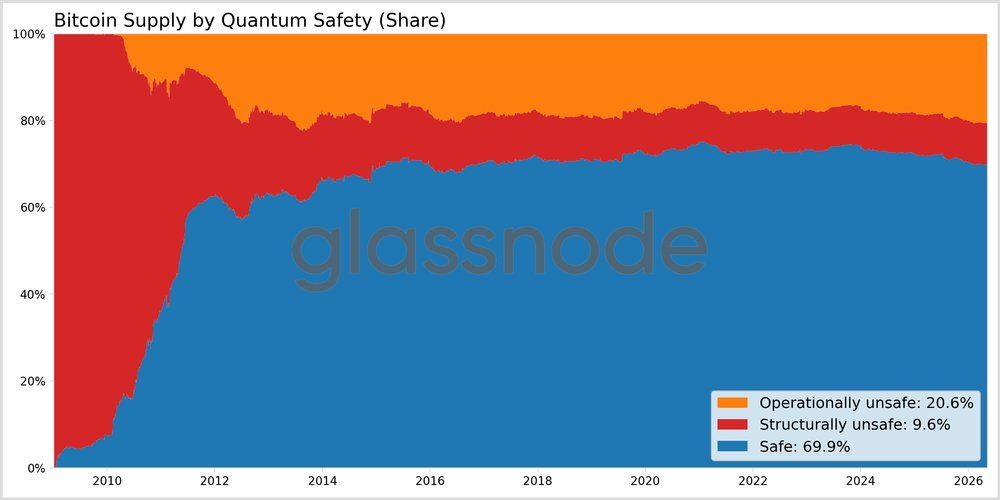
Glassnode data shows 4.12 million Bitcoin (BTC) are held in quantum-exposed addresses due to address reuse, partial spending, and custody practices, more than double the 1.92 million BTC exposed by Bitcoin’s older script types.
The on-chain firm splits Bitcoin’s quantum-exposed supply into structural risk stemming from the protocol’s design and the exposure of public keys, and operational risk arising from how holders manage their addresses and outputs.
Why Structural and Operational Exposure Are Not the Same
Structural exposure covers outputs where the public key appears on-chain by default. The bucket includes early Pay-to-Public-Key (P2PK) coins from the Satoshi era, bare multisig, and modern Pay-to-Taproot (P2TR) outputs.
Operational exposure works differently. Address types like Pay-to-Public-Key-Hash (P2PKH) and Pay-to-Witness-Public-Key-Hash (P2WPKH) hide public keys behind hashes at rest. However, once a holder reuses an address or partially spends from it, that protection no longer applies to any remaining balance.
Glassnode puts the two buckets at 30.2% of all issued Bitcoin combined. Together, they show that the operational share is 2.1 times larger than the structural share.
“The main insight is that most current at-rest exposure is not simply a legacy script-design problem – it is a key- and address-management problem,” the firm said.
Follow us on X to get the latest news as it happens

Where Wallet Behavior Shows Up On-Chain
The report revealed that exchanges form the largest identifiable subset of operationally exposed BTC. They hold about 1.66 million BTC, roughly 40% of the pool.
“It also appears high in relative terms: roughly half of labeled exchange-held BTC falls into the susceptible bucket, compared with less than 30% of non-exchange supply,” Glassnode said.
Exposure varies sharply between custodians. Glassnode marks Coinbase balances at 5% exposed. Meanwhile, Binance sits near 85% and Bitfinex at 100%.
Other Bitcoin holding entities also diverge. WisdomTree appears fully exposed. Grayscale holds about half its supply in exposed outputs. However, sovereign wallets in the US, UK, and El Salvador show zero exposure.
Glassnode notes exchange-held BTC has drifted from roughly 55% operationally safe in 2018 to about 45% today.
Bitcoin Improvement Proposal 360 (BIP-360) would harden Taproot. However, much of the operational bucket can shrink today through address rotation and avoided reuse, without any consensus change.
Subscribe to our YouTube channel to watch leaders and journalists provide expert insights
The post Glassnode Finds 20% of Bitcoin Quantum-Exposed by Behavior, Not Code appeared first on BeInCrypto.


Disclosure: This article does not represent investment advice. The content and materials featured on this page are for educational purposes only.
Prop trading firms weigh building custom technology versus licensing ready-made infrastructure in 2026.
Summary
- Prop trading firms now choose between building custom tech stacks or licensing white-label systems for faster market entry.
- Custom prop firm platforms offer control but require $500K+ and 6–12 months of development before launch.
- Licensed prop trading systems enable faster launch, lower risk, and built-in crypto-ready infrastructure for new operators.
The proprietary trading industry has gone from a niche segment to a multibillion-dollar industry in a few years. With that growth comes a question every new operator faces early: Should they build a prop firm technology from scratch, or license a proven system and go live faster?
The answer depends on where the user wants to spend their time and capital. Getting it wrong is one of the most expensive mistakes an operator can make.
The case for building from scratch
Building a prop technology stack gives full control over every part of the business. Operators can design custom risk engines, shape the trader experience from onboarding to payout, and own the underlying code exclusively. For firms with deep technical talent and a genuine technology edge, this path can set a firm apart over time.
The trade-offs are significant. A custom build typically requires 6 to 12 months of development before a single trader logs in. The upfront investment frequently exceeds $500,000 when factoring in engineering, QA, platform integrations, payment gateway development, and risk detection systems. Ongoing maintenance, security patches, and other updates add recurring costs that add up as the firm scales.
The real risk is much subtler than the price tag. Custom builds carry delivery risk. Timelines can slip, and features tend to go live unfinished. Every week spent debugging a checkout flow or reconciling a payout ledger is a week the firm is not getting traders or generating revenue.
The case for licensing
White-label solutions have matured exponentially in recent years. A modern licensed stack typically includes: trader dashboards, CRM, challenge management, risk monitoring, KYC workflows, payment processing, and capital backing. Meanwhile, operators retain full control of their brand and customer relationships while the tech provider handles the backend.
The primary advantage is speed. Firms using a licensed approach can go live in as little as one week, compared to months spent on a custom build. That speed translates directly into earlier revenue, faster market validation, and lower capital burn during the critical launch window.
Licensing also shifts capital exposure. Because most turnkey providers handle funded account backing, the operator does not need to personally underwrite trader payouts. This changes the risk profile of the business entirely, particularly for first-time operators who may underestimate how quickly payout liability can grow during a strong trading month.
The crypto factor
The rise of crypto trading has accelerated this decision. Operators need systems that handle crypto payments, high-volume onboarding, and risk monitoring across asset classes. Building that from scratch adds months. Licensing it removes the complexity without limiting the offer.
Where operators get it wrong
The most common mistake is treating the tech decision as a permanent one. Firms often start licensed, validate their model, and only build custom once they know which components justify the investment. Building everything from day one, before there is real traction, has ended more prop firms than bad marketing.
A second common failure point is payment processing. Firms that build their own payment layer without expertise in chargeback management and multi-rail redundancy often find this part more costly than the rest of the stack combined.
According to Grand View Research, the global algorithmic trading market was valued at $21.06 billion in 2024 and is projected to reach $42.99 billion by 2030, growing at a 12.9% compound annual growth rate. More entrepreneurs are entering the prop firm space as a result. The firms that scale will spend capital on what sets them apart, not replicating what already exists.
Choosing the right path
Operators entering the industry in 2026 should evaluate their launch path against three criteria: time to revenue, total cost of ownership, and the operational burden each option places on a team.
Licensing the backend and focusing on brand, community, and trader experience is typically the most efficient strategy for new firms entering the market. Some providers, including PropAccount.com, offer turnkey prop firm solutions with integrated payment processing and capital support, enabling faster market entry and eliminating the need for complex in-house development.
The strategic question is not whether a firm can build the technology. It is whether building is the strongest use of that capital.
Disclosure: This content is provided by a third party. Neither crypto.news nor the author of this article endorses any product mentioned on this page. Users should conduct their own research before taking any action related to the company.


AI Financial, formerly known as Alt5 Sigma, wants the market to know that it’s more than just its token holdings, and calling it a WLFI treasury company isn’t the right way to describe it.
“AiFi continues to operate an active fintech and digital payments business while executing on a broader long-term strategy across digital assets, settlement infrastructure, tokenization, and next-generation financial technologies,” a company spokesperson told CoinDesk in an email. “Characterizing the company solely as a ‘treasury company’ does not accurately reflect the breadth of AiFi’s operating business.”
AI Financial operates ALT5 Pay, its crypto payments platform, and ALT5 Prime, its over-the-counter digital asset trading business. Since quarter-end, it has also announced the acquisition of tokenization and ICO infrastructure firm Block Street, signed a commercial agreement with SuperQ Quantum, and outlined broader expansion into digital financial infrastructure.
The response from the spokesperson comes after AI Financial’s latest SEC filing painted a starkly different picture of its current financial profile.
The Nasdaq-listed company disclosed in this filing that it held 7.28 billion WLFI tokens, worth $706.4 million at the end of March, down from an acquisition cost of roughly $1.46 billion. By comparison, its operating fintech business generated just $4.7 million in quarterly revenue.
AI Financial also warned in this filing that recurring losses and a $5.5 million working capital deficit raise “substantial doubt” about the company’s ability to continue as a going concern within one year after the financial statements were issued.
Complicating the picture further, the company’s WLFI holdings remain contractually locked, limiting its ability to convert its largest asset into cash. AI Financial ended the quarter with just $10.5 million in cash.
AI Financial’s relationship with WLFI goes far beyond ownership. World Liberty CEO Zach Witkoff serves as the company’s chairman. Co-founder Zachary Folkman sits on its board; WLFI has lent it $15 million, secured by WLFI tokens, and WLFI holds rights equivalent to roughly 46% of its fully diluted equity.
But the question is, can investors see past WLFI when looking at AI Financial as a whole?
AI Financial may be building a broader fintech and digital infrastructure platform, but its SEC filing suggests WLFI remains the asset defining its financial story.
Unlike a typical digital asset treasury company holding bitcoin or another liquid asset, AI Financial’s relationship with WLFI is more complex: the issuer of its core treasury asset also has deep governance, lending and equity ties to the company itself.
The Digital Asset Market Clarity Act just cleared its hardest committee test. If it becomes law, it ends the single most damaging fact of life for American crypto: not knowing who is in charge. But the version that reaches President Trump’s desk will be shaped by three fights still being waged in the Senate, and the outcome of those fights decides who wins and who loses.
Summary
- The Senate Banking Committee advanced the CLARITY Act in a 15 to 9 vote, moving the crypto market structure bill closer to a full Senate vote.
- The proposal would divide digital assets into categories overseen by the SEC and CFTC, while also creating a separate framework for payment stablecoins.
- Ethics rules tied to President Donald Trump’s crypto connections, stablecoin yield limits, and anti-money laundering provisions remain among the biggest unresolved issues before the bill can reach the White House.
The restaurant with two inspectors
Imagine running a restaurant where the health inspector and the fire marshal both insist your kitchen is theirs to police. Neither will put their rules in writing. And if you guess wrong about whose instructions to follow, the penalty is that they shut you down and sue you.
That, more or less, has been the experience of building a crypto company in the United States since around 2017. The Securities and Exchange Commission and the Commodity Futures Trading Commission have spent the better part of a decade in an unresolved turf war over digital assets, and the industry has lived in the gap between them. Tens of billions of dollars in fines have been paid. Founders have spent years in litigation just to extract an answer that regulators could have written down in advance. Most builders simply gave up and left, for Dubai, Singapore, Switzerland, anywhere a straight answer arrived in less than three years.
The Digital Asset Market Clarity Act, universally shortened to the CLARITY Act, is Washington’s most serious attempt to end that era. And after months of stalemate, it just took its biggest step forward yet. On May 14, 2026, the Senate Banking Committee voted 15-9 to advance the bill to the Senate floor, with two Democrats crossing party lines to join every Republican on the panel.
That vote was not the finish line. It was the moment the bill stopped being a wishlist and became real legislation with a credible path to law. For anyone who trades, builds, invests in, or simply holds digital assets, the question is no longer whether to pay attention. It’s what, concretely, changes if this thing passes, and what the unresolved fights still being waged in the Senate will mean for the version that actually becomes law.
This is a long answer to that question.
What the bill actually does: three boxes, two regulators
Strip away the acronyms and the 270-plus pages, and the CLARITY Act does one structurally simple thing. It sorts every digital asset into one of three categories and assigns each category to a regulator.
Digital commodities. A token whose value comes from a functioning, sufficiently decentralized blockchain, where the network does something real and the token is the fuel that powers it. Bitcoin and Ether are the obvious cases, and both are widely expected to land here, formalizing what has been their de facto treatment for years. Digital commodities fall under the CFTC.
Investment contract assets. A token is sold the way startup equity is sold, where a centralized team raises money from the public and promises to build something with it. These stay with the SEC, which is where that agency has always had its firmest legal footing.
Permitted payment stablecoins. Dollar-pegged tokens designed to actually move money. These get a separate category with joint SEC and CFTC oversight, building on the GENIUS Act stablecoin framework that passed earlier.
Three boxes. Two regulators. The biggest reduction in legal fog the American crypto industry has ever been offered.
The mechanics behind that simple structure are what make the bill consequential. The CLARITY Act gives the CFTC exclusive jurisdiction over the spot and cash markets for digital commodities, which is a dramatic expansion for an agency that has historically referred to derivatives rather than the underlying assets themselves. Exchanges, brokers, and dealers handling digital commodities would register with the CFTC through a new, purpose-built pathway, instead of trying to force themselves into securities rules written in 1933 and 1934 for a very different kind of asset.
The SEC, in turn, keeps authority over genuine securities offerings. The bill draws a line, in federal statute, between the moment a token is being sold as a fundraising instrument by a centralized team and the moment the underlying network has matured enough that the token trades as a commodity. That maturation test, the question of when a project becomes “decentralized” enough to graduate from SEC to CFTC oversight, is one of the most legally intricate parts of the bill, and one of the most important.
For developers, there’s a provision that may matter more than the jurisdictional sorting itself: protection for people who write open-source code but never have custody of user funds. Under the CLARITY Act, publishing a smart contract would stop being treated as the legal equivalent of running an unlicensed money-transmitting business. For a corner of the industry that has watched developers face personal legal exposure simply for shipping code, this is foundational.
What approval would mean, by who you are
A regulatory framework is not an abstraction. It lands differently depending on where you sit in the ecosystem. Here is the concrete picture.
If you are a developer or founder
The immediate change is the disappearance of a specific, paralyzing fear: that building in the open is itself a legal risk. A clear registration pathway means a US-based project can launch knowing which agency it answers to and what compliance looks like, rather than discovering the answer through an enforcement action two years later.
The decentralization maturity test gives projects something they have never had, which is a roadmap. A token can begin its life under SEC oversight as an investment contract asset and, as its network decentralizes, move into the digital commodity category. That transition used to be a matter of speeches, blog posts, and hope. Putting it into statute means a founder can plan around it.
The likely practical effect is repatriation. A meaningful share of the talent and capital that decamped to friendlier jurisdictions did so for one reason: those places offered a straight answer. Remove that disadvantage, and the math on building in the US changes.
If you are an exchange, broker, or custodian
For the largest US platforms, the bill turns an existential ambiguity into an operational task. Instead of litigating whether the assets they list are securities, exchanges would register with the CFTC and operate under a defined rulebook. The bill includes an expedited registration process and provisional status, so platforms are not frozen out while the CFTC builds its full framework.
This is a double-edged outcome. Clarity is not the same as leniency. A registered exchange will face real, enumerated obligations: custody standards, disclosure requirements, conduct rules, and capital expectations. The era of regulatory vapor ends, but so does the era of regulatory absence. Compliance will have a cost. The industry’s bet is that a known, payable cost beats an unknowable, unbounded legal risk. For most serious operators, that bet is obviously correct.
If you are a retail investor or token holder
The benefits here are real but slower and less glamorous. Defined disclosure requirements for token issuers mean better information before you buy. Custody and conduct rules for registered intermediaries mean more protection for assets you hold on a platform. The legal status of the assets in your wallet becomes a settled question rather than an open one.
There’s also a subtler consequence. A credible US framework is the precondition for the next wave of institutional products, and for traditional financial institutions to offer crypto services to ordinary customers without regulatory peril. Approval doesn’t put crypto in your bank tomorrow. It removes the biggest single obstacle standing between today and that future.
If you hold or use stablecoins
This is where the bill’s politics get sharp, and the detail matters. The compromise negotiated by Senators Thom Tillis and Angela Alsobrooks draws a careful line. Intermediaries, exchanges, for instance, would be prohibited from paying yield on a customer’s idle, passive stablecoin holdings. The intent is explicit: a passive stablecoin balance must not be allowed to function like an interest-bearing bank deposit. But the same provision permits rewards tied to activity, meaning incentives connected to actually spending or using a stablecoin, as long as they don’t resemble passive interest.
If that distinction sounds narrow, it is. It’s also the fault line over which this entire bill nearly collapsed, and it explains a fight covered in the next section.
The three fights that will shape the final bill
The version of the CLARITY Act that passed committee is not the version that will become law. Three contested issues remain open, and each one will shape who benefits and by how much. Anyone trying to understand what approval “means” has to watch these, because the answer is still being written.
Fight one: ethics, and the shadow of the Trump family
This is the single biggest political wedge between the bill and final passage. Many Senate Democrats are demanding an ethics provision barring senior government officials from holding business ties to the crypto industry, a demand driven, unambiguously, by President Trump’s family’s extensive crypto ventures, including the World Liberty Financial project.
Republicans on the Banking Committee declined to include such language in the committee bill, arguing that ethics sits outside the committee’s remit and can be added later by floor amendment. The committee specifically voted down a Democratic ethics amendment. That rejection is the most direct explanation for why most Democrats voted no.
The arithmetic makes this unavoidable. On the Senate floor, the bill needs 60 votes. Assuming every Republican supports it, that means roughly seven Democrats have to come along. Crypto-friendly Democrats, including Senators Kirsten Gillibrand and Ruben Gallego, have stated plainly that they won’t provide those votes without an ethics provision. Industry advocates now describe some form of ethics language as “almost all but guaranteed” to be added before a floor vote.
But there’s a counter-pressure pulling the other way. Senator Cynthia Lummis, a key negotiator, warned that the President himself has to sign off, and that if the bill becomes, in her words, a cudgel aimed specifically at him, he’ll veto it without hesitation. The realistic landing zone is therefore an ethics provision strong enough to win seven Democratic votes but weak enough to survive a presidential signature. That’s a narrow target, and where exactly the language lands will tell you a great deal about how seriously the final law treats conflicts of interest.
Fight two: illicit finance and law enforcement
A coalition of law enforcement groups argues the bill doesn’t do enough to stop digital assets from being used in financial crime, and would make catching bad actors harder. The concern gained urgency from a Treasury FinCEN advisory flagging crypto platforms and stablecoins as a channel for sanctioned actors to launder illicit proceeds.
Senators have filed amendments to strengthen anti-money-laundering and sanctions provisions. Backers of the bill counter that it actually strengthens AML and sanctions rules and gives law enforcement better tools. How this gets resolved affects the compliance burden on every registered intermediary, and the bill’s credibility with the national-security-minded senators whose votes are in play.
Fight three: the banks
America’s banking industry is the bill’s most powerful organized opponent, and its objection is
fundamentally about deposits. If stablecoins can pay anything resembling yield, banks fear money will drain out of deposit accounts, the same deposits that fund lending. In the days before the committee vote, bank trade groups reportedly sent more than 8,000 letters to senators demanding revisions. Even after the Tillis-Alsobrooks compromise, banking groups complain the activity-rewards language leaves room for workarounds.
This is not a sideshow. It’s a genuine clash between two financial industries over the future shape of money, and the banks have decades of lobbying infrastructure behind them. The final stablecoin language will be one of the most negotiated paragraphs in the entire bill.
The road from here
Even on an optimistic reading, the CLARITY Act has several gates left to clear.
First, the Senate Banking Committee bill has to be merged with a parallel version produced by the Senate Agriculture Committee, since the two panels share jurisdiction over digital assets, into a single unified text. Industry insiders expect intense negotiation over the next several weeks, and this is the most likely vehicle for inserting the ethics compromise.
Second, the merged bill faces a full Senate floor vote requiring 60 senators.
Third, because the House passed its own version of the CLARITY Act back in July 2025, any Senate- passed bill containing new components, such as the stablecoin yield language, the DeFi provisions, or ethics rules, has to be reconciled with, or accepted by, the House before it can go to the President.
The timeline is genuinely tight. White House officials have floated a target of a signing on or around July 4, 2026. Industry advocates describe an effective “drop-dead deadline” before the August recess, after which the midterm elections and a potentially less crypto-friendly Congress raise the degree of difficulty considerably. Prediction markets have put the odds of passage in 2026 in the rough vicinity of two-in- three, while at least one Wall Street analyst has been more cautious, calling a successful floor vote “in play but not the expected outcome.”
In other words: reachable, not guaranteed.
What it means, in the end
It’s worth being precise about the nature of what is on offer here, because both boosters and skeptics tend to overstate it.
The CLARITY Act is not a gift to the crypto industry. It’s a rulebook. It hands the industry the thing it has asked for over and over, a definitive answer to “who regulates this?”, and the price of that answer is a genuine, enforceable obligation. Exchanges will register. Issuers will disclose. Intermediaries will be examined. For an industry that has at times romanticized its own lawlessness, the deepest meaning of approval is that the era of operating in the absence of rules ends, and the era of operating under them begins.
For the United States as a whole, the bill is a bet that a clear domestic framework will pull
Builders, capital, and talent back home, and that the alternative, ceding the next decade of financial infrastructure to other jurisdictions, is the worst outcome.
And for the ordinary participant, the developer shipping code, the trader on an exchange, the person holding a stablecoin, the change is less a single dramatic event than the removal of a decade-long background hum of uncertainty. The legal status of the asset in your wallet becomes a settled fact. The platform you use answers to a named regulator. The developer who wrote the protocol is not a criminal for having written it.
That’s what crypto purgatory ending actually looks like. Not paradise. Just, finally, a map.
The committee’s vote on May 14 was the moment the map stopped being a rumor. The next two months, the merged text, the ethics deal, the floor math, and the House vote will decide what the map actually says. Watch the floor math. Watch the ethics negotiations. And when the merged text lands, read it. The details are the story now.
This article is for informational purposes and does not constitute legal, financial, or investment advice. Legislative situations evolve quickly; the status described reflects developments as of mid-May 2026.

Bitcoin has hit resistance at its 200-day moving average and is showing signs of a trend reversal, according to CryptoQuant on Wednesday. The move closely mirrors a March 2022 pattern where a 43% rally stalled at the same level before prices declined further.
“Overall, Bitcoin demand has flipped into contraction,” the analyst wrote.
The platform’s “Bull Score Index” has declined from 40 back to extreme bearish territory at 20, “as stalling stablecoin liquidity, and negative price momentum simultaneously eroded the composite signal.”
This score is consistent with the deep bear market readings of February and March, when prices declined to $60,000, and historically “has preceded either further price weakness or extended consolidation,” they added.
Bitcoin Correction Likely to Continue
If the correction continues, the $70,000 level represents the primary on-chain support target, the traders’ on-chain realized price. The analysts noted that this level has functioned as a “precise inflection point” throughout the current bear market cycle.
A break below this back into the $60k zone could result in new bear market lows, however. Meanwhile, Glassnode reported on Wednesday that Bitcoin has reclaimed the True Market Mean at $78,300 but failed to sustain above it. However, it also noted that the correction from recent highs is likely to continue if previous cycle patterns repeat.
“Any deeper correction from current levels would therefore reframe the recent rally as a local top within the ongoing bear market, a structure that has recurred multiple times in prior cycles and remains the higher probability outcome until price demonstrates sustained follow-through.”
Bitcoin momentum has faded from full max momentum, reported Swissblock on Thursday. It remained cautiously bullish, stating that as long as momentum does not degrade significantly, “the base case is consolidation, not breakdown.”
Bitcoin momentum has faded from full max momentum.
But as long as it does not fall below -0.5, this does not imply breakdown.
What usually follows is consolidation.
The key reference is June–July 2025.
Momentum faded from full strength, but the indicator never broke below… https://t.co/QkVFmMTReb pic.twitter.com/ZarKY77Bx3
— Swissblock (@swissblock__) May 21, 2026
Crypto Market Outlook
Bitcoin has climbed steadily over the past 24 hours, gaining 1.7% from $76,600 to tap $78,000 twice during the Thursday morning Asian trading session.
However, this level is also a resistance zone that needs to be overcome quickly for BTC to reach $80,000 again. Volumes and sentiment suggest it will be thwarted here again.
Ether prices have mirrored the move, but it remains bearish under $2,150 at the time of writing, while the altcoins were notching larger gains. Hyperliquid and Zcash had exploded with double-digit gains on the day.
The post Bitcoin’s Key Resistance Stall Could Send it Tumbling Much Lower: Analysts appeared first on CryptoPotato.


Anthropic is on track to generate $10.9 billion in second-quarter revenue, more than doubling its first-quarter haul.
The figure puts the artificial intelligence (AI) company on track for its first quarterly operating profit.
Anthropic Q2 Revenue Set To Double
According to The Wall Street Journal, Anthropic shared the numbers with investors as part of an ongoing funding round that could lift its valuation past OpenAI’s.
“The projections, which were reviewed by The Wall Street Journal, provide a window into the meteoric rise of a startup that was once a laggard in the artificial-intelligence race, and defy the conventional wisdom that AI companies’ huge spending needs hamper near-term profitability,” the report read.
The Claude maker expects to post an operating profit of $559 million in the June quarter. First-quarter revenue reached $4.8 billion, meaning sales more than doubled within months.
Follow us on X to get the latest news as it happens
The firm has posted strong gains this year, and investor talks are underway on a funding round pegged at a $900 billion valuation. That price would lift Anthropic above OpenAI, which was last valued at $852 billion during a March funding round.
Meanwhile, rival OpenAI has faced setbacks this year. The maker of ChatGPT missed internal revenue and weekly user targets in early 2026.
Even so, the company has pushed ahead with its IPO plans. OpenAI is working with Goldman Sachs and Morgan Stanley on a confidential S-1 filing that could land as early as Friday. Anthropic itself is weighing a public listing as soon as October.
Subscribe to our YouTube channel to watch leaders and journalists provide expert insights
The post Anthropic Eyes First Profitable Quarter on $10.9 Billion Q2 Revenue Projection appeared first on BeInCrypto.


Ontop has partnered with OpenTrade to launch a ~3% APR rewards product on USD balances for thousands of global workers, converting idle payroll funds into yield in under a month.
Summary
- Ontop launches ~3% APR rewards on USD balances for global workers
- OpenTrade provides plug-and-play institutional-grade yield and infrastructure
- Pilot hit $1m in two weeks, now $3m+ in user funds under management
The move shifts Ontop from a pure payroll and payments provider toward a broader financial platform for distributed teams worldwide.
Global workforce platform Ontop has rolled out a ~3% APR rewards program on USD balances held in its Global Account, powered by OpenTrade’s stablecoin and fiat yield infrastructure, after processing more than $1 billion in payroll to workers across 150+ countries in 2025. The new product targets one of the largest pools of idle capital in fintech — uninvested payroll sitting between pay cycles — by allowing Ontop’s global users to earn rewards on their USD while mitigating inflation, currency devaluation, and repatriation risk, regardless of jurisdiction.
The partnership is explicitly designed to be plug-and-play for Ontop’s existing stack. OpenTrade handled legal structuring, portfolio management, and automated reporting, enabling Ontop to bring the ~3% APR rewards product from concept to launch in under a month with “no material operational lift.” According to the companies, the program is fully embedded into the Ontop Global Account, so users experience it as a native feature rather than a separate investment product or external platform.
Turning idle balances into yield and revenue
The initial pilot for the rewards product went live in December 2025 with 1,300 users and reached $1 million in user-provided funds in less than two weeks, before scaling to Ontop’s full customer base. Total user-provided funds now exceed $3 million, with OpenTrade’s APIs wired directly into Ontop’s reporting systems to provide real-time, daily visibility into balances and performance. All activity takes place within the existing Global Account, positioning it as a single financial home where remote workers can get paid, store capital, move it, and now earn yield.
For Ontop, the integration also opens a new revenue line beyond subscription and payroll processing fees. The company now captures a margin on the balances it allocates to OpenTrade’s infrastructure, effectively evolving from a pure payroll and payments platform into a financial operating system for global teams — without building an in-house treasury stack or taking on additional operational overhead. Fixed-term products, which would likely offer different yield and duration profiles, are already in development and scheduled to launch in the coming weeks.
OpenTrade COO Jeff Handler framed the partnership as an example of how fintechs still reliant on legacy rails can access institutional-grade yield without re-architecting their core systems. In comments to crypto.news, he said: “the majority of the fintech world still runs on dollars in traditional bank accounts that moves on traditional banking rails, but that shouldn’t be a barrier to accessing plug-and-play institutional-grade yield,” Handler said. “Our ability to meet Ontop where they’re at operationally, without requiring them to rebuild their infrastructure, is exactly what OpenTrade was designed to do.”
Building a financial OS for global workers
Ontop co-founder Julian Torres positioned the rewards launch as central to the company’s broader thesis that financial infrastructure has failed to keep pace with the globalisation of work. “At Ontop, we’re building the financial infrastructure for the global workforce. The future of work is global, but financial systems haven’t caught up,” Torres said. “Through our Global Account, we’re not just helping workers get paid, we’re giving them a place to store, move, and grow their money. Our partnership with OpenTrade is a key step in turning idle balances into real financial opportunity anywhere in the world.”
OpenTrade, backed by Circle and a16z Crypto, describes itself as institutional-grade yield infrastructure for fintechs, neobanks, and payroll providers, with more than $268 million in transaction volume processed to date and asset management operations overseen by Five Sigma Finance, a UK-regulated manager supervising over $6 billion for institutional clients. Ontop, meanwhile, positions its Global Account and payroll stack as a comprehensive solution for companies hiring and paying distributed teams, using the new rewards layer to deepen engagement and differentiate in an increasingly crowded global employment and contractor-payments market.


Morgan Stanley has resubmitted a spot Solana ETF application that would hold and stake SOL under the ticker MSOL, extending the bank’s push deeper into U.S. crypto exchange-traded products.
Summary
- Morgan Stanley’s revised S-1 says the trust will hold SOL directly and reflect staking rewards in net asset value.
- The filing places Solana alongside the bank’s expanding crypto ETF lineup, including its recently launched MSBT Bitcoin ETF.
- Solana was priced at $84.91 on crypto.news at the time of reporting.
Morgan Stanley has filed a revised registration statement for a spot Solana (SOL) exchange-traded fund, a product that would trade under the ticker MSOL and hold SOL directly while staking part of the fund’s assets through third-party providers. The filing shows the bank is not merely seeking passive price exposure but wants staking rewards to accrue inside the product itself, a structure that could differentiate it from simpler spot vehicles.
The fund is formally structured as the Morgan Stanley Solana Trust, and the preliminary prospectus says its investment objective is to track the performance of SOL in U.S. dollars, adjusted for expenses and liabilities, while also reflecting rewards from staking a portion of the trust’s SOL. The same filing says the sponsor plans to choose staking providers based on “performance, reliability, and reputation,” including “uptime and slashing history.”
Morgan Stanley’s earlier crypto ETF expansion gives the filing broader significance. In a previous crypto.news story, the bank’s move into Bitcoin and Solana ETFs was described as evidence that digital assets had gone “from compliance headache to boardroom strategy” as regulatory guardrails tightened.
Filing details
The prospectus states that the trust is a passive investment vehicle and “will not utilize leverage, derivatives or any similar arrangements” in pursuing its objective. It also says the trust intends to hold SOL in custody with regulated third-party custodians and may distribute staking rewards at least quarterly when required under current Internal Revenue Service guidance.
Morgan Stanley’s language is unusually explicit about why investors might want the structure. The filing says the trust is meant to provide access to SOL “through a traditional brokerage account without the potential barriers to entry or risks involved with holding or transferring SOL directly.” That is the pitch in plain English: exposure without private keys, wallets, or direct on-chain handling.
The filing also includes a notable market data point. As of Dec. 20, 2025, SOL had a total market capitalization of about $70.54 billion and ranked as the seventh-largest digital asset by market capitalization, according to CoinMarketCap data cited in the prospectus.
Broader push
The Solana filing follows Morgan Stanley’s broader push into crypto-linked products. Another crypto.news story reported that the bank’s spot Bitcoin ETF, MSBT, was set to begin trading on NYSE Arca on April 8 with a 0.14% fee, entering a market where BlackRock’s IBIT and Fidelity’s FBTC had already pulled in more than $74.3 billion in net inflows since launch.
That matters because MSOL is not an isolated filing but part of a coordinated buildout across spot crypto products. Crypto.news also reported in another story that Morgan Stanley had expanded crypto investment access across all clients and account types, reinforcing the idea that the bank now sees digital assets as a mainstream wealth product rather than a niche alternative.
At the time reflected on crypto.news pricing pages, Bitcoin (BTC) traded at $77,450.00 and Ethereum (ETH) at $2,130.03, while Solana changed hands at $84.91. If approved, MSOL would give Morgan Stanley a direct way to package that Solana exposure into a regulated, exchange-traded wrapper built for traditional investors.
Pi Network’s PI Token Gains Momentum Amid Bullish News From OKX

San Antonio, Oklahoma City tied 1-1 heading into game 3

Microsoft is pulling the plug on SMS codes, wants you to switch to passkeys


-

 Crypto World5 days ago
BloFin War of Whales 2026 Grand Prix opens registration for $5M trading championship
-

 Fashion5 days ago
Weekend Open Thread: Theory – Corporette.com
-

 Crypto World5 days ago
E-Estate Announces 1 Year Live: Washington DC Summit as Real Estate Tokenization Enters Its Next Phase
-

 Tech6 days ago
Tech Moves: Microsoft AI leader jumps to OpenAI; former AI2 exec joins Meta; and more
-

 Tech5 days ago
Google reimburses Register sources who were victims of API fraud
-
 Crypto World7 days ago
Google’s Gemini AI Predicts Incredible Solana Price by the End of 2026
-

 Business6 days ago
H&R Real Estate Investment Trust (HR.UN:CA) Q1 2026 Earnings Call Transcript
-
 Entertainment7 days ago
Zara Larsson Has Blunt Response To Chris Brown Diss
-

 Sports5 days ago
Napoleonic enters 2026 Doomben 10,000 field via Abounding withdrawal
-
 Crypto World5 days ago
BeInCrypto 100 Institutional Awards Nomination: KAST for Best Digital Assets Neobank and Best Digital Assets Fintech
-
 Crypto World5 days ago
Bitcoin Battles US Bond Nerves With BTC Price Dip Toward New May Lows
-

 Fashion4 days ago
On the Scene at Gucci’s Cruise Show in New York City: Mariah Carey, Kim Kardashian, Lindsay Lohan, Iman, and More!
-
 Crypto World5 days ago
Wall Street’s Boldest Gold Prediction Has Russians Rushing to Buy
-

 Crypto World5 days ago
ICE and CME urge US regulators to curb Hyperliquid energy trading
-

 Fashion5 days ago
Trending Western Style Vests Perfect for Summer
-

 Politics6 days ago
DWP PIP Timms review continues to be an absolute farce
-

 Entertainment6 days ago
David Letterman Returns to Late Show, Blasts Cancellation
-

 Crypto World5 days ago
IREN closes $3 billion convertible notes deal amid AI infrastructure expansion
-
 Crypto World6 days ago
Lido Finance Selects Chainlink CCIP as the Official Cross-Chain Infrastructure for wstETH Security
-

 Fashion4 days ago
Amazon Sundays: Memorial Day Hosting
You must be logged in to post a comment Login