Connect with us
DAPA Banner

Tech

Most US teens say TikTok, Instagram and Snapchat aren’t hurting (or helping) their mental health

Published

on

Most teens in the United States say that Instagram, TikTok and Snapchat aren’t harming their mental health, though a slightly higher proportion report negative effects on their sleep and productivity, according to a new report from Pew Research. The report offers fresh insights into how teens perceive the effects of social media at a time when there are increasing calls to ban younger teens from social platforms altogether.

The report is based on a survey of 1,458 teens between the ages of 13 and 17. Teens were asked about their use of Instagram, Snapchat and TikTok and how those apps affect them. Pew also asked the teens’ parents to weigh in.

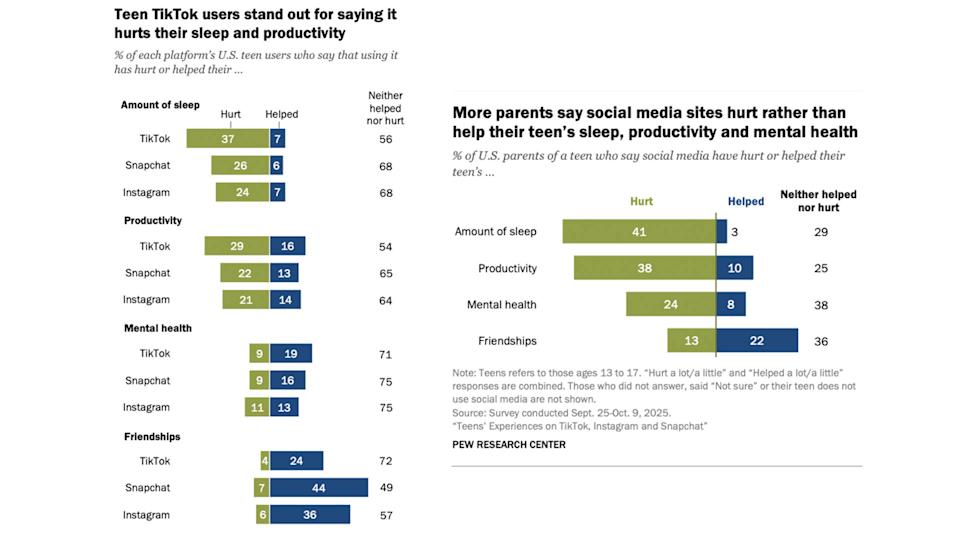
Relatively few teens reported negative mental health effects, with 9 percent of Snapchat and TikTok users and 11 percent of Instagram users saying they thought the services had hurt their mental health. More teens reported negative effects on sleep and productivity, however, especially when it comes to use of TikTok. Thirty-seven percent of teens said their use of the app had hurt their sleep and 29 percent reported that it had affected their productivity. Even so, the majority of teens responded that the apps had “neither helped nor hurt” their mental health, sleep or productivity.

Teens and their parents differed on the effects of social media platforms.

Teens and their parents differed on the effects of social media platforms. (Pew Research)

A significant number of teens did say that social media apps had helped their friendships, particularly Snapchat. At the same time, the app had a “somewhat higher rate” of bullying and harassment compared with the other services.

Advertisement

While the self-reported data is hardly a definitive answer to whether social media is harming teens, the numbers do offer a somewhat different narrative than the one that lawmakers, regulators and other critics have used to pursue social media bans and civil litigation against major companies. Meta, Snap and TikTok are all facing lawsuits that claim the platforms have purposefully created addicting features and enabled other harms to teen users,

Perhaps unsurprisingly, when researchers surveyed those same teens’ parents, they had a more negative view of the apps’ impact on their children. About four in ten parents said that social media hurts their kids’ sleep and productivity and about a quarter thought it hurt their mental health. Forty-four percent of parents whose teens use TikTok said they thought their child was spending “too much” time in the app.

“The share of parents who say the same of Snapchat and Instagram is lower,” the researchers note. “But the same pattern continues for both, with parents being more likely than teens to describe their teens’ use of these sites as excessive.”

The report isn’t the first time Pew has polled teens on their relationship with social media. Last year, a separate report found that teens were becoming more worried about social media, though they were less likely to say they had been negatively impacted on a personal level.

Advertisement

Source link

Continue Reading
Click to comment

You must be logged in to post a comment Login

Leave a Reply

Tech

Large solar farms in the UAE may accidentally create rainstorms that could reshape how deserts manage water shortages

Published

on


  • Dark solar panels turn desert heat into rain clouds, not just electricity
  • A 20 square kilometer solar farm produces more rain than a year of cloud seeding
  • The Persian Gulf’s moist winds are what the desert solar needs to make rain

In the United Arab Emirates, where water is more valuable than oil, new research suggests large solar farms could trigger their own rainstorms.

A modelling study led by climate scientist Oliver Branch at the University of Hohenheim found dark solar panels absorb more heat than the surrounding reflective desert sand.

Source link

Continue Reading

Tech

Thieves Posing As Apple Support In Texts & Phone Calls, Company Warns

Published

on


iPhone users around the world are encountering an Apple Pay scam that could lose you thousands of dollars if you fall victim. According to Consumer Affairs, there is currently a widespread scam going around that looks like a text from Apple regarding Apple Pay fraud. The text is actually not from Apple at all, but from a scammer wanting to get a hold of your bank account or credit card information. 

The scam is simple and relies on victims feeling a sense of urgency and panic, making these fraudulent text message schemes quite common. The text will read that a purchase was attempted with your Apple Pay, resulting in your account being locked. It will then say that immediate action is required to get the account back or reverse the charges. If you end up calling the provided number, you will be speaking to a scammer who wants access to your money. They may also send a link to a website that will prompt you to enter sensitive information that hackers can later use. 

Advertisement

How to protect yourself against scammers on your iPhone

If you have received a message like this from someone claiming to represent Apple, it’s more than likely a scammer. Apple does not reach out for private information or request that customers call, text, or email them. Don’t click on any links or call any provided numbers. Apple provides this advice to its customers: “If you get an unsolicited or suspicious phone call from someone claiming to be from Apple or Apple Support, just hang up.” You can check Apple Pay right on your iPhone, and you’ll be able to tell if it’s frozen or if a suspicious transaction was made. You can also call your bank to see if anyone’s made any purchases. 

If you believe that you may have already been in contact with a scammer, don’t panic just yet. Notify your bank or credit card issuer to let them know that the recent transaction was the result of a scam. You should then report the incident to Apple by taking a screenshot of the text and sending it to reportphishing@apple.com) and the Federal Trade Commission (FTC). 

Remember, since you authorized the transaction, it may be difficult to get the money back. Many victims have reported that they haven’t been able to. It’s best to recognize the red flags to avoid being in contact with the scammers at all. These scams are quite common since they are easy to pull off, so you’ll also see them pretending to be from Amazon or other popular companies. Apple customers have been targeted by these types of scams multiple times.

Advertisement


Source link

Advertisement
Continue Reading

Tech

Comparing the latest action cameras

Published

on

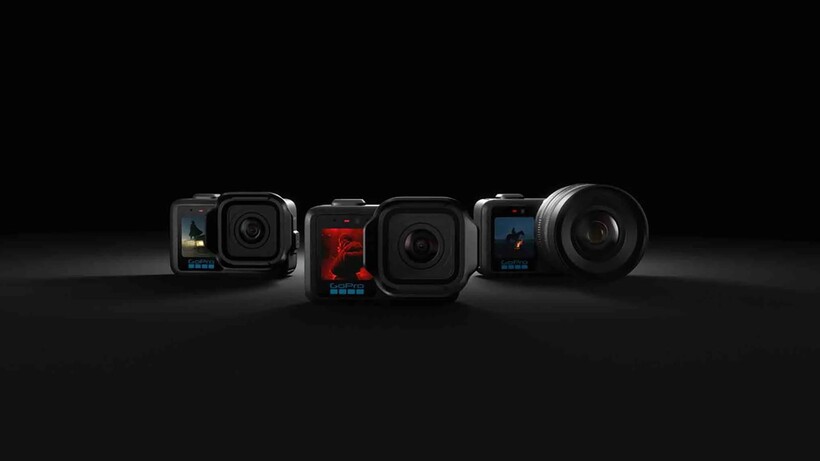
The Mission 1 series is the latest range of GoPro action cameras, flanked by the Mission 1 Pro and Mission 1 Pro ILS. 

So, how does the Mission 1 Pro ILS compare to the Mission 1 Pro? Why should you opt for the ILS model over the “standard” Pro iteration?

While we’re yet to review any of the Mission 1 series, we’ve looked closely at the specs of both the Mission 1 Pro and Mission 1 Pro ILS to see what really separates the two. Keep reading to learn more about the new Mission 1 line-up.

Check out our GoPro Mission 1 Pro vs Mission 1, where we’ve compared the flagship to the more entry-level model. Otherwise, our list of the best action cameras includes all our favourite models from the past year or so.

Advertisement

Price and Availability

At the time of writing, GoPro is yet to reveal the exact prices of any Mission 1 camera. However, we can expect more information between April 19-22, and we’ll be sure to update this versus once we find out the pricing.

Advertisement

In terms of availability, GoPro explains that customers will be able to pre-order the Mission 1 Pro from May 21st ahead of its official launch on May 28th. As for the Mission 1 Pro ILS, GoPro has stated that it will be available from the beginning of Q3 2026.

Both have a 50MP sensor and GP3 processor

We’ll start with a key similarity between the two cameras. Both the Mission 1 Pro and Mission 1 Pro ILS are equipped with a 50MP, one-inch sensor and sport GoPro’s GP3 processor. It’s also worth noting that these are the same specs as the GoPro Mission 1.

Advertisement

The 50MP sensor features a larger surface area, native 1.6µm pixels and 3.2µm fused pixels which GoPro promises ensures both cameras are able to capture more light in darker and trickier environments. Plus, thanks to the 5nm GP3 processor, the Mission 1 series should see “category-leading battery runtimes and thermal performance” too. 

Finally, both the Mission 1 Pro and Mission 1 Pro ILS sport an AI Neural Processor Unit for “next-generation” video pixel processing and better low-light image performance.

We’ll have to wait until we get our hands on either of the cameras to confirm GoPro’s claims, but it’s fair to say at this early stage, the Mission 1 series certainly looks promising.

GoPro Mission 1 line upGoPro Mission 1 line up
Image Credit (GoPro)

Advertisement

GoPro Mission 1 Pro ILS is mirrorless

One of the key differences between the Mission 1 Pro and the Pro ILS is that the latter is mirrorless. In a nutshell, this means the ILS model uses electronic viewfinders (EVFs) to display images digitally, rather than using a mirror to reflect its image onto an optical viewfinder. The ILS model also has an interchangeable lens mount that supports Micro Four Thirds (MFT) lenses and adapters which, according to GoPro, allows a “virtually limitless range of lenses to be paired with the camera”. 

Advertisement

With this in mind, if you want a more versatile camera that allows you to play around with different lenses and adapters, then the ILS is the more suited option out of the two.

GoPro Mission 1 Pro ILSGoPro Mission 1 Pro ILS
Image Credit (GoPro)

GoPro Mission 1 Pro ILS supports in-camera HyperSmooth stabilisation

A feature first introduced on the Hero 7 Black, the Mission 1 Pro ILS supports GoPro’s in-camera image stabilisation technology, HyperSmooth. This feature works by cropping a small amount from the edge of the frame to help reduce camera motion, so recordings aren’t wobbly or jittery. 

GoPro also states that the ILS’ HyperSmooth works with “any rectilinear, prime focal length lens” for added versatility too.

GoPro Mission 1 Pro is water resistant

Even without housing, which is sold separately, the Mission 1 Pro can survive in up to 20m (66 feet) of water. However, if you opt for a protective case then the Mission 1 Pro will be water resistant down to a whopping 60m (196 feet), plus the case’s built-in mounting fingers will allow you to capture content both horizontally and vertically too.

Advertisement

Advertisement

In comparison, GoPro states that the Mission 1 Pro ILS is “weatherproof”, but doesn’t actually expand on what that means. Perhaps it might not be as water resistant as the Mission 1 Pro without a case, but we’ll have to wait for GoPro’s confirmation. 

Early Verdict

Promised to be the world’s “smallest, lightest, and most rugged 8K and 4K Open Gate cinema cameras”, the Mission 1 series is undoubtedly one of the most exciting camera launches of the year so far – although we’ll have to wait and see how they really perform in everyday use.

At this early stage, the Mission 1 Pro ILS is best suited for those who want the flexibility and versatility that comes from swapping out lenses. On the other hand, the Mission 1 Pro is a great choice for those looking for a compact action camera that will see them through most uses.

We’ll be sure to update this versus once we review both the cameras.

Advertisement

Source link

Continue Reading

Tech

Signed software abused to deploy antivirus-killing scripts

Published

on

Signed software abused to deploy antivirus-killing scripts

A digitally signed adware tool has deployed payloads running with SYSTEM privileges that disabled antivirus protections on thousands of endpoints, some in the educational, utilities, government, and healthcare sectors.

In a single day, researchers observed more than 23,500 infected hosts in 124 countries trying to connect to the operator’s infrastructure, with hundreds of infected endpoints present in high-value networks.

More than just adware

Security researchers at managed security company Huntress discovered the campaign on March 22, when signed executables viewed as potentially unwanted programs (PUPs) triggered alerts in multiple managed environments.

Wiz

PUPs, or adware, are regarded more as a nuissance than malicious, as their role is typically to generate revenue for the developer by showing advertisement pop-ups, banners, or through browser redirects.

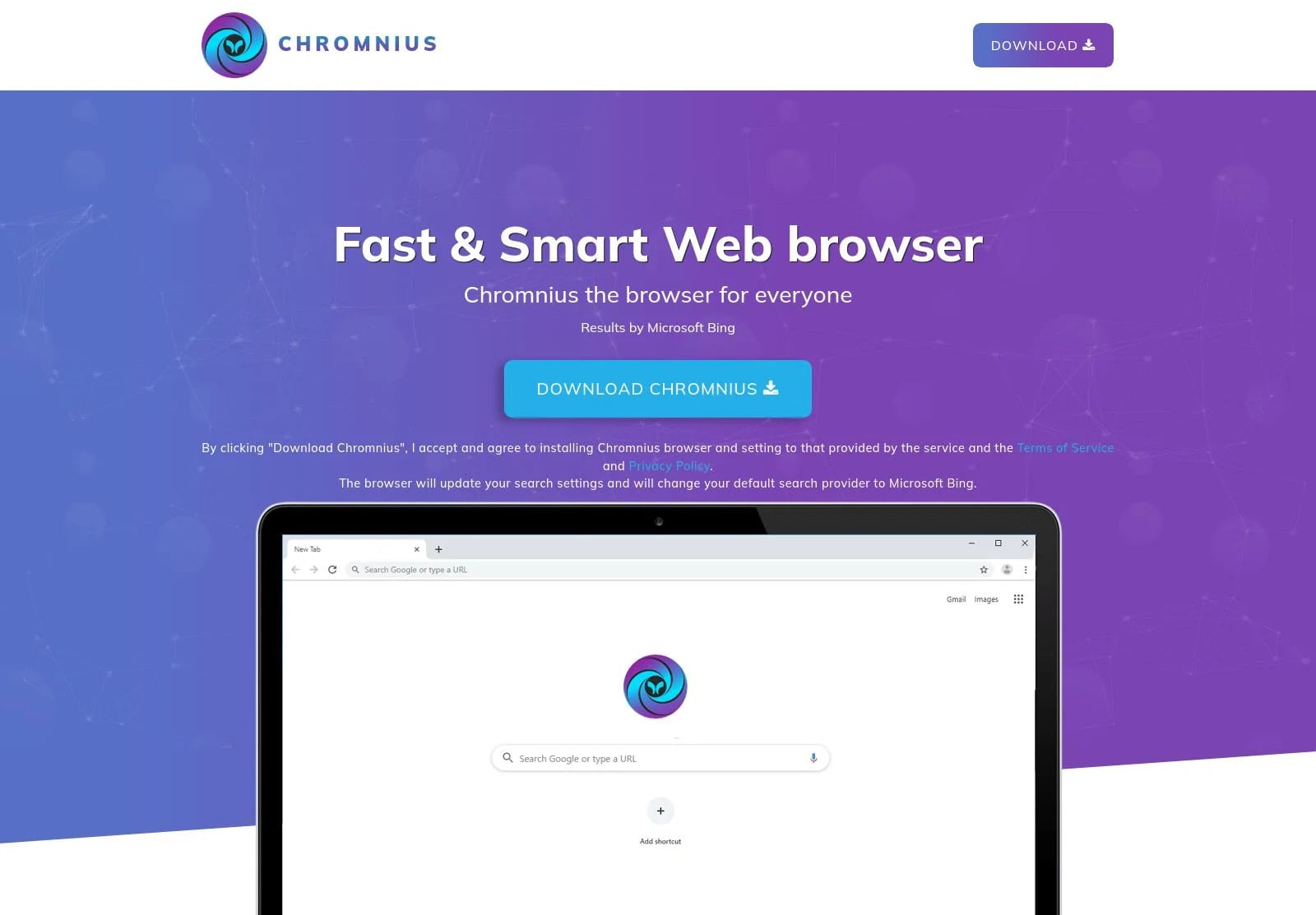
Huntress researchers say that the software was signed by a company called Dragon Boss Solutions LLC, involved in “search monetization research” activity and promoting various tools (e.g., Chromstera Browser, Chromnius, WorldWideWeb, Web Genius, Artificius Browser) labeled as browsers but detected as PUPs by multiple security solutions.

Advertisement
The Chromnius tool website
Source: Huntress

Beyond annoying users with ads and redirects, Huntress researchers say the browsers from Dragon Boss Solutions also feature an advanced update mechanism that deploys an antivirus killer.

Deactivating security

Huntress researchers discovered that the operation relied on the update mechanism from the commercial Advanced Installer authoring tool to deploy MSI and PowerShell payloads.

Analyzing the configuration file for the update process revealed several flags that made the operation completely silent and with no user interaction. It also installed the payloads with elevated privileges (SYSTEM), prevented users from disabling automatic updates, and checked frequently for new updates. 

According to the researchers, the update process retrieves an MSI payload (Setup.msi) disguised as a GIF image, which is currently flagged as malicious on VirusTotal by only five security vendors.

The MSI payload includes several legitimate DLLs that Advanced Installer uses for specific tasks, such as executing PowerShell scripts, looking for specific software on the system, or other custom actions defined in a separate file named ‘!_StringData‘ that includes instructions for the installer.

Advertisement

Huntress says that before deploying the main payload, the MSI installer conducts reconnaissance by checking the admin status, detecting virtual machines, verifying internet connectivity, and querying the registry for installed antivirus (AV) products from Malwarebytes, Kaspersky, McAfee, and ESET.

The security products are disabled using a PowerShell script named ClockRemoval.ps1, which is placed in two locations. The researchers say that installers for the Opera, Chrome, Firefox, and Edge browsers are also targeted, likely to avoid potential interference with the adware’s browser hijacking.

Attack overview
Compromise overview
Source: Huntress

The ClockRemoval.ps1 script also executes a routine when the system boots, at logon, and every 30 minutes, to make sure that AV products are no longer present on the system by stopping services, killing processes, deleting installation directories and registry entries, silently running vendors’ uninstallers, and forcefully deleting files when uninstallers fail.

It also ensures that the security products cannot be reinstalled or updated by blocking the vendor’s domains through modifying the hosts file and null-routing them (redirecting to 0.0.0.0).

During the analysis, Huntress found that the operator did not register the main update domain (chromsterabrowser[.]com) or the fallback one (worldwidewebframework3[.]com) used in the campaign, presenting them with the opportunity to sinkhole the connection from all infected hosts.

Advertisement

As such, they registered the main update domain and watched “tens of thousands of compromised endpoints reach out looking for instructions that, in the wrong hands, could have been anything.”

Based on the IP addresses, the researchers identified 324 infected hosts in high-value networks:

  • 221 academic institutions in North America, Europe, and Asia
  • 41 Operational Technology networks in the energy and transport sectors, and at critical infrastructure providers

  • 35 municipal governments, state agencies, and public utilities

  • Advertisement
  • 24 primary and secondary educational institutions

  • 3 healthcare organizations (hospital systems and healthcare providers)

  • networks of multiple Fortune 500 companies

BleepingComputer tried to reach out to Dragon Boss Solutions but could not find contact infor as their site is no longer operational.

Huntress warns that, while the malicious tool currently uses an AV killer, the mechanism to introduce far more dangerous payloads onto infected systems is in place, and could be leveraged at any time to escalate the attacks.

Advertisement

Additionally, since the main update domain was not registered, anyone could claim it and push arbitrary payloads to thousands of already infected machines with no security solutions protecting them, and through an already established infrastructure.

Huntress recommends that system administrators look for WMI event subscriptions containing “MbRemoval” or “MbSetup,” scheduled tasks referencing “WMILoad” or “ClockRemoval,” and processes signed by Dragon Boss Solutions LLC.

Additionally, review the hosts file for entries blocking AV vendor domains and check Microsoft Defender exclusions for suspicious paths such as “DGoogle,” “EMicrosoft,” or “DDapps.”

Automated pentesting proves the path exists. BAS proves whether your controls stop it. Most teams run one without the other.

This whitepaper maps six validation surfaces, shows where coverage ends, and provides practitioners with three diagnostic questions for any tool evaluation.

Advertisement

Source link

Continue Reading

Tech

Why more S’poreans are choosing jobs below their credentials

Published

on

1 in 5 Singaporeans are overqualified for their jobs, according to a new MOM study

Singapore workers are better educated than ever, but that doesn’t always translate into the jobs they take.

A new Ministry of Manpower (MOM) study, released on Apr 14, finds that nearly one in five (19.4%) of resident workers held qualifications higher than what their jobs required in 2025, up from 16.3% in 2015.

And most of them chose this path voluntarily, with about nine in 10 underemployed workers—equivalent to 17.7% of the resident workforce—saying they had done so by choice.

Many were motivated by factors such as job stability, opportunities to apply their skills, and more interesting work. Others cited preferences such as better work-life balance and working hours, personal interests, or higher earnings in roles like sales, rather than an inability to find jobs that matched their qualifications.

Advertisement

NTUC Assistant Secretary-General Patrick Tay said many workers are making deliberate career choices that prioritise flexibility, fulfilment, or life-stage needs, reflecting a labour market that offers diverse pathways rather than one that is structurally misaligned.

Despite the rise in overqualification rates, the data suggests it is not driven by a shortage of suitable jobs, The Straits Times reported. Roles requiring tertiary education now account for 64.2% of the job market, closely matching the 64% share of tertiary-educated workers, up from 51.6% in 2015.

Only 1.7% of the resident workforce were involuntarily overqualified: a figure that has stayed below 3% for the past decade, according to MOM’s study, which draws on labour force surveys and international benchmarking. MOM said this suggests a limited structural mismatch in the labour market.

The report also found that overqualification was more common among younger workers, particularly those early in their careers. Among those who are involuntarily overqualified, more than one-third are under 35.

Advertisement

MOM noted that this likely reflects career building, with younger workers gaining experience before moving into better-matched roles later on.

Overqualified tertiary-educated workers tend to cluster in sales jobs, which may offer high earning potential, or in administrative and financial-related roles, where younger workers gain experience in entry-level roles before progressing to higher positions.

Many are also found in clerical roles such as general office clerks and client information clerks, or private-hire car drivers.

For older workers aged 60 and above, voluntary overqualification rises, with some choosing less demanding roles or alternative paths as retirement nears.

Advertisement

Employers are increasingly looking at skills and experience over paper qualifications

The studies also highlighted a shift in hiring trends, with employers increasingly favouring skills and experience over academic qualifications.

In 2025, academic credentials took a back seat for nearly 80% of vacancies. 48.2% of employers prioritised relevant experience, while 20.1% focused on skills instead.

At the same time, employers continue to face difficulties filling roles requiring specialised expertise, such as data scientists, teaching and training professionals, and civil engineers, pointing to skills gaps in the workforce.

These gaps have resulted in increased workloads for existing staff, missed business opportunities and slipping quality standards.

Advertisement

MOM and NTUC pointed out that these findings point to “differences in perspective between workers and employers”. 

“This suggests the key issue is not excess qualifications per se but ensuring that workers’ skillsets remain aligned with evolving job requirements,” MOM added.

NTUC called for expanded worker support across all career stages, with particular focus on early-career assistance, multi-skilling opportunities, and transition programs for those entering new career phases.

  • Read more articles we’ve written on Singapore’s job trends here.

Featured Image Credit: Shadow_of_light/ depositphotos

Advertisement

Source link

Continue Reading

Tech

What Makes Edtech Work for Students [Infographic]

Published

on

Even the most well-intentioned edtech can fall short if it does not meet students where they are. After several years studying the usability of edtech for teachers, the research team at ISTE+ASCD turned its attention to students — examining how the technical and pedagogical design of digital tools shapes their learning experiences.

In partnership with In Tandem and Sesame Workshop, researchers spoke with high school students across the United States to understand how they actually use edtech in real learning contexts. The findings identify five areas that matter most to students and offer guidance for educators and product designers seeking tools that are intuitive, meaningful and engaging.

Click here to see the full infographic.

A full framework and guidance for edtech buyers and product providers will be released in 2026.

Source link

Advertisement
Continue Reading

Tech

DeVore Fidelity Orangutan O/Reference at AXPONA 2026: When Tone Matters More Than Everything Else

Published

on

Year 26 for DeVore Fidelity and John DeVore wasn’t chasing spectacle at AXPONA 2026. He was doing something far more dangerous. In a show packed with $100,000 loudspeakers, including his own Orangutan O/Reference, most systems impressed for five minutes and then slowly gave the game away. This one didn’t follow that script. It didn’t try to overwhelm you. It didn’t ask for attention. It just sat there and delivered tone, weight, and emotional clarity in a way that made a lot of other rooms feel like expensive distractions.

That should make people uncomfortable. It should. Because once you hear it, the usual suspects asking for down payment money and ballroom sized rooms to prove their point start to feel a little less convincing.

This is a four piece system with real bandwidth and real room flexibility, but that’s not the point. It sounds like music with consequences. And at six figures, it has to do more than impress. It has to mean something.

We all claim we’re chasing the same thing, but it’s more complicated. This has always been a solitary pursuit. After decades and more than 80 shows, it’s clear the draw isn’t the gear. It’s the search. The hope that a system can deliver both emotional and intellectual connection. Not just analysis, but something that lingers after the last note fades, when the glow of the tubes slips into darkness and you’re left alone with it, letting whatever it stirred settle in. And it has to cut through whatever you brought with you into the room, including the cheap Scotch.

Advertisement

That’s where the divide really lives. Technical precision is easy to admire. Resolution, speed, imaging. We can all point to those things and agree they exist. But connection is harder. It asks more from the listener and more from the system. It demands that the music move beyond being a collection of sounds and become something personal. Something that reaches past the brain and settles somewhere deeper. That’s the part no spec sheet can quantify, and the part most systems never quite deliver.

The problem is that a lot of high-end audio, especially at the six figure level, mistakes luxury for meaning. It reminds me of riding in a Mercedes Maybach S-Class. Immaculate finishes. Impressive engineering. A price tag that clears the room. And total isolation from the experience. You’re removed from the road. Removed from the moment. Audio can fall into the same trap.

At some point, you have to feel something or the whole thing starts to ring hollow. 

If you’ve never had that moment, where a system pushes you past analysis and into something uncomfortable and real, then none of this matters. The gear. The price. The endless debates online with nasty idiots. It’s just expensive insulation from the thing you said you wanted in the first place.

Advertisement

DeVore Fidelity Orangutan O/Reference: Engineering That Serves the Music

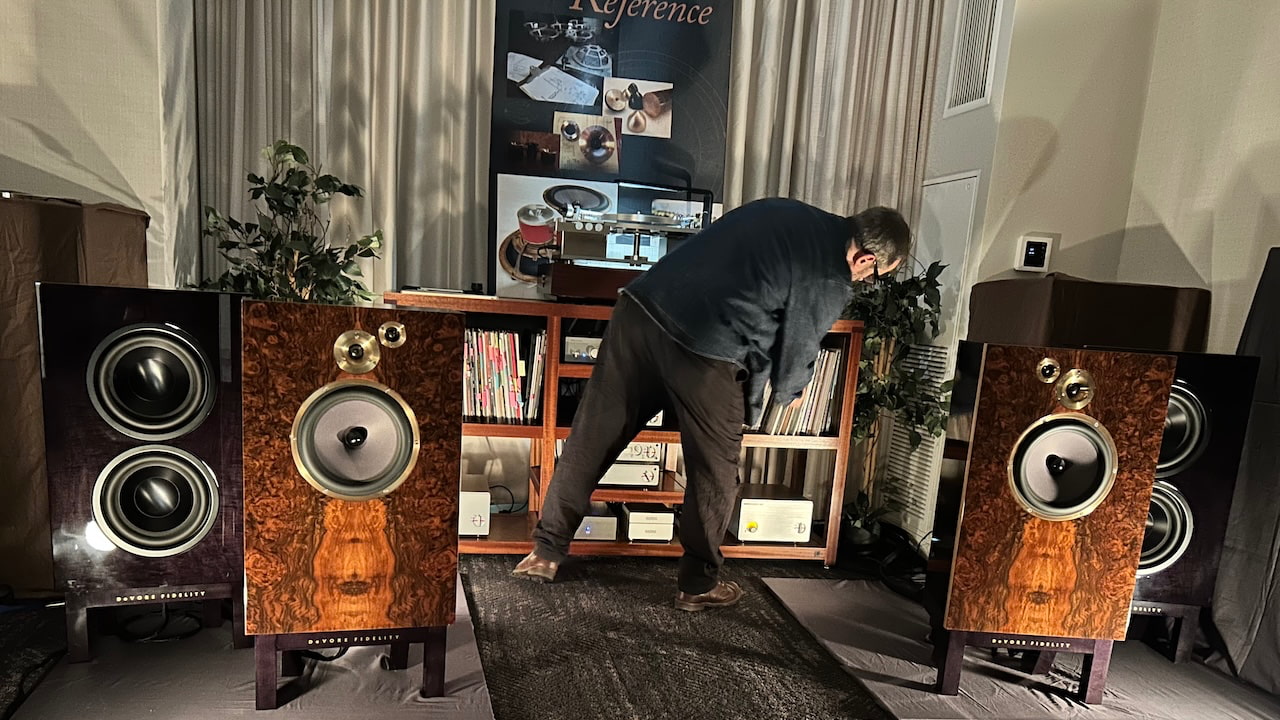
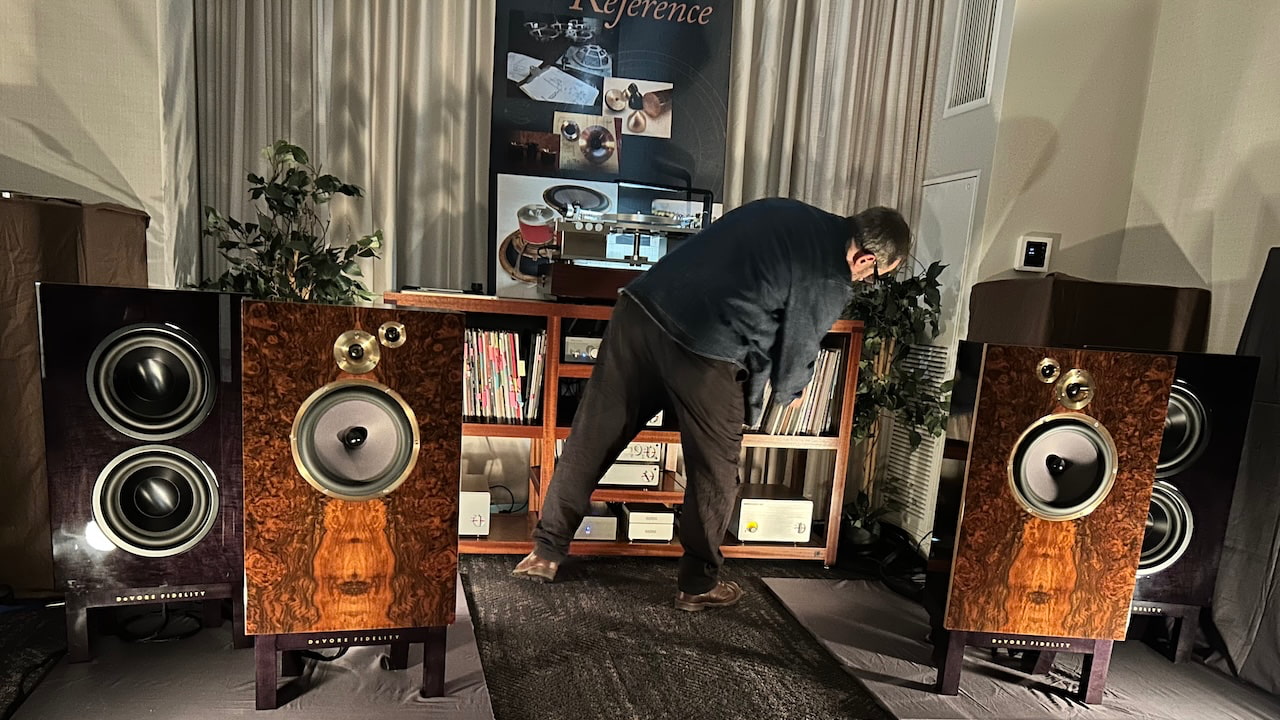
DeVore Fidelity Orangutan O/Reference Loudspeaker System at AXPONA 2026

The Orangutan O/Reference is a four piece system split into the A and B modules, each with a clear role. The A handles the main range with a 10-inch paper cone woofer built around an AlNiCo motor, copper Faraday rings, and a bronze phase plug to keep distortion low and behavior consistent across the band. Above that, a 1-inch silk dome tweeter and 0.75-inch super tweeter are both horn loaded in machined bronze, which helps with sensitivity and control without pushing the top end into something aggressive. The cabinet details are not cosmetic. Bronze ports and a decoupled brass input plate are there to reduce vibration and keep things clean.

The B module takes care of the bottom end with an 11-inch aluminum woofer and a matching passive radiator tuned below 20 Hz, powered by a dedicated 700 watt Class D amplifier with an all analog control section. You get adjustable crossover, phase, and low frequency EQ, but the key is how it connects to the rest of the system. The bass section takes its signal from the same amplifier driving the A module, so the tonal balance and texture remain consistent from top to bottom. It is not doing its own thing off to the side. It follows the same chain, which makes integration far less of a guessing game.

At $99,000, none of this should surprise anyone. What does stand out is that DeVore Fidelity actually gives you a meaningful range of finish options that let the speakers work in real living spaces. That should be standard at this level, but too many brands still treat it like an afterthought. John DeVore has never had that problem. His speakers don’t dominate a room visually, even when they are capable of filling it sonically.

Advertisement. Scroll to continue reading.

They scale in a way that feels almost deceptive. Bigger than they look. More powerful than they have any right to be. And maybe most important, they invite experimentation.

Advertisement

I’ve heard DeVore systems driven by everything from low powered tubes to blowtorch solid state, across a wide range of sources, and there isn’t a single “correct” answer. That’s rare. Most speakers at this level demand a specific chain and punish you if you get it wrong. These don’t. They let you find your own way.

Where Tone Stops Being a Preference and Starts Being the Point

devore-fidelity-orangutan-right-axpona-2026

One of the constants in any DeVore room is that you’re not subjected to the same audiophile greatest hits you’ve heard 500 times. No safe demo tracks polished to death. If you’ve spent any time watching John DeVore speak on YouTube, you already know where that comes from. He’s direct. Intelligent. Thoughtful. He understands the subject and doesn’t hide behind it. And in the room, that translates to a kind of quiet confidence. He’s not hovering. Not steering reactions. He built it. He knows what it does.

There’s a reason his speakers divide people. Some listeners want scale, impact, and the visual statement of something that looks engineered to within an inch of its life. Polished metal. Exotic materials. A kind of precision that feels clinical. DeVore goes in a different direction. Across his lineup, including the Orangutan series, the emphasis is on how instruments and voices actually sound. Not as data points, but as living things.

Tone is the anchor. The weight of a piano. The texture of a saxophone. The human edge in a voice when it starts to crack. These speakers are not microscopes. They behave more like instruments themselves, moving air, resonating, and shaping energy in a way that feels closer to the real thing.

By his standards, the system looked almost restrained. A rack of Nagra electronics, not the top tier, feeding a Yuki AP-01EM with Glanz tonearms into a Phasemation phono stage and cartridges, all tied together with AudioQuest. Nothing about it leaned on excess. The sound told a different story. It was clear, grounded, and saturated with tone, with bass that filled the room without taking control of it.

Advertisement

Before I left, the gentleman running the room put on Nick Cave. Just a quiet nod and the needle dropped. That voice carries history. The piano behind it has mass and decay that can collapse into something flat if the system misses the mark. I’ve heard far more expensive setups get it wrong. This one didn’t. It held together. It felt intact.

I moved into the second row and leaned forward, resting my chin on my hands against the back of the chair in front of me. Closed my eyes and remembered her. Her soft blonde hair in my hands. Those eyes. The smile that made me feel like I could take on the entire Empire by myself. It wasn’t nostalgia. It wasn’t distant. It was right there. Immediate. And a little dangerous in how quickly it pulled me in.

When a system can pull something like that out of you without asking permission, it’s doing something very few ever manage. If you’re looking for a reason to care, that’s it. And if you’re wondering what it might take to get there, start saving.

And before anyone starts wondering if I stumbled into a pot of gold after AXPONA, between the ATC EL50 Anniversary, Quad 2912X, and these from DeVore Fidelity, let’s be clear. I’ll be reviewing a pair of Orangutan O/baby this summer. Those I can afford. The emotional aftermath is another story.

Advertisement

MSRP: $99,000/pair at devorefidelity.com/oref/

Advertisement. Scroll to continue reading.

Source link

Advertisement
Continue Reading

Tech

Best Standing Desks of 2026

Published

on

I tested the Seville Classics Airlift Height Adjustable Desk with Glass Top, the Seville Classics Airlift Pro S3 Electric Height Adjustable Standing Desk (no longer available), the Steelcase Solo Sit-To-Stand Desk, the Fezibo Height Adjustable Electric Standing Desk with Double Drawer and The Grovemade Desk but they didn’t make the cut. The Airlift with Glass Top came close to earning a spot above. It’s a beautiful, sturdy desk at a midrange price that would be a great add to a modern workspace. It also features a small center drawer for holding the basics. Unfortunately, its built-in touchscreen wasn’t very responsive and the two USB-A ports, while theoretically a nice tech feature, are outdated for most of today’s phones and tablets.

The Airlift Pro S3 was a decent desk, but it was a little tougher to install than the others in its size range, and it had a cheaper-looking finish than the overall winner for best standing desk (the Uplift V3 Standing Desk).

The Steelcase Solo desk was surprisingly simple to install for its size. Instead of using screws to install the legs, these simply lock into place. The desk is sturdy, looks nice and is quiet when raising and lowering.

The Fezibo model was intriguing to me because of its built-in storage, but I found this model more difficult to assemble than many of the others. Still, it’s a reasonable option if you’d like storage compartments integrated into your desk and two levels: one for holding your monitor and the other for your keyboard and related accessories.

Advertisement

The Grovemade Desk I received had some mechanical errors. While the team was great about getting this fixed and working with me on it, it did mean having to take the desk halfway apart and put it back together. After replacing the legs, the lift function was louder and a bit more clunky than others we have tested. The cord management and craftsmanship are fantastic and the drawer allows you to keep your desktop clean while a lot of standing desks don’t offer that. While the price of the Grovemade Desk likely reflects the great care they take in hand crafting the desktops, compared to other desks on this list, you can get great quality options for much less money.

As always, consider your specific needs before you buy a sit-stand desk. Do you have a lot of space and a higher budget? Consider the Uplift models. The Ikea model is a fantastic midsize manual desk at a great price. Regardless of your home setup, one of these models is bound to suit your needs. If you aren’t sold on a standing desk, consider a standing desk converter for your existing desk instead.

Source link

Advertisement
Continue Reading

Tech

‘If these centers aren’t thoughtfully planned and coordinated, they can place extraordinary demands on electric infrastructure, the surrounding environment and host communities’: Maine becomes first US state to pass data centre construction ban

Published

on


  • Maine becomes the first US state to ban large data centers
  • A temporary moratorium will restrict power to under 20MW
  • A dedicated council will report back on its findings

Maine has passed a new law restricting, and in many cases effectively banning, new data center construction in certain areas.

In doing so, Maine has become the first state to pass such a law, and with many others worried over the environmental impact of data centers, it might just be the first of many.

Source link

Advertisement
Continue Reading

Tech

Adobe’s new Firefly AI Assistant wants to run Photoshop, Premiere, Illustrator and more from one prompt

Published

on

Adobe today launched its most ambitious AI offensive to date, unveiling the Firefly AI Assistant — a new agentic creative tool that can orchestrate complex, multi-step workflows across the company’s entire Creative Cloud suite from a single conversational interface — alongside a raft of new video, image, and collaboration features designed to position the company at the center of the rapidly evolving AI-powered content creation landscape.

The announcements, which also include a new Color Mode for Premiere Pro, the addition of Kling 3.0 video models to Firefly’s growing roster of third-party AI engines, and Frame.io Drive — a virtual filesystem that lets distributed teams work with cloud-stored media as though it lived on their local machines — represent Adobe’s clearest signal yet that it views agentic AI not as a feature upgrade but as a fundamental reshaping of how creative work gets done.

“We want creators to tell us the destination and let the Firefly assistant — with its deep understanding of all the Adobe professional tools and generative tools — bring the tools to you right in the conversation,” Alexandru Costin, Vice President of AI & Innovation at Adobe, told VentureBeat in an exclusive interview ahead of the launch.

The stakes could hardly be higher. Adobe is fighting to convince Wall Street, creative professionals, and a wave of well-funded AI-native competitors that its decades-old software empire can not only survive the generative AI revolution but lead it.

Advertisement

How Adobe turned a research prototype into a 100-tool creative agent

The centerpiece of today’s announcement is the Firefly AI Assistant, which Adobe describes as a fundamentally new way to interact with its creative tools. Rather than requiring users to manually navigate between Photoshop, Premiere, Illustrator, Lightroom, Express, and other apps — selecting the right tool for each step of a complex project — the assistant lets creators describe an outcome in natural language. The agent then figures out which tools to invoke, in what order, and executes the workflow.

The assistant is the productized version of Project Moonlight, a research prototype Adobe first previewed at its annual MAX conference in the fall of 2025 and subsequently refined through a private beta. “This is basically [Project] Moonlight,” Costin confirmed to VentureBeat. “We started with all the learnings from Moonlight, and we engaged with customers. We looked internally. We evolved that architecture to make it more ambitious.”

Under the hood, Adobe says it has assembled roughly 100 tools and skills that the assistant can call upon, spanning generative image and video creation, precision photo editing, layout adaptation, and even stakeholder review through Frame.io. The system is built around a single conversational interface inside the Firefly web app where users describe what they want and the assistant maintains context across sessions. Pre-built Creative Skills — purpose-built, multi-step workflow templates such as portrait retouching or social media asset generation — can be run from a single prompt and customized to match a creator’s own style. The assistant also learns a creator’s preferred tools, workflows, and aesthetic choices over time, and understands the content type being worked on — image, video, vector, brand assets — to make context-aware decisions.

Crucially, outputs use native Adobe file formats — PSD, AI, PRPROJ — meaning users can take any result into the corresponding flagship app for manual, pixel-level refinement at any point. “We always imagine this continuum where you can have complete conversational edits and pixel-perfect edits, and you can decide, as a creative, where you want to land,” Costin said. The Firefly AI Assistant will enter public beta in the coming weeks, though Adobe did not specify an exact date.

Advertisement

Why Wall Street is watching Adobe’s AI pricing model so closely

For a company whose AI monetization story has faced persistent skepticism from investors, the pricing structure of the Firefly AI Assistant will be closely watched. Costin told VentureBeat that, at launch, using the assistant will require an active Adobe subscription that includes the relevant apps — meaning users who want the agent to invoke Photoshop cloud capabilities, for instance, will need an entitlement that includes the Photoshop SKU. Generative actions will consume the user’s existing pool of generative credits, consistent with how Firefly credits work across the rest of Adobe’s platform.

“To use some of these cloud capabilities from Photoshop and other apps, you need to have a subscription that includes access to the Photoshop SKU,” Costin explained. “You’ll be consuming your credits when you use generative features.” He acknowledged, however, that the model could evolve: “As we better understand the value of this — and the costs of operating the brain, the conversation engine — things might change.”

The question of whether Adobe can convert AI enthusiasm into meaningful revenue growth is anything but theoretical. When Adobe reported its most recent quarterly results in March, it touted 10% year-over-year revenue growth to $6.4 billion and disclosed that annual recurring revenue from AI standalone and add-on products had reached $125 million — a figure CEO Shantanu Narayen projected would double within nine months.

Adobe adds Chinese AI video models to Firefly, raising commercial safety questions

Alongside the assistant, Adobe is expanding Firefly’s roster of third-party AI models to include Kling 3.0 and Kling 3.0 Omni, two video generation models developed by Kuaishou, the Chinese technology company. Kling 3.0 focuses on fast, high-quality production with smart storyboarding and audio-visual sync, while the Omni variant adds professional controls for shot duration, camera angle, and character movement across multi-shot sequences. The additions bring Firefly’s model count to more than 30, joining Google’s Nano Banana 2 and Veo 3.1, Runway’s Gen-4.5, Luma AI’s Ray3.14, Black Forest Labs’ FLUX.2[pro], ElevenLabs’ Multilingual v2, and others.

Advertisement

When asked whether Adobe had concerns about integrating a model from a Chinese tech company given the current geopolitical climate, Costin was direct: “We think choice is what we want to offer our customers.” He explained that Adobe’s strategy distinguishes between its own commercially safe, first-party Firefly models — trained on licensed Adobe Stock imagery and public domain content — and third-party partner models, which carry different commercial safety profiles. “For some use cases, like ideation, non-production use cases, we got requests from customers to support some external models,” Costin said. “If I’m in ideation, I might be more flexible with commercial safety. When I go into production, I’d want to have a model that gives you more confidence.”

This raises an important nuance for the agentic era. When the Firefly AI Assistant autonomously selects which model to use for a given task, the commercial safety guarantees may vary depending on which engine it invokes. Costin pointed to Adobe’s Content Credentials system — the metadata-and-fingerprinting framework developed through the Content Authenticity Initiative — as the mechanism for maintaining transparency. “The agentic power — and the fact that the assistant has access to all of those models — means it could decide to use a model that carries different content credentials,” he acknowledged. “But with the transparency of content credentials, the user will know how a particular piece of content was created and can decide whether that’s commercially safe or not.” Adobe offers commercial indemnity for its first-party Firefly models but applies different indemnity levels for third-party models — a distinction that enterprise buyers, in particular, will need to carefully evaluate.

Inside Adobe’s active collaboration with Nvidia on long-running AI agent infrastructure

Adobe’s agentic ambitions also intersect with its strategic partnership with Nvidia, announced earlier this year at Nvidia’s GTC conference. When asked whether the Firefly AI Assistant’s agentic capabilities are built on NVIDIA’s agent toolkit and NeMo infrastructure, Costin revealed that the collaboration is active but has not yet made it into a shipping product.

“We’re in active discussions — investigating not only Nemotron,” Costin said. “They have this technology called Open Shell and Nemo Claw, which give us the ability to efficiently run long-running agentic workflows in a sandboxed environment.” He said the technology would become increasingly important as Adobe pushes the assistant to handle longer, more autonomous creative tasks — but cautioned that “it’s not shipping yet. It’s being actively explored.”

Advertisement

For Nvidia, which is building an ecosystem of enterprise AI agent platforms with partners like Adobe, Salesforce, and SAP, the partnership could eventually serve as a high-profile proof point for its agent infrastructure stack in the creative vertical. For Adobe, the ability to run complex, long-duration agentic workflows efficiently and securely in sandboxed environments could be the technical foundation that separates the Firefly AI Assistant from lighter-weight chatbot integrations offered by competitors. The partnership also signals Adobe’s recognition that the computational demands of agentic AI — where a single user request may trigger dozens of model calls and tool invocations — require infrastructure partnerships that go well beyond what a software company can build alone.

Premiere Pro’s new color grading mode and the tools Adobe is shipping today

Beyond the headline AI assistant announcement, Adobe’s broader set of updates reflects a company trying to strengthen its position across every phase of the content creation pipeline. Color Mode in Premiere Pro may be the most significant near-term upgrade for working editors. Entering public beta today, Color Mode is described as a first-of-its-kind color grading experience built specifically for the way editors — rather than dedicated colorists — think and work. Adobe notes that it was developed through an extensive private beta with hundreds of working editors, and that participants reported they “actually enjoy color grading” — a sentiment suggesting Adobe may have found a way to democratize one of post-production’s most intimidating disciplines. General availability is expected later in 2026.

The Firefly Video Editor gains audio upgrades including the Enhance Speech feature migrated from Premiere and Adobe Podcast, direct Adobe Stock integration with access to more than 800 million licensed assets, and simple color adjustment controls with intuitive sliders and one-click looks. On the image editing front, Adobe introduced Precision Flow, which generates a range of semantic variations from a single prompt and lets users browse them via an interactive slider — a novel approach that Costin described as “the best slider-based control mixed with the best semantic understanding of not only the existing scene, but what the scene could be.” AI Markup complements this by letting users draw directly on images to specify where and how edits should be applied. After Effects 26.2 adds an AI-powered Object Matte tool that dramatically accelerates rotoscoping and masking — create accurate mattes of moving subjects with a hover and click, refine with a Quick Selection brush, and perfect edges with a Refine Edge tool.

Frame.io Drive wants to kill the shipped hard drive and make cloud media feel local

Rounding out the announcements, Frame.io Drive addresses one of the most persistent pain points in distributed video production: getting media from point A to point B without losing hours — or days — to downloads, syncing, and shipped hard drives. Frame.io Drive is a desktop application that mounts Frame.io projects to a user’s computer so media appears in Finder or Explorer and behaves like local files. The underlying technology, called Frame.io Mounted Storage, streams media on demand as applications request it, while local caching ensures smooth playback. The product builds on streaming technology provided by Suite Studios, and the real-time file access capability is included with every Frame.io account. Adobe emphasized that all content lives solely within Frame.io and is never shared with third parties.

Advertisement

The move positions Frame.io not just as a review-and-approval tool at the end of the production pipeline but as the central media layer from the very beginning of a project — from first capture through final delivery. If successful, the strategy could significantly deepen Adobe’s lock-in with professional video teams by making Frame.io the single source of truth for distributed productions. Frame.io Drive and Mounted Storage will roll out in phases, with Enterprise customers gaining access starting today and accounts on other plans following shortly. Others can join a waitlist.

Adobe’s biggest challenge isn’t building the AI — it’s convincing creators to trust it

Taken together, today’s announcements paint a picture of a company executing aggressively across multiple fronts — but also one that is navigating a complex moment. Adobe first introduced Firefly in March 2023 as a family of generative AI models focused on image and text effects, with a strong emphasis on commercial safety through training on licensed Adobe Stock content. In the two years since, the company has rapidly expanded into video generation, multi-model access, and now agentic workflows — a trajectory that mirrors the broader industry’s shift from standalone AI features to AI-native systems.

But the competitive field has grown dramatically. Runway, Pika, and a host of AI-native video generation startups have captured mindshare among creators. Canva has aggressively integrated AI into its design platform. And the emergence of powerful foundation models from OpenAI, Google, and Anthropic — the latter of which Adobe says it will integrate with Firefly AI Assistant capabilities — means the barrier to building creative AI tools has never been lower. Adobe is also navigating these product ambitions against a complex corporate backdrop: the impending departure of CEO Shantanu Narayen, an actively exploited zero-day vulnerability in Acrobat Reader (CVE-2026-34621) that had been used by hackers for months before being patched this week, a U.K. antitrust investigation over cancellation fees, and a recent $75 million lawsuit settlement.

Adobe’s response, articulated clearly through today’s launches, is to lean into what it believes is its deepest moat: the integration of AI into a set of professional-grade, category-leading applications that no startup can replicate overnight. Costin framed the agentic transition as empowering rather than threatening to creative professionals, comparing Creative Skills to a next-generation version of Photoshop Actions — the macro-recording feature that has long allowed power users to automate repetitive tasks. “We want to help our customers become — from the ones doing all the work — to be creative directors, doing some of the work, but most importantly, guiding the assistant in executing some of those creative visions,” he said.

Advertisement

It is a compelling pitch — and, in its own way, a revealing one. For three decades, Adobe made its fortune by selling the tools that turned creative vision into finished pixels. Now it is asking its customers to let an AI agent handle more of that translation, trusting that the human role will shift from operating the tools to directing the outcome. Whether creators embrace that bargain — and whether Wall Street rewards it — will determine not just Adobe’s trajectory but the shape of an entire industry learning to create alongside machines.

Source link

Continue Reading

Trending

Copyright © 2025